Most expansion advice gets the metaphor wrong. Founders spend months designing the ship: market selection, channel strategy, freight logic, pricing architecture, retailer outreach. Then they enter a new region with no equivalent of a bosun's locker. No local tools, no spare parts, no operating feel for the conditions that determine whether the vessel keeps moving.
That's why apparently strong international launches stall so quickly. The product may be sound. The ambition may be justified. The forecasts may even be sensible. What's missing is the unglamorous local readiness layer that prevents avoidable breakdowns once a brand meets real buyers, real service expectations, and real regional variation.
The phrase Bosun's Locker Southport works unusually well as a business metaphor because it points to something operational, not theatrical. It suggests stocked readiness. It suggests local judgement. It suggests knowing what fails in a given environment, and what needs to be close at hand before failure happens.
The Overlooked Detail That Sinks International Expansion
Most founders are told to think bigger about expansion. In practice, many need to think smaller.
A new market rarely fails because the headline strategy was too ambitious. It fails because the operating detail was too generic. The listing copy sounds imported. The returns logic doesn't match local buyer behaviour. Customer support answers the wrong questions. Fulfilment timing feels inconsistent. Compliance language is technically present but commercially unconvincing.

Big strategy often hides small weakness
One pattern we continue seeing is that brands confuse market entry with market readiness. They assume that once distribution is available and product pages are live, localisation is largely complete. It isn't. That's only the visible layer.
What becomes visible during international expansion is whether the business has built a local operating toolkit for friction, exceptions, and regional nuance. If it hasn't, every minor issue becomes expensive. Not always in obvious ways. Sometimes through margin leakage. Sometimes through lower repeat confidence. Sometimes through the quiet erosion of trust that never appears in a board update until the market underperforms.
Practical rule: If your expansion model only works when customers behave exactly as forecast, the model isn't localised enough.
The overlooked detail is rarely one dramatic error. More often, it's a cluster of small mismatches. That's what makes the Bosun's Locker Southport idea so useful. It shifts the founder's attention from vision alone to operational preparedness in a specific environment.
What founders usually miss
Three blind spots appear repeatedly:
- Local buyer context: Product demand may exist, but the reasons people buy, compare, and delay often differ by region.
- Service expectations: Buyers judge speed, clarity, and confidence against local norms, not against your home market.
- Commercial fit: A catalogue that performs well domestically may need a different assortment structure, support language, or packaging logic elsewhere.
Strong products don't automatically become strong brands across borders. They need local operating intelligence attached to them. Without that, expansion remains a transport exercise rather than a market transition.
Marketplace Fragmentation and the Missing Local Toolkit
Marketplace fragmentation doesn't begin when channels multiply. It begins when a brand presents itself as one thing internally and appears as several disconnected things externally.
A founder sees one coherent business. The buyer in a new market often sees a product listing, a shipping promise, a support email, a return condition, and a brand voice that don't fully agree with each other. That gap is where trust weakens.
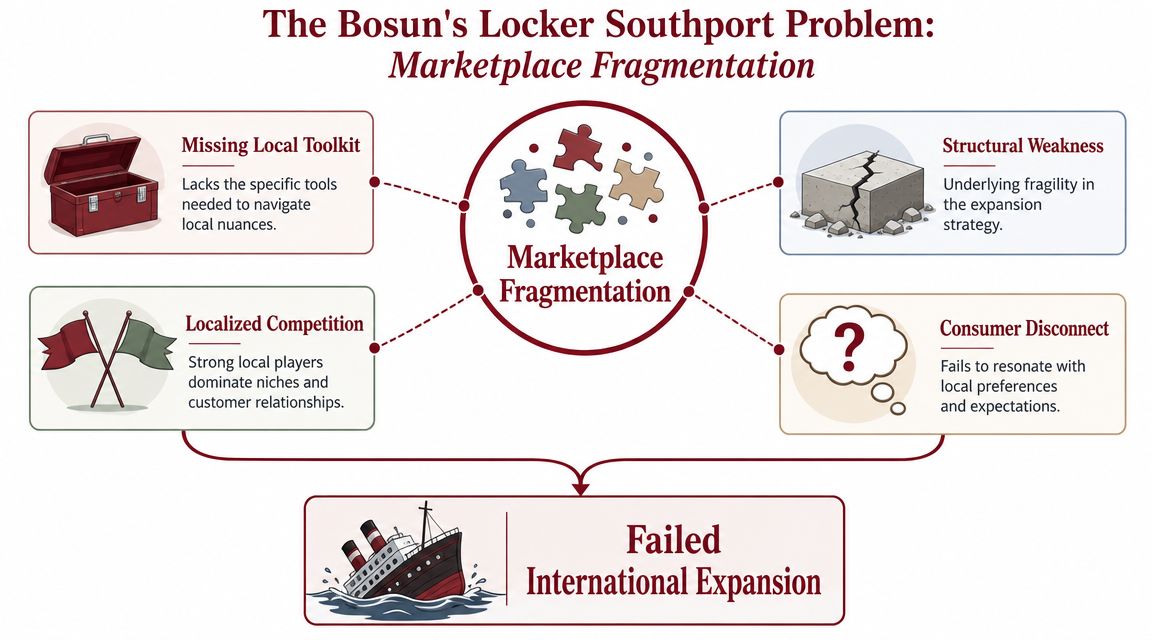
The Bosun's Locker Southport problem in marketplace terms
The practical issue isn't that brands lack ambition. It's that they enter local ecosystems with an incomplete toolkit. They carry centralised assumptions into decentralised conditions.
That usually creates four forms of fragmentation:
| Friction point | What brands assume | What local markets expose |
|---|---|---|
| Customer service | One script can cover all regions | Buyers ask market-specific questions that generic teams can't answer well |
| Returns and replacements | A universal policy is enough | Local expectations around convenience and reassurance vary sharply |
| Catalogue structure | Best-sellers travel cleanly | Top domestic SKUs don't always map neatly to regional demand |
| Brand communication | Translation solves clarity | Buyers respond to context, not just language |
A useful reference point is why some products feel closer than others in marketplace localisation. The underlying issue isn't translation quality on its own. It's whether the brand feels like it belongs inside the local buying environment.
Why generic international rollout breaks down
Across multiple marketplace ecosystems, the same failure pattern appears. Head office optimises for speed. The market demands relevance.
That tension affects more than conversion. It shapes how platforms interpret seller reliability, how buyers assess risk, and how much commercial effort is needed to sustain each sale. A fragmented setup usually needs more intervention to produce the same outcome a cohesive localised setup can generate more naturally.
The pattern is easier to see visually.
A listing can cross a border overnight. Operational credibility can't.
The Bosun's Locker Southport metaphor matters because it reframes localisation as stocked preparedness, not cosmetic adjustment. If the local toolkit is missing, the business can still launch. It just can't absorb friction well.
An Operational Observation from Southport
Those looking for Bosun's Locker Southport may be interested in a chandlery, brokerage, or local marine business. For founders, it also illustrates something far more useful. It shows what operational depth looks like when it has been built in one place over time.
Bosun's Locker was established in 1975, and is described as the oldest established boat sales and boat gear shop on the Gold Coast on its own site, with a Southport Yacht Club presence of over 30 years. That gives it a local market footprint of 51 years from 1975 to 2026 in the marine category, according to Bosun's Locker's business history.
What long local presence actually signals
The important point isn't longevity for its own sake. It's what that longevity tends to produce operationally.
A business with that kind of embedded local role usually learns which questions customers ask before purchase, which concerns emerge seasonally, what standards buyers expect from advice, and how service credibility is built in that community. It doesn't rely on abstract market summaries. It accumulates judgement through repeated contact with the same environment.
That's where many international brands misread local competition. They compare products and prices, but underestimate context advantage. The incumbent may not win because it has broader range or louder marketing. It may win because buyers trust that it understands the conditions they're buying for.
Local strength often looks ordinary from a distance. Up close, it's made of accumulated relevance.
Why remote brands struggle against embedded operators
A remote seller entering the same region often arrives with polished assets and weak local intelligence. The catalogue may look complete. The operating model may still be shallow.
That shallowness shows up in predictable ways:
- Advice gaps: The business can describe product features but not local use conditions.
- Support gaps: Teams answer policy questions well but struggle with buyer uncertainty.
- Decision gaps: Merchandising is based on central sales logic rather than local buying signals.
This matters well beyond marine retail. In household goods, hardware, consumer products, and premium lifestyle categories, one issue we repeatedly observe is that founders treat local knowledge as an optional overlay. It's closer to structural infrastructure than optional marketing.
For brands reviewing expansion risk, supply chain risk management is part of the same conversation. If local readiness is thin, the burden lands on freight, stock planning, support teams, and replacement workflows almost immediately.
Bosun's Locker Southport is useful because it reminds us that deep market fit is often built through highly specific, environment-aware operating behaviour. That can't be improvised from a distant head office once the listings are already live.
Building Your Brand's Bosun's Locker in New Markets
Founders don't need to open a local storefront in every region. They do need to build the equivalent of one operationally.
That means creating a market-specific toolkit before scale pressure arrives. Not after complaints increase. Not after returns reveal the mismatch. Before the market starts teaching the business expensive lessons.
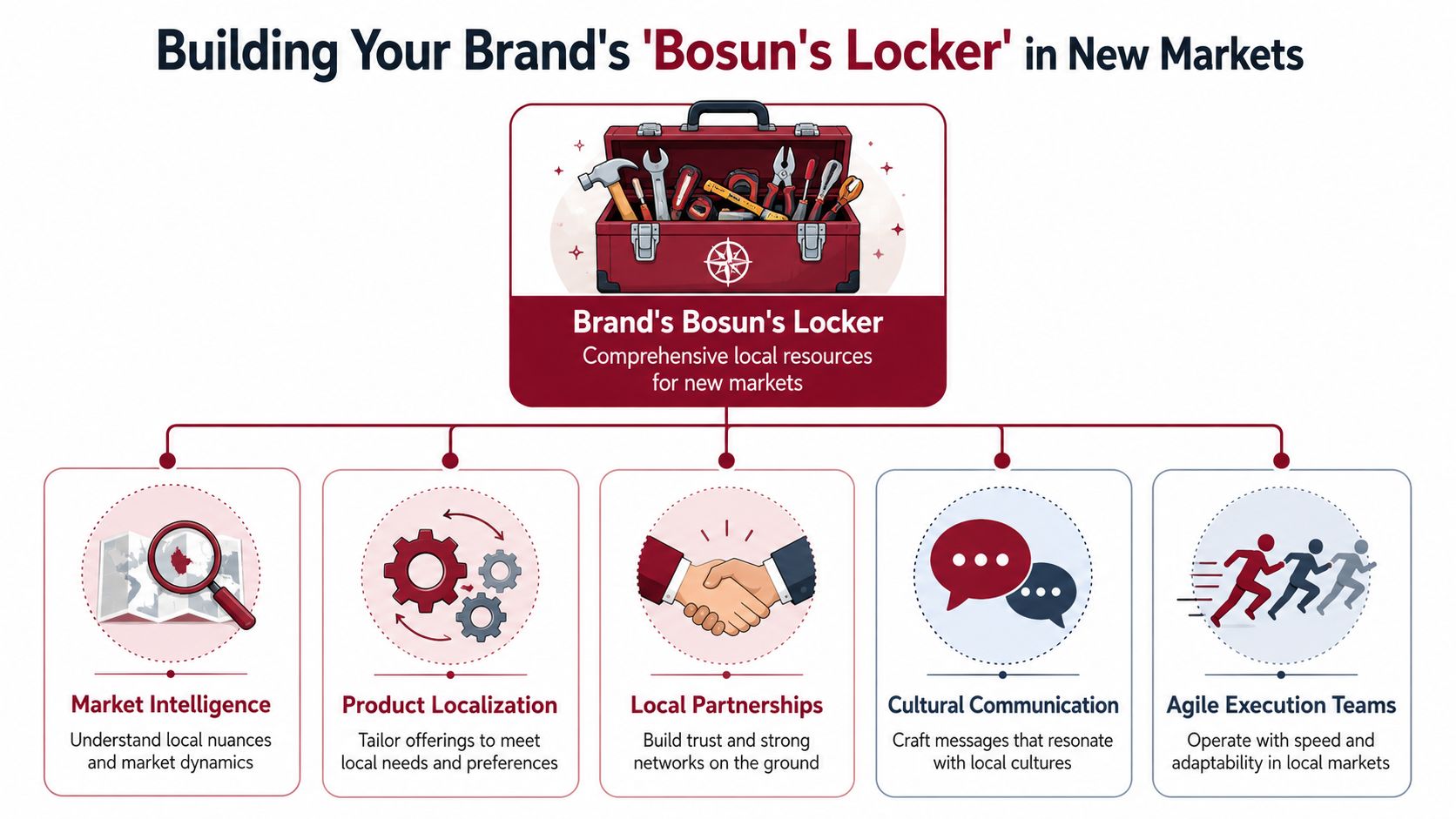
The tools that belong in the locker
The first tool is local guidance logic. That matters because generic retail communication often skips the practical advice buyers search for. In the marine context, Sail Paradise's chandlery overview notes a gap around region-specific boating advice, while Australian boating regulators emphasise safety compliance for variable weather. The broader lesson is obvious. If a market has local risk conditions, the brand needs locally relevant guidance, not just product availability.
The second tool is fulfilment logic that matches buyer confidence requirements. Fast shipping matters, but credibility matters more. Buyers want to know what happens if the item is wrong, late, damaged, or unsuitable. Local confidence isn't built by courier speed alone. It's built by predictable resolution.
Third comes catalogue adaptation. Not every expansion needs a wide assortment. In many cases, narrower and more deliberate wins. The right range for a new market is usually the range your support team can defend, your logistics model can sustain, and your brand story can explain clearly.
A working checklist for operators
A practical local locker often includes:
- Customer questions mapped by market: Not generic FAQs. Real pre-purchase doubts and post-purchase concerns by region.
- Returns pathways that feel local: Convenience, clarity, and response tone need to match buyer expectation in that market.
- Assortment discipline: Launch products that fit the region's use case, not just the products that sell best at home.
- Feedback loops: Reviews, support tickets, account manager notes, and marketplace signals need to feed decision-making quickly.
If local buyers need local reassurance, a global script will underperform no matter how polished it sounds.
Who builds this in practice
Some brands build this internally through regional commercial leads, operations teams, and channel managers. Others use external operators who already understand cross-border adaptation. One option is TPR Brands' work in marketplace and regional growth, which focuses on market adaptation, channel fit, and controlled expansion for established product businesses.
What matters isn't who owns the work. What matters is that someone owns it deliberately.
A brand's bosun's locker in a new market should contain enough local intelligence to answer a simple test. When friction appears, can the business resolve it in a way that feels native to the buyer, not imported from head office?
The Commercial Value of Ecosystem Cohesion
Founders often treat localisation as cost. Operators usually recognise it as margin protection.
When a business creates ecosystem cohesion, sales become easier to defend. Customer support carries less strain. Marketplace presentation feels more credible. Returns become less chaotic because the buyer understood the offer properly in the first place. None of that is glamorous, but all of it is commercial.
Why smaller specialist models are instructive
Available company data indicates Bosun's Locker operates at a relatively small scale, with fewer than 25 employees and revenue under AU$5 million, according to Bosun's Locker company data on ZoomInfo. That kind of profile usually points to a high-touch advisory model where curation, service quality, and repeat local demand matter more than mass-market volume.
That matters because many growth-stage brands learn the wrong lesson from scale. They assume larger reach should make them more standardised. In practice, local markets often reward the businesses that stay more precise.
Cohesion changes the economics
A cohesive marketplace ecosystem does a few things well:
- It reduces contradiction: Product page, fulfilment promise, support response, and replacement process align.
- It protects brand value: Discounting and overexposure become less necessary when the proposition is locally credible.
- It improves resilience: Brands with stronger local operating structure are usually less exposed to sudden platform or competitor pressure.
The commercial upside of localisation isn't just more demand. It's fewer avoidable losses around every sale.
marketplace ecosystem strategy becomes more useful than channel-by-channel optimisation. A business doesn't scale internationally by copying listings into new geographies. It scales by creating local coherence across the whole buying journey.
Is Your Expansion Strategy Ready for the Local Test?
A useful founder question isn't “Can we enter this market?” It's “Have we built the local locker required to operate in it properly?”
That test is stricter, and it should be. It forces attention onto service logic, buyer trust, catalogue fit, fulfilment realism, and region-specific communication. Those factors rarely headline the expansion plan, but they decide whether the plan survives contact with the market.
Bosun's Locker Southport is a helpful mental model because it points to what many brands neglect. Readiness isn't abstract. It's stocked. It's specific. It reflects the conditions of the place you're entering.
If your international strategy still depends on a centralised model feeling local everywhere, it's worth stopping before the rollout gets bigger. Marketplace expansion is an ecosystem transition, not a listing exercise. The brands that understand that tend to build slower at the start, and far more solidly over time.
If you're assessing whether your product business is prepared for cross-border marketplace expansion, TPR Brands works with established brands on the operational side of market entry, including localisation, channel fit, and commercially controlled regional growth.