Brisbane web design prices can start at around AUD 1,500–2,000 for a single-page site, sit around AUD 2,500 for a basic website, and move into AUD 10,000–20,000+ for e-commerce or more advanced builds. But the most important number usually isn't on the quote. It's the hidden cost of building a site that can't support the brand's future growth ambitions.
That's where most advice on web design Brisbane prices falls short. It treats the website as a design purchase, sometimes as a marketing line item, and rarely as commercial infrastructure. For an established brand, that framing is too small.
One pattern we continue seeing is founders buying for today's launch requirement and only later discovering that the site can't support wholesale content, direct-to-consumer growth, ERP connections, marketplace data flows, or localisation for new regions. The upfront saving feels sensible. The rebuild arrives at exactly the wrong time.
Moving Beyond Price The Real Cost of a New Website
The most common mistake in website procurement is asking for a quote based on page count. Five pages, ten pages, a product section, a contact form. That sounds tidy, but it ignores the commercial question that matters. What capability does the business need the site to carry over the next few years?
A brochure-style build can be perfectly rational for a business with limited digital ambition. But that logic breaks down for brands planning channel expansion, catalogue growth, trade support, or future international movement. The site stops being a marketing asset and starts functioning as a system that has to support multiple commercial jobs at once.
Founders often discover this too late. They approve a lower quote, launch a visually acceptable site, then run into problems when they need cleaner product architecture, stronger SEO foundations, or integration with operational tools. At that point, they're no longer comparing website prices. They're paying for rework, migration, and delay.
The quote rarely captures the strategic risk
A low quote can still be expensive if it locks the business into weak decisions. Template restrictions, shallow CMS setup, poor content structure, and no integration planning usually don't break on day one. They break when the company starts adding complexity.
Practical rule: If the website will support lead generation, e-commerce, distributor education, or future market entry, treat it like infrastructure, not artwork.
That's also why mature brands shouldn't judge a provider on visual polish alone. A homepage mock-up can hide structural weakness. Stronger operators ask how the site will handle product expansion, content governance, technical SEO, future language variation, and data movement between systems.
A useful mental shift is to stop asking, “What does a website cost?” and start asking, “What does the wrong website prevent?” In commercial terms, the answer can include slower rollout into new channels, duplicated admin work, content bottlenecks, inconsistent brand presentation, and a rebuild that lands just as growth starts accelerating.
Capability matters more than page count
One issue we repeatedly observe is that businesses with strong products still under-spec the platform carrying those products online. That tends to create a gap between brand quality and digital execution. The result is familiar. Buyers encounter a fragmented experience, and internal teams work around platform limitations instead of using the site as a growth asset.
That wider brand problem is part of why great products fail to become great brands online. The website often looks finished while remaining commercially underbuilt.
For established businesses, web design Brisbane prices only make sense when viewed against future use. A cheaper launch is only cheaper if the site can still serve the business when the company adds complexity later.
Decoding Common Brisbane Web Design Pricing Models
Not all quotes mean the same thing. Two providers can price similar work in completely different ways, and those structures change how risk sits between client and supplier. That matters more than many founders expect.
In Brisbane, indicative website design pricing starts at around AUD 1,500–2,000 for a single-page site, rises to about AUD 2,500 for a basic website, and commonly reaches AUD 10,000–20,000+ for e-commerce or more advanced builds. One Brisbane-based source also notes that designers may charge up to AUD 250 per hour for specialist work, which tells you how strongly scope and expertise influence pricing according to this Brisbane website pricing breakdown.
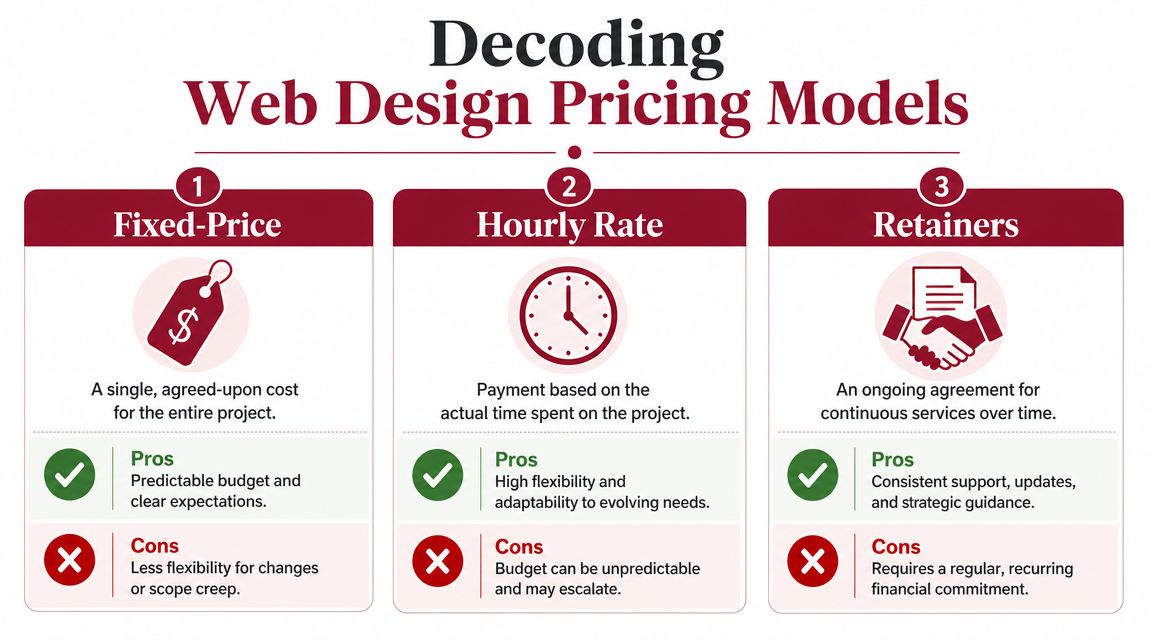
Fixed-price works when the brief is stable
Fixed-price projects suit businesses that know exactly what they need. The page structure is clear. The functionality is defined. Internal stakeholders are aligned. In those cases, fixed pricing gives budget clarity and usually speeds up procurement.
The trade-off is rigidity. Once the project starts, changes become commercial events. If your team is still figuring out product hierarchy, conversion flows, or content depth, a fixed quote can create friction quickly.
This model tends to work best for straightforward brand sites, contained redesigns, or tightly scoped launches.
Hourly pricing suits evolving builds
Hourly pricing is more flexible, especially when discovery is still happening during the build. Brands that are refining messaging, testing architecture, or integrating with multiple business systems sometimes need that flexibility.
The downside is obvious. Budget certainty drops. The client also needs stronger project discipline because unclear decisions, slow approvals, and changing requirements directly affect cost. In practice, hourly pricing often rewards organised clients and punishes indecision.
A lower hourly rate doesn't necessarily create better value. If the provider needs more time because the planning is weak, the total cost can still drift upward.
This is also why experienced buyers look past the visible rate and examine process maturity. The same commercial logic shows up across channel decisions, including marketplace fee structures and hidden cost layers. Price format changes behaviour.
Retainers fit brands building over time
A retainer is less about a launch and more about continuity. It suits businesses that need the site to evolve with campaigns, channel expansion, product updates, operational changes, and international readiness.
This model works well when the website is tied closely to ongoing commercial activity. The business isn't buying a one-time asset. It's securing access to design, technical support, and strategic refinement over time.
Retainers are often the most sensible structure for brands expecting regular landing page creation, integration adjustments, performance improvement, and platform governance. They can feel more expensive emotionally because the spend is recurring, but for growth-oriented companies they often reduce the stop-start cost of repeated procurement.
Understanding Price Brackets What You Actually Get
Web design Brisbane prices don't just reflect aesthetics. They reflect capability, process, accountability, and strategic depth. That's why two quotes can differ sharply even when the visible deliverables look similar.
For Australian small-to-medium business websites, the price bands most relevant to Brisbane buyers are AUD $2,000–$5,000 for a quality brand site with basic features, AUD $5,000–$15,000 for a 5–10 page custom company site, and AUD $7,000–$20,000+ for e-commerce builds, with premium e-commerce projects able to run much higher according to this Brisbane-focused web designer pricing guide.
That range is less about “cheap versus expensive” and more about what kind of commercial problem the provider can solve.
Freelancer capability can be excellent, but narrow
A strong freelancer can be a very good fit when the scope is well defined and the founder already has clarity on brand, content, and commercial requirements. You may get direct access to the person doing the work, faster communication, and efficient execution.
What you're usually not buying is broad strategic challenge. Most freelancers can't also act as strategist, UX lead, developer, QA layer, technical SEO lead, and integration architect at the same depth. Some can cover several of those areas, but the operational risk sits more heavily with the client.
That's often fine for contained projects. It becomes less comfortable when multiple stakeholders, product lines, or systems are involved.
Small agencies bring process and shared responsibility
Small agencies usually sit in the middle for a reason. They often provide enough structure to manage timelines, revisions, and handover more reliably than a solo operator, while still being accessible and commercially practical.
For many established Brisbane businesses, this is the sensible middle tier. The agency can usually manage strategy, design, development, and deployment in a more coordinated way. You also reduce single-person dependency.
The limitation appears when the business needs deeper commercial architecture. If the site must support complex product ecosystems, future localisation, or cross-channel integration, some agencies remain too production-led.
Premium agencies should change the conversation
A premium provider shouldn't stop at delivering a nicer website. They should alter the quality of decision-making. That means helping the business define what the platform must support commercially, not just what it should look like at launch.
Across multiple marketplace ecosystems, one issue repeatedly appears. Brands invest heavily in product development, packaging, trade relationships, and fulfilment, then underinvest in the digital layer that has to connect those pieces coherently. Better agencies understand that the website has to support trust, consistency, and operational scale across channels.
Here's the practical comparison.
| Provider Type | Typical Price Range (AUD) | Best For | Strategic Capability |
|---|---|---|---|
| Freelancer | AUD $2,000–$5,000 | Defined scopes, smaller brand sites, businesses with strong internal direction | Good execution on contained work. Strategy often remains client-led |
| Small agency | AUD $5,000–$15,000 | Established companies needing process, custom company sites, coordinated delivery | Moderate to strong. Better project management, broader skill coverage |
| Premium agency | AUD $7,000–$20,000+ and often higher for premium e-commerce | Brands building for channel complexity, e-commerce depth, or future scale | High. More likely to address architecture, integrations, scalability, and long-term commercial fit |
The real purchase isn't code or design time. It's confidence that the site won't become a structural problem when the business grows.
That's the lens founders should use. Not “Who can build this cheapest?” but “Who is reducing future commercial friction?”
The Hidden Factors That Truly Drive Website Costs
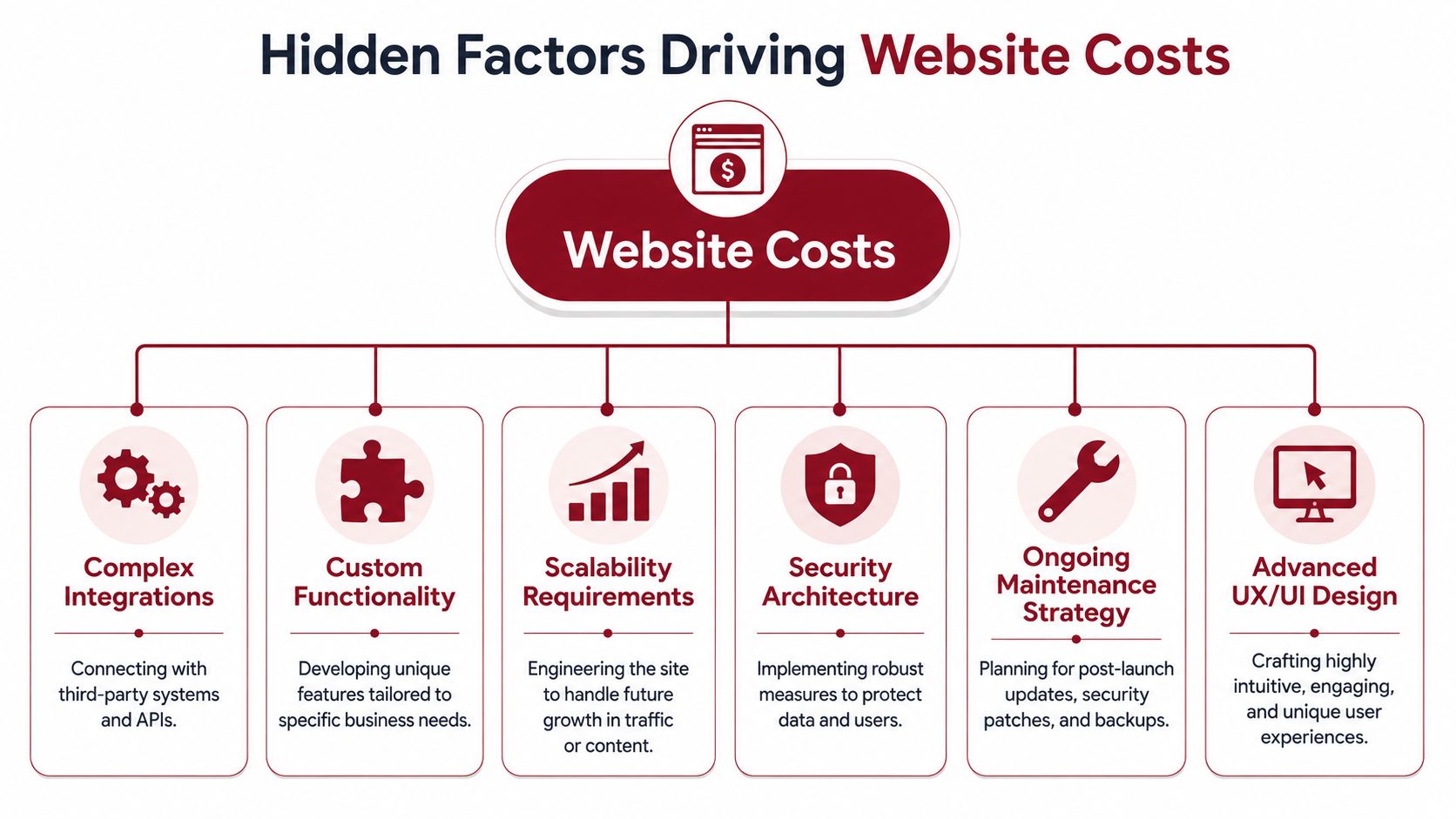
The biggest cost drivers in a website project usually aren't visual. They sit underneath the interface, in the decisions that determine how flexible, connected, and scalable the site will be later.
That's why the false bargain matters. A cheap Brisbane website in the A$1,000–A$3,000 range may only make sense for businesses with no real growth ambition, while established firms can save money by avoiding rebuilds through a more capable initial investment in the A$10,000–A$50,000 range for sites with SEO foundations, CRM or API integrations, and e-commerce readiness, as outlined in this Brisbane pricing analysis focused on long-term value.
Early in the project, it helps to visualise where cost pressure comes from.
Template speed versus brand integrity
Templates reduce time. That's their job. They can be perfectly useful for simple launches where uniqueness and operational depth aren't major priorities.
The problem starts when the template controls the business rather than the other way around. Teams then shape navigation, content hierarchy, product presentation, and conversion paths around a prebuilt structure that wasn't designed for their actual sales model. The site launches quickly but carries compromises into every later change.
Custom design costs more because it usually requires more planning, more decisions, and more testing. But for brands with a clear market position, custom work often protects brand coherence and improves long-term usability.
E-commerce complexity isn't just “add cart”
Many buyers underestimate what makes e-commerce expensive. It isn't the presence of a checkout alone. Cost rises when the catalogue is nuanced, promotions need rules, payment logic must be secure, and customer journeys need to work cleanly across mobile, desktop, and repeat purchase scenarios.
A brand selling a focused line of household products has very different needs from a manufacturer with multiple ranges, accessories, spare parts, trade inquiries, and distributor crossover. The architecture has to support that complexity before the visual layer starts doing its job.
The same applies to operational quality. If fulfilment updates, stock logic, or order data need to move between systems, the website becomes part of a wider commercial ecosystem. At that point, underbuilding it creates friction elsewhere.
This is also where quality assurance standards become commercially relevant. Better architecture lowers the chance that growth exposes hidden technical weakness.
CMS and integrations decide future flexibility
CMS choice is often treated as a technical preference. It isn't. It affects who can edit content, how new regions can be added, whether product and resource structures can expand cleanly, and how painful future migration becomes.
A localisation-ready website needs clean content modelling. A site expected to support international expansion may eventually need region-specific content, different buying paths, market-specific compliance messaging, or multi-currency support. If the underlying system is rigid, every expansion step becomes slower and more expensive.
Later in the build, it's worth hearing how practitioners frame the difference between launch requirements and architectural requirements.
Integrations create similar pressure. CRM links, ERP handoffs, inventory syncing, distributor forms, booking tools, support systems, and marketplace-adjacent workflows all require planning. Teams often focus on whether a connection is technically possible. The better question is whether it will remain stable, maintainable, and clear to internal users.
Cheap websites usually fail at the point where the business asks them to do more than they were designed to carry.
That's the hidden engine behind many rebuilds.
Sample Budget Scenarios for Established Brisbane Brands
The cleanest way to think about web design Brisbane prices is to match budget to commercial intent. Not every business needs the same level of build, and not every site should be engineered for international complexity on day one. But the investment should still reflect where the company is trying to go.
Across Australia, small- to medium-business website design typically costs AUD 3,000–10,000, while custom eCommerce or larger business sites can exceed AUD 20,000 and in some cases reach AUD 50,000+, according to this Australian website cost guide. That pricing hierarchy is useful because it mirrors a real difference in commercial responsibility.

The established local brand standardising its presence
A business in this category usually has traction already. It may sell through stockists, referrals, trade relationships, or a modest digital mix. The problem isn't visibility alone. It's inconsistency.
A site in the mid-range often makes sense here. The goal is to unify the brand, improve trust, organise service or product information properly, and establish a cleaner digital foundation. This type of project doesn't need enterprise-level architecture, but it does need enough structure to avoid looking temporary.
Typical priorities include:
- Brand coherence: The site should reflect the level of maturity the business already has offline.
- Content structure: Product, service, and support information must be easy for buyers and partners to use.
- Future readiness: The build shouldn't collapse the moment the team adds new landing pages, product families, or channel-specific content.
The growing manufacturer launching national direct-to-consumer
This scenario changes the role of the site. It's no longer only presenting the business. It's starting to carry revenue responsibility, customer education, and fulfilment-related logic.
The budget climbs because the site now needs stronger e-commerce foundations, cleaner product architecture, and more deliberate integration thinking. A manufacturer moving into direct-to-consumer often has a hidden complexity that simple online-first brands don't. Product specifications, range logic, replacement parts, stock handling, and trade-versus-retail information all need clearer handling.
What usually matters most here isn't visual flourish. It's whether the build can support operational reality without creating manual workarounds.
A website for a growing product business shouldn't just convert buyers. It should reduce friction between marketing, operations, and fulfilment.
The founder building for international expansion
This is where the website becomes a strategic asset in the strongest sense. Brands preparing for overseas growth need more than strong design and checkout functionality. They need architecture that can absorb localisation, multi-market content logic, and future system complexity.
That doesn't mean every business should overbuild immediately. It does mean founders should avoid locking themselves into platforms and structures that make regional expansion messy later. What becomes visible during international expansion is that weak digital infrastructure creates translation issues, content duplication, process confusion, and inconsistent customer experience across regions.
Signals that justify a higher investment include:
- Localisation plans: The business expects regional messaging, market-specific pages, or future language requirements.
- System dependency: The website needs to connect with CRM, inventory, order management, or partner-facing tools.
- Channel expansion: The site must support both direct sales and a broader ecosystem that may include marketplaces, distributors, and international commercial partners.
At that level, the spend isn't just funding a website. It's funding optionality.
Making a Commercially Sound Decision Beyond the Quote
The strongest procurement decisions usually come from founders who stop comparing quotes as if they're buying the same thing. They rarely are. One provider may be pricing design output. Another may be pricing discovery, architecture, QA, integration thinking, and post-launch stability.
That's why the final decision should centre on commercial fit. If the business expects the site to support product growth, digital acquisition, operational integration, or later international movement, then the right partner is the one thinking several steps ahead.
Questions that expose strategic depth
Ask potential providers questions that force them to reveal how they think.
- How would you structure this site if we needed to localise for new markets later? Strong answers discuss architecture, content modelling, and future expansion paths.
- What assumptions are you making about integrations? Weak providers treat this as an add-on. Better ones ask which systems the business may need to connect over time.
- How do you approach SEO foundations during the build? This helps reveal whether search structure is planned or left as a cosmetic afterthought.
- What would trigger a rebuild in your view? Good operators can tell you what kinds of shortcuts create future platform failure.
- How do you test for resilience after launch? Mature providers talk about QA, workflows, governance, and maintainability, not just browser checks.
The best quote often isn't the lowest one
One pattern we continue seeing is businesses selecting the cheapest acceptable option, then paying again when growth adds complexity the original build can't carry. That's avoidable.
A commercially sound decision weighs not only current needs, but also how the website will support brand consistency, ecosystem cohesion, and channel expansion over time. Founders who already think this way in distribution, retail, and product sourcing should apply the same discipline to the website.
That broader commercial lens also matters across digital channel strategy, including work such as Gold Coast online marketing planning, where execution quality depends heavily on the strength of the underlying platform.
Choose the partner who understands where the business is going, not just what needs to go live.
If you're evaluating a new website as part of a bigger growth move, TPR Brands works with established product businesses that need more than a surface-level digital presence. The focus is on building commercially coherent brand ecosystems that can support new channels, stronger positioning, and structured expansion across Australia and international markets.