If a product already has a strong reputation at home, why does quality so often become unstable the moment the brand enters a new market?
The answer usually isn't that the product suddenly became worse. It's that the operating environment became more fragmented. New distributors, new freight paths, new compliance expectations, new packaging runs, new customer service teams, new warehouses, and sometimes new factories all start touching the same SKU. What looked like a product advantage in one market turns into a coordination problem in several.
One pattern we continue seeing is that founders treat quality assurance standards as evidence of legitimacy when they should be treating them as instruments of control. A certificate can help open a conversation. It can't protect a brand from quality drift across outsourced production, marketplace fulfilment, and international channel expansion.
For established product brands, that distinction matters. Expansion doesn't just test demand. It tests whether your quality system can survive distance, handoffs, substitutions, and local interpretation without weakening the customer experience that built the brand in the first place.
Why 'Certified' Products Still Fail in New Markets
A brand can win locally for years, then stumble within months of entering a new region. The usual explanation is product-market fit, pricing pressure, or competition. Sometimes that's true. Often, though, the underlying issue is much more operational.
A domestic best-seller in home improvement or consumer electronics can arrive in a new market with the same design files, same packaging intent, and same performance claims, yet customers still experience it differently. Retail cartons get handled differently. Storage conditions change. Assembly tolerances that were manageable in one supply chain become inconsistent across a second supplier or a different final-mile path. Reviews start mentioning defects, missing parts, cosmetic inconsistencies, or setup friction that the original market barely saw.
Certification doesn't travel on its own
Founders often assume a certified product will remain a quality product wherever it goes. That assumption fails because the certificate doesn't govern every operational handoff. It confirms that a standard was met in a particular context. It doesn't guarantee the same discipline across new factories, importers, or channel partners.
That's why marketplace expansion needs to be treated as an ecosystem shift, not just a sales channel decision. The same pattern shows up when brands move from Australia into larger, more layered markets. In this analysis of what brands often get wrong about Amazon expansion from Australia to the US, the primary pressure point isn't listing creation. It's whether the operating model still holds together once fulfilment, customer expectation, and category competition change.
Practical rule: Quality rarely breaks all at once. It usually breaks at the handoff.
The quiet erosion of trust
Customers don't see your internal process. They see whether the product arrives complete, works as expected, and feels consistent with the promise your brand made. If that experience starts varying by batch, warehouse, or region, trust weakens quickly.
What becomes visible during international expansion is that “quality” isn't a single attribute. It's the sum of repeated decisions made by suppliers, logistics teams, packaging vendors, marketplace operators, and support teams. If those decisions aren't governed by a durable standard, the brand ends up absorbing the cost.
A certified product can still fail in a new market because certification is static, while expansion is dynamic. The businesses that manage this well don't rely on past proof. They build systems that keep proving the standard every time the product moves.
Shifting from Product Quality to Process Integrity
A lot of quality conversations still happen at the wrong level. Teams talk about whether the product is “premium”, “well made”, or “tested”. Those descriptions might be true, but they don't tell you whether the business can reproduce the same outcome across more suppliers, more regions, and more channels.
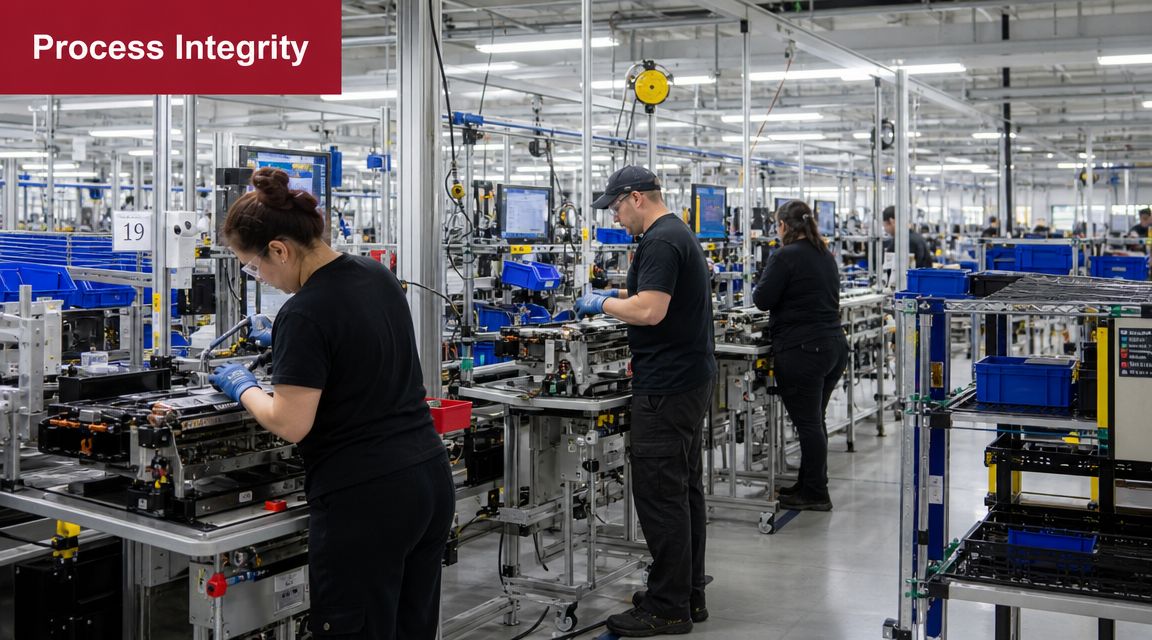
The stronger framing is process integrity. That means the business can show how quality is defined, where it is checked, who is accountable, what happens when something drifts, and how corrective action closes the loop. That's very different from saying the factory has a certificate on file.
The overlooked question scaling brands have to answer
The most useful question isn't whether you have a quality assurance standard. It's whether you can prove it across a fragmented operating model.
The gap is well captured in the question raised by this quality assurance approach reference: “What QA controls should be essential when scaling beyond one factory or one market?” That matters because quality-sensitive businesses need evidence that QA is operationalised through audits and corrective action, especially when production and distribution are fragmented.
That's the point many brands reach after their first expansion friction. They realise quality isn't just about factory output. It also sits inside supplier onboarding, packaging control, inbound inspection, warehousing discipline, marketplace prep, and returns analysis.
What process integrity looks like in practice
Process integrity usually shows up in ordinary but hard-to-fake operating behaviours:
- Specifications are controlled: The approved version is obvious, current, and shared across all relevant parties.
- Supplier conversations are evidence-based: Teams ask what a manufacturer can consistently hold, not just what they're willing to quote.
- Escalation is predefined: If a component changes, a defect appears, or a shipment lands outside tolerance, people know what happens next.
- Corrective action is documented: The issue doesn't disappear after a replacement order or a refund cycle.
A quality system becomes commercially valuable when it stops being a factory credential and starts acting like a governance mechanism.
Mature brands set themselves apart. They stop treating quality as a claim attached to the product and start treating it as a system attached to the business.
Comparing Key Global QA Standards for Hardware
For hardware and consumer product brands, not all standards do the same job. Some help prove your management system is credible. Others help demonstrate that the product can legally or safely enter a market. Founders who lump them together usually end up over-investing in the wrong proof or under-preparing for the right gatekeeper.
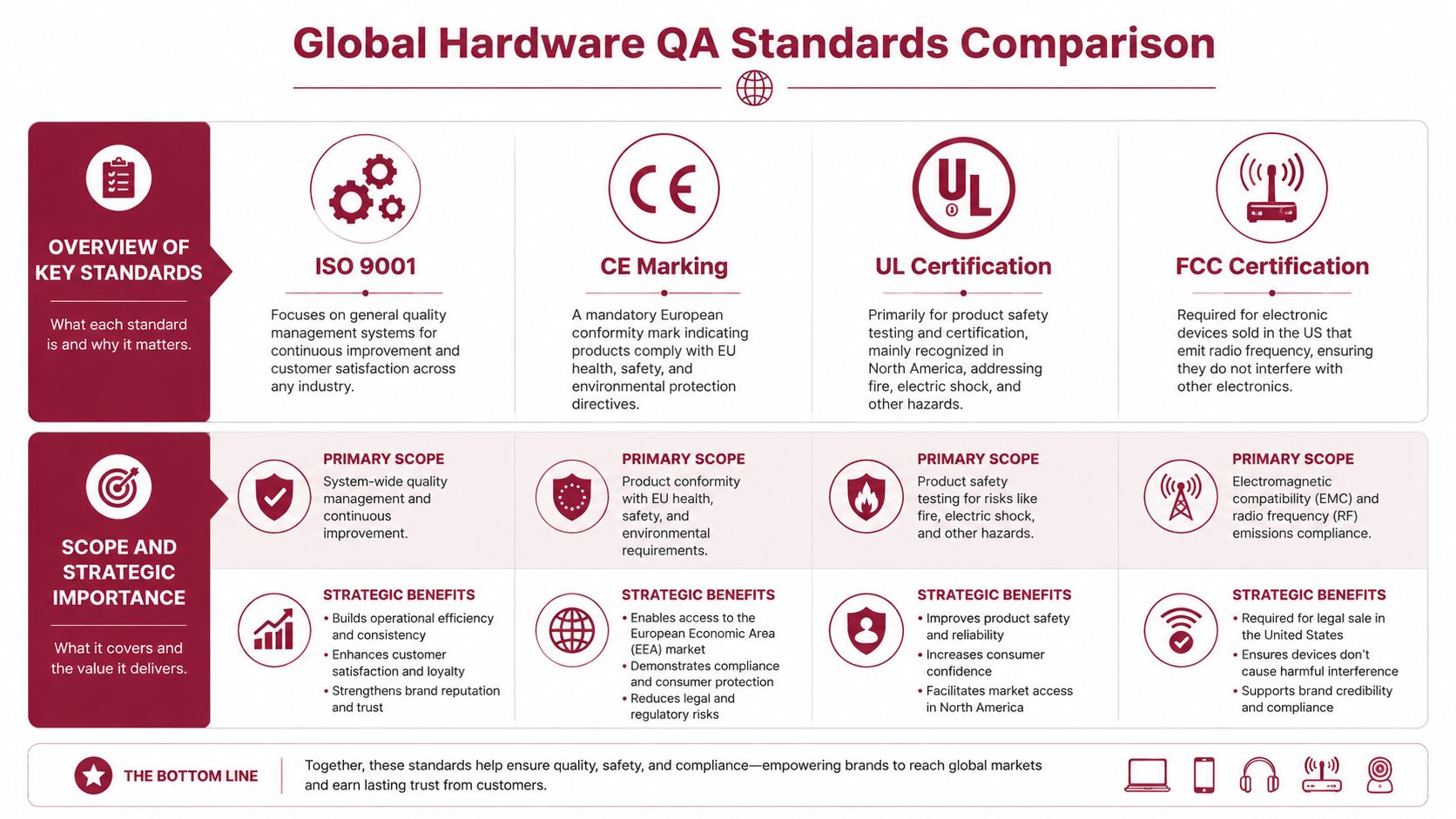
What ISO 9001 really signals
ISO 9001 matters because it shifts the conversation away from product claims and towards system reliability. In Australian practice, ISO 9001:2015 is tied to process control, risk-based thinking, corrective action, and continual improvement. Its significance is broader than certification itself. It reflects a market shift towards integrated quality systems that connect design, sourcing, and production through auditable controls.
For a founder, the commercial value is straightforward. ISO 9001 can help demonstrate that your business doesn't rely on heroics, memory, or supplier goodwill to maintain standards. It tells distributors, larger retail partners, and procurement teams that your operation is organised around repeatability.
What product conformity standards do differently
CE marking, UL certification, and FCC-related approvals solve different problems. They aren't interchangeable with ISO 9001 because they speak to product conformity and market access, not just management discipline.
Here's the practical distinction.
| Standard | Primary Focus | Commercial Value | Key Markets |
|---|---|---|---|
| ISO 9001 | System-wide quality management | Helps prove operational control and repeatability | Broad international relevance |
| CE Marking | Product conformity with applicable EU requirements | Supports entry into European channels and distributor confidence | European markets |
| UL Certification | Product safety assurance | Builds trust with North American retailers and safety-conscious channels | United States and parts of North America |
| FCC Certification | Radio frequency compliance for electronic devices | Supports lawful sale of relevant electronic products in the US | United States |
A hardware brand entering Europe may need CE-related conformity to get the product accepted. A connected device entering the US may need safety and radio-frequency compliance to avoid friction with retailers, import processes, or channel partners. ISO 9001 won't replace those.
To make the distinction clearer, this visual summary is useful before teams start market planning.
Choosing the right standard for the expansion goal
One issue we repeatedly observe is that brands chase the most familiar standard instead of the one that answers the actual commercial question.
- If the issue is operational consistency, ISO 9001 is often the relevant signal.
- If the issue is legal market entry, conformity requirements matter more.
- If the issue is retailer or distributor confidence, recognised safety marks can carry more weight than a broad process certificate.
- If the issue is marketplace scale, the answer is usually a combination of system control and product-specific compliance.
That's why quality assurance standards need to be treated as a portfolio of tools, not a single badge. Brands expanding through marketplaces often realise this late, usually after trying to sell on Amazon with a product that is technically strong but operationally under-documented for the markets they want to enter.
An Operational View of Sourcing and Production
The commercial difference between a weak QA system and a strong one usually appears during supplier conversations.
When quality is vague, sourcing becomes a price exercise. The supplier promises capability, the buyer assumes alignment, and both sides discover the gap later through defects, rework, or customer complaints. When quality assurance standards are well built, the conversation changes. Teams stop asking only what the unit cost is and start asking how consistency will be maintained, evidenced, and corrected.
Strong standards change the balance of power
Across multiple marketplace ecosystems, the brands that hold quality better during expansion tend to run sourcing with clearer control points. They define approved materials, tolerances, packaging requirements, inspection thresholds, labelling rules, and escalation paths before production pressure rises.
That doesn't make the relationship adversarial. It makes it legible.
A supplier can only be held to a standard that is documented, auditable, and tied to consequence. Otherwise, every quality issue turns into a debate about interpretation. That's where substitution risk grows. Components get swapped. Packaging stock changes. Workarounds appear on the line. The product still ships, but it no longer arrives as the brand intended.
The most expensive quality problems often begin as undocumented exceptions.
Governance matters more than good intentions
Serious markets don't treat quality as an informal aspiration. Australia's official statistics system is built on a formal framework anchored in the ABS Quality Declaration and the Australian Bureau of Statistics Act 1975, giving quality assurance a legal and governance basis rather than leaving it to informal practice, as outlined in this reference on quality assurance frameworks in official statistics.
That principle transfers well to supply chains. Brands scaling across factories or regions need their own version of that discipline. Not bureaucracy for its own sake. Governance that keeps standards intact when people, sites, and incentives start pulling in different directions.
This is also why supply chain risk management becomes inseparable from quality management once a business expands internationally. Quality drift rarely starts as a dramatic failure. It usually begins with a sourcing compromise nobody classified as strategically important at the time.
An Audit-Ready Framework for Your QA System
A quality system becomes useful when it can survive scrutiny from outside the business. That might be a retailer audit, a major distributor due diligence process, a marketplace compliance request, or acquisition-stage operational review. If the system only works when your internal team explains it verbally, it isn't ready.
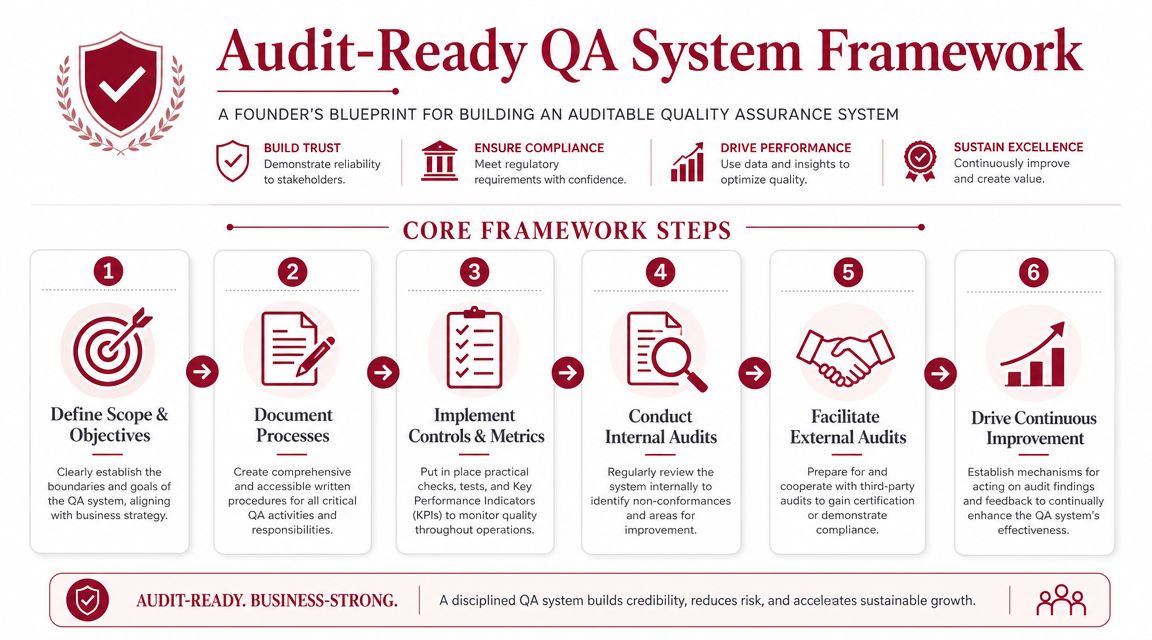
A practical benchmark comes from layered QA/QC design. The most effective workflow first defines quantitative acceptance criteria, then applies automated validation against those criteria, then uses continuous monitoring to detect anomalies, as described in this QA/QC workflow reference. The important lesson isn't limited to data systems. It applies directly to physical products and supply chain operations. Quality should be tested against explicit objectives, not vague intent.
Start with what quality means for your brand
Founders often inherit generic QA language that says almost nothing. “High quality”, “meets standards”, and “customer satisfaction” don't help operators make decisions under pressure.
A stronger system starts with scope and policy. What exactly is essential for your brand? Is it finish consistency, electrical reliability, packaging presentation, assembly accuracy, shelf readiness, returns performance, or all of the above? The answer should reflect your commercial position, not just your engineering preference.
Build controls where quality can actually break
Once the policy is clear, map control points across the value chain. Don't limit this to factory output.
Consider controls across:
- Incoming materials: Approved supplier lists, inspection rules, and change notification requirements.
- Production: In-process checks, line-clearance routines, tooling verification, and traceability of any deviation.
- Packaging and presentation: Carton integrity, insert accuracy, barcode verification, and localisation checks for each market.
- Post-production movement: Warehouse handling, relabelling, prep work for marketplace channels, and returns diagnostics.
The point is to place controls where errors can be introduced, not just where they become visible.
Make corrective action part of the system
An audit-ready QA system doesn't just record non-conformance. It drives response. If a batch fails, a complaint pattern appears, or a supplier goes off-standard, the business should know who investigates, how root cause is logged, what containment action happens immediately, and how recurrence is prevented.
That closed-loop discipline is where many brands still struggle. They can identify a problem, but they can't show a repeatable mechanism for resolution.
Operator view: If the same issue can happen twice for the same reason, the corrective action process isn't mature yet.
Treat documentation as an operating asset
Documentation often gets dismissed as admin. In reality, it's one of the few ways to keep quality stable when the organisation scales faster than the original team can supervise.
A useful test is simple. If a new supplier, warehouse partner, or operations lead joined tomorrow, could they understand the standard without a founder explaining it live? If not, the system still depends too heavily on memory and personalities.
Audit-ready doesn't mean overbuilt. It means clear enough to be followed, checked, challenged, and improved.
How Quality Signals Shape Marketplace Trust
Customers never audit your internal quality documents. Marketplaces don't watch your production line. But both react to the signals your system produces.
If the product arrives complete, performs as expected, and stays consistent across orders, the channel reads that as reliability. If customers start reporting faults, missing accessories, dead-on-arrival units, setup problems, or packaging inconsistency, the marketplace reads that too. Over time, those signals shape trust more than any product description ever will.

Small controls prevent public failures
One useful lesson comes from sensor-based QA. The most operationally valuable controls are rule-based checks on timestamp integrity, allowable value ranges, frozen-value persistence, rate-of-change spikes, internal consistency, and spatial consistency. These checks target common failure modes and help prevent silent corruption, as explained in this reference on data QA and QC controls.
The hardware and marketplace equivalent is straightforward. Many visible product failures begin as small, technical misses that nobody flagged early enough. Wrong insert in the carton. Inconsistent firmware state. Barcode mismatch. Incorrect charger variant. Cosmetic drift from an unapproved finish change. Each issue may look minor in isolation. Publicly, they all land as the same message: this brand isn't consistent.
Trust is built operationally, then expressed commercially
A recent marketplace review revealed something simple but important. The brands with the strongest trust signals often look calm from the outside because they've done the messy backend work well. Their listings don't need to compensate for avoidable operational friction.
Marketplace trust is shaped by:
- Review stability: Customers describe a repeatable experience rather than conflicting ones.
- Returns discipline: Fewer preventable defects feed back into cleaner channel performance.
- Seller health: Internal control supports the external metrics marketplaces use to judge reliability.
- Brand coherence: The product, packaging, after-sales experience, and listing promise all align.
For brands selling through major platforms, brand registry protection matters. But registry tools work best when the underlying customer experience is already consistent. Protection can defend an asset. It can't replace process integrity.
Customers read quality through outcomes, not intentions.
Quality assurance standards are often treated as a backend function. In marketplace environments, they're also a frontline trust mechanism. They reduce the kind of inconsistency that turns private operational weakness into public commercial damage.
Building a Cohesive and Scalable Global Brand
A strong product doesn't become a strong international brand by default. It gets there when the business can preserve quality through more complexity than it originally had to handle.
That's why quality assurance standards matter far beyond compliance. They hold together sourcing, production, logistics, channel expansion, and customer trust. They give a founder a way to scale without depending on constant intervention. They let a commercial team enter new regions without diminishing the experience that made the product valuable in the first place.
The brands that travel well usually share one trait. They don't mistake past product success for future operating control. They build systems that make consistency transferable.
In practical terms, that means treating quality as part of brand architecture. Not a factory issue. Not a document set. A commercial discipline that protects margin, reputation, and channel confidence as the business expands.
If you're assessing whether your current operating model can support international growth without quality fragmentation, TPR Brands works with established product businesses to evaluate channel readiness, supply chain cohesion, and the structural issues that often undermine expansion long before they appear in sales reports.