A useful question for any retail partner or investor is this. How can a category that looks simple on the surface reveal so much about a brand's operational discipline?
Bean bags are a strong test case because they tempt people into shallow evaluation. The product looks informal. The buying journey looks straightforward. The catalogue often appears easy to internationalise. But one pattern we continue seeing across multiple marketplace ecosystems is that “simple” products often hide the most commercially important signals. Construction quality, fill logic, closure design, moisture management, compliance history, and sizing communication all sit beneath the styling layer.
That's why Epona Bean Bags is more interesting as a business case study than as a consumer review. The brand sits in a category where durability, safety, and product explanation matter more than many operators first assume. For a founder, distributor, or marketplace strategist, that changes the lens completely. The question stops being whether the product photographs well. The question becomes whether the catalogue carries the kind of product discipline that survives channel expansion, fulfilment friction, and customer scrutiny in mature markets.
Beyond the Product A Signal of Brand Maturity
A strong local product doesn't automatically become a strong international brand. That assumption causes a lot of quiet damage.
In furniture-adjacent categories, the risk is even higher because customers assess quality through use, not just appearance. A product can look premium online and still create downstream problems if the engineering, sizing logic, or materials don't hold up in real environments. Retail partners know this. Marketplace operators know it too. They're not just reviewing style. They're reading for signs of product maturity.
Why apparently simple categories are often harder to scale
Bean bags sit in an unusual middle ground. They're casual, but they aren't trivial. They occupy lifestyle, outdoor living, occasional seating, and sometimes hospitality use cases at the same time. That creates a broader decision set than many founders expect.
A serious buyer tends to look for signals like these:
- Construction discipline: Are seams, zips, liners, and fabrics chosen for actual use conditions, or just for margin preservation?
- Customer translation: Can the brand explain size, fill, comfort, and intended use without creating confusion?
- Category fit: Does the product behave like décor, seating, or utility furniture in each channel?
- Operational resilience: Will the product produce avoidable service issues once it enters higher-volume fulfilment environments?
Those aren't abstract questions. They shape return risk, review quality, retail confidence, and wholesale repeatability.
Practical rule: The simpler a product looks, the more closely experienced operators inspect the details no customer sees in the first ten seconds.
Epona Bean Bags is useful because it gives enough visible evidence to judge those details. The brand is associated with an Australian business in Currimundi, Queensland, and its Houzz listing describes the company as specialising in high quality, contemporary bean bag furniture for indoor and outdoor use, according to Epona Co.’s Australian Houzz profile. That matters commercially because it places the brand inside a specific regional operating context rather than a generic, unanchored ecommerce shell.
What experienced partners actually look for
When we assess a catalogue like this, we're usually looking past the hero image. We want to know whether the brand has thought through failure modes, not just features.
For Epona, the more relevant question isn't “Are bean bags popular?” It's whether the product line reflects the kind of disciplined decision-making that can travel across regions with minimal brand damage. That's the threshold between a nice product and an expandable one.
Category Provenance and Compliance DNA
The strongest categories often have a regulatory backstory that shaped how good operators build products today. Bean bags in Australia fit that pattern.
Epona's relevance starts with geography. The business associated with Epona Bean Bags is based in Currimundi, Queensland 4551, Australia, as noted in Bliss Bean Bags' category history and market context overview. That same source also places bean bags' deeper origins around 2000 B.C. in Ancient Egypt, notes developments in China around the 12th century, and points to the first bean bag chair patent in 1968. Commercially, that combination matters. It means the category has deep cultural familiarity, but relatively recent furniture standardisation.
Why Australia matters more than people think
For Epona, an Australian base isn't just a location detail. It suggests the brand developed inside a market where category safety and product construction have carried real weight for decades.
Bean bag furniture in Australia reached a clear regulatory milestone in 1995, when products were required to use reinforced seams and safety zips, according to this bean bag category history summary. The same source places the modern furniture-era origin of the bean bag chair in 1968–1969. That's a short commercial history compared with older furniture classes, and one shaped directly by safety-driven manufacturing evolution.
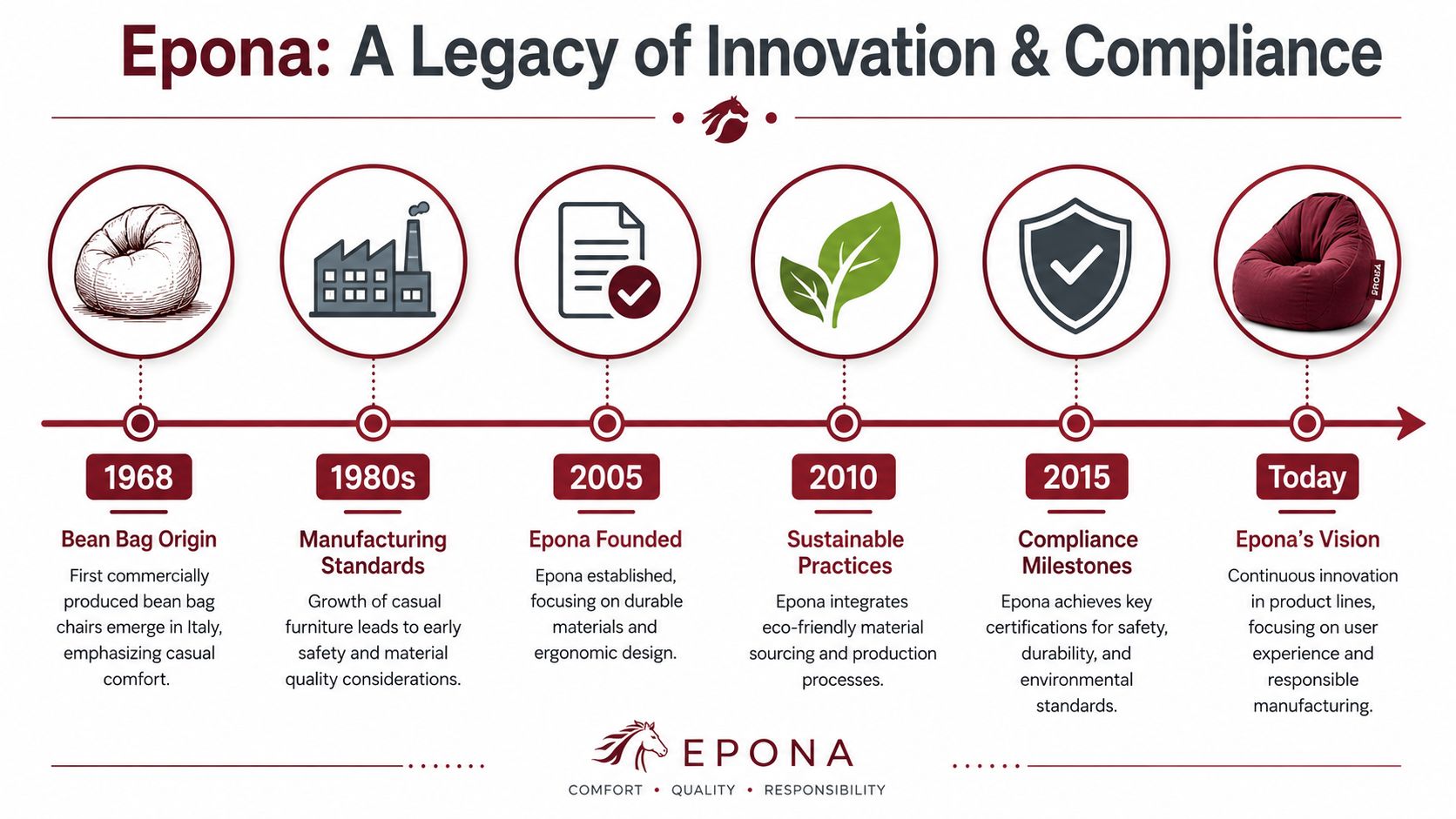
That matters to any partner evaluating expansion readiness. A brand born in a more regulated domestic environment often starts with better habits around stitching, closures, and risk control. Not always. But often enough that it becomes a useful screening signal.
Compliance history becomes product language
A recent marketplace review revealed that many furniture and soft-goods brands still treat compliance as paperwork. Better operators build it into the product story itself. Epona sits in a category where that distinction matters.
Here's the commercial read:
| Signal | Why it matters to partners |
|---|---|
| Australian category discipline | Suggests the product line emerged in a market that expects safer closure and seam standards |
| Recent commercial category history | Means product norms are still closely tied to modern manufacturing decisions |
| Indoor and outdoor positioning | Expands channel relevance, but also raises scrutiny on construction consistency |
For mature retail ecosystems, compliance isn't just defensive. It's persuasive. It gives buying teams confidence that the product's casual aesthetic doesn't hide weak build quality.
That's also why quality assurance standards in expansion planning matter more than many brands realise. When a category carries a regulatory legacy, the buyer expects to feel that discipline in the product, the packaging, and the way the brand communicates use.
A brand's home market often tells you more about its expansion readiness than its catalogue copy does.
Deconstructing Material and Product Line Choices
Material choice is where a catalogue either starts to look commercially literate or starts to look generic. In categories like outdoor leisure furniture, that distinction shows up quickly.
The useful lens for Epona Bean Bags isn't whether the range looks broad. It's whether the product architecture appears intentional. Good product lines separate indoor comfort from outdoor exposure with different design logic. Weak ones apply the same construction assumptions to every use case and hope the customer won't notice until after purchase.
Reading the catalogue like an operator
A retail buyer usually reads materials as a proxy for expected claim rates, customer satisfaction, and channel fit. That's especially true in products that sit outdoors, near pools, or in high-turn hospitality settings.
With Epona, the strongest signal isn't any single fabric mention. It's the apparent willingness to solve for environment-specific use. That's an important distinction. Outdoor seating has to survive a different set of stresses than indoor occasional furniture. UV, damp conditions, repeated movement, seam load, and cleaning expectations all create a harder commercial brief.
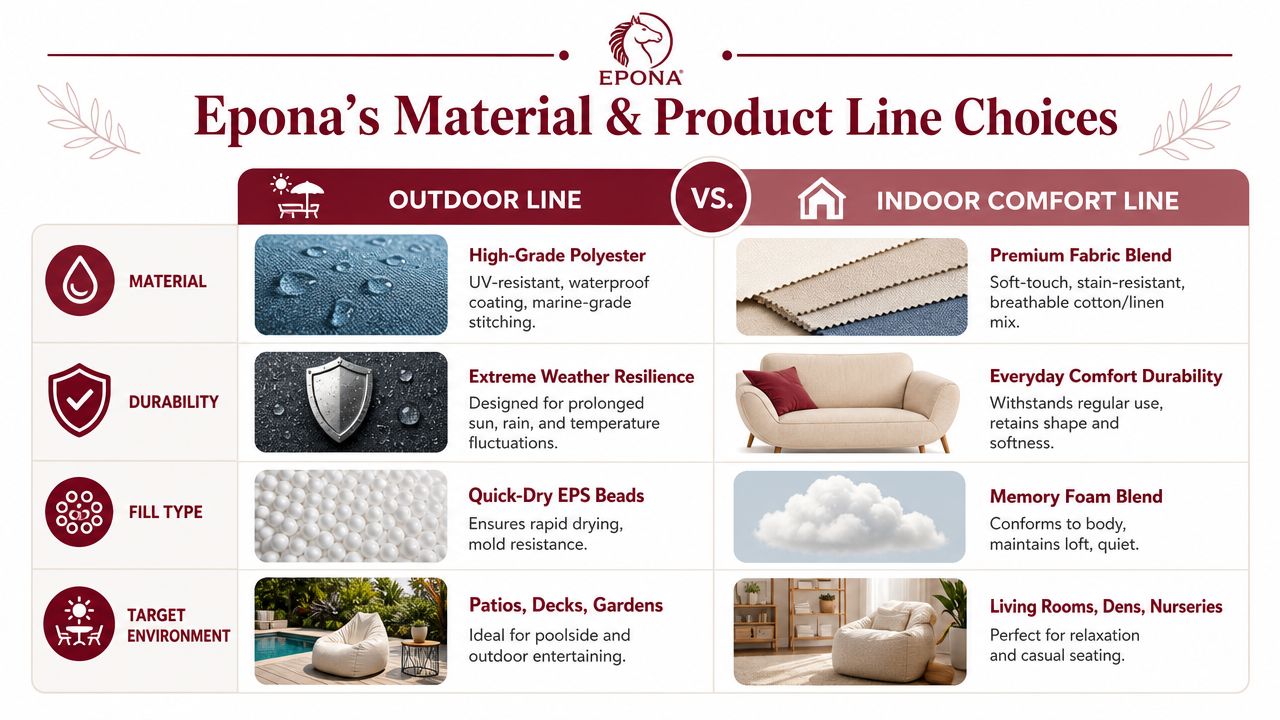
What experienced partners tend to infer from that kind of separation:
- Outdoor intent: The brand understands that weather-exposed products need a different construction conversation from lounge-room products.
- Channel suitability: Products built for poolside or resort-style contexts can create B2B relevance beyond direct-to-consumer demand.
- Price integrity: Better materials and more thoughtful construction usually give a brand more room to defend margin without relying on discounting.
What works and what usually fails
Across multiple marketplace ecosystems, one issue we repeatedly observe is brands collapsing all bean bag variants into one merchandising logic. That usually creates three problems. The indoor range feels underspecified, the outdoor range feels overstated, and the customer can't tell what they're paying for.
Stronger brands do the opposite. They make the trade-offs legible.
A commercially useful way to assess the line is this:
| Decision area | Strong signal | Weak signal |
|---|---|---|
| Environment match | Product details reflect where and how it will be used | Same language used for every SKU |
| Durability posture | Construction choices imply lifecycle thinking | Durability appears only as a marketing adjective |
| Range coherence | Each model has a clear role in the catalogue | Catalogue breadth substitutes for clarity |
Operator insight: Materials don't just define performance. They define which channels will trust the brand enough to stock it.
That's where Epona becomes more than a furniture label. It becomes a test of whether the brand is building a coherent system of use cases. For expansion, that matters far more than having a large SKU count. A focused catalogue with clear material logic is easier to localise, easier to range, and easier to defend in markets where customers read product detail carefully.
The Commercial Value of Thoughtful Engineering
Most product teams say they build for real-world use. Fewer can point to a design choice that proves it.
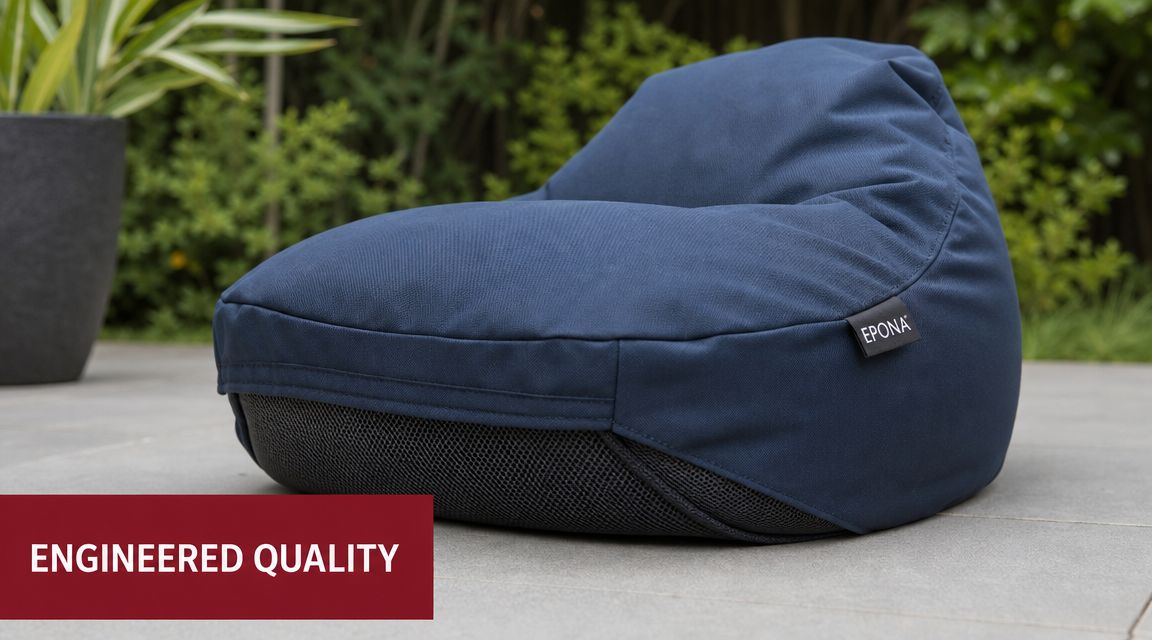
Epona has one particularly telling example in its outdoor and pool-oriented products.
A small detail with large operational meaning
Epona's outdoor bean bags use a mesh liner rather than a fully sealed polyester inner in water-contact applications. The reason is operational, not cosmetic. The product team found that a waterproof outer shell alone still allowed moisture ingress through seams, and the mesh design lets water move in and out, reducing trapped-water buildup and the fabric stress that can contribute to seam failure, as shown in Epona's product demonstration on outdoor liner design.
That's the kind of feature experienced operators pay attention to. It shows the team has identified a likely failure mode, tested the simplistic solution, seen where it breaks down, and changed the architecture accordingly.
Why this matters to retail and marketplace partners
A waterproof claim is easy to write. Engineering for what happens after water gets through the seams is harder. That difference separates surface-level merchandising from product stewardship.
For a distributor or retailer, the commercial value sits in the downstream effects:
- Fewer preventable complaints: Customers don't evaluate outdoor furniture in lab conditions. They judge it after repeated exposure.
- Stronger reputation protection: Products that age badly near water create disproportionate trust damage.
- Better B2B relevance: Hospitality and poolside settings expose design shortcuts quickly.
That kind of engineering rarely becomes the hero message in consumer marketing, but it often becomes decisive in due diligence.
Here's the relevant product footage for that kind of assessment.
The broader lesson
One pattern we continue seeing is that the best-performing catalogues often win because of invisible product decisions. Not louder branding. Not more aggressive ad spend. Just fewer structural mistakes.
Epona's mesh-liner decision is a good example of a brand solving the actual use environment rather than the idealised sales-page version of it. For international scaling, those details matter because they travel well across channels. Good engineering usually needs translation. Bad engineering usually needs concealment.
The Sizing Gap and Fulfilment Implications
Not every issue in a catalogue is a product flaw. Some are communication flaws with real commercial consequences. Sizing is one of the most common.
That's where Epona Bean Bags shows a familiar challenge. Public guidance appears to leave a gap between nominal product size and practical customer understanding. For categories sold unfilled or partly configured by the customer, that gap can become expensive.
Where the ambiguity sits
A fill demonstration mentions roughly 350 litres for one chair configuration and 80–100 litres for an ottoman in this product filling video. The same source highlights the broader issue: there isn't an accessible sizing matrix that helps buyers connect fill volume to body size, comfort preference, or intended use.
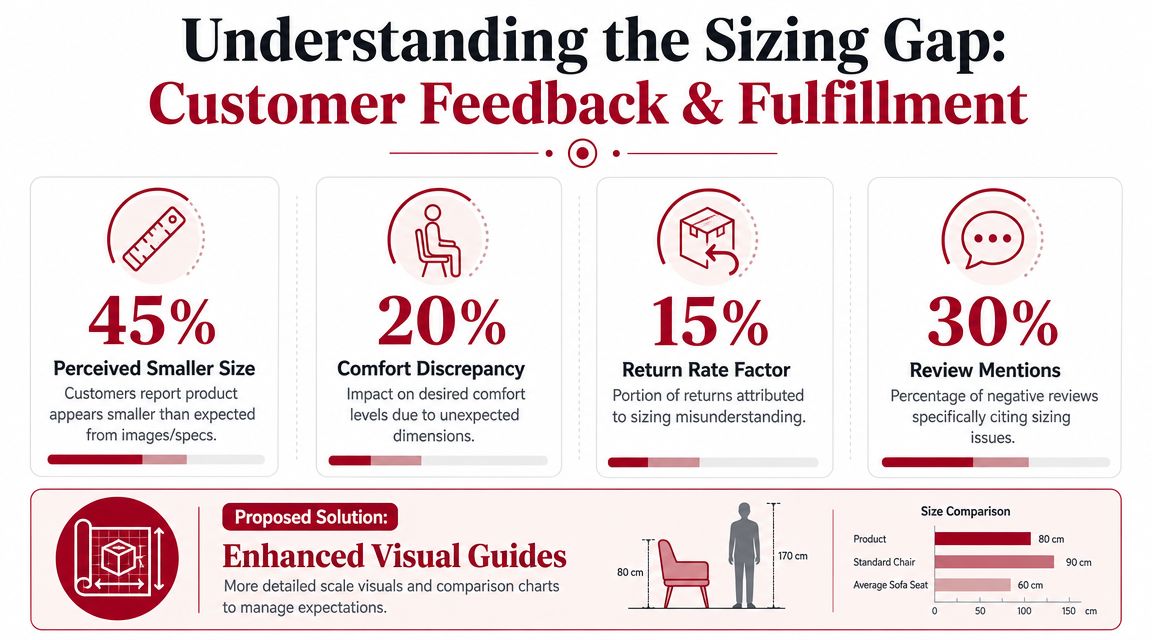
That's a manageable issue, but it isn't a trivial one. In marketplace environments, ambiguity around size and fill often shows up in three places first: product questions, review friction, and post-purchase dissatisfaction that isn't caused by product quality at all.
Why this becomes a fulfilment problem
When customers buy a bean bag shell separately from fill, the product experience starts before use. It starts with expectation setting. If the brand doesn't translate litres into a felt seating outcome, the buyer has to guess.
That creates practical complications:
- Underfilling risk: The customer blames the chair for comfort issues that are really setup issues.
- Overfilling risk: Comfort can decline if the product becomes too rigid for the intended seating posture.
- Fulfilment complexity: Large empty shells are efficient to ship, but that efficiency only works if setup guidance is strong enough to prevent confusion.
A recent marketplace review revealed that this is one of the most common weak points in otherwise capable home and lifestyle brands. They optimise packaging and freight profile, but leave the customer to solve the ergonomics.
That's why international fulfilment strategy has to include product interpretation, not just movement of goods. A product that ships efficiently but lands ambiguously can still underperform commercially.
The customer doesn't distinguish between a product problem and a guidance problem. They experience both as disappointment.
For Epona, this doesn't undermine the range. It identifies a localisation task. Before entering less forgiving marketplaces, the sizing and fill story would benefit from clearer buyer-facing translation tied to use cases, body expectations, and desired seating feel.
Translating Product Strengths for International Markets
The commercial question isn't whether Epona has product strengths. It does. The key question is whether those strengths can be translated into the language each marketplace rewards.
That's where many brands lose momentum. They carry the same product truth into every region, but they don't adapt the framing. International expansion then becomes a listing exercise instead of an ecosystem transition.
The same product means different things in different markets
A regulated Australian category background can support trust in other mature markets, but trust doesn't travel automatically. It needs local interpretation.
In the UK, a buyer may respond strongly to durability, weather practicality, and quality cues tied to outdoor living in tighter residential settings. In the US, the same product line may need stronger segmentation across patio leisure, poolside use, and casual family seating. In Canada, seasonality and storage behaviour may shape the conversation more directly. The underlying product can stay consistent. The surrounding commercial language usually can't.
That's why marketplace localisation often determines whether products feel native or imported. The issue isn't just translation of words. It's translation of relevance.
What Epona appears to have in its favour
From an operator's perspective, Epona has several assets that tend to matter in expansion:
| Expansion asset | Marketplace implication |
|---|---|
| Regulated home-market roots | Helps support trust signals in mature retail environments |
| Environment-specific engineering | Gives the brand a credible performance story beyond aesthetics |
| Indoor and outdoor relevance | Creates flexibility across direct, retail, and project channels |
Those are useful foundations. They can support premium positioning if the brand avoids generic merchandising.
What still needs localisation before launch
The sizing and fill guidance stands out as the main pre-launch translation task. Not because it indicates weak product design, but because it creates too much room for customer interpretation.
Across multiple marketplace ecosystems, many otherwise strong catalogues lose efficiency. They launch with technically correct product information, but not with decision-friendly information. That distinction matters. Customers don't buy technical truth alone. They buy confidence.
If Epona were being prepared for broader international rollout, I'd want to see:
- Use-case led size guidance: Seat for reading, poolside lounging, teens, adults, or occasional use.
- Fill outcome explanation: Softer sink-in feel versus firmer support.
- Channel-specific merchandising: Retail, hospitality, and marketplace presentations should not look identical.
That's the broader strategic lesson. Product quality creates the right to expand. It doesn't complete the expansion job. The brand still has to convert its strengths into a locally legible proposition.
Building a Commercially Cohesive Expansion Strategy
Epona Bean Bags is a good reminder that expansion readiness is rarely visible in a hero image. It shows up in category discipline, product engineering, material logic, and how clearly the brand helps buyers make the right decision.
That's also why founder teams should resist the idea that marketplace growth starts with more listings. It usually doesn't. It starts with a hard assessment of whether the product's real strengths are coherent enough to survive new channels, new customer expectations, and new operational conditions.
A catalogue like this suggests a serious product foundation. It also shows the kind of work that still matters before scaling harder. Clarify sizing. Translate use cases more precisely. Make sure each market receives the product in the language that best fits its buying logic.
For brands working through that transition, options range from internal commercial planning to external channel and market support. One option is TPR Brands' Amazon expansion work, which focuses on helping established product businesses move into new channels and regions with more structure around positioning, compliance, and commercial fit. The important point isn't the provider. It's the operating standard. Expansion works better when product, channel, and localisation decisions are made together.
Serious growth rarely fails because the product had no potential. It fails because the ecosystem around the product wasn't built with enough discipline.
If you're assessing whether your own catalogue is ready for new marketplaces, a strategic conversation with TPR Brands is a practical place to start. The work begins with product truth, channel fit, and localisation readiness, not surface-level listing activity.