Many brands assume international growth is mainly a marketing challenge. In reality, fulfilment is often what determines whether global expansion scales profitably or stalls under operational pressure.
A strong product may generate demand overseas, but customer experience is ultimately shaped by delivery speed, shipping reliability, landed costs, and post-purchase trust. If those systems break down, growth becomes difficult to sustain regardless of how strong the product itself may be.
This is why international fulfilment strategy matters far beyond logistics. It influences conversion rates, customer retention, pricing competitiveness, and brand perception in every market you enter.
For ecommerce and Amazon-focused brands, fulfilment is no longer just an operational function. It is a strategic growth infrastructure that determines how efficiently a company can expand across borders while protecting margins and customer experience.
Brands that scale globally tend to approach fulfilment differently. They validate markets carefully, build scalable inventory systems, stay ahead of compliance obligations, and use local fulfilment networks to create faster and more reliable customer experiences.
This guide explains how international fulfilment strategy supports sustainable global growth, how Amazon fulfilment models fit into expansion planning, and what brands must do to avoid the operational mistakes that commonly slow international scaling.
Turning Fulfilment Into a Competitive Advantage
For a long time, logistics was seen as a necessary evil—a cost to be minimised. In the direct-to-consumer world, that mindset is a liability. The smartest brands now treat fulfilment as a core part of their brand and retention strategy. Why? Because a flawless delivery experience has a direct line to brand loyalty, positive reviews, and repeat purchases.
The journey your product takes after the “buy” button is clicked is loaded with opportunities to build real brand value:
- Speed and Certainty: Fast, predictable shipping isn’t a luxury; it’s the baseline expectation. Meeting or beating local delivery times is the quickest way to earn trust in a new market.
- The Unboxing Moment: The quality of the packaging and the condition of the item on arrival shape how a customer perceives your brand’s quality and attention to detail.
- No Nasty Surprises: Nothing sours a new customer relationship faster than unexpected fees. A well-planned fulfilment strategy bakes all duties and taxes into the checkout price for total transparency.
For any brand expanding overseas, your fulfilment network is your front line. It’s often the only physical interaction a new customer will have with you. Getting this right isn’t just an operational task; it’s fundamental to building a brand that can last.
How to Build a Scalable International Fulfilment Strategy
Thinking strategically about fulfilment from the beginning is what prevents the painful growth stalls that plague so many expanding brands. Early success on a single marketplace can create a false sense of security, often masking underlying weaknesses in logistics. Once you start expanding, those small cracks become critical failures.
A scalable fulfilment foundation is about designing a system that can handle growth without breaking down. This requires a deep understanding of where to place inventory, how to forecast demand, and how to stay compliant across different countries. It’s about building a system that turns logistics into a genuine competitive advantage.
For instance, a brand might test a new market like Australia by shipping cross-border. But as sales volume picks up, the strategic move is to shift to in-country fulfilment. This simple change can slash delivery times from weeks to days, dramatically lower the landed cost per unit, improve margins, and allow for more competitive pricing.
This is how brands turn fulfilment from a simple delivery function into a powerful engine for profitable, sustainable global growth. It’s what separates the brands that truly scale from those that just stagnate.
Choosing Your Market and Fulfilment Model
Smart global expansion starts with surgical focus, not a scattergun approach that drains capital and kills momentum. I’ve seen too many founders with great products try to be everywhere at once, resulting in stalled growth and operational chaos. The brands that succeed globally are deliberate. They choose their markets carefully and have a clear, phased plan for their fulfilment. This is what separates enduring global brands from cautionary tales.
Choosing the Right Markets First
Your first move isn’t picking a shipping carrier; it’s figuring out where your product has the best chance to win. For most consumer product brands, this means starting with mature, high-spending e-commerce economies where you can gain a foothold without reinventing the wheel. We always advise brands to look for a strong mix of consumer demand, manageable competition, and a familiar operating environment.
Key markets to evaluate first usually include:
- The United States: The world’s largest and most competitive consumer market. The scale is immense, but you’ll need a significant investment in both marketing and inventory to make an impact.
- The United Kingdom: A sophisticated e-commerce market with high online spending. It’s an excellent entry point into the broader European landscape.
- Canada: Culturally similar to the US but a distinct market in its own right. It’s a logical second step for brands that have already found their footing south of the border.
These markets aren’t just large; they have established Amazon infrastructures that allow you to test and scale with relatively low risk. You can gather real-world sales data before you commit to a full, in-country operation. Your choice on fulfilment will directly impact your brand’s growth trajectory. Get it right, and you’re on the path to sustainable growth. Get it wrong, and you risk losing customers and damaging your brand’s reputation.
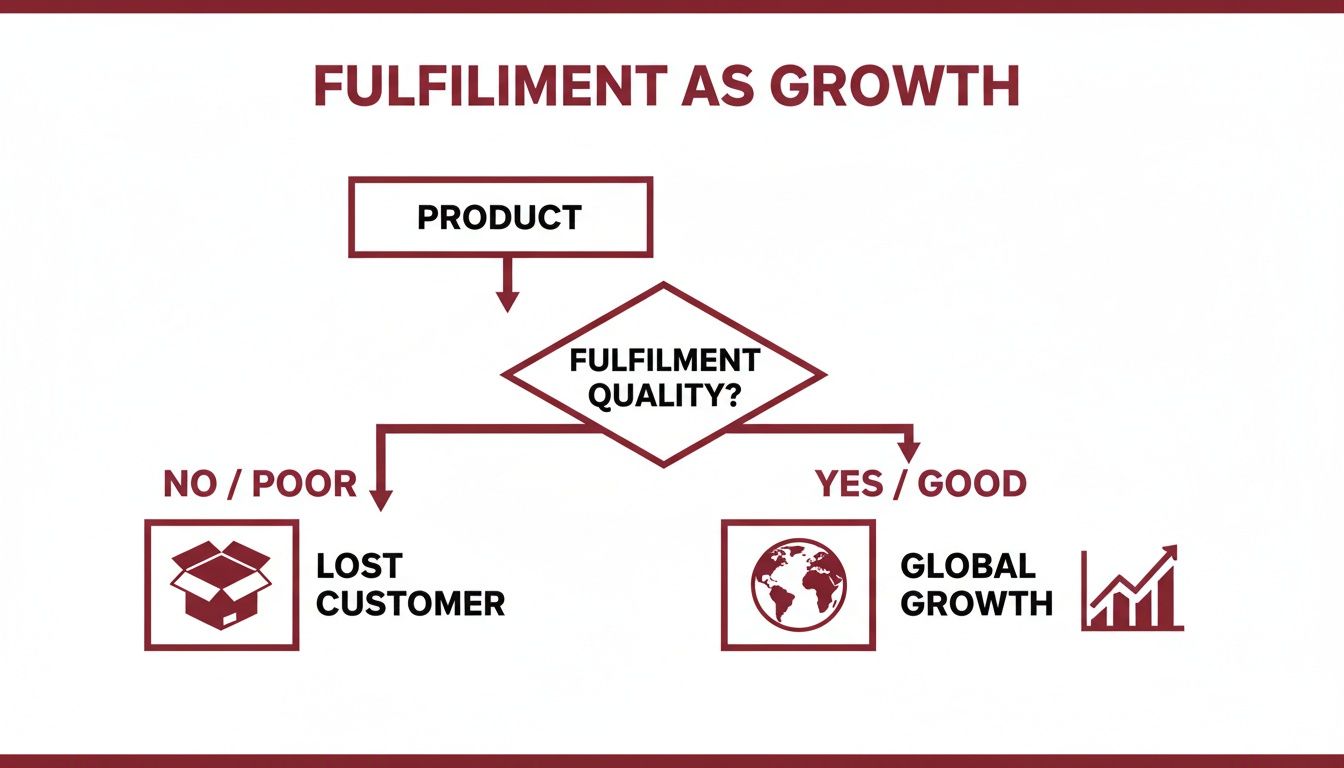
As you can see, there are really only two paths. It’s a stark reminder of how critical your logistics and delivery experience are to your global ambitions.
Selecting the Right Amazon Fulfilment Model
Once you have a shortlist of target markets, the next decision is your fulfilment model. For brands tapping into Amazon’s ecosystem, there are three main options, each with strategic trade-offs. Choosing the right program at the right time can accelerate progress, while picking a model that doesn’t align with your growth stage can cause major setbacks.
Amazon International Fulfilment Program Comparison
| Fulfilment Model | Best For | Main Advantage | Main Limitation |
|---|---|---|---|
| FBA Export | Testing international demand | Low upfront risk | Slower delivery |
| Pan-European FBA | Expanding across Europe | Faster EU delivery | Complex VAT obligations |
| Amazon Global Selling | Serious international scaling | Local delivery speeds | Higher operational complexity |
Let’s break down what these programs mean in practice.
A Closer Look at the Models
FBA Export is the simplest way to dip your toe in international waters. You hold inventory in your home country’s FBA centres, and Amazon handles cross-border shipping. It’s a fantastic tool for testing demand without taking on new inventory risk. The main drawback? Shipping times are longer and costs are higher for the customer, which can make your product less appealing than locally-stocked alternatives. Think of it as a validation tool, not a long-term growth plan.
Pan-European FBA is designed for brands targeting Europe. You send inventory to a single Amazon Fulfilment Centre in an EU country, and Amazon distributes your stock across its European network. This enables faster delivery and Prime eligibility across the continent. It’s perfect for brands committed to the EU market. The biggest consideration here is the immediate creation of complex VAT obligations in every country where Amazon stores your inventory, requiring expert tax management from day one.
Amazon Global Selling is the model for serious international expansion. Here, you open a dedicated selling account in your target country (e.g., Amazon.co.uk, Amazon.de), ship your inventory in bulk to their local FBA centres, and operate just like a local seller. This is for brands that have already proven demand. It’s a big commitment involving larger inventory buys, freight forwarding, and customs clearance, but it gives you the fastest delivery times and the most competitive pricing. To learn more, see our insights on managing an Amazon store for global growth.
The strategic sequence we see work time and time again is to test with FBA Export to validate demand, then graduate to Amazon Global Selling once you have clear data that justifies the investment. Skipping this validation step is a common and costly mistake. It’s all about making informed decisions that align with your capital and growth stage.
Understanding International Compliance and Taxes
This is where promising international expansions often grind to a halt. You’ve validated your product and identified a market, but the maze of cross-border compliance and taxes feels like an intimidating challenge. Let’s be clear: this is the least glamorous part of scaling globally, but it is the most critical. A misstep here doesn’t just cause delays; I’ve seen it lead to seized inventory, crippling fines, and brands getting permanently barred from a marketplace. Success isn’t just about understanding the rules—it’s about building a system to manage them from day one.
Product Compliance Requirements
Demystifying Product Compliance
Product compliance isn’t a one-size-fits-all checklist. Each market has its own set of standards, and what passes in the United States might be completely non-compliant in Europe or Australia. Think of it as needing a different “passport” for your product in every new country. Key areas that frequently trip up founders include:
- Safety and Material Standards: Europe’s CE marking is a well-known example, certifying a product meets health, safety, and environmental standards. Similar frameworks exist globally.
- Labelling and Language: Packaging almost always needs to be adapted with local languages, specific warning labels, and required symbols. Failure to do this can get your entire shipment rejected at the border.
- HS Codes: The Harmonised System (HS) code is a universal classification for goods. Assigning the wrong code is a frequent error that leads to incorrect duties, customs delays, and potential penalties.
Getting compliance right isn’t just an administrative hurdle; it’s a fundamental part of earning the right to sell in a new market. Smart brands treat it as a strategic priority, not an afterthought, to de-risk their entire expansion.
VAT, GST, and Cross-Border Tax Obligations
Tackling the International Tax Landscape
Alongside compliance, the tax landscape is another area where founders often feel out of their depth. The core principle is straightforward: when you sell goods in a foreign country, you are often obligated to collect and remit taxes to that country’s government. Ignoring this is not an option. Tax authorities are becoming increasingly sophisticated, and the penalties for non-compliance are severe.
A practical starting point is understanding the main tax types you’ll encounter:
- Value-Added Tax (VAT): Used throughout Europe and many other parts of the world. As an overseas seller, you are typically required to register for VAT once you meet certain sales thresholds.
- Goods and Services Tax (GST): Similar to VAT, this is the system used in countries like Australia and Canada. If you’re selling into Australia, you’ll need to understand your GST obligations from the outset.
- Sales Tax: The model used in the United States, it varies significantly from state to state, creating a complex web of rules for sellers to manage.
For markets like Australia, the opportunity is immense, but so is the need for operational excellence. The Australian e-commerce fulfilment services market was valued at USD 1.7 billion in 2024 and is projected to soar to over USD 3.8 billion by 2030. This explosive growth underscores why streamlined compliance is critical for capturing market share. You can get more insights on this trend from e-commerce fulfilment in Australia at Grand View Research.
The key is to proactively manage these obligations. Partnering with a specialist can simplify this process immensely. You can also explore our resources for more on succeeding with Amazon selling internationally. Ultimately, maintaining good standing with local authorities ensures your path to market remains smooth and profitable.
Building a Resilient Logistics and Inventory System
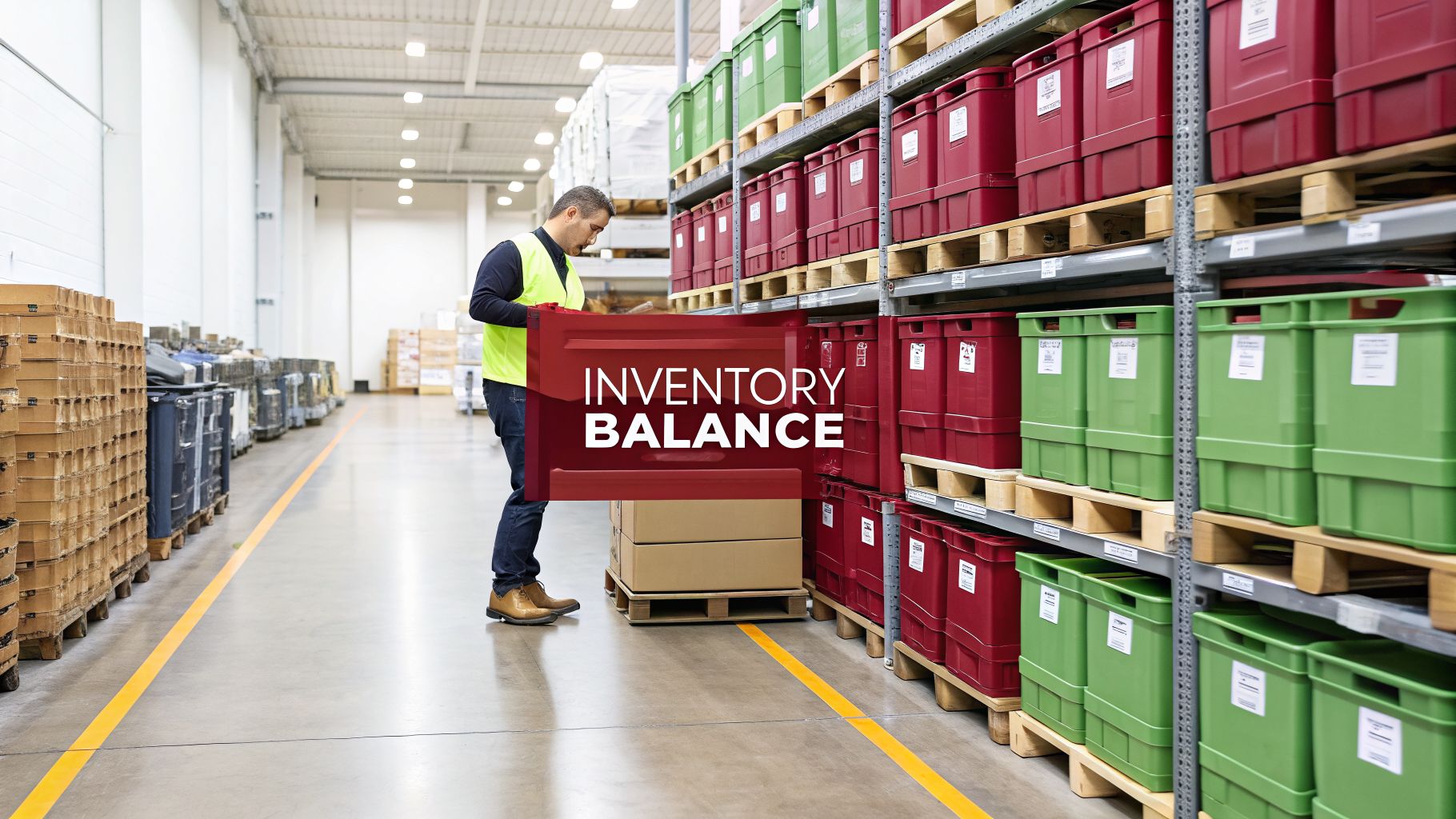
Your supply chain is the physical backbone of your brand. While operating in a single domestic market, it’s easy to miss its weaknesses. But the moment you start selling across multiple countries, any crack in your logistics and inventory strategy becomes a critical point of failure. A resilient plan isn’t just about having enough stock; it’s about having the right stock in the right place at the right time. This is where many founders get into trouble, either by tying up too much capital in slow-moving inventory or underestimating demand and losing crucial sales momentum.
Balancing Inventory and Cash Flow
The core tension in global inventory management is a constant battle between capital efficiency and product availability. Every unit sitting in an overseas warehouse is capital that isn’t working for you. At the same time, a stockout in a new market can kill your launch and send potential customers straight to a competitor.
International inventory planning is a different game than domestic forecasting. You have to account for:
- Longer Lead Times: Ocean freight, customs clearance, and local ground transport can add weeks or months to your supply cycle.
- Demand Volatility: New markets are unpredictable. Your initial sales forecasts will be educated guesses, at best.
- Multi-Location Stock: Spreading inventory across different fulfilment centres (like FBA in the UK and a 3PL in the US) adds layers of complexity.
This means you have to move beyond simple sales forecasting. A smarter approach is to maintain a “safety stock” level in each market—a buffer that accounts for unexpected demand spikes or supply chain delays.
The Australian e-commerce market’s recent performance highlights this perfectly. In 2023, the market hit $63.6 billion, making robust fulfilment networks essential. The Black Friday period saw a 10% jump in online spend, proving that peak events severely strain even established logistics. A resilient inventory plan is non-negotiable. You can discover more insights about these Australian e-commerce trends on Oceanportlink.com.
Choosing the Right 3PL or Fulfilment Partner
As you expand, you’ll face a critical decision: consolidate your global fulfilment with a single, large third-party logistics (3PL) partner, or build a network of regional specialists. The right choice depends on your scale, product complexity, and management bandwidth.
A single global 3PL can simplify management, but a one-size-fits-all approach often lacks the local nuance needed for market-specific challenges. A network of regional specialists, on the other hand, gives you deep local expertise. Using best-in-class partners in each region—one for North America, one for Europe, one for Australia—often results in better service and more tailored solutions, though it increases management overhead. For more detailed strategies, check out our guide on leveraging Amazon FBA for international markets.
When evaluating potential partners, look beyond the price sheet. Their real value lies in their ability to solve problems. Ask about their process for handling customs issues, their reverse logistics capabilities, and their experience with products similar to yours. Their answers will reveal far more about their competence than a simple cost-per-pick quote.
Protecting Pricing and Brand Value Across Marketplaces
Expanding onto global marketplaces puts your brand’s integrity on the line. I’ve seen countless founders master their product and logistics, only to watch their brand value erode from uncontrolled pricing and rogue sellers. This isn’t a minor annoyance; it’s a direct threat to your profitability and long-term brand equity. Using platforms like Amazon can accelerate growth, but that speed comes with risk. Without a clear channel and pricing strategy, you can quickly lose control of your brand’s narrative and its perceived value.
Brand protection becomes an offensive strategy, not just a defensive reaction. It’s about making sure your global expansion builds brand equity instead of letting it bleed out through price wars and inconsistent representation.
Managing MAP Policies and Channel Conflict
One of the biggest headaches founders face is channel conflict. A distributor in Germany undercuts your official Amazon UK price, or an unauthorised seller in Canada lists your product for 30% less than your own US store. Suddenly, you’re competing against yourself. In that race to the bottom, the winner is always the lowest price—never your brand.
This is why a Minimum Advertised Price (MAP) policy is non-negotiable for any serious international expansion. A MAP policy isn’t a price-fixing agreement; it’s a unilateral policy that dictates the lowest price a reseller can advertise your product for. It sets a floor for your brand’s value. Of course, creating a MAP policy is just the first step. Enforcing it across different regions and legal systems is the real work.
- Regional Legal Nuances: The enforceability of MAP policies differs hugely between markets like the US, Europe, and Australia. You need a strategy adapted to local competition laws.
- Systematic Monitoring: Manually tracking prices is impossible at scale. Successful brands use automated software to monitor online listings and flag violations instantly.
- Clear Consequences: Enforcement needs a clear, tiered system of consequences, from initial warnings to suspending shipments to non-compliant retail partners.
A MAP policy without enforcement is just a suggestion. Founders who succeed globally are ruthless in protecting their pricing. They understand that every discount erodes the premium their brand commands and makes a strategic fulfilment network less profitable.
Using Amazon Brand Registry Effectively
While MAP policies help manage known partners, the biggest threat often comes from unknown counterfeiters and unauthorised sellers. This is where you must use the tools provided by marketplaces like Amazon.
Amazon Brand Registry is your primary weapon. It gives brand owners a powerful suite of tools to proactively protect their intellectual property. By enrolling your trademark, you get access to:
- Automated Protections: Amazon uses information about your brand to proactively remove suspected infringing or inaccurate content.
- Powerful Search Tools: You can search the Amazon catalogue for content that uses your brand’s images, logos, or copyrighted material and report violations with a streamlined process.
- Greater Listing Control: As the registered brand owner, you have more influence over the product detail pages that carry your brand name.
The Australian market provides a clear example. Australia Post’s 2026 eCommerce Report shows that while 9.8 million households spent $69 billion online in 2025, shoppers are becoming more cautious, with a 3% drop in orders over $500. This data confirms that while marketplaces drive volume, it’s brand trust and strategic fulfilment that protect your margins and lock in high-value sales in a cost-conscious environment. You can explore more from the AusPost eCommerce report on coghlan.com.au.
Protecting your brand isn’t a separate activity from your growth strategy—it is the strategy. It ensures that as you scale, the value you’ve worked so hard to build isn’t siphoned off by others.
Your International Expansion Execution Plan
A brilliant international strategy is useless until it becomes an operational reality. I’ve seen countless brands create impressive plans that gather dust because they lack a clear, step-by-step execution playbook. A successful launch isn’t a single big bang. It’s a series of well-defined stages, each with its own goals and measures of success. By breaking the process down, you keep control and make smarter decisions.
Testing the Waters: Market Validation
The first move is always about gathering real-world data with minimal risk. Your goal isn’t to drive massive revenue; it’s to confirm that genuine demand exists and test your core assumptions before you commit significant capital. This is where a program like FBA Export can be incredibly valuable, allowing you to use existing inventory to see who bites. At this stage, you aren’t chasing profit. You’re tracking leading indicators:
- Click-Through Rate (CTR) & Conversion Rate: Are shoppers in the new market actually clicking on your product, even with longer shipping times?
- Customer Enquiries: What questions are coming in about shipping costs, taxes, or product specifics? This is pure gold for refining your strategy.
- Initial Sales Velocity: Is there a steady, even if small, flow of orders? This tells you there’s a real market waiting to be tapped.
Committing to the Market: Your In-Country Launch
Once you’ve validated that real demand exists, it’s time to go all-in with an in-country presence. This means shipping inventory directly to a local fulfilment centre. This is the moment your brand stops being an import and starts competing like a local. The focus shifts immediately to operational excellence and profitability. Your key metrics become much sharper:
- Landed Cost Per Unit: This is your north star—the total, all-in cost to get a single unit from your factory to the local fulfilment centre, ready to ship.
- Order-to-Delivery Time: How fast can a customer get your product? Speed is a major competitive advantage on Amazon.
- Early Customer Feedback: Monitor your first product reviews and seller feedback like a hawk. Are there any issues with damaged packaging or how the product is perceived in the new market?
Scaling Up: Optimisation and Growth
With a solid launch behind you and your core fulfilment infrastructure running smoothly, the final stage is all about scaling and optimising for long-term growth. The heavy lifting of the launch is done; now, the focus turns to refinement. Your performance indicators become more sophisticated as you look to build a lasting brand presence:
- Inventory Turn: How fast is your stock selling through? This measures how efficiently you’re managing your capital.
- Return Rate: Are you seeing higher-than-expected returns? This can signal a market-specific issue with product fit or description.
- Repeat Purchase Rate: Are customers coming back for more? This is the ultimate sign that you’re building a loyal customer base, not just making one-off sales.
At TPR Brands, we partner with founders navigating these exact challenges as they expand into international markets. We help turn great products into scalable global brands by building the right strategic foundations.
What is international fulfilment?
International fulfilment is the process of storing, packing, shipping, and delivering products to customers across multiple countries while managing customs, taxes, and logistics operations.
What is the best fulfilment model for international ecommerce?
The best model depends on sales volume and market maturity. Many brands begin with cross-border fulfilment before moving inventory into local fulfilment centres as demand grows.
Why is local fulfilment important for Amazon expansion?
Local fulfilment improves delivery speed, lowers shipping costs, increases conversion rates, and helps brands qualify for Prime shipping benefits.
International expansion rarely fails because demand does not exist. More often, growth stalls because fulfilment systems were never designed to support scale across multiple markets.
As brands expand internationally, fulfilment becomes deeply connected to profitability, customer experience, operational resilience, and long-term brand value. Shipping speed, landed costs, inventory placement, compliance systems, and marketplace control all influence whether growth remains sustainable.
The strongest global brands treat fulfilment as strategic infrastructure rather than a back-end operational task. They validate markets carefully, invest in scalable logistics systems, and maintain tight control over pricing, customer experience, and inventory performance across every region they enter.
For founders building international ecommerce operations, the goal is not simply reaching more countries. The goal is building a fulfilment system capable of supporting profitable global growth over the long term.
Find out more about how we partner with brands to build scalable global operations at https://tprbrandsau.com.