For many ecommerce brands, Amazon FBA appears to offer a simple path into international markets. The infrastructure already exists, fulfilment is outsourced, and Amazon provides immediate access to millions of global customers.
Yet many proven products still fail during international expansion.
The issue is rarely product quality alone. More often, brands struggle because they approach Amazon FBA as a logistics tool rather than a complete expansion strategy. What works in a domestic market frequently breaks down when pricing structures, customer expectations, competition, and operational complexity change across regions.
Successful Amazon FBA expansion requires far more than shipping inventory into another country. Brands must align fulfilment, localisation, pricing, compliance, and marketplace positioning to compete effectively inside highly developed ecommerce markets.
This guide explains why strong products often fail during Amazon FBA expansion and what founders must do differently to scale internationally with greater control and profitability.
Why Local Success Often Fails During Global Expansion
Many founders discover the hard way that a domestic playbook rarely translates overseas. The distribution networks, consumer trust, and marketing messages that built your brand at home are not universal. Marketplace success requires more than a great product; it requires strategic positioning and market understanding. Simply listing a product in a new country is a tactic, not a strategy—a distinction that separates brands that scale from those that stall.
Why Amazon FBA Is Not a Simple Expansion Shortcut
The promise of Amazon FBA is seductive: ship your products to an Amazon warehouse, and they handle the rest. This surface-level simplicity obscures deep strategic challenges. Founders who treat FBA as a simple logistics solution run into predictable—and entirely preventable—roadblocks.
We see the same patterns repeat:
- Flawed Market Translation: A brand assumes the features that resonate in their home country will appeal to German or American buyers. Without local market intelligence, their listings and advertising fail to connect.
- Operational Blind Spots: Founders underestimate the complexities of customs, import duties, and country-specific regulations like Canada’s bilingual labeling laws. A single error can trap inventory at the border for weeks, incurring unforeseen costs.
- Brand Value Erosion: Without a clear strategy, brands get dragged into price wars, losing control over their positioning and eroding the equity they worked so hard to build.
Key Insight: Global expansion fails when founders confuse having access to a market with having a strategy for it. Marketplace success isn’t about being present; it’s about being positioned correctly.
Why Strong Products Fail in New Markets
Consider a successful Australian outdoor gear brand. Their marketing brilliantly captures the local lifestyle, and their domestic distribution is perfected. Confident, they launch on Amazon.com in the US.
Almost immediately, they become invisible, lost in a crowded market of established American competitors. Their marketing falls flat because it doesn’t speak to US hiking culture. Worse, unexpected FBA storage fees and high international shipping costs crush their margins. They face a no-win choice: raise prices and become uncompetitive, or accept near-zero profit.
This is not a product failure; it is a failure of market translation. The brand assumed product quality was enough. What they lacked was the on-the-ground intelligence to adapt their pricing, positioning, and logistics for a new commercial ecosystem. For an Amazon seller, making the leap from local hero to strategic global player requires far more than just a great product.
Using Amazon FBA as a Global Expansion Strategy
Most founders view Amazon FBA as a shipping service. This is a profound miscalculation. For established brands, Amazon FBA is a powerful strategic tool for testing and entering new markets with calculated risk and minimal capital outlay. It’s not about outsourcing shipping; it’s about plugging your brand into Amazon’s global infrastructure, instantly accessing millions of Prime members who trust Amazon’s delivery promise—an asset that takes years and millions to build independently.
Sidestep Massive Upfront Capital Investment
Traditional international expansion involves enormous fixed costs: leasing foreign warehouses, building local distribution, and hiring new teams. It’s a high-stakes bet that can drain resources long before you validate market demand.
Amazon FBA transforms this equation. It allows you to sidestep massive infrastructure investments, treating market entry as a variable operational expense, not a capital risk. This keeps your brand agile and financially lean while you explore new territories, directing capital toward marketing and brand positioning instead of warehouses.
FBA as a Market Validation Laboratory
Smart brands never go “all-in” on a new country from day one. Amazon FBA enables a phased, data-driven approach. By shipping a small, calculated amount of inventory to an FBA center in a market like Canada, the UK, or Germany, you can gather immediate, real-world data to answer critical questions:
- Is there genuine demand? You see real sales figures, not just projections.
- What are the true unit economics? You gain a clear picture of actual FBA fees, duties, and taxes that impact your margins.
- How do local customers respond? You collect reviews and feedback to refine your product and messaging for that specific market.
Armed with this data, you can make an informed strategic decision. If the market shows strong potential, you invest more deeply. If not, you can withdraw with minimal financial exposure. This is how brands expand intelligently.
Capitalizing on FBA-Driven Market Growth
This strategy is particularly effective in rapidly growing e-commerce markets like Australia. Over 8.8 million Australians now shop on Amazon annually, a number growing by a million each year. Amazon captures around 10% of Australia’s total online spend—a share projected to hit 25% by 2030, fueled by FBA’s expanding network. For deeper analysis, consider exploring detailed insights on Amazon Australia’s growth.
By using FBA, you aren’t just selling a product; you are tapping into a multi-billion-dollar logistics and customer trust ecosystem to validate and scale your brand across the globe. International logistics is often the most intimidating aspect of global expansion, but a methodical approach using Amazon FBA can turn this operational headache into a competitive advantage.
When you send products to an FBA warehouse in another country, you become an importer. This requires mastering the details of international trade.
Managing International Logistics and Compliance
At the heart of customs clearance are Harmonized System (HS) codes, which classify your products for authorities worldwide. An incorrect HS code is a common and costly mistake, leading to shipments being held, re-evaluated, or rejected at the border—all while Amazon’s strict receiving deadlines loom.
- Correctly classify every SKU. Use government resources or consult a customs broker to ensure accuracy.
- Calculate your true landed cost. This must include your product cost, shipping, import duties, taxes (like GST/HST in Canada), and brokerage fees. Underestimating this will evaporate your margins.
For founders, mastering the details of international trade is not optional. A single customs error can wipe out more profit than weeks of marketing can generate. Compliance demands the same strategic focus as brand building.
This strategic flow leverages Amazon’s infrastructure to transition a brand from local hero to global player.
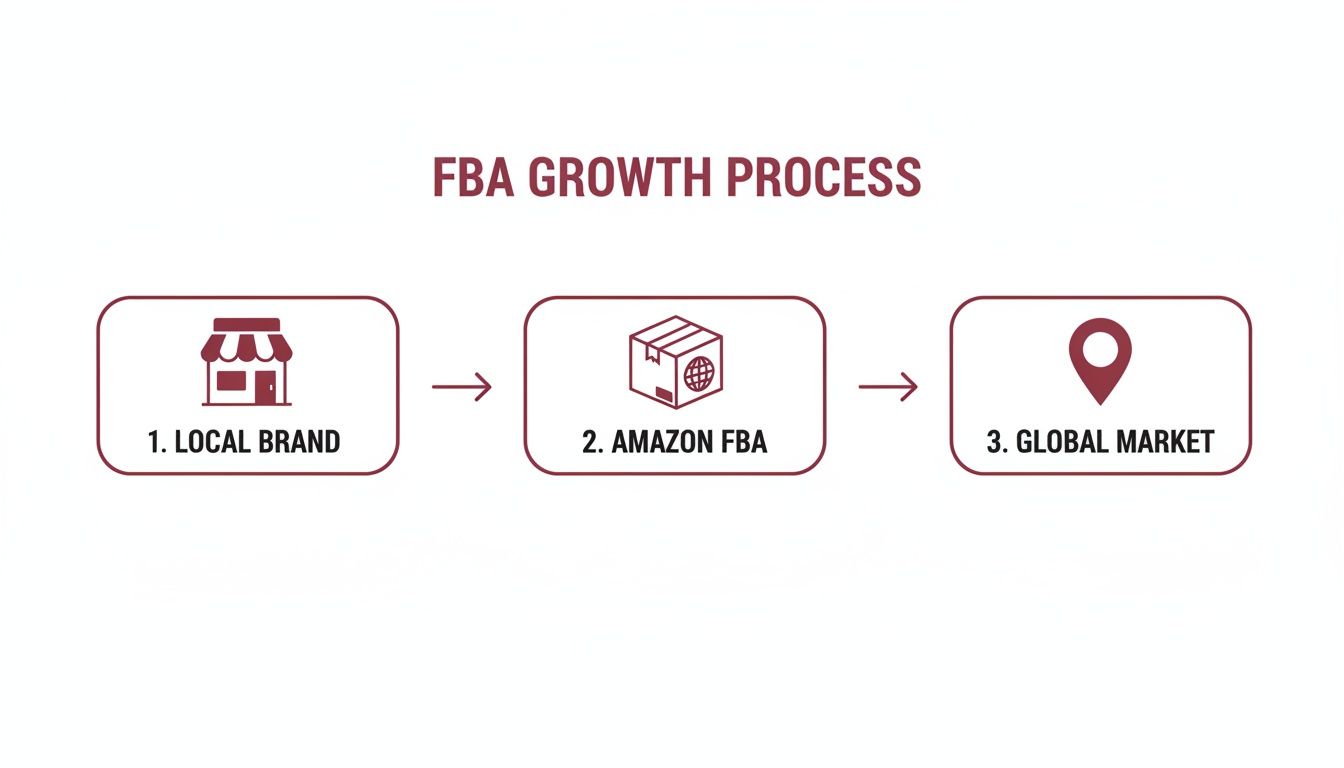
Amazon FBA provides the operational bridge, making global expansion a manageable process rather than a logistical nightmare.
FBA International Expansion Checklist: Key Operational Milestones
This checklist outlines the roadmap from initial planning to full operation in a new market like Canada.
| Phase | Key Action | Strategic Consideration |
|---|---|---|
| Phase 1: Compliance & Classification | Correctly identify HS Codes for all SKUs. | An incorrect HS code is a common and costly error leading to shipment delays or rejection. Accuracy is paramount. |
| Phase 2: Landed Cost Analysis | Calculate all duties, taxes (GST/HST), and fees. | Your true landed cost determines your final market pricing and profitability. Don’t underestimate it. |
| Phase 3: Partner Vetting | Select a freight forwarder and customs broker experienced with Amazon FBA. | Partners who know Amazon’s system will prevent common inbound receiving issues and save you time and money. |
| Phase 4: Packaging & Prep | Ensure all products and cartons meet Amazon’s inbound requirements. | This includes FNSKU labelling, poly-bagging, and ensuring country-specific rules like bilingual packaging are met. |
| Phase 5: First Shipment & Launch | Coordinate the first inbound shipment and monitor its progress through customs and into FBA. | Your launch timing depends on this. A smooth first shipment sets the tone for your ongoing operations. |
Systematically moving through these milestones separates brands that scale smoothly from those that get stuck.
Adhering to Amazon’s Inbound Requirements
Once goods clear customs, they must meet Amazon’s strict inbound requirements. The fulfillment network is a finely tuned machine; deviation from its standards can result in rejected inventory, creating a logistical and financial crisis.
Key areas include:
- Packaging and Prep: Products must be packaged to survive a long, automated journey. This may require bubble wrap, poly-bagging, or more durable shipping cartons.
- Labeling: Every unit and carton requires a specific Amazon barcode (FNSKU). For markets like Canada, local regulations such as bilingual labeling on the product packaging itself are non-negotiable.
These are not suggestions; they are rules. We cover the operational details in our broader guide to selling on Amazon effectively.
Choosing Logistics Partners Wisely
Trying to manage international logistics alone is a classic founder mistake. A network of reliable partners is essential. Your two most critical partners will be a freight forwarder (handling physical movement) and a customs broker (acting as your legal representative at the border).
When vetting these partners, ask one critical question: What is your experience with Amazon FBA shipments? A partner who deeply understands Amazon’s system—from its frustratingly specific delivery appointments to its carton labeling rules—is invaluable. They help you avoid the common pitfalls that derail so many brands trying to scale globally.
Protecting Brand Value During Amazon FBA Expansion
The single biggest fear for founders expanding onto a marketplace like Amazon is losing control. It’s a valid concern. Strong brands get dragged into damaging price wars, have listings hijacked, and watch their brand story get diluted.
This occurs when founders treat Amazon FBA as a volume play instead of a strategic distribution channel. Maintaining brand equity requires a proactive approach, using Amazon’s own systems to your advantage.
Using Amazon Brand Registry Strategically
For any serious brand on Amazon, enrolling in Brand Registry is non-negotiable. It is the single most powerful tool for protecting your intellectual property and maintaining control over your brand’s presence.
Once enrolled, you gain access to a suite of tools to take command:
- Secure Your Product Listings: You gain authority over page content, stopping rogue sellers from changing your images, bullet points, and descriptions.
- Police Counterfeits and Infringement: Brand Registry provides tools to find and report listings that infringe on your trademarks or sell fake products.
- Elevate Your Brand Story: You unlock A+ Content, replacing standard text descriptions with visually engaging modules to share your brand story, add comparison charts, and use high-quality lifestyle imagery.
For a founder, Brand Registry is more than a defensive tool; it’s a platform for telling a consistent brand story across global markets. It transforms a product page into a branded storefront.
This control ensures a customer in Canada sees the same professional representation of your brand as a customer in your home market.
Building a Profitable International Pricing Strategy
Pricing on Amazon is a delicate balance. A common mistake is simply converting a domestic retail price to the local currency, which ignores the unique cost structure of international FBA.
A sustainable pricing model must factor in every cost associated with the new market:
- FBA Fulfilment Fees
- Monthly Storage Fees
- International Shipping & Import Costs (freight, duties, taxes, brokerage)
- Local Taxes (e.g., GST/HST in Canada)
- Currency Fluctuations
Only after calculating your true “landed cost” can you set a retail price that protects your profitability and reflects your product’s value. The convenience of FBA should be positioned as a premium service, justifying a price point that maintains your brand’s integrity—not an excuse to join a race to the bottom.
Why Strategic Partnerships Improve Amazon FBA Growth
Even with a powerful system like Amazon FBA, many founders discover that going it alone internationally is a slow and expensive journey. FBA provides the logistical infrastructure, but it doesn’t provide market intelligence. This is the gap where countless great products fail to become great global brands.
Scaling into multiple FBA markets introduces layers of complexity—different consumer habits, unique competitors, and subtle cultural nuances. Managing these variables across several time zones can quickly overwhelm an in-house team.
The Hidden Costs of Solo Expansion
Attempting to navigate this complexity alone leads to predictable, costly mistakes. We’ve watched brands perfect their FBA process for Canada, only to be blindsided by German customs laws or UK VAT requirements. These aren’t just logistical hurdles; they are a significant drain on time, capital, and focus.
The risks of going it alone are real:
- Operational Drag: Teams spend more time troubleshooting customs paperwork than on marketing and growth.
- Wasted Marketing Spend: Without local knowledge, ad campaigns fail to resonate, yielding a low return on investment.
- Slower Speed to Market: Every logistical challenge solved for the first time is a delay that a seasoned partner would have anticipated.
This is why, even in an era of DTC technology, strategic distribution partnerships are more relevant than ever.
A partner with established expertise doesn’t just offer convenience; they provide strategic velocity, allowing your brand to enter and scale in new markets faster and with far less risk.
Partners as a Force Multiplier
A true strategic partner acts as an extension of your team, bringing deep, localized knowledge of the very systems you’re trying to navigate. They understand the nuances of distribution, compliance, and market adaptation because they’ve done it many times before.
For instance, expanding into a market like Australia is far more manageable with a partner who understands its unique FBA landscape. A good partner leverages Amazon’s growing infrastructure—now six fulfillment centers with plans for more—to give brands a seamless entry. The evidence is clear: Amazon’s growing share of Australian online sales is creating massive opportunities for partner-led growth.
This is the core value of a strategic partnership: leveraging someone else’s established network and hard-won experience to accelerate your own journey.
Accelerating Your Brand’s Global Journey
Ultimately, partnering is not an admission that you can’t do it yourself. It’s a strategic decision to do it smarter, faster, and more profitably. It’s about focusing your team on what they do best—building a great product and a compelling brand story—while relying on experts to handle the operational complexities of global expansion.
A partner who deeply understands the Amazon FBA ecosystem can help you sidestep the costly learning curve and turn the intimidating process of international scaling into a predictable growth engine. This approach is fundamental to building a lasting Amazon expansion strategy. This collaborative model is how promising products become resilient global brands.
Navigating Amazon FBA for global expansion brings up important questions. Here, we address the common concerns we hear from brand builders, focusing on the insights that drive real-world decisions.
What Is the Difference Between Using FBA and MCF?
This is a fundamental strategic question. Fulfilment by Amazon (FBA) is designed for selling products on an Amazon marketplace. Your products are stored in Amazon’s warehouses, making them eligible for Prime shipping—a major driver of sales.
Multi-Channel Fulfilment (MCF) is a separate service. It allows you to use Amazon’s fulfilment network to ship orders from other sales channels, like your DTC website.
For brand founders, the strategic choice is clear:
- Use FBA to test and scale within a new international Amazon marketplace.
- Use MCF to consolidate your global inventory and provide fast shipping for off-Amazon sales in that region.
How Do I Price My Product for International FBA?
Many brands make critical errors here. Simply converting your domestic price will almost certainly destroy your margins. A strategic pricing model must be built from the ground up, starting with your true landed cost per unit. This includes:
- Manufacturing cost
- International freight and insurance
- Customs duties, brokerage fees, and import taxes
- Amazon’s FBA fulfilment fees
- Monthly FBA storage fees
Only after calculating this number can you add your desired profit margin and a buffer for marketing and returns. This data-driven approach ensures your pricing is sustainable and reflects your brand’s value.
Can I Use My US FBA Inventory to Sell in Canada?
Yes, through a program called Remote Fulfilment with FBA. This lets you fulfil orders on Amazon.ca using inventory stored in US fulfilment centres. We see this as an excellent, low-risk tool for testing demand in the Canadian market.
However, it is not a long-term scaling solution. Longer delivery times and higher shipping costs for Canadian customers hurt conversion rates. The smart strategy is to use Remote Fulfilment to validate the market, then transition to stocking inventory directly in Canadian FBA centres to offer a superior customer experience.
Is Amazon Brand Registry Really Necessary?
For any founder serious about building a brand, the answer is an unequivocal yes. Operating on Amazon without Brand Registry is like trying to build a house on land you don’t own.
Brand Registry is your primary tool for control. It allows you to lock your product listings, preventing unauthorized sellers from changing your content. It gives you the power to report and remove counterfeit products efficiently. Beyond protection, it unlocks critical marketing tools like A+ Content and Brand Stores, which are essential for telling your brand story. Without it, you are just another product on a crowded shelf.
At TPR Brands, we work with founders navigating these challenges as they expand into international markets. Our focus is on partnering with established consumer product brands that have proven products, strong manufacturing capabilities, and the ambition to scale globally. We help these brands enter high-potential Amazon marketplaces like Australia, the United States, and Canada, building long-term category leadership. Our team handles the operational and marketplace strategy so founders can stay focused on what they do best: building their brand. Find out more at https://tprbrandsau.com.