For many founders of successful product brands, there comes a point where growth stalls. Your product has a proven track record, domestic sales are strong, but the momentum is starting to level off. This is the moment a proven product either scales into a global brand or risks stagnation.
Many great products struggle internationally, not because demand is weak, but because expansion strategy is flawed.
The Hidden Risk of a Saturated Home Market
For any ambitious founder, reaching the top of your domestic Amazon marketplace feels like a major win. You’ve earned consistent sales, great reviews, and solid brand recognition. But this success often hides a major strategic risk: relying solely on a single marketplace is a defensive game, not a growth strategy.
Any single market, no matter how strong, is finite. Once you’ve captured a significant share of local demand, every bit of new growth becomes harder and more expensive to win. Sooner or later, new competitors—both local and international—will crowd into your space, pushing up advertising costs and squeezing your margins.
When Domestic Success Becomes a Liability
This is where many great product brands get stuck. They’ve done everything right—optimised their listings, perfected their ad campaigns, and built a loyal following—but the growth curve flattens out. The very platform that fuelled their initial rise now becomes a ceiling.
The real danger for established Amazon sellers isn’t a sudden crash in sales. It’s the slow, quiet erosion of growth potential as the domestic market simply runs out of room. Building real, long-term brand value means breaking free from this single-market dependency.
Hitting this plateau isn’t a sign of failure; it’s a signal that your brand is ready for its next strategic chapter. The question must shift from, “How do we sell more in our home market?” to “How do we use our domestic success to launch into larger, more profitable global markets?”
The Marketplace Dominance and Growth Ceiling Paradox
Amazon’s growing dominance highlights both the opportunity and the risk. While the platform gives brands incredible reach, it also concentrates all competition in one place. By 2026, Amazon Australia reached an impressive 60% of Australian shoppers, a huge jump from previous years. With 93% of Australian consumers buying from marketplaces, it’s clear that while you need to be on Amazon, it’s also a crowded battlefield.
This creates a paradox for successful Amazon sellers:
- High Visibility: Your brand is right in front of a massive, ready-to-buy audience.
- Intense Competition: You’re fighting for attention against every other brand targeting that same audience.
- Limited Scale: Your total addressable market is ultimately capped by the population of a single country.
Relying entirely on this one ecosystem makes a brand vulnerable. A simple algorithm change, a spike in competitor ad spend, or a new international player entering the market can threaten your position overnight. Moving into markets like the US, Canada, or the UK isn’t about abandoning your home base. It’s about taking the momentum you’ve built and strategically reinvesting it into channels with far greater scale. This is how a proven product becomes an enduring global brand.
How Smart Brands Choose Their First International Market
Too many international expansion plans fail because brands rush into new markets without a clear strategic framework. For ambitious Amazon sellers, the temptation is to immediately target the largest prize—usually the USA—but this is often a fatal miscalculation.
A smarter approach, one focused on product fit, competitive pressure, and logistical reality, will always outperform a blind rush for scale.
Moving beyond your home market requires a different way of thinking. It’s not about finding the biggest audience; it’s about finding the right audience where your brand can build a strong, defensible position. True global growth isn’t a land grab. It’s a series of calculated, controlled market entries.
The decision tree below outlines the first strategic choice many Amazon sellers face: whether to keep optimising at home or begin expanding overseas.
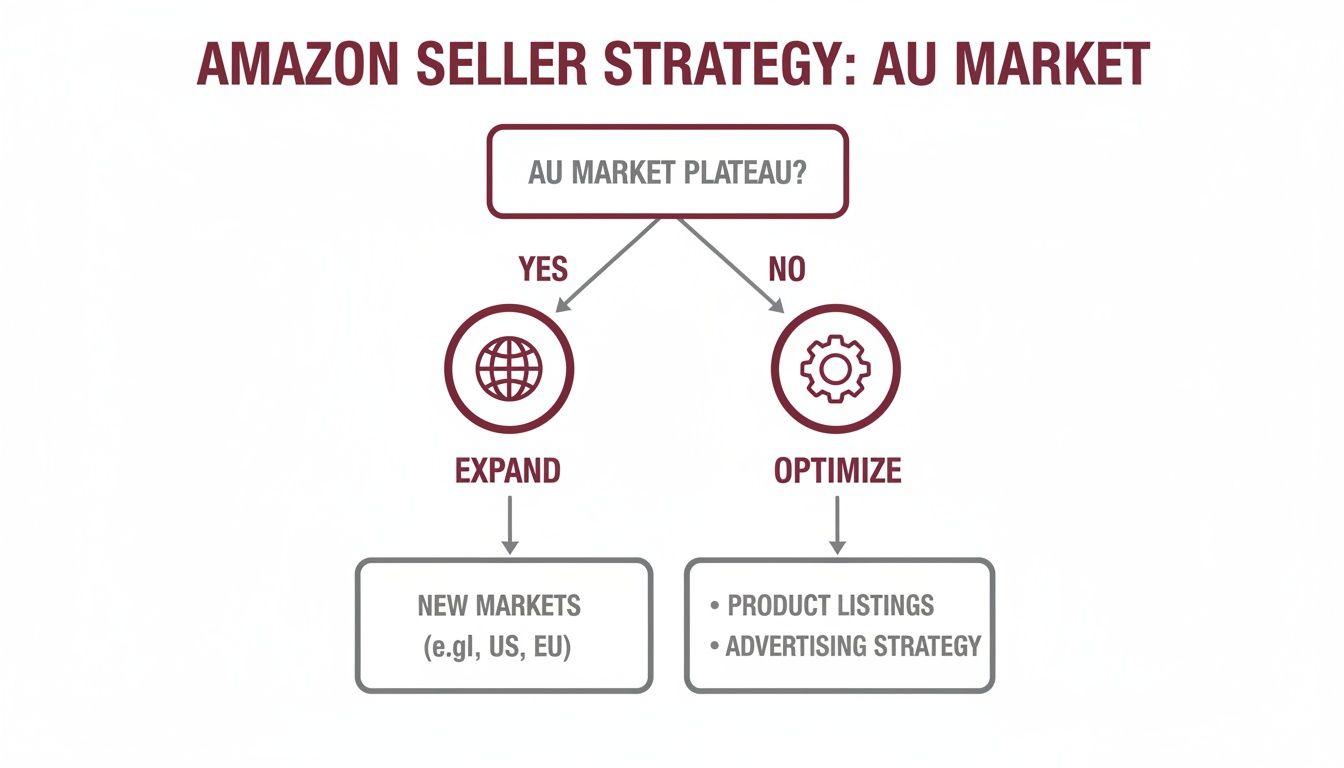
This visual highlights a critical decision point. Once domestic sales have plateaued, the logical next step for brand growth is controlled expansion, not just endless optimisation.
Looking Beyond Raw Market Size
The sheer scale of the Amazon US marketplace is intoxicating. With independent sellers averaging over $290,000 in annual sales, it’s a powerful magnet for growth. But it’s also the most competitive and expensive retail battleground on earth. Many brands burn through their entire launch budget there with very little to show for it.
For a brand founder, the best first market is rarely the largest. It’s the one where you have the highest probability of winning, establishing a strong foothold, and generating the cash flow needed to fund your next move.
Smart founders evaluate potential markets using a more nuanced set of criteria:
- Product-Market Fit: Is there an existing, organic demand for what you sell, or will you have to spend a fortune creating it? Look at local search volumes, competitor sales data, and cultural nuances.
- Competitive Density: How crowded is your niche? A less-saturated market like Canada, or even specific categories in the UK, can offer a much clearer path to becoming a top seller and building momentum.
- Logistical Feasibility: What are the real, all-in costs of landing your product in-country? You need to model everything—shipping, customs duties, and FBA fees. Markets with simpler import rules, like the US from Australia, present a lower operational hurdle.
A Strategic Comparison of Top Expansion Markets
Let’s break down the most common expansion targets for established brands.
The US offers unmatched scale but demands a significant investment in both marketing and inventory just to make a dent. For a deeper look at this specific move, our guide on how to sell on Amazon USA from Australia provides a detailed breakdown of the process.
Canada, on the other hand, is a fantastic starting point. It’s a culturally similar market with far less competition. It can serve as the perfect testing ground for a North American strategy, allowing you to refine your messaging and operations on a smaller, more manageable scale before you decide to tackle the US.
The UK acts as an excellent gateway to Europe. While smaller than the US, its marketplace is mature and its shoppers are digitally savvy. Establishing a presence here can be a strategic beachhead for future expansion into Germany, France, and beyond.
To help you think through this, the table below compares these markets based on what truly matters to a founder, not just raw sales volume.
International Market Comparison for Established Brands
| Market | Market Size & Scale | Competitive Landscape | Consumer Profile & Nuances | Strategic Advantage |
|---|---|---|---|---|
| USA | Unmatched. The largest and most mature Amazon marketplace globally. | Extremely high. Intense competition across almost every category. | Diverse, high-spending consumer base but requires significant marketing spend to capture attention. | The ultimate prize for scaled brands, offering massive revenue potential once established. |
| Canada | Smaller, but growing steadily. Around 1/10th the size of the US market. | Moderate. Significantly less crowded than the US, offering a clearer path to ranking. | Culturally similar to Australia and the US, making messaging and branding easier to adapt. | A perfect “test market” for a North American strategy and a lower-risk first step. |
| UK | A large, mature, and sophisticated ecommerce market. | High, but with pockets of opportunity. Less intense than the US. | Digitally savvy shoppers with high expectations for quality and service. | The ideal beachhead for a broader European expansion strategy. |
| Australia | Growing rapidly but still smaller than the US/UK. | Moderate to high, and increasing as more international sellers enter. | A familiar consumer base that is rapidly adopting online shopping habits. | The perfect place to refine your Amazon model and prepare for international launch. |
| Japan | The 3rd largest ecommerce market globally, with a strong Amazon presence. | High, with unique cultural and language barriers. | Highly discerning consumers who value quality, detail, and brand reputation. | A high-reward market for brands that can properly localise their product and messaging. |
Ultimately, your choice should be a deliberate one based on data, not just ambition. Analyse the competitive landscape, model your landed costs and potential margins, and pick the market that offers the best balance of opportunity and risk for your brand. This structured approach is what separates brands that scale sustainably from those that fail after their first international attempt.
Fortifying Your Brand for Global Expansion
Having a great product does not automatically translate into a great global brand. Countless ambitious brands stumble when they expand internationally, and it's rarely because of a lack of demand. The real point of failure is a lack of preparation.
Many founders treat international expansion as a simple copy-paste of their domestic business. They quickly run into unforeseen compliance issues, cultural missteps, or gaps in brand protection that bring their momentum to a halt.
Real brand control starts long before you make your first international sale. It’s the unglamorous but critical groundwork that prevents costly mistakes, seized shipments, and long-term damage to your brand’s reputation. This is where you shift from being a reactive seller to a strategic global operator.
Auditing Your Brand for a Global Audience
Before you even think about logistics, you need to take a hard look at your brand assets. What works in your home market might fall completely flat—or worse, cause offence—in the United States or Japan.
This audit goes much deeper than just translating your product listings. You need to really dig into:
- Brand Name and Slogan: Does your name or tagline have an unintended, negative meaning in another language? A quick search can help you dodge a potential disaster.
- Visual Identity: Do your brand colours, logo, and imagery resonate with your target market? Colour symbolism, for example, varies dramatically between Western and Eastern cultures.
- Positioning and Messaging: Does your core value proposition still make sense to a new audience? A product sold on its convenience in one market might need to be repositioned around its durability in another.
This process is about stress-testing your brand’s ability to communicate clearly and effectively, ensuring your message lands exactly as you intend it to.
Proactive Brand and Product Protection
Once you've validated your brand's messaging, the next move is to protect it legally and technically. Many founders learn this the hard way after counterfeiters or copycats hijack their brand in a new marketplace.
Launching in a new market without securing your intellectual property is like building a house on land you don't own. It's only a matter of time before someone else claims it, and by then, it's too late.
Your brand protection checklist must include:
- International Trademarks: Secure your brand name and logo in every target market before you launch. Systems like the Madrid Protocol can help, but the key is to act early.
- Domain and Social Handles: Even if you plan to sell only on Amazon, secure the matching domains (.com, .co.uk, .ca) and social media usernames. This stops others from cybersquatting and controlling your brand's story online.
- Product Compliance Deep-Dive: This is absolutely non-negotiable. Every market has its own set of rules for product safety, labelling, and electronics. Your product may need CE marking for Europe, UKCA for Great Britain, or FCC certification for the US.
Ignoring these compliance rules is a fast track to having your shipments seized by customs, your listings suspended, and your capital tied up indefinitely. It’s a risk no serious brand can afford. This foundational work ensures that when you do enter a new market, you do so from a position of strength. You can find more insights on the Australian ecommerce landscape and its projections on Statista.
Building Your International Operations Model
Scaling your brand internationally is less about ambition and more about getting the operational structure right. A proven product gives you the right to compete on the world stage, but a solid operational model is what actually lets you win.
Many ambitious Amazon sellers falter at this stage. It’s rarely a lack of sales that trips them up; it’s because their operational backbone cracks under the weight of global complexity.
The first big decision you’ll face is which path to take. Do you build an international operation from the ground up, or do you work with a strategic expansion partner? Going it alone offers total control but comes with a massive learning curve in areas you likely have zero experience in, like international tax law and entity formation. A partnership, on the other hand, allows you to plug into an existing framework, giving you instant access to established logistics networks and on-the-ground expertise.
Navigating the Financial and Legal Framework
Before a single product crosses a border, you have to build the financial and legal infrastructure to support it. This part is non-negotiable and, frankly, it’s where many DIY expansion plans completely collapse. The complexity here is significant, and mistakes are costly.
Here are the key structural pieces you need to get right:
- International Business Entities: Will you need to set up a new company in your target market, like a US LLC or a UK Ltd company? This has major implications for liability, taxes, and your operational freedom.
- VAT/GST Registration: Value-Added Tax (VAT) in the UK and Europe or Goods and Services Tax (GST) in Canada are not optional. You must be registered before you start selling. Failing to do this can lead to suspended listings and severe financial penalties.
- Multi-Currency Banking: You'll be earning revenue in currencies like USD or GBP and likely paying suppliers in another. You need a system to manage foreign exchange without letting conversion fees eat away your profits. Services like Wise or WorldFirst are essential tools.
Many founders badly underestimate the administrative drag of international operations. It's not just about setting things up once; it's the ongoing management of compliance, filings, and reporting across multiple countries. This is often the single biggest reason to work with an expansion partner who already has these systems dialled in.
This behind-the-scenes work is what makes clean, profitable growth possible. Skimping on it introduces risks that can cripple your business before it ever gains real momentum.
Choosing Your Distribution and Fulfilment Model
Once your corporate structure is sound, your next decision is how you'll physically get products into your customers' hands. For Amazon sellers, this choice usually comes down to two very different paths.
Amazon Global Selling (AGS) is the path of least resistance. It lets you ship inventory from your home country directly to FBA warehouses in another market. It's fast to set up and can feel like a simple extension of your domestic business. The trade-off? You pay a premium in shipping costs, face longer lead times, and have less control over your stock once it’s in Amazon’s network.
In-Country FBA Operations is the more strategic, controlled approach. This involves importing your goods in bulk into the target country, clearing customs, and then sending them to local FBA warehouses from there. This model delivers several key advantages:
- Lower Per-Unit Costs: Shipping in bulk freight is far cheaper than sending international parcels.
- Faster Restocking: You can replenish FBA inventory from a local 3PL warehouse in days, not weeks.
- Greater Brand Control: It gives you a physical foothold in the market, allowing for better quality control and more strategic inventory management.
While setting up in-country operations is more complex, it's the model that supports sustainable, long-term scale. It shows you're serious about the market and is the path chosen by brands building a durable global presence. To understand more about this approach, you might be interested in our guide on finding the right Amazon expansion partner. Your choice of operational model will directly influence your profitability, your ability to scale, and the level of control you keep over your brand’s future.
Structuring Your International Launch for Long-Term Success
A successful international launch isn't about creating a sudden, unsustainable sales spike. For serious brand builders, it's about establishing a strong, defensible market position from day one. This requires a deliberate, multi-layered playbook, not just flipping a switch and hoping for the best.
This is where you move far beyond simple translation and embrace true listing localisation. It’s the art of culturally adapting every single element of your product page—from the copy and keywords to your main images and A+ Content—to match local consumer psychology and expectations.
Beyond Translation: The Art of True Localisation
A critical mistake many brands make is simply translating their domestic copy into American English or Japanese. That’s not localisation; it’s a recipe for failure. True localisation requires a much deeper understanding of the market. What pain points do US consumers prioritize? What features do Canadian shoppers value most?
Your approach needs to be more forensic:
- Dig for Local Keywords: You have to research local search terms, including slang and regional variations. A keyword that drives traffic in the UK might be completely irrelevant in Canada.
- Adapt Your Imagery: Your product photos and lifestyle shots need to feel familiar to the target market. This might mean using local models, environments, and use-cases that resonate culturally.
- Refine Your Copy's Nuances: Adjust your tone, phrasing, and how you frame benefits. For instance, a US audience might respond to more direct, bold claims, while a UK audience often prefers a more understated message.
This meticulous adaptation makes your product feel like a local offering, not a foreign import. It builds immediate trust and has a dramatic impact on your conversion rates.
Building a Pricing Model That's Actually Profitable
Your pricing strategy is another area that demands serious attention. The most common error is simply applying a currency conversion to a domestic price. This almost guarantees you’ll lose money.
A robust international pricing model has to account for the full, landed cost of getting your product into the customer's hands.
Many brands fail internationally because they never achieve profitability. They focus on top-line revenue without forensically modelling every single cost between their factory and the customer's doorstep. Profitable scaling requires a pricing strategy built on reality, not optimism.
Your financial model needs to precisely calculate:
- International freight and shipping costs.
- Import duties, tariffs, and customs brokerage fees.
- Local marketplace referral and FBA fees.
- VAT/GST and other mandatory taxes.
- The marketing and advertising spend required to gain initial traction.
Only after you’ve factored in every one of these variables can you set a retail price that protects your margins and fuels sustainable growth. This isn't just about covering costs; it’s about building a profitable foundation from which to scale.
The Layered Launch: Building Sustainable Momentum
Finally, your launch strategy itself should be a controlled campaign designed to build velocity and social proof over time. Forget about trying to hit the number one bestseller spot on day one. The real goal is to create steady, organic growth that the Amazon algorithm rewards.
The explosive category sales on Amazon Australia, especially in electronics and appliances, are projected to reach billions of Australian dollars by 2026, highlighting the immense potential for home improvement and household product sellers. As these projected sales figures on Statista show, this is a clear signal of market opportunity. Amazon’s seamless customer journey can turn a strong product into a scalable brand across multiple regions.
A strong, layered launch combines several key elements:
- Enrol in the Vine Program: Start by using Amazon's own system to generate those critical first reviews from trusted reviewers.
- Run Strategic PPC Campaigns: Begin with targeted, low-funnel keyword campaigns to drive initial sales from high-intent shoppers who are ready to buy.
- Drive External Traffic: Use existing email lists, social media channels, or partnerships with local influencers to send qualified external traffic to your new listing.
- Launch with Promotions and Coupons: Use introductory offers to lower the barrier to purchase for early customers and accelerate that all-important initial sales velocity.
This deliberate approach creates a powerful flywheel effect. The initial sales and reviews improve your organic ranking, which drives more traffic, leading to more sales. It's a controlled burn that builds long-term brand health—the only way for serious Amazon sellers to win in a competitive new market.
Founder FAQs for Global Amazon Expansion
For founders of established product brands, the idea of international expansion brings up tough, strategic questions. The path forward is often unclear, clouded by conflicting advice and operational complexity. This section provides direct answers to the most common questions we hear from ambitious brand owners as they weigh their global options.
When Is the Right Time to Expand My Amazon Business Internationally?
The right time isn’t tied to a specific revenue number; it’s about market saturation and operational readiness. The ideal moment is when your domestic growth starts to plateau despite continuous optimisation, and your business has consistent profitability and a stable, predictable supply chain.
Your brand should already have strong reviews and clear product-market fit in your home market. The mistake many brands make is waiting for a sales decline. Expansion should be a proactive move made from a position of strength, allowing your core business to fund the move without being compromised.
If your domestic operations are chaotic, adding new markets will only amplify existing problems.
What Is the Biggest Mistake Brands Make Selling on Amazon Internationally?
The single biggest mistake is assuming a 'one-size-fits-all' strategy will work. This error often shows up as simply translating listings without any cultural adaptation, using the same pricing model everywhere, and completely ignoring market-specific compliance and consumer behaviour.
A product that’s a bestseller in Australia can easily fail in Japan or Germany. This is rarely due to the product itself. The failure comes from a marketing message or value proposition that doesn't resonate with the local audience.
Smart brands treat each country as a distinct and separate launch. They conduct deep research into local consumer psychology, competitor positioning, and search behaviour before investing a single dollar in inventory.
Should I Use Amazon Global Selling or Find a Local Partner?
This decision comes down to a trade-off between brand control and speed. Amazon Global Selling (AGS) is undeniably the path of least resistance. It's faster to set up and handles much of the logistical complexity, which is attractive for many Amazon sellers.
However, that convenience comes at a cost: you sacrifice significant control over branding, pricing, and strategic positioning.
For serious brands aiming to build a defensible, long-term global asset, working with a strategic expansion partner is the more deliberate approach. A partner provides on-the-ground expertise, ensuring your brand is positioned correctly from day one and that all compliance is handled meticulously. While this path takes more initial planning, it is designed to protect and enhance your brand's value over the long run.
How Do I Protect My Brand From Counterfeiters in New Markets?
Brand protection in new marketplaces must be proactive, not reactive. The first and most critical step is to secure your trademarks in every single target market before you launch. This is non-negotiable.
Once your trademarks are registered, immediately enrol in Amazon's Brand Registry. This gives you access to a suite of powerful reporting and brand protection tools that are essential for defending your listings.
Finally, maintain tight control over your supply chain and distribution network. Unauthorised "grey market" sellers often emerge from leaks or weaknesses in your own distribution system. For many brands, managing this constant vigilance is a key function of a dedicated expansion partner who understands the nuances of each marketplace's policies and can act swiftly to protect your brand integrity. It's a foundational element of controlled global growth.
At TPR Brands, we work with founders navigating these challenges as they expand into international markets. If you’re ready to scale your proven product into a global brand, start a brand expansion conversation with us.