Most founders don’t fail in global expansion because their product is weak.
They fail because their Amazon logistics strategy is not built for scale.
Amazon makes international selling look simple—send inventory in, and it moves globally. But underneath that simplicity is a system that can either accelerate growth or quietly limit it.
The difference between brands that scale and brands that stall is not demand.
It is logistics design.
Why Amazon Logistics Shapes Global Expansion Outcomes

For ambitious founders, treating Fulfilment by Amazon (FBA) as a commodity is a common but critical misstep. The pitch is seductively simple: send Amazon your products, and they handle the rest. This transactional view, however, completely misses the strategic implications for your brand. And that’s exactly where most brands get caught.
The true power of Amazon’s logistics network lies not in its ability to ship a single package, but in its capacity to drive rapid market penetration, shape customer trust, and fundamentally influence your brand’s global position. It’s an operational ecosystem designed for scale, and failing to understand its dynamics is a significant risk.
Amazon Logistics as Strategic Infrastructure
Thinking of FBA as just “shipping” leads to a predictable plateau in your brand’s growth. Founders who adopt this mindset often find their early success stalls. They don’t realise it until growth slows… and margins start tightening. They become reactive, constantly battling stock-outs, rising fees, and inventory complexities instead of driving their brand forward.
In contrast, insightful founders see Amazon’s infrastructure for what it is: a pre-built, multi-billion-dollar global distribution network. They don’t just use it; they integrate it into their core business strategy.
This mindset shift reframes the entire conversation:
- Market Entry: It’s not about sending products to a new country. It’s about using Amazon’s established warehouses and delivery networks to test, validate, and scale in markets like Australia or Europe with minimal upfront capital.
- Customer Trust: Fast, reliable delivery is a core component of brand perception. Amazon has conditioned customers to expect it. Failing to meet this standard damages your brand’s credibility, even if you don’t sell on the platform.
- Capital Efficiency: Strategic use of the network allows for intelligent inventory placement across regions, reducing stock-outs and optimizing cash flow tied up in inventory.
The question a founder should ask is not, “How much does FBA cost?” The real question is, “How can I deploy Amazon’s logistical power to outmaneuver competitors and accelerate my international roadmap without sacrificing brand equity?”
The Real Cost of Getting It Wrong in Global Markets
Consider the common trajectory of many DTC brands. They build strong initial traction on their own website, then turn to Amazon as a seemingly easy next step. They view it as just another sales channel with a built-in fulfilment solution.
Soon, they find themselves trapped. Their margins are eroded by opaque and ever-changing fees, their inventory is commingled with lower-quality products, and they have no direct relationship with their customers. They get stuck reacting to Amazon’s rules rather than dictating their own growth. Sales are coming in… but control is slipping.
This happens because they failed to realize that mastering Amazon logistics is a strategic discipline. It requires a deep understanding of marketplace economics, its trade-offs, and how to use the system to build brand equity—not just move units. Great products do not automatically become great brands; marketplace success requires strategic positioning.
Inside the Amazon’s Logistics Machine
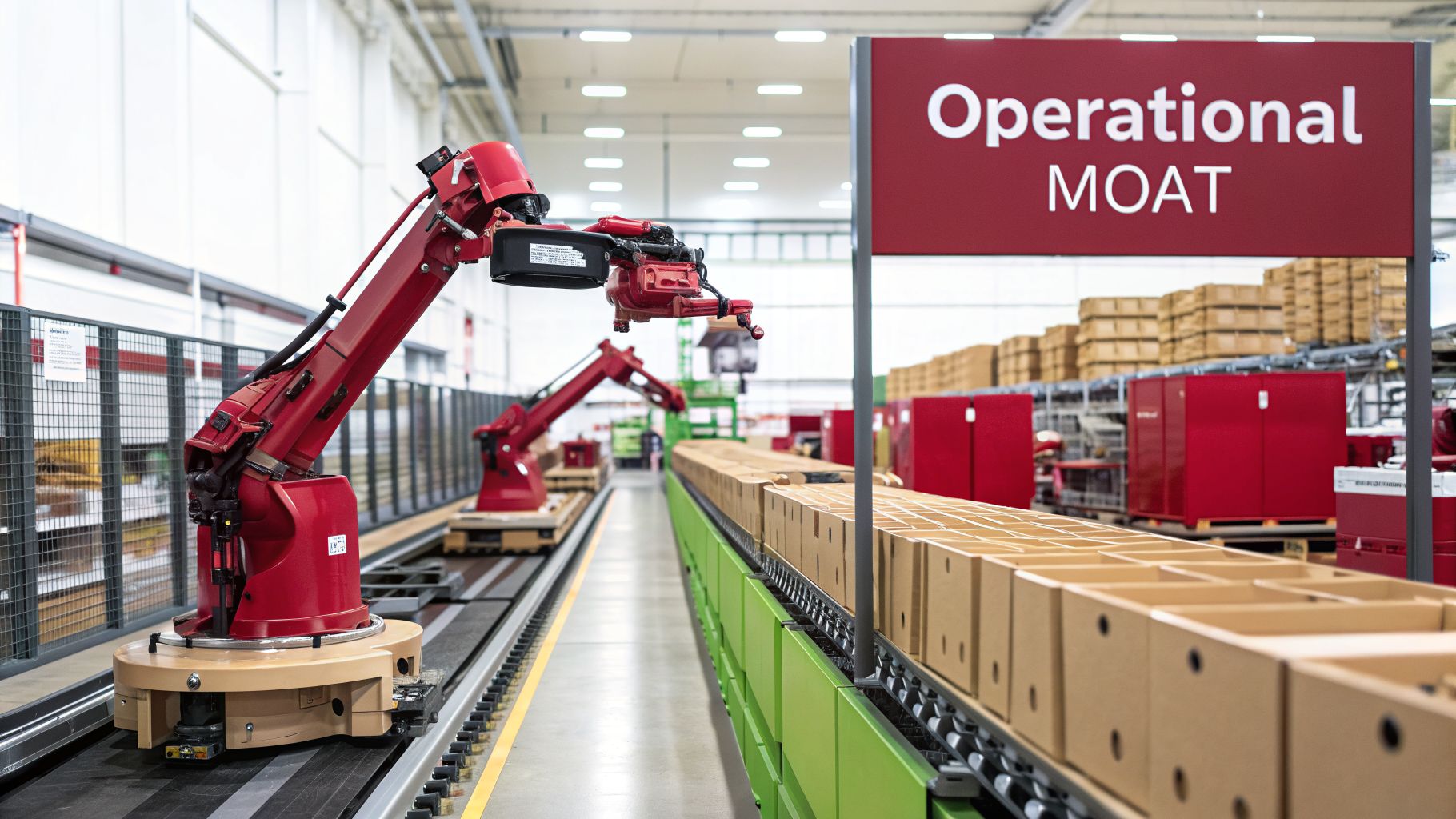
To truly grasp Amazon logistics, you must look past the delivery vans and see the machine behind them. It’s an operations network built not just for size, but as a strategic moat designed to create an almost unbeatable competitive advantage. For any founder planning global expansion, understanding how this machine works is non-negotiable.
This isn’t about big warehouses. It’s about what those physical assets represent: market power, control over the customer experience, and a barrier to entry that rises with every dollar Amazon invests.
Analysing the Operational Moat
Amazon’s strategy is to invest so heavily in infrastructure that independent brands cannot replicate it. This goes far beyond basic warehousing; it’s a complex web of robotics, data analytics, and proprietary software working in concert to predict demand, position stock, and shrink delivery times.
Consider a market like Australia. As e-commerce demand has exploded, so has the logistical challenge. To dominate this space, Amazon recently committed AU$750 million to a new robotics fulfilment centre in Brisbane. Spanning 150,000 square metres, it’s designed to handle over 125 million packages a year.
An investment of this scale reveals the long-term game. Amazon is building the infrastructure that will control the market for years to come. For your brand, competing with that level of operational efficiency on your own isn’t just expensive; it’s a strategic dead end.
The dollar figure of these investments is less important than what it signifies: the cost of competing on logistics is rising exponentially. This forces founders to make a strategic choice: build your own slow, expensive system or plug into an existing one intelligently.
How Infrastructure Translates to Market Power
This massive infrastructure directly fuels the dynamics of modern e-commerce. As a brand founder looking to scale, you must understand how these components connect to create market dominance.
-
Delivery Speed as a Weapon: Amazon turned delivery speed into its primary competitive weapon, making it a key driver of customer preference. Its network density enables same-day or next-day delivery in major cities—a standard independent brands can rarely match profitably.
-
Customer Trust as a Default: The reliability of Amazon’s delivery network builds immense customer trust. When a customer sees the Prime badge, they don’t just see “free shipping.” They see a promise of “fast, reliable, and guaranteed.” That trust extends to the products sold within that ecosystem.
-
Predictive Inventory Placement: The network doesn’t just move boxes; it anticipates purchases. By analyzing vast datasets, Amazon forecasts regional demand and prompts sellers to position inventory closer to customers, cutting both shipping times and costs.
This integrated system is what makes Amazon logistics more than a service—it’s a strategic environment. For a brand entering a new market, tapping into this pre-built network offers an immediate competitive edge in delivery experience. A deeper dive into making this work requires a strategic approach to fulfilment. The key for founders is not to compete with this machine head-on, but to determine how to align with its power to accelerate your own brand’s growth.
The Strategic Trade-Offs of Amazon Fulfilment
Sooner or later, every founder confronts the same dilemma with Amazon logistics. It’s a classic tug-of-war. On one side, you have the immense fulfilment power of Amazon. On the other, the very real risks of losing brand control and margin erosion.
Framing this as a simple ‘yes’ or ‘no’ decision is a strategic error. The founder’s job is to analyze the trade-offs and build a strategy that uses the system without letting it use you.
The upside is undeniably attractive. That’s why so many brands walk straight into it. Plugging into Fulfilment by Amazon (FBA) instantly grants your product the Prime badge. This isn’t a minor icon; it’s a powerful signal of trust and speed for millions of buyers, associating your brand with a delivery standard that is nearly impossible to build independently. FBA offloads the immense operational weight of warehousing, carrier negotiation, and returns processing, freeing you to focus on product and brand strategy.
Weighing the Benefits Against the Hidden Costs
But this convenience comes at a price, and many costs are not immediately apparent. The most obvious impact is on your margins. Amazon’s fee structure is complex and dynamic. Fulfilment fees, storage fees, and long-term storage penalties can erode profitability, especially with imperfect inventory management.
Then there’s the loss of brand identity. With FBA, your carefully designed product arrives in a generic brown Amazon box. The unique unboxing experience—a critical touchpoint for DTC brands—is erased. You become just another box from Amazon, not a distinct brand delivering a memorable moment.
The most dangerous trade-off, however, is losing your direct relationship with the customer. Amazon owns that relationship. You are denied the email address and purchase history data vital for building a long-term, resilient brand off the marketplace.
Finally, you have the risk of commingled inventory. To maximize warehouse efficiency, Amazon may store your products alongside identical items from other sellers, including counterfeiters. If a customer receives a low-quality fake, it’s your brand reputation that suffers, not Amazon’s. Navigating the Amazon FBA environment requires a sophisticated strategy to mitigate these risks.
Strategic Analysis: FBA vs. Independent Fulfilment
To make the right decision, you must think like a brand strategist, not a logistics manager. The best path depends entirely on your long-term vision. This table breaks down the key factors.
| Strategic Factor | Amazon Fulfilment (FBA) | Independent Fulfilment |
|---|---|---|
| Market Access | Instant access to Prime customers and rapid international market entry. | Slower, more capital-intensive rollout into new markets. |
| Brand Control | Limited. Products ship in Amazon packaging, sacrificing the unboxing experience. | Full control over packaging, branding, and customer touchpoints. |
| Customer Data | Minimal. Amazon owns the direct customer relationship and data. | Complete ownership of customer data for retargeting and relationship building. |
| Operational Cost | Seemingly lower upfront costs, but variable fees can erode margins over time. | Higher initial setup and fixed costs, but greater control over long-term expenses. |
| Reputation Risk | High risk from commingled inventory and negative reviews tied to fulfilment issues. | Direct control over quality assurance and the entire customer experience. |
| Channel Dependence | Creates heavy reliance on a single channel, making your brand vulnerable to policy changes. | Fosters channel diversification and builds a more resilient business model. |
The decision to use Amazon logistics isn’t just operational; it’s one of the most important strategic choices a founder can make. Smart brands treat FBA as a powerful tool for specific objectives—like testing a new market—while building independent channels to protect brand equity and control their long-term destiny.
Navigating Global Expansion with Strategic Partners
All analysis points to one reality: succeeding with Amazon logistics on a global scale is not about using a service. It’s about navigating a complex strategic landscape. For founders with international ambitions, the challenge isn’t just listing a product in a new country; it’s getting it there efficiently, legally, and profitably.
This is where the conversation must shift from marketplace tactics to international strategy. The complexities of global logistics are immense and often dangerously underestimated—right up until a container is stuck at port or a shipment is rejected by customs.
The True Cost of Going It Alone
Attempting to build an international logistics operation from scratch is a massive undertaking that drains capital and stalls growth for otherwise promising brands. The hurdles extend far beyond finding a shipping carrier. This is where most founders lose time, money, and momentum.
Founders often run headfirst into a wall of complexity:
- Customs and Compliance: Each country has a unique maze of importation rules, product classification (HS codes), and documentation requirements. A single error can lead to costly delays, fines, or seizure of goods.
- Biosecurity and Port Delays: Markets like Australia have strict biosecurity protocols. Unforeseen inspections and port congestion can leave inventory sitting on a dock for weeks, destroying sales forecasts and creating stock-outs.
- Last-Mile Economics: Rising fuel costs, driver shortages, and high customer expectations for fast delivery create a perfect storm for last-mile expenses. Without expert management, these costs can destroy margins.
These are not minor operational headaches; they are strategic barriers to entry. For many brands, trying to solve them independently is a recipe for failure, turning the founder into a logistics manager and distracting them from building the product and brand.
The Power of Strategic Partnership
This is precisely why smart brands don’t try to become global logistics experts. Instead, they find partners who already possess the deep, on-the-ground knowledge needed to navigate these challenges. Many brands grow faster through strategic partnerships.
A true strategic partner is not just a freight forwarder. They act as an extension of your team, providing access to established infrastructure and local expertise that would take years and millions of dollars to build.
While this process looks straightforward, the journey from factory to FBA warehouse is filled with pitfalls that a strong partner helps you avoid entirely.
Competitive pressures are only increasing. Amazon Australia’s expansion, for instance, includes major investments in Victoria’s logistics ecosystem. These local insights on Victoria’s supply chain highlight the immense operational scale needed to compete—a scale a partner provides from day one.
Partnership isn’t a sign of weakness; it’s a strategic decision to accelerate growth. It’s about moving faster and smarter by leveraging someone else’s hard-won expertise and established networks.
Choosing the right partner is critical. It’s about finding a team that understands your brand, shares your vision for controlled growth, and has a proven track record of managing the complexities that stop other brands. Our Amazon expansion partner guide offers a playbook for evaluating and selecting the right firm for your global journey. For founders ready to scale, choosing partnership is often the most intelligent choice.
Building a Resilient Brand Beyond the Marketplace

Every founder learns this lesson eventually: Amazon logistics is a powerful tool, but it is not your brand. Early success on the marketplace is intoxicating, but betting your entire company on a single platform is one of the biggest strategic mistakes a founder can make.
Real, long-term brand value is built off-Amazon. It comes from owning your customer relationships, controlling your brand narrative, and building distribution channels that you control.
Think of Amazon as a launchpad for international expansion, not the final destination. The strategic lesson is to build a brand so strong that its value is tied to its reputation, not the whims of a marketplace algorithm.
Using Amazon as a Strategic Launchpad
Smart founders use the marketplace for what it does best. It’s an incredibly effective tool for testing product-market fit in a new country, generating initial sales, and gathering real-world feedback—all without the massive capital outlay of a traditional retail launch.
But once you’ve proven the market, the game must change. You must use that initial momentum to build your own assets. This is the time to invest in your direct-to-consumer (DTC) website, build an email list, and define your brand’s voice on your own terms. Amazon can deliver initial reach; your own channels build genuine loyalty and deliver higher margins.
The measure of success isn’t your Amazon sales rank. It’s how effectively you convert a marketplace transaction into a direct, lasting relationship with a customer who is loyal to your brand, not just Amazon’s fast shipping.
This is the precise point where many brands stall. They become addicted to the volume and never do the slower, harder work of brand building, leaving them completely exposed when marketplace dynamics inevitably shift.
Navigating the Complexities of Diversification
Expanding beyond a single marketplace introduces new challenges, especially in international markets. The recent e-commerce boom highlights the growing demands in e-commerce logistics. These are real-world roadblocks that can halt an international launch. A multi-channel strategy must go hand-in-hand with a robust logistics and compliance plan.
To build a brand that can weather these storms, focus on these pillars:
- Own Your Customer Data: Prioritize capturing customer information through your DTC site. This data is the most valuable asset you have for future growth.
- Control the Brand Experience: From custom packaging to follow-up emails, every touchpoint must reinforce your brand—something you relinquish within the Amazon ecosystem.
- Diversify Your Revenue Streams: Explore other marketplaces, wholesale deals, and direct retail opportunities. A resilient brand never relies on a single source of income.
Building a brand that is bigger than Amazon requires a fundamental shift in thinking. It forces founders to see Amazon logistics not as their entire operation, but as just one tool in a much larger global expansion toolkit.
At TPR Brands, we work with founders navigating these exact challenges. We help turn marketplace success into lasting brand equity as they expand into international markets, ensuring their great product becomes a truly great and resilient global brand.
Founder FAQs: Strategic Insights on Amazon Logistics
When building a brand, key strategic questions about using Amazon logistics for global expansion always arise. These are not tactical queries about fees; they are foundational concerns about brand control, scalability, and long-term enterprise value. Here are the straight answers.
How can I use Amazon for scale without losing brand control?
This is the central tension. The answer isn’t to avoid the platform but to compartmentalize it. Use Amazon’s logistical power for specific strategic goals, not as your entire operational backbone.
For instance, use FBA to aggressively test a new international market like Australia, gaining world-class delivery speeds from day one. Simultaneously, you must invest in building your own direct-to-consumer (DTC) presence in that same market.
Use Amazon for market penetration and volume; use your own channels to capture customer data, control the brand experience, and build a direct relationship. True brand control isn’t about running from Amazon; it’s about ensuring it’s just one of several strong distribution channels you command.
Will Amazon’s fees destroy my margins during expansion?
They can, but only with reactive management. The key to protecting margins isn’t the fulfillment fee per unit; it’s mastering inventory velocity and placement. Amazon’s fee structure is designed to penalize slow-moving or improperly placed stock.
This is where a strategic partnership is critical. An expansion partner with deep expertise in Amazon logistics helps you:
- Optimize Inventory Levels: Use predictive analytics to avoid both costly stock-outs and punishing long-term storage fees.
- Manage Landed Costs: Accurately calculate all duties, taxes, and shipping fees before sending a single unit, ensuring your pricing strategy is profitable from the start.
- Leverage Multi-Channel Fulfilment (MCF): Use a single pool of FBA inventory to serve multiple channels, dramatically improving turnover rates.
Protecting margins on Amazon is a game of operational excellence. Without a sophisticated approach to inventory, rising fees will erode profits.
Founders often focus on the per-unit fee, but the real margin killers are the hidden costs of poor inventory planning and unforeseen storage penalties. Smart management turns this liability into a competitive advantage.
How does relying on Amazon Logistics affect my company’s exit value?
Over-reliance on Amazon can significantly devalue your brand to a potential acquirer. A business generating 90% of its revenue from a single marketplace is seen as high-risk. Acquirers are not buying an Amazon listing; they are buying a brand, its customer base, and its future potential.
To build real, transferable enterprise value, you must demonstrate:
- Channel Diversification: A healthy mix of revenue from your DTC site, other marketplaces, and wholesale or retail partnerships.
- Owned Customer Data: A robust email list and first-party customer data that you own and can use for marketing—a powerful asset an Amazon-only business lacks.
- Brand Equity Independent of Amazon: Proof that customers seek out your brand by name, not just because it has a Prime badge.
Using Amazon logistics to establish a beachhead in a new market is a smart move that can increase your valuation. Becoming wholly dependent on it does the opposite. For a successful exit, the story must be one of controlled, diversified, and sustainable growth—not risky reliance on a single platform.
Global expansion does not fail because demand is missing.
It fails because logistics, fulfilment, and compliance are treated as operational afterthoughts instead of strategic foundations.
Amazon can accelerate growth—but it can also limit it if used without a clear system behind it.
The brands that scale internationally treat logistics as infrastructure, not execution.
Everything else is secondary.
Find out more at tprbrandsau.com.