For established brands, Amazon creates a difficult strategic question.
The platform offers enormous reach, strong purchase intent, and global expansion opportunities. At the same time, it can erode pricing power, weaken channel control, and compress margins if it is managed poorly.
That is why Amazon management matters.
Most brands do not fail on Amazon because demand is missing. They fail because the operational system behind the marketplace is reactive, fragmented, or built for short-term sales instead of long-term brand growth.
Effective Amazon management is not just about listings or advertising. It is about building a controlled expansion system that protects pricing, strengthens brand positioning, and supports profitable scale across multiple markets.
This guide explains how established brands approach Amazon strategically, from marketplace positioning and logistics through to pricing architecture, brand protection, and international expansion.
What Is Amazon Management?
Amazon management refers to the systems, operational controls, and strategic decisions that shape how a brand performs on Amazon over time.
For established brands, this usually includes:
– Marketplace positioning
– Listing optimisation
– Advertising management
– Pricing and margin control
– Inventory forecasting
– International expansion planning
– Brand protection and unauthorised seller control
– Fulfilment and logistics management
– Channel strategy across Amazon, DTC, and retail
Strong Amazon management is not simply about increasing sales volume. It is about protecting profitability while scaling sustainably.
Why Amazon Management Fails for Most Brands
For many founders I speak with, Amazon presents a paradox. It’s an undeniable volume driver – a channel far too large to ignore—yet it often feels like a direct threat to the brand equity you’ve spent years building.
I have worked with established brands that entered Amazon with strong products, healthy demand, and proven retail traction, only to discover the marketplace was exposing operational weaknesses they had never needed to solve before. This plateau isn’t a sign of a bad product; it’s a symptom of a flawed marketplace strategy. The real-world patterns are almost always the same:
- Losing Pricing Power: Unauthorised third-party sellers pop up, triggering a race to the bottom that erodes margins and devalues your product in the eyes of the consumer.
- Brand Story Dilution: Your compelling brand narrative, carefully crafted on your own website, gets lost. On Amazon, your product risks becoming just another item in a sea of competitors, stripped of its story and soul.
- Reactive Firefighting: Your team spends its days reacting to listing issues, counterfeit threats, and pricing wars instead of focusing on proactive growth. This is tactical chaos, not strategic management.
The goal of effective Amazon management isn’t just to sell more units. It’s to build an impenetrable brand presence that commands premium pricing, fosters customer loyalty, and translates seamlessly across international borders.
This shift in perspective is what separates brands that struggle from those that dominate. A strategic approach focuses on controlling the controllable and building a resilient brand asset on the marketplace. Marketplace economics reward brands that understand this.
A clear example of strong Amazon management at scale is the deliberate expansion of Amazon into Australia. Its e-commerce market share grew from just 2% in 2018 to a projected 15.2% by 2026. This wasn’t an accident. It was a calculated strategy of competitive pricing, rapid SKU expansion, and focusing on high-demand categories—a lesson in marketplace dominance. You can explore more about this expansion on Investing.com.
This playbook is designed to reframe your thinking away from tactical chores and toward a focused, strategic discipline. It’s about achieving marketplace dominance through deliberate positioning, not just listing products and hoping for the best.
Strategic Amazon Management vs Tactical Selling
| Aspect | Tactical Selling (Common Approach) | Strategic Management (Founder-Focused Approach) |
|---|---|---|
| Primary Goal | Win the Buy Box, maximise short-term sales velocity. | Build long-term brand equity and protect profitability. |
| Pricing | Reactive; often leads to price wars with unauthorised sellers. | Proactive; sets and defends a premium pricing structure. |
| Brand Control | Listings are inconsistent, brand story is diluted or lost. | Brand messaging is controlled, consistent, and reinforced. |
| Focus | Daily “firefighting”—reacting to listing issues and seller violations. | Proactive growth—market expansion, category dominance. |
| Outcome | Eroded margins, brand devaluation, channel conflict. | Sustainable growth, enhanced brand value, market leadership. |
Seeing the two side-by-side makes the choice clear. While tactical selling might deliver a short-term sales bump, it almost always comes at the expense of your brand’s long-term health. Strategic management, on the other hand, turns Amazon into a powerful asset for global growth.
How Established Brands Scale Internationally on Amazon
Taking a successful brand international on Amazon is one of the biggest challenges a founder will face. There’s a common assumption that what worked in your home market will simply repeat itself in the US, UK, or Japan. This is a frequent and very expensive mistake.
Real global expansion demands a strategic playbook, not just a set of optimistic sales projections. This is where Amazon management shifts from local optimisation to a global strategy. It’s about being methodical in how you evaluate new territories, not just chasing sales volume at any cost.
The process flow below shows this exact shift—moving from common, reactive pitfalls to a proactive, strategic framework.
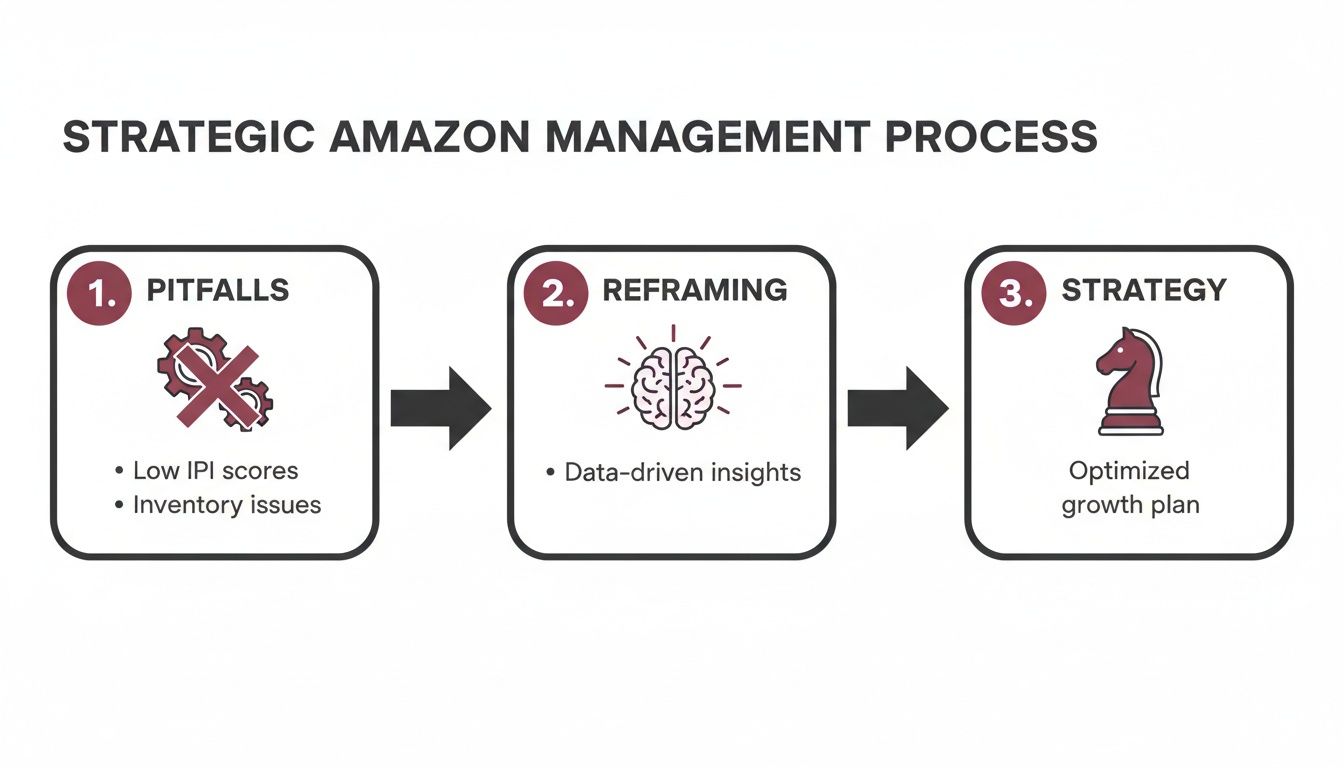
The real insight here is getting ahead of the problems. It’s about building a plan that anticipates risk instead of just reacting to it.
Beyond Sales Projections
A genuine market assessment goes much deeper than surface-level data. It means analysing the specific competitive landscape you’re about to enter.
For a premium hardware brand, launching into the mature US market means going head-to-head with established giants. That same brand might find a much faster path to market leadership in a high-growth, less crowded market like Australia.
Your analysis must cover:
- Cultural Nuances: How do local customers actually search for your product? What features do they care about? A key power tool feature in one country might be completely irrelevant in another.
- Competitive Density: Who are the dominant players on Amazon in that specific region? You need to know their price points, review counts, and how aggressively they advertise.
- Local Trust Signals: What certifications, warranties, or brand messaging resonate with local buyers and give them the confidence to click “buy”?
Pre-Launch Validation and Protection
Before you ship your first unit, the goal is to de-risk the entire launch. This starts with targeted research to validate demand and, just as importantly, ensuring your product is 100% compliant from the moment it lands.
For example, any product with electronic components will face different electrical standards in the UK versus the US. It’s a non-starter if you get it wrong. Missing this can get your inventory seized and kill your launch before it even begins.
One of the most critical pre-launch steps is locking down your brand. Enrolling in Amazon Brand Registry in your target marketplace before you launch is non-negotiable. It’s your first and best defence against the counterfeiters and listing hijackers who love to target new market entrants.
Waiting until you have a problem is already too late. Securing your brand identity gives you control over your product pages and stops others from destroying your brand’s reputation. To see how this fits into the bigger picture, you can learn more about our approach to Amazon management and brand growth.
The Strategic Lesson
Smart brands don’t gamble on international expansion; they use a framework to make calculated, data-driven decisions. This is what positions your brand for long-term success, not just a flash-in-the-pan sales spike.
Here’s what that framework looks like in practice:
- Market Opportunity Scorecard: Systematically score potential markets based on criteria like competitive saturation, consumer spending power, logistical complexity, and alignment with your brand’s core strengths.
- Compliance and IP Audit: Identify every legal, regulatory, and intellectual property requirement for your top 1-2 target markets.
- Logistics and Margin Modelling: Build a detailed financial model for each market, accounting for international shipping, FBA fees, storage costs, customer returns, and local taxes to be certain the market is actually profitable.
- Phased Launch Plan: Outline a clear, step-by-step launch sequence. This allows you to learn and adapt from your first international market before expanding to others, reducing risk and preserving capital.
By building this playbook, you change international expansion from a high-stakes gamble into a calculated business strategy. It’s this level of planning that separates the brands that scale globally from the great products that get stuck at their own border.
Mastering Cross-Border Logistics and Inventory
For any founder, logistics is where the promise you make to your customers becomes real. It’s also where your profitability can be made or broken, especially when you start selling across borders.
Thinking about cross-border logistics isn’t just an FBA versus FBM choice. It’s about designing an entire operational system that protects your margins while giving customers a flawless experience, no matter where they are in the world.
You have to think like a founder here. You aren’t just “shipping products”—you’re building a supply chain that can handle disruption and scale as you grow. The goal is to stop thinking about shipping costs and start designing a global delivery network.
Designing a Hybrid Fulfilment Model
Relying only on Amazon’s Fulfilment by Amazon (FBA) service can seriously limit your options, particularly when you’re expanding internationally. A smarter strategy almost always involves a hybrid model.
This means combining FBA with other fulfilment methods to give you more flexibility and control.
- Third-Party Logistics (3PL) Partners: A good 3PL in your target market becomes your local hub. They can take in your bulk shipments, handle customs, and then drip-feed inventory into Amazon’s FBA network as you need it.
- Fulfilled by Merchant (FBM): For your larger or slower-selling items, your 3PL partner can manage direct-to-customer shipping, saving you from Amazon’s high long-term storage fees.
A hybrid model gives you a crucial buffer. I’ve seen it countless times—Amazon’s warehouses get congested or FBA intake is restricted, especially during peak season. Your 3PL partner ensures your supply chain doesn’t just grind to a halt. It’s your strategic insurance policy against the unpredictable.
Amazon’s infrastructure is a huge asset. By 2026, Amazon AU is on track to operate over 10 fulfilment centres across Australia. This network is a key reason why 25% of third-party sellers there now earn over $100,000 AUD a year. It lets you scale without massive capital investment, but it works best when it’s part of a bigger, more strategic logistics plan.
Multi-Region Inventory Planning
The single biggest operational headache in global Amazon management is inventory. Overstock and you get hit with punishing storage fees. Stock out and you destroy your sales velocity and Best Seller Rank (BSR), which can take months to recover.
Getting inventory planning right comes down to sophisticated demand forecasting, not just educated guesses.
Here are a few core principles for multi-region inventory management:
- Forecast by Marketplace: Never use a single global forecast. A product’s demand in the UK winter is completely different to its demand in the Australian summer.
- Set Buffer Stock Levels: Hold a calculated amount of safety stock at your 3PL, not just inside FBA. This lets you replenish Amazon’s stock in a hurry if you see an unexpected sales spike.
- Actively Manage Ageing Stock: Use Amazon’s own reports to find slow-moving inventory before it becomes a financial drain. Have a clear plan to either sell it off or have your 3PL remove it.
This is a dynamic process. It’s a constant balancing act, shifting inventory to have products available for customers while keeping costs as low as possible. You can explore this further in our deep-dive guide on Amazon logistics.
Ultimately, a world-class logistics and inventory system is what makes sure your great product gets into your customer’s hands, exactly as promised, anywhere in the world—profitably.
Protecting Your Brand and Pricing Power
On Amazon, your brand’s value is constantly under attack. It’s an open marketplace, which means unauthorised sellers, price wars, and inconsistent brand messaging aren’t just risks—they’re daily realities. I’ve seen far too many great brands treat these issues as fires to put out.
Successful Amazon management isn’t about firefighting. It’s about building a fortress around your brand before you even launch.
This means using Amazon’s own protection tools proactively, not just as reactive fixes. It’s the difference between controlling your brand’s destiny and letting a chaotic marketplace dictate it for you.

Building a Proactive Defence
The moment your product shows any sign of success, opportunistic sellers will appear. They might be selling legitimate but diverted stock (grey-market goods) or, even worse, outright counterfeits. Both are poison for a growing brand.
A proactive defence always starts with Amazon Brand Registry. Enrolling gives you the authority to lock down your product detail pages, ensuring your images, copy, and A+ Content stay exactly as you designed them.
But smart brands don’t stop there. They layer on multiple levels of protection:
- Amazon Transparency: This program puts a unique QR-style code on every single unit you make. Before an item can be shipped, it has to be scanned to prove it’s authentic. It’s one of the most effective ways to stop counterfeits cold.
- Project Zero: For brands with a strong track record of reporting fakes, Amazon grants the power to remove counterfeit listings themselves, instantly. No waiting for Amazon support to take action.
The real-world pattern is clear: brands that wait for a counterfeit or grey-market problem to arise always lose. They lose sales, customer trust, and control. The brands that win are those who build their defences before the first attack.
This approach transforms Amazon’s ecosystem from a threat into a shield, giving you the control needed to maintain your brand’s integrity.
Escaping the Race to the Bottom
Just as damaging as counterfeits is the slow erosion of your pricing. All it takes is one unauthorised seller undercutting your price to trigger a chain reaction, devaluing your product.
Protecting your price is about discipline, not just monitoring software. It all starts with a clear and legally sound Minimum Advertised Price (MAP) policy distributed to all your legitimate retail partners.
When a violation happens, you have to act. Every time. It’s not about winning every skirmish; it’s about building a reputation for consistent enforcement.
Finally, you must understand your margins. This goes way beyond your landed product cost. Your true margin calculation has to account for all the variable costs that eat into your profit:
- Market-Specific FBA Fees: These change based on product size, weight, and country.
- International Shipping & Duties: The real cost to get inventory into a foreign fulfilment centre.
- Advertising Cost of Sale (ACoS): Your ad spend is a direct cost against every unit sold.
- Customer Returns: Return rates can vary dramatically between markets.
- Storage & Removal Fees: The cost of inventory that sits too long in Amazon’s warehouses.
Only by modelling these costs can you set a price that is both competitive and genuinely profitable. This level of financial control is a hallmark of sophisticated Amazon operators. It ensures that as you scale, your profitability scales with you.
Driving Growth with Strategic Advertising
Many founders see Amazon advertising as just another cost of doing business. For brands serious about global expansion, it is one of the most powerful tools for market entry, data gathering, and brand building.
It’s not just an expense. It’s a direct investment in your long-term market share.
Truly effective Amazon advertising goes far beyond obsessing over ACoS (Advertising Cost of Sale). It’s about building a full-funnel strategy that ties directly into your business goals, whether that’s launching in a new country or defending your category leadership.
Beyond Keywords to Campaign Architecture
A smart advertising strategy is built on a clear campaign structure that separates your objectives.
- Top-of-Funnel (Brand Awareness): These campaigns mostly use Sponsored Brands and Sponsored Display to introduce your brand to new audiences. The goal isn’t an immediate sale. It’s about building recognition and getting into a customer’s mind before they even know they need your product.
- Mid-Funnel (Consideration): This is where you target shoppers actively researching your category. It involves broader keyword strategies and targeting competitor products (ASIN targeting) to draw attention away from rivals.
- Bottom-of-Funnel (Conversion): These are your high-intent campaigns. They focus on branded search terms and very specific keywords to drive the final sale with maximum efficiency. This is also how you protect your brand space from competitors.
A common mistake I see is founders pouring their entire ad budget into bottom-of-funnel ads. While this can look good on an ACoS report, it leaves the top of your funnel completely empty. You end up only capturing existing demand instead of creating new demand, which ultimately caps your growth.
Advertising as a Data-Gathering Machine
One of the most valuable—and often overlooked—parts of Amazon advertising is the data it gives you. Every click and search term is a direct signal from your customers. For a brand entering a new market like Australia or Japan, this feedback is pure gold.
Instead of spending months on traditional market research, you can launch a series of small, targeted ad campaigns to quickly find out:
- What keywords local customers actually use to search for products like yours.
- Which competitor weaknesses you can use to your advantage in your messaging.
- What price points connect with shoppers and drive the best conversion rates.
Imagine launching in a new country. By running Sponsored Display ads targeted at competitor listings, you can instantly see which ones are getting clicks. This isn’t just an advertising tactic; it’s real-time market intelligence that should inform everything from your listing copy to your future product development.
Allocating Your Budget Strategically
How should you split your budget? It depends on your specific goals.
| Objective | Primary Ad Type | Budget Allocation Focus | Key Metric |
|---|---|---|---|
| New Market Entry | Sponsored Brands, Sponsored Display | High (Awareness & Discovery) | New-to-Brand Metrics, Impressions |
| Category Defence | Sponsored Products (Branded Search) | Moderate (Protecting Brand) | Share of Voice, Branded Search ACoS |
| Profit Maximisation | Sponsored Products (Long-tail Keywords) | High (Conversion) | Total ACoS (TACoS), Profitability |
For a brand launching into a new market, a big chunk of the budget—maybe 60-70%—should go towards top-of-funnel awareness. You have to buy that initial visibility.
For an established brand, the focus might flip, with 60-70% spent on bottom-of-funnel campaigns to defend market share and maximise profitability.
This is the core of strategic Amazon management. It’s about turning your ad spend from a reactive cost into a proactive tool for building your brand, gathering critical market data, and driving sustainable growth.
The Amazon Management System That Drives Growth
Scaling on Amazon doesn’t happen by chance. It requires a structured Amazon management system:
– Market validation before launch
– Listing optimisation built for conversion
– Keyword indexing for visibility
– Strategic advertising for demand generation
– Brand protection and pricing control
– Long-term scaling across multiple regions
Without this level of Amazon management, even great products fail to gain traction.
When an Amazon Expansion Partner Makes Sense
Trying to scale a brand globally on your own is a monumental task. I’ve watched too many founders with brilliant products burn out trying to do it all themselves. They hit a wall, growth stalls, and they get bogged down by costly mistakes.
It’s a tough lesson many learn the hard way: a great product doesn’t automatically become a great global brand.
The complexities just pile up. Suddenly, you’re not a product innovator anymore. You’re a part-time international tax expert, a cross-border logistics manager, and a cultural marketing specialist. This is the operational quicksand where so many brands get stuck.
Why the Right Partner Changes Everything
This is exactly where bringing on the right partner can completely change the game. Smart founders realise they can’t be an expert in everything. They understand that building deep, on-the-ground knowledge in every single new market is slow, incredibly expensive, and fraught with risk.
Instead, they find a firm that already has the infrastructure and expertise built. This gives them immediate access to:
- Established distribution networks to get products into the right channels from day one.
- Compliance and regulatory knowledge to avoid disastrous errors.
- Local market intelligence to ensure your branding, pricing, and messaging actually connect with local customers.
A strategic partnership isn’t about giving up control. It’s a calculated decision to accelerate growth, de-risk your expansion, and free you up to focus on what you do best—building incredible products.
It’s a fundamental shift in mindset. You stop wasting energy on the operational headaches of global execution and instead focus your team on product development and brand vision. You’re not outsourcing your brand; you’re insourcing decades of specialised market entry experience.
Making the Partnership Model Work
A good partnership collapses the entire expansion timeline. What would have taken you years to build can be achieved in months because the operational backbone is already there. You can launch into new regions with the structure, relationships, and on-the-ground team ready to go.
This approach isn’t for everyone, but for established brands with proven products, it’s the most direct path to becoming a household name around the world.
For a deeper look into selecting the right ally for your journey, check out our guide on finding an Amazon expansion partner. It’s about making sure your product’s potential isn’t limited by your own bandwidth.
Amazon Management FAQs
How do I keep control of my brand on a platform built for price wars?
This is one of the biggest fears I hear from founders. The key is to be proactive. Locking down your listings with Amazon Brand Registry is the first, non-negotiable step.
You have to enforce a strict Minimum Advertised Price (MAP) policy and actively hunt for unauthorised sellers. The most successful brands also use programs like Amazon Transparency, which puts a unique code on every unit to stop counterfeits before they ever reach a customer.
Ultimately, you win by shifting the battleground from price to value. This means investing in high-quality A+ Content, a compelling Brand Store, and strategic advertising that tells your brand’s story.
Is it better to expand everywhere at once or go one market at a time?
Going one by one is almost always the smarter move. A phased rollout lets your brand learn and adapt without burning through your capital and stretching your team too thin.
Start with a market that’s a close cousin to your home turf—think of a US brand expanding to Canada or the UK. This first launch acts as your pilot program, helping you iron out the wrinkles in your logistics, compliance, and marketing playbook.
The experience you gain dramatically de-risks your next moves into more complex markets like Japan or Germany, where the cultural and logistical hurdles are much higher.
When does a strategic partner make more sense than building an in-house team?
A strategic partnership is the right call when the speed and complexity of going global outweigh the desire to build it all yourself. It’s for founders who realise their time is better spent on product innovation and brand vision, not getting bogged down in foreign tax law or marketplace algorithms.
If you don’t have deep expertise in international logistics, multi-country compliance, or the nuances of local markets, a partner can be a game-changer. An experienced partner with existing infrastructure can shave years off your timeline and help you sidestep the expensive mistakes that so many brands make when they try to go it alone.
Build an Amazon Growth System That Protects Your Brand
Amazon can accelerate growth for established brands, but only when the marketplace is managed strategically.
The brands that scale successfully are usually the brands that control pricing, protect margins, manage logistics properly, and approach expansion with a structured operating model rather than a short-term sales mindset.
TPR Brands works with established consumer brands across Australia, the US, Canada, and the UK to build scalable Amazon growth systems that support long-term expansion.
If you are evaluating Amazon as a serious growth channel, we can help you assess marketplace positioning, operational readiness, pricing structure, and international expansion strategy before costly mistakes appear.