A lot of Australian brands reach the same point at roughly the same stage of maturity.
The product works. Retailers know the name. Repeat purchase is healthy. Operations are no longer chaotic. Then growth starts to feel narrower than it used to. You can still add revenue domestically, but each gain costs more effort, more discounting, or more channel conflict than it did two years earlier.
That is when Canada starts to look attractive.
For hardware, home improvement, household and consumer product brands, it often appears to be the logical next move. English-speaking for most of the market. Familiar retail logic. Strong appetite for practical, durable products. A market big enough to matter, but not so sprawling that it forces reckless expansion from day one.
That logic is directionally right. It is also a point where a lot of founders get themselves into trouble.
From Domestic Success to Global Ambition
The founder conversation usually starts with a simple assumption. “If we can sell this across Australia, we should be able to sell it in Canada.”
Sometimes that turns out to be true. Often, only part of it is true.
A strong Australian brand can carry real advantages into Canada. Product quality can stand out. Packaging can feel premium. A disciplined approach to sourcing and retail presentation often travels well. But export australian products is not the same as repeating your domestic playbook in a different postcode.
Canada rewards structure. It punishes casual market entry.
Australia exported $370.9 billion in goods in 2023, yet more than 50% of that value came from resource-based exports such as iron ore and mineral fuels, which leaves a clear diversification opportunity for established consumer and hardware brands moving into value-added markets like Canada, according to this breakdown of Australia’s export profile.
That matters for founders because it frames the opportunity properly. You are not stepping into a crowded national habit of exporting finished consumer brands at scale. In many categories, you are building a path that is still underdeveloped. The advantage is upside. The downside is that you cannot rely on a well-worn template.
For brands exploring how to export Australian products, the first strategic shift is mental. Stop thinking in terms of shipping product offshore. Start thinking in terms of entering a market with a controlled operating system.
Canada is close enough to tempt shortcuts
Brands often make avoidable mistakes here.
They assume their existing packaging will pass. They assume pricing can be adjusted later. They assume Amazon.ca will tell them whether the market likes the product. They assume a distributor can fix weak positioning after the fact.
Those assumptions usually create expensive friction.
A Canadian launch succeeds when the brand treats market entry as a full commercial rollout, not a trial shipment with hope attached.
The founder-level decision
The decision is not whether Canada is attractive. In many cases, it is.
The decision is whether your business is ready to support Canadian entry with the same seriousness you applied to building domestic traction. If the answer is yes, Canada can become a meaningful second market. If the answer is no, the brand often burns time, margin and retailer confidence before it learns what was missing.
Phase 1 Assessing Your Brand's Canadian Market Fit
The work starts before logistics, before distributor outreach, and well before your first production run for export.
You need evidence that your product belongs in Canada in a way that is commercially sensible.

Start with use case, not category
Founders often begin with a competitor list. That helps, but it is not enough.
A category can look crowded while a use case inside that category remains underserved. A garage organisation product, moisture-control household tool, wall-repair accessory, pet clean-up item, or small electrical convenience product can fail in one retail context and win in another because the buyer problem is framed differently.
Ask tighter questions:
- Where is the product used: Indoor, outdoor, seasonal, trade-facing, family-facing, apartment-friendly, rural, cold-climate suited.
- What pain does it remove: Installation time, storage clutter, maintenance effort, safety concern, cleaning frustration.
- What proof does the buyer need: Demonstration, certification, durability claims, before-and-after visuals, retailer trust, reviews.
If you cannot state the Canadian use case clearly, the market fit is not proven yet.
Pressure-test your pricing logic
A product that feels premium in Australia can feel overpriced in Canada once freight, duties, tax handling, bilingual packaging changes and channel margin are layered in.
That does not mean the product cannot work. It means the price story has to survive the full stack.
Use a simple screening table early.
| Question | Healthy signal | Warning sign |
|---|---|---|
| Can the landed cost support your intended MSRP? | Margin remains intact after channel costs | Margin only works if you discount your own standards |
| Is the product visibly differentiated? | Quality, design, packaging or function is obvious | Product relies on explanation that retail staff will not give |
| Can a Canadian buyer understand value quickly? | Message is immediate | Product needs long education to justify price |
| Does the range travel well? | Hero SKUs are easy to launch first | Every SKU depends on a full line rollout |
A founder does not need perfect certainty at this stage. But you do need to know whether your economics survive reality.
Use trade gap analysis instead of chasing obvious demand
Most brands search for visible demand. Better operators search for demand with room.
One useful method is the gravity model of trade, which compares predicted versus actual exports to identify underserved markets. That approach matters for non-commodity products because Australia ranks 74th globally in economic complexity, indicating room for more diversified manufactured exports beyond resource-heavy trade, as discussed in this analysis of gravity-model trade opportunity.
The practical lesson is straightforward. Do not just ask, “Is Canada a big market?” Ask, “Is Canada relatively under-served for this type of Australian-made or Australian-positioned product?”
That changes your research.
Look for signs such as:
- Imported category quality gaps: The market has options, but many are generic or low-trust.
- Retail assortment sameness: Shelves are full, yet products look interchangeable.
- Strong product-market story overlap: Your Australian brand origin supports ruggedness, quality, outdoor utility, clean design, or performance credibility.
- Channel white space: National retail may be crowded, while regional chains, speciality dealers, e-commerce bundles, or installer channels remain open.
This next resource is useful if your team is mapping market-entry thinking visually before committing inventory.
Separate founder conviction from market evidence
I have seen strong brands confuse domestic loyalty with export readiness.
The product may be excellent. The team may be experienced. None of that automatically means the Canadian buyer will interpret the value proposition the same way. Local context changes everything from merchandising to weather relevance to pack-size logic.
If your market-fit work ends with “Canada looks similar to Australia”, you have not done enough work.
A proper assessment ends with a decision, not optimism. Either the product has a credible wedge, a viable landed-cost structure and a channel path, or it does not. If it does not, fix the proposition before you ship anything.
The Non-Negotiable Compliance and Regulatory Gauntlet
Founders often treat compliance as a finishing task. It is not. It is part of market strategy.
When a brand enters Canada without a disciplined compliance process, the failure rarely looks dramatic at first. It looks administrative. A coding issue. A label problem. A missing document. A product description mismatch. Then inventory sits still, launch dates slip, and every downstream commitment starts to wobble.
HS codes are not a paperwork formality
Accurate Harmonized System classification determines tariffs, duties and customs handling. The code has to match the product precisely. The source guidance on Australian export procedures gives a clear example of that granularity with export code 08051011 for “Fresh Navel Oranges”, showing how specific classification needs to be, and it warns that incorrect classification can trigger delays, penalties, shipment rejection or reclassification fees, as outlined in this export compliance guide covering HS code validation.
That lesson applies directly to hardware, home products and consumer goods.
A founder might think a product is simple. Customs does not care whether it feels simple. It cares whether the classification is accurate. Multi-material products, electrical components, kits, accessories and bundled items are where brands often create trouble for themselves.
What usually goes wrong
The pattern is predictable.
A business uses an internal description that makes sense to sales teams, not to customs brokers. Packaging, invoice language and broker documentation do not align perfectly. The destination authority or broker reviews the shipment. The classification is questioned. The product is held while someone reconstructs what should have been resolved before dispatch.
That delay can do more damage than the direct cost. Retail windows move. Launch marketing loses momentum. Distributor confidence weakens.
Documentation errors are expensive because they multiply
Export documentation is category-specific. Generic knowledge is not enough.
Food and beverage items need health certificates and sanitary or phytosanitary compliance. Technical equipment requires safety documentation. Industrial products need category-specific licences. Packaging details, cautionary statements and product descriptions also matter, and errors can lead to rejection, penalties and broader regulatory issues. The available guidance notes that the administrative cost of non-compliance can exceed $300,000 per violation or twice the transaction value, whichever is greater, in administrative cases, according to this review of common export-process mistakes and documentation failures.
For founders, the important point is not fear. It is sequence.
Do not treat documentation as something logistics “handles later”. It needs input from product, packaging, regulatory, operations and commercial teams before the first shipment is booked.
Canadian compliance is product-specific
Different products trigger different obligations.
For hardware and electrical categories, product safety standards and certification pathways need checking before channel entry discussions go too far. For cosmetics, personal care and wellness products, ingredient, claims and notification requirements need their own review. For household goods, packaging language, cautionary labelling and product instructions can become the issue that slows everything down.
A practical internal review should include:
- Classification control: Confirm the exact HS code with broker input before first shipment.
- Packaging review: Verify claims, warnings, translations, materials callouts and product naming.
- Certificate map: Identify what the category requires in Canada and what must be renewed or updated.
- Document consistency: Make sure carton labels, invoices, broker docs and product descriptions all match.
The shipment that gets stopped is rarely the one with the worst product. It is often the one with the weakest process discipline.
Quebec and bilingual packaging are often underestimated
Otherwise capable teams often get caught here.
Many brands assume they can launch broadly in Canada with English-first assets and tidy up French later. That may work for a narrow test in limited circumstances, but it is a dangerous default for a serious market-entry plan. Packaging, instructions, warnings and marketing content often need a proper bilingual approach if you want national credibility and fewer downstream revisions.
The problem is not just legal exposure. It is operational waste. If you redesign late, you rework inventory, labels, approvals and channel conversations all at once.
Compliance should sit inside commercial planning
The best operators build a market-entry gate.
No SKU moves into production for Canada until classification, packaging, required documents, and any category-specific approvals have been signed off together. This avoids the common founder mistake of celebrating a purchase order before the product is ready to cross the border cleanly.
That discipline feels slower at the front end. It is faster where it matters.
Choosing Your Channel Strategy for Controlled Growth
A lot of brands entering Canada make the same tactical error. They try to be everywhere quickly because early momentum feels urgent.
That usually weakens the brand.
Canada gives you several viable routes, but they do not all serve the same purpose. You need to decide whether the first phase is about validation, distribution reach, retail credibility, margin control, or a combination that your team can support.
The channel question is really a control question
A founder should ask three things first:
- Where can the product win without excessive discounting?
- Which channel gives the cleanest market feedback?
- What level of operational complexity can the team absorb without harming the domestic business?
Those answers often remove at least one channel from the opening plan.
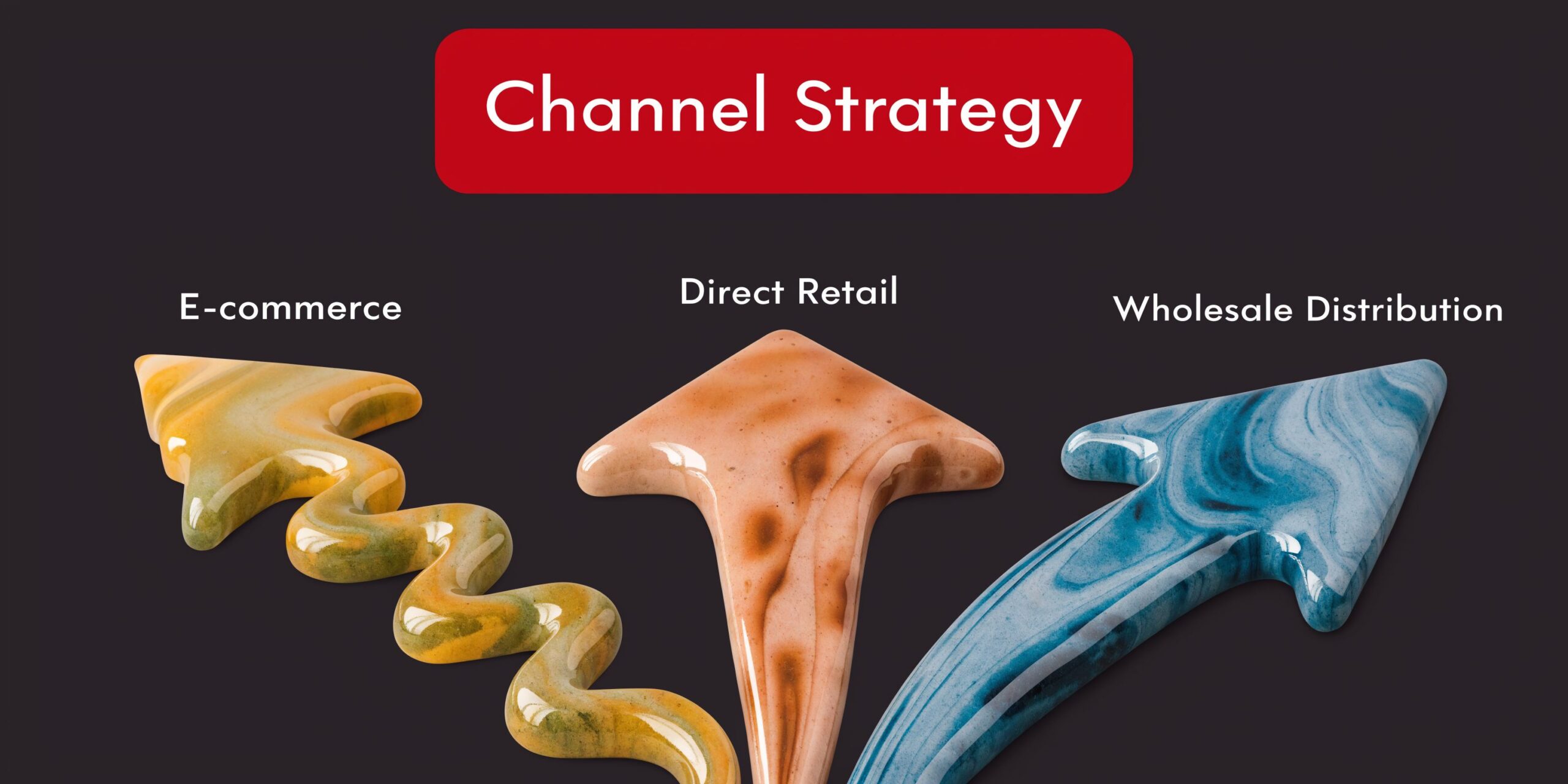
Comparing the main paths
| Channel | What it does well | Where it breaks down |
|---|---|---|
| Major retail | Delivers visibility and scale potential | Demands compliance, supply consistency and strong trade economics |
| Distributor model | Provides local relationships and market navigation | Can dilute control if partner alignment is weak |
| Amazon.ca | Useful for testing, discovery and review generation | Can train the market to compare on price alone |
| DTC | Builds direct customer feedback and brand presentation | Customer acquisition and fulfilment can become costly fast |
Big-box retail can validate the brand, but only when the range is ready
Retailers such as Canadian Tire, Home Depot and RONA can open meaningful volume. They can also expose weak preparation immediately.
Large retail is not just a sales channel. It is a systems test. Packaging, replenishment, claim substantiation, bilingual readiness, carton compliance and in-market support all show up there. If your first launch relies on a major chain before you have market feedback and operational rhythm, you can create a very public failure.
For many brands, big-box should be a phase-two or phase-three objective, not the opening move.
A good distributor can accelerate judgment, not just sales
Founders sometimes frame distributors as margin leakage. Bad distributor relationships can be exactly that. Good ones do something different.
They shorten the learning curve. They tell you which SKUs will travel, which accounts are realistic, what local objections keep repeating, and where your packaging or pricing story is weak. That local intelligence often matters more than the initial sales order.
The question is not whether to use a distributor. It is whether the distributor has the right incentives, category relevance and brand discipline.
Amazon.ca is a tool, not the strategy
Amazon.ca can be useful for launch sequencing. It helps test pricing tolerance, content resonance, review language, conversion friction and return patterns. It can also reveal whether your hero SKU attracts attention without needing immediate national distribution.
What it should not do is become your entire Canadian identity.
When brands rely on Amazon alone, they often learn the wrong lessons. They start optimising for ad efficiency, discount response and marketplace ranking mechanics, then discover that those behaviours weaken premium positioning in other channels. If you are considering that path, this overview of Amazon Canada expansion considerations is a useful starting point.
Smart brands use Amazon.ca to gather signal. Weak brands let it define the brand.
DTC looks attractive on paper
Direct-to-consumer gives you cleaner data and stronger message control. But Canada is not automatically a cheap DTC test bed.
Cross-border fulfilment, local shipping expectations, returns handling, bilingual service standards and paid acquisition economics can all tighten the room for error. DTC works best when the product has high clarity, strong average order value, and a clear reason for the customer to buy direct rather than through a retailer.
A phased approach usually protects brand value
A controlled sequence often works better than a broad launch:
- Start with a focused SKU set: Use hero products, not the whole catalogue.
- Choose one learning channel first: Often Amazon.ca, a distributor, or a targeted account group.
- Refine before expanding: Adjust packaging, pricing, content and inventory mix based on actual market behaviour.
- Scale into broader retail later: Only when replenishment and positioning are stable.
Founders who protect channel order usually protect margin too.
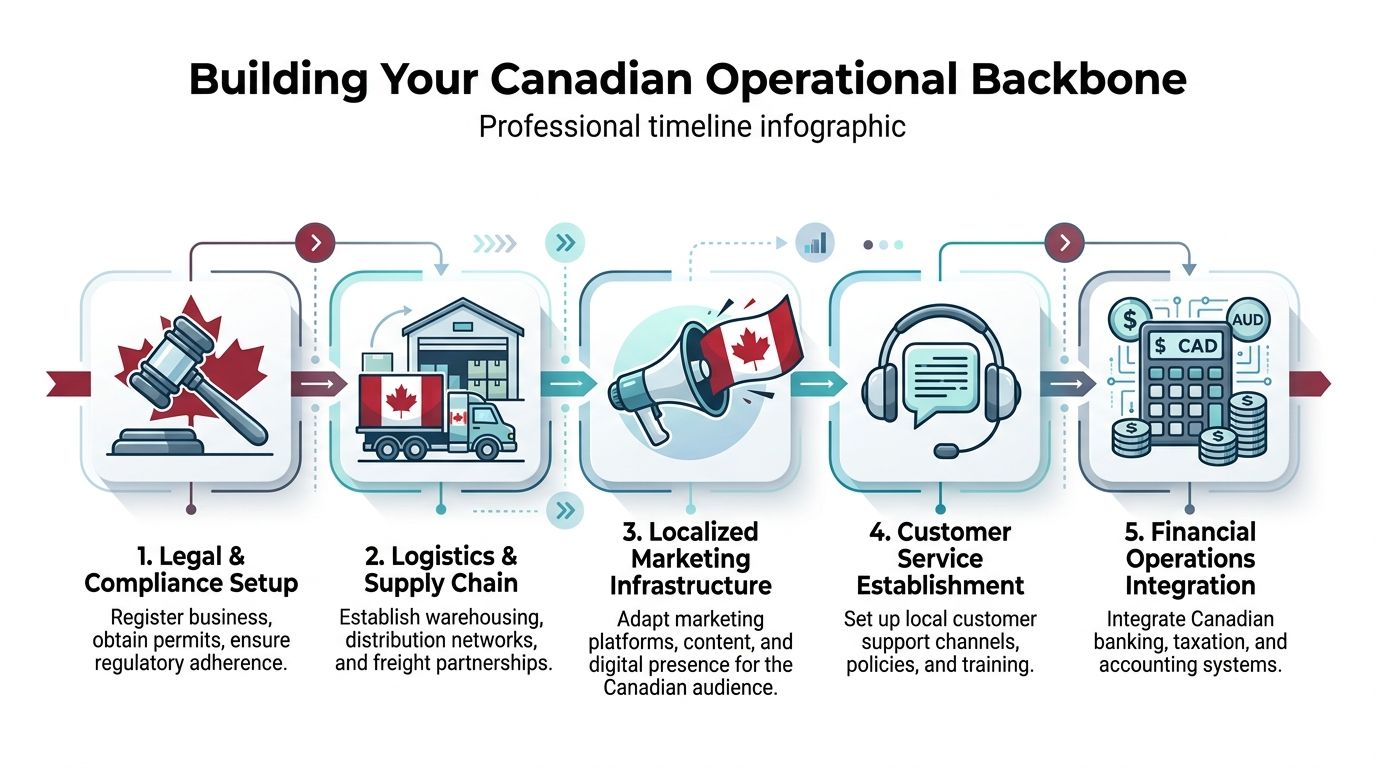
Building the Operational Backbone for Market Entry
A Canadian launch does not fail because one spreadsheet was wrong. It fails when pricing, logistics, service, and local execution were built as separate workstreams instead of one operating system.
That is the backbone.
Landed cost decides more than margin
Many founders calculate a rough export cost, add target margin, and move forward. That is not enough for Canada.
You need a fully loaded landed-cost model that reflects freight assumptions, customs treatment, insurance, taxes, currency exposure, packaging modifications, warehousing, returns, and channel-specific deductions. If one of those sits outside the model, your MSRP may look viable while your net profit disappears.
Use this checklist before you finalise Canadian pricing:
- Base product cost: Confirm current production cost by SKU, not blended averages.
- Freight assumptions: Run both ocean and air scenarios where relevant.
- Border costs: Include duties and any customs-related handling.
- In-market costs: Warehousing, pick-pack, returns, retailer compliance fees, marketplace fees.
- Currency discipline: Decide how often pricing will be reviewed against exchange movements.
Logistics strategy changes your commercial strategy
Founders often debate freight modes as if it is a procurement choice. It is really a market-entry choice.
Air freight can help a launch recover from timing pressure, but it can distort true unit economics. Ocean freight improves economics on paper, but it increases forecasting pressure and raises the cost of being wrong on inventory mix. Neither is universally right.
The smarter question is which logistics design supports the channel sequence you chose.
A narrow launch with a small hero range may tolerate one model. A retail rollout requiring dependable replenishment may require another. The key is to avoid building a channel plan that your freight reality cannot support.
Local fulfilment reduces friction faster than most brands expect
Canadian customers, retailers and channel partners respond better when inventory is already positioned to serve the market with less cross-border uncertainty.
That often means using a Canadian 3PL, or at minimum structuring fulfilment so domestic Canadian delivery does not depend on improvised cross-border handling. Brands exploring that side of the equation should think carefully about their logistics setup for market expansion.
A local fulfilment structure can improve:
- Retail reliability
- Marketplace delivery performance
- Customer service outcomes
- Return handling
- Inventory visibility
It also gives the team cleaner operational data.
Supply chain resilience is now part of brand protection
Recent geopolitical risk and supply-chain decoupling concerns have increased the appeal of onshoring and friend-shoring to markets such as the US, Canada and the UK, trading some productivity for greater security and brand protection, as described in this discussion of export vulnerability and pragmatic partner-market positioning.
For a founder, that is not abstract geopolitics. It is a practical operating principle.
If your Canadian entry depends on one brittle route, one rushed broker process, one overloaded warehouse, or one partner with poor visibility, your brand is exposed. A resilient operating model may cost more upfront, but it protects launch integrity and retailer trust.
The cheapest route into Canada is often the one that creates the most expensive problems six months later.
Partner selection is an operational decision, not just a commercial one
Experienced teams separate themselves here.
A Canadian partner should not be judged only by who can place orders. You need to know how they handle forecasting, account relationships, compliance communication, inventory planning, launch support and issue escalation.
A useful screening framework looks like this:
| Area | What to test |
|---|---|
| Market knowledge | Do they understand your category and where it fits? |
| Operational capability | Can they manage stock, documentation, and retailer requirements cleanly? |
| Incentive alignment | Do they grow premium brands, or do they chase volume? |
| Communication quality | Will they surface problems early, or after they are costly? |
| Territory logic | Are they strong nationally, regionally, or in a specific channel only? |
The wrong partner creates noise. The right one compresses learning and lowers execution risk.
Build the system before the excitement
Canadian expansion looks exciting when the first buyer call goes well.
That is usually the wrong moment to speed up.
Strong launches are built when legal, freight, pricing, packaging, inventory planning and partner responsibilities are all tied together before the first serious channel commitment. If one part is still being improvised, the backbone is not ready yet.
Your Go-to-Market Blueprint and Measuring Success
The launch should feel controlled, not loud.
A lot of brands confuse activity with traction. They announce too broadly, push inventory too early, or activate multiple channels before they know which part of the proposition is working. The result is messy data and expensive corrections.
Pre-launch should remove uncertainty, not create hype
Before the first inventory lands, the team should have four things locked:
- Localised assets: Packaging, listings, product pages, imagery, claims and instructions fit Canadian expectations.
- Final compliance sign-off: Nothing is “still being confirmed”.
- Inventory logic: Hero SKUs are prioritised and stock depth matches the opening channel strategy.
- Accountability map: Everyone knows who owns freight, content, service issues, retail communication and replenishment.
Founders often want to rush this stage because revenue is close enough to imagine. That impatience usually leaks into execution.
Launch in a way that creates usable signal
A good launch tells you what to do next.
That means limiting the moving parts. Start with the core range. Watch customer questions carefully. Review return reasons. Track whether channel partners are reordering because the product is moving, not because they were generous with an opening order.
The first phase should help you answer questions like:
- Is the value proposition clear without heavy discounting?
- Which SKU becomes the anchor product?
- Do customers understand the packaging and claims?
- Does the Canadian buyer interpret the brand as practical, premium, novel, or something else?
The KPIs that matter to founders
Top-line revenue can flatter a weak launch.
A better scorecard focuses on quality of traction:
| KPI | Why it matters |
|---|---|
| Channel-specific profitability | Shows whether growth is healthy or being bought |
| Reorder behaviour | Indicates whether sell-through is real |
| Return reasons | Exposes positioning, quality or expectation gaps |
| Brand search growth in Canada | Suggests awareness is building beyond paid effort |
| Service friction | Reveals where the operating model is under strain |
That scorecard gives founders something more valuable than vanity. It shows whether the business is building a repeatable market.
What smart brands do after launch
The brands that scale well into Canada do not assume the initial plan was perfect.
They review packaging language, revise listings, narrow or expand SKU focus, adjust trade support, and improve partner communication based on real customer behaviour. They stay deliberate. They protect price. They avoid chasing weak channels just to report a larger footprint.
Controlled expansion usually looks slower in month one and stronger in year two.
The broader lesson is simple. International growth is not a shipping exercise. It is a brand and operating discipline exercise. Founders who treat it that way preserve optionality. They can add channels, deepen retailer relationships and increase volume without damaging the brand they worked hard to build.
Frequently Asked Questions for Australian Founders
Is Canada really easier than the US for Australian brands
In some categories, yes. The market can be more manageable for a focused entry plan. But “easier” does not mean simple. Compliance, bilingual requirements, pricing pressure and local fulfilment still need proper planning.
Should we launch nationally from day one
Usually no.
A tighter rollout gives cleaner feedback and lowers risk. Start with the products and channels that tell you the most, then expand once your offer is proving itself in-market.
Can Amazon.ca tell us if the market wants our product
It can tell you part of the story.
It is useful for testing discoverability, conversion and review response. It does not replace retail strategy, local partnership, or a broader brand-positioning plan.
Do we need a local Canadian partner
Not in every case, but many brands benefit from one.
The right partner reduces blind spots around channel fit, retailer expectations, service handling and local execution. The wrong partner adds complexity, so due diligence matters as much as the contract itself.
What is the most common founder mistake
Treating export as a logistics project.
The brands that struggle usually underinvest in market-fit analysis, packaging readiness, compliance control and local execution. They move product before they build the operating system that supports the product.
Should we take the full product range into Canada
Usually not first.
Lead with the SKUs that best express the brand and can survive the economics cleanly. Hero products travel better than overbuilt catalogues.
How do we know if Canada is worth the effort
You know when three things line up. The product solves a clear local use case. The landed-cost model still supports profit. The opening channel strategy gives you a realistic path to learn and scale without damaging brand value.
If you are an established brand looking to expand with more structure and less guesswork, TPR Brands works with proven product companies navigating exactly these kinds of cross-border growth decisions. The focus is not chasing volume at any cost. It is building the right channel, compliance and operational foundation so strong products can become durable brands in new markets.