Australia is often where great brands are built, but it is rarely where ambitious founders want growth to stop.
Once local demand is proven, the next question becomes obvious: can the product scale internationally without losing the quality, positioning, and brand identity that made it successful in the first place?
That is where most expansion strategies fail.
Exporting Australian products is not simply about finding overseas buyers or setting up international shipping. Every new market introduces different customer expectations, pricing pressures, regulatory requirements, and operational risks. What works in Sydney does not automatically work in Los Angeles, London, or Seoul.
The brands that scale globally are rarely the ones moving the fastest. They are the ones expanding with a structured strategy built around market selection, compliance, logistics, brand positioning, and long-term channel control.
This guide breaks down how established Australian brands can approach international expansion strategically, avoid common export mistakes, and build sustainable growth across global markets.
Your Product Works in Australia. International Expansion Is Different.
Many founders assume international growth is simply the next version of domestic growth.
It is not.
Selling internationally changes almost every part of the business. Customer behaviour changes. Competition changes. Regulations change. Margins change. Even the reasons customers buy can change between markets.
We regularly see Australian brands succeed locally, then struggle internationally because they approach expansion as replication instead of adaptation.
A product that performs strongly in Melbourne may need completely different positioning in the United States or Europe. Packaging, compliance, pricing strategy, logistics, and marketplace expectations all shift once a product crosses borders.
Strong export strategies are built around three core questions:
- Is there proven demand in the target market?
- Can the product compete profitably after logistics and compliance costs?
- Does the brand positioning translate internationally?
Without answering those questions properly, expansion becomes expensive very quickly.
The strongest global brands approach exporting Australian products as a structured growth strategy rather than a simple sales opportunity.
You can see how this plays out even on a single platform in our guide on how to sell on Amazon Australia.
Global Expansion Requires Adaptation
Successful international expansion is rarely a copy-and-paste process.
Every market operates differently, particularly across North America, Europe, and Asia. Consumer expectations, compliance requirements, and competitive landscapes vary significantly between regions.
For example, Australian cosmetics brands entering the US market often face additional compliance layers such as California Proposition 65 requirements. Hardware and electronics brands may need different certifications, labelling standards, or warranty structures depending on the country.
That means exporting Australian products successfully requires more than freight and distribution. It requires operational adaptation.
Before entering any market, founders should evaluate:
- Market demand and category maturity
- Competitive saturation
- Local pricing expectations
- Compliance and regulatory requirements
- Marketplace and retail access
- Brand positioning relevance
The goal is not simply entering more countries. The goal is building profitable and defensible market positions internationally.
Choosing the Right International Markets
One of the biggest mistakes founders make is expanding into markets based purely on size.
Large markets attract attention, but they also attract intense competition, higher advertising costs, and stronger incumbent brands.
A better strategy is identifying markets where Australian products already hold strong positioning advantages.
Australian-made products are often associated with quality, safety, durability, and premium manufacturing standards. In the right category, this creates a competitive advantage that can support stronger pricing and faster market entry.
Strong market selection should evaluate:
- Existing demand for Australian products
- Competitive density
- Customer purchasing power
- Import complexity
- Logistics costs
- Marketplace accessibility
- Long-term growth potential
The objective is not global presence for its own sake. The objective is sustainable international growth with strong margins and defensible positioning.
Look Beyond the Obvious Metrics
Market size alone is a vanity metric. A massive market like the US might seem attractive, but its size is irrelevant if it’s saturated with low-cost competitors and your brand can’t get any traction. A smaller, more targeted market where your product’s value proposition truly resonates can be far more profitable in the long run.
We always advise founders to build a weighted scorecard. It’s a simple but powerful tool for comparing potential markets across several critical dimensions:
- Consumer Affinity: Is there an existing appreciation for Australian-made goods? Look at import data for complementary products, not just your own category.
- Competitive Intensity: Who are the key players? Are they discount brands or premium competitors? High competition isn’t always bad, especially if it’s at a lower quality tier than your own.
- Regulatory Alignment: How similar are the product standards, labelling laws, and compliance requirements to Australia’s? Significant differences add cost and time you might not have.
- Channel Access: Are the primary sales channels (like specialised retail or specific online marketplaces) accessible, or are they locked down by established players?
Macro Trends and Sweet Spots
Analysing macro trends is crucial for seeing where the opportunity is heading, not just where it is now. For instance, the growing demand for high-quality, sustainably sourced beauty and wellness products across North America and the UK creates a natural opening for Australian brands built on these principles.
We see the same thing in the home improvement sector. The strong appetite for durable, well-designed products in these regions plays directly into Australia’s strengths in hardware and consumer goods. This isn’t guesswork; it’s about connecting global trends to local strengths.
The infographic below shows the typical journey from a local Australian brand to a global player, highlighting the strategic shifts needed at each stage.
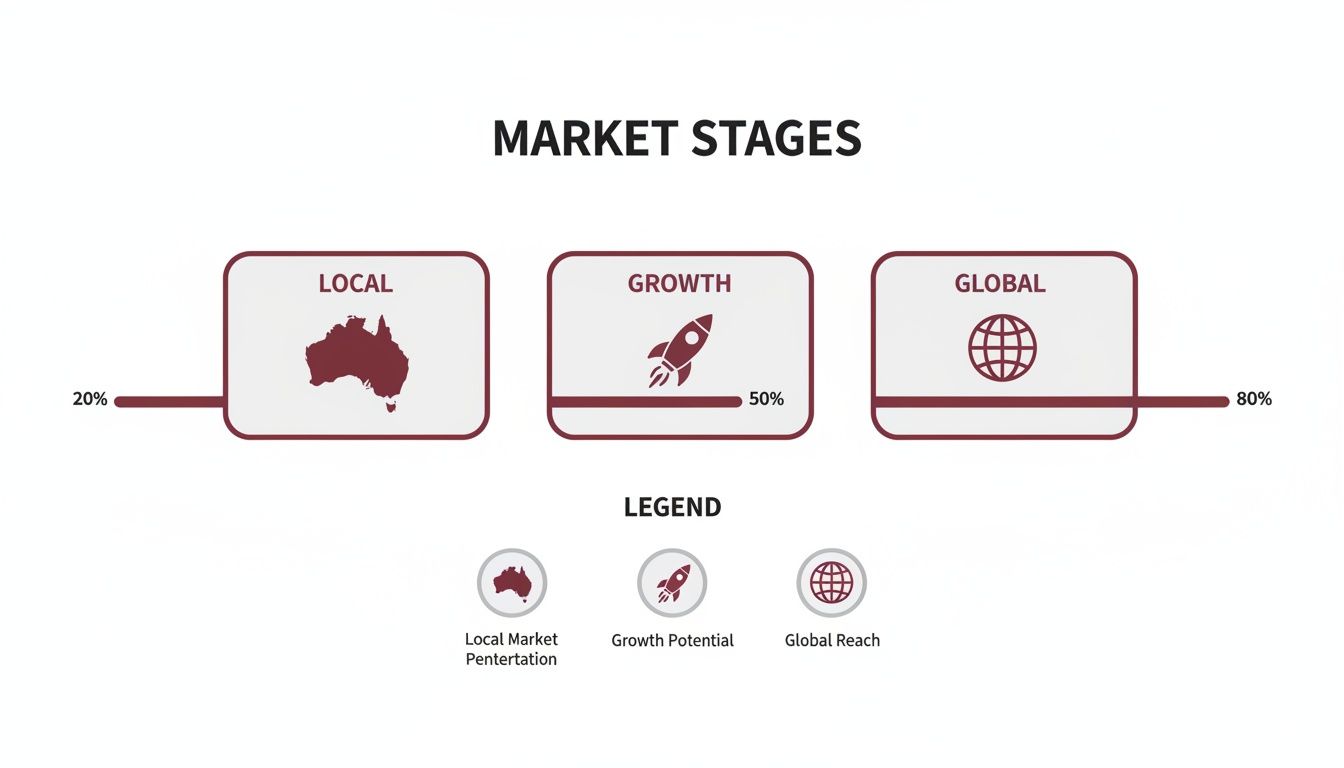
This journey from local success to the growth stage requires a deliberate strategy, which becomes even more critical when you’re aiming for a global presence.
The table below offers a high-level comparison of the most common export destinations for established Australian brands. It’s designed to give you a starting point for your own analysis, weighing the pros and cons of each major region.
Comparative Analysis of Key Export Markets for Australian Brands
| Market | Market Size (Consumer Goods) | Consumer Profile & Affinity for AU Products | Regulatory Hurdles | Strategic Opportunity |
|---|---|---|---|---|
| USA | $7T+ | High affinity for premium, natural, and outdoor lifestyle products. Sees AU as a source of quality and innovation. | Moderate-High: FDA, CPSC, EPA. Complex state-by-state laws. Requires significant investment in compliance. | Massive scale. Ideal for brands with strong capital backing and a clear niche to dominate. High reward but high risk. |
| UK | $500B+ | Very high. Shared cultural ties and language reduce friction. Strong demand for health, wellness, and high-quality food/beverage. | Low-Moderate: Post-Brexit standards are similar to AU but evolving. Labelling and certification are key. | Excellent ‘first step’ market. A familiar consumer environment allows brands to test international strategies with lower risk. |
| Asia (Key Mkts) | $10T+ (varies) | High and growing, especially for safe, clean-label food, infant products, and luxury skincare. AU brand = trust. | High: Varies significantly by country (e.g., China, Japan, S. Korea). Often requires local partnerships for navigation. | Huge growth potential. A rising middle class with disposable income actively seeks premium imported goods. |
This comparison highlights a critical truth: there’s no single “best” market. The right choice depends entirely on your product category, capital, and risk appetite. The US offers scale, the UK offers familiarity, and Asia offers explosive growth.
The data backs up a focused approach. Australia’s exports are already substantial and growing, creating established trade pathways for new brands. For example, key markets like China ($102.63 billion in 2026 exports), Japan ($30.62 billion), and South Korea ($19.87 billion) show the immense scale of Asian demand. For founders in sectors like hardware and home improvement, these figures prove that strategic partnerships can tap into massive, existing trade streams. You can explore the complete export data insights on tendata.com to see the sheer scale of these opportunities.
The goal isn’t to be everywhere. The goal is to be dominant where it matters. A data-driven approach allows you to place your bets with confidence, investing your finite resources into markets where you have a genuine right to win.
Ultimately, prioritising markets is an exercise in strategic focus. It forces you to define your ideal customer and competitive landscape on a global scale. Making these informed, defensible decisions about where to invest your capital and energy is the first and most critical step in a successful campaign to export Australian products to the world.
Compliance Is a Strategic Requirement, Not an Afterthought
Compliance is one of the most underestimated parts of international expansion.
Many founders treat compliance as something to solve after entering a market. In reality, it should influence market selection from the very beginning.
Different countries operate under completely different regulatory frameworks. Product standards, safety certifications, ingredient restrictions, packaging requirements, and labelling laws can vary significantly between regions.
For Australian brands exporting internationally, compliance challenges often include:
- FDA requirements in the United States
- UKCA certification in the United Kingdom
- EU product and ingredient regulations
- Country-specific packaging and labelling laws
- Import documentation and customs requirements
Missing these requirements can delay launches, increase costs, or stop products entering the market entirely.
Strong international brands build compliance planning into their expansion strategy early rather than reacting once problems appear.
The US: A Patchwork of Federal and State Rules
Entering the United States is uniquely complex. It’s not one market. It’s a federation of states, and each one has the power to add its own consumer laws on top of the federal ones. This creates layers of compliance challenges.
For most consumer goods, you’ll be dealing with several key bodies:
- FDA (Food and Drug Administration): This is the gatekeeper for food, beverages, dietary supplements, and cosmetics. Their rules on ingredient lists, health claims, and manufacturing practices are notoriously strict.
- CPSC (Consumer Product Safety Commission): This body oversees the safety of thousands of products, from kids’ toys to electronics, setting standards for things like lead content and flammability.
But the real challenge comes from state-level laws. California’s Proposition 65, for instance, demands specific warnings for products containing chemicals known to cause cancer or reproductive harm. A product that’s perfectly fine in 49 other states might need completely different labelling—or even reformulation—just to be sold in California.
The question isn’t “Is my product compliant?” It’s “Is my product compliant everywhere I intend to sell it?” Getting that distinction wrong is where so many brands get into trouble.
We’re navigating this exact issue right now for a multi-million dollar Australian cosmetics brand. The project involves a painstaking reformulation of their successful Aussie line to meet the tough ingredient bans of both the EU and the specific demands of Prop 65. The goal is to do it all without changing what makes the product great. It’s a high-stakes process that shows why compliance has to be proactive, not reactive.
The UK and Asia: Distinct but Demanding Frameworks
Post-Brexit, the United Kingdom has brought in its own UKCA (UK Conformity Assessed) marking. While it mostly follows old EU standards for now, it’s a separate and evolving set of rules that demands its own due diligence. For brand owners, it’s another certification to secure and maintain.
Key Asian markets like Japan, South Korea, and China each have their own significant compliance hurdles. Labelling laws are incredibly precise, often needing translation and adaptation by experts on the ground. Product testing and registration can be slow and confusing, and the system often works better for those who partner with local experts who know how it works.
This regulatory friction is a huge reason why founders look for strategic support. It takes specialised knowledge that most internal teams just don’t have. To learn more about how a marketplace-focused approach can help, take a look at our insights on strategic Amazon selling.
Despite the challenges, the demand for quality Australian products is incredibly strong. In 2026, Australia recorded a goods trade surplus of US$4,579.6 million with the United States, with exports reaching $33,697.1 million. The strong performance of categories like machinery and transport equipment in key US states shows a clear appetite for well-engineered Australian products. You can discover more about the US-Australia trade balance on census.gov.
Ultimately, smart brands don’t see compliance as a barrier. They treat it as a strategic asset. When you meet and exceed the highest international standards, you build enormous trust with both consumers and retailers. It becomes a powerful part of your brand story—a real demonstration of quality and a strong defence against competitors who cut corners.
Building an International Logistics System
Exporting Australian products successfully requires more than international shipping.
As brands scale globally, logistics becomes a major factor influencing profitability, customer experience, and operational stability.
Many founders initially attempt to manage international fulfilment directly from Australia. While this may work for early testing, it usually becomes inefficient as order volume grows.
Long delivery times, expensive freight costs, and difficult returns processes create friction that damages both margins and customer satisfaction.
This is why most scalable international brands eventually move toward structured fulfilment systems that include:
- Bulk freight shipping
- Regional warehousing
- Third-party logistics providers (3PLs)
- Local inventory management
- Multi-region fulfilment strategies
The objective is not simply moving products internationally. It is creating a supply chain that supports long-term growth while protecting customer experience and profitability.
Air vs. Sea: The First Strategic Decision
The choice between air and sea freight looks simple on the surface, but it has deep strategic consequences for your business. Air freight is fast, often just a matter of days, making it perfect for high-value, low-volume goods or for quickly restocking a new market to meet a sudden spike in demand.
The problem? Its high cost can absolutely crush your unit economics, especially for anything with size or weight. This is why sea freight remains the backbone of most international supply chains. Its cost-effectiveness for bulk shipments brings the per-unit cost way down. The trade-off, of course, is time. A 4-6 week transit means you have significant capital tied up in goods on the water and requires much sharper inventory forecasting.
The smartest brands don’t choose one or the other. They use a hybrid model: sea freight for planned stock replenishment and air freight as a strategic tool to react to market opportunities or prevent damaging stockouts.
The Local Fulfilment Imperative
Shipping direct-to-consumer (D2C) from Australia might seem like a good way to test the waters in a new market, but it is not a scalable long-term strategy. High international shipping fees, long delivery times, and a nightmare returns process create a poor customer experience that will quickly undermine a premium brand.
For any serious international growth, moving to a bulk-shipment-and-local-fulfilment model is non-negotiable. It’s a game-changer. Here’s what it involves:
- Shipping in Bulk: You send container-loads of product via sea freight to your target region, like the US, UK, or Europe.
- Warehousing In-Market: You partner with a third-party logistics (3PL) provider there to receive and store your inventory.
- Local Fulfilment: The 3PL then picks, packs, and ships orders directly to customers in that country, offering them the fast, affordable shipping they expect.
This model transforms the customer experience. Suddenly, they aren’t “ordering from Australia” anymore; they’re buying from a local brand. It also centralises your stock within the region, making you a far more attractive partner for local retailers and distributors who need reliable supply. To go deeper on this, check out our guide on designing your global logistics strategy.
Australia’s export infrastructure is already built to handle immense international trade volumes. In a recent month, our goods exports hit $44,318 million, a 6.0% jump from the month before. While a surge in non-monetary gold played a part, this was underpinned by a solid $6,197 million in rural goods and $32,329 million in non-rural goods. These figures, from the Australian Bureau of Statistics, show that local supply chains are well-equipped to handle serious volume for consumer brands. You can read the full report on Australian international trade from the ABS.
Vetting and Managing Your 3PL Partners
Choosing an overseas 3PL provider is one of the most critical decisions you’ll make in your expansion journey. This isn’t just another vendor relationship; they are the final touchpoint your brand has with its customers. A bad 3PL can destroy your reputation with lost orders, sloppy packaging, and slow deliveries.
When you’re vetting a partner, you have to look beyond the price sheet. Ask the hard questions about their technology, their order accuracy rates, and their specific experience with brands in your category. Most importantly, find out how they handle problems. A great partner is transparent and proactive when things inevitably go wrong.
Managing inventory across multiple 3PLs in different time zones and currencies requires serious operational discipline. It’s complex, for sure. But it’s the price of entry for building a supply chain that doesn’t just work, but one that lasts and enables true global growth.
Choosing the Right Expansion Channel
Many founders assume direct-to-consumer expansion is the best path into international markets.
In reality, building international growth entirely alone is often expensive, slow, and operationally difficult.
Successful global brands usually combine multiple channels strategically, including:
- Ecommerce marketplaces
- Retail partnerships
- Distribution partners
- Local fulfilment networks
- Direct-to-consumer sales
Each channel serves a different purpose.
Amazon may provide rapid customer access and marketplace visibility. Retail partnerships may create credibility and large-scale volume. Distribution partnerships may simplify logistics, compliance, and local market entry.
The strongest export strategies combine these channels instead of relying entirely on one approach.
International expansion becomes significantly more manageable when brands build partnerships that provide local expertise, operational infrastructure, and established market access.
The Illusion of Direct Control
Going direct seems appealing on the surface. You control the branding, the customer experience, and you keep all the margin. However, this model often breaks down internationally.
The cost of acquiring a customer in a new, hyper-competitive market like the US can be astronomical. You’re starting from zero brand awareness, competing against established local players with deep pockets and years of trust.
On top of that, the operational complexity is immense. You need to manage international shipping, customs, returns, and local customer service. Each of these adds friction for the customer and erodes your margins. This is not a scalable foundation for growth.
The core mistake is believing that channel control equals brand control. In reality, a poorly executed direct channel with a clunky customer experience does far more damage to your brand than partnering with an expert who can deliver excellence on your behalf.
The Primary Market Entry Channels
When you’re looking to export Australian products, your realistic options boil down to three main avenues. Each comes with its own set of trade-offs, and the right choice often depends on your category, capital, and long-term ambition.
-
Major Retailers (Bricks-and-Mortar): Getting your product onto the shelves of a major US retailer like The Home Depot or a UK chain like B&Q offers immediate volume and credibility. The downside? It’s incredibly difficult to get those meetings. Retail buyers are gatekeepers who want proven sellers, and they demand a lot in terms of supply chain reliability and marketing support.
-
Ecommerce Marketplaces (Amazon): Amazon is the 800-pound gorilla. It offers unparalleled access to a massive customer base that is primed to buy. But Amazon is a channel, not a brand-building strategy. Relying on it solely leaves you vulnerable to algorithm changes, price wars, and hijackers. It’s a powerful tool, but it should be part of a diversified strategy.
-
Specialised Distribution Partners: This is often the most overlooked but most effective channel for sustainable growth. A true distribution partner does more than just move boxes. They act as your brand’s extension in the new market, handling sales, marketing, logistics, and retail relationships.
Why Partnership is the Fastest Path to Scale
The partnership model works because it allows you to plug into an existing infrastructure that would take you years and millions of dollars to build yourself.
Imagine having immediate access to:
- Deep Market Knowledge: An on-the-ground team that understands the nuances of the local consumer, the competitive landscape, and the regulatory environment.
- Established Retail Relationships: A sales team that already has the mobile numbers of the key buyers you need to reach.
- On-the-Ground Compliance Experts: Professionals who can navigate the complexities of FDA regulations or UKCA marking, turning compliance from a barrier into a competitive advantage.
This is the strategic lesson that smart founders learn. Instead of trying to become an expert in US logistics or UK retail marketing, you find a trusted partner who already has that expertise. This de-risks your expansion and dramatically accelerates your timeline.
The trade data backs this up, showing the immense potential for Australian products in the USA. With key exports like meat, precious metals, and pharmaceutical products already representing billions, the channels are proven. A partnership strategy allows you to tap into these established streams efficiently. According to one report, meat and edible meat offal alone accounted for $4.11 billion in exports to the USA.
We see this play out constantly. A great Australian brand with a stellar product will struggle for years trying to make headway alone. Then, they find the right partner and within 12 months they have significant retail placement and a thriving online presence. The product didn’t change; the channel strategy did.
At TPR Brands, we embody this partnership model. We work with founders to navigate these exact challenges, providing the strategic support and on-the-ground infrastructure needed to turn a great Australian product into a global brand. It’s not about giving up control; it’s about gaining momentum.
Your Questions on Exporting Australian Products Answered
When founders start thinking about a global launch, the same hard questions always come up. The stakes are high, and the path forward is often clouded by generic advice and conflicting information. Here are direct answers to the most common strategic questions we hear from founders looking to export their Australian brands.
What Is the Biggest Mistake Founders Make When Expanding Overseas?
The single biggest mistake is assuming what worked in Australia will work everywhere else. I’ve seen so many founders fall into this trap—a “copy-and-paste” expansion where they replicate their domestic marketing, packaging, and even product formulations in a new market. This is a fast way to burn through capital and stall growth before you even get started.
Successful international expansion isn’t about replication; it’s about intelligent adaptation. It demands a real willingness to adjust your strategy to fit local consumer habits, competitor pressures, and cultural norms. A brand message that resonates with a customer in Brisbane might be completely missed by one in Boston.
How Much Capital Do I Need to Start Exporting?
There’s no magic number, but it’s almost always more than you think. The costs go far beyond just shipping products out the door. Founders need to budget properly for:
- Market Research: Deep analysis to prove there’s real demand and understand your competitive position.
- Product Compliance: Fees for certifications (e.g., FDA, UKCA), lab testing, and potential reformulations for different regions.
- Legal & IP: Registering your trademarks in each target country and drafting solid international partner agreements.
- Logistics & Tariffs: The real costs of freight, in-market warehousing, import duties, and taxes.
- Marketing Launch: The investment needed to build brand awareness from zero in a new, often crowded, market.
This is where a partnership model is so effective. By plugging into a partner’s existing infrastructure, compliance knowledge, and retail relationships, you can dramatically de-risk the financial side of your expansion.
Can I Just Sell on Amazon in a New Country?
While Amazon is a massive channel for reaching a huge audience, it is not a complete market-entry strategy. Relying only on a single marketplace is a high-risk move that puts your brand at the mercy of factors you can’t control.
An algorithm change can destroy your visibility overnight. A sudden account suspension—justified or not—can bring your revenue to a dead stop. Smart brands use Amazon as one powerful tool within a diversified strategy that also includes direct retail, other online platforms, and distributor relationships. This builds a much more resilient, defensible, and valuable brand in the long term.
How Do I Protect My Brand and IP Internationally?
Protecting your intellectual property isn’t an afterthought; it’s a foundational step. It starts with registering your trademarks in each target market well before you launch anything there. Waiting until you have traction is too late—by then, a squatter may have already claimed your name.
Just as important are the legal agreements you have with any distributors, 3PLs, or partners. These contracts need to be airtight, clearly defining territories, performance expectations, and brand usage guidelines. Your brand is your most valuable asset; defending it proactively is one of the most critical investments you’ll make.
At TPR Brands, we work with founders navigating these exact challenges. We provide the strategic support and on-the-ground infrastructure to help established Australian brands expand intelligently into new markets. If you are ready to scale, we can help build the path forward. Find out more about our partnership model.