Most brands don’t fail when they enter Amazon Australia because their product is bad. They fail because they treat it like just another channel.
If you’re already seeing traction and looking at expanding, Amazon Australia can be a powerful move. But how you enter determines whether you build momentum… or lose it.
If you’re reading this, chances are you’ve already got something working. You’ve proven demand somewhere else. Now you’re looking at Amazon Australia and wondering how to do it properly without losing control of your brand.
I’ve built and scaled businesses over the past 27 years. What I’m doing now is working with brands that are ready to expand through Amazon with the right structure behind them.
Not as a quick win… but as a long-term growth channel.
While the US or UK are common defaults, Amazon Australia has matured from an emerging player into a dominant force. Entering it correctly is a strategic move toward structured global growth, not just an opportunity to open another sales channel.
What most brands get wrong when entering Amazon Australia:
– Treating it like just another channel
– Copying what worked in another market
– Not understanding margins properly
– Letting control slip too early
The Market Insight: Australia’s Ecommerce Consolidation
The mistake most brands make here is assuming the market hasn’t changed much. It has.
International brands often view Australia through an outdated lens, underestimating the speed at which its ecommerce market has consolidated. The landscape has fundamentally changed. Australian consumers, once accustomed to fragmented online retail and slow domestic shipping, now demonstrate a clear preference for the speed and trust of a single, dominant platform.
We’re seeing this shift play out with brands right now. What used to work even a few years ago doesn’t land the same way anymore.
This isn’t a mere trend; it’s a deep shift in consumer behaviour and marketplace economics. The debate over if a serious brand needs a presence on Amazon Australia is over. The strategic question founders must now address is how to enter this market to build a defensible, long-term brand position.
How Fulfilment Excellence Forged Consumer Trust
For years, Australian online shoppers tolerated long delivery times and inconsistent service as the standard. Amazon’s arrival, backed by massive investment in its local FBA network and advanced robotic fulfilment centres, shattered this status quo. Amazon single-handedly reset consumer expectations for speed and reliability.
This operational excellence has translated directly into marketplace trust. And that trust carries over to the brands that position themselves properly inside that system. Shoppers now associate the Amazon brand with:
- Speed: Predictable, fast delivery that most domestic competitors cannot match.
- Reliability: Confidence that products will arrive as described and on time.
- Convenience: A frictionless shopping experience from search to checkout.
For an established brand, this is an incredibly powerful dynamic. Leveraging Amazon’s fulfilment network isn’t just about logistics; it’s about inheriting the trust and brand equity Amazon has painstakingly built with Australian consumers. A great product doesn’t automatically become a trusted brand in a new market; it requires strategic positioning.
The Data Confirms a Winner-Take-All Market
The anecdotal evidence is clear, but the data paints a stark picture of market consolidation. The balance of power in Australian ecommerce has decisively tilted, creating a new set of distribution dynamics.
Recent market analysis reveals a significant transfer of shopper loyalty. Here’s how the two largest marketplaces are trending.
Australian Online Marketplace Shift 2023-2026
| Marketplace | Shopper Penetration (2023) | Shopper Penetration (2026) | Growth/Decline |
|---|---|---|---|
| Amazon Australia | 52% | 60% (projected) | +8% |
| eBay Australia | 62% | 51% (projected) | -11% |
Amazon’s projected climb to 60% shopper penetration by 2026, while its primary rival eBay is expected to fall to 51%, signals a fundamental restructuring of the market. You can explore the full report on Australian marketplace trends to understand the scale of this shift.
This momentum makes Amazon Australia a non-negotiable channel for any serious brand founder. It’s about aligning your product with the platform defining the future of Australian retail. Brands that act decisively now will be positioned to own their categories tomorrow.
Positioning Your Brand to Win, Not Just Compete

Many brands attempt to enter Amazon Australia by simply replicating their US or UK marketing playbook. This is one of the fastest ways to stall growth. Founders often believe a great product will find its market anywhere, but this ignores a crucial lesson: marketplace success requires strategic positioning, not just product availability. Australian shoppers’ buying habits have been shaped by years of frustrating experiences with international sellers.
Simply translating listings and running identical ad campaigns is a tactical approach that fails to build a brand. To succeed, you need a deliberate strategy to position your brand not as another option, but as the only intelligent choice for a market that values trust and certainty.
Translating Brand Value for the Australian Consumer
Your core value proposition—whether superior design, durability, or performance—must be re-framed for the Australian context. This isn’t about changing your product; it’s about adapting how you communicate its value.
Consider a US brand selling premium outdoor gear. In America, the marketing might focus on ruggedness for extreme mountain conditions. In Australia, that message must pivot. Highlighting its reliability for a family camping trip or its durability under the harsh Australian sun is far more resonant. It’s a subtle but vital shift from an aspirational story to one of practical, local dependability.
Your brand’s narrative must address the unspoken questions every Australian buyer has:
- Is this a legitimate seller? Aussie consumers are wary of unfamiliar international brands.
- Will it arrive quickly? The promise of fast, local fulfilment is a primary conversion driver.
- Is it suited for Australian conditions? Your product must feel relevant to their specific lifestyle.
Many great products fail internationally not because the product is weak, but because their positioning is generic. They sell a product, not a solution that resonates with a new market’s unique priorities.
How Smart Brands Analyze the Competition
Analyzing your competition on Amazon Australia should not be about finding a way to undercut their price. That’s a race to the bottom that erodes brand value. A founder-focused analysis uncovers strategic gaps.
Examine the top-selling products in your category and ask different questions:
- What are their reviews really saying? Ignore the five-star praise; the three-star reviews are a goldmine of unmet needs and customer frustrations you can solve.
- How are they positioned? Are they a budget option, a premium choice, or a niche player? Where is the underserved space?
- What is their content quality? Poor-quality images, vague descriptions, and a lack of A+ Content signal an opportunity for a professional brand to establish dominance.
This strategic lesson is simple: shift your focus from competing on price to competing on brand perception and customer experience. You stop being just another listing and become the trustworthy, professional alternative. Success on Amazon Australia hinges on this repositioning. As you plan your entry, explore deeper insights on how to sell on Amazon Australia from overseas with a strategy built for long-term brand control.
Navigating the Operational Hurdles of Market Entry
Global expansion is often won or lost in operational execution. Many founders, experts in product and marketing, underestimate the complexity of landing goods in a new country. Entering Amazon Australia is a prime example of this pattern. The real work begins long before your product ever reaches an FBA warehouse.
Successful expansion isn’t about shipping boxes from A to B. It’s about building a resilient and cost-effective supply chain that can navigate customs, compliance, and fluctuating consumer demand. This is precisely where many brands falter, burning capital and time on avoidable problems.
The Non-Negotiable Compliance Checklist
Before shipping a single unit, you must get your compliance and regulatory affairs in order. Australia has strict standards, and failure to comply can lead to seized shipments, fines, or a ban from the marketplace.
Your core focus areas must include:
- Australian Border Force (ABF) and Customs: Goods valued over AUD $1,000 require a formal customs declaration. Correctly classifying products with Harmonized System (HS) codes to determine duties and taxes is critical.
- Goods and Services Tax (GST): A 10% GST is payable on most imported goods. As an overseas business, you will likely need to register for GST if your turnover meets the threshold.
- Product-Specific Regulations: This is a common failure point. Electronics must meet Australian electrical safety standards and carry the Regulatory Compliance Mark (RCM). Cosmetics and household chemicals face specific ingredient and labeling laws.
Assuming you can “figure this out as you go” is a critical strategic error. A clear compliance plan is fundamental.
I’ve seen brands with brilliant products fail in Australia simply because they didn’t budget for compliance testing or misunderstood their GST obligations. These aren’t minor details; they are fundamental to building a sustainable business in this market.
Fulfilment Models: The Founder’s Dilemma
Once you have a clear path through customs, your next major decision is fulfilment. For most brands entering Amazon Australia, the choice boils down to two models: a direct FBA setup or working with an in-market distribution partner.
Direct FBA Setup
Going direct with FBA provides maximum control over inventory, pricing, and brand presentation. You manage your own shipping into Australia and control every aspect of your listings.
- Pros: Higher potential margins, direct brand control, and full access to Amazon’s customer data.
- Cons: Higher initial capital outlay, requires deep knowledge of Australian logistics and tax, and you bear all operational risks.
Strategic Distribution Partnership
This model involves working with an established local entity that handles importation, compliance, warehousing, and fulfilment. They become your operational arm on the ground.
- Pros: Lower risk and capital requirements, instant access to local expertise, and a simplified operational structure.
- Cons: Lower direct margins and less day-to-day control over marketplace operations.
The right choice depends on your brand’s resources, risk tolerance, and long-term goals. For many established brands, a strategic partnership offers a structured, lower-risk pathway to test and scale. This is a common challenge for founders, and we delve deeper into this decision in our guide on how to sell on Amazon Australia from overseas. The key is to make a deliberate choice that prioritizes sustainable growth over a chaotic dash for sales.
A Disciplined Launch and Growth Strategy
Expanding into Amazon Australia isn’t about flipping a switch. I’ve seen many brands treat a new market launch as a single event, but experienced founders know it’s a process. It starts with deliberate pre-launch work and flows into a continuous cycle of analysis, adjustment, and growth.
The goal is to build momentum without losing control—a common trap for brands that grow faster through strategic partnerships. This requires a disciplined strategy covering brand protection, advertising, and inventory management.
Pre-Launch: Building a Foundation for Control
Before your first sale, your priority is to lock down your brand assets. Rushing this stage leads to firefighting later, from dealing with listing hijackers to recovering from a poor first impression.
Your essential pre-launch checklist:
- Secure Amazon Brand Registry: This is non-negotiable. It provides access to A+ Content, Brand Stores, and critical brand protection tools. It is your first line of defense against unauthorized sellers.
- Build Initial Social Proof: Launching with zero reviews is a major handicap. Use the Amazon Vine program to get early, credible reviews from trusted voices. This initial feedback builds immediate buyer confidence.
The Initial Launch: Data Gathering, Not a Sales Blitz
Your launch advertising strategy should focus on targeted visibility and data gathering, not just blowing a budget. An overly aggressive, broad PPC campaign can drain capital with little strategic insight to show for it.
We recommend a more focused approach:
- Sponsored Products Campaigns: Start with automatic campaigns to let Amazon’s algorithm identify relevant customer search terms. This data is invaluable for building targeted manual campaigns later.
- Defensive Product Targeting: Run campaigns targeting your own product pages to prevent competitors from poaching traffic from your listings.
- Monitor ACoS Closely: Your initial Advertising Cost of Sale (ACoS) will likely be high. The goal isn’t immediate profit but finding the balance between visibility and cost. Track performance daily and be ready to shift budget toward campaigns that work.
A common mistake is scaling ad spend too quickly before knowing which search terms convert. A patient, data-driven approach in the first 30-60 days sets you up for long-term, profitable growth.
This diagram illustrates the core operational flow for entering the Australian market.
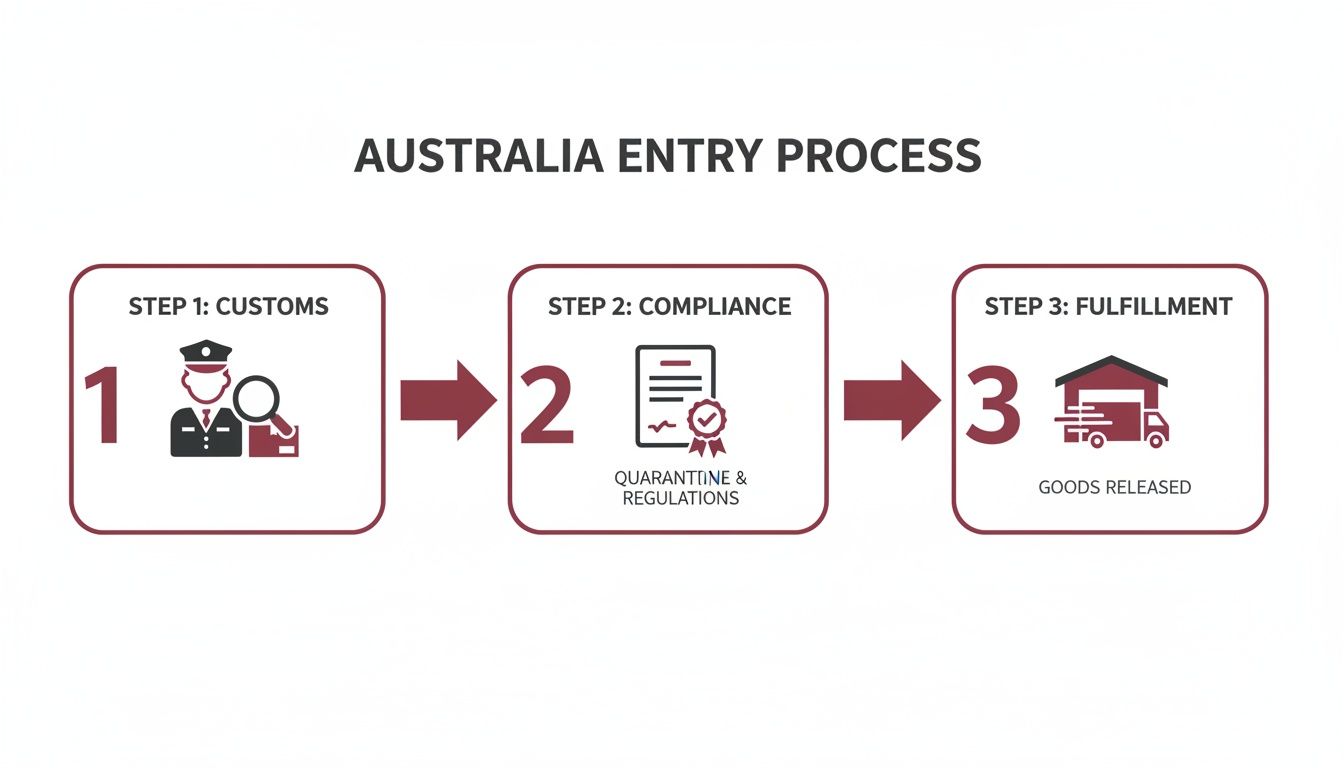
Each of these steps—Customs, Compliance, and Fulfilment—is a critical checkpoint where a lack of preparation can halt your entire launch.
Interpreting Data for Intelligent Growth
Once sales begin, your focus must shift to interpreting data and making smart inventory decisions. This is where many brands stumble, hit by costly stockouts or tying up capital in slow-moving products.
Your early sales data is your most valuable asset. While projections for 2026 show a massive opportunity on Amazon Australia, with sales expected to hit several billion dollars, you need real-world data to guide your strategy. For example, up to 75% of Australians plan domestic travel in the summer, spiking sales for items like packing cubes. You can read more on Statista about Australian online sales projections to see the scale, but your own data is what truly matters.
Use your initial sales velocity to build a more accurate forecast. Pay close attention to:
- Sales Velocity by ASIN: Identify top-performing products early and ensure you have enough stock. A stockout on a bestseller can kill your sales rank and momentum.
- Regional Demand: Amazon’s reports can show where your sales originate geographically. This is gold for planning inventory placement and optimizing delivery speeds.
By moving from a reactive launch to a proactive growth strategy, you ensure your expansion into Amazon Australia is both profitable and controlled.
Using Australia as a Global Expansion Springboard
For ambitious brand founders, entering Amazon Australia should never be the final goal. Experienced operators view it differently: they see Australia as a strategic testing ground—a lower-risk, high-reward environment to build a playbook for global expansion. Global expansion requires market understanding, and Australia is the ideal place to acquire it.
The Australian market is sophisticated enough to be a meaningful challenge but less brutally competitive than the US or UK. This unique position allows you to refine operations, test brand positioning, and gather invaluable data before committing to larger, more complex regions. A successful launch here validates that your product has international appeal and your operational model is sound.
Building Your Global Expansion Blueprint
The systems and strategies you perfect in Australia become the template for future growth. Every challenge overcome, from navigating customs to fine-tuning PPC campaigns, contributes to a repeatable process for entering new markets.
By the time you decide to enter the US or European markets, you have a proven framework for:
- Brand Positioning: You know how to adapt your messaging for a new audience.
- Operational Efficiency: You have a streamlined process for compliance, importation, and FBA management.
- Data-Driven Forecasting: You use real-world sales data to build accurate demand forecasts.
- Marketing Strategy: You have identified advertising tactics that deliver the best return.
This is a far more intelligent approach than a high-stakes launch in a hyper-competitive market. The strategic lesson is clear: smart brands learn from markets, they don’t just enter them.
The data, customer feedback, and operational knowledge you gain in Australia de-risk future expansion efforts and dramatically increase your chances of success in larger, more difficult arenas.
The Network Effect of Strategic Partnerships
Another critical advantage of starting with Australia is the network effect it creates. Establishing a relationship with a strategic partner to handle your Australian operations is not just solving a single market-entry problem; it’s building a foundation for a global distribution network.
Many operational partners, like TPR Brands, have established networks in other key regions like the US, Canada, or the UK. A successful partnership in one country often opens the door to streamlined entry into others.
This creates tremendous efficiencies. The partner already understands your brand, your products, and your standards. This concept is central to our Amazon Store management approach. The right partnership allows brands to expand intelligently, turning a great product into a worldwide brand.
Strategic Questions Founders Ask About Amazon Australia
As a founder, you’re constantly weighing opportunity against risk. When considering international expansion into a market like Amazon Australia, the questions that matter are strategic, not just tactical. Here are straight answers to questions we hear most often from established brand owners. These insights come from years of helping brands navigate the real-world complexities of global marketplaces.
How Much Capital Is Really Needed to Launch?
A purely tactical answer is a few thousand dollars for initial inventory and ads. Most founders don’t need more information here.
They need clarity on how to approach it properly. A strategic answer focuses on capital efficiency. The better question is, “How can I test this market with the least amount of capital at risk?”
You can dramatically reduce your initial outlay by planning a lean launch, focusing on a handful of core SKUs and working with a strategic partner to manage the process. This approach helps you avoid the heavy, upfront investment of building your own logistics and compliance framework. You’re not funding a full-scale operation; you’re investing in a controlled, intelligent market test.
Can We Just Use the Same Marketing and Creative?
Technically, you can. Strategically, you shouldn’t. Copying and pasting your US or European creative is one of the quickest ways to signal you’re an outsider. Australian consumers are savvy and can spot generic, one-size-fits-all marketing instantly.
Your brand’s core message may be universal, but its expression needs to be localized. This means:
- Adjusting imagery: Show products in a way that reflects Australian lifestyles.
- Refining copy: Use local language and focus on pain points relevant to an Aussie customer.
- Highlighting local fulfilment: Emphasizing fast, reliable shipping is a massive trust signal.
Even small tweaks that demonstrate local understanding can have an enormous impact on conversion rates and brand perception.
Founders often overestimate the universality of their marketing. A real connection happens when a brand shows it understands the local customer, not just when it makes a product available to them.
What’s the Single Biggest Mistake Brands Make?
The biggest mistake is confusing early sales with a successful strategy. This is probably the most common trap we see. We see it constantly: a brand gets an initial sales spike on Amazon Australia from pent-up demand or an aggressive launch campaign and assumes they’ve “cracked” the market.
This is a dangerous illusion. Sustainable growth isn’t about a launch spike; it’s about building a profitable, repeatable sales engine. Smart brands look past initial numbers and focus on metrics that define long-term health:
- Repeat purchase rates
- Customer review sentiment
- Profitability after all fees and ad spend
- Organic search ranking improvements
A launch is a moment in time. Building a brand is a continuous process of analysis and refinement. The founders who succeed are those who stay disciplined long after the initial excitement fades, focused on building a resilient business, not just chasing revenue.
I’ve built businesses, scaled them, lost them, and rebuilt again.
What I’m doing now is applying everything I’ve learned to help brands expand the right way through Amazon.
If you’re looking at Amazon Australia as your next move, this is the part that’s worth getting right.
If you want a second set of eyes on it, happy to chat.