The most popular advice on intellectual property protection is also the least useful once a brand starts scaling. It treats IP as a filing exercise. Register the name. Lodge the application. Save the certificate. Move on.
That works only until expansion starts exposing the brand to new distributors, new marketplaces, new manufacturers, new search results, and new forms of copying. At that point, intellectual property protection stops being a legal admin task and starts behaving like what it is: a commercial control system.
One pattern we continue seeing is that founders move quickly on product, packaging, channel launch, and wholesale outreach, then leave IP until a problem forces attention. By then, the issue usually isn't just infringement. It's channel confusion, pricing damage, lost distributor confidence, and a brand story that no longer belongs entirely to the company that built it.
For product brands, especially in hardware, household, home improvement, and premium consumer categories, the pertinent question isn't whether copying can be eliminated. It can't. The critical question is whether the commercial value created by the business keeps accruing to the business as it enters more fragmented marketplace ecosystems.
Your Brand's Most Undervalued Commercial Asset
Founders often treat IP spend as defensive overhead. That framing is too narrow. Strong intellectual property protection supports pricing power, improves channel control, reduces avoidable brand confusion, and gives the business more advantage when entering new regions.
Australia gives brands a stronger starting point than many founders realise. In the 2025 International IP Index, Australia ranked 15th out of 55 economies with a score of 76.13%, ahead of Canada at 18th and New Zealand at 21st, according to the 2025 International IP Index. For an Australian brand, that matters because it means the home market sits within a mature protection environment before expansion begins.
Why founders misread the value of IP
The mistake isn't usually ignorance. It's sequencing.
Founders understand patents, trade marks, designs, and copyright in theory. What gets missed is the way those rights affect commercial behaviour once the brand enters retail networks, marketplaces, and cross-border fulfilment systems. A trade mark isn't just a legal right. It helps preserve naming consistency across listings, packaging, distributor materials, and enforcement processes. A design filing isn't just a certificate. It can influence how confidently a brand launches a visually distinctive product into a category full of lookalikes.
The challenge is that many strong products stall. They're commercially sound, but the surrounding brand architecture is too loose to defend margin once visibility increases. That's also why great products often fail to become great brands online. The issue usually isn't product quality alone. It's that the ecosystem around the product hasn't been protected well enough to scale cleanly.
Commercial rule: If your brand can be easily copied, mislabelled, repackaged, or imitated across channels, you don't fully control the value you're creating.
What IP protection actually does in expansion
For established product businesses, IP performs four commercial jobs at once:
- Protects brand identity: It helps the market recognise the authentic source of the product.
- Defends differentiated product value: It creates friction for direct imitation.
- Supports partner confidence: Distributors and channel partners prefer brands that can document ownership and act quickly when issues arise.
- Preserves future options: Licensing, acquisition, regional partnerships, and marketplace enforcement all work better when rights are clear.
The strongest operators don't obsess over collecting registrations for their own sake. They use IP to make the business easier to scale without losing control.
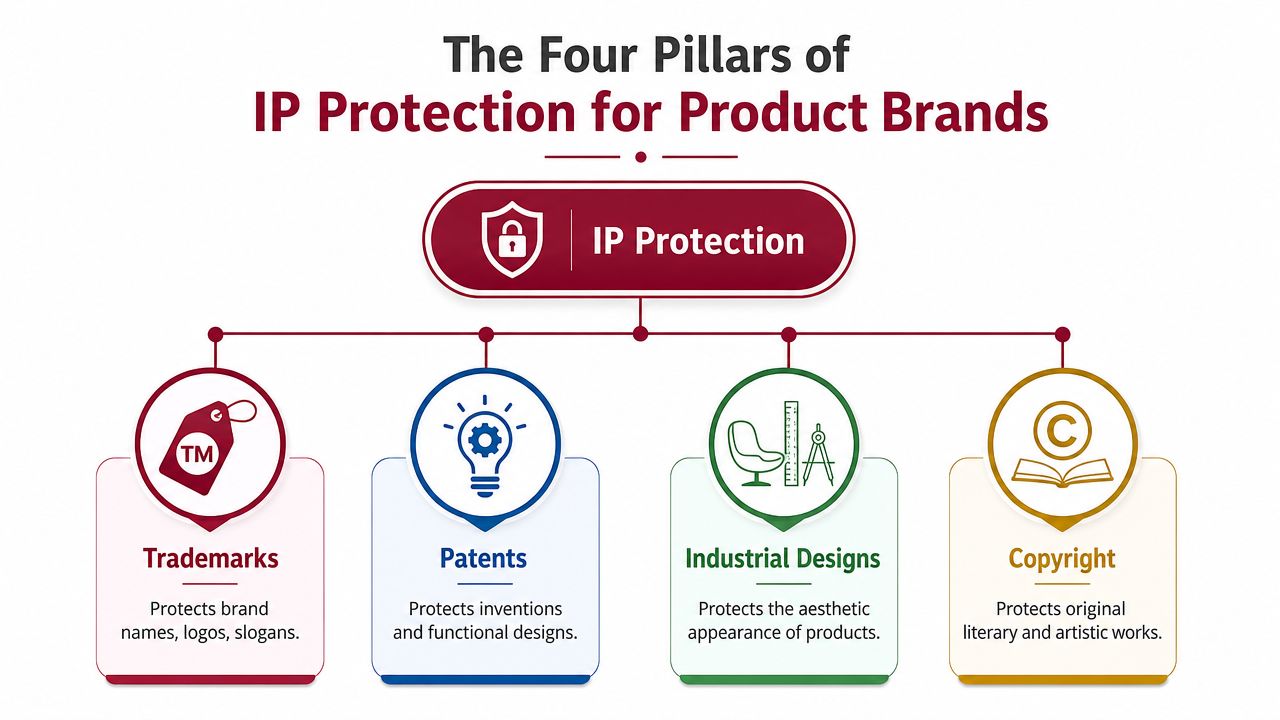
The Four Pillars of IP Protection for Product Brands
A useful IP strategy starts by separating what each right protects. Product brands often blur these categories, then spend in the wrong place. A logo issue gets treated like a patent question. A functional innovation gets left as a branding discussion. A packaging asset gets ignored because it doesn't look “technical” enough.
The clearer approach is to map each right to a commercial asset class.
What each pillar does in practice
Trade marks protect the identifiers customers and partners use to recognise your business. That includes names, logos, and other brand-facing elements tied to market recognition. For most product companies, this is the first layer of commercial defensibility because it anchors every listing, carton, product page, and retail discussion.
Patents protect inventions and functional innovation. For hardware and engineered products, patents offer protection for the thing competitors can study, replicate, and relaunch if it's technically distinctive and suitable for disclosure.
Industrial designs protect appearance. For many consumer products, the visual layer matters more than founders initially think. If shape, finish, silhouette, or visual presentation influences buying behaviour, design protection deserves serious attention.
Copyright protects original creative expression. In product businesses, that often covers manuals, photography, packaging artwork, product copy, diagrams, campaign assets, and other original materials that travel through digital commerce environments.
One issue we repeatedly observe is that brands entering marketplaces focus almost entirely on trade marks, then leave the rest exposed. That creates a partial moat. It doesn't create a cohesive one.
Comparing core rights
| IP Type | What It Protects | Typical Duration (AU) | Strategic Purpose for Product Brands |
|---|---|---|---|
| Trade marks | Brand names, logos, slogans, source identifiers | Varies by registration and renewal framework | Protects brand recognition, channel identity, and market trust |
| Patents | Functional inventions and technical innovations | Varies by patent type and legal status | Protects product differentiation that can be reverse-engineered |
| Industrial designs | Visual appearance of a product | Varies by registration framework | Protects distinctive form, styling, and product presentation |
| Copyright | Original literary and artistic works | Varies by work and ownership context | Protects packaging artwork, manuals, imagery, copy, and creative assets |
Where operators usually prioritise first
The right order depends on category, risk, and channel plan. Still, a practical pattern often looks like this:
- Trade marks first: If you're building a long-term brand, naming control usually can't wait.
- Patents where reverse-engineering risk is high: If a competitor can inspect the product and replicate the function after launch, delay becomes dangerous.
- Design rights where buying behaviour is visual: This is common in home, lifestyle, household, and premium product categories.
- Copyright as supporting infrastructure: It won't replace the other rights, but it strengthens control over the assets that marketplaces and resellers frequently copy.
For brands operating on Amazon and similar channels, this hierarchy also affects how platform-side enforcement works, which is why Amazon Brand Registry in Australia often becomes relevant once trade mark foundations are in place.
Protecting Your Unregistered Rights and Trade Secrets
Some of the most valuable IP in a product business never appears on a public register. It sits in supplier files, formulation notes, quality-control methods, CAD drawings, BOM variations, calibration settings, retailer terms, sourcing logic, and internal product roadmaps.
That invisible layer is often what makes the business hard to replicate.

Why legal notices are not enough
Trade secrets only stay valuable if the business behaves as though they matter. In practice, that means operational discipline, not just confidentiality language in a contract.
Guidance on IP governance points to a more actionable model: combine an auditable asset inventory with access controls, MFA, encryption, and data-loss prevention so the business can prevent unauthorised exfiltration of sensitive data instead of relying on legal remedies after the fact, as outlined in this ISO 27001 IP rights policy guidance.
That matters in exactly the places scaling brands become more exposed. Third-party logistics. Contract manufacturing. Shared cloud folders. Freelancer access. Overseas QA reviews. Distributor onboarding. Every handoff creates another point where proprietary information can leak without any dramatic breach event.
Trade secret protection fails quietly. Most losses don't begin with litigation. They begin with uncontrolled access.
What a workable control model looks like
An operator-led trade secret approach usually includes a small number of disciplined practices:
- Asset classification: Decide what counts as commercially sensitive. Product drawings, supplier specs, costing logic, and channel plans shouldn't all live in the same undifferentiated folder structure.
- Access by role: Engineers, agencies, factories, and distributors rarely need the same level of visibility.
- Documented ownership: Every sensitive asset should have an internal owner who decides access, version control, and retention.
- Technical safeguards: MFA, encryption, and DLP reduce the risk of information moving out unnoticed.
- Controlled third-party sharing: Use need-to-know disclosure rather than sending full packs by default.
What founders often overlook
Founders usually think of trade secrets as a backup option when patenting feels too expensive or too slow. That's incomplete.
Trade secrets are often the better primary choice when the information won't be visible after launch, when disclosure would give competitors too much insight, or when the value sits in process rather than product appearance. In manufacturing-led categories, that can include test methods, tolerances, process sequencing, sourcing relationships, and workaround knowledge accumulated over time.
The practical point is simple. If the business can't identify its hidden IP, it can't protect it. If it can't control access to that IP, it doesn't really own the commercial edge it thinks it has.
Navigating Global IP Territoriality and Treaties
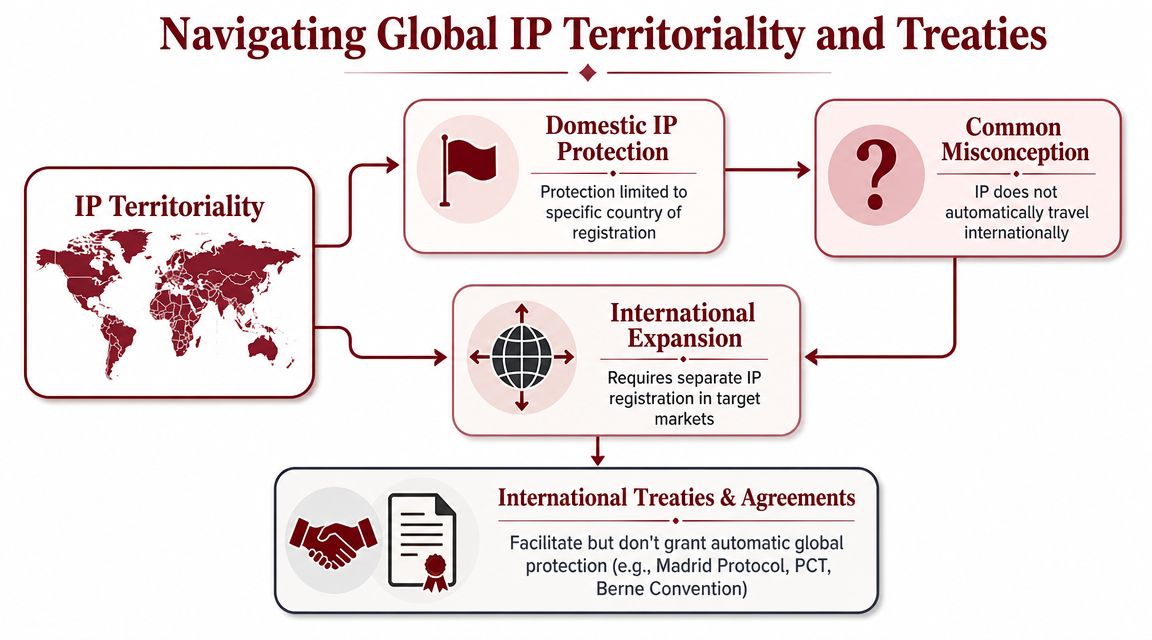
Founders often treat international IP as an admin exercise that starts after market entry. In practice, territoriality shapes commercial risk much earlier than that. A right secured at home does not follow the product into every Amazon store, distributor network, or reseller ecosystem, as its online visibility alone is not a guarantee.
That gap creates expensive exposure. A brand can build demand in a new market, attract copycats, and still have little practical control over listings, naming, product design, or technical claims because the filing sequence did not match the expansion sequence.
Territoriality is the commercial constraint
IP rights are territorial, but the commercial problem is broader than legal geography. Different markets create different forms of exposure. In one country, the immediate risk may be a local distributor filing your brand first. In another, it may be marketplace sellers copying your listing assets before your own channel strategy is established. In a third, the issue may be product teardown and fast design imitation.
That is why IP planning has to sit inside the wider international expansion strategy for brands entering fragmented markets, not beside it. Filing decisions affect who can represent the brand, how cleanly marketplace channels can be controlled, and whether brand value accrues to the owner or leaks to opportunistic intermediaries.
A short explainer can help frame the concept:
Treaties create filing pathways, not worldwide cover
International treaties help businesses coordinate protection across jurisdictions. They do not create a single global right.
That distinction matters because many founders overestimate what a treaty filing has bought them. Madrid can help with trade marks. The Patent Cooperation Treaty can help stage patent activity. Hague can help with designs in participating jurisdictions. Each system reduces some administrative friction, but each still ends in country or regional rights, local examination standards, local objections, and local enforcement realities.
The practical question is not whether a treaty exists. The practical question is whether that treaty supports the order in which your brand will become visible, copied, stocked, or searched for.
Filing quality matters before international scale
For patent-led businesses, weak early records create problems later. If the invention may need protection, the application has to be supported by material that shows what was developed, by whom, and in what form. For Australian technical businesses, one useful reference point is enablement. The filing must explain the invention clearly enough for a skilled person to reproduce it, as outlined in this intellectual property guide for technical businesses.
I see the same commercial mistake repeatedly. Teams move fast on product launch, delay documentation, then try to reconstruct technical history once overseas interest appears. By then, the business is not just fixing a legal record. It is trying to protect margin, distributor confidence, and channel control after the product has already entered circulation.
Practical rule: Patent what a competitor can learn from the product itself. Keep secret what remains hidden in process, sourcing, tolerances, testing, or operating know-how.
That rule becomes more valuable as channels multiply. Marketplace ecosystems reward speed and visibility. Territorial IP rules reward sequencing and evidence. Brands that treat treaties as part of commercial risk management, rather than a box-ticking legal step, usually preserve more control over pricing, listing ownership, partner quality, and long-term brand value.
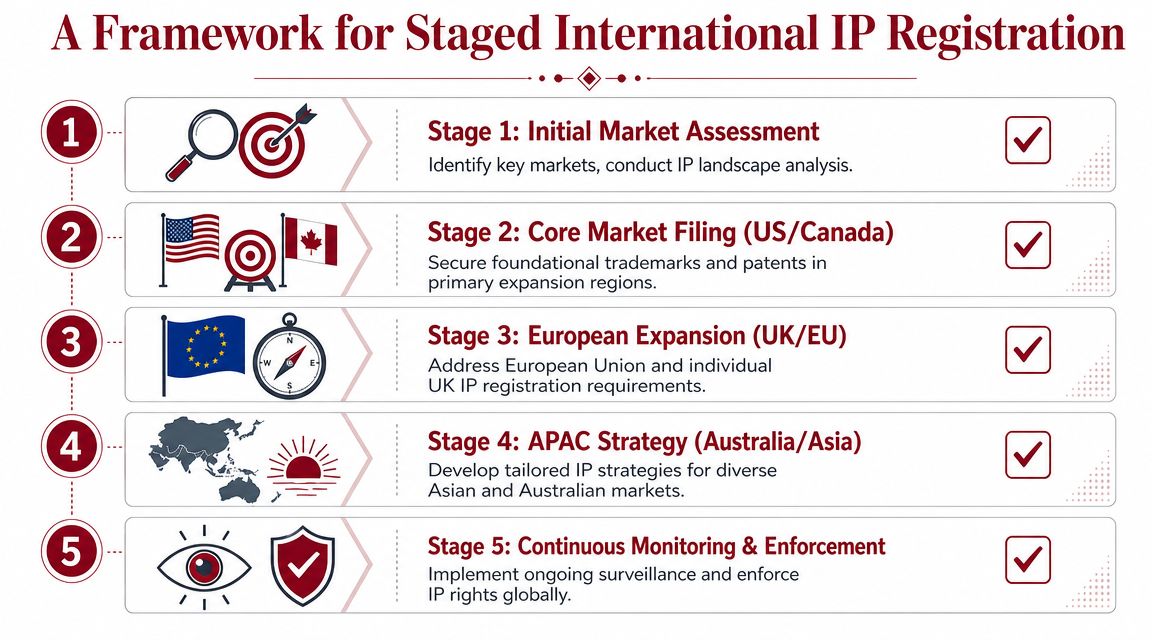
A Framework for Staged International IP Registration
International IP registration works best as a market entry decision, not a filing exercise. Founders who treat it as a legal checklist often spend too early in the wrong countries, then arrive late in the markets that shape pricing power, listing control, and partner confidence.
Filing sequence matters because commercial exposure is uneven. One country may generate little revenue but set search visibility, reseller behaviour, or distributor expectations for an entire region. Another may matter mainly because copying starts there and then spreads through marketplaces.
A staged model that reflects commercial reality
A workable model starts with exposure, not theory.
File first in markets that shape perception and channel control
Prioritise the countries where the brand will be seen, searched, reviewed, and resold early. These markets often deserve trade mark attention before broader rollout because they influence how the brand is represented across distributors, retail partners, and marketplace listings.Match the filing queue to the way the product can be copied
Products that can be understood by inspection create a different risk profile from products protected by hidden process know-how. If the external design drives demand, design rights may move up the list. If the advantage sits inside manufacturing method, sourcing logic, or tolerances, formal registration in every secondary market may be less urgent than strict internal controls.Use contracts to cover the gap between intent and registration
Expansion rarely waits for every filing to clear. During that gap, confidentiality terms, distributor restrictions, manufacturing agreements, and ownership clauses help contain risk while the registration program catches up. They do not replace territorial rights, but they buy time and reduce avoidable leakage.
A decision lens founders can actually use
The better question is not which rights are available. It is where a loss of control will hurt margin, channel quality, or brand value fastest.
Use four filters:
Where would confusion or imitation damage sales quality first?
That usually points to trade mark priority.What can a competitor copy from the product itself?
That should trigger patent or design review.What remains hidden after purchase but still creates commercial advantage?
That belongs in trade secret discipline, access controls, and contract design.Which countries matter because they influence adjacent markets, not just local revenue?
That determines staging.
International expansion teams often make better choices than isolated legal or sales functions. They map rights against channel behaviour. A useful planning reference is a structured global expansion strategy for international marketplace and channel growth.
What staged expansion looks like in practice
Primary markets usually justify filing before launch, or at least before meaningful channel activity begins. Those are the countries where losing the name, the product presentation, or the first serious distributor can create expensive downstream problems.
Secondary markets often call for a narrower position at first. The business may rely on contracts, controlled disclosure, and selective filings while it tests whether the market becomes a real revenue node, a visibility node, or a copying risk.
Later-entry regions deserve discipline, not autopilot. By that stage, the company has more evidence about what customers value, what competitors imitate, and which channels create the most exposure. That usually produces better filing decisions than a blanket international program designed too early.
The commercial advantage is coordination. Strong operators keep IP planning tied to launch calendars, distributor appointments, marketplace entry, and product roadmap decisions. TPR Brands, for example, works with established product companies on international marketplace and channel expansion, which can help align filing priorities with regional go-to-market timing when several markets are opening at once.
Marketplace Enforcement and Proactive Brand Monitoring
Registration creates the right. It doesn't create the outcome.
In digital marketplaces, brand value is usually damaged by delay rather than by a single dramatic infringement event. A copied listing sits live too long. A reseller uses brand assets inconsistently. A confusingly similar product appears beside the original. Customers stop distinguishing between authorised and unauthorised offers. Margin pressure follows.
Why reactive enforcement underperforms
A purely reactive model waits for visible damage, then starts filing complaints. That can work for isolated incidents. It doesn't work well for brands operating across fragmented ecosystems where listings, imagery, resellers, and search results shift constantly.
One pattern we continue seeing is that businesses assume a registered trade mark will carry more practical weight than it does on its own. In reality, enforcement depends on documentation, platform readiness, internal ownership, and response speed. If nobody in the business is monitoring misuse, the registration becomes passive.
Active rights change behaviour. Dormant rights mostly create paperwork.
What proactive protection looks like
An ecosystem-aware enforcement model usually includes:
- Brand registry participation where relevant: This can improve platform-side reporting and control processes.
- Regular listing review: Not just for obvious counterfeits, but for image misuse, title inconsistency, unauthorised bundles, and channel leakage.
- Clear ownership internally: Someone needs authority to decide what gets escalated and how fast.
- Evidence retention: Screenshots, listing histories, packaging comparisons, and communication records matter.
- Authorised seller clarity: If partners and channels are loosely managed, enforcement gets harder because the market itself becomes confusing.
This is one reason Amazon listing control matters far beyond conversion optimisation. Listing discipline shapes whether the market can clearly recognise the genuine brand ecosystem in the first place.
The real objective
The goal isn't to win every dispute. It's to signal that the brand is organised, documented, and defended.
That signal matters to customers, distributors, marketplaces, and opportunistic competitors alike. Brands that monitor consistently usually preserve a cleaner commercial environment. Brands that ignore enforcement until revenue is already affected tend to discover that legal ownership and market control are not the same thing.
Common Pitfalls and Advanced Strategic Thinking
The most expensive IP mistakes usually come from misalignment, not ignorance. A founder files too late because growth moved faster than expected. A team patents the wrong thing and discloses more than it should. A company secures rights domestically but expands as if those rights travel automatically. Or a business registers assets without building the operating controls needed to make those rights useful.
Those are common problems. The more advanced one is subtler.
Protection can also create friction
A well-developed IP strategy has to recognise the tension between protection and access. Academic analysis has described how over-protection can create a “negative public domain”, where downstream use and access become more restricted than is commercially helpful, as discussed in this analysis of IP, access, and development.
For hardware and consumer brands, that matters more than many legal summaries admit. A product often needs installers, service partners, repair networks, aftermarket compatibility, and channel education to scale properly. If the business locks down every asset with no commercial nuance, it can end up slowing adoption in the very ecosystem it needs to build.
Better strategic judgement
The stronger position is usually selective control.
- Patent the core technology when it's central, visible, and worth disclosing.
- Keep repair or process know-how secret when partners need outcomes, not full technical visibility.
- License deliberately when broader adoption helps the category or channel.
- Avoid filing for assets that need openness to spread across service or distributor networks.
That's the level where intellectual property protection becomes commercially intelligent instead of merely defensive. It stops being a stack of filings and becomes part of market design.
Founders don't need maximal protection everywhere. They need the right protection, in the right order, for the right commercial reason.
If your brand is moving into new regions, new marketplaces, or new channel structures, TPR Brands helps established product companies align brand control, market entry, and commercial expansion so growth doesn't outpace the ecosystem needed to protect it.