Most Amazon Australia advice is built for first-time sellers. Established brands face a different risk: losing control while scaling.
Amazon Brand Registry Australia is not an admin step—it’s the control layer that determines who owns your listings, pricing, and brand presence from day one.
Australia is not just a smaller version of the US or UK. It is a separate operating market with its own tax settings, product rules, customer expectations, and trademark considerations. Founders who treat Amazon AU as a copy-paste launch often discover the problem late, after content is live, claims need revision, and enforcement options are limited.
The practical question is simple. Who controls the brand assets, listing authority, and infringement response from day one?
If the answer is unclear, the launch is early.
Brand Registry is often filed under admin. For an established brand, it is the control system behind premium positioning on Amazon AU. It affects who can shape your product detail pages, how quickly you can act on misuse, and whether your Australian entry builds brand equity or discounts it. For brands planning Amazon marketplace expansion in Australia, that decision belongs at the start, especially where international trademark ownership and local compliance do not line up neatly.
The practical question is simple. Who controls the brand assets, listing authority, and infringement response from day one?
Founder Hook and Introduction
Founders rarely struggle with the decision to enter Amazon Australia. The expensive mistake is treating entry as a listing task instead of a control decision.
Established brands usually arrive with strong proof that the product works. They have traction in retail, DTC, distribution, or another Amazon region. That history helps, but it also creates a false sense of transferability. Australia rewards disciplined localization and punishes assumptions, especially when trademark ownership, regulatory claims, and catalogue governance sit across different entities or jurisdictions.
That is why Amazon marketplace expansion in Australia needs to be planned as an operating model, not a channel launch.
A brand can have healthy demand and still lose ground quickly if the setup is loose. Listings are copied from the US or UK with claims that do not fit local standards. Trademark filings are still in progress while resellers or distributors start creating product detail pages. Compliance evidence exists, but the team responsible for Amazon cannot produce it fast when questions arise. By the time sales start, the brand is already reacting instead of directing.
Why the stakes are higher than they look
Amazon AU gives established brands real upside, but it also exposes weak internal alignment. The common failure point is not product quality. It is fragmented ownership across legal, marketing, operations, and marketplace teams.
I see the same pattern repeatedly with cross-border brands. The founder assumes the Australian launch can borrow authority from an overseas registration or an existing Amazon presence. Amazon usually treats those as separate questions. Who owns the trademark rights for this market? Who controls the listings on day one? Who can act if claims, imagery, or product titles are changed by another seller? If those answers are unclear, the launch carries more risk than the forecast suggests.
Practical rule: Organise trademark ownership, compliance records, and listing authority before launch. Cleaning it up later is slower, more expensive, and far more public.
Amazon Brand Registry as a Control System
For an established brand, Brand Registry is less about admin and more about market control.
It helps your team protect brand assets, set the standard for product page content, and respond faster when another seller creates confusion around your offer. It also matters for a more strategic reason. In Australia, many established brands enter through a mix of local distributors, offshore entities, and inherited intellectual property structures. Brand Registry forces clarity on who has standing to control the brand inside Amazon. That question becomes critical long before an infringement dispute appears.
Used properly, Brand Registry supports premium positioning and cleaner execution. Used late, it becomes a recovery project.
Why Amazon Brand Registry Australia Is Non-Negotiable
Founders often treat Brand Registry as a cleanup tool for counterfeit complaints and listing abuse. In Australia, that framing is too small. For an established brand, Brand Registry is the operating layer that determines who controls product detail pages, brand presentation, and enforcement rights inside Amazon AU.
The strategic case starts with control
Amazon Australia is crowded with third-party sellers, parallel importers, agencies, and local distribution partners. That creates a specific problem for overseas brands entering the market. The issue is rarely just bad actors. It is fragmented authority.
If the trademark sits with one entity, the Amazon account is operated by another, and a distributor has historical claim over listings or packaging assets, the brand enters the market with weak control from day one. Brand Registry forces those questions into the open. That is why established brands should treat it as a prerequisite, not an admin task.
The real value is speed under pressure. When titles are rewritten, images are replaced, or a reseller starts shaping customer expectations around your product, the team with Brand Registry has clearer standing and better tools to respond.
Brand Registry changes the risk profile of an AU launch
Beginner guides usually present Brand Registry as a way to protect logos and report infringement. That misses the commercial point. In Australia, it affects how cleanly a premium brand can enter a market where local compliance, tax settings, content adaptation, and seller structure all interact.
I have seen brands spend heavily on launch media, local inventory, and agency support while leaving ownership and registry issues unresolved. The result is predictable. Listing authority gets blurred, internal teams argue over who can make changes, and enforcement becomes slower precisely when the brand is trying to build trust with first-time customers.
That is a poor trade.
Brand Registry does not remove every marketplace risk. It does make those risks easier to contain.
The trademark route is a strategic decision, not a filing detail
Before Brand Registry can work properly, the trademark path has to match the brand’s actual expansion plan. There are usually three workable routes.
| Path | Best for | Main advantage | Main trade-off |
|---|---|---|---|
| Direct Australian trademark application | Brands treating Australia as a serious standalone market | Clear local ownership position | Separate filing process and local administration |
| Madrid Protocol designation | Brands building wider international trademark coverage | Australia can sit inside a broader filing plan | Less flexibility if ownership, classes, or market priorities change |
| Amazon IP Accelerator | Brands that need earlier access to Brand Registry while trademark work is underway | Faster practical access to Amazon brand tools | Temporary solution if the underlying trademark strategy is weak |
The wrong choice usually comes from impatience. A founder wants the account live, assumes the existing overseas mark will be enough, and postpones the ownership discussion. On Amazon AU, that shortcut often creates a larger problem later. The brand may be selling, but the legal and operational foundation is still unstable.
What sophisticated brands get right
Strong operators align three things before scale. The trademark owner has clear standing. The Amazon account structure reflects that ownership. The local market plan accounts for Australian requirements rather than importing a US or UK setup unchanged.
That alignment matters because Brand Registry only helps when Amazon can see who is entitled to act for the brand. If your legal entity structure, listing control, and market entry model are pulling in different directions, Brand Registry becomes slower to use and less effective when disputes start.
For established brands, that is the point to focus on. Brand Registry is not just protection. It is control, and control is what turns an Australian launch from a seller setup into a brand expansion.
Trademark Strategy for Amazon Brand Registry Australia
Trademark work is where many founders either slow down intelligently or rush into later problems. The amazon marketplace rewards speed in some areas, but trademark strategy isn’t one of them. A poor filing decision can create friction long after the first listings go live.
Start with your real operating structure
Before you file anything, confirm four basics internally:
- Ownership entity: The legal owner of the trademark should match the entity that will control the brand in market.
- Brand expression: The word mark, logo use, and packaging should align. Small inconsistencies create avoidable verification issues.
- Category scope: File in a way that reflects the products you plan to sell, not every theoretical future category.
- Territory logic: Decide whether Australia is a standalone priority or part of a broader international filing sequence.
In this situation, founders often discover that the business structure on paper doesn’t match the expansion structure in practice.
Direct filing versus international designation
A direct filing with IP Australia usually suits brands that want a locally grounded position. It’s straightforward in concept, but it still requires discipline. The mark should match what appears on packaging and listings. If your packaging, inserts, and product photography show one form of the brand while the filing shows another, Amazon verification and later enforcement get harder.
Madrid Protocol designation can be the right move when the brand is entering multiple markets in a coordinated way. The benefit is strategic alignment. The cost is that your Australian move becomes partly dependent on the way the wider international filing is structured.
Neither route is automatically better. The better route is the one that matches how the business will operate.
When IP Accelerator makes sense
Founders often ask whether Amazon IP Accelerator is a shortcut. It is, but only in a narrow sense.
It can help brands gain earlier practical access to Brand Registry while the full trademark process continues. That can be valuable when launch timing matters, content development is already underway, and delaying branded assets would hold back the whole channel. But it shouldn’t replace proper thinking about long-term ownership, category scope, and market sequence.
A rushed decision here usually shows up later as an expensive clean-up exercise.
A useful overview of the practical workflow is below.
Documents to gather before you touch the application
Most delays happen because teams open the process before the inputs are ready. A founder doesn’t need to file every field personally, but should make sure the following pack exists first:
-
Trademark details
Registration or application details exactly as filed, including owner name and mark format. -
Brand asset set
Logo files, packaging images, product photos, and any product shots showing the mark clearly on goods or packaging. -
Entity documents
The trading entity details used across Amazon Seller Central, invoicing, and brand ownership records should be consistent. -
Catalogue map
A simple list of which SKUs will launch first, under what naming structure, and in which product categories. -
Verification contact plan
Decide in advance who receives trademark correspondence and who on your team will action Amazon requests quickly.
If the legal owner, seller account, packaging, and listing assets don’t line up, don’t expect Amazon to solve the inconsistency for you.
The founder decision is not legal only
Trademark choice is really a commercial decision disguised as a legal one. It affects how fast you can activate branded content, how cleanly you can enforce misuse, and how much rework the team will absorb later.
For brands with real traction, the right question isn’t “What’s the cheapest path to Brand Registry?” It’s “Which path protects the business if Australia becomes a durable growth market?”
Amazon Brand Registry Enrolment Process (AU Guide)
By the time you start enrolment, the work should feel procedural. If it feels uncertain, the preparation probably isn’t complete.
Founders don’t need to sit inside Seller Central clicking every button, but they do need oversight on the inputs. Most enrolment delays aren’t caused by Amazon being mysterious. They’re caused by mismatched information, unclear ownership, or teams submitting before their documents are aligned.
What to have prepared before submission
A clean enrolment package usually includes:
- Registered brand name: It should match the trademark record and the way the brand appears on the product or packaging.
- Trademark reference: The filing or registration information must be accurate and current.
- Product category context: Amazon needs to understand what kind of goods the brand covers.
- Visual proof: Use images that clearly show the brand on the product itself or on durable packaging.
- Responsible contacts: Decide who handles account access, legal follow-up, and verification messages.
For overseas teams, this is often where handoff problems start. The legal adviser has one version of the mark, the operations team has another, and the content team has already built listings around a third version. Fix that before submitting.
The enrolment phase founders should monitor closely
The technical submission itself is rarely the strategic problem. Verification is.
Amazon’s code process and follow-up checks only work smoothly when the correct rights-holder contact receives the request and knows what to do with it. If those messages go to an inbox nobody monitors or to an adviser who isn’t coordinated with the ecommerce team, the launch timeline stalls for reasons that look avoidable because they are avoidable.
For overseas brands building an AU presence, this is also where the broader operating model matters. If your team is preparing to sell on Amazon Australia from overseas, Brand Registry shouldn’t sit in isolation from account governance, content ownership, and local compliance review.
Think in systems, not features
Most brands treat Brand Registry tools as separate tasks. One team builds A+ Content. Another team launches Sponsored Brands. Someone else creates a Store. That fragmented approach usually produces a fragmented customer experience.
A better model is to treat these assets as one brand system.
| Tool | What it does | Strategic use |
|---|---|---|
| A+ Content | Expands product page storytelling | Clarifies value, comparisons, use cases, and trust cues |
| Brand Store | Creates a branded destination inside Amazon | Organises the range and gives shoppers a controlled path through the catalogue |
| Sponsored Brands | Places the brand at the top of relevant search journeys | Captures demand while reinforcing brand identity, not just individual SKU visibility |
Why this matters for premium positioning
If you’re trying to hold margin, the goal isn’t only to increase clicks. It’s to justify confidence.
A+ Content should answer the doubts that hold back conversion. The Store should make the assortment feel intentional. Sponsored Brands should lead shoppers into the part of the catalogue that supports your broader pricing strategy, not just whatever product has the shortest-term ad opportunity.
The founder’s job isn’t to admire Brand Registry features. It’s to make sure they work together as a commercial argument for why your product deserves its position.
That’s where premium brand experience starts to show up inside the amazon marketplace.
Activating Brand Tools to Dominate the Marketplace
Brand Registry only starts creating value when the tools are tied to a clear commercial plan. Established brands expanding into Australia usually do not struggle with access. They struggle with translation. A brand system that works in the US, UK, or EU often loses precision on Amazon AU if the content, range logic, and compliance settings are copied across without adjustment.
Once the tools are live, the primary question is how to protect premium positioning inside a channel designed to compress products into side-by-side comparisons.
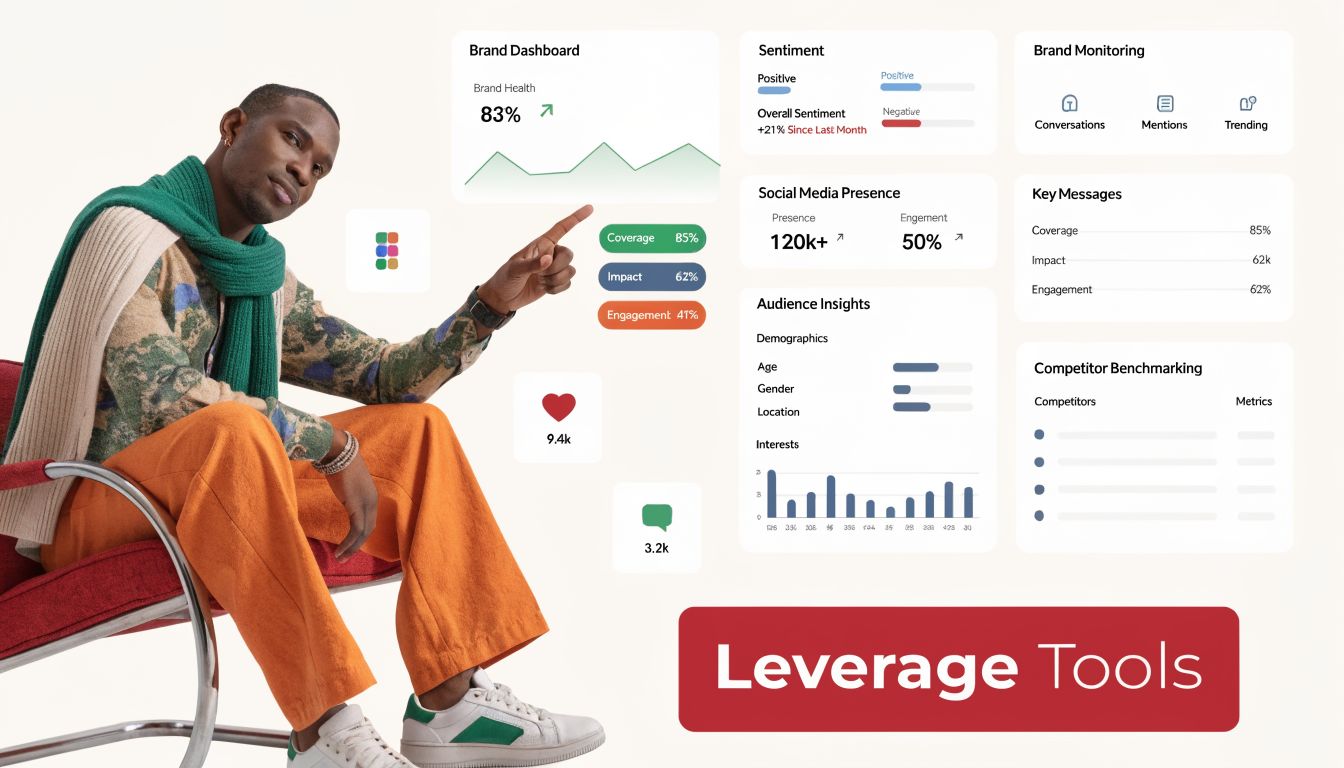
A plus Content should carry the sales argument
A+ Content needs to do more than look polished. Strong brands use it to reduce the specific doubts that stall a purchase, especially when shoppers are comparing imported products, local competitors, and private label offers on the same results page.
Good A+ Content does four jobs well:
- Clarifies range logic: It shows which model, size, or variant fits which customer need.
- Answers objections early: It deals with setup questions, compatibility concerns, quality cues, or usage limits before the shopper leaves the page.
- Supports margin protection: It gives customers a reason to choose the better-fit product rather than the cheapest visible option.
- Signals operational maturity: Clear, accurate content suggests the brand is established, monitored, and serious about the market.
This is particularly important for hardware, household, and consumer product brands because shoppers often compare visually similar items at speed. If the listing does not organise that decision, price and review volume usually take over.
Your Brand Store should reflect how Australians shop the range
A Brand Store works best when it is built around buying paths, not internal category labels. Brands entering Australia with a trimmed catalogue need this discipline even more. A partial launch can still look deliberate if the Store explains how the range fits together and where the customer should go next.
In practice, that often means structuring the Store by use case, project type, room, routine, or product family. Accessories, refills, and trade-up products should never feel buried. If they are hard to find, basket size suffers and the catalogue starts to look thinner than it is.
For founders building out their Amazon selling strategy in Australia, the Store is one of the few places on the platform where the brand controls sequence, context, and assortment logic.
Sponsored Brands should direct intent, not just buy exposure
Sponsored Brands are most useful when they reinforce the structure behind the catalogue. Sending every click to the same destination wastes that opportunity.
A better approach is to match the destination to the search intent:
| Search type | Better destination | Why it works |
|---|---|---|
| Brand-led searches | Brand Store or curated landing page | Confirms legitimacy and creates cross-sell opportunities |
| Category intent searches | Hero SKU or focused collection page | Concentrates traffic where the offer is strongest |
| Product comparison searches | Listings with the strongest A+ Content | Lets the content answer objections and support conversion |
In this area, established brands usually outperform newer sellers. They treat ad placement as part of positioning, not just demand capture.
Activation depends on local accuracy
Brand tools lose value quickly when the local execution is careless. Australian expansion creates small but material points of friction. Product claims, GST settings, variation structure, fulfilment planning, and local terminology all affect how credible the brand looks once traffic arrives.
I have seen brands invest heavily in creative assets, then weaken conversion with US spelling, unclear pack sizing, or imported comparison tables that do not match the AU range. None of those issues looks dramatic on its own. Together, they make the catalogue feel transplanted rather than established.
What tends to work, and what usually breaks
The strongest outcomes usually come from disciplined localisation, tight catalogue control, and clear ownership across content, ads, and rights management. The weak outcomes are predictable. Teams copy global assets into AU, send paid traffic before the listing system is coherent, and treat enforcement as a separate operational problem.
Support models vary. Some brands need trademark and compliance advice. Others need marketplace operators who can maintain catalogue quality and adapt the brand for local buying behaviour. TPR Brands can be one operating partner in that mix for channel expansion and market adaptation. The right model depends on whether the main constraint is legal setup, execution capacity, or cross-border coordination.
Navigating Enforcement and Cross-Border Compliance Risks
Most brand owners pay attention to Amazon protection only after a listing problem appears. By then, the issue is usually larger than it needed to be.
Enforcement inside the amazon marketplace and compliance outside it have to be managed together. If you only do the first, you can still lose time, listings, or account standing because the underlying local requirements weren’t handled properly.
A practical enforcement checklist
Use this as an operating rhythm, not a one-off clean-up.
- Monitor branded listings regularly: Check for unauthorised edits, image swaps, incorrect variation structures, and offer activity that changes how the brand is presented.
- Keep evidence organised: Save packaging shots, product images, trademark records, and product identifiers in a shared place the team can access quickly.
- Use Report a Violation with precision: Broad complaints are weak. Clear evidence tied to a specific misuse gets better traction.
- Escalate patterns, not only incidents: One bad listing might be noise. Repeated misuse suggests a structural issue that needs tighter oversight.
- Review internal permissions: Sometimes listing damage comes from your own fragmented account access rather than an external hijacker.
This isn’t glamorous work, but it protects the asset you’ve invested in building.
Compliance is the part many imported brands underestimate
Australia can be forgiving of mediocre marketing. It is less forgiving of poor compliance discipline.
A recurring blind spot is imported goods entering Amazon AU without adequate pre-listing review for local standards, especially in categories where safety, labelling, or usage claims matter. Existing content often misses a reported 25% increase in compliance-related suspensions for imported goods on Amazon AU in the last 12 months, which has been noted in this discussion of Amazon AU compliance risk. For founders, that means market entry work has to include a local compliance audit before catalogue rollout, not after.
If your products touch electrical standards, consumer law, instructions for use, or packaging disclosures, treat Australia as its own approval environment.
A suspended listing is rarely just a listing problem. It disrupts launch timing, ad efficiency, inventory planning, and internal confidence in the market.
What founders should check before launch and during scale
The most useful way to handle this is as a live checklist.
Before launch
-
Confirm product standards
Make sure the product itself meets relevant Australian requirements for its category. -
Review labels and packaging
Check whether the outer packaging, warnings, and usage instructions are suitable for AU sale. -
Audit claims language
Product claims that are acceptable elsewhere may need adjustment under Australian Consumer Law. -
Align legal and commercial teams
The people managing compliance and the people building the listings need to work from the same source material.
During launch
- Watch for suppression signals: Listing issues often appear first as warnings, missing fields, or content restrictions.
- Check the customer-facing page after every major change: Teams often assume updates published correctly when they didn’t.
- Document support interactions: If a case needs escalation, organised records matter.
During scale
- Re-audit when the catalogue expands: A clean first launch doesn’t guarantee the next product family is equally ready.
- Review imported goods workflows: Compliance can drift when sourcing, packaging, or inserts change.
- Tighten channel governance: If multiple markets share assets, make sure AU requirements don’t get overwritten by another region’s version.
For founders already exploring broader Amazon selling strategy in Australia, local expertise proves commercially useful. The hidden costs of non-compliance aren’t only regulatory. They show up in delayed launches, wasted ad spend, stranded operational effort, and avoidable account friction.
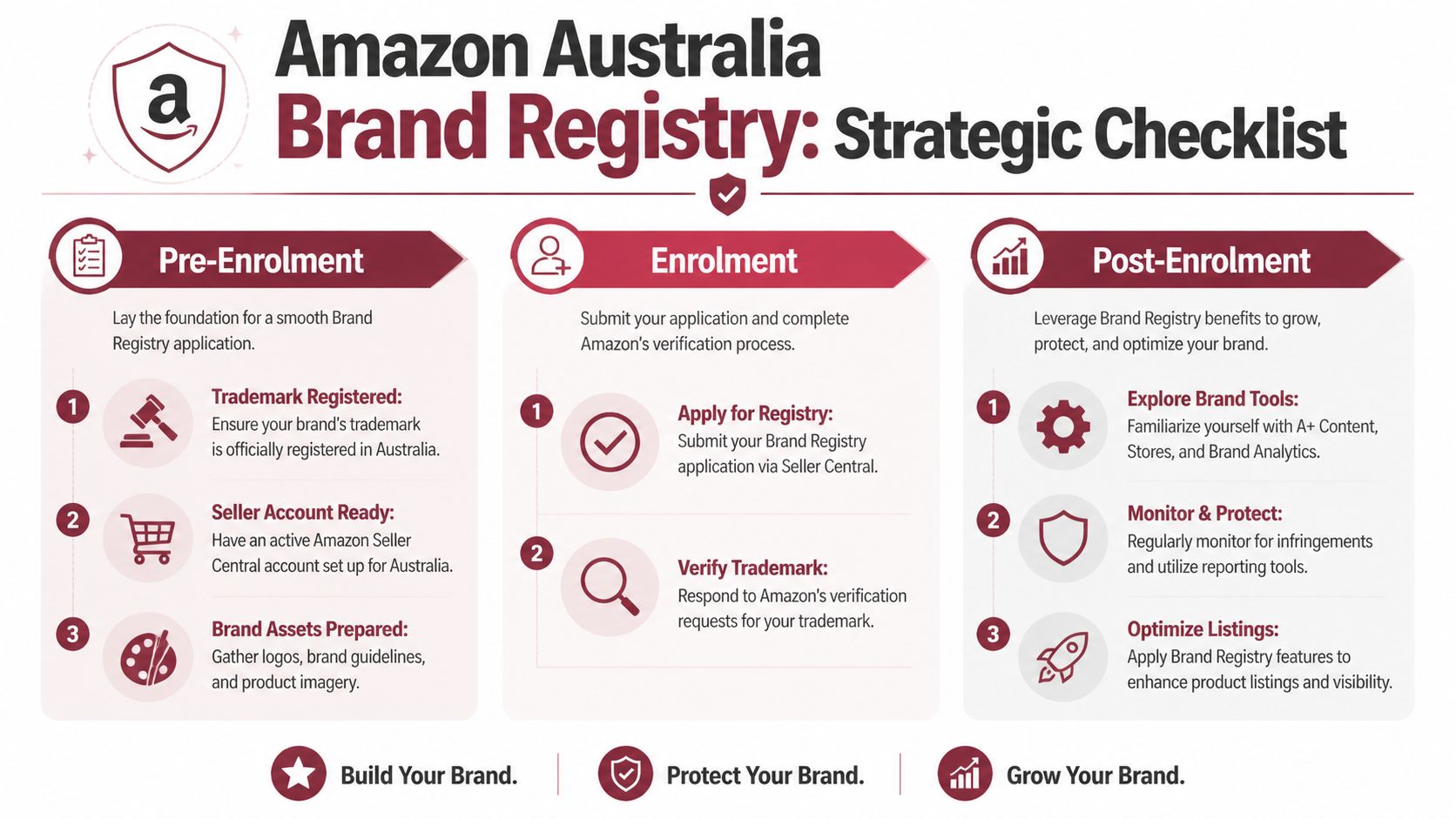
Your Strategic Checklist for Amazon Australia Brand Registry
A strong Amazon Australia launch doesn’t begin with uploading a listing. It begins with deciding how much control you want over the market you’re entering.
Use this checklist as a working document for your team.
Pre-enrolment priorities
-
Choose the trademark route deliberately
Decide whether direct Australian filing, Madrid designation, or IP Accelerator matches your timeline and long-term market intent. -
Align ownership details early
Make sure the trademark owner, seller entity, and operating structure don’t conflict. -
Prepare proof of brand use
Gather packaging, product photos, and branded assets that clearly connect the mark to the goods. -
Localise the market offer
Don’t assume overseas listings will translate cleanly into AU customer expectations.
Enrolment execution checks
| Focus area | What to confirm |
|---|---|
| Trademark data | Exact match between filing details and Amazon submission |
| Brand name usage | Consistent across packaging, listings, and internal records |
| Team roles | Clear owner for legal follow-up, account admin, and content readiness |
| Verification handling | The right person will receive and action Amazon requests promptly |
Post-enrolment activation moves
-
Build A+ Content with commercial logic
Use it to reduce doubt, compare products properly, and support premium positioning. -
Design the Brand Store around buying behaviour
Organise by use case or product family, not internal category jargon. -
Use Sponsored Brands to shape discovery
Direct shoppers into curated brand experiences, not random SKU endpoints. -
Set an enforcement rhythm
Monitor the catalogue, preserve evidence, and address misuse before it compounds. -
Treat compliance as ongoing
Recheck product, packaging, and claims whenever range, suppliers, or source assets change.
Founders who do this well don’t treat Brand Registry as the finish line. They use it as the operating base for disciplined growth.
Conclusion The Path to Scalable Brand Growth
Brand Registry isn’t the goal. Controlled expansion is.
The amazon marketplace can be a strong channel for Australian growth, but only when the brand enters with legal clarity, local compliance discipline, and a deliberate plan for how branded assets will support margin and trust. Great products don’t automatically become strong marketplace brands. They become strong brands when the founder protects positioning as carefully as they pursue revenue.
At TPR Brands, we work with founders navigating these challenges as they expand into international markets, helping ensure a proven product scales with control rather than losing value in the process.
If you're assessing whether your brand is structurally ready for Amazon Australia, TPR Brands works with established product companies that need disciplined channel expansion, local market adaptation, and brand protection as they grow into new regions.