Most advice about amazon marketplace expansion focuses on speed. List the product, launch ads, send inventory, and scale fast.
That approach works for short-term sellers. It rarely works for established brands trying to build long-term international growth.
For Australian product companies, Amazon is not just another sales channel. It is a competitive market environment with different customer expectations, operational pressures, pricing dynamics, and brand risks. A strong product can gain international traction quickly, but poor market selection, weak positioning, and loose operational planning can damage margins and dilute brand value just as fast.
The real challenge is not simply getting products listed overseas. It is building an expansion strategy that protects pricing power, supports operational stability, and allows the brand to scale internationally without losing control of how the business is positioned.
Why Great Australian Products Fail Internationally
Australian founders often assume overseas growth is a translation exercise. New market, same product, same story, same economics.
That’s rarely how it plays out.
A product can be strong in Australia and still struggle abroad because the company exported the listing instead of adapting the business model. The first signs usually appear in places founders don’t expect. Unit economics get tighter. Freight and fulfilment distort pricing. Customer expectations shift. Competitors frame the category differently. What looked premium at home looks generic in a larger market.
Product quality is rarely the real problem
Most failed international launches aren’t failures of invention. They’re failures of positioning and operating design.
A founder enters the US or UK through amazon marketplace because the channel feels accessible. The catalogue goes live quickly. Early sales create confidence. Then the pressure starts.
- Price pressure rises because your product sits beside local incumbents, private label copycats, and aggressive resellers.
- Messaging weakens because packaging, imagery, and claims that worked in Australia don’t always express value clearly in another market.
- Execution becomes fragmented because inventory, compliance, support, and advertising are being managed across time zones without local structure.
Great products rarely fail overseas because nobody wants them. They fail because the company confuses availability with market fit.
What founders usually underestimate
International growth punishes loose thinking. Amazon rewards speed at the listing level, but brand expansion needs discipline at the business level.
Three mistakes show up again and again:
- Treating Amazon as the strategy instead of one channel inside a broader market entry plan.
- Assuming domestic proof equals global readiness when the operating model hasn’t been rebuilt for a new region.
- Chasing topline revenue while ignoring whether margin, brand control, and repeatability remain intact.
The right conclusion isn’t that amazon marketplace is a bad option. It’s that it magnifies whatever strategic clarity, or confusion, the brand already has.
The Commercial Drivers for Global Brand Expansion
Founders often reduce global expansion to one idea. More customers. That’s true, but it’s not the full commercial case.
The stronger reason to expand is that international growth changes the structure of the business. It can reduce concentration risk, improve negotiating power with suppliers, sharpen the brand, and create new strategic options that don’t exist in a single-market model.
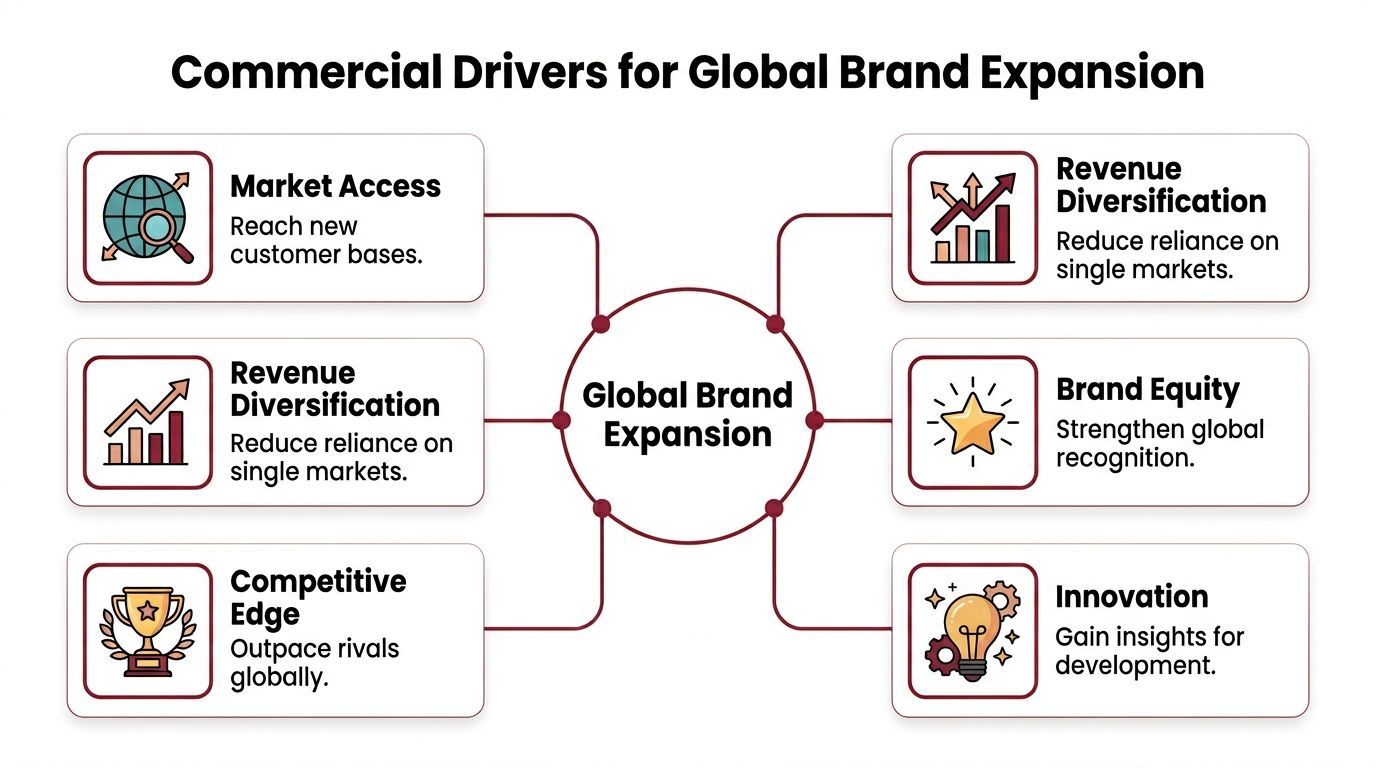
Market access changes the growth ceiling
Australia can produce excellent consumer products, but domestic scale has limits. Once a brand has built retail traction, stable operations, and repeat purchase behaviour, growth often slows unless it opens new territory.
That’s where international channels become commercially meaningful. Expansion isn’t just about finding extra buyers. It’s about moving the brand into markets where category depth, customer volume, and channel diversity are far larger.
Revenue diversification reduces single-market dependence
A business tied too tightly to one economy carries hidden fragility. If local retail conditions change, consumer sentiment softens, or a major account becomes unstable, the impact lands across the entire business.
International expansion spreads that exposure. Different markets respond differently to inflation, retail cycles, channel shifts, and competitor behaviour. A broader footprint doesn’t remove risk, but it can stop one market from dictating the whole company’s trajectory.
Practical rule: expand when diversification improves resilience, not just when revenue feels flat.
Margin structure can improve in the right markets
Not every market improves profitability. Some destroy it. But some categories support stronger pricing architecture abroad than they do at home.
That’s especially relevant for brands that have already proven product quality and customer acceptance in Australia. In the right region, a company may find better price realisation, a more premium category frame, or less dependence on discount-heavy retail conventions.
The mistake is assuming this happens automatically. It only happens when pricing, fulfilment, tax treatment, and channel mix are designed deliberately.
Seasonality can be balanced across regions
Some products sell in waves. Garden, outdoor, home improvement, household, and lifestyle categories all feel this at different times.
Operating across multiple markets can soften those peaks and troughs. It won’t eliminate planning pressure, but it can create a steadier revenue base and more predictable production rhythm. For founders managing cash flow, manufacturing slots, and inventory commitments, that stability matters more than headline sales growth.
Scale improves sourcing leverage
More volume creates options. Suppliers respond differently when the forecast is built on multi-region demand rather than one domestic market.
That can affect:
- Production planning, because suppliers are more willing to reserve capacity for repeatable orders.
- Negotiation advantage, because a larger, more stable buying profile can support better commercial terms.
- Product development, because scale justifies running improved packaging, market-specific variants, or upgraded components.
These gains don’t come from launching everywhere. They come from expanding in a controlled sequence that suppliers can support.
Brand equity strengthens when the business travels well
A product sold in one market can be successful. A product that translates across markets starts to become a brand.
That shift matters commercially. Stronger brand equity can improve channel discussions, support premium positioning, and protect the company from becoming a pure commodity seller. International presence can also sharpen internal decision-making. Teams become more precise about what the brand stands for because weak positioning is exposed quickly when entering new markets.
Expansion also creates innovation pressure
This is one of the most overlooked benefits.
When a brand enters new geographies, it gets clearer feedback on packaging, claims, use cases, and customer objections. That pressure often improves the product itself. It can expose where the offer is overbuilt, under-explained, or misaligned with how buyers shop the category.
A founder should view expansion as both a growth move and a learning system.
| Commercial driver | Why it matters |
|---|---|
| Market access | Opens larger customer pools and new channel pathways |
| Revenue diversification | Reduces dependence on one economy or account base |
| Margin opportunity | Creates room for stronger pricing in selected markets |
| Seasonal balance | Helps smooth demand cycles across regions |
| Scale leverage | Improves sourcing, planning, and production confidence |
| Brand development | Forces clearer positioning and stronger market relevance |
The point isn’t to go global because it sounds ambitious. The point is to expand when it improves the underlying economics and strategic resilience of the business.
The Amazon Marketplace A Double-Edged Sword
Amazon is often described as a sales channel. That understates it. It’s a market environment with its own incentives, its own rules, and its own penalties for brands that enter casually.
The opportunity is obvious. The risk is less obvious until the brand is already exposed.
The scale is real
The amazon marketplace generated $637.9 billion in revenue in 2024, with 9.7 million sellers reaching over 310 million customers. It also controls approximately 40 cents of every eCommerce dollar in the U.S., which is why the platform is hard to ignore for any brand considering international growth (Amazon marketplace statistics compiled by eDesk).
That scale creates reach that very few channels can match. For an Australian founder, amazon marketplace can compress the time between local success and international market access.
But scale attracts density. The same platform that gives you access to demand also places you inside a crowded, comparison-heavy environment where visibility is earned under pressure.
The platform solves access, not positioning
Amazon can help a brand become available quickly. It doesn’t decide how the brand will be perceived.
That distinction matters. Founders often enter the platform thinking operational convenience is the same as market strategy. It isn’t. If your listing looks interchangeable, buyers will compare price. If your packaging doesn’t signal trust, they’ll hesitate. If your product story depends on a rich retail environment or founder education, Amazon may compress that story into a much thinner commercial surface.
An understanding of the local channel begins with how amazon marketplace works in Australia, then extends to the conditions of each overseas market.
Where brands lose control
Amazon is powerful because it standardises customer experience. That same standardisation can reduce brand control.
Common pressure points include:
- Price visibility, where every competing offer sits nearby and changes buyer expectations quickly.
- Customer relationship distance, because Amazon owns much of the transaction environment.
- Channel conflict, when marketplace pricing disrupts retail or distributor relationships in other regions.
- Brand dilution, if resellers, poor listings, or inconsistent cataloguing weaken presentation.
If a founder can’t explain how the brand will defend margin and meaning inside amazon marketplace, the launch is early.
The smartest brands treat Amazon as both an acquisition engine and a risk surface. They play offence through discoverability and conversion. They play defence through pricing discipline, channel rules, and operational control.
That’s why Amazon works best for companies that already know what they are protecting.
Your Pre-Launch Strategy: Market, Channel, and Pricing
Most international problems begin before launch. They start when a founder picks the obvious market, the obvious channel, and a price copied from domestic logic.
That approach feels efficient. It usually creates expensive corrections later.

Choose the market that fits the business
Founders often default to the US because it’s large or the UK because it feels familiar. Neither is automatically the right first move.
The right launch market sits at the intersection of product relevance, competitive intensity, compliance burden, fulfilment practicality, and brand readiness. A market can be large and still be wrong if the category is crowded, the cost to serve is high, or the customer expects a value proposition your current offer can’t support.
A better evaluation process asks:
- Does the product solve a clear need in this market?
- Will buyers understand the value quickly without founder-led explanation?
- Can the business support local service expectations and returns handling?
- Is the category already dominated by entrenched operators with stronger local trust?
For Australian hardware and home improvement brands, this becomes even more important. Technical standards, installation assumptions, usage environments, and packaging language can all affect fit.
Decide whether Amazon is the entry point or the whole model
Some brands should start on amazon marketplace. Very few should treat it as the entire international strategy.
An Amazon-first launch can make sense when the goal is controlled market testing, rapid visibility, and operational simplicity. It’s less effective when the brand needs education, trade relationships, installer networks, or a premium purchase environment that depends on richer storytelling.
A simple decision table helps.
| Channel approach | Best fit | Main risk |
|---|---|---|
| Amazon only | Fast market entry and direct demand testing | Overdependence on one platform |
| Amazon plus local DTC | Brands that need both conversion and story control | More operational complexity |
| Amazon plus distribution partners | Products needing retail access, field support, or local credibility | Lower direct control if partner quality is weak |
| Distributor-led first | Categories where relationships and compliance matter more than speed | Slower early learning from direct customer data |
A strong launch often uses Amazon as one part of a wider sequence, not the destination.
Build pricing before you build demand
Pricing is where many international launches break.
Founders commonly start with a simple conversion from Australian retail price. That ignores what shapes the landed economics. Freight, tariffs, marketplace fees, storage, returns, channel margin, tax treatment, promotional expectations, and local competitive anchors all affect what price is viable.
The better approach is to work backwards from required margin and forwards from customer willingness to pay.
Questions that protect margin
- What is the minimum acceptable landed margin by market?
- How much discounting can the brand tolerate without changing customer perception?
- Will Amazon pricing destabilise other channels or retail partners?
- Can the business hold a consistent premium position across regions?
A bad international price doesn’t just reduce profit. It teaches the market how to undervalue the brand.
Align market, channel, and price as one system
These decisions aren’t separate. A market with difficult fulfilment may require a different channel mix. A channel with strong fee pressure may force a different pack size, bundle structure, or promotional cadence. A premium pricing ambition may only work if the launch market has the right customer and the right listing execution.
That’s why pre-launch planning should look less like a checklist and more like architecture.
What usually works
- Start where the product can win clearly, not where the map looks impressive.
- Use amazon marketplace deliberately, especially when it can validate demand without becoming your only route to market.
- Set pricing rules early, including minimum margins, discount boundaries, and channel conflict guardrails.
What usually doesn’t
- Copying domestic assumptions into a foreign market.
- Entering multiple regions at once before the first operating model is stable.
- Using low price as the main wedge in a category where better-funded competitors can respond faster.
- Separating finance from brand strategy, which often leads to revenue growth without commercial quality.
A founder should know, before launch, what the business is trying to prove. Product-market fit in a new region. Channel economics. Retail readiness. Brand portability. If that question isn’t clear, the launch tends to produce noise rather than insight.
Navigating the Operational Realities of Scaling
The strategic model can be sound and still fail in execution. International expansion proves less glamorous and more revealing.
A brand can survive imperfect creative. It usually can’t survive poor compliance, unstable inventory flow, or a fulfilment system that breaks under real demand.

Compliance problems rarely announce themselves early
One of the hardest parts of cross-border expansion is that compliance issues often sit until a shipment is held, a listing is challenged, or a marketplace asks for documentation the business assumed it already had.
This is especially relevant for Australian sellers. One under-covered issue is account health and appeals tied to local requirements. Research cited by Retail Dive notes that seller forums indicated 25-30% of AU third-party sellers faced suspensions in 2025 due to local documentation mismatches, with appeal success rates below 40% without specialised AU legal preparation. The same source also notes an 18% year-over-year rise in AU Marketplace suspensions in Q4 2025, linked to stricter import compliance after tariff changes (Retail Dive coverage of seller suspension concerns).
The lesson isn’t to fear the platform. It’s to respect documentation. Product files, test reports, importer records, GST treatment, consumer law obligations, and local labelling standards need to be organised before they’re requested.
Fulfilment is a brand decision, not just a logistics decision
Many founders treat fulfilment as a backend issue. Customers don’t.
Late delivery, poor packaging integrity, stockouts, damaged returns, and inconsistent inventory availability all shape how the brand is perceived. Amazon FBA can solve some of this. Regional 3PLs can solve other parts. In some cases a distribution partner is the better fit because fulfilment is only one layer of a wider local operating need.
A practical assessment often looks like this:
| Fulfilment model | Strength | Constraint |
|---|---|---|
| FBA | Tight integration with amazon marketplace operations | Less flexibility outside Amazon |
| Regional 3PL | More control across channels | Requires stronger oversight |
| Distribution partner | Combines logistics with local market execution | Partner selection matters enormously |
For founders comparing options, the operational trade-offs become clearer when mapped against fulfilment models used in expansion planning.
Reliable delivery protects trust. Predictable stock flow protects the economics behind that trust.
Supply chains fail at the edges
A typical scenario looks like this. The launch forecast is conservative. Sales come in stronger than expected. Reordering takes longer than planned. The next shipment lands late because documentation or routing wasn’t prepared for scale. Ads continue running. Stock disappears. Ranking drops. Cash gets trapped in reactive freight decisions.
None of that means demand was weak. It means the supply chain wasn’t built for volatility.
Founders should pressure-test:
- Lead times, including what happens when a supplier slips.
- Buffer stock policy, especially for marketplaces that punish stockouts indirectly through lost momentum.
- Packaging durability, because damage rates can rise when products move through longer routes and more handling points.
- Returns handling, which becomes expensive and reputation-sensitive fast.
Timelines need realism
International launches often fail internally before they fail externally. Teams expect a quick revenue step-change, then get impatient when early complexity slows progress.
A healthier view separates launch from stabilisation. First the business proves compliance, fulfilment flow, listing quality, and demand signal. Then it improves repeatability. Then it decides whether to deepen investment.
That sequence sounds slow. It’s usually faster than recovering from a rushed launch.
Better launch KPIs
Early international KPI sets should include more than sales.
- Contribution margin by market
- In-stock consistency
- Return reasons
- Documentation readiness
- Customer review patterns
- Channel conflict signals from other partners
Revenue matters. It just isn’t enough on its own. A founder needs indicators that show whether the launch is becoming operationally stable, commercially defendable, and scalable without constant intervention.
The Partnership Playbook: Expanding Alone vs With a Partner
Every founder eventually reaches the same decision point. Build the international machine internally, or work with people who already have parts of that machine in place.
Neither path is automatically superior. The right answer depends on the company’s resources, tolerance for complexity, and view of control.

Expanding alone gives control and demands bandwidth
The DIY model appeals to founders who want direct visibility across every moving part. They hire consultants, source local operators, negotiate with logistics providers, and manage channel decisions from the home market.
That can work well when the business already has international capability, spare management capacity, and enough capital to absorb a slower learning curve. It also suits teams that see expansion as a core in-house competency they want to build over time.
The downside is coordination load. Separate advisers don’t always share incentives. Knowledge can remain fragmented. The founder often becomes the system that holds the expansion together.
A partner can compress complexity
A strategic partner changes the shape of the project. Instead of assembling every function independently, the brand plugs into an existing structure with market knowledge, operator relationships, and execution pathways already in place.
That doesn’t remove all risk. It changes where the risk sits.
One option in that model is a specialist such as TPR Brands’ amazon expansion partner approach, which focuses on helping established consumer product companies enter new regions through structured channel, compliance, and operational support.
The real trade-offs
| Decision factor | Expanding alone | Expanding with a partner |
|---|---|---|
| Speed to market | Usually slower while systems are built | Often faster if infrastructure already exists |
| Upfront investment | Higher internal setup burden | More variable, depending on partner model |
| Operational control | Maximum direct control | Shared control with defined boundaries |
| Execution risk | Higher if the team lacks local depth | Lower in some areas, partner-dependent in others |
| Local intelligence | Must be built or bought piece by piece | Often embedded in the relationship |
The wrong partner can slow a good brand. The right partner can stop the founder from spending a year building capabilities they only need to use selectively.
When each model makes sense
A founder should consider expanding alone when:
- The team already has cross-border operating experience
- The category is simple to service
- The business wants to own every capability internally
- Management can dedicate real time to market build-out
A partnership model usually makes more sense when:
- Speed matters, but brand control still matters
- Compliance and distribution complexity are high
- The business wants local execution without building a full overseas team
- Leadership would rather stay focused on product, brand, and capital allocation
The key insight is that partnership isn’t a shortcut for weak brands. It’s often the more disciplined choice for strong brands that want controlled expansion instead of improvisation.
Conclusion Building a Global Brand Not Just a Listing
Amazon can accelerate international expansion, but speed alone does not create a durable global brand.
The companies that scale successfully through Amazon Marketplace are usually the ones that approach expansion strategically. They select markets carefully, protect pricing discipline, adapt positioning for local buyers, and build operational systems that can support growth without creating instability across the wider business.
For established Australian brands, international expansion should strengthen the company, not simply increase sales volume. That means treating Amazon as one part of a broader commercial strategy rather than relying on the platform as the strategy itself.
The strongest global brands are rarely the fastest at launch. They are the most disciplined in how they manage positioning, fulfilment, compliance, pricing, and channel control while expanding into new regions.
At TPR Brands, we work with established product businesses that are expanding into Amazon Marketplace and other international channels with a stronger focus on operational structure, brand protection, and long-term commercial growth.
If you’re assessing international expansion opportunities, TPR Brands helps established brands evaluate market readiness, channel strategy, and the operational requirements needed to scale globally with greater control and stability.