The most dangerous advice about amazon usa is also the most common. List the product, turn on ads, use FBA, and let the market decide.
That approach works for opportunistic sellers. It often damages established brands.
The US Amazon marketplace is not a simple export channel. It’s a dense retail environment with unforgiving price visibility, high operational demands, and instant comparison against entrenched competitors. A product that performs well in Australia can still lose in the US for reasons that have nothing to do with quality. Usually the failure starts earlier, at positioning, margin design, channel planning, and compliance discipline.
Founders often assume expansion is mainly a demand question. It usually isn’t. The harder question is whether the brand can enter amazon usa without training the market to see it as a commodity.
The Founder's Hook Why 'Listing on Amazon USA' Is a Flawed Strategy
A listing is not a strategy. It’s a storefront asset inside someone else’s retail system.
That distinction matters because amazon usa was built for scale, speed, and category dominance from the beginning. Amazon launched in 1994, expanded across all 50 US states within its first two months of operation in 1995, and by 2023 had surpassed FedEx and UPS to become the number one delivery company in the United States, using 185 fulfilment centres. For brands entering that system today, the scale is matched by seller density, with third-party sellers accounting for 60% of paid units on the platform according to this Amazon timeline summary.
Why the simple launch plan fails
Founders usually enter with one of three assumptions:
- The product already works at home: So they assume the US market only requires translation into US spelling, freight, and ads.
- Amazon will create demand: It won’t. Amazon reveals demand, but it also reveals price sensitivity, weak differentiation, and poor listing hierarchy very quickly.
- Operational scale will protect the brand: Scale helps fulfilment. It doesn’t protect positioning.
The mistake is treating amazon usa as an ecommerce task when it’s really a market-entry decision.
A strong product can still be badly introduced. If the first version of your US presence is under-positioned, underpriced, or operationally clumsy, Amazon records that reality in public. Reviews, conversion behaviour, competitor responses, and Buy Box pressure all start shaping the brand’s market identity before most founders realise what’s happening.
The real question founders should ask
The question isn’t, “How do we get listed?”
It’s, “What role should amazon usa play in our US market architecture?”
For some brands, Amazon should be the primary launch vehicle. For others, it should be a controlled validation channel. For many, it should sit alongside selective distribution, retail conversations, or a direct channel that protects narrative and pricing.
That’s the difference between chasing sales and building a durable market position. Brands exploring that path need to think beyond setup and into channel design, pricing control, and localisation from the start, especially if they’re considering a dedicated amazon usa expansion approach.
A marketplace can scale a brand fast. It can also flatten it fast.
The Global Expansion Mirage Why Success in Australia Doesn't Translate
Australian founders often describe the US as “the same customer base, just bigger”. That reading is expensive.
The US is not a larger version of Australia. It’s a different commercial environment with different search behaviour, price anchoring, promotional expectations, regional use cases, and category saturation. A product that reads as premium in one market may land as mid-tier in another. Sometimes it lands as overpriced, even when the quality is objectively strong.

Bigger market, narrower relevance
Most generic Amazon advice pushes founders toward “unserved demand”. For established brands, that often sends them in the wrong direction.
The more useful pattern is usually inside the category, not outside it. As noted in this analysis of Amazon competition and unserved demand, “the biggest opportunities exist in specialized accessories, niche variations, and products solving specific problems within broader categories”. That matters for Australian brands because the smarter move is often adapting a proven product line to a specific US sub-niche, rather than inventing a new SKU just to look “Amazon native”.
A hardware or household brand may already have the right product. What it often lacks is the right market framing.
Positioning breaks before the product does
Many launches go off course when the founder sees a successful domestic item and assumes the same value story will travel intact.
It rarely does.
Consider the practical shifts that happen when a brand enters amazon usa:
| Market factor | What founders assume | What often happens |
|---|---|---|
| Price perception | “We’re premium” | US shoppers compare against more price points and more substitutes |
| Product story | “Our existing messaging is clear” | Local category language may frame the use case differently |
| Assortment | “Launch the hero SKU first” | The hero may need a bundle, accessory, or niche variation to stand out |
| Customer expectation | “Fast shipping is enough” | Shoppers also expect immediate clarity on fit, use case, and value |
Adaptation is not dilution
Some founders resist market-specific adaptation because they think it compromises the original brand.
Usually the opposite is true. Refusing to adapt is what weakens the brand, because it forces the product into the wrong competitive frame.
A better US entry strategy often includes:
- Refined assortment: Start with the SKU variation that solves a sharper problem, not necessarily the domestic bestseller.
- US-specific language: Rework bullets, imagery, and claims around local buying logic.
- Channel-aware positioning: Decide whether the product should compete on quality, application specificity, bundle utility, or brand trust.
- Selective depth: Enter one profitable subcategory well before broadening the catalogue.
The brand that wins in amazon usa is rarely the one with the most products. It’s usually the one with the clearest reason to exist in a very specific search context.
Anatomy of a Failed Launch Common Patterns of Brand Erosion
The failed launch usually doesn’t look like failure at the start.
It looks encouraging. A few early sales come through. The team sees movement in Seller Central. Advertising starts generating clicks. The founder feels validated because the US market is responding.
Then the economics start telling a different story.

Stage one, sales disguise weak structure
The brand enters amazon usa with a revenue mindset instead of a margin mindset. The launch plan is built around listing speed, ad activation, and stock arrival.
What’s missing is the full economic model.
For Australian brands using FBA, the first-year profitability success rate is cited at around 64%, but that headline hides serious cash-flow stress. Unaccounted costs such as inbound placement fees can turn a projected 30% margin into as low as 5% if mismanaged, and many teams underestimate the capital tied up in 3 to 6 months of inventory, according to this Amazon seller metrics analysis.
That’s not a minor planning error. It changes every decision after launch.
Stage two, pricing starts doing the wrong job
Once costs begin to surface, founders often react by pushing harder on volume.
They discount. They bundle badly. They increase ad spend against listings that were never properly positioned. They start chasing category signals that belong to other brands with different cost structures.
The visible symptom is price movement. The hidden damage is brand training.
Shoppers learn quickly. If the brand enters as promotional, inconsistent, or unclear, the market starts reading it as replaceable. At that point, even decent sales can be misleading because the brand is buying velocity by lowering its future pricing power.
Stage three, internal pressure creates external damage
This is usually when the founder or commercial team starts asking the wrong operational questions:
“Can we lower price a bit more?”
That may help unit movement while weakening premium perception.“Can we send more stock to avoid running out?”
That may increase working capital pressure before the economics are proven.“Can we add more SKUs?”
That often spreads ad spend and operational attention across too many weak listings.“Can we let Amazon sort the fulfilment complexity?”
Only if the cost structure still supports the category.
Early sales can hide a broken launch model. Revenue is the easiest metric to celebrate and one of the worst metrics to trust on its own.
Stage four, the brand loses optionality
The long-term problem isn’t just lower margin. It’s reduced strategic flexibility.
A brand that has trained the market to buy only on discount becomes harder to place with distributors, retail partners, and even premium online resellers. Channel conflict appears. Price consistency erodes. The founder spends more time defending decisions than establishing advantage.
The launch that was meant to open the US market starts narrowing future options instead.
What failed launches usually have in common
A pattern shows up repeatedly:
| Failure pattern | What it looks like in practice |
|---|---|
| Weak margin modelling | Fees, freight, returns, and inventory carrying costs were underestimated |
| Poor inventory judgement | Too much stock too early, or too little stock in the wrong SKU |
| Generic listing strategy | Product pages describe features but don’t establish differentiated value |
| Panic discounting | Price drops compensate for weak conversion instead of fixing the offer |
| Channel blindness | Amazon decisions undermine future wholesale or distribution relationships |
None of this means amazon usa is the wrong channel. It means unmanaged entry creates predictable brand erosion.
The best founders don’t ask whether they can launch. They ask what kind of launch preserves control.
A Strategic Roadmap for Controlled US Market Entry
A disciplined amazon usa entry isn’t built in one move. It’s staged.
The right sequence reduces expensive surprises. It also forces the brand to prove fit before scale makes mistakes harder to unwind.
A useful planning model looks like this.
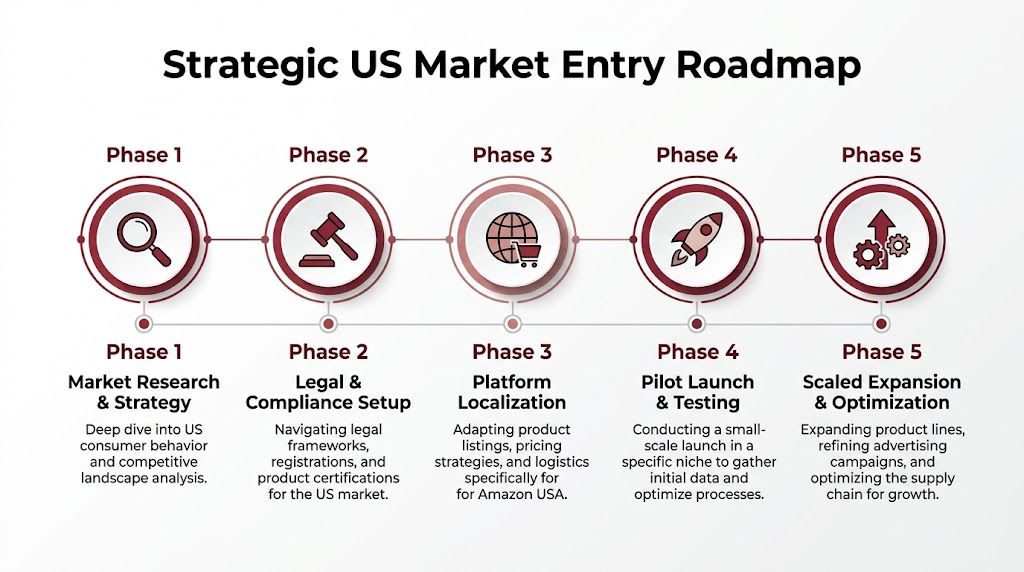
Phase one market validation before channel commitment
Start with the market, not the listing.
That means pressure-testing whether the product’s current form, claims, packaging, and use-case story make sense in the US category context. Founders often skip this because the product already sells elsewhere. That’s precisely why they should do it.
Look at competing listings manually. Review language, image hierarchy, bundle logic, and where differentiation appears. The main question isn’t whether your product is better. It’s whether a US buyer can understand why it’s better fast enough to choose it.
Use this phase to decide:
- Which SKU enters first: Usually not the broadest range item. Start with the clearest commercial proposition.
- Which category language dominates: Your internal terminology may not match the way US shoppers search or compare.
- Which claims need restraint: A strong domestic packaging claim may create compliance or expectation issues in the US.
- Which features deserve visual emphasis: Founders often over-explain manufacturing quality and under-explain practical use.
Practical rule: If the product page needs too much education before the value becomes obvious, the first launch SKU probably isn’t the right one.
Phase two compliance and pricing architecture
At this point, many brand owners still behave like marketplace sellers when they should be acting like operators.
Before launch, build a full landed-cost model and a compliance map. Do not approve the channel until both are complete.
For many household, hardware, and consumer products, the compliance burden isn’t just federal. State-level issues can matter. Labelling, material disclosures, packaging instructions, and product-specific standards can alter what can be sold, how it can be sold, or what wording appears on the detail page.
At the same time, pricing needs to do more than clear a spreadsheet. It needs to protect future channel flexibility.
A sensible pricing model should answer:
| Pricing question | Why it matters |
|---|---|
| Can the product absorb marketplace fees and still support the brand’s positioning? | Margin without positioning is fragile |
| Will the US retail price create conflict with other channels? | Incoherent pricing weakens trust and partner confidence |
| Is the product being priced for launch velocity or long-term value? | Short-term traction can train the wrong customer behaviour |
| What happens if promotional pressure increases? | If the model breaks under moderate discounting, the launch is unstable |
Phase three fulfilment design after the 2026 shift
At this point, outdated advice becomes dangerous.
Effective January 1, 2026, Amazon discontinued its FBA prep services, and from January 15, 2026 increased base fulfilment fees by an average of $0.08 per unit, according to this analysis of the post-2026 FBA cost shift. For international brands, that changes the economics of the standard “send it to FBA and let Amazon handle the rest” model.
The strategic question is no longer just whether to use FBA. It’s whether to use FBA alone.
For many brands, the better approach is one of these:
- Pure FBA: Works when the product is operationally simple, margin-rich, and stable in demand.
- Hybrid model: A private 3PL handles prep, overflow stock, or channel flexibility while FBA supports Prime-facing inventory.
- 3PL-first with selective marketplace fulfilment: Useful when the brand expects varied channel growth beyond Amazon.
Logistics, at this juncture, ceases to be merely a backend function and evolves into a brand-protection decision. Teams that need structured support often compare freight forwarders, 3PL operators, internal warehouse capability, and market-entry partners such as TPR Brands’ logistics support model before finalising channel design.
A weak fulfilment structure creates hidden costs. A good one preserves margin and keeps the brand operationally flexible.
To see how this kind of channel planning plays out in practice, the following discussion is useful before lock-in:
Phase four pilot launch with controlled exposure
Do not scale catalogue breadth on day one.
Launch narrowly. Pick one or a small number of SKUs with the cleanest economics and the clearest positioning. Then use that pilot to learn under controlled conditions.
A proper pilot should test:
- Conversion quality: Are buyers understanding the product as intended?
- Price resilience: Does the listing need constant incentive to move?
- Operational reliability: Are inbound, prep, stock flow, and customer service holding up?
- Review pattern: Are customer reactions validating the intended use case or exposing confusion?
This stage is where experienced operators stay patient and inexperienced teams overreact.
If conversion is weak, don’t assume the answer is more advertising. Often the issue is packaging expectation, image sequencing, review scarcity, offer structure, or the wrong customer segment.
Phase five scale only after the system works
Expansion should come after proof, not before it.
That means increasing spend, depth, and assortment only when the initial launch has demonstrated a workable relationship between margin, inventory, fulfilment, and brand positioning. If one of those four is still unstable, scale will amplify the problem.
A controlled scale plan usually follows a sequence:
- Stabilise the hero listing.
- Add adjacent variants or accessories that strengthen average order value or use-case authority.
- Expand inventory depth where demand quality is proven.
- Introduce wider channel activity only when Amazon pricing won’t distort the broader brand.
The point isn’t caution for its own sake. It’s preserving strategic advantage while the brand learns a new market.
Protecting Brand Equity and Margins in a Crowded Marketplace
Most founders treat Amazon as a demand machine. Established brands need to treat it as a reputation environment.
That shift changes almost every decision. The question stops being, “How do we sell more units?” and becomes, “How do we make sure every unit sold strengthens the brand rather than cheapens it?”

Amazon’s US infrastructure is massive, with over 185 fulfilment centres, and third-party sellers drive 60% of total paid units. That scale gives brands access to powerful fulfilment and visibility, but it also places them in a highly crowded environment where standing out depends on protecting value, not just shipping efficiently, as outlined in this Amazon history and marketplace overview.
Control the narrative before the market writes it
If your listing doesn’t explain the product’s value clearly, the category will explain it for you, usually through comparison on price.
That’s why brand assets matter on Amazon. Not as cosmetic extras, but as defensive infrastructure.
The goal is simple. Remove ambiguity.
Use the brand-controlled elements available to establish what the product is, who it’s for, what problem it solves, and why it deserves its price. For many brands, that means tightening image order, improving A+ Content, structuring bundles more intelligently, and controlling storefront logic through tools connected to Amazon Brand Registry support.
Margin protection is a commercial discipline
Margin erosion rarely begins with one catastrophic decision. It starts with small compromises that feel reasonable in isolation.
A founder discounts to get momentum. Then accepts a lower return on ads because launch matters. Then tolerates pricing inconsistency because stock needs to move. Then adds variants that weaken operational focus.
The way out is disciplined refusal.
Use a simple decision filter:
| Decision area | Brand-first response |
|---|---|
| Weak conversion | Improve offer clarity before touching price |
| Slower sales than expected | Check product-market framing before broadening ad spend |
| Competitor discounting | Protect positioning unless the category economics still work |
| Stock pressure | Reduce exposure and tighten forecasting instead of training buyers to wait for deals |
The market doesn’t only remember your product. It remembers how you priced it, how clearly you explained it, and whether it felt dependable.
Use Amazon data selectively, not obsessively
Amazon gives founders a live view into buyer behaviour. That’s useful, but only if interpreted through brand strategy.
A few examples matter more than dashboard noise:
- Search term fit: Are buyers finding the product through the intended use case, or through a broad query that attracts low-intent traffic?
- Listing interaction: Are shoppers engaging with the right images and content sequence?
- Review language: Do customers describe the product the way the brand wants to be known?
- Variant behaviour: Are certain configurations clarifying the offer, or fragmenting demand?
This matters beyond Amazon. The right marketplace signals can sharpen broader US positioning, packaging decisions, and retail discussions. The wrong interpretation can push a brand into short-term tactics that damage long-term value.
Prime access is useful, not sufficient
FBA and Prime eligibility can improve convenience and support conversion. That does not mean they create defensibility.
Prime helps remove fulfilment friction. It does not solve weak differentiation, lazy assortment logic, or poor pricing architecture. In a crowded amazon usa environment, operational excellence is expected. It isn’t a moat.
The moat comes from clarity, discipline, and consistency.
Scaling with Partners When to Go It Alone vs When to Collaborate
Some brands should go direct into amazon usa. Others shouldn’t.
The wrong decision usually comes from pride, not analysis. Founders assume partnership means loss of control, or they assume internal teams can absorb US expansion because they already run domestic ecommerce well. Those are different operating conditions.
When going alone can work
Direct control makes sense when the business already has several things in place:
- Internal marketplace capability: The team can manage listing quality, advertising judgement, inventory planning, and commercial decision-making without learning in public.
- Operational confidence: Freight, prep, storage, compliance, and customer service can be handled without improvisation.
- Clear channel boundaries: The company knows how Amazon will sit alongside wholesale, retail, or direct channels.
- Financial patience: Leadership can fund a measured launch without forcing premature scale.
If those conditions are present, a solo approach can work well.
When collaboration is the better commercial decision
Partnership becomes sensible when speed, complexity, and risk start colliding.
That often happens when a brand has a strong product but lacks one of the following: US compliance experience, on-the-ground operational support, channel strategy discipline, or confidence in how to localise without diluting the original proposition.
In those cases, the partner’s job isn’t to “run Amazon”. It’s to reduce strategic error.
A strong expansion partner should help the brand answer questions such as:
- What should enter first, and what should stay out?
- How should pricing be set so future channels remain viable?
- Which fulfilment model protects margin under current conditions?
- Where does localisation improve performance without weakening the brand?
- What early decisions would be difficult to reverse later?
The best partner does not add noise. They remove avoidable mistakes.
How to evaluate the right kind of partner
Most founders ask whether the partner can generate sales. That’s too shallow.
Better evaluation criteria include:
| What to assess | Why it matters |
|---|---|
| Market understanding | US entry fails when local category logic is misunderstood |
| Operational transparency | Hidden process gaps become margin leaks later |
| Brand sensitivity | Growth that weakens positioning isn’t real progress |
| Channel judgement | Amazon decisions affect future retail and distribution options |
| Decision quality | You need someone who will challenge bad expansion logic, not just execute it |
A weak partner acts like a service provider. A strong one behaves like a commercial operator with alignment around brand value, not just marketplace activity.
Turning a Great Product into a Global Brand
The hard part of amazon usa isn’t access. It’s discipline.
The platform is large enough to create real scale and unforgiving enough to expose every weakness in positioning, cost design, fulfilment planning, and channel judgement. That’s why great products still fail there. Not because they lacked quality, but because they entered the market with a seller mindset instead of a brand strategy.
Founders who do this well don’t confuse activity with traction. They localise carefully, sequence entry deliberately, protect pricing, and treat operational decisions as brand decisions. They understand that global expansion is not a copy-paste exercise from the domestic market.
For founders navigating the complexity of international growth, the right support can be the difference between getting listed and building a durable presence. At TPR Brands, that work sits at the intersection of positioning, channel strategy, logistics, and market adaptation.
If you're an established brand looking to expand into new markets without sacrificing margin or brand control, TPR Brands works with proven products to build structured, controlled growth across channels and regions.