Many great products struggle internationally, not because demand is weak, but because the expansion strategy is flawed. Founders with proven products often see the Amazon marketplace in Australia as a simple sales channel, but treating it this way is a major strategic error. Exceptional products falter here not due to lack of quality, but due to a fundamental misunderstanding of the market’s unique dynamics.
The Flawed Assumption: Why a Proven Product Isn’t Enough
The most common mistake brands make is assuming a successful product in one market will automatically succeed in another. This leads to a ‘copy-paste’ approach to global expansion—what worked in the US or UK is applied directly to Australia, with the expectation of identical results.
The hard truth is that this mindset is the primary reason high-quality products fail to gain real traction. The Australian market has its own economic and consumer dynamics that can dismantle a poorly planned launch with surprising speed. Ignoring these nuances leads to predictable, and often painful, outcomes.
The Founder’s Dilemma: Stalled Growth and Eroding Margins
We see founders get caught in this difficult position all the time. They have a product with a history of success, backed by glowing customer feedback and strong sales data in their home market. Yet, upon entering Australia, they hit a wall of frustrating challenges:
- Stalled Growth: Initial sales may look promising but quickly plateau as the one-size-fits-all strategy fails to resonate with local buying habits.
- Margin Erosion: Unexpected logistics costs, pricing pressure from local competitors, and compliance expenses begin to erode profitability.
- Brand Dilution: A generic marketing message can feel disconnected, failing to build the consumer trust required to command a premium price.
These issues are symptoms of a strategic gap—a failure to recognize that entering Australia requires more than just listing products on Amazon. It demands a dedicated, market-specific brand strategy.
“Product excellence doesn’t guarantee global success. The most common mistake we see is brands treating Australia as a smaller version of the US market. This oversight is where growth strategies unravel.”
Success on the Amazon marketplace in Australia depends entirely on adapting to its specific landscape. For example, Australia’s vast geography makes logistics a central strategic pillar, not an operational afterthought.
A brand that truly masters Fulfilment by Amazon (FBA) can gain a massive competitive advantage over those attempting to ship from overseas, simply because Australian shoppers prioritize speed and reliability. You can learn more about becoming a successful Amazon seller in our detailed guide.
Ultimately, the products that thrive here are those backed by a strategy that respects Australia’s distinct market conditions. It’s about building a brand within the local context, not just selling a product.
The Unignorable Shift in Australian Ecommerce
For any brand founder, understanding where customers are is foundational to any successful expansion. In Australia, the ecommerce environment has undergone a massive consolidation. What was once a fragmented market is now centered around one dominant player.
To achieve meaningful success here, one must realize that Australian shoppers have evolved beyond simple price comparison. The Amazon marketplace in Australia is at the heart of this change, displacing older platforms and resetting consumer expectations entirely.
Market Dynamics: The New Rules of Commerce
Recent market data reveals a clear structural shift in Australian ecommerce. The numbers tell a compelling story: Amazon’s dominance is projected to reach 60% of Australian shoppers by 2026, a significant increase from 52% just three years prior. In that same period, eBay’s reach declined from 62% to 51%, marking a definitive changing of the guard.
This is occurring while nearly 93% of consumers have purchased from a marketplace in the last year. You can explore the full analysis of this market evolution to understand the depth of these changes.
What’s driving this shift? It’s a fundamental move away from price and towards overall value. The primary reasons Australian shoppers now choose a marketplace are not solely about finding the cheapest deal. They are driven by:
- Speed of Delivery: A top priority for 35% of buyers.
- Prime Benefits: A key deciding factor for 31% of shoppers.
- Platform Preference: A direct preference for the Amazon experience, motivating 28% of purchases.
This data illustrates exactly why a flawed expansion strategy can lead to stalled growth and shrinking margins. I’ve seen it happen time and again.
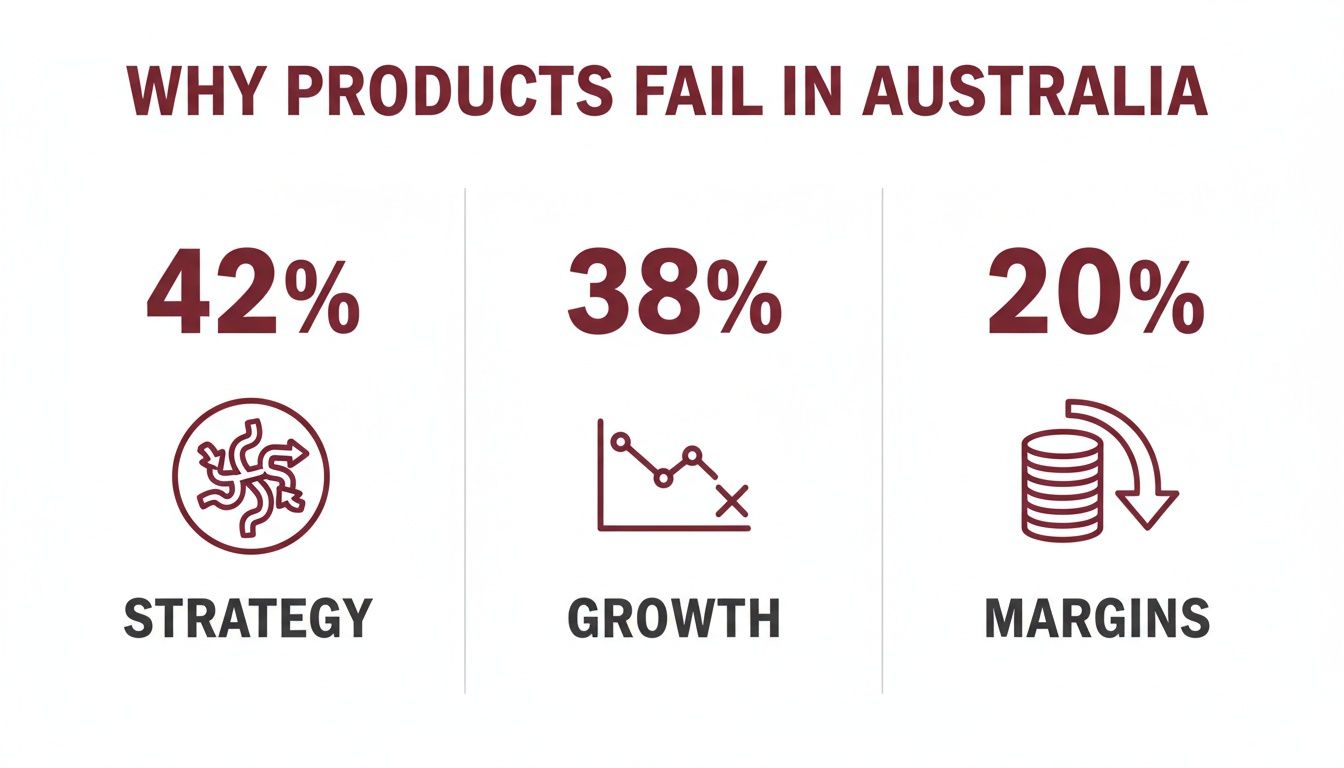
The infographic above highlights the common traps—weak strategy, growth ceilings, and margin erosion—that brands fall into when they misread the market. It shows that success isn’t just about the product; it’s about how you approach the market’s new reality.
Why Consumer Trust Is the New Currency
Beyond speed and convenience, another powerful factor has come to the forefront: trust. Product reviews are now a key part of the decision-making process for 24% of consumers, which underscores Amazon’s significant advantage in building shopper confidence.
For founders in categories like tools, household goods, and consumer electronics, this is a critical insight. When quality and performance are paramount, the trust baked into the Amazon platform provides a powerful halo effect for your brand.
This is not a temporary trend; it is a permanent structural change in Australian consumer behavior. They expect fast, reliable delivery and a frictionless buying experience, and they are overwhelmingly turning to the platform that consistently delivers it.
For any brand with serious ambitions in Australia, a strong, strategic presence on the Amazon marketplace in Australia is no longer just an option. It is the central pillar of a modern go-to-market plan. Ignoring this shift isn’t just missing an opportunity; it’s risking irrelevance.
Mastering the Operational Pillars of the Australian Market
For founders ready to take their brand global, Australia often looks like a golden opportunity. But entering a market this vast comes with some serious operational hurdles. Down here, logistics aren’t just a line item on a spreadsheet—they are the central nervous system of your entire strategy. Getting this right is what separates the brands that scale from the ones that stall out.
Success on the Amazon marketplace in Australia really boils down to mastering three critical pillars: logistics, mobile commerce, and advertising. For a product-focused founder, nailing these fundamentals is the key to turning a great product into a profitable, scalable Australian business.
Solving the Tyranny of Distance with FBA
Australia’s geographic scale creates major fulfilment challenges for international brands. We’re talking about a population spread across a landmass the size of the continental United States. Trying to deliver products quickly and affordably from an overseas warehouse, or even a single warehouse in Sydney, is a recipe for disaster. Brands learn this the hard way through sky-high cart abandonment rates and a flood of negative customer reviews.
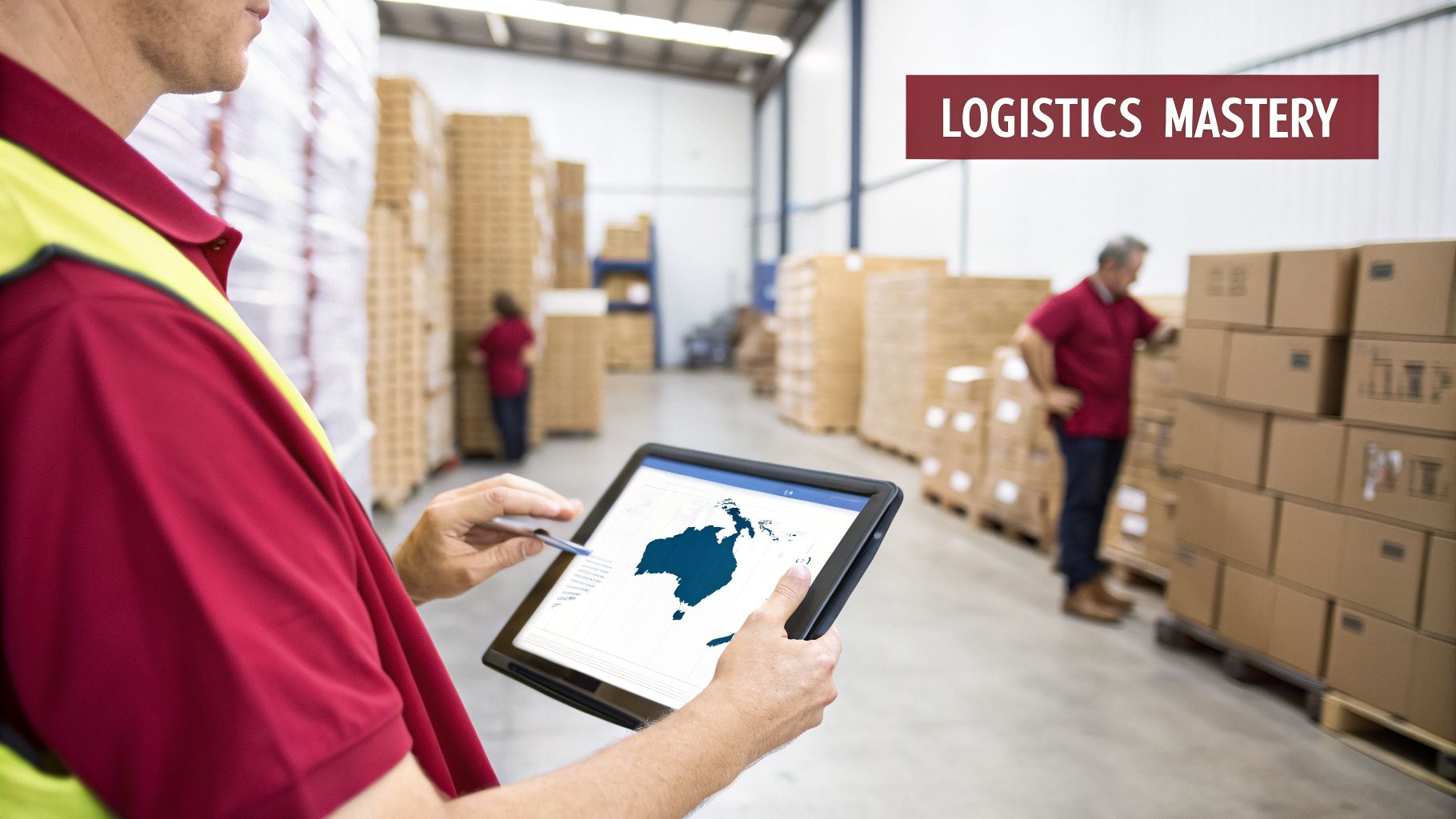
This is precisely where Fulfilment by Amazon (FBA) shifts from a “nice-to-have” to a non-negotiable strategic asset. By tapping into Amazon’s network of fulfilment centres, your products are strategically positioned closer to customers in major hubs like Sydney, Melbourne, and Brisbane.
Using FBA transforms Australia’s immense geographical challenge from a potential growth-killer into a powerful competitive advantage. It allows you to meet the high consumer expectations for speed set by Amazon Prime, effectively levelling the playing field against established local players.
The operational payoff is immediate. You get to sidestep the enormous cost and complexity of building your own national logistics network. We explain more about how FBA streamlines Australian market entry in our guide on the topic. For founders, it means you can stop worrying about freight management and stay focused on what you do best: building your brand and creating great products.
Winning the Mobile Commerce Battleground
Here in Australia, the customer journey starts and ends on a smartphone. This isn’t just a trend; it’s the default behaviour. In fact, mobile devices drive about 95% of online shopping activities in Australia, and account for a massive 65-95% of all ecommerce traffic. This mobile-first reality makes Amazon’s powerful user experience a critical part of getting your products discovered and purchased. You can read more about Australian marketplace dynamics to see just how dominant mobile has become.
Amazon’s app is built for this environment from the ground up, offering:
- Advanced Personalisation: It shows customers the exact products they’re most likely to want.
- Rapid Filtering: Shoppers can instantly narrow down huge catalogues to find what they need.
- One-Click Purchasing: It eliminates friction at the most crucial point in the sales process.
For any brand entering the market, this is an instant operational win. You don’t have to spend a fortune developing a world-class mobile shopping experience—you simply plug your brand into one that already dominates the market.
Reframing Advertising as a Strategic Investment
Finally, I see a lot of founders treat advertising as a discretionary marketing expense. On the Amazon marketplace in Australia, that’s a strategic mistake. In crowded and competitive categories, paid visibility is no longer an option; it’s practically a mandatory cost of entry.
Instead of thinking of it as “advertising,” I tell founders to think of it as paying for premium shelf space in the country’s busiest digital store. A well-run Amazon Ads campaign gets your proven product in front of high-intent shoppers at the exact moment they’re ready to buy.
It’s a pragmatic investment that accelerates the feedback loop, drives that critical initial sales velocity, and helps your product gain the organic ranking it needs for long-term, sustainable growth.
Before diving in, it’s worth taking a moment to assess whether your brand is truly ready. We use this checklist with our partners to ensure all operational bases are covered.
Amazon AU Operational Readiness Checklist
| Operational Area | Key Consideration for Australia | Strategic Implication |
|---|---|---|
| Logistics & Fulfilment | The “tyranny of distance” across a vast continent. | An FBA-first strategy is almost essential to meet Prime delivery expectations and compete on cost. |
| Mobile Commerce | The consumer journey is overwhelmingly mobile-first (95% of shopping activity). | Your listings must be optimised for mobile viewing, not just desktop. A+ Content is key. |
| Advertising Strategy | Paid visibility is a non-negotiable cost of entry in competitive categories. | Budget for Amazon Ads as a core part of your launch, not an afterthought, to drive initial velocity. |
This checklist isn’t exhaustive, but it frames the core operational pillars you must have in place. Mastering Amazon’s tools—FBA for logistics, mobile-optimised listings for conversion, and advertising for visibility—is what gives you a clear path to scalable and profitable success in the Australian market.
The Difference Between a Product and a Brand on Amazon

Many founders view the Amazon marketplace in Australia as little more than a sales engine. They get caught up in optimizing keywords, chasing initial sales, and fighting for visibility. While these tactical elements have their place, this mindset misses the far more valuable objective: building a lasting brand.
I see this pattern play out repeatedly, even with companies that have fantastic products. They achieve early sales targets, but then growth flattens. Why? Because they’ve created a series of transactions, not a brand. Their product becomes just another commodity, indistinguishable from dozens of others and forced to compete on price and reviews alone.
A simple listing is fragile. A true brand, however, builds a protective moat around your business. It creates equity, inspires loyalty, and defends your profit margins against the relentless downward pressure of the marketplace. The smartest founders don’t just sell on Amazon; they build their brand within Amazon.
From Merchandising to Brand Storytelling
The leap from a listing to a brand is entirely strategic. A listing is mere merchandising—it displays a product and its features. A brand is about storytelling—it communicates your value, builds trust, and makes a promise to your customer.
Amazon provides a powerful suite of tools designed for this exact purpose, yet they are criminally underutilized by most sellers. The moment you move beyond the basic product detail page is when you begin to pull away from the competition.
These are not “nice-to-have” enhancements; they are foundational assets for building your brand.
-
Amazon Brand Registry: This is your non-negotiable first step. It is the key that unlocks all of Amazon’s branding tools and, just as importantly, protects your intellectual property from hijackers and counterfeit products. Consider it the foundation for controlling your brand on the platform.
-
A+ Content: This is where you transform your product description from a dry wall of text into a rich, visual narrative. Use high-quality imagery, comparison charts, and persuasive copy to showcase your product, articulate its unique advantages, and proactively answer customer questions.
-
Amazon Storefronts: Your Storefront is your brand’s dedicated home on Amazon. Think of it as a multi-page digital showroom where you can curate collections, share your origin story, and create a polished, cohesive experience that cements your brand identity. It’s your opportunity to appear as a serious contender, not just another random seller.
When you use these tools strategically, you seize control of your brand’s narrative right inside the ecosystem where Australian shoppers are making their buying decisions.
“A great product might get you the first sale. A great brand gets you the repeat sale and the customer loyalty that follows. Founders who get this treat Amazon not as a channel to be exploited, but as a platform to build upon.”
Creating a Defensible Brand Position
Your objective is to become the default choice in your category. When a customer seeks a solution to their problem, you want your brand to be the one that immediately comes to mind. This only happens through consistent, strategic brand communication.
On the Amazon marketplace in Australia, this means using your A+ Content and Storefront to answer the unspoken questions every customer has:
- Why should I trust your product over a cheaper one?
- What makes your quality or innovation genuinely better?
- What is the story and mission behind this company?
A founder-led brand always has an authentic story to tell, and Amazon’s platform provides the perfect canvas. A well-executed brand presence builds trust, which in turn justifies a premium price and insulates you from competitors who are stuck fighting in the bargain bin.
At the end of the day, hitting initial sales numbers is merely the first checkpoint. Real, sustainable growth on a competitive platform like the Amazon marketplace in Australia comes from building a brand that customers recognize, trust, and actively seek out. A listing is temporary; your brand is the asset that will last.
The Hidden Risks of an Uncontrolled Amazon Launch
For any founder with a great product, the prospect of international expansion is exhilarating. But entering the Amazon marketplace in Australia introduces a new set of risks—ones that can quietly unravel your hard-earned brand value if not managed from day one. I’ve seen too many brands rush in, driven by the excitement of growth, only to find themselves managing operational issues they never anticipated.
Entering without a plan is a classic mistake. It leads to damaging channel conflict with existing partners, destroys your carefully built pricing structure, and can even expose your brand to serious compliance penalties. The founders who succeed are those who view risk management not as a bureaucratic task, but as a fundamental part of their growth strategy. They understand that on an open marketplace like Amazon, brand control is paramount.
The Dangers of Channel Conflict and Brand Dilution
When a brand launches on Amazon Australia without a tight channel strategy, the result is almost always chaos. The first problem is channel conflict. Suddenly, your new Amazon store is competing directly with the distributors and retail partners you’ve spent years building relationships with. This can burn bridges and spark a race to the bottom on price, where your profit margins become the primary casualty.
The situation worsens when unauthorized third-party sellers get involved. These operators often source products through grey-market channels and list them on Amazon themselves. Without a plan to stop them, you quickly lose control over:
- Pricing Integrity: These sellers often slash prices to win the Buy Box, setting a new, lower price expectation in the market and devaluing your brand overnight.
- Brand Presentation: They have no incentive to create quality listings. You’ll find your products sold with grainy images and sloppy, inaccurate descriptions that damage your brand’s reputation.
- Customer Experience: They cannot provide the same level of support, leading to negative reviews that get attached to your product, not to the seller who caused the problem.
This messy expansion erodes the very brand equity you’ve worked so hard to create. The only way to avoid this downward spiral is with a deliberate, controlled launch.
Navigating Australian Compliance
Beyond marketplace chaos, Australia has a robust regulatory system that can create major headaches for unprepared brands. Claiming ignorance is not a defense—non-compliance can lead to hefty fines or even having your products pulled from the market entirely. There are a few key areas every founder needs to pay close attention to.
The Australian Consumer Law (ACL) is especially strict. It gives consumers automatic guarantees on the products they buy, which often go far beyond a manufacturer’s own warranty. You absolutely must understand your obligations for returns, repairs, and replacements under the ACL. It’s non-negotiable.
On top of that, founders need to be ready for specific compliance rules, including:
- Goods and Services Tax (GST): You are required to register for, collect, and remit a 10% GST on most products sold to Australian customers.
- Product Safety Standards: Depending on your category—like electronics, toys, or cosmetics—your products will have to meet specific mandatory safety and information standards.
- Labelling Requirements: Rules around country of origin, ingredient lists, and other labelling details must be followed precisely.
Strategic foresight is the only way to manage these complexities. A successful entry into the Amazon marketplace in Australia is built on a strategy that anticipates these risks from the start. You can explore our guide on what it takes to start selling on Amazon for a deeper look at these early steps. Smart brands use Amazon to grow methodically, ensuring every move strengthens their brand instead of exposing it to risk.
A Strategic Roadmap for Your Australian Launch
Entering the Amazon marketplace in Australia isn’t a one-shot deal. It’s a strategic campaign that demands a measured, phased rollout. The founders who win are the ones who treat it with precision—they validate, position, and then scale, analysing results at every turn.
This isn’t about following a beginner’s YouTube tutorial. It’s about executing a proper plan focused on the performance indicators that actually matter to a founder: profitable revenue, defensible market share, and lasting brand equity. Smart brands move through a clear go-to-market roadmap.
Phase 1: Market Validation and Entry
Your first move shouldn’t be a full-scale invasion; think of it as a reconnaissance mission. The goal is to test the market with minimal risk and gather real-world data before you commit serious capital.
This phase is all about:
- Targeted Product Selection: Don’t launch your entire catalogue. Start with a curated selection of your proven hero products to focus your resources on items with the highest chance of success.
- Initial FBA Deployment: Commit a limited inventory run to Fulfilment by Amazon (FBA). This lets you test how shoppers respond to Prime eligibility and fast delivery.
- Baseline Keyword & Competitor Analysis: Get a clear picture of the initial search landscape and identify the key players you’ll be competing against.
Your primary goal here isn’t sales volume; it’s data acquisition. Are customers searching for your type of product? How do they react to your price point? This early data will inform every single decision you make from here on out.
Phase 2: Strategic Brand Positioning
Once you’ve confirmed there’s initial demand, the focus shifts from testing the waters to building your brand. This is where you separate your product from the crowd and start building a protective moat around your listings.
Activities in this phase include:
- Full Brand Registry Implementation: Securing your brand is non-negotiable. It unlocks essential tools like A+ Content and your own brand Storefront.
- A+ Content & Storefront Rollout: Transform your basic listings into rich, brand-centric experiences that tell your story and communicate your unique value.
- Review Generation Strategy: Actively work on getting those first crucial customer reviews to build social proof and shopper trust.
The key metric now becomes brand engagement. Are shoppers visiting your Storefront? Is your A+ Content actually improving conversion rates? You’re building an asset, not just moving units.
Phase 3: Scaling and Performance Analysis
With a solid brand foundation in place, you can finally hit the accelerator. This is where you invest in growth, using Amazon’s tools to aggressively—but intelligently—capture market share.
This phased approach is what separates fleeting sales from the establishment of a scalable international brand. It’s about being deliberate, measuring what matters, and understanding that each stage builds on the last.
This final phase focuses on:
- Strategic Advertising Campaigns: Use Amazon Ads to target high-intent keywords, defend your branded search terms, and drive traffic directly to your new Storefront.
- FBA Inventory Optimisation: Expand your FBA stock levels based on the sales data you’ve gathered to prevent stockouts and maintain momentum.
- KPI Monitoring: Track the metrics that truly matter to a founder, like Total Advertising Cost of Sale (TACoS), market share in your sub-category, and, most importantly, profitable revenue.
Navigating these steps successfully requires deep market knowledge and strategic foresight. For many founders, a strategic partnership is the most effective way to accelerate intelligent expansion.
Key Strategic Questions for Founders
Expanding a successful product into a new market always brings up critical questions. For brand founders looking at the Amazon marketplace in Australia, these questions are less about basic operations and more about strategy, risk, and protecting their brand long-term.
Here are the high-level concerns we hear most often.
Is the Australian Market Large Enough to Justify the Effort?
This is a common first question, and the answer is absolutely yes. But you have to look beyond raw population numbers. While smaller than the US or UK, the Australian market is mature, wealthy, and consolidating quickly around Amazon.
The real opportunity isn’t about volume; it’s about value. For brands with proven products, Australia is a chance to build significant market share with far less competition than in more saturated regions. It’s about capturing a high-value customer base that understands and is willing to pay for quality. Success here comes from a proper strategic entry, not just throwing products online and hoping for the best.
Can I Test the Market Before Committing to FBA?
You can, but I see this backfire all the time. Many founders think about starting with Fulfilment by Merchant (FBM) to dip a toe in the water, shipping directly to Australian customers from an overseas warehouse to gauge demand.
Strategically, this is a dangerous move. Australian consumers are now completely used to the speed and convenience of Prime. Long delivery times and unexpected international shipping fees almost guarantee a poor customer experience. This leads to negative reviews that can kill your brand’s reputation before you even get started.
A much smarter way to test the market is with a limited, targeted Fulfilment by Amazon (FBA) launch. By sending a small batch of your hero products to an Australian FBA centre, you give your brand the best possible chance to make a strong first impression under real-world conditions.
How Do I Protect My Brand from Unauthorised Sellers?
This isn’t just a good idea—it’s the absolute foundation of your entire Australian strategy. The Amazon marketplace is an open platform. If you don’t control your brand, someone else will.
The first, non-negotiable step is securing Amazon Brand Registry. This gives you a powerful set of tools to control your own product listings, represent your brand accurately, and—most importantly—remove counterfeit products or unauthorised sellers who threaten to devalue your brand.
Beyond Brand Registry, you need a clear channel strategy from day one. You must decide exactly who is authorised to sell your products in Australia and actively monitor the marketplace for anyone who isn’t. This prevents the price wars and channel conflict that can erode your brand’s value in a new market. Building a sustainable, profitable business on the Amazon marketplace in Australia is only possible when you are in complete control of your presence.
At TPR Brands, we work with established consumer brands expanding into major ecommerce markets including Australia, Canada, and the United States.
Our focus is helping brands navigate marketplace operations, logistics, compliance, advertising, and long-term positioning without sacrificing margin or brand control.
We partner with companies that already have proven products and strong manufacturing capability, helping them scale strategically across international marketplaces.
If you’re ready to expand into new markets with a clear strategy, visit us at tprbrandsau.com to learn how a partnership can accelerate your growth.