Many founders of great products struggle internationally, not because demand is weak, but because their expansion strategy is flawed. They assume a high-quality product is enough to win market share, only to find themselves dragged into brutal, margin-killing price wars on platforms they don’t control. This is a strategic miscalculation, and it’s the primary reason so many promising products fail to become great global brands.
This is exactly what we see with brands coming to us—they’ve built a strong product, proven demand, but hit a wall when trying to scale through Amazon or expand internationally.
The digital shelf is no longer the alternative; it’s the main arena where brands are built, tested, and scaled for long-term growth.
From Product Success to Brand Dominance: The Strategic Leap

A great product gets you in the door. It doesn’t guarantee success. In the crowded world of online selling, having something exceptional to sell is just the starting point—the absolute minimum requirement. The fundamental mistake many founders make is confusing a product with a brand. A product performs a function; a brand builds a connection, creates trust, and justifies a premium price.
Platforms like Amazon make this distinction painfully clear—because without the right strategy, even great products get forced into price competition instead of building real brand value.
The Product vs. Brand Analogy
Think of it this way: you need a new kitchen knife. One option is a generic, no-name knife in a plain box. The other is from a brand you recognize, one with a reputation built on years of trust, reliable performance, and thousands of positive reviews. Both knives do the same job, but one has earned loyalty and can command a higher price.
The generic knife is a product. The trusted name is a brand. The art of successful online selling lies in strategically turning your product into that trusted brand. This requires a deliberate effort to build a fortress of consumer trust and perceived value around what you sell. This brand equity is what protects you from the constant downward price pressure that defines most online marketplaces.
A great product doesn’t automatically become a great online brand. It requires a strategic and intentional effort to build equity, establish trust, and communicate value far beyond its functional features.
Building Brand Equity in a Digital World
Translating your product’s real-world value into something that resonates on a digital shelf comes down to a few core pillars. Get these right, and you build a brand that connects with customers and carves out its own defensible space.
Key pillars for building a powerful online brand:
- Strategic Positioning: Be crystal clear about who your product is for and what makes it genuinely different and better. This narrative must be consistent everywhere, from your product listings to your packaging and customer service.
- Controlling the Narrative: Actively manage your brand’s story through high-quality photography, compelling descriptions, and genuine customer reviews. If you don’t control the narrative, the marketplace and your competitors will define your product for you.
- Cultivating Consumer Trust: Trust is the currency of online commerce. It is earned through social proof, transparent policies, and outstanding customer service. Trust turns a first-time buyer into a loyal advocate.
Without these strategic pieces, even a product with a fantastic track record in physical retail can fall flat online. Marketplaces are not just sales channels; they are brand-building arenas. Founders who understand this achieve sustainable, long-term growth. They aren’t just selling products; they’re building valuable assets that command loyalty and pricing power.
The Common Traps of Marketplace-Led Growth

The pattern is predictable: a strong launch on a platform like Amazon, exhilarating early sales, and a feeling that you’ve cracked the code for online growth. But this initial momentum is often deceptive. What begins as a powerful sales channel can devolve into stalled growth, shrinking margins, and a slow loss of brand control.
It’s also the exact stage where most brands reach out to us—when sales are coming in, but margins are shrinking and control is slipping. In the chase for rapid sales volume, they build their brand on a foundation they don’t own. The very platform that delivered their first big win becomes a source of frustration, its direction dictated by algorithmic whims and brutal competition.
The Illusion of Easy Scale
A marketplace-first approach prioritizes tactical sales over strategic brand building. It’s easy to get caught up in daily metrics—sales velocity, conversion rates, ad spend—and lose sight of the bigger picture. This tunnel vision creates serious blind spots.
One of the biggest is algorithmic dependency. Your brand’s visibility is tied to an algorithm you cannot control. A single, unannounced change can wipe out your sales overnight. You are a tenant, not a landlord, and the rules can change at any moment.
Another huge risk is the erosion of your brand identity. On a marketplace, your product is forced into a standardized template, surrounded by competitors. It becomes almost impossible to tell your unique story or build a real relationship with your customers. They aren’t your customers; they belong to the marketplace.
Many brands chase early marketplace sales only to discover they’ve become a commodity. They win the battle for a quick transaction but lose the war for long-term brand equity and customer loyalty.
Real-World Consequences for Founders
These are not theoretical problems; they have a real impact that can stop a brand’s growth in its tracks. I regularly speak with founders who are stuck at a frustrating plateau, unable to scale further without destroying their profitability.
Common scenarios include:
- Price Wars and Margin Compression: Aggressive competitors, often with lower overheads, copy your key features and slash the price. This forces you into a defensive position, eating away at the margins needed to innovate and grow.
- Logistical Nightmares: Taking a marketplace strategy international introduces immense complexity. Suddenly, you’re wrestling with different compliance laws, import duties, and tax rules for every country.
- Loss of Customer Connection: Marketplaces stand between you and your customer. You lose valuable data about who is buying your product and why, making it impossible to build a community or drive repeat business.
This cycle is precisely why so many promising products never become enduring brands. They get stuck in a tactical loop, optimizing for a single channel instead of building a resilient, strategic business. Breaking free requires a different way of thinking.
This table breaks down the difference between simply listing a product and strategically building a brand for the long term.
Strategic Online Selling vs. Tactical Marketplace Listing
| Factor | Tactical Marketplace Listing | Strategic Brand Selling |
|---|---|---|
| Primary Goal | Maximize short-term sales velocity and revenue on a single platform. | Build long-term brand equity and customer loyalty across multiple channels. |
| Brand Control | Minimal. The brand story and presentation are dictated by the marketplace's format. | Maximum. The brand controls the narrative, customer experience, and data. |
| Customer Relationship | The marketplace owns the customer relationship and all associated data. | The brand owns the customer relationship, enabling direct communication and retention. |
| Pricing Power | Limited. Highly susceptible to price wars and downward margin pressure. | Strong. A powerful brand can command premium pricing and protect margins. |
| Long-Term Risk | High. Dependent on a single platform's algorithms and policies. | Low. Diversified across multiple channels, creating a more resilient business. |
The tactical approach might deliver a quick win, but the strategic path builds a valuable, defensible asset. It’s the difference between a fleeting sales spike and a brand with real staying power.
Decoding International Market Expansion: The Case of Australia
Many founders approach new markets like Australia with a “copy-paste” mindset, assuming strategies that worked in North America or Europe will translate. This is a flawed and expensive assumption. The Australian consumer is distinct, our geography presents unique logistical hurdles, and the online selling market has its own rhythm. For brands looking at Amazon Australia, this is where strategy becomes the difference between scaling profitably or getting stuck in a low-margin channel.
To succeed, you must move beyond generic advice and analyze market-specific dynamics. Understanding these local nuances is a non-negotiable part of any intelligent expansion plan.
Market Size and Consumer Penetration
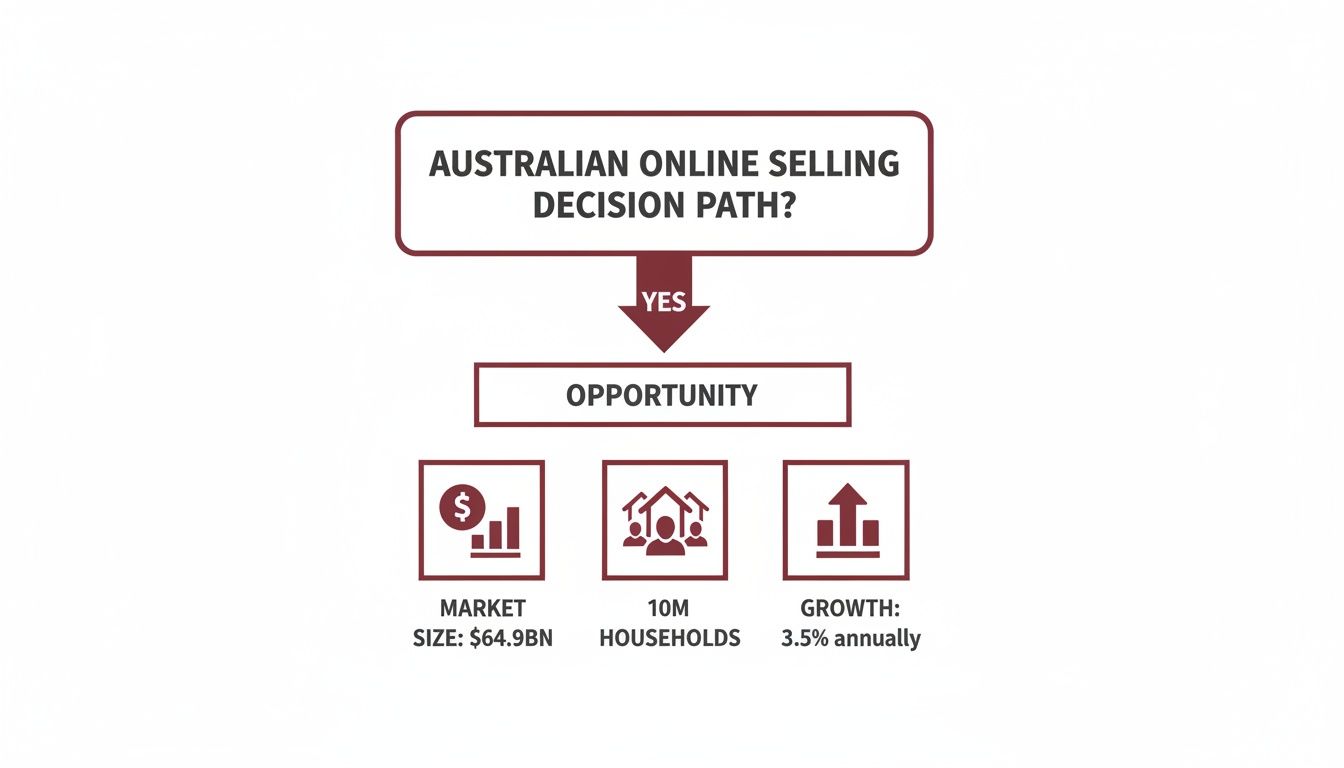
The Australian online market is not just mature; it’s on a solid growth trajectory. Industry analysis projects the online shopping sector will expand to a market size of $64.9 billion by 2026. This steady growth is built on deep consumer adoption, with nearly 10 million households now regularly shopping online. This signals a robust and active digital economy. You can find more details in this detailed eCommerce report on Australia.
For brands in categories like hardware, home improvement, and lifestyle goods, this sustained growth represents a prime opportunity. It shows a market with both the capacity and the appetite for high-quality products, provided they are positioned and delivered correctly.
A common mistake is to view Australia as a single, homogenous market. The reality is a collection of distinct consumer hubs, each with its own logistical complexities. A successful online selling strategy must account for this from day one.
Dominant Categories and Consumer Behaviour
While the market is diverse, certain categories consistently outperform. The Home & Garden sector, for instance, remains a powerhouse, demonstrating the Australian consumer’s ongoing investment in their home environment.
Understanding these preferences is crucial. It allows brand founders to identify where the strongest demand lies and how to tailor their messaging. This requires on-the-ground intelligence that goes far beyond surface-level market reports.
Additionally, Australian consumers place a high value on:
- Trust and Transparency: Clear shipping times, straightforward return policies, and local customer service are fundamental expectations.
- Quality and Durability: In categories like hardware and outdoor goods, there is a strong preference for products built to last.
- Local Relevance: Brands that demonstrate an understanding of local culture build much stronger connections.
Navigating these nuances—from regulatory compliance to distribution networks and marketplace expectations—is where many international brands stumble. For a deeper look into the specifics of one of Australia’s largest marketplaces, you might be interested in our guide on the Amazon marketplace in Australia.
The Founder’s Dilemma: Build In-House or Partner for Growth?
As a founder with a winning product, you will eventually face a critical decision: build an in-house team to conquer new markets or find a strategic partner to accelerate growth? Many founders instinctively lean towards the in-house route, believing it offers more control. However, that path is almost always slower, more expensive, and fraught with operational headaches that divert focus from what you do best—creating incredible products.
The Hidden Workload of In-House Expansion
Attempting to build an international presence alone means becoming an expert in fields outside your core business. You’re no longer just a brand founder; you’re running a small-scale multinational.
Suddenly, you’re tangled in a web of new challenges:
- Regulatory and Tax Compliance: Every country has a maze of tax laws, import duties, and product standards. One mistake can halt your inventory at the border.
- Supply Chain and Logistics: You must build an entirely new supply chain, from finding trustworthy warehouses to negotiating with local carriers and managing cross-border freight.
- Local Market Nuances: True success requires genuine, on-the-ground knowledge of local consumer behavior, marketplace rules, and customer service expectations.
Building this internally is a massive undertaking. It burns capital and, more importantly, it steals focus from product innovation and brand strategy.
For most established brands, the fastest and most capital-efficient way to expand isn’t to hire a massive internal team. It’s to plug directly into a strategic partner’s existing infrastructure and expertise. Smart founders get to market faster and with less risk by partnering.
The Strategic Edge of Partnership
A strategic partner is a launchpad. This is exactly how we work with brands—providing the infrastructure, marketplace strategy, and operational execution needed to scale on Amazon without losing control. They provide the operational engine needed to enter a new market quickly and without guesswork. Instead of spending months or years building it yourself, you gain instant access to a proven system.
This is about leverage. You leverage their deep knowledge of local compliance, their established logistics networks, and their hard-won experience navigating the specific marketplace you want to dominate. The data highlights the size of the prize: Australia’s eCommerce spending is on track to hit AU$56.07 billion in 2024, with 17.08 million monthly online shoppers—a number expected to climb to 23.14 million by 2029, as detailed in this comprehensive social commerce report.
This model turns a high-risk, cash-intensive gamble into a smart, calculated move. It allows founders to keep their focus on brand and product, while a trusted partner manages the heavy operational lifting. If this path sounds right for you, understanding what to look for in an Amazon expansion partner is a critical next step.
Turning Your Product Into a Scalable Global Brand
The leap from a successful product to a dominant global brand does not happen by accident. The world of **online selling** rewards strategy, not just product strength. A great product gets you in the game, but deliberate brand positioning, deep market understanding, and operational excellence determine whether you build a lasting asset or just a temporary sales channel.
The path is littered with avoidable traps. Promising brands stall by relying solely on a single marketplace, underestimating the complexity of international logistics, or assuming a one-size-fits-all strategy will work across different cultures.
From Tactical Sales to Strategic Growth
The most critical shift is moving from a tactical mindset to a strategic one. Instead of asking, “How can we sell more products online today?” the question becomes, “How do we build a brand that can win new markets tomorrow?”
This requires a commitment to:
- Building Brand Equity: Creating an identity that commands loyalty and protects pricing power.
- Owning the Customer Relationship: Moving beyond borrowed marketplace audiences to build direct connections.
- Developing Operational Agility: Mastering the complexities of compliance, distribution, and logistics in new territories.
Success in modern online selling comes from superior strategy. It’s the result of intentional decisions made long before a product ever hits the digital shelf, all focused on building a resilient, multi-channel brand.
For founders with exceptional products, navigating these challenges is the final frontier. The complexities of international growth demand expertise that often falls outside a founder’s core genius. This is where the right strategic alliance becomes a decisive advantage.
A partner with established infrastructure and on-the-ground intelligence can mean the difference between a few extra sales and building a truly global brand. For leaders ready to make that leap, exploring a partnership is the most important next move.
Answering Key Strategic Questions
This section tackles the high-level questions we hear most often from founders planning their next move. The goal is to share the strategic thinking that successful brand builders use to grow sustainably.
Is an Amazon-Only Strategy a Good Idea?
Relying on Amazon as your only strategy is a massive risk. It’s a tactical move, not a brand-building one. This approach leaves you completely exposed to algorithm changes, price wars, and gives you zero direct relationship with your customers. Smart founders use Amazon as one part of a bigger picture—a channel to drive volume and reach new customers, but it must sit alongside channels where you control your brand, your pricing, and your customer data.
How Do I Know if My Product Is Ready for International Expansion?
A product is ready to go international when you have consistent, repeatable success in your home market. But that’s only half the story. The real test is whether the leadership team is prepared for the operational hurdles of a new market—compliance, logistics, and genuinely understanding a new culture.
Readiness is less about your product and more about your operational maturity. It’s about having the systems and mindset to handle complexity without taking your eye off your core business. This is where a partner can help you see and fill the gaps.
What Is the Biggest Mistake Brands Make When Expanding?
The most common and expensive mistake is the ‘copy-paste’ strategy. Brands assume what worked in one country will work everywhere else. It never does. They fail because they don’t invest the time to understand local consumer habits, compliance laws, or distribution realities. Your home market success won’t automatically translate; a market-specific strategy is non-negotiable.
Should I Hire an In-House Team or Partner for Expansion?
Building an in-house team for international growth is a slow, expensive, and risky path. You’re hiring for skills you don’t have, in a market you don’t understand. A strategic partner gives you immediate access to on-the-ground expertise, logistics networks, and compliance knowledge from day one.
For founders, this path offers serious advantages:
- Speed to Market: Enter a new market in a fraction of the time.
- Capital Efficiency: Turn a massive capital expense into a predictable operating cost.
- Reduced Risk: Leverage a partner’s experience to sidestep costly mistakes.
- Sustained Focus: Keep your core team focused on what they do best—building great products.
For any founder who values speed and capital efficiency, partnering is almost always the smarter choice. It provides a clear path to growth without the operational drag of building a multinational company from the ground up.
At TPR Brands, we work directly with founders who already have strong products and want to scale them properly through Amazon and international markets.
We help structure the entry, build the brand positioning, and manage the execution so growth doesn’t come at the expense of margin or control.
If you’re at that stage where your product is working—but scaling online isn’t—this is where the right strategy makes all the difference. Start a conversation with us.