A product that succeeds in Australia, Europe, or Canada can still collapse in the US online marketplace.
Not because demand is weak. Not because the product is bad. And usually not because the founder lacks ambition.
The problem is that many brands underestimate how different the American market really is.
The US ecommerce ecosystem moves faster, costs more, and punishes operational mistakes harder than almost any other market. A strategy that works domestically can break apart quickly under the pressure of Amazon fees, fragmented regulations, rising advertising costs, and intense competition.
This is why expansion into the US requires more than simply listing products online. It requires a deliberate market-entry strategy built around logistics, compliance, positioning, pricing, and long-term brand protection.
This guide explains where strong brands usually struggle — and how founders can build a more resilient path into the US online marketplace.
Why US Online Marketplace Expansion Stalls Great Products

Many brands underestimate how different the US ecommerce environment is from their domestic market.
The truth is, the US isn’t one market. It’s a fractured collection of regional consumer habits, mind-boggling state-by-state regulations, and a retail pace that can overwhelm even the most seasoned entrepreneur. Your early success in your home country was built on local knowledge and direct relationships. Those same strategies that got you here often become liabilities when you’re dealing with a market 13 times the size.
The Illusion of a Single Market
Founders often make the mistake of treating Amazon.com like a simple channel extension, similar to launching on another local platform. This is a critical error in judgment. The US online ecosystem, especially Amazon, operates with a level of competition and velocity that is an order of magnitude greater than anything in Australia or Europe.
-
Pace of Competition: New competitors can emerge, gain traction, and challenge your market position in a matter of weeks, not months. The speed at which you have to react to pricing shifts, new ad campaigns, and a sudden influx of reviews is absolutely relentless.
-
Compliance Complexity: Unlike Australia’s unified regulatory framework, the US system is a layered nightmare. Federal laws from agencies like the FDA or FCC are just the beginning. Then you have state-specific rules, like California’s Proposition 65, which can demand unique product labelling and create logistical headaches if you aren’t prepared.
-
Consumer Expectations: American online shoppers have been conditioned by Amazon Prime to expect near-instant delivery and frictionless returns. A three-week shipping window from an overseas warehouse is a non-starter. It will kill your launch momentum before it even begins.
The pattern we see most often is early Amazon success followed by stalled growth. A brand invests heavily in its first big shipment, launches on the US online marketplace, and sees a promising initial sales spike. Then, reality hits. Margins are thinner than projected, returns start piling up with no cost-effective way to manage them, and a surprise compliance issue freezes all their inventory.
Where Strategy Breaks Down
The core problem is almost always a lack of on-the-ground, market-specific understanding. A great product can fail not because of low demand, but because its operational and commercial strategy was built for an entirely different environment. Global expansion requires deep market understanding.
The tools provided to Amazon sellers can create a false sense of security. If you’re heading down this path, it’s vital to grasp the nuances that separate a real brand expansion from just listing a product for sale.
Costly mistakes usually pop up in a few key areas:
- Inventory Mismanagement: Overestimating initial demand and sending too much stock can trap a brand in a cycle of crippling storage fees and, eventually, liquidation losses.
- Margin Erosion: Failing to accurately calculate every single “landed cost”—freight, customs duties, US taxes, and all the marketplace fees—means your US pricing might be unprofitable from day one.
- Brand Dilution: Without a cohesive strategy, your product can quickly become just another commodity, lost in a sea of look-alikes and forced to compete on price alone.
Smart brands recognize that building a durable presence in the US online marketplace requires moving beyond the simple exporter mindset. It demands a strategic approach that treats the US as a distinct, complex, and resource-intensive venture.
Laying Your US Legal and Financial Foundation
Before you sell a single product, getting your American legal and financial structure right is non-negotiable. This is where so many international founders make their first, and often most expensive, mistake. They try to operate from their home country’s entity, which creates a huge amount of liability and operational friction that can stop an expansion dead in its tracks.
This isn’t just about ticking boxes for Amazon. It’s about building a stable foundation to protect your core business, satisfy US banking and tax authorities, and show the market you’re a serious, long-term player. Treating this as a mere administrative task is a recipe for disaster—think stalled inventory, frozen funds, and legal headaches you never saw coming.
Choosing Your US Business Entity
Your first big decision is what type of US company to form. For most international founders, the choice boils down to a Limited Liability Company (LLC) or a C-Corporation (C-Corp). While you’ll need formal advice from your accountant and lawyer, it’s crucial to understand the implications from a founder’s perspective.
-
Limited Liability Company (LLC): This is the most common and practical choice for international sellers. An LLC acts as a legal firewall, separating your personal assets and your parent company from your US business liabilities. It offers what’s called “pass-through taxation” by default, meaning profits and losses are passed to the owners. For a foreign owner, this creates specific US tax filing obligations that you have to get right.
-
C-Corporation (C-Corp): A C-Corp is a more complex legal structure that’s taxed separately from its owners. It’s often the go-to if you plan on seeking US venture capital investment later on. The major downside is “double taxation”—the corporation pays tax on its profits, and then shareholders pay tax again on any dividends.
For the vast majority of brands expanding to the US, the LLC provides the ideal balance of liability protection and operational simplicity.
To help you visualise the differences, here is a high-level comparison of the two most common structures for international sellers.
US Business Entity Comparison For International Sellers
| Feature | LLC (Limited Liability Company) | C-Corporation |
|---|---|---|
| Liability | Provides a strong liability shield, separating business debts from personal and parent company assets. | Offers the highest level of liability protection for owners (shareholders). |
| Taxation | “Pass-through” taxation. Profits/losses are passed to owners. Creates US tax filing obligations for foreign owners. | Taxed at the corporate level. Can lead to “double taxation” if profits are distributed as dividends. |
| Setup & Compliance | Simpler to set up and maintain with less formal requirements (e.g., no mandatory board meetings). | More complex to establish and maintain, with strict formal requirements for meetings, records, and reporting. |
| Best For | Most e-commerce sellers, lifestyle brands, and businesses prioritising operational simplicity and liability protection. | Businesses planning to raise venture capital from US investors or requiring a complex ownership structure. |
While a C-Corp has its place, especially for venture-backed companies, the LLC is almost always the more straightforward and cost-effective path for international brands entering the US marketplace.
The Three Pillars of US Operations
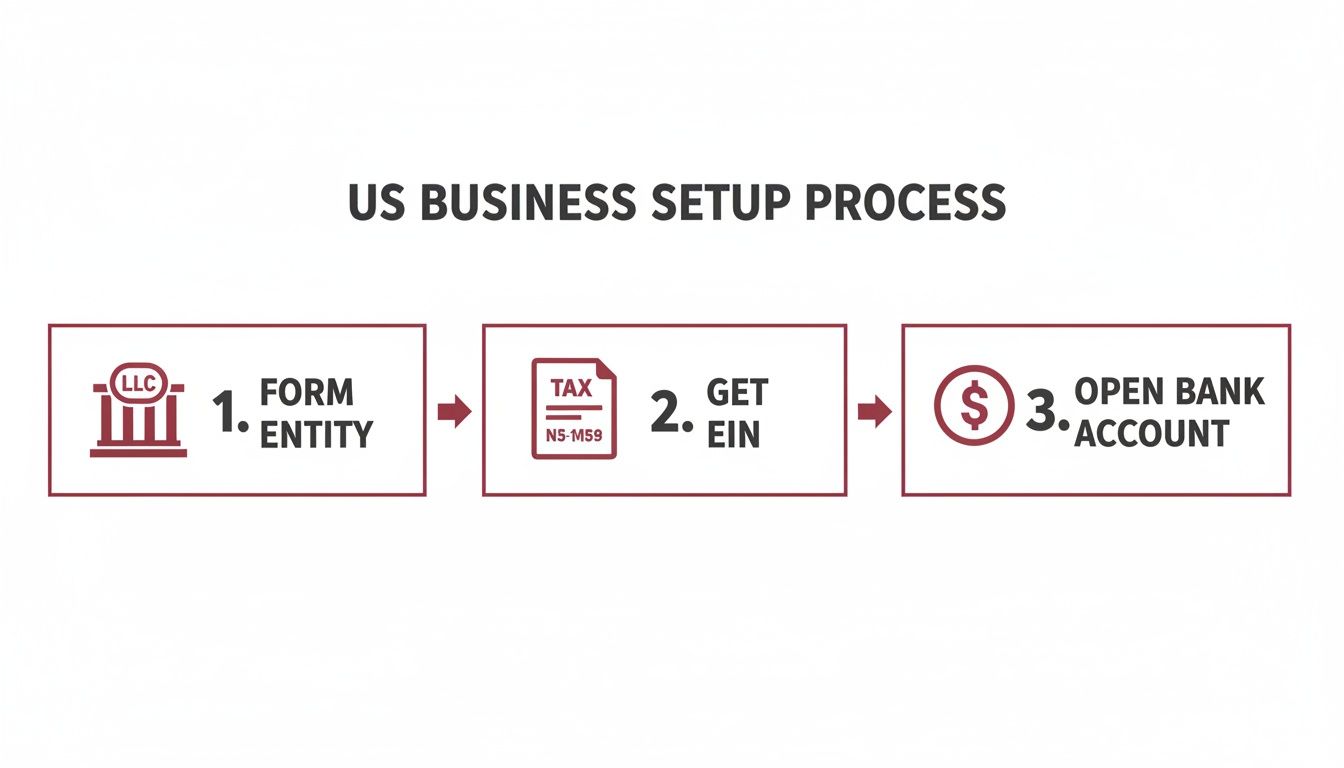
Once your entity is registered, you need three critical components to operate legitimately. Trying to get around these steps with personal accounts or shadowy third-party services is a high-risk game that Amazon’s verification systems are built to catch.
Don’t even think about taking shortcuts here. The entire US system is built on verification. Having a properly registered US company with its own EIN and a legitimate US bank account is the only sustainable way forward. Anything less introduces a level of risk that can destroy your entire US investment.
1. Employer Identification Number (EIN)
Think of an EIN as your company’s tax file number. It’s a unique nine-digit number assigned by the Internal Revenue Service (IRS) to businesses operating in the United States. You absolutely must have one to open a US bank account, file federal taxes, or hire any US staff. Securing your EIN is the first thing you do right after forming your LLC or C-Corp.
2. US Business Bank Account
Amazon and other platforms need a US-based bank account to send your payments to. While you can use currency conversion services, a dedicated US bank account in your US company’s name is the proper way to do it. It simplifies your accounting, cuts down on fees, and proves your operational legitimacy. Thankfully, many modern banks cater to international founders and allow for remote account setup once your legal entity and EIN are sorted.
3. Getting Your Head Around Sales Tax
This is the one that trips up nearly every international founder. The US doesn’t have a national GST. Instead, sales tax is a chaotic mess of state, county, and even city-level rules. As an online seller, you might have to collect and pay sales tax in states where you have a “nexus”—a connection that can be triggered simply by storing your inventory in an Amazon FBA warehouse.
Ignoring sales tax is not an option. It can lead to massive back-tax bills, crippling penalties, and getting your seller account suspended. Budgeting for sales tax compliance software right from day one is one of the smartest strategic investments you can make.
Mastering Your Cross-Border Supply Chain
Getting your product from a warehouse in your home country to a customer’s doorstep in the US is where your international strategy meets cold, hard reality. This is the part of the journey that dictates your true profitability and determines whether you can scale.
I’ve seen too many founders focus entirely on product and marketing, only to find themselves bleeding money on unexpected freight costs, customs delays, and inefficient fulfilment. Mastering your cross-border logistics isn’t just an operational chore; it’s a core strategic function for any brand serious about succeeding in the US.
FBA vs FBM: The Strategic Fulfilment Decision
Your first major logistical decision is how you’ll get products to American customers. Amazon gives you two main options: Fulfilment by Amazon (FBA) and Fulfilment by Merchant (FBM). This choice isn’t just about who packs the box; it fundamentally shapes your customer experience, cost structure, and operational workload.
-
Fulfilment by Amazon (FBA): You ship your inventory in bulk to Amazon’s US warehouses. From there, Amazon handles storage, picking, packing, and shipping for every order. Crucially, this is how you get the Prime badge, which is a massive driver of consumer trust and conversions. The trade-off is that you pay significant fees for storage and fulfilment, and you lose some control over your inventory and branding.
-
Fulfilment by Merchant (FBM): You or a third-party logistics (3PL) partner manage your own inventory in the US and fulfil orders as they come in. FBM gives you complete control over your packaging and customer service. It can sometimes be more cost-effective for large, heavy, or slow-moving items, but you lose the powerful Prime badge and are solely responsible for meeting Amazon’s strict shipping performance metrics.
For most international brands, a hybrid strategy is the smartest way forward. Use FBA for your fast-moving, high-margin hero products to take full advantage of Prime. Then, use FBM (ideally through a US-based 3PL) for your slower-moving SKUs or oversized items. This also gives you a buffer of inventory outside of Amazon’s ecosystem, which is always a wise move.
Navigating Customs and Compliance
Getting your goods into the US is more than just booking a freighter. It involves a complex web of customs declarations and product compliance that can halt your shipment indefinitely if you get it wrong. We have seen founders lose thousands on avoidable errors right here.
Harmonized System (HS) Codes are absolutely critical. These are internationally standardised codes used by customs to classify products. Using the wrong HS code can lead to your goods being held, re-valued at a higher duty rate, or even seized. You must work with your freight forwarder to ensure every single product is correctly classified before it leaves its country of origin.
The official guidance from U.S. Customs and Border Protection makes it clear: the burden of compliance—from classification to valuation and safety—rests squarely on you, the importer.
Beyond customs, you must meet US-specific product compliance standards. This isn’t optional. For example:
- Health & Wellness Products: Often require registration with the Food and Drug Administration (FDA).
- Consumer Electronics: Need to meet Federal Communications Commission (FCC) regulations for electromagnetic interference.
- Children’s Products: Must adhere to strict safety standards from the Consumer Product Safety Commission (CPSC).
Failure to comply with these regulations can result in your listings being shut down and your inventory becoming unsellable. Vetting these requirements before your first shipment is a non-negotiable step for any serious founder. For more insights on building out your presence, check out our guide on creating a powerful Amazon store that aligns with US market expectations.
Launching and Winning On the US Online Marketplace

On the US Amazon marketplace, visibility is earned, not given. Simply having a product available for sale guarantees absolutely nothing. Winning requires a deliberate commercial strategy designed to capture attention, build trust, and drive sales velocity from day one.
This means moving well beyond a simple cost-plus pricing model and developing a sophisticated launch plan. It’s about turning a static product page into a powerful, revenue-generating asset that resonates with discerning American buyers.
Calculating Your True Landed Cost and Price
Before you can even think about setting a competitive price in US dollars, you must understand your true landed cost. This is exactly where I see many international brands watch their margins evaporate.
Your landed cost isn’t just your manufacturing cost plus shipping. It’s the total expense to get a single unit from your factory floor into a US customer’s hands.
A realistic calculation must include:
- Cost of Goods Sold (COGS): The price you pay your manufacturer per unit.
- International Freight & Insurance: The cost per unit to ship your bulk order to the US.
- Customs Duties & Tariffs: Calculated based on your product’s HS code and country of origin.
- US Ground Transport: The cost to move inventory from the port to an Amazon FBA or 3PL warehouse.
- Amazon Fees: This includes referral fees (typically ~15%), FBA fulfilment fees, and monthly storage costs.
- Marketing & Returns: A critical percentage allocated for advertising and handling returned or unsellable stock.
Only after accounting for every single one of these costs can you set a USD price that actually protects your margin. Pricing based on an incomplete picture is a fast path to an unprofitable venture.
Optimising Your Listing to Convert American Buyers
A successful Amazon listing is far more than just a collection of keywords; it’s a sales pitch. You need to build a compelling argument that persuades a sceptical American consumer to choose your product over dozens of others.
This is achieved through a combination of persuasive copy and high-impact visuals. Your listing should be built around these core elements:
- Benefit-Driven Title: Go beyond simply stating what the product is. Lead with the primary benefit it delivers or the problem it solves.
- Persuasive Bullet Points: Use each bullet point to address a key feature, explain its direct benefit, and overcome a potential customer objection.
- High-Quality Imagery: This is non-negotiable. You need a mix of clean product shots on a white background, lifestyle images showing the product in use, and infographics that highlight key features.
American online shoppers are visually driven and time-poor. They will judge the quality of your entire brand based on your product photography in a matter of seconds. Investing in professional, market-specific imagery is one of the highest-return activities you can undertake.
A+ Content is your space to truly tell your brand story on the product page. Use this section to build a deeper connection, compare your product to competitors, and reinforce what makes your brand unique.
This attention to detail must extend to the mobile experience. In Australia, for example, smartphones now drive 47% of all online shopping sessions. That trend is even more pronounced in the US, making it critical that your images and A+ Content are clear and compelling on a small screen. You can discover more about evolving consumer behaviour in the Australian market and its global implications.
The Strategic Launch Plan for Sales Velocity
Your first 30–60 days on the US Amazon marketplace are critical. Your immediate goal isn’t profitability; it’s sales velocity. You need to generate sales to prove to Amazon’s algorithm that your product is relevant, which in turn boosts your organic ranking and visibility for the long term.
A strategic launch involves a careful application of Amazon’s advertising tools.
First, launch with aggressive Pay-Per-Click (PPC) advertising. Start with a focused Sponsored Products campaign targeting a small, highly relevant set of “exact match” keywords. The objective here is to drive initial conversions and gather performance data, not to be profitable from day one.
At the same time, work to generate early reviews. Enrolling in the Amazon Vine program is an effective way to get your first batch of credible reviews. This social proof is essential for building trust with new customers who have never heard of your brand.
Finally, you need to monitor and optimise. After the initial launch phase, analyse your advertising data. Shift your budget towards the keywords and campaigns that are converting at a profitable rate, and only then begin to expand your reach. This methodical approach stops you from burning through your entire launch budget with no clear return.
When To Partner For Scalable Growth
That initial rush of sales in a new marketplace is a fantastic feeling. But what happens next can make or break your US expansion. I’ve seen it countless times—that early success quickly exposes every single operational weakness you have.
Suddenly, your founding team is pulled away from building the brand and is instead drowning in tasks they were never meant to handle from the other side of the world. The dream of global expansion starts to feel more like a logistical nightmare.
Things like managing returns, handling customer service across a 16-hour time difference, and navigating the confusing world of US inventory management become a huge drag on the business. This is the exact moment every founder has to ask: do we keep trying to do this alone, or is it time to bring in a partner?
The Hidden Costs of Going It Alone
Trying to run a US ecommerce operation from another country creates a silent friction that eats away at your margins and kills your momentum. It’s not just the big, obvious challenges; it’s the death-by-a-thousand-cuts that pulls you away from what you do best.
Your team ends up burning valuable time on low-value, high-stress jobs:
- Chasing freight forwarders for updates on a customs delay.
- Waking up for pre-dawn calls to solve a minor customer complaint.
- Figuring out how to dispose of returned stock stuck in an FBA warehouse without losing your shirt.
This isn’t scaling. It’s firefighting. This operational burden is precisely why so many promising international brands hit a wall after their initial launch. They get their products listed, but they can’t sustain the day-to-day operations required to win in the long run.
Partnering isn’t an admission that you can’t handle it. It’s a sign of strategic maturity. Smart founders know their time is better spent building the brand, not becoming amateur experts in US logistics. Many brands grow faster through strategic partnerships.
Finding the Right Strategic Partner
A good partnership is about more than just outsourcing a few tasks. It’s about embedding on-the-ground expertise and infrastructure directly into your US strategy. A great partner becomes an extension of your own team, executing the market-specific work needed to scale sustainably.
The kind of partner you need really depends on your immediate pain points and your long-term goals.
The Three Main Partnership Models
1. Specialised Agencies
These firms focus on one specific area, like Amazon PPC advertising or listing optimisation. They bring deep expertise in a narrow field, which is a solid choice if your operations are running smoothly but you need to sharpen your marketing.
2. Third-Party Logistics (3PL) Providers
A US-based 3PL gives you a physical presence for inventory management outside of Amazon’s own network. They can handle storage, FBM fulfilment, and most importantly, returns. A reliable 3PL is non-negotiable for managing reverse logistics, which is incredibly expensive to handle from abroad.
3. Full-Service Brand Expansion Partners
This is the most integrated approach. A full-service partner, like our team at TPR Brands, acts as your entire operational and strategic arm in the new market. We manage everything from the supply chain and compliance right through to marketplace strategy and sales growth. This model is designed for founders who want to accelerate growth without getting pulled into the weeds. You can read more about what to look for in an Amazon expansion partner on our blog.
The right partnership allows you to make a calculated choice: focus on your brand vision while a trusted expert executes the plan on the ground. In a market where Australian online marketplaces are becoming more concentrated—a recent report noted they captured AU$16 billion in spending, or 39% of all online spend growth—having a clear and focused international expansion strategy is more critical than ever. You can read the full report on Fox and Lee.
Common Founder Questions About US Expansion
When international founders first think about expanding to the US, the same critical questions always come up. It’s not just about logistics or marketing; it’s about the fundamental structure of the expansion, the real costs involved, and knowing when to ask for help.
Based on our work helping brands make this leap, I’ve seen what keeps founders up at night. These are the most common—and most important—questions that need clear answers before you even think about shipping your first product.
Do I Really Need a US Business Entity?
The short answer is yes. While it’s technically possible to sell on Amazon USA without a US entity, I see it as a huge, unnecessary risk that signals you’re not truly committed to the market. Smart founders treat this as a non-negotiable first step.
Setting up an LLC is standard practice for a good reason. It creates a legal firewall, separating your core business and personal assets from any potential liabilities in your US operations. That protection alone is worth the setup cost.
More importantly, having a US entity just makes everything else work. It’s what you need to:
- Get an Employer Identification Number (EIN) from the IRS.
- Open a proper US business bank account.
- Correctly manage the complicated state-by-state sales tax obligations.
- Build credibility with everyone from suppliers to Amazon itself.
Trying to get by without one almost always ends in headaches—account verification problems, payment holds, and a shaky foundation that just can’t support real growth. It’s the first real move you make when you’re serious about the US market.
What Are the Biggest Hidden Costs I Should Plan For?
Founders consistently underestimate three specific costs that can silently destroy their margins and sink a launch budget. Moving past the obvious costs like inventory and shipping is essential for getting your numbers right.
First is US sales tax compliance. It’s a nightmare compared to a national GST. Sales tax is a complex puzzle that varies by state. Just storing inventory in an Amazon FBA warehouse can trigger “nexus” in multiple states, meaning you suddenly have to collect and pay taxes in each one. This almost always requires specialised software and expert help—a cost most brands never budget for.
Second are customs duties and surprise freight fees. A simple mistake, like using the wrong HS code to classify your products, can lead to massive delays and unexpected bills from customs. These costs are entirely avoidable with the right preparation.
Third, and often the most painful, are the costs of returns and unsellable inventory. Shipping a single returned item from a US customer all the way back to your home country is almost never profitable. You need a US-based way to handle returned stock—whether that’s inspecting, repackaging, liquidating, or disposing of it. This becomes a direct hit to your bottom line.
How Much Should I Realistically Budget for an Amazon Launch?
There’s no single magic number, but underfunding your launch is one of the fastest ways to fail. It’s less about a specific dollar figure and more about having the right mindset. Your initial goal isn’t profit; it’s about getting sales velocity and generating reviews to prove to Amazon’s algorithm that your product belongs there.
For a product in a moderately competitive category, I’d say a starting point of US$5,000 to US$12,000 for the first 45-60 days of advertising is a realistic range. Think of this budget as an investment in data and momentum.
Your launch budget is not for making money; it’s for buying data. The goal is to discover which keywords convert and to prove to Amazon that your product is relevant. Only then can you shift your focus to profitability.
You need to focus this initial spend on a tight group of high-intent keywords with targeted PPC campaigns. Don’t make the mistake of spreading your budget too thin across hundreds of terms. The goal is to win a small battlefield first, then expand.
When Does a Strategic Partner Make More Sense Than Hiring?
This is a critical turning point for any founder. It’s time to seriously consider a partner when the day-to-day operations of the US market start pulling you and your team away from what you’re supposed to be doing: leading the brand and creating great products.
If you find your days are being eaten up by cross-border logistics, customer service emails from a different time zone, and American compliance headaches, that’s a clear sign your current approach isn’t scalable. At that point, you’re not a founder anymore—you’re an overworked international ops manager.
For many founders, the challenge is not product quality. It is operational complexity.
As expansion grows across multiple regions, logistics, compliance, advertising, and marketplace management can quickly consume internal resources. This is why many established brands eventually work with specialised marketplace partners that already understand the operational realities of international ecommerce.
At TPR Brands, we work with established consumer brands expanding into major ecommerce markets including the United States, Canada, and Australia.
Our focus is helping founders navigate marketplace operations, international logistics, compliance, and long-term brand positioning without losing control of margin or brand value.
We partner with brands that already have proven products and strong manufacturing capability, helping them scale strategically across global marketplaces.