Scaling beyond your home market isn’t a logistics decision—it’s a structural one. A lot of founders reach the same point at roughly the same time. Domestic sales are healthy, retail relationships are established, the product reviews are strong, and the internal question changes from “Does this work?” to “Where do we take it next?”
That’s where amazon distribution starts to look less like a channel decision and more like a growth lever. The temptation is to treat Amazon as fast infrastructure you can plug into after the core work is done. In practice, Amazon is part logistics network, part market access system, part operational stress test. It can accelerate a proven brand, but it can also expose weak positioning, weak compliance discipline, and weak inventory planning very quickly.
For established product companies, the issue usually isn’t product quality. It’s whether the business is structured to expand without losing control of margin, customer experience, and brand equity.
The Crossroads for Successful Brands
A successful product in one market often creates false confidence about the next one. Founders see demand, see Amazon’s reach, and assume expansion is mostly a matter of shipping stock into a new fulfilment centre and turning on listings.
That’s rarely how it plays out.
Amazon’s Australian network alone had over 20 fulfilment centres and logistics facilities operational by 2025, processing more than 10 million units monthly through FBA, with third-party sellers accounting for 65% of units sold in the AU marketplace, according to Statista’s Amazon market overview. That scale is exactly why Amazon is attractive. It is also why mistakes compound quickly. A weak launch doesn’t stay small for long. It spreads across inventory, cash flow, reviews, and ranking.
Amazon Distribution Strategy: Why It’s Not Just Logistics
The wrong way to think about amazon distribution is as a downstream operations function. That mindset leads teams to ask late-stage questions such as:
- Where should we store stock?
- What carrier will handle delivery?
- Should we use FBA or manage fulfilment ourselves?
Those matter, but they come after bigger decisions.
The better questions are about fit and control:
- Is this market aligned with how buyers understand our category?
- Will our packaging, claims, and certifications survive local scrutiny?
- Can we support the operational rhythm Amazon demands without forcing margin down?
- Are we building distribution, or are we handing strategic control to a marketplace?
Amazon rewards operational discipline. It doesn’t compensate for the lack of it.
The inflection point that catches good brands out
Most established brands don’t fail internationally because the product is poor. They fail because they assume marketplace access equals market readiness.
A product can be successful at home and still be badly positioned abroad. Search behavior differs. Competitive framing differs. Consumer trust signals differ. In some markets, packaging detail matters more. In others, delivery speed, local certifications, and price architecture matter more than the founder expects.
That’s why smart expansion starts before the first shipment. The strongest operators treat Amazon as one component inside a broader expansion model. They decide which regions justify investment, what level of control the brand needs, and how much operational complexity the internal team can realistically absorb.
What disciplined brands understand early
A mature amazon distribution strategy usually reflects four beliefs:
- Reach is not the same as readiness. Marketplace access doesn’t solve legal, financial, or localization risk.
- Logistics shapes brand perception. Delivery delays, stockouts, and returns affect trust as much as creative or advertising.
- Control has a cost. More control over fulfilment, pricing, and customer experience usually means more operational burden.
- Speed is only useful when the structure is sound. Launching quickly into the wrong setup often creates expensive clean-up work.
Founders who understand that early tend to scale more deliberately. They don’t chase presence for its own sake. They build a roadmap that lets distribution support the brand, rather than subtly redefining it.
Phase 1: Strategic Foundation for Amazon Distribution

The expensive mistakes in global expansion usually happen before launch. They happen in market selection, compliance assumptions, and internal planning discipline.
A founder may feel ready because the product is proven, the supply base is stable, and the domestic economics work. None of that automatically answers whether a new Amazon market is commercially sensible. Expansion decisions need to be filtered through category fit, operational complexity, and legal exposure, not just ambition.
Choose markets for strategic fit
Large markets attract attention, but scale alone doesn’t make them good first moves. The better first market is often the one where your product’s value proposition survives translation with minimal distortion.
That requires looking at issues such as:
- Search intent alignment. Buyers need to use language that matches how your product is already understood or can be translated clearly.
- Competitive density. A crowded category with entrenched low-price sellers can punish brands that rely on quality cues and margin protection.
- Operational distance. A market that looks attractive on paper can become awkward if support, returns handling, packaging updates, or customs coordination all sit outside your current capability.
- Regulatory friction. Some categories tolerate straightforward entry. Others require local standards, testing, relabelling, or product adaptation before the first sale.
One practical way to assess this is to score markets by strategic friction rather than market size. A slightly smaller market with cleaner compliance and clearer positioning often gives a founder a better first international win.
Compliance isn’t admin, it’s market access
At this point, many brands underestimate the risk.
Existing guides often miss Australian-specific compliance requirements such as AS/NZS 3820, which contribute to the rejection of 15% of imported goods annually, while biosecurity delays for hardware imports average 7 days, according to the cited analysis on compliance and hidden import friction. For a founder, that isn’t a technical side note. It affects launch timing, inventory availability, and cash tied up in product that can’t move.
Practical rule: If compliance is treated as a post-launch clean-up item, the market hasn’t really been selected yet.
For brands entering Australia from the US or UK, the issue is often less about whether the product works and more about whether the product is documented, labelled, certified, and packaged in ways the market will accept. The same principle applies elsewhere. Every region has its own version of hidden friction.
A sensible pre-launch review should cover:
- Product-specific standards. Electrical, materials, safety, and category requirements.
- Import documentation. Labelling, declarations, certificates, and customs treatment.
- Tax and entity structure. Whether you’re selling directly, through a local entity, or via a partner.
- Claims discipline. Product copy, packaging language, and marketing claims that may need revision.
- Returns and warranty expectations. These affect customer experience and margin at the same time.
Build the launch structure before the first shipment
A lot of founders want certainty before they commit. Expansion doesn’t work that way. What you want instead is a structure that reduces avoidable uncertainty.
That usually means deciding who owns each function before inventory moves:
| Decision area | Internal team | External specialist | Shared ownership |
|---|---|---|---|
| Market selection | Strong if category knowledge is deep | Useful for local validation | Often best |
| Compliance review | Risky if the team lacks local expertise | Usually necessary | Common |
| Listing localisation | Possible internally | Better with market context | Strong option |
| Inventory planning | Internal finance and ops should lead | Specialist input helps | Often best |
| Marketplace operations | Depends on team depth | Useful where local execution is needed | Common |
Founders exploring a structured approach to Amazon expansion strategy often do best when they separate strategic ownership from execution burden. The brand should still control positioning, economics, and product standards. It doesn’t need to personally absorb every local operational task.
A short operational walkthrough helps clarify where these decisions become real:
What strong preparation looks like
The most resilient launches tend to share three traits:
- They enter one market for a reason. Not because it’s available, but because the product has a credible position there.
- They map hidden costs early. Compliance delays, rejected goods, relabelling, and returns aren’t treated as surprises.
- They define control points. The founder knows which decisions stay with the brand and which can be delegated safely.
That’s the foundation. Without it, amazon distribution becomes a reactive exercise. With it, logistics starts doing what it should do. Support a brand strategy that was already coherent before the cartons left the warehouse.
Phase 2 Structuring Your Amazon Distribution Model
A founder can make the wrong Amazon decision before the first shipment leaves the warehouse.
The mistake usually starts with a narrow question. Should we use FBA or FBM? For an established brand entering a new region, that is too small a frame. The key decision is how much infrastructure to own, how much operational risk to carry, and where control has to stay inside the business because the downside of getting it wrong is brand damage, margin erosion, or a compliance problem that slows the whole expansion plan.
The fulfilment model you choose shapes margin, stock exposure, customer experience, reporting clarity, and the amount of operational pressure your team absorbs each week. It also affects what kind of company you need to become in order to support international growth.
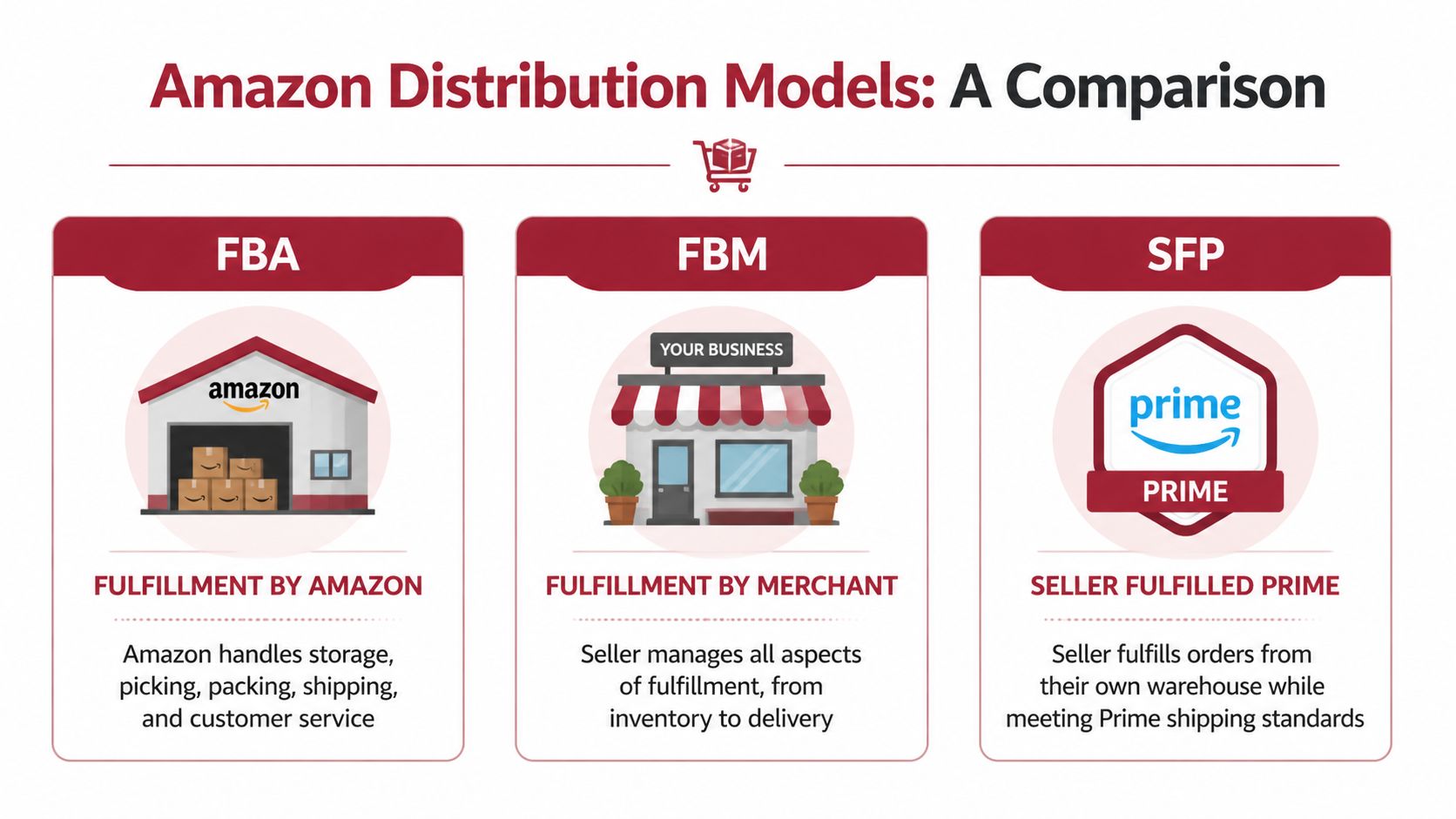
FBA vs FBM vs Partner Model Explained
Fulfilment by Amazon (FBA) gives brands immediate access to Amazon’s warehousing and last-mile system. That shortens the path to market and helps meet local delivery expectations early. It also means accepting Amazon’s storage rules, inbound requirements, fee logic, and inventory constraints. FBA reduces operational effort in some areas while increasing dependence on a platform whose priorities are not the same as yours.
Fulfilment by Merchant (FBM) keeps more control inside the brand. Inventory stays closer to your own systems, and you retain more oversight of packaging, fulfilment standards, and service decisions. The cost is operational strain. Cross-border FBM becomes difficult quickly once returns, delivery speed, tracking quality, and local service expectations start to matter at scale.
Strategic Partner Model gives established brands another option. The brand keeps control of positioning, pricing architecture, product governance, and expansion priorities. A local operator supports warehousing, compliance coordination, marketplace execution, and market-specific operational decisions. For the right business, this is less an outsourcing choice and more a way to contain execution risk without giving up strategic control.
Amazon Distribution Models A Comparison
| Factor | Fulfilment by Amazon (FBA) | Fulfilment by Merchant (FBM) | Strategic Partner Model |
|---|---|---|---|
| Customer delivery reach | Strong through Amazon network | Depends on your own network | Depends on partner structure |
| Inventory control | Lower day-to-day control once stock is inbound | High control | Shared control |
| Operational burden on internal team | Lower in last-mile execution | High | Moderate |
| Margin visibility | Can become complex due to Amazon fees and placement decisions | Clearer internally, but more cost lines to manage | Depends on agreement structure |
| Speed of entry | Often faster once compliance is cleared | Slower if building local capability | Faster if partner capability already exists |
| Local market adaptation | Limited unless managed actively | Flexible but resource-heavy | Strong if partner understands local market |
| Scalability across regions | Good within Amazon systems | Difficult without broader infrastructure | Good when partner has multi-market capability |
| Brand control | Moderate | High | Can be high if governance is clear |
FBA works best when speed matters more than operational autonomy
FBA is often the right move for brands that need in-market logistics capability fast and do not want to build local fulfilment from scratch. That is especially relevant in a new region where delivery speed influences conversion and a poor early customer experience can weaken launch momentum.
The trade-off is straightforward. FBA can push a business to optimise for Amazon’s operating system instead of its own long-term channel design. Storage fees, restock limits, prep requirements, and placement decisions can all change the economics of a market after launch. Seasonal brands, oversized products, and ranges with regulatory complexity usually feel that pressure first.
FBA is infrastructure. It is not channel strategy.
FBM works when control is the priority and the operation can support it
FBM suits brands with mature warehouse systems, disciplined customer support, and confidence in meeting local service expectations from day one. It can also fit brands that need tighter control over packaging presentation, bundles, or post-purchase handling.
The risk is rarely the first ten orders. The risk is what happens when volume rises and the operating model has no slack in it. Delivery exceptions increase. Returns sit too long. Customer messages wait. A team that looked capable on paper starts spending senior time fixing fulfilment issues instead of managing the market.
That is why FBM often makes sense as a selective model. It can work well for a narrow SKU group, a testing phase, or products that do not fit Amazon’s warehouse economics. It is less often the cleanest answer for broad regional scale.
The partner model often makes the most commercial sense for established brands
Successful product companies do not need to own every operational layer. They need visibility, governance, and confidence that local execution will not drift away from brand standards or commercial targets.
A capable partner can manage inventory flow, compliance coordination, listing operations, and regional execution while the brand keeps authority over pricing guardrails, product decisions, and channel priorities. For founders assessing Amazon logistics support for international expansion, that structure is often the rational choice when the business is strong commercially but thin on local infrastructure.
The quality of the partner matters more than the existence of one. The right partner reduces friction, shortens learning curves, and surfaces problems early. The wrong partner adds another layer between the founder and the market, which creates reporting gaps, slower decisions, and less control than the model promised.
How to choose without overengineering the decision
Use three filters.
- Choose FBA if your priority is speed, broad delivery coverage, and a lighter local fulfilment build-out.
- Choose FBM if your systems, service capability, and warehouse operation can already support market-level expectations consistently.
- Choose a partner model if you want to expand into a region without building a full operating layer internally.
The best model is the one your business can run repeatedly under pressure, with clear economics and no loss of brand control.
Phase 3 Go-to-Market Execution and Brand Translation
A founder can do months of work on entity setup, fulfilment design, and compliance, then lose momentum in the first 30 days because the market never fully understands the product. The listing is live, stock is available, ads are running, and conversion still stalls. In most cases, the problem is not demand alone. It is a weak translation of value into the buyer's local decision criteria.
Strong brands do not copy their domestic Amazon playbook into a new region and hope familiarity will carry them. They decide what must stay fixed, brand promise, price architecture, product truth, and what must change so the offer makes sense in-market. That decision matters because each region filters trust differently. Some buyers want technical clarity first. Others want proof of safety, compatibility, or ease of use before they will even compare price.
Translate the positioning, not just the copy
Literal localisation rarely fixes that. Good execution starts with the commercial question: why should this buyer trust this product here?
The same SKU can win on different grounds across regions. A product positioned around premium materials in one market may need to lead with installation simplicity in another. A product that sells on lifestyle aspiration at home may need more functional proof, clearer dimensions, or stronger standards language abroad. Founders who miss that distinction usually misread early performance and assume the market is weak, when the actual issue is that the argument was built for the wrong audience.
That is why the review process should cover more than translation.
- Title logic. Lead with the attributes local buyers use to screen options quickly.
- Image sequence. Put the clearest trust-building frames first, not the assets that performed best in the home market.
- A+ Content emphasis. Adjust the balance between brand story, product proof, usage education, and comparison support.
- Objection handling. Surface the concerns that stop purchase in that region, including fit, standards, ingredients, materials, or setup.

A practical example helps. A home improvement brand may sell domestically on toughness and product lifespan. In a new market, that same listing may convert better when it explains installation steps, local standards alignment, and what is included in the box. A household brand built around lifestyle imagery may need to shift toward usage clarity if shoppers in that region compare products more analytically.
Buyers reward brands that are easy to trust in their local context.
That trust also depends on control of brand assets. Before driving traffic, established brands should make sure their content, trademarks, and listing authority are protected through Amazon Brand Registry setup and protection. Without that layer, go-to-market execution gets harder because content changes, unauthorised sellers, and ownership disputes can distort the launch before the brand has clean feedback.
Build pricing from landed reality, not domestic habit
Pricing errors usually start before launch. Founders anchor to domestic margin expectations, home-market competitor sets, or a target retail price that made sense before freight, taxes, marketplace fees, and returns behaviour changed.
A workable launch price starts with landed economics in the target region and then tests whether the market will accept that value proposition. That includes import cost, indirect tax, fulfilment fees, promotional pressure, customer service burden, and any local adaptation required to sell legally and credibly. If the numbers only work with aggressive discounting, the issue is usually structural, not tactical.
Three mistakes appear often.
- Underpricing to force early traction. That can bring in price-sensitive buyers who do not stay loyal and make future correction difficult.
- Ignoring channel conflict. A low Amazon launch price can destabilise distributors, retail accounts, or direct-to-consumer pricing in the same region.
- Using discounts to cover weak positioning. Promotions can accelerate demand that already exists. They do not fix a confusing offer.
Founders should treat price as a market-entry signal, not just a margin calculation. It tells buyers where the product belongs, tells partners how seriously the brand protects value, and tells the business whether expansion economics are durable.
Create early sales velocity without weakening the brand
New-region launches need momentum, but disciplined momentum. Traffic before clarity is expensive. Discounts before trust are hard to unwind.
A tighter go-to-market plan usually starts with a narrower range and a sharper brief. Select the SKUs with the clearest fit, lowest adaptation burden, and strongest proof of repeatability. Finish the listing before paid traffic scales. Make sure reviews are earned within policy through a reliable post-purchase experience, not rushed through tactics that create compliance risk. Use early advertising to test message fit, search intent, and conversion friction, not just to buy top-line sales.
Operational readiness still matters here, but from a market-learning perspective. If a launch creates stock gaps, long delivery promises, or inconsistent customer experience, the team learns the wrong lessons. It becomes hard to tell whether conversion weakness came from the offer, the traffic, or the operating model.
Treat launch as a structured learning period
The first stage of market entry should answer a set of founder-level questions. Which objections show up fastest? Which claims improve conversion without creating compliance exposure? Which search terms indicate real purchase intent rather than casual browsing? Where does margin tighten earlier than planned?
Brands that handle this well document assumptions before the launch starts. They define the expected buyer, the lead message, the acceptable margin band, the price boundaries, and the signals that would justify a change. That discipline prevents reactive decisions after a slow week or a single ad result. It also makes partner oversight easier because the team is measuring against a strategy, not improvising around noise.
A controlled launch gives Amazon enough signal to rank the offer properly and gives the brand enough evidence to refine the offer without drifting into confused messaging or unnecessary discounting. For established companies, that is the objective in Phase 3. Get the product into the market in a form the local buyer can trust, then learn fast enough to improve before bad assumptions turn into expensive habits.
Phase 4 Scaling Operations and Protecting Your Brand
Launches get attention. Operations determine whether the business keeps the gains.
Once a product starts moving across Amazon, the challenge changes. You’re no longer trying to prove demand. You’re trying to preserve service quality, maintain stock health, protect pricing integrity, and stop operational drift from eroding the economics.
That requires governance. Not just hustle.
Inventory discipline is a growth function
Poor inventory management doesn’t only create stock problems. It damages ranking, weakens conversion, increases reactive freight decisions, and strains cash flow.
For Amazon Australia FBA sellers, maintaining Inventory Accuracy above 99% is critical. A drop below 95% can trigger penalties and lead to 15 to 20% revenue loss from miscounts, while top sellers achieve 99.5% accuracy, correlating to a 25% higher Order Fulfilment Rate, according to Amazon warehouse performance metrics for AU sellers.
That data tells founders something important. Operational precision is not a back-office detail. It is revenue protection.
What better operators do differently
They build routines, not heroic recoveries.
- They audit stock records frequently. Barcode discipline, cycle counts, and reconciliation against marketplace data stay active.
- They separate fast movers from long-tail complexity. Not every SKU deserves the same replenishment logic.
- They forecast around risk, not optimism. Seasonal demand, supplier delays, and launch spikes are planned for early.
- They watch return patterns for hidden listing issues. Returns can reveal product misunderstanding before customer sentiment turns.
A scaling brand should treat stock accuracy, replenishment logic, and returns analysis as commercial functions. They affect sales quality directly.
Brand protection has to be operationalised
As visibility increases, so does exposure. Listing hijacks, pricing inconsistency, grey-market leakage, and poor reseller behaviour all become more damaging in international marketplaces because the founder is further from the problem.
Brand protection needs clear systems:
| Risk area | What founders should control |
|---|---|
| Listing ownership | Ensure official listings, assets, and copy are governed centrally |
| Price integrity | Set channel rules and monitor discount behaviour across markets |
| Counterfeit and misuse | Use marketplace protection tools and escalation processes |
| Content consistency | Keep claims, imagery, and technical details aligned by region |
| Reseller sprawl | Decide who is authorised to sell and where |
For brands managing this through Amazon, Brand Registry support can be one part of a broader governance approach. The key isn’t the tool itself. It’s whether the business has a clear policy on how violations are identified, escalated, and resolved.
Measure the business like an operator, not just a seller
Many teams watch top-line sales too closely and everything else too late.
A stronger review rhythm looks at:
- Stock health
- Fulfilment reliability
- Return reasons
- Advertising efficiency
- Price consistency across channels
- Contribution margin by SKU and market
That last point matters. International Amazon growth can look strong at revenue level while degrading profit through fees, remediation costs, returns, and fragmented inventory.
Protecting the brand means making harder choices earlier
Sometimes the best operational move is restraint. Don’t expand the catalogue too quickly. Don’t enter the next market before the current one is stable. Don’t chase every revenue opportunity if it introduces channel conflict or pricing confusion.
Experienced operators know that a strong brand can survive slower expansion. It won’t always survive careless expansion.
Conclusion When to Partner for Global Expansion
International amazon distribution looks deceptively simple from the outside. Amazon provides the marketplace, the infrastructure is visible, and the path appears faster than building traditional distribution market by market.
But the essential work sits underneath. Market selection requires discipline. Compliance requires local understanding. Fulfilment model decisions shape control and margin. Listing translation affects conversion. Inventory governance protects ranking and revenue. Brand protection becomes more important, not less, as the business scales.
For most established founders, the core decision isn’t whether Amazon matters. It does. The key decision is where the internal team should spend its energy.
If your people are spending their best hours untangling cross-border operational friction, they aren’t spending those hours on product development, channel strategy, or brand building. That’s where partnership becomes strategic rather than merely convenient.
The right partner doesn’t take control away from the founder. It helps the founder keep control over what matters most. Positioning, standards, channel discipline, and long-term brand value. Execution in new regions can then happen with more structure and less reinvention.
That’s often the difference between a product that appears internationally and a brand that scales internationally.
Founder FAQs on International Amazon Expansion
Should we enter one Amazon market at a time or launch into several?
For most established brands, one well-chosen market is the better first move. It creates a cleaner learning environment. You can test localisation, pricing, operations, and compliance with less noise. Multiple launches at once can work, but only if the internal team already has the structure to govern them without making reactive decisions.
Is FBA always the best option for international amazon distribution?
No. FBA is powerful, but it isn’t automatically the right model. It suits brands that want fast access to in-market fulfilment and broad Amazon reach. It is less suitable when the product requires unusual handling, the margin profile is sensitive, or the brand needs tighter control over fulfilment and customer experience. The right answer depends on the product, the market, and the team behind it.
What’s the biggest mistake founders make before expanding?
They assume product success will carry the business through market differences. It won’t. The product may still be strong, but the expansion can fail if compliance is weak, positioning doesn’t translate, or the chosen fulfilment model creates operational strain the business can’t absorb.
If your brand has already proven demand and you're evaluating how to expand into new Amazon markets without losing control of margin, positioning, or operational quality, TPR Brands works with established product companies navigating exactly those decisions.