Most advice on Gold Coast online marketing is built for service businesses chasing the next enquiry. That's fine if you run a local practice, trade service, or venue.
It's a poor framework if you're an established product brand.
A founder with proven products doesn't need another recycled checklist about posting on Instagram, tweaking ad audiences, or “being active” on Google. Ultimately, the question is whether digital channels are strengthening the brand's broader commercial position. Are they helping secure better retail relationships, support stockists, validate demand in new regions, and prepare the business for marketplace or international expansion without eroding margin?
That's the lens that matters. Gold Coast online marketing isn't just a local demand tool. For the right brand, it becomes the first layer of a much larger commercial system.
Beyond Local Leads Reframing Gold Coast Online Marketing
The common assumption is simple. If you're based on the Gold Coast, your online marketing job is to generate local traffic and local sales.
That assumption is too narrow for product businesses with traction.
Most Gold Coast online marketing content focuses on tactics such as SEO, social posting, and ad budgets, but rarely addresses whether local digital channels are the right growth lever for established product brands. For Australian hardware, home-improvement, and consumer product companies, the strategic issue is channel mix, especially which digital activities support wholesale, retail, and export expansion without weakening margin. Australia Post reported Australians spent $69 billion online in the 12 months to June 2025 in this discussion of local channel strategy.
The wrong question founders keep asking
Founders often ask, “How do we get more leads on the Gold Coast?”
That's usually not the highest-value question. A stronger question is, “What role should digital play in our channel architecture?”
If the business already has product-market fit, digital shouldn't be judged only by direct last-click sales. It should also be judged by whether it improves:
- Stockist support: helping customers find retailers, distributors, or local availability
- Sales confidence: giving wholesale buyers a stronger impression of brand maturity
- Category authority: making the brand easier to trust during comparison
- Expansion readiness: creating cleaner foundations for marketplaces and new geographies
Practical rule: If a channel creates traffic but weakens pricing power, creates channel conflict, or trains buyers to wait for discounts, it isn't helping the business scale well.
Local activity can still be strategic
None of this means local visibility doesn't matter. It does. But local visibility should feed a larger commercial outcome.
For a home organisation brand, local search visibility might support retail sell-through. For a hardware brand, it might make distributor conversations easier because demand already appears visible. For a premium household product, it might act as a controlled test market before national rollout.
One pattern that keeps showing up is this. Brands that treat digital as a short-term lead machine often end up with fragmented messaging, inconsistent pricing signals, and weak channel discipline. Brands that treat it as infrastructure make better decisions later when marketplaces, retail, and international expansion become realistic options.
What founders should reframe
Gold Coast online marketing isn't just about capturing demand that already exists nearby. It can also help shape how the brand is perceived by buyers, retailers, marketplaces, and partners.
That shift changes what “working” looks like.
A strong campaign isn't only the one that converts today. It's the one that leaves the business better positioned across the whole ecosystem tomorrow.
Understanding the Gold Coast Digital Ecosystem
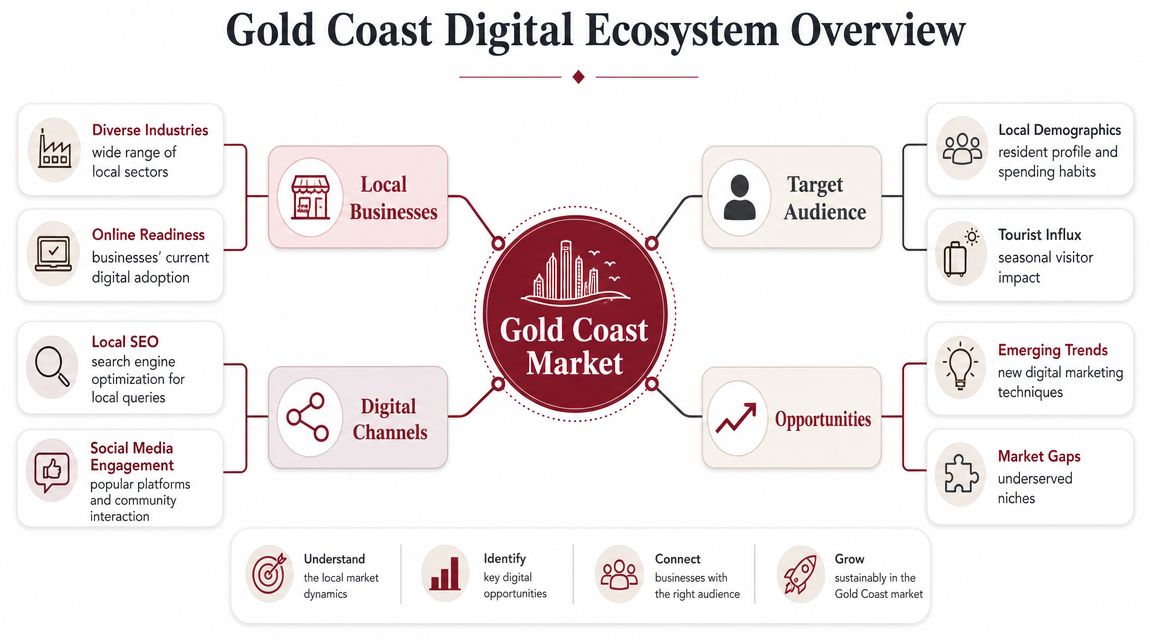
The Gold Coast is often discussed as though it's a simple local market. It isn't. From a digital perspective, it behaves more like an active commercial testing ground where local intent, mobile behaviour, and multi-channel discovery overlap.
That matters for product brands because digitally mature local markets tend to expose structural weaknesses quickly. If the brand isn't easy to find, easy to understand, and easy to trust on a phone, the problem shows up early.
Mobile intent changes how discovery works
Gold Coast online marketing is shaped by a highly digital audience. In 2026, over 55% of global website traffic is projected to come from mobile devices, and 72% of users find a store within five miles of their search location, according to these Australian digital marketing statistics.
For local product businesses, that changes the role of digital channels. Search isn't only about awareness. It's often the bridge between product curiosity and a nearby purchase. A customer may discover the brand on a mobile search, compare options quickly, then buy through a stockist, showroom, or retail partner.
That's why weak mobile execution causes more than minor friction. It disrupts local discovery, retailer support, and customer confidence at the same time.
The Gold Coast works well as a proving ground
For founders, the Gold Coast has another advantage. It's a useful place to observe whether the brand translates cleanly across channels.
This isn't just about running ads in one postcode. It's about seeing whether the business can hold together across:
| Commercial layer | What to watch |
|---|---|
| Search visibility | Whether buyers can find the brand when they search by product need, not just brand name |
| Retail support | Whether local stockists and availability are easy to locate |
| Mobile trust | Whether the site and brand presentation feel credible on first visit |
| Message clarity | Whether the value proposition survives quick comparison behaviour |
A lot of founders underestimate how revealing this is. If the local ecosystem is already showing inconsistent positioning, unclear stockist information, or weak mobile presentation, those issues usually become worse when the brand expands.
Buyers don't experience channels in isolation. They move across search, retailer pages, reviews, social content, and branded pages as one connected journey.
Local behaviour often predicts larger scaling friction
One issue repeatedly observed in product categories such as household goods, home improvement, and premium consumer products is that channel inconsistency shows up before growth stalls. The business may still be selling, but the ecosystem starts looking untidy.
That can mean one thing on the Gold Coast and something else in another region. The same issue becomes more expensive on a marketplace.
A useful way to think about this is through localisation. The brand needs to feel coherent in the context where the buyer encounters it. That same principle applies later in international settings, which is why marketplace localisation and perceived product fit matters far earlier than most founders expect.
Aligning Digital Channels with Commercial Goals
A channel isn't strategic because it's popular. It's strategic because it serves a clear commercial job.
That distinction gets lost in a lot of Gold Coast online marketing conversations. SEO gets treated like traffic generation. Paid search gets treated like demand capture. Social gets treated like visibility. In practice, each channel should be assessed by what it contributes to the business model.
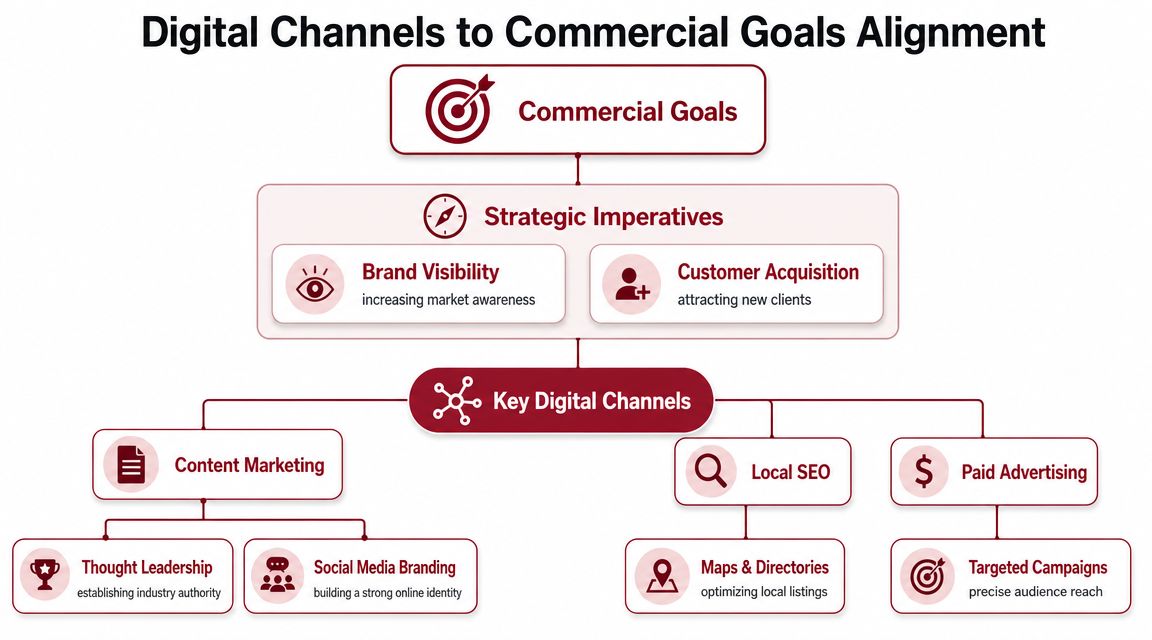
Australian performance marketing has become a structured system rather than a purely creative exercise. 75% of people never scroll past the first page of search results, 70–80% ignore paid search ads and click organic listings instead, and the average return is over $22 for every $1 spent on SEO, as outlined in this Australian industry roundup on digital marketing performance. That same source also notes that the return only materialises when SEO is tied to clear commercial goals.
Give each channel a commercial brief
When brands underperform online, it's often because every channel is trying to do everything.
A more useful model is to assign a job to each channel.
- Organic search: build category authority, support non-branded discovery, and strengthen retailer confidence
- Paid search: capture high-intent demand where the commercial path is already clear
- Social media: reinforce brand identity and product context, especially where visual proof helps consideration
- Content: reduce friction in buyer evaluation, answer objections, and support wider channel credibility
That sounds obvious, but many brands still run channels without a clear brief. They spend on paid traffic to solve a trust problem. They produce social content to solve a discoverability problem. They write blog articles that don't support any actual commercial objective.
What better allocation looks like
The strongest operators don't ask which channel is best. They ask which channel is appropriate for the current commercial constraint.
If a founder is trying to support retail partners, local SEO and stockist visibility matter more than broad social engagement. If the business is trying to win wholesale confidence, authority content and a coherent branded site usually carry more weight than short bursts of paid traffic. If the issue is launch validation for a new range, paid search and controlled landing pages may be useful, but only if the brand already looks credible.
A short way to pressure-test the plan is this:
| Channel | Bad use | Better use |
|---|---|---|
| SEO | Chasing traffic with vague informational content | Supporting discovery tied to product intent and stockist pathways |
| Paid search | Buying clicks before the site earns trust | Capturing demand with a clear commercial path |
| Social | Posting constantly without a positioning function | Showing product context, use cases, and brand standards |
| Content | Publishing for volume | Building authority that supports broader sales conversations |
Here's a useful visual summary of that alignment.
Don't confuse demand generation with channel design
One pattern we continue seeing is that brands measure digital activity too narrowly. They ask whether a campaign drove sales, but not whether it improved the business's channel architecture.
That's the deeper point behind thinking about Amazon as distribution rather than just sales. The same logic applies earlier on the Gold Coast. Your digital channels shouldn't operate like isolated marketing tactics. They should work as commercial assets that make the brand easier to distribute, easier to trust, and easier to scale.
Operator view: Good digital strategy doesn't just acquire customers. It makes the next retailer, distributor, or marketplace conversation easier.
From Local Presence to Marketplace Expansion
A lot of brands assume the move from local digital success to marketplace growth is straightforward. Build awareness, list the products, turn on ads, and scale.
That isn't how it usually plays out.

One pattern that keeps appearing across consumer electronics, home organisation, household products, and premium lifestyle categories is this. The brand can look strong in its home market while still being structurally unprepared for marketplace expansion.
Why local strength doesn't automatically transfer
A brand might have clean local recognition, decent direct sales, and positive retailer feedback. Then it enters a marketplace and discovers that discovery, comparison, and conversion behave differently there.
The problems usually aren't dramatic. They're cumulative.
- The product story fragments across brand site, marketplace listings, distributor pages, and retailer content.
- Pricing signals drift when different channels frame the value differently.
- Content quality varies between internal assets and partner-controlled pages.
- Search visibility becomes diluted because buyers encounter summaries, listings, and third-party references before they ever reach the brand.
This matters even more now because AI-assisted discovery and zero-click behaviour are changing how buyers compare options. Traditional local SEO is becoming less sufficient on its own as buyers move across AI summaries, marketplaces, and distributor sites. The challenge is staying visible and controlling the brand narrative as discovery fragments, as discussed in this article on Gold Coast digital visibility and AI search.
Marketplace expansion is rarely a listing problem. It's usually an ecosystem cohesion problem.
A stronger expansion sequence
The better sequence is less exciting and more commercially sound.
First, the brand uses local digital channels to clarify positioning, sharpen product messaging, and prove that customers can move cleanly from discovery to purchase. Then it uses that learning to structure marketplace entry with tighter control over content, channel roles, and operational expectations.
That sequence matters because marketplaces don't forgive ambiguity. If the brand's value proposition is already fuzzy on the Gold Coast, it won't become clearer once it's competing inside a crowded catalogue.
What founders should look for early
A recent marketplace review pattern revealed a simple indicator. Brands that expand well usually have consistency across the following before they scale harder:
- Product narrative: the reason to buy is expressed similarly across site, retail, and marketplace environments
- Channel role clarity: each channel has a defined commercial purpose
- Operational readiness: fulfilment, support, and stock logic match the brand promise
- Data discipline: product information is organised well enough to syndicate cleanly
That's why marketplace ecosystem strategy becomes important before major channel expansion, not after. The Gold Coast presence is useful, but only if it's treated as the first stage of ecosystem design rather than a self-contained marketing exercise.
Structuring Your Team for Scalable Growth
The in-house versus agency question gets framed badly. Most versions reduce it to cost, control, or convenience.
For established product brands, the more useful question is whether the team structure matches the complexity of the growth plan.
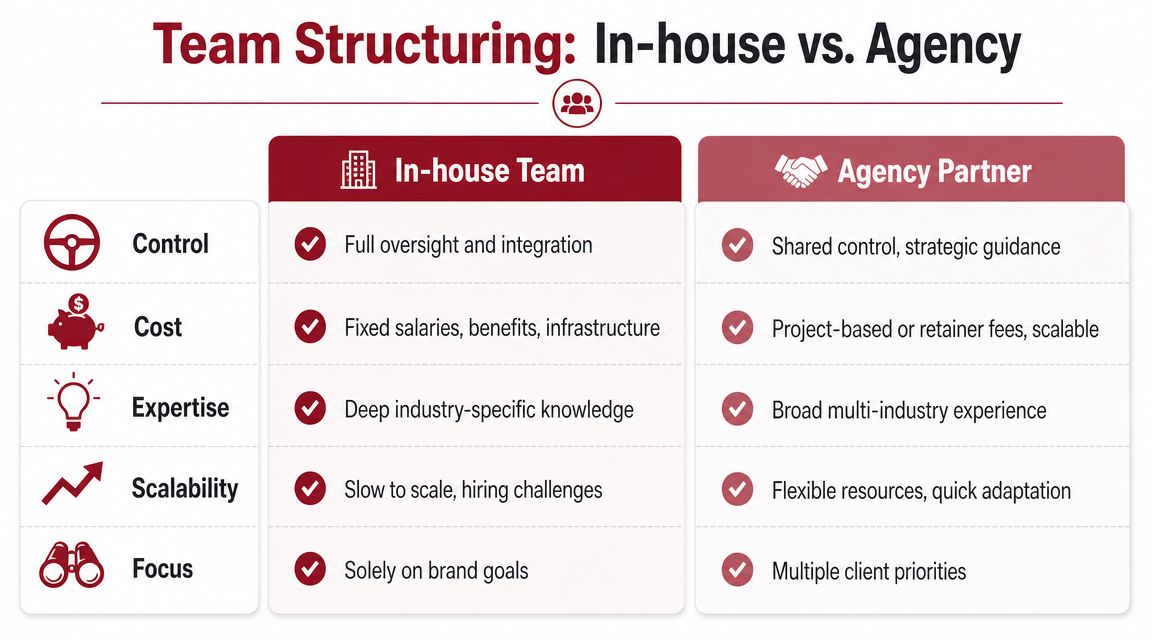
A single capable in-house marketer can do a good job managing local campaigns, coordinating content, and keeping core channels moving. But the moment the business starts layering on marketplace expansion, international localisation, retailer support, cross-border operations, and technical performance demands, the skill requirement changes.
The hidden cost of partial capability
A critical technical constraint in Australian online marketing is mobile-first delivery, because Google primarily ranks the mobile version of a site. For product brands, a slow or unstable mobile experience doesn't just affect local SEO. It weakens paid landing page performance, creates a poor first impression, and damages trust for later high-consideration purchases, as explained in this overview of mobile-first SEO and performance on the Gold Coast.
That's a useful example because it shows how apparently technical work carries strategic consequences.
A founder might think they need “someone to run marketing”. What they often need is coordinated capability across:
- Technical performance: mobile speed, content parity, landing page stability
- Channel planning: understanding how direct, retail, and marketplace channels affect each other
- Commercial judgement: knowing when not to chase traffic that creates channel conflict
- Expansion readiness: preparing product, content, and operational structure for new markets
A practical way to decide
The decision is usually clearer when viewed through business stage.
| Situation | Best fit |
|---|---|
| Stable local growth, limited channel complexity | In-house ownership can work well |
| National growth with multiple stockists or retail dependencies | A blended model often makes more sense |
| Marketplace entry or international expansion | Specialist external capability becomes far more important |
A team structure should be designed around the next layer of complexity, not the current comfort zone.
What often breaks first
The first issue usually isn't creativity. It's coordination.
The internal marketer may have a thorough understanding of the brand but not have enough exposure to marketplace mechanics, localisation pressure, or distributor dynamics. A generalist agency may know lead generation but not understand how pricing discipline, retailer relationships, and fulfilment structure affect the brand's long-term position.
That's why founders should evaluate support partners less like campaign suppliers and more like ecosystem operators. The primary requirement isn't more activity. It's decision-making quality across channels, markets, and operational constraints.
Building Your Brand's Commercial Ecosystem
The strongest brands don't treat Gold Coast online marketing as a standalone function. They treat it as one part of a broader commercial ecosystem.
That ecosystem includes how the brand is discovered, where it is purchased, how product information travels, how pricing is interpreted, how fulfilment supports trust, and how each channel affects the others. Once a founder sees the business through that lens, marketing decisions become less reactive.
What stronger brands do differently
They don't chase every available channel. They choose the channels that fit the brand's commercial model.
They don't evaluate performance only through short-term traffic or attributed conversions. They also look at whether the channel strengthens retailer support, protects margin, improves message consistency, and prepares the business for wider expansion.
They don't assume a good catalogue will automatically create a strong marketplace presence either. Across multiple marketplace ecosystems, one issue repeatedly observed is that strong products can still underperform when the surrounding commercial structure is fragmented.
Cohesion matters more as the business grows
A founder can sometimes get away with inconsistency at a small scale. Once the business expands, inconsistency becomes expensive.
That's where a lot of friction enters:
- Brand cohesion slips when content, pricing, and product narratives differ across channels
- Margin pressure increases when channel roles aren't defined clearly
- Partner confidence weakens when the digital footprint looks disorganised
- Expansion gets harder when localisation and data structure were never built properly
The brand customers trust is usually the brand that appears organised everywhere they look.
Gold Coast online marketing as early infrastructure
Seen properly, Gold Coast online marketing is early infrastructure for later scale. It gives the founder a live environment in which to test whether the brand can hold together across search, content, retailer support, and digital comparison behaviour.
That's also why broader thinking about online selling across channels and markets matters. Selling online isn't one activity. It's a network of decisions about visibility, control, channel fit, and operational readiness.
The practical lesson is straightforward. If your digital presence only helps you win the next order, it's underbuilt. If it helps the business become more coherent, more trusted, and easier to expand without losing control, it's doing its real job.
If you're an established product brand thinking beyond local campaigns and into channel expansion, retail support, or international marketplace growth, TPR Brands is built for that conversation. The work is less about adding more marketing activity and more about structuring a commercially coherent brand ecosystem that can scale across Australia, the US, Canada, and the UK without losing margin, clarity, or control.