A strong marketplace ecosystem strategy can determine whether a brand scales cleanly across regions and channels or slowly loses control as expansion increases.
The usual explanation is execution. Listings need work. Ads need tuning. Reviews need management. Those things matter, but they don’t explain the whole pattern. Across multiple marketplace ecosystems, the primary dividing line is usually structural. Some brands treat expansion as channel accumulation. Others treat it as ecosystem design.
That difference shapes everything that follows. It affects pricing discipline, fulfilment confidence, compliance readiness, seller control, and whether new revenue strengthens the brand or pulls it apart. In that sense, Why Some Marketplace Ecosystems Scale While Others Fragment isn’t really a question about marketplaces alone. It’s a question about commercial design under pressure.
The Marketplace Ecosystem Strategy Paradox
A strong product often creates the wrong kind of confidence. Founders see traction in one channel, then assume the next step is obvious: add more marketplaces, widen distribution, increase exposure. Revenue may rise for a period, but cohesion often falls faster.
That’s the paradox. More channel presence can coincide with less commercial control.
I once spent twenty minutes looking for a potato peeler in a kitchen drawer that technically contained three potato peelers.
That’s fragmentation.
More tools. Less function.
More channels can do exactly the same thing to a brand.

One issue we repeatedly observe is that brands mistake surface visibility for scalable growth. A product appears in more places, but the buyer experience becomes inconsistent. Pricing starts to drift. Marketplace copy diverges from the brand site. Retail relationships pull one way, D2C pulls another, and operational teams spend more time reconciling exceptions than building momentum.
The conversation needs to move beyond listings at this stage. A catalogue can travel across channels very quickly. An ecosystem cannot. It needs structure, agreed rules, and operating discipline. That’s why the distinction between a product catalogue and a marketplace ecosystem matters so much once a brand moves past early traction.
Channel growth and brand weakening can happen together
The warning signs are rarely dramatic at first. They show up as friction.
- Margin pressure increases: New channels create extra fees, duplicated handling, and reactive discounting.
- Commercial clarity drops: Teams can’t always explain which channel is growing profitably and which is consuming attention.
- Buyer trust softens: The same product appears with conflicting content, different price points, or uneven delivery expectations.
Growth becomes fragile when every new channel adds demand but also adds contradiction.
The founder tension is usually this. Sales are coming in, so the expansion looks justified.
That’s what makes fragmentation dangerous.
It often arrives disguised as growth.
But the business feels heavier, not stronger. More agencies, more dashboards, more seller conversations, more operational workarounds. That isn’t always a sign of ambition. Quite often, it’s a sign the business has started scaling fragmentation rather than scale itself.
The real question founders should ask
The useful question isn’t “How many marketplaces should we enter?”
It’s “What kind of commercial system are we creating as we expand?”
That framing changes decision quality. It forces a harder look at whether a channel improves buyer access without weakening price control, whether it fits the fulfilment model, whether it supports the brand’s positioning in that market, and whether it introduces dependencies the business will later struggle to unwind.
Founders who answer that question early usually avoid a common trap. They don’t confuse more points of sale with a stronger market position. They build for coherence first, then reach.
Listing Management and the Illusion of Marketplace Growth
A lot of marketplace service models are built around a narrow promise. Improve the listing. Improve the ad account. Improve conversion. On paper, that sounds commercially sensible. In practice, it often optimises one visible layer while the rest of the system becomes less stable.
That’s why listing management can create the illusion of growth. It improves local metrics inside a channel without resolving the structural conditions that determine whether expansion will hold.
What listing management usually gets right
The tactical work has value. Better images help. Cleaner copy helps. Keyword discipline helps. PPC management, review flow, and marketplace merchandising all have a role.
No serious operator dismisses that.
But those activities are best understood as maintenance inside an already coherent system. They are not a substitute for system design. A brand that wants durable scale needs more than a polished storefront. It needs distribution logic, inventory alignment, price governance, fulfilment confidence, and a clear view of what each channel is doing to the wider brand.
A recent marketplace review revealed the same pattern seen in many scaling environments. In Australian marketplace ecosystems, siloed channel management has been associated with a 25 to 40% increase in fulfilment costs, with inventory inaccuracies up to 35% and stockouts that reduce conversion rates by 18% on high-demand categories, according to Base’s analysis of marketplace growth and operational fragmentation.
Where the agency model often breaks
The weakness isn’t that listing optimisation is wrong. It’s that many providers stop there.
If the primary conversation stays focused on ACOS, session share, click-through rate, and title optimisation, several strategic questions remain untouched:
- Who controls channel conflict: If a brand’s D2C site, Amazon listing, retail account, and reseller network are all pricing differently, who resolves it?
- Who owns stock truth: If Shopify, Amazon AU, eBay AU, and wholesale systems all hold different inventory assumptions, who decides what is available?
- Who protects brand position: If new channels generate volume by compressing price and weakening presentation, is that growth or erosion?
That’s why Amazon listing control is only one part of a larger commercial question. Control over the page doesn’t automatically mean control over the ecosystem around the page.
Operational reality: A well-optimised listing can still sit inside a badly designed growth model.
Tuning one engine in a vehicle built to drift
The easiest way to understand this is to separate channel optimisation from ecosystem performance.
| Focus area | Listing-led view | Operator-led view |
|---|---|---|
| Primary metric | Conversion inside one marketplace | Commercial performance across channels |
| Main intervention | Content, PPC, reviews | Distribution, fulfilment, pricing, compliance |
| Typical time horizon | Immediate uplift | Durable scalability |
| Blind spot | Cross-channel damage | Slower initial activity |
Founders usually feel the difference before they can name it. The business starts producing exceptions. Customer service sees contradictory promises. Operations teams manually patch inventory issues. Sales teams resent channel overlap. Finance sees revenue moving but margin quality becoming harder to explain.
That’s not a listing problem. It’s a structural growth problem.
When Marketplace Ecosystem Strategy Breaks Down
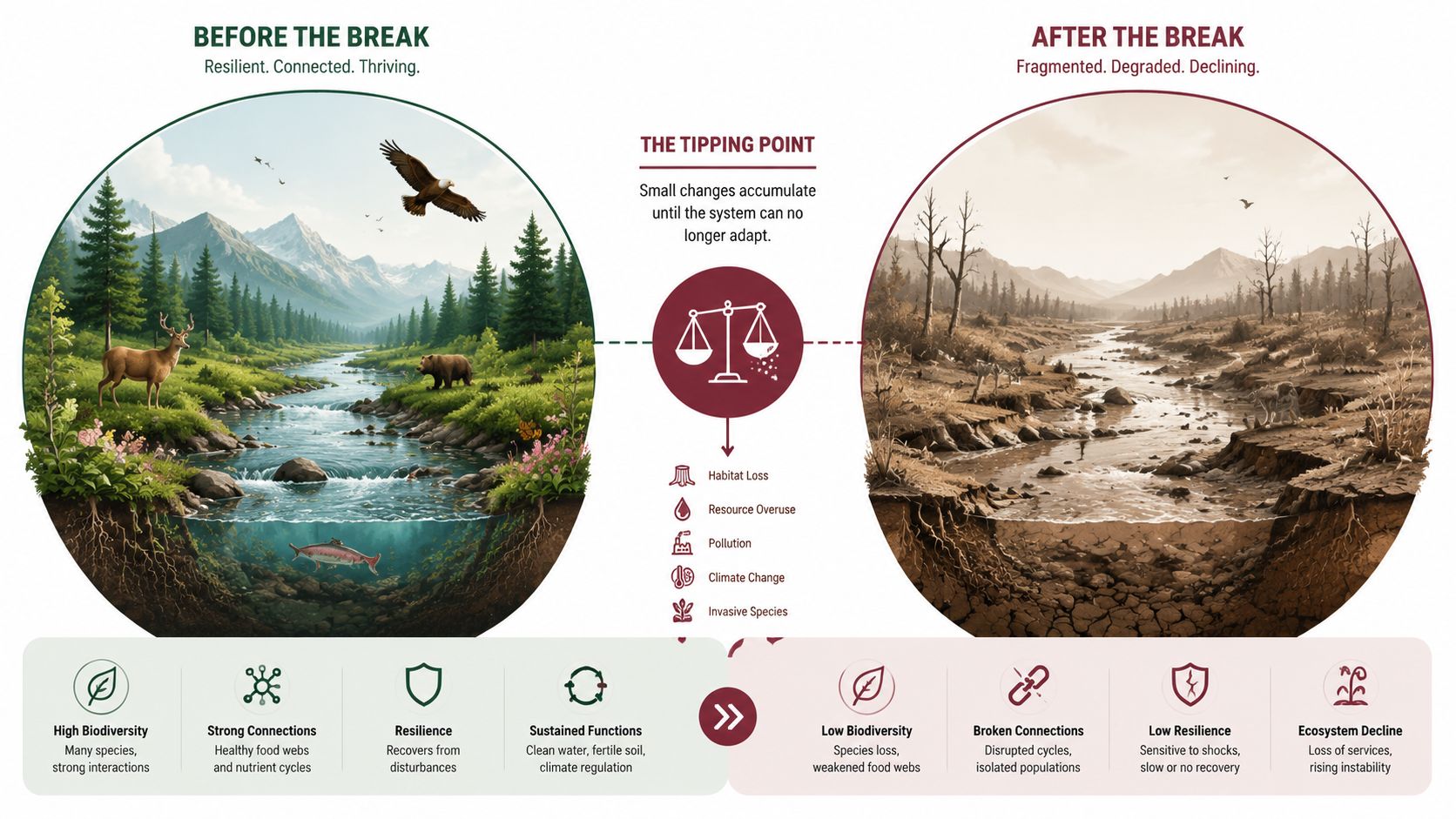
One pattern we continue seeing is that fragmentation doesn’t begin when a listing looks messy. It begins earlier, when the business allows each channel to operate as if it were commercially independent.
At that point, the brand may still look healthy from the outside. Orders are moving. Sellers are active. New channels are live. But the internal signals are changing. Teams stop working from one commercial truth and start negotiating between conflicting ones.
I’ve seen businesses reach the point where nobody was even sure which spreadsheet represented reality anymore.
One said the inventory was healthy.
One said stock was missing.
One had somehow turned half the cells green for reasons nobody could explain.
The dangerous part is that fragmentation rarely feels catastrophic while it’s happening. It just slowly erodes clarity.
What fragmentation looks like in practice
It rarely arrives as a single failure. It shows up as accumulated inconsistency.
- Price inconsistency: The same SKU carries different value signals across D2C, retail marketplaces, and third-party sellers.
- Content inconsistency: Product claims, specifications, bundles, and imagery vary depending on who uploaded the page.
- Ownership inconsistency: No one has full authority over distribution, channel strategy, and post-sale experience.
- Customer inconsistency: Delivery standards, returns handling, and service expectations differ by channel in ways the buyer experiences as brand failure.
A fragmented ecosystem asks buyers to trust one brand while delivering several different versions of it.
When the break becomes measurable
The commercial impact becomes visible once volume rises. A 2023 study of Australian brands found those centralising fulfilment saw 40% higher GMV growth versus fragmented operations. The same source notes successful scalers integrated omnichannel systems, boosting marketplace GMV by 150%, while 70% of pre-2020 marketplaces failed due to operational fragmentation, with 28% fulfilment error rates and 15% supplier churn. Those figures were cited earlier from Base’s marketplace operations analysis, and they matter because they show the point at which untidy growth becomes structural weakness.
That is the actual point of fragmentation. It’s the moment when inconsistency stops being administrative noise and starts changing the economics of the business.
A fragmented marketplace presence usually reflects a fragmented commercial model behind it.
I’ve also seen growing businesses end up with stock split across warehouses, garages, spare rooms, and “temporary overflow” locations that quietly became permanent.
Revenue was increasing.
Nobody could confidently explain where everything actually was.
That’s usually the moment growth stops feeling exciting and starts feeling heavy.
For brands dealing with unauthorised resellers or channel overlap, the symptoms are often already visible in seller behaviour. Multiple sellers chase the same demand, content quality falls, price integrity weakens, and the platform starts rewarding activity that may not support the brand long term.
Some brands end up with so many marketplace sellers involved that trying to work out who controls pricing starts to feel like a family WhatsApp thread nobody moderates anymore.
That’s why questions around Amazon multiple sellers are rarely just about seller count. They’re usually about control architecture.
Two Approaches to Marketplace Growth
| Aspect | Listing Management (Typical Agency) | Brand Scaling (Expansion Partner) |
|---|---|---|
| View of the problem | Page performance issue | Ecosystem design issue |
| Core objective | Improve marketplace metrics | Build channel cohesion and margin resilience |
| Fulfilment stance | Managed per channel | Unified across channels |
| Seller control | Reactive | Structured and deliberate |
| Pricing logic | Platform-by-platform | Brand-wide commercial governance |
| Expansion mindset | Add more channels | Enter the right channels in the right sequence |
The difference is strategic maturity. One model treats marketplaces as media inventory. The other treats them as operating environments with consequences.
What Strong Marketplace Ecosystem Strategy Looks Like
The brands that scale cleanly don’t always move faster at the start. They usually move with more structure. They decide what the ecosystem is meant to do before they decide how many channels to activate.
That sounds obvious, but it’s uncommon in practice.

A useful external marker comes from Australia’s marketplace data. A 2025 Deloitte Australia study found ecosystems scale 3x faster with high buyer fragmentation but low seller concentration. The same analysis noted excessive seller concentration in categories such as hardware, where 4 firms control 65% of Australian supply, contributes to 30 to 50% failure rates in marketplace expansions, as summarised in Sharetribe’s discussion of marketplace fragmentation.
Strong ecosystems widen demand but control dependency
That finding matters because many founders think scale comes from signing more sellers or opening more distribution points. In reality, stronger ecosystems often scale by broadening buyer access while preventing any single seller, retailer, or channel configuration from becoming too dominant.
In operator terms, cohesive brands do a few things differently.
They design channel roles deliberately
Not every channel should do the same job. One may be best for category discovery. Another may work as a high-volume replenishment environment. A third may support premium positioning better because the buyer expectations are different.
When brands ignore those role differences, channels start competing with each other instead of supporting the wider system.
They treat fulfilment as brand infrastructure
Fulfilment isn’t a backend function once marketplaces scale. It shapes trust, price flexibility, and the ability to expand without creating service inconsistency. Cohesive brands align inventory logic, routing rules, and post-sale handling around the buyer experience they want to deliver.
They protect margin before they chase volume
Expansion looks attractive when a new marketplace opens demand quickly. But if that demand only appears through discounting, duplicated fees, or loss of channel discipline, the ecosystem gets weaker as revenue rises. Mature operators assess margin durability, not just marketplace traction.
Commercial test: If a new channel grows revenue but weakens distribution control, it probably isn’t expansion. It’s leakage.
The strategic pillars are connected
A cohesive ecosystem doesn’t come from one decision. It comes from connected decisions.
- Distribution control keeps seller behaviour aligned with brand intent.
- Compliance readiness removes hidden barriers that only appear once scale or geography changes.
- Positioning consistency ensures the buyer meets the same brand logic across environments.
- Operational integration prevents channels from creating different versions of stock truth, service promises, or margin assumptions.
Across multiple marketplace ecosystems, the better operators don’t obsess over whether every channel looks identical. They focus on whether every channel feels commercially coherent. That’s a higher standard, and it’s the one that scales.
The International Test Why Expansion Reveals All Weaknesses
Domestic growth can hide a surprising amount of structural weakness. Teams can compensate manually. Buyers already understand the category. Existing distributors smooth over gaps. A business can look more mature than it really is because the market around it is familiar.
International expansion removes that protection.

Small domestic cracks become major international failures
What becomes visible during international expansion is how much of the original growth model depended on local familiarity rather than real system strength.
A product feed that was merely untidy at home becomes a compliance problem abroad. A pricing structure that looked manageable in one market becomes unstable once duties, marketplace fees, and local fulfilment conditions enter the model. A loose reseller approach becomes far harder to control when several territories, currencies, and customer expectations overlap.
This is why international marketplace growth is best understood as an ecosystem transition. It isn’t just a bigger version of local listing management.
One recent signal from the Australian context is especially relevant. Emerging regulatory shifts in AU-Asia expansion have been linked to marketplace fragmentation. A 2026 report noted 42% of Australian consumer product brands abandon Asian marketplace pushes due to unstandardised compliance, alongside a 35% increase in hardware product rejections in 2025 due to tightened biosecurity rules, according to this analysis of marketplace shifts and compliance pressure.
The pressure points international markets expose
The hard part isn’t usually opening the account. It’s holding together the system behind it.
- Compliance strain: Product, packaging, import, and category rules vary in ways that can disrupt a launch long after commercial plans are approved.
- Localisation gaps: Messaging that works in Australia, the US, or Canada may not translate cleanly into buyer confidence elsewhere.
- Fulfilment mismatch: Delivery expectations differ by market, and so does tolerance for delay, substitution, or poor returns handling.
- Commercial distortion: Currency, tax, landed cost, and distributor layering can turn an apparently healthy channel into a weak one very quickly.
That’s why fulfilment structure becomes more important, not less, as a brand expands internationally. It is one of the few operational functions that directly affects margin, trust, compliance execution, and repeat purchase likelihood at the same time.
International growth doesn’t create structural weakness. It exposes weakness that was already there.
Mature brands localise without losing themselves
The strongest operators don’t treat localisation as cosmetic. They adapt market entry around the realities of the region while keeping the core commercial logic intact. Product positioning, packaging assumptions, compliance workflow, channel selection, and service expectations all need to fit the market being entered.
That requires judgement, not just activation.
Founders often discover this too late. They enter a new region believing they are extending an existing model, only to realise they are rebuilding several parts of it under pressure. Brands with cohesive ecosystems usually feel that pressure earlier and respond better because their systems were designed to travel.
Building Your Growth Ecosystem Next Steps for Founders
By the time a founder starts questioning channel sprawl, the issue usually isn’t visibility. It’s coherence. The business already has demand. What it needs is a stronger structure for deciding where demand should go, how it should be served, and which channels deserve to shape the brand’s next phase.
That starts with asking better questions of current partners and prospective ones.
Red flags that signal a narrow growth model
If a partner talks almost entirely about ads, listings, and conversion rate, they may be solving a thin slice of the problem.
Watch for these signals:
- Metric tunnel vision: The conversation stays fixed on marketplace performance metrics with little attention to margin quality, fulfilment alignment, or channel conflict.
- No distribution point of view: There’s no serious discussion of seller control, unauthorised activity, or pricing discipline across markets.
- No compliance depth: International expansion is treated as account setup rather than market adaptation.
- No ecosystem sequencing: Every new channel is framed as opportunity, with limited scrutiny on whether it strengthens or weakens the wider system.
A stronger partner usually thinks in terms of architecture. They want to know which channels should lead, which ones should support, where the brand can hold authority, and what operational conditions need to be in place before expansion becomes durable.
What a better commercial conversation sounds like
In the Australian home improvement marketplace, high buyer fragmentation has been identified as a key driver of scale. Marketplaces reaching more than 1 million unique monthly buyers generated over $1 billion in annual revenue, while those with concentrated buyer bases stagnated. The same analysis notes that brands scaling into fragmented buyer pools via partners reduced risk by 35%, according to Eli Chai’s examination of buyer fragmentation and marketplace scale.
That insight matters because it changes what founders should optimise for. The goal isn’t broader presence. It’s access to the right buyer structure, through the right operating model, without allowing concentration risk, seller chaos, or operational fragmentation to undermine the brand.
The most useful growth partner doesn’t just help a brand enter marketplaces. They help the brand decide what kind of marketplace business it is building.
For founders, the practical next step is simple. Audit the business as an ecosystem, not as a set of listings. Look at channel roles, pricing governance, fulfilment design, compliance readiness, seller control, and whether your current model can survive international pressure without becoming more complex than it is profitable.
That’s the shift that separates reactive expansion from deliberate scale.
The brands that scale cleanly aren’t usually the ones adding marketplaces the fastest.
They’re the ones building systems strong enough to survive growth without losing control of pricing, positioning, fulfilment, trust, or themselves in the process.
TPR Brands works with established product businesses that need more than marketplace activation. If you’re assessing how to expand without losing control of distribution, margin, positioning, or international readiness, a strategic conversation with TPR Brands can help clarify what a cohesive growth ecosystem should look like before the next channel makes the business harder to run.