The most common advice on stalled marketplace sales is also the most misleading. A product launches, traffic looks thin, conversion is weak, and the immediate conclusion is obvious: we need reviews.
Sometimes that's true. Often it isn't.
For established brands, “no reviews, no sales” is usually not the diagnosis. It's the visible symptom. The deeper problem sits elsewhere, in discoverability, offer clarity, fulfilment confidence, channel fit, or the simple fact that the product has been dropped into a marketplace ecosystem that doesn't yet know how to interpret it.
That distinction matters more in Australia than many founders realise. The market is already highly digital. The Australian Bureau of Statistics reported that in 2023–24, 82% of people aged 15–64 purchased goods or services online (ABS figures referenced here). In a buying environment like that, reviews absolutely matter. But experienced operators know that if a product isn't being seen by the right shopper, or if the listing doesn't answer the buyer's core uncertainty, no review tactic will rescue the economics for long.
One pattern we continue seeing is that brands treat marketplaces like isolated sales channels when they're distribution environments with their own behavioural logic. That's why the framing in Amazon isn't a sales channel, it's a distribution channel is useful. It forces the right question. Not “How do we get more reviews?” but “What is the marketplace failing to do for this product right now?”
Why Chasing Reviews Is a Commercial Distraction
When founders say they have a reviews problem, they're usually describing one of three situations.
The first is simple underexposure. The product isn't getting enough qualified traffic, so no one buys, and because no one buys, no reviews arrive. The second is weak conversion after the click. Shoppers land on the listing, but the offer feels uncertain, overpriced, poorly explained, or operationally risky. The third is channel mismatch. The product may sell well elsewhere, yet the marketplace audience, search behaviour, or competitive set makes the current listing structurally misaligned.
In all three cases, reviews are downstream.
Reviews matter, but they don't diagnose the issue
A review count is a trust signal. It is not a root-cause analysis. Founders who jump straight into review generation without understanding traffic quality or offer strength often spend money solving the wrong problem.
Practical rule: If the product isn't winning search visibility, price confidence, or fulfilment trust, adding reviews won't fix the commercial model. It will only make the weakness slightly more expensive.
That's why experienced operators treat low review volume as a clue, not a conclusion. If a product has been live long enough and still has no credible review base, the important question isn't whether shoppers like reviews. They do. The question is why the product hasn't generated the sales conditions that naturally create them.
The real cost of misdiagnosis
The commercial damage comes from sequencing mistakes.
A team spends time chasing post-purchase emails, inserts, rating requests, or marketplace-approved review prompts. Meanwhile, the hero image doesn't establish the product properly. The listing title attracts the wrong search intent. Delivery timing creates hesitation. Competitive pages answer compatibility, warranty, and use-case questions more clearly.
That's not a review problem. That's a market entry problem.
A recent marketplace review revealed this pattern across higher-consideration household and home-improvement products. Buyers were not rejecting the product because it lacked stars. They were pausing because the page failed to remove uncertainty. In these categories, uncertainty sits around fit, durability, installation, compliance, and failure risk. Reviews help reduce that uncertainty, but only after the listing has done its job.
Diagnosing the Real Problem Beyond Reviews
The fastest way to get unstuck is to stop debating opinions and inspect the funnel. Not a complicated dashboard. Just the path from visibility to click to purchase.
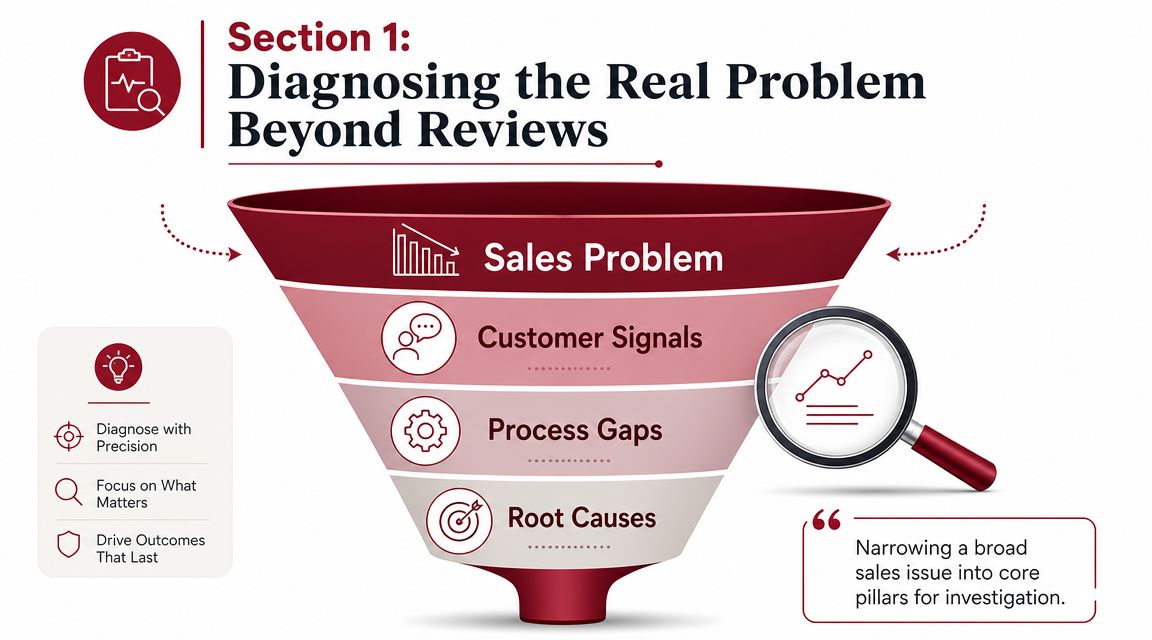
The useful diagnostic frame is Traffic, Offer, and Channel. Most stalled marketplace sales can be traced back to one of those three.
Traffic
If qualified buyers aren't seeing the product, there's no sales engine to optimise.
Look first at impressions and search visibility. If those are weak, reviews may be largely irrelevant because the market hasn't meaningfully encountered the product. This is common when a brand assumes existing retail strength will automatically transfer into marketplace discoverability.
Ask:
- Search relevance: Is the product indexed and surfaced for the terms buyers use?
- Category placement: Is it sitting in the right browse path, or has the marketplace effectively hidden it?
- Traffic quality: Are ads or search placements attracting the right shopper, not just any shopper?
If this layer is broken, the article on why your product isn't selling on Amazon even though it should be captures the broader issue well. Strong products often fail because the channel never positions them properly at the point of discovery.
Offer
If traffic exists but conversion stalls, inspect the offer before you touch reviews.
Offer is more than price. It includes the main image, product framing, feature hierarchy, delivery promise, warranty confidence, compatibility detail, and whether the page explains why this product is worth the decision risk.
A simple operating table helps:
| Diagnostic signal | What it usually suggests |
|---|---|
| Low impressions | Discoverability problem |
| Healthy impressions but weak clicks | Search message or thumbnail problem |
| Healthy clicks but weak conversion | Offer, trust, or fulfilment problem |
| Conversion concentrated on one SKU only | Catalogue clarity or SKU architecture problem |
Channel
Some products are viable. They're just in the wrong commercial setting, or entered too early.
Across multiple marketplace ecosystems, one issue we repeatedly observe is founders assuming every proven product belongs on every major platform. It doesn't. Some categories are search-led and price-comparison heavy. Others depend on stronger educational content, specialist retailers, or bundled ecosystem trust.
The question isn't whether the product is good. The question is whether this marketplace can explain the product efficiently enough to convert unfamiliar buyers.
That's the point where review conversations often become a distraction. If the channel itself creates too much friction, the product won't accumulate reviews at a useful pace anyway.
Common Root Causes for Stalled Marketplace Sales
Once you stop treating reviews as the main event, a different set of problems becomes visible. They're usually less glamorous and more operational.
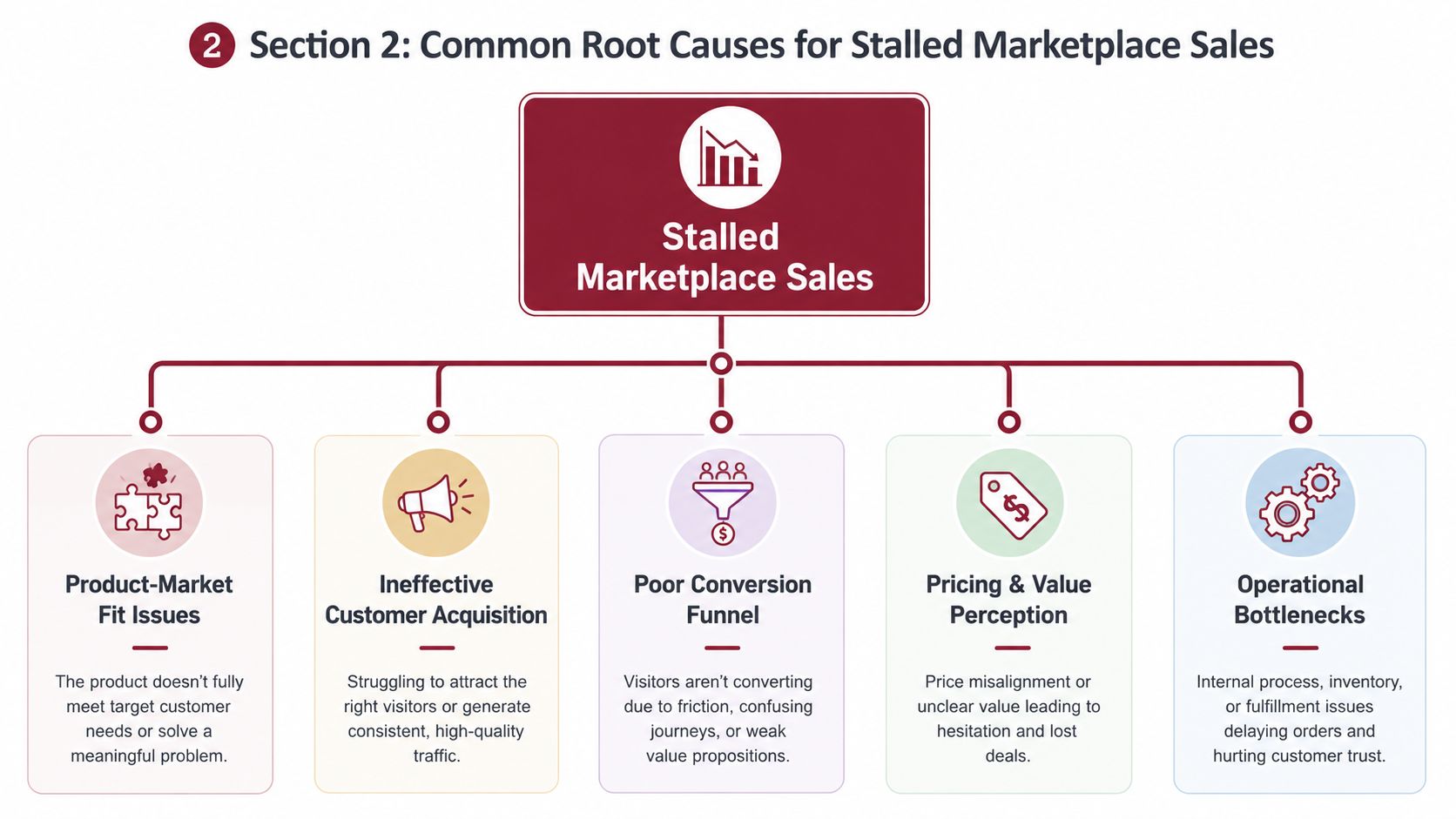
In recent marketplace reviews across connected devices, household products, lifestyle goods, and premium home categories, a handful of recurring root causes keep appearing.
The product is positioned for retail, not for marketplace search
A shelf can carry ambiguity. A marketplace can't.
In physical retail, packaging, in-store placement, and prior brand familiarity do part of the selling. Online marketplaces strip that away and force the product to win in compressed space. Search result thumbnails, short titles, selective feature exposure, and highly comparative buying behaviour change what counts as persuasive.
That's where Amazon product discoverability becomes commercially important. Not because of platform mechanics alone, but because poor discoverability often signals a positioning mismatch. The product may be premium, but the listing communicates generic utility. Or the product may solve a specific problem, but the page leads with broad claims instead of the actual use case that gets the click.
Fulfilment looks uncertain
Founders often underestimate how quickly weak fulfilment signals damage conversion.
If delivery appears slow, expensive, unreliable, or poorly explained, buyers hesitate. They don't need a negative review to decide against the purchase. The friction is already visible. This is especially true in home-improvement and household categories where timing affects the project, installation, or replacement need.
Common signs include:
- Delivery friction: Lead times that feel too long for the category expectation.
- Stock inconsistency: Variants appearing unavailable at the exact moment the customer is deciding.
- Returns ambiguity: Unclear return pathways for products with fit or compatibility risk.
A lot of “review problems” are really fulfilment confidence problems wearing a different label.
Price is technically competitive but commercially unconvincing
Being close to competitor pricing doesn't mean the offer feels safe.
If the page fails to justify quality, longevity, inclusions, or support, the buyer reads the product as expensive even when it may be fairly priced. This shows up often with premium consumer goods. The product might be better. The marketplace page just hasn't translated that difference into decision confidence.
Here the issue isn't price alone. It's price relative to perceived proof.
A high-consideration product without enough proof doesn't look premium. It looks risky.
That proof can come from several places. Reviews are one of them. So are clear specifications, compatibility statements, warranty framing, installed-use imagery, and consistent brand presentation.
The ecosystem around the product is fragmented
This is the quieter problem. It damages sales without attracting much attention.
A buyer sees one set of claims on the marketplace listing, another tone on the brand site, inconsistent imagery across retail partners, and unclear after-sales expectations. Nothing looks overtly wrong, but the brand doesn't feel coherent. In fragmented ecosystems, trust erodes before the shopper can articulate why.
This tends to hit established brands moving into new channels. They assume catalogue strength will carry over, but marketplace buyers are evaluating not just the SKU. They're evaluating whether the surrounding commercial environment feels dependable.
A product with no reviews in a coherent ecosystem can still convert. A product with some reviews inside a fragmented ecosystem often won't convert as well as expected.
Running Quick Experiments to Validate the Root Cause
Founders don't need a six-month strategy project to test these assumptions. They need controlled experiments that isolate what's actually broken.
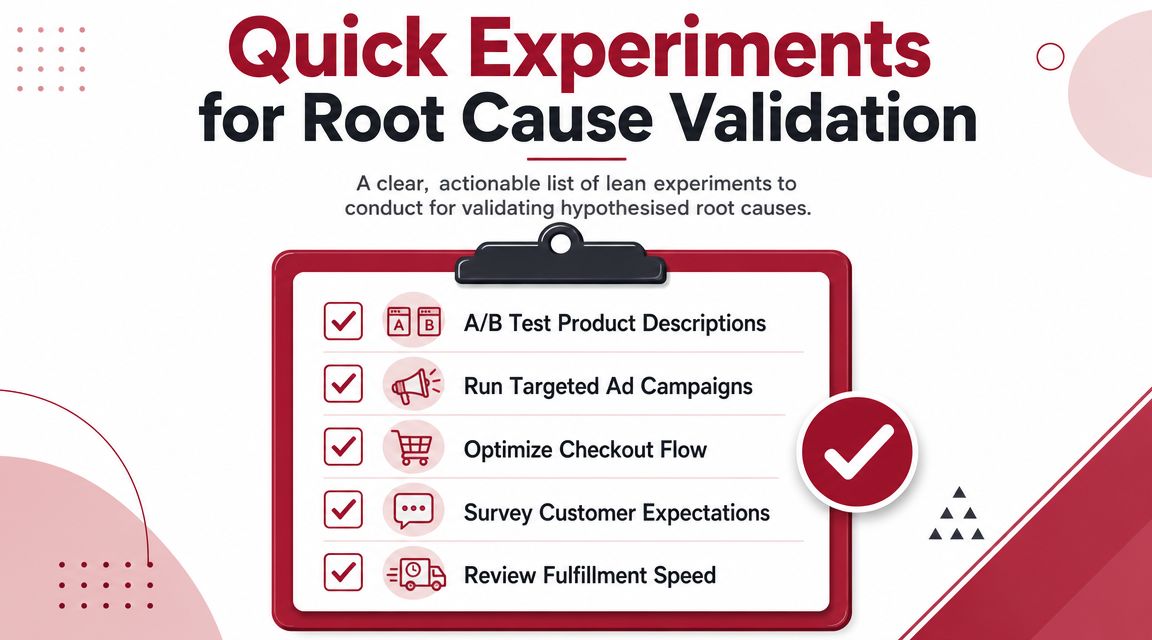
The mistake is making broad changes all at once. Adjusting price, images, ad structure, copy, and fulfilment timing together produces activity, but not clarity.
Start with one hypothesis at a time
Use lean tests with a single question behind each one.
Traffic hypothesis: If the right shoppers see this product, they'll engage.
- Run a tightly targeted ad test on the most relevant search terms.
- Watch click behaviour and search term quality, not just spend.
Main image hypothesis: Buyers aren't understanding the product at first glance.
- Test a more explicit hero image or alternate lead visual where the platform allows.
- Watch click-through movement.
Price perception hypothesis: The product is being read as too risky for its current price point.
- Trial a controlled price adjustment or value bundle.
- Watch conversion quality, not just units.
Fulfilment hypothesis: Delivery timing is suppressing purchase confidence.
- Improve shipping promise, stock coverage, or delivery message for a limited set of SKUs.
- Watch conversion on the affected items only.
Information gap hypothesis: Buyers need more certainty before purchase.
- Rework bullets, A+ content, image stack, or FAQ content around fit, warranty, compliance, and use-case clarity.
- Watch session-to-order performance after the content change settles.
Don't confuse motion with learning
Many ad accounts go wrong here. Spend increases, activity rises, and the team assumes the issue is being solved. Often it isn't.
The operating question is narrower: what changed, and did that change remove a specific buyer objection?
The piece on why your Amazon ads are spending money but not making it gets at this well. Paid traffic can amplify a problem faster than it solves one. If the product page, offer, or fulfilment model is weak, more traffic just produces a cleaner view of the weakness.
This short discussion adds a useful lens on testing decisions in-market:
Keep the scorecard simple
A practical scorecard usually needs only a few measures:
| Experiment type | Primary signal to watch |
|---|---|
| Search visibility test | Impressions and click quality |
| Thumbnail or title test | Click-through change |
| Offer or price test | Conversion movement |
| Fulfilment adjustment | Conversion and returns pattern |
| Content clarity update | Reduced hesitation in conversion path |
Operator's view: The best early experiments don't prove you're right. They show you what the market is objecting to.
That's enough to make a much better next decision.
A Prioritised Framework for Lasting Marketplace Growth
Once the root cause becomes clearer, sequencing matters. Most brands underperform because they work on the right issues in the wrong order.
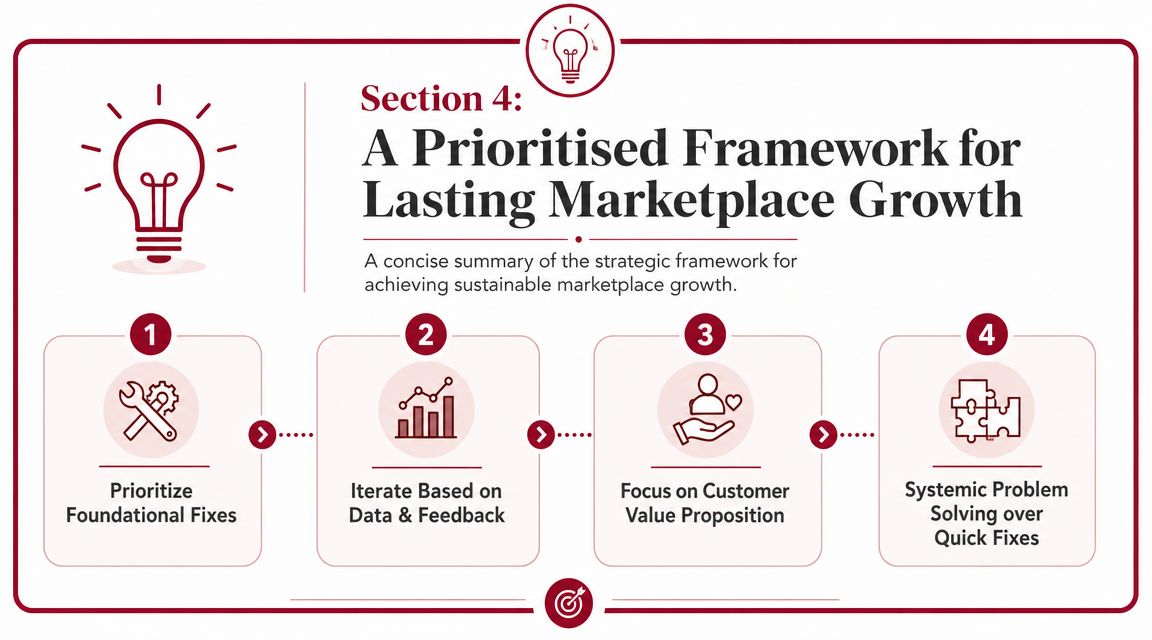
The resilient approach is to fix structural, then foundational, then tactical issues. Reviews sit in that third layer. They matter a lot, but they work best once the first two layers are stable.
Structural first
Structural issues shape whether the marketplace can support the product properly at all.
That includes channel choice, fulfilment model, stock positioning, range architecture, and whether the category is being approached with the right commercial expectations. If those pieces are weak, tactical optimisation becomes expensive maintenance.
Examples include:
- Channel mismatch: A product needing education is pushed into a comparison-heavy environment.
- Fulfilment misalignment: A premium offer is paired with a delivery promise that feels uncertain.
- Catalogue sprawl: Too many variants create confusion before any single SKU builds momentum.
These aren't listing problems. They're operating model problems.
Foundational next
Once the structure is viable, the offer has to carry its weight.
Effective pricing logic, value communication, visual hierarchy, warranty clarity, and product-page proof must work together. In Australia, that matters acutely because buyers are highly digital and compare aggressively across channels, as noted earlier.
A useful way to think about this layer is buyer hesitation. If someone lands on the listing with real purchase intent, what exactly would make them pause? The answer is usually visible in the page itself.
Tactical after that
Such is the role of reviews: Important, commercially powerful, but not foundational.
The reason is straightforward. Review generation performs best when the product is already being seen, understood, and purchased at a reasonable rate. At that point, the first batch of authentic reviews can materially improve conversion. A Medill Research study found that moving a product page from 0 to 5 reviews increased purchase likelihood by 270%, and higher-priced items saw a 380% conversion increase when reviews were displayed (Medill Research findings).
Those numbers matter. They also get misused.
They do not mean every underperforming SKU should jump straight into review chasing. They mean that once the underlying commercial engine is functioning, early authentic review density becomes an accelerator, especially on higher-priced products where failure risk feels more expensive to the buyer.
Reviews are strongest when they confirm an offer the shopper already wants to trust.
That's the commercial framing founders need. Not “reviews first”, but “reviews at the right moment”.
What stronger brands do differently
The brands that scale well across marketplaces usually share a few habits:
- They diagnose before they optimise. They don't assume all weak sales are trust problems.
- They protect fulfilment confidence. They know operational friction kills conversion.
- They treat proof as multi-layered. Reviews matter, but so do imagery, compatibility detail, and brand coherence.
- They build momentum around priority SKUs. They don't spread effort thinly across the entire catalogue.
This is why the phrase No Reviews, No Sales? The True Problem Isn't What You Think resonates with experienced operators. The review count is visible. The structural weakness often isn't.
Expanding Your Brand Ecosystem Strategically
What becomes visible during international expansion is that this problem compounds across markets. A listing that underperforms in Australia doesn't necessarily need more reviews. It may need different localisation, different fulfilment structure, different category framing, or a different SKU mix entirely.
That's why copy-paste marketplace expansion fails so often. Founders export the same catalogue logic, same content hierarchy, same pricing assumptions, and same trust signals into a new region, then act surprised when the sales curve stalls. The marketplace looks familiar. The ecosystem behaviour isn't.
Across multiple marketplace ecosystems, one pattern we continue seeing is that established brands overestimate product transferability and underestimate context. The same item can feel obvious in one region and uncertain in another. In one market, the buyer cares most about speed and price. In another, compatibility, warranty, and compliance do more of the conversion work. Reviews matter in both, but they don't solve for localisation errors.
The more mature approach is to treat expansion as an ecosystem transition. That means asking harder questions before scale begins. Which SKUs should enter first? Which proof points need localisation? Which fulfilment model protects trust? Which channel mix reinforces the brand rather than fragmenting it?
Founders who approach marketplaces this way tend to make better decisions earlier. They waste less money forcing traction. They notice when “no reviews” is just the easiest explanation available.
And that's usually the core issue. Not a lack of stars, but a lack of commercial alignment.
If you're an established brand looking at marketplace expansion and want an operator-level view of where growth is faltering, TPR Brands works with founders and commercial teams on the structural side of marketplace scale. That includes channel fit, localisation, fulfilment confidence, and building a cohesive brand ecosystem across Australia, the US, Canada, the UK, and beyond.