Most advice on unprofitable Amazon ads starts too low in the stack. Cut bids. Add negatives. Pause broad match. Tighten budgets.
Sometimes that helps. Often it doesn't.
One pattern we continue seeing is that founders ask a platform question when they're dealing with a marketplace positioning problem. If your Amazon ads are spending money but not making it, the issue often sits outside the campaign manager. The ads are exposing a commercial weakness that already existed: weak localisation, soft offer economics, catalogue mismatch, poor listing conversion, or a marketplace ecosystem that isn't mature enough for your current assumptions.
That distinction matters because tactical optimisation can make a bad setup fail more neatly, but it won't make it profitable. Established brands usually don't need more dashboard activity. They need a clearer read on what the clicks are revealing about the business.
Beyond ACoS The Real Reason Your Ad Spend Is Unprofitable
ACoS is useful, but it's also one of the easiest ways to misread what's happening.
Founders often look at rising spend and low sales and assume the ad account is inefficient. Sometimes that's true. But for established product brands, especially those entering or rebuilding on Amazon, unprofitable spend is often the output of a deeper mismatch between traffic, offer, and marketplace readiness.
The usual fixes often treat the symptom
Lowering bids can reduce loss velocity. Negative keywords can remove obvious waste. Campaign restructuring can improve control. None of those are bad moves.
The problem is that they're often applied before the commercial basics have been tested properly. If the product page doesn't justify the price, if shipping expectations are unclear, if the imagery doesn't match category norms, or if the catalogue hasn't been localised for how Amazon shoppers search, ad efficiency won't stabilise for long. It will just move around.
Practical rule: If you can only improve performance by buying less traffic, you probably haven't fixed the real conversion issue.
This is why the strongest operators don't isolate PPC from margin, assortment, and listing quality. They read ad inefficiency as a commercial signal. In many cases, the better question isn't “what bid should we set?” It's “why does this traffic fail to become revenue once it arrives?”
ACoS can hide a weaker commercial model
An ad account can look busy while the underlying offer is fragile. That happens when teams optimise around visible ad metrics but ignore what the full unit economics are saying. If your contribution after fees, fulfilment, promotions, and returns is already tight, advertising won't rescue the model. It will expose it faster.
That's why brands working through Amazon profit margins need to treat paid traffic as part of the commercial system, not a separate growth lever. You don't fix unprofitable ads by tuning media alone when the listing, pricing logic, or catalogue structure can't support the click.
A founder usually feels this before the dashboard explains it. Spend keeps moving. Sales don't. The reporting says “activity”. The P&L says “leakage”.
What the ads are really telling you
When Amazon ads spend without producing sales, they're usually revealing one of three realities:
- The wrong shopper is clicking because targeting is too loose or search intent is misunderstood.
- The right shopper is arriving but not convinced because the detail page, price, or fulfilment promise is weak.
- The business is measuring the wrong thing and mistaking attribution noise for pure campaign failure.
That's a more useful starting point than chasing a lower ACoS in isolation.
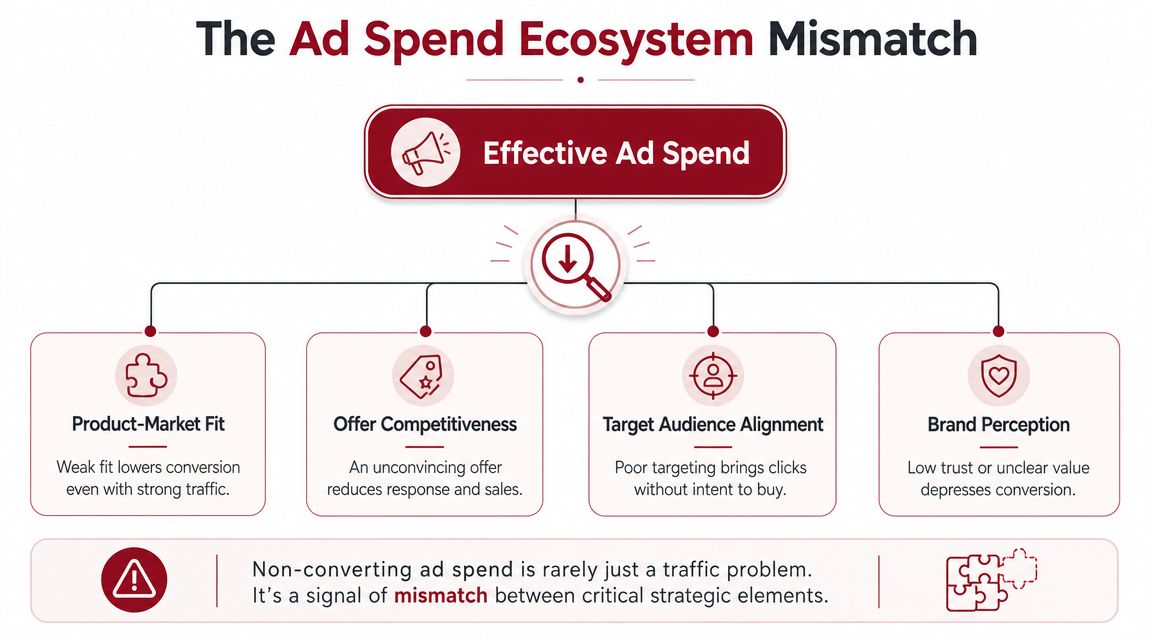
Diagnosing Ad Spend Through an Ecosystem Lens
Amazon performance doesn't happen in a vacuum. It reflects how well your product, offer, and operating model fit the marketplace you're selling into.
That's especially important in Australia, where Amazon is part of the retail market but not the whole market. As noted in SPS Commerce's discussion of why ads aren't converting on Amazon, Amazon Australia launched in December 2017, and the platform remains newer than the US and UK. The same analysis notes that Australians were buying online at record levels in 2023, but Amazon remains one of several major destinations. For operators, that means ad traffic can be poorly matched to local shopper intent if campaigns aren't tightly structured for the AU catalogue and search behaviour.
Why marketplace maturity changes ad economics
In a mature marketplace, brands can sometimes absorb inefficiency while they learn. In a newer or smaller marketplace, weak assumptions show up faster.
That's one reason Australian Amazon performance often gets misdiagnosed. Teams borrow campaign structures from larger markets, import keyword logic from US accounts, and expect demand behaviour to translate cleanly. It rarely does. Search language, product expectations, competitive sets, and price anchoring all shift by market.
What becomes visible during international expansion is that marketplace maturity affects the cost of mistakes. In a smaller demand pool, every irrelevant click has more weight. Every weak listing leaks more value. Every mismatch between ad promise and actual offer gets punished sooner.
Read ad performance as ecosystem feedback
A recent marketplace review revealed that poor ad performance usually points to one of these ecosystem issues:
| Signal in the ad account | Likely ecosystem issue |
|---|---|
| Clicks without orders | The listing or offer isn't converting local demand |
| High spend on discovery terms | Catalogue positioning is too broad for the market |
| Branded traffic with poor sales efficiency | Competitor comparison is stronger than expected |
| Uneven results across products | Assortment isn't equally ready for marketplace traffic |
That's why a strong diagnosis goes beyond campaign settings. It asks whether the marketplace operation is cohesive enough to support paid demand in the first place.
The Australian lens matters
For AU sellers, this is less about “fixing ads” and more about aligning the commercial system around local buying behaviour. Pricing needs to make sense in the local category context. Keyword strategy needs to reflect how Australian shoppers search. Content has to answer local objections clearly. Fulfilment expectations need to feel credible, not borrowed from another region.
Teams thinking this way usually move faster because they stop treating Amazon media as an isolated function. They treat it as one readout inside a broader marketplace ecosystem strategy.
Poor ad performance is often the marketplace telling you the channel isn't commercially coherent yet.
Deconstructing the Journey of a Non-Converting Click
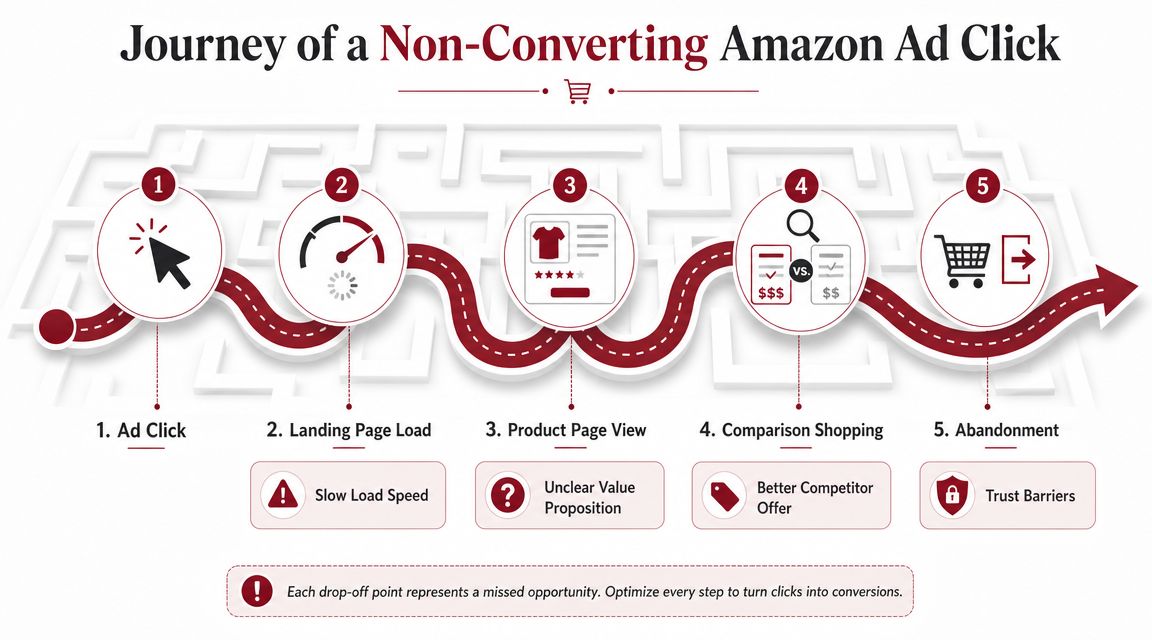
A non-converting click isn't one problem. It's a sequence of failures.
The ad gets the shopper interested. The listing then has to confirm that interest, defend the value, reduce doubt, and make purchase feel easier than comparison. If any part of that chain breaks, the spend is recorded and the sale disappears.
Where the click goes wrong first
One common technical cause is traffic intent mismatch. ThinkNectar cites an Amazon PPC audit dataset in which 20%–60% of ad spend went to search terms with zero historical conversions, which points to structural waste rather than a simple bid issue in many accounts, as outlined in their analysis of why Amazon ads stop scaling. In practice, this often shows up when broad match harvests loosely related searches, product targeting is left too open, or auto campaigns keep spending without segmentation.
For Australian sellers, that problem is more painful because the demand pool is smaller. A handful of irrelevant terms can distort your read on the whole category.
A cleaner operational pattern usually looks like this:
- Use broad match carefully for discovery, not as the centre of spend.
- Move proven demand into exact and phrase so you can control economics more tightly.
- Review search term reports weekly and isolate high-spend, no-sale queries before they keep draining budget.
- Tighten product targeting with better ASIN filtering instead of assuming adjacent products are relevant enough.
Then the listing fails the handoff
Some clicks are poor quality. Others are good clicks wasted by a weak destination.
If CTR is healthy and orders are weak, the problem often sits on the product page. The shopper arrives interested, then starts noticing friction. The hero image doesn't explain the product quickly. The title is technically accurate but not commercially clear. The variant logic is messy. The price feels out of line with perceived value. Delivery expectations aren't reassuring enough. Review proof may exist, but not in a way that helps the decision.
A lot of brands still treat these as listing polish issues. They're not. They're post-click revenue issues.
Here's a useful explainer on the mechanics behind that post-click drop-off:
The journey usually breaks in one of these places
Operational cue: High click-through with low conversion usually means the ad promise is working better than the product page.
Search term mismatch
The shopper searched broadly, the campaign matched loosely, and your ad appeared relevant enough to win the click.Expectation gap on arrival
The listing doesn't look like what the ad implied, or it doesn't answer the reason the shopper clicked.Competitive comparison
The shopper opens alternatives, compares price, images, delivery, and confidence signals, then leaves.Trust hesitation
Even if the product is good, the page doesn't remove enough uncertainty to justify purchase now.
Brands that improve Amazon product discoverability without improving the post-click experience usually increase traffic faster than revenue. That's why “why your Amazon ads are spending money but not making it” is rarely solved by visibility alone.
Interpreting Your Ad Data as Commercial Intelligence
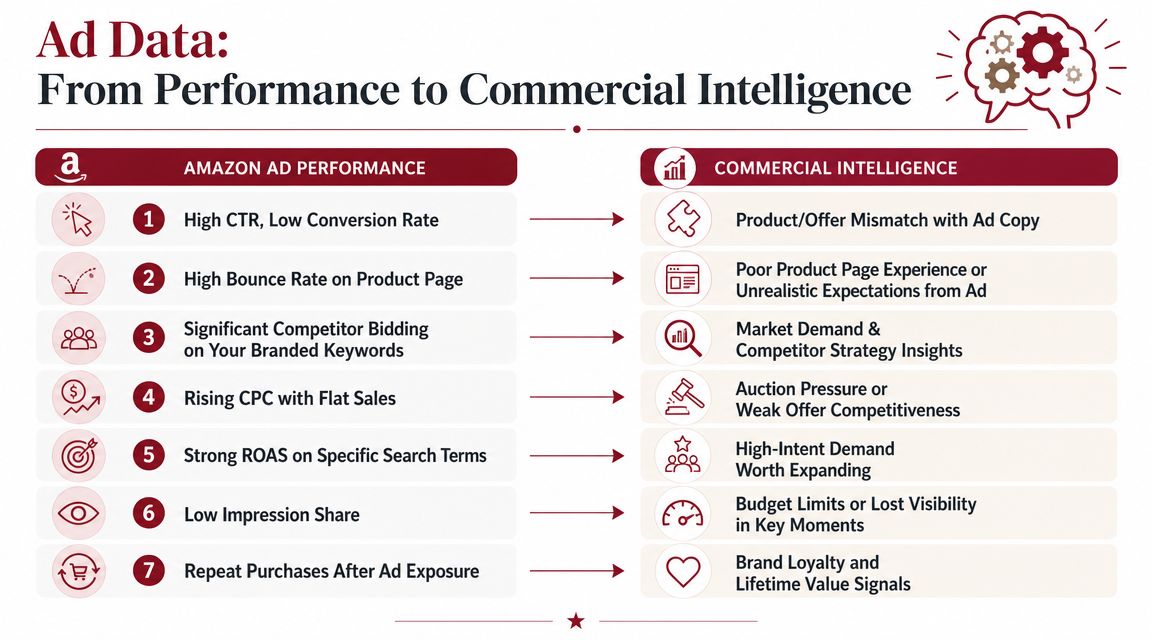
A weak ad result isn't just a performance problem. It's information.
The best marketplace operators don't read advertising data as a stream of isolated metrics. They use it to understand whether the product is resonating, whether the offer is competitive, whether localisation is landing properly, and whether the market is responding differently than expected.
Stop reading ad reports like a media buyer only
Founders often get pulled into ACoS because it's visible and immediate. But a single campaign efficiency number won't tell you enough about the actual state of the business.
A stronger read asks wider questions:
| What you see | What it may mean commercially |
|---|---|
| Strong branded conversion, weak non-branded conversion | The market trusts the brand more than the category positioning |
| Good traffic, soft add-to-cart behaviour | The offer is being considered, not chosen |
| Sales volatility after pricing changes | Price sensitivity is higher than your team assumed |
| Traffic growth without account-wide sales support | Paid demand is outrunning marketplace readiness |
Broader commercial views, such as total sales impact, are more useful than staring at campaign-level efficiency alone. Whether a team calls that TACoS internally or tracks it through another trading lens, the point is the same. Ads should be read against whole-account performance, not treated as a sealed box.
Some wasted spend is actually a measurement issue
One issue we repeatedly observe is that teams collapse very different problems into one phrase: “the ads aren't working”.
In Australia, that can be especially misleading. An AU-focused seller discussion on Amazon Seller Forums highlights recurring confusion when advertisers mix Sponsored Ads with off-Amazon traffic. Sales can be missed or misread when attribution windows, mobile browsing behaviour, or brand-search leakage aren't being interpreted correctly. In smaller-budget environments, a modest amount of misattribution can distort ACoS and ROAS quickly.
That doesn't mean every weak result is an attribution problem. It means measurement hygiene matters before you start cutting spend aggressively.
Some of what looks like wasted spend is the cost of poor diagnosis, not poor demand.
Use ad data to ask better strategic questions
Instead of asking only whether a campaign is efficient, ask:
- Which SKUs deserve traffic at all based on margin, page quality, and competitive readiness?
- Which search themes reveal real buying intent versus early-stage curiosity?
- Which products convert only on branded demand and therefore need stronger category positioning?
- Which market frictions are local rather than universal across regions?
That's the level where ad data becomes useful to commercial leadership, not just channel management. It starts informing pricing, assortment, launch sequencing, and localisation priorities. It also helps teams building a more coherent product and brand narrative through broader product marketing thinking, rather than trying to solve every issue inside campaign settings.
A Prioritised Framework for Fixing Unprofitable Ad Spend
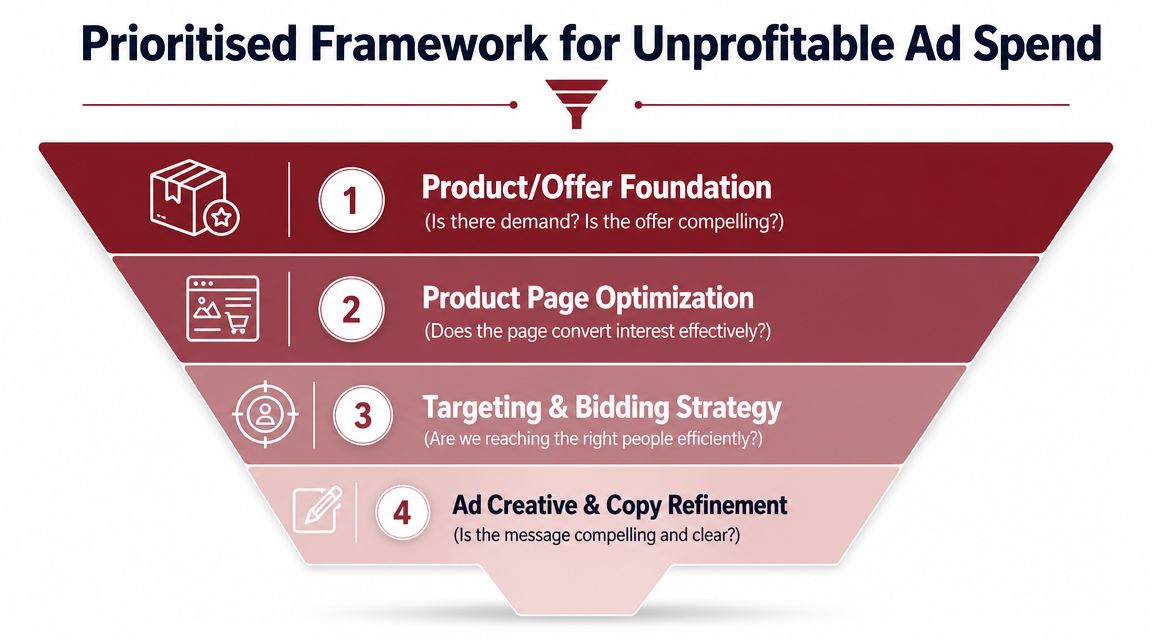
When ads are spending without making money, the correct order of operations matters. A common approach is to start inside the ad account because that's where the spend is visible. Stronger operators start with whether the traffic should have been bought in the first place.
Start with the product page and the offer
HeadlineMA notes that when click-through rate is healthy but conversion is poor, the destination page is often the root issue, and their guidance is to use break-even ACoS as the ceiling for bidding decisions in their review of why Amazon advertising may not be working. That's an important operational discipline because Amazon's system can optimise only from the signals it receives. If the detail page is weak, the platform keeps learning from noisy click behaviour rather than strong purchase behaviour.
For Australian accounts, this matters even more. A smaller marketplace gives you less room to absorb conversion leakage.
Before touching bids, check the basics with commercial honesty:
Price position
Is the product clearly competitive for the category, not just internally acceptable to the brand?Variant structure
Are shoppers landing on the right option, or are they arriving in a confusing selection tree?Image hierarchy
Does the first image set communicate use case and value quickly enough for mobile shoppers?Keyword-to-page alignment
Does the listing fulfil the intent implied by the search term and ad?
Then tighten targeting and control the learning loop
Once the page can convert credibly, move into traffic control.
A sensible sequence is:
- Reduce spend on terms and targets with repeated no-sale behaviour.
- Separate discovery from proven intent so broad exploration doesn't contaminate core performance.
- Bid from break-even logic, not from aspirational target ACoS.
- Protect inventory and fulfilment reliability. A campaign cannot stay efficient if the operational promise is unstable.
Commercial filter: Don't scale any campaign that depends on the customer overlooking an obvious weakness in the offer.
Build a repeatable review cadence
The accounts that recover fastest usually adopt a simple operating rhythm rather than chasing constant tweaks.
A practical review cycle might look like this:
| Review area | What to assess |
|---|---|
| Search term quality | Which terms are spending without commercial intent |
| Listing conversion | Which pages attract clicks but fail to produce orders |
| Offer competitiveness | Where price, delivery, or pack logic falls short |
| SKU eligibility | Which products should be advertised now versus later |
This is also the point where some brands bring in outside operational support. That can include internal marketplace leads, specialist analysts, or ecosystem partners such as TPR Brands when the issue sits across localisation, catalogue structure, regional expansion, and commercial channel fit rather than ads alone.
The main thing is order. Fixing bids before fixing conversion usually just creates neater-looking losses.
From Ad Spend to Strategic Investment
Founders often experience ad wastage as frustration first. That's understandable. The platform charges immediately, while the reason for failure is usually distributed across pricing, content, targeting, fulfilment, and measurement.
But that's also why this problem is more valuable than it looks.
Non-converting ad spend is one of the clearest forms of marketplace feedback a brand can get. It tells you whether local shoppers understand the offer. It shows whether your category positioning holds up under comparison. It exposes whether the listing supports purchase intent or just attracts attention. It reveals whether international expansion has produced a commercially coherent presence, or directly copied a domestic setup into a different ecosystem.
Strong brands don't separate ads from the marketplace
Across multiple marketplace ecosystems, the companies that build durable Amazon performance tend to share one habit. They don't treat advertising as a rescue function.
They treat it as a test of ecosystem readiness.
That mindset changes the response. Instead of asking how to stop spend, they ask what the spend is revealing. Is the catalogue right for this market? Is the product page local enough? Is fulfilment confidence strong enough? Is price aligned with the way this specific market evaluates value?
The real return comes from better diagnosis
When you look at the issue that way, ad spend becomes more than a cost line. It becomes a way to pressure-test expansion assumptions.
That matters for established brands moving across regions. Marketplace growth rarely fails because the product is bad. It usually fails because the ecosystem around the product isn't aligned tightly enough for the market it's entering.
If you solve that, Amazon ads become much easier to manage. If you don't, the account keeps reporting activity while the business absorbs the friction.
If your team is working through why Amazon ads are spending money but not making it, TPR Brands works with established product businesses on the broader commercial questions behind that pattern, including marketplace positioning, localisation, channel readiness, and international expansion structure.