Your product already sells. The catalogue is proven. Retail partners know the line. Marketplace expansion looks like the obvious next move.
So why do capable brands still get new-region launches wrong?
Usually, it isn't because the product suddenly stopped being good. It's because leadership treated demand forecasting as a spreadsheet exercise instead of a commercial operating discipline. They assumed home-market demand patterns would travel cleanly. They assumed channel launch momentum represented steady-state demand. They assumed the model mattered more than the market structure around it.
That assumption creates quiet drag. Inventory lands in the wrong place. paid activity gets set against the wrong demand window. Replenishment gets timed to internal optimism rather than external buying behaviour. Margin pressure appears later, but the mistake began earlier.
Introduction The Unseen Drag on International Growth
One issue we repeatedly observe is that founders talk about international demand as if it were a simple extension of existing demand. It rarely is. New markets introduce different buying rhythms, different fulfilment expectations, different promotional sensitivity, and different retail or marketplace maturity. The forecast that worked in one region often becomes directionally useful but operationally dangerous in another.
In the Australian context, demand planning has increasingly been shaped by volatile supply chains and retail seasonality in a relatively concentrated market, where forecasting errors can quickly affect stock availability and margin. A core shift in practice has been the move from static annual planning to ongoing statistical forecasting loops that use clean historical data, external indicators, and forecast-error measurement to improve planning discipline, as outlined in this guide to demand forecasting in supply chains.
Forecasting is really a coordination problem
Forecasting is often framed as prediction. In practice, it's closer to coordination.
A useful forecast helps a brand answer questions such as:
- Where should stock sit: not just by country, but by channel and fulfilment path.
- When should inventory move: before promotions, seasonal peaks, or channel launches distort lead times.
- What level of uncertainty is acceptable: because some misses create inconvenience, while others damage working capital or availability.
- Which signal deserves trust: marketplace sales, wholesale orders, retailer intake, or promotional plans.
That's why demand forecasting belongs in the same conversation as inventory structure, channel strategy, and supply chain risk management. The forecast doesn't sit above operations. It drives them.
Practical rule: If a forecast can't change a purchasing, inventory, or channel decision, it isn't yet commercially useful.
Expansion punishes lazy assumptions
Across multiple marketplace ecosystems, the brands that scale cleanly don't treat forecasting as a finance-side reporting task. They treat it as an early warning system for international friction. They expect variance. They expect regional exceptions. They expect the first answer to be incomplete.
That mindset matters because expansion is not a listing exercise. It's an ecosystem transition. You are moving into a different network of customer expectations, fulfilment constraints, promotional mechanics, and competitive signals. Demand forecasting only becomes valuable when it reflects that reality.
Defining Expansion-Focused Forecasting Objectives
A common mistake is building one forecast and asking it to solve everything. That's where confusion starts. The question is never merely, “What will demand be?” The essential question is, “What commercial decision are we trying to make?”

A launch forecast for a new UK marketplace channel should not look like a replenishment forecast for an established US distributor. A finance forecast for cash planning should not be built with the same level of granularity as an operations forecast for inbound inventory allocation.
Start with the decision, not the model
When teams begin with tools, they usually overbuild. When they begin with decisions, they get sharper.
A founder expanding internationally usually needs forecasts for a handful of distinct decisions:
| Decision area | What the forecast needs to answer | Typical planning view |
|---|---|---|
| Initial channel entry | What stock should land for launch and early trading | Conservative range with scenario views |
| Replenishment planning | When to reorder and in what mix | Ongoing demand rhythm by SKU or category |
| Marketing coordination | When demand is likely to respond to promotions or events | Campaign-linked windows |
| Cash and working capital | How much inventory exposure the business can carry | Aggregated commercial view |
| Capacity and fulfilment | Whether operations can support the demand pattern | Operational constraints view |
The point isn't complexity. The point is fit.
Good objectives force better trade-offs
One pattern we continue seeing is that teams use detailed forecasts to answer broad strategic questions, then use broad forecasts to make detailed stock decisions. Both create friction.
Use a forecast objective that matches the commercial consequence:
- If stockouts are the main risk, the forecast should prioritise availability and response speed.
- If overstock is the bigger danger, the forecast should focus on downside protection and slower inventory commitment.
- If channel expansion is the priority, the forecast should separate launch distortion from repeat demand.
- If marketplace performance is under review, the forecast should connect demand assumptions to actual operational outcomes.
That's also where benchmarking matters. Before forecasting what a market could do, teams need a realistic view of what similar channels, categories, and operational setups have historically supported. A disciplined performance benchmarking process helps stop ambition from being mistaken for demand.
Forecasts fail when they answer the wrong question accurately.
Define the boundaries early
A useful expansion forecast should specify three things before anyone opens a model:
Time horizon
Short-term launch planning, medium-term replenishment, and longer-term capacity planning require different assumptions.Level of detail
Country-level planning may be enough for finance, but operations may need channel, SKU family, or fulfilment-node views.Acceptable error
Not every forecast needs the same precision. Some decisions can tolerate directional ranges. Others can't.
Founders who get this right create alignment early. The commercial team knows what the forecast is for. Operations know how to use it. Finance knows how much confidence to place in it. That sounds basic, but in expansion work it often separates organised growth from expensive noise.
Unifying Fragmented Data Across Marketplaces
Most forecasting problems don't begin with the model. They begin with the data estate underneath it.
International expansion introduces fragmentation quickly. Amazon Seller Central reports one way. Vendor relationships report another. Shopify captures direct demand differently again. Retailer portals may record orders, not end-customer sales. Then there are returns, delayed settlement files, currency effects, and regional product mappings that don't align cleanly.
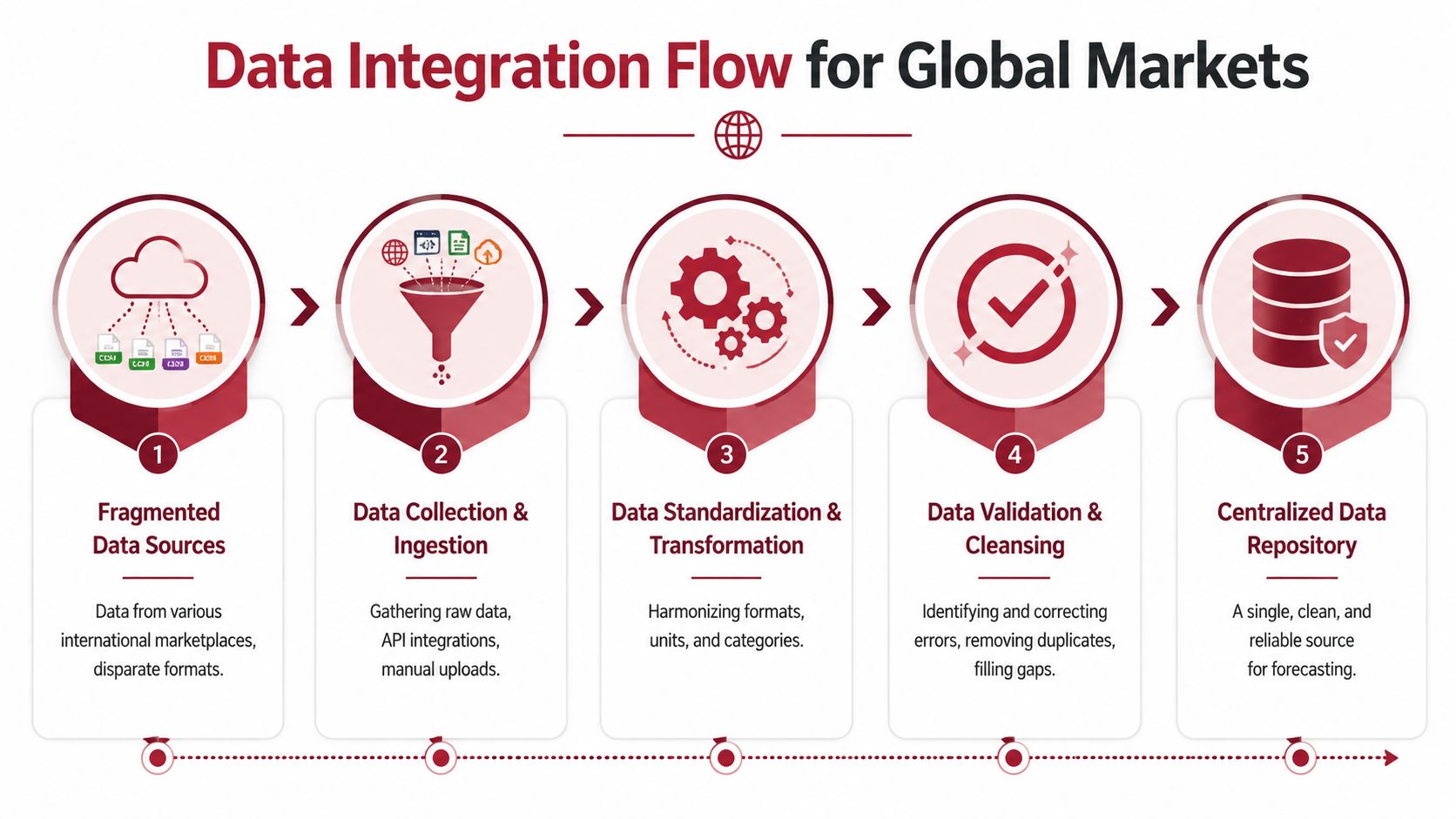
Different channels describe demand differently
Many teams often fall into the trap of overestimating certainty. They combine unlike data and assume the result is a single truth. It isn't.
A marketplace order, a distributor purchase order, and a retail sell-through report are not interchangeable demand signals. Each sits at a different point in the ecosystem.
Here's where confusion usually appears:
- Marketplace sales data reflects consumer purchases, but can be distorted by stockouts, listing suppression, or fulfilment lag.
- Wholesale orders may reflect customer demand, inventory loading, or buyer caution.
- Direct-to-consumer sales often show faster response to pricing, content, and promotion changes.
- Retail partner data may arrive late, incomplete, or aggregated at a level that hides SKU-level behaviour.
Clean data is commercial infrastructure
Teams often talk about “building a single source of truth” as a technical project. In expansion, it's a margin protection project.
A reliable forecasting dataset needs agreed rules for:
| Data issue | What goes wrong if ignored | Better operating choice |
|---|---|---|
| SKU naming variation | Products split into false duplicates | Create one master product structure |
| Currency inconsistency | Revenue and demand get mixed up | Standardise commercial reporting rules |
| Returns treatment | Demand appears stronger than reality | Separate gross sales from net demand view |
| Stockout periods | Historical demand gets artificially suppressed | Flag constrained trading periods |
| Channel timing differences | Demand appears to move unpredictably | Align reporting windows before modelling |
A recent marketplace review revealed that many forecasting errors were classification errors. The data looked complete, but it was describing different commercial events under the same label.
Local context has to live in the data
This matters even more across regions. Holidays, weather shifts, promotional calendars, and fulfilment models shape demand in ways generic exports won't capture. If your localisation is weak, your forecast usually is too.
That's why data preparation and market adaptation sit close together. The more clearly a product is positioned and translated into local market expectations, the easier it becomes to interpret demand properly. That commercial layer is often overlooked in forecasting conversations, but it's central to marketplace localisation and why some products feel closer than others.
A clean model built on messy demand definitions gives you cleaner-looking mistakes.
Build from consistency before complexity
For most brands, the right order is simple:
- Collect data from each marketplace, retailer, and owned channel.
- Standardise product, channel, and date structures.
- Validate anomalies such as returns spikes, stockouts, or reporting gaps.
- Contextualise with known events, launches, and promotions.
- Centralise into a version of the data the business can trust.
That sequence sounds operational because it is. Demand forecasting becomes far more dependable when the business stops arguing about what the inputs mean.
Selecting the Right Forecasting Approach
When teams finally get cleaner data, they often ask the wrong next question. They ask which algorithm is best.
That framing creates unnecessary noise. The commercial question is which forecasting approach best fits the market, the product, and the quality of available history.
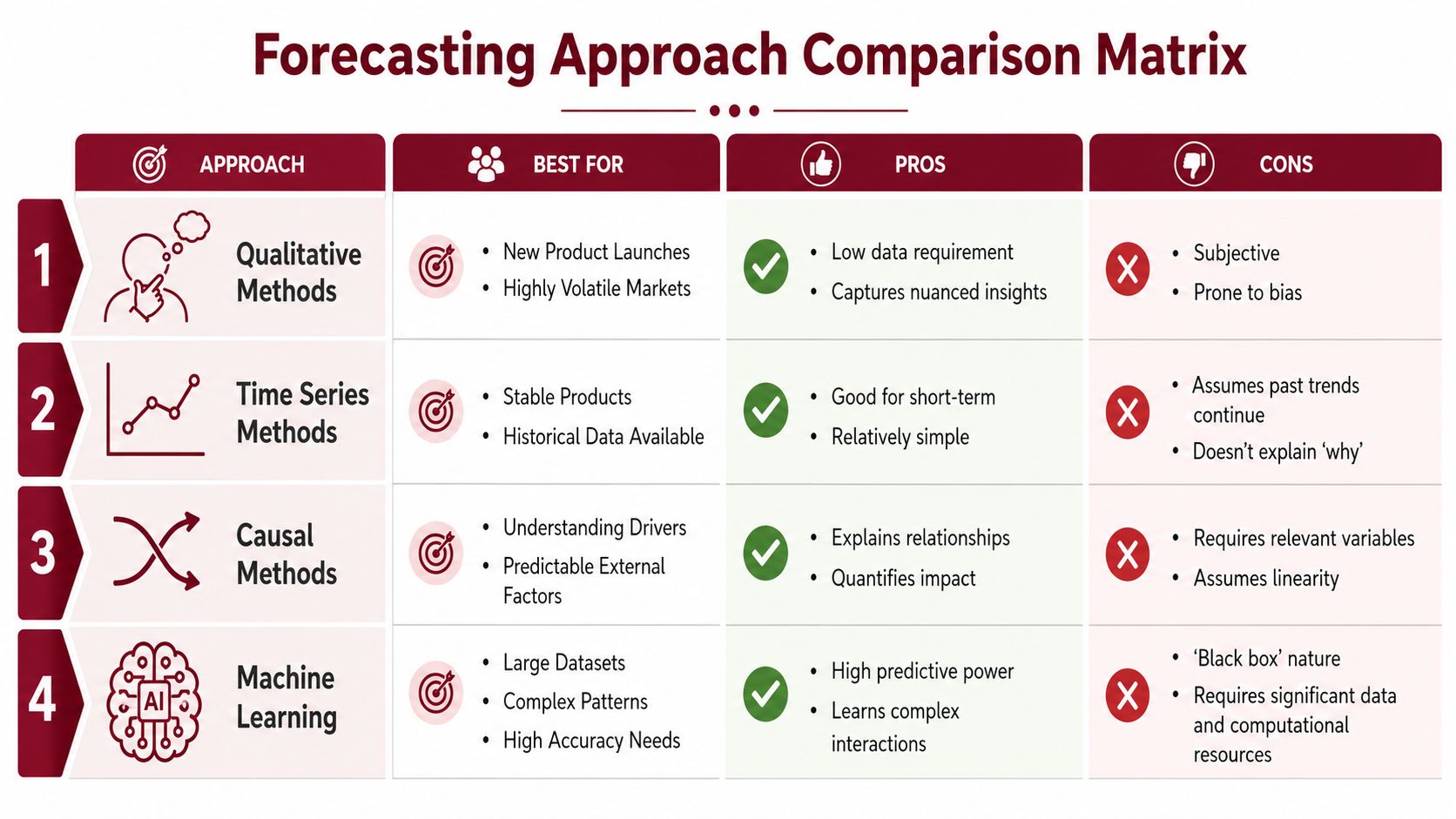
In Australia, demand forecasting developed as a formal retail and supply chain discipline through analytics work that emphasised historical sales, seasonality, and external drivers. Modern methods now routinely combine time-series analysis, regression, and machine-learning approaches rather than relying on judgment alone, with forecast accuracy evaluated against actual sales using metrics such as MAPE, as described in IBM's overview of modern demand forecasting methods.
Method choice follows commercial reality
That doesn't mean every brand should jump to machine learning. It means modern practice recognises that different methods answer different problems.
Here's a practical comparison:
| Approach | Best used when | Where it struggles |
|---|---|---|
| Qualitative judgment | New launches, sparse history, major market change | Bias, inconsistency, internal politics |
| Time-series methods | Established products with repeatable patterns | Regime changes, channel launches, structural shifts |
| Causal or regression methods | External drivers like promotions, weather, or seasonality matter | Weak variable selection, unstable relationships |
| Machine learning | Larger datasets with layered interactions | Sparse data, poor explainability, overfitting |
What works in mature markets
For stable products with reliable history, simple statistical methods often outperform complicated systems that try to discover patterns that aren't commercially meaningful. Founders sometimes underestimate this. They assume sophistication equals precision.
It often doesn't.
If demand is relatively established, a straightforward time-series approach can be easier to explain, easier to maintain, and easier to challenge when it goes wrong. That matters because forecasting isn't only about generating a number. It's about building trust across supply chain, finance, and channel teams.
Later in the process, this short explainer is useful context for teams comparing forecasting logic in practice.
What works in volatile expansion environments
New-market entry is different. Historical data is sparse, launch effects distort early demand, and local competition changes the shape of uptake. In that setting, judgment doesn't disappear. It becomes more important.
A better approach in those conditions often blends:
- A base statistical view from whatever history is reliable
- Commercial overrides for launches, retailer onboarding, or planned promotions
- External drivers such as weather exposure, holiday timing, or channel-specific events
- Scenario ranges rather than one confident point forecast
One pattern we continue seeing is that operators who understand demand concentration make better forecasting choices. In expansion, not every SKU or channel deserves the same modelling effort. Some products carry most of the risk and opportunity. That's one reason ideas like power law distribution matter operationally. Forecasting effort should follow commercial importance, not just data availability.
More model complexity does not solve weak market understanding.
Choose the method you can govern
A forecasting system has to be explainable enough for the business to use. If the commercial team can't challenge it, supply chain won't trust it. If finance can't understand its assumptions, it won't guide investment decisions properly.
That is why the strongest approach is often hybrid. Not because hybrid sounds advanced, but because expansion usually involves both measurable history and informed judgement. The key skill is knowing which part of the forecast belongs to each.
From Data to Decision Integrating and Validating Forecasts
A forecast only starts creating value when someone uses it to make a decision and then checks what happened next.
That sounds obvious, but many businesses still treat demand forecasting as a monthly output rather than an operating loop. The file gets circulated. A few people glance at it. Purchasing makes a call. Then the organisation moves on until the next cycle.
Build a review rhythm around variance
What stronger operators do differently is simple. They compare forecast against actual demand, investigate the gap, and decide whether the miss came from the model, the market, or execution.
Because modern forecasting commonly evaluates accuracy against actual sales using measures such as MAPE, that review loop is part of the discipline, not an optional afterthought, as noted earlier in the IBM reference. The metric matters less than the behaviour around it. Teams need a repeatable way to inspect misses without turning every variance into blame.
A practical operating rhythm usually includes:
- A demand review where sales, operations, and finance look at actual versus forecast.
- A variance diagnosis that separates stock constraints, promotions, competitor activity, and model error.
- A decision response covering replenishment, spend pacing, or forecast overrides.
- A learning log so the same surprise isn't rediscovered in the next cycle.
Use scenarios to expose hidden assumptions
Consider a common expansion scenario. A household brand launches in a new region through marketplaces first, then adds wholesale accounts. Early marketplace sell-through looks strong, so the team lifts future demand expectations across all channels.
Then the next period softens.
What happened? Often, one of three things:
- Launch demand pulled forward orders that would otherwise have come later.
- Early demand came from a narrow customer cluster, not broad market adoption.
- Stock availability or ad intensity temporarily exaggerated the pattern.
The forecast wasn't useless. The interpretation was.
When actuals diverge from the forecast, start by asking what the business assumed, not which person was wrong.
Make the forecast visible to the people who execute it
Forecasting trust rises when the operating teams can see how the number was built. A black-box output tends to get ignored until there's a problem. A transparent forecast, even if imperfect, is easier to improve.
That usually means documenting:
| Forecast element | Why it matters to the business |
|---|---|
| Base demand logic | Helps teams understand the starting assumption |
| Event adjustments | Shows where promotions, launches, or holidays changed the number |
| Risk flags | Highlights uncertainty before inventory is committed |
| Ownership | Makes clear who updates, reviews, and approves the forecast |
The strongest brands don't aim for a forecast that never moves. They build one that gets revised intelligently as market evidence improves. That's what turns forecasting from a reporting task into an operating capability.
Navigating Common Forecasting Pitfalls in New Markets
Most forecasting errors in new markets aren't mathematical failures. They are context failures.
Teams import home-market assumptions, trust early launch signals too much, or feed sparse history into systems that need stability to work properly. The result is a forecast that looks rigorous but misses the ecosystem reality around the product.
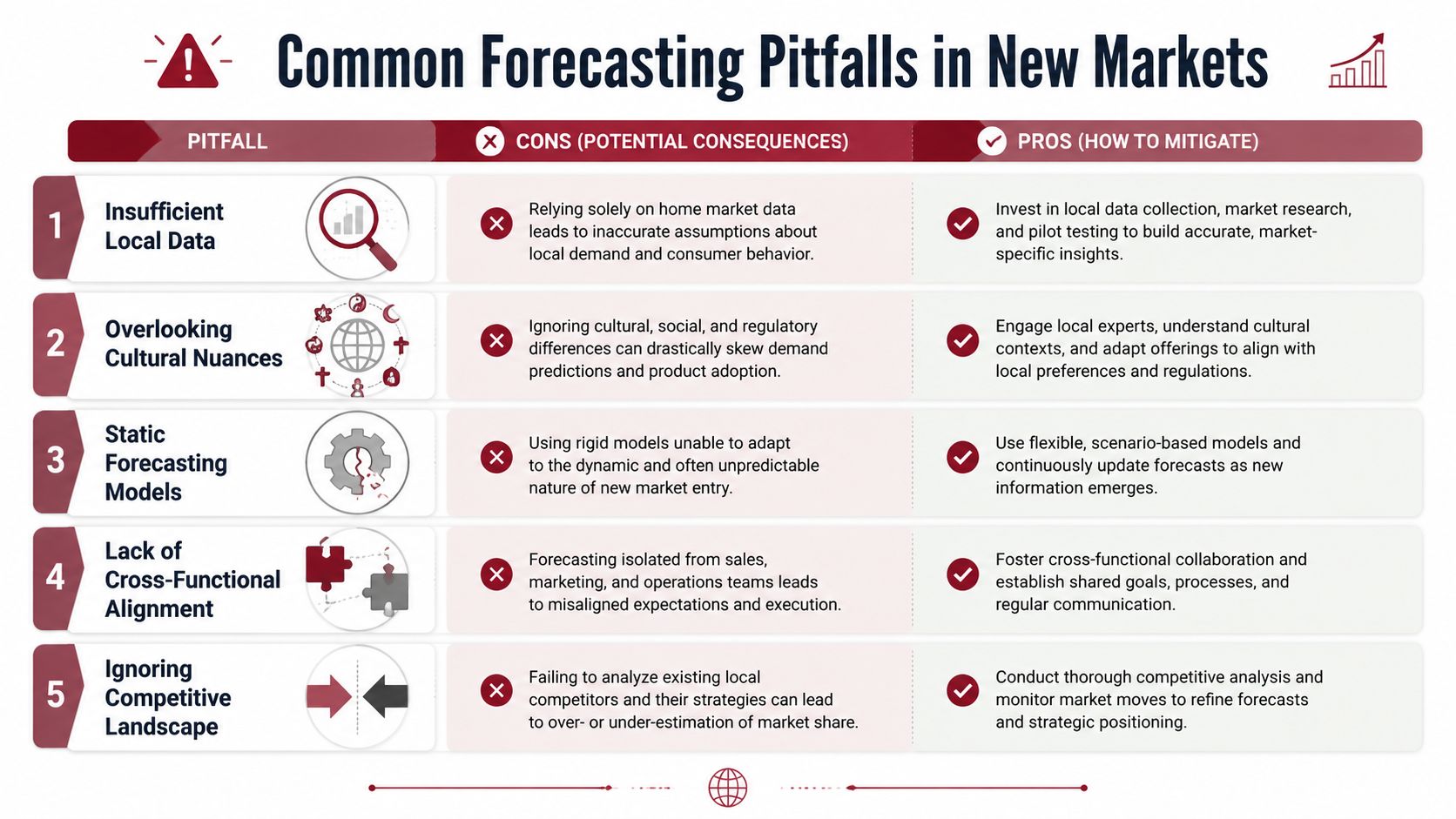
The mistakes that show up repeatedly
For smaller or newer Australian channels, the main issue is often data sparsity, regime shifts, and event sensitivity rather than model choice alone. Guidance over the last year has increasingly emphasised uncertainty intervals, change-point detection, and probabilistic outputs, reflecting a broader shift away from static forecasting toward scenario-aware planning, as discussed in NetSuite's article on forecasting in data-sparse channel environments.
That lines up with what operators see in practice.
Home-market seasonality gets copied across regions
This is common in categories affected by climate, holidays, or local shopping behaviour. A timing pattern that feels stable in Australia can mislead badly in the UK, North America, or Europe.Launch-period demand gets mistaken for baseline demand
New listings often produce abnormal behaviour. Curiosity, pent-up demand, channel incentives, and promotional support can all distort the first read.Historical sales hide stock-constrained demand
If a product was unavailable, the recorded history may understate what customers would have bought.AI gets asked to solve a market-structure problem
When the issue is sparse data or abrupt change, a more complex model can become a more complex way to be wrong.
Better mitigation looks disciplined, not dramatic
The practical response is not to abandon forecasting. It's to make it more conditional.
Use ranges when certainty is low. Use point forecasts when the operating environment has earned that confidence.
Strong teams also do a few things consistently:
- Flag change points early: channel launch, listing changes, weather shocks, and promotional resets should be marked as structural events.
- Separate constrained demand from observed sales: especially where stockouts or fulfilment delays distort the history.
- Review local demand drivers before importing assumptions: regional behaviour matters more than internal consistency.
- Keep forecasts scenario-aware: base case, upside, and downside views are often more useful than one polished number.
The brands that handle expansion well don't expect demand forecasting to remove uncertainty. They use it to make uncertainty visible early enough to act on it.
TPR Brands helps established product brands turn expansion decisions into structured commercial systems, not hopeful channel moves. If you're assessing international marketplace growth and need a clearer view of demand, localisation, fulfilment, and ecosystem fit, TPR Brands brings operator-led support built for serious brands scaling across regions.