Most advice about compliance documentation is too narrow. It treats the subject like a legal filing problem, something to tidy up after the commercial work is done. In practice, that's backwards.
For brands entering new marketplaces, new retail channels, or new countries, compliance documentation often decides whether expansion moves cleanly or starts absorbing time, margin, and leadership attention. A strong product can still stall if the underlying evidence is fragmented, outdated, or impossible to retrieve when a distributor, marketplace, customs broker, insurer, or regulator asks for it.
One pattern we continue seeing is simple. Mature brands treat documentation as operating infrastructure. Unprepared brands treat it as a box of certificates. The difference shows up quickly when catalogue complexity rises, product variations multiply, and local market requirements stop matching the assumptions built in the home market.
The Hidden Drag on International Expansion
Founders are often told that compliance sits in the back office. It doesn't. It sits in the middle of market access.
When a brand expands internationally, compliance documentation becomes part of the commercial pathway. It affects onboarding, fulfilment confidence, customs responsiveness, retailer acceptance, product claims, insurance discussions, and the speed at which a team can answer hard questions with evidence instead of internal guesswork. That matters in a climate where scrutiny is real. In Australia, the compliance environment has become more enforcement-driven, with ASIC completing 4,792 surveillances and investigations in 2023–24, while the OAIC received 527 Notifiable Data Breach notifications in the first half of 2024, as outlined in SafetyCulture's compliance documentation overview.
Why the common view is too small
The popular advice says compliance documentation is mainly about avoiding penalties. That's incomplete. The operational issue is that weak documentation slows expansion before anyone talks about enforcement.
A marketplace team may have a viable listing strategy, local pricing, and channel demand. None of that helps if product files can't prove what standard applies, which test report supports the live SKU, what warning label was approved for the market, or whether the current user instructions match the product revision being shipped.
Practical rule: If the business can't produce the right evidence quickly, it doesn't have a documentation system. It has a storage problem.
Across multiple marketplace ecosystems, documentation maturity is often a leading indicator of whether a brand can scale predictably. Teams with organised records tend to launch with fewer internal delays. Teams without them spend expansion periods chasing files across email threads, supplier folders, and old packaging drafts.
The drag rarely looks dramatic at first
It usually starts as friction.
- Launch friction: Category approvals pause while someone looks for test evidence.
- Channel friction: A distributor asks for technical files and receives mismatched versions.
- Fulfilment friction: Shipments are held while product declarations or supporting records are clarified.
- Brand friction: Marketing publishes claims that legal or quality can't properly substantiate.
These aren't isolated admin errors. They're signs that the brand's operating structure isn't aligned. That's why compliance sits alongside wider supply chain risk management rather than outside it.
What becomes visible during international expansion is whether the business has built a cohesive commercial system, or just assembled a collection of departments that each hold part of the truth.
Compliance Documentation as a Commercial Asset
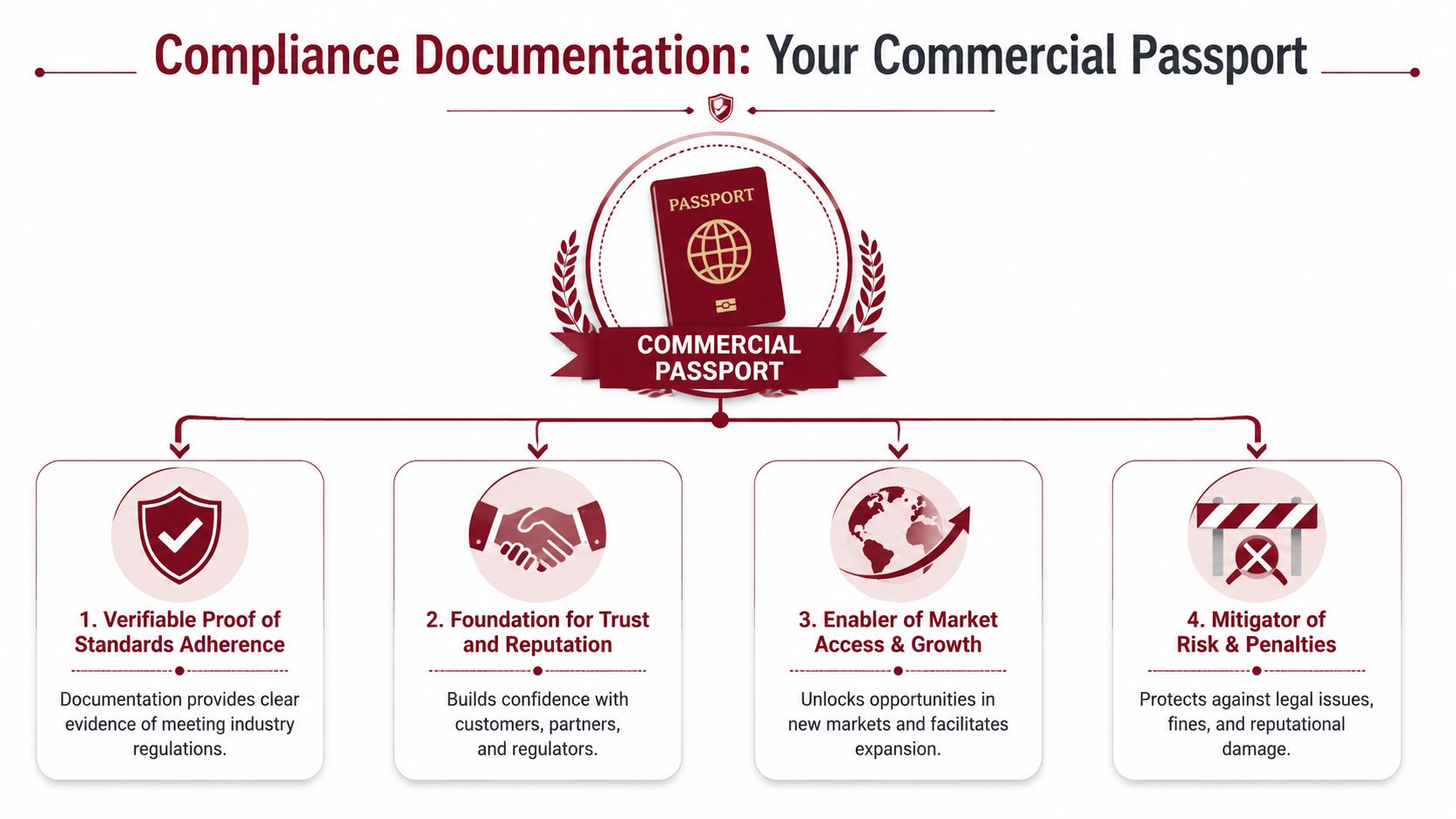
The most useful way to think about compliance documentation is not as a filing obligation, but as a commercial asset. It functions like a passport for the product. It proves where the product can go, under what conditions, and with what supporting evidence.
That passport is rarely a single document. It's a structured set of records that may include declarations, test reports, labelling files, artwork approvals, technical specifications, risk assessments, user instructions, supplier confirmations, and internal approval trails. When those records are connected and current, the business moves with far more confidence.
What strong documentation really does
A well-built documentation set creates commercial advantage in ways many teams underestimate.
- It supports market access. Retailers, marketplaces, importers, and distributors often want evidence before they commit shelf space or onboarding resources.
- It protects claims integrity. Product pages, packaging, and manuals can be checked against approved evidence rather than rewritten from memory.
- It reduces transaction friction. Teams can answer requests without rebuilding the file from scratch every time.
- It strengthens trust. Buyers may never read the technical file, but channel partners and regulators will judge the brand by how well that file stands up.
Cohesion matters more than volume
One issue we repeatedly observe is the assumption that more files mean lower risk. Usually the opposite is true. Large document libraries become dangerous when they aren't structured around product identity, market applicability, and version control.
A certificate in isolation is weak. A declaration without linked test evidence is weaker. A test report that doesn't clearly relate to the exact model, label, or bill of materials being sold can create a false sense of security.
Documentation becomes commercially useful when it answers three questions fast: what product is this, what market is this for, and what evidence supports the claim?
That's why mature operators organise documentation around retrieval, not storage. They don't ask whether a file exists somewhere. They ask whether the correct, current file can be produced for the exact SKU, sales channel, and target region involved.
Why this changes expansion economics
When documentation is accessible and structured, the commercial team can move faster without creating hidden risk for quality, legal, or operations. New channel conversations become easier. Cross-border onboarding gets less fragile. Internal teams spend less time reconciling contradictions.
The commercial upside is often overlooked because it doesn't look like marketing activity. But it shapes whether growth is controlled or chaotic. Strong brands understand that product credibility isn't only built through reviews, design, or positioning. It's also built through the internal proof system that supports every claim the brand takes into market.
Mapping the Global Compliance Landscape
International expansion gets messy when teams assume compliance travels neatly across borders. It doesn't. A product that is acceptable in one market is not automatically ready for another, even when the product itself hasn't changed.
The operational challenge isn't just legal complexity. It's divergence. Marks differ. labelling conventions differ. evidence expectations differ. Some markets focus on one style of declaration, others on technical files, import records, or local warnings. The product team may think in terms of one finished item, but each region often sees a different compliance object.
What changes from market to market
In Australia alone, baseline record discipline already matters. The Australian Taxation Office's GST rules require businesses to keep records for 5 years, while the Privacy Act's APP 11 requires entities to take reasonable steps to protect personal information through documented controls, as explained in this discussion of Australian compliance obligations. If one market already expects retention and evidence, multi-market expansion naturally becomes more demanding.
The point isn't that every founder needs to become a regulatory specialist. The point is that every expansion plan needs a documentation architecture that reflects regional variation.
| Region | Key Certification Mark | Common Substance Regulation | Typical Electrical Safety Standard | Noteworthy Requirement |
|---|---|---|---|---|
| Australia | RCM or market-specific declaration depending on product type | Substance and product restrictions vary by category | Electrical safety expectations vary by product and state-based framework | Documentation often needs to align with importer, labelling, and local evidence expectations |
| United States | FCC or other category-specific approvals depending on product type | Proposition 65 may become relevant for certain products and sales contexts | UL or other recognised safety frameworks are commonly expected commercially | State-level variation can create extra labelling or warning complexity |
| Canada | Category-specific certification marks depending on product class | Substance rules depend on category and intended use | CSA-aligned safety expectations are common | Bilingual labelling can become operationally important |
| United Kingdom | UKCA for applicable products | RoHS and related controls may apply by product type | UK electrical safety expectations mirror product-specific frameworks | Post-Brexit marking and file alignment need active attention |
| European Union | CE for applicable products | RoHS and REACH commonly shape documentation requirements | EN standard alignment is commonly relevant | Technical files and declarations must support the exact product configuration placed on market |
| Japan | Product-category marks and approvals vary | Substance and materials expectations differ by category | Product-specific electrical frameworks apply | Local language and importer handling can become a practical gating issue |
The table isn't a legal checklist. It's a commercial warning. Regional compliance isn't a copy-and-paste task.
The real issue is localisation friction
Across multiple marketplace ecosystems, the strongest teams recognise that compliance is part of localisation. They don't separate product adaptation from documentation adaptation.
That means asking questions such as:
- Does the live packaging match the market where the unit will be sold?
- Does the declaration relate to the exact model variation, not just the product family?
- Have local warnings, instructions, and importer details been aligned?
- Can the team show which evidence applies in each region?
A recent marketplace review revealed that many brands localise customer-facing content long before they localise their internal evidence base. That creates a dangerous mismatch. The listing appears market-ready, but the documentation stack still reflects the home market.
Good operators map requirements before channel launch
Broader environmental regulations and product obligations start interacting with catalogue planning, freight decisions, and packaging approvals.
The cleanest international launches usually happen when brands define evidence requirements before channel entry, not after the first product hold, dispute, or onboarding rejection.
That approach changes the expansion sequence. Instead of asking, “Can we sell this there?” at the end, mature teams ask it at the start, with documentation mapped to product, market, and channel from the outset.
Where Documentation Strategy Breaks Down
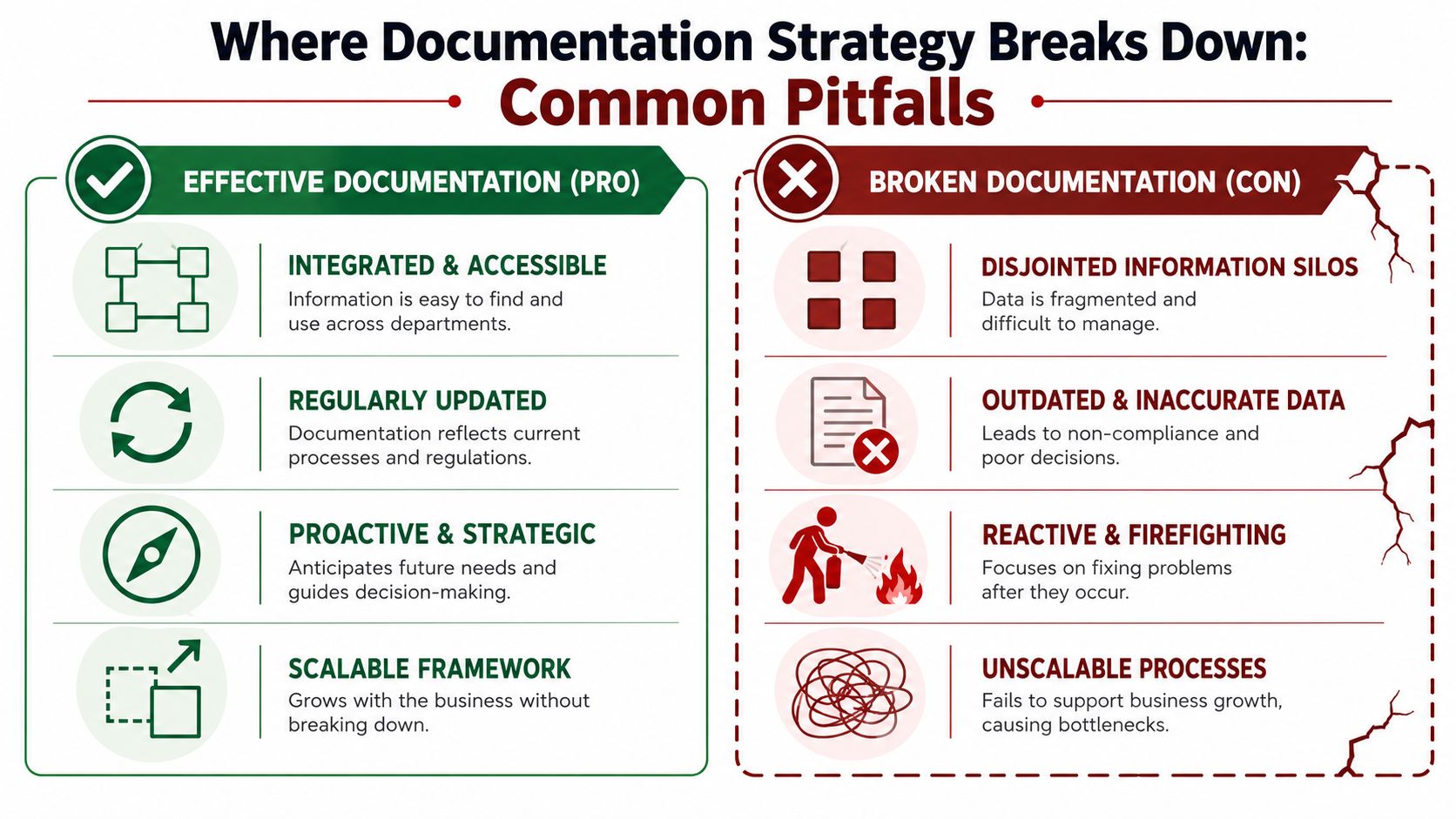
Most documentation failures don't come from a complete absence of paperwork. They come from fragmentation.
The engineering team has old test reports. The sourcing team has supplier declarations. Packaging sits with design. Marketplace copy sits with marketing. Legal has a policy folder. Quality has another repository entirely. Everyone assumes the business is covered because each department holds a piece of the picture.
It isn't covered. It's split.
The failure usually starts with ownership
A major operational gap is ownership across the product lifecycle. Current guidance increasingly pushes teams to actively maintain compliance documentation through version control and scheduled reviews, and it raises the practical question of who updates which record, when, and against which obligation, as discussed in MeisterTask's analysis of compliance documentation ownership.
That question is where many scaling brands hesitate. They have responsible people, but not responsible ownership. Those are different things.
A document with no named owner becomes a historical artefact very quickly.
When ownership is unclear, updates happen only after an external trigger. A customer complaint prompts a check. A retailer asks for evidence. A shipment gets queried. A platform requests substantiation. The team then scrambles to reconstruct the decision trail.
What broken systems look like in real operations
One pattern we continue seeing is that product changes happen faster than document changes. A component substitution is approved. Packaging copy is refreshed. A warning statement is shortened to fit artwork. A supplier changes. A manual gets reformatted. The documentation set doesn't move with those changes.
That creates predictable failure modes:
- Incorrect claims in market: Sales copy reflects ambition, not approved evidence.
- Outdated manuals or labels: The shipped product no longer matches the latest controlled file.
- Customs or onboarding delays: Documents exist, but no one can confirm which version applies.
- Audit stress: Teams can retrieve records, but not the dated trail that explains what was in force at the relevant time.
Why silos get worse during expansion
Domestic businesses can sometimes hide weak documentation behind team familiarity. People know who to call. The product range is smaller. Local channel expectations are understood informally.
International expansion removes that safety net. New distributors don't know your history. Overseas partners don't accept “we'll send the final file later” as a reliable process. Marketplace ecosystems also expose contradictions quickly, because product pages, packaging, technical files, and support materials all need to line up across multiple touchpoints.
A recent marketplace review revealed that the brands under the most pressure weren't necessarily the least compliant. They were the least retrievable. They had evidence, but no operating model for assembling it into a defensible product record at speed.
Building an Auditable and Scalable Compliance System
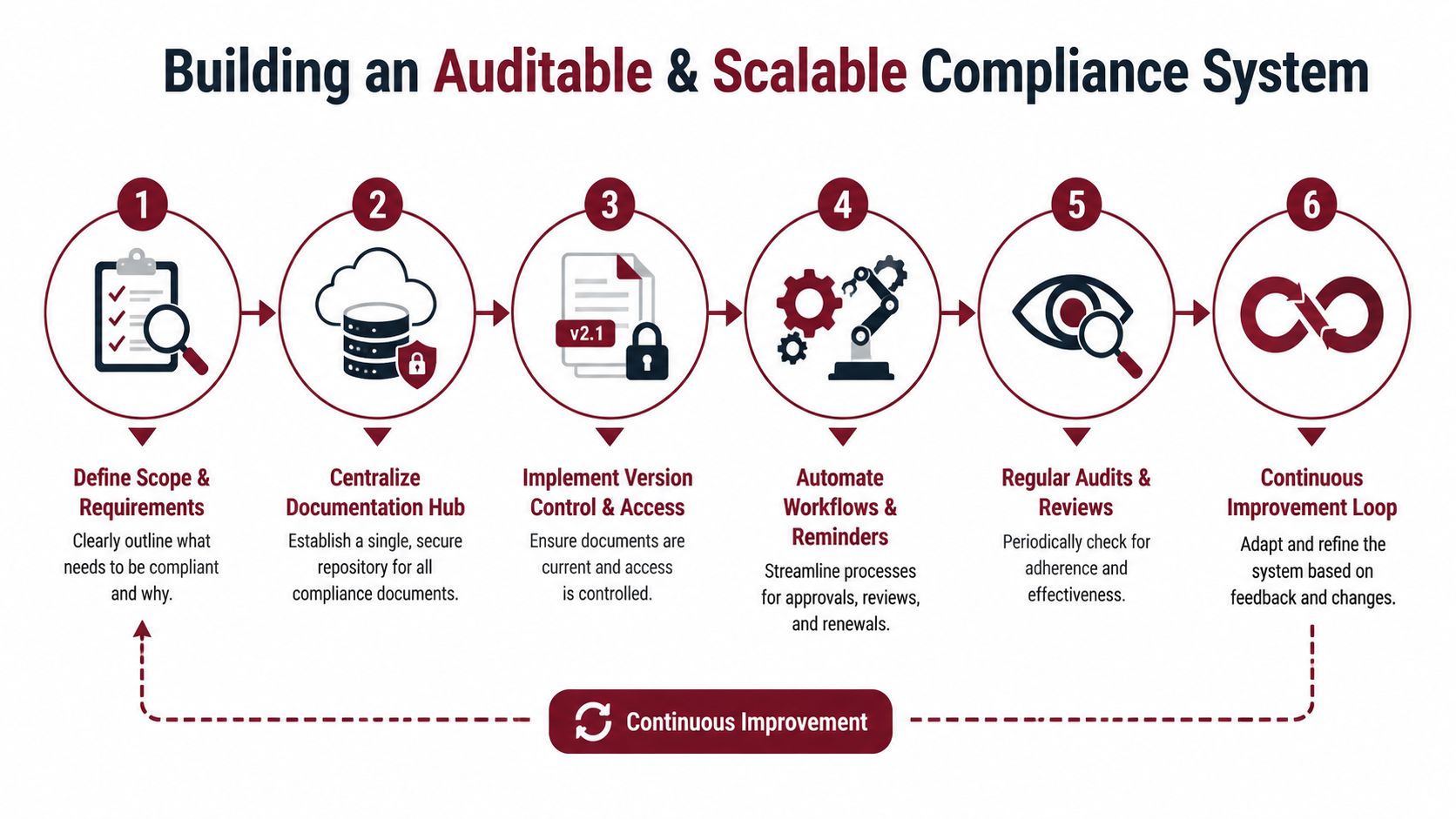
The brands that handle expansion well don't rely on heroic admin effort. They build systems that make the right evidence easier to maintain and easier to retrieve.
That starts with a shift in mindset. Compliance documentation should not sit as a static PDF archive. It should sit inside a living operating structure tied to products, revisions, markets, and approvals.
A useful visual summary sits below.
What mature systems do differently
For regulated products, documentation becomes operationally reliable only when it is built around machine-readable traceability. In Australia, an Australian Declaration of Conformity is most useful when it links product test reports, risk assessments, and labels to a specific revision-controlled SKU. Without that traceable evidence chain, the declaration is weak in an enforcement review, as outlined in Essential Data's discussion of compliance documentation workflows.
That principle scales well beyond Australia. Strong systems usually share a few characteristics:
A central documentation hub
Product evidence sits in one governed environment, not across private inboxes and desktop folders.SKU-level linkage
Files are attached to exact models, variants, and revisions. Not broad product families.Controlled access
Teams can retrieve what they need, while edit rights stay limited and auditable.Review triggers
Product changes, supplier changes, artwork changes, and market-entry decisions trigger document review.
Audit-ready by default
The practical goal is simple. The business should be able to produce the right document set for the right product and market without rebuilding the story manually each time.
That matters commercially as much as legally. It reduces hesitation during onboarding. It helps insurers, distributors, and channel partners evaluate the product more efficiently. It also strengthens the brand's position when product responsibility becomes part of a wider discussion around product liability insurance.
The following video offers useful context on building stronger compliance processes.
The standard that matters
Build the system so the audit trail is created during normal operations, not reconstructed after the event.
That is where scalable brands separate themselves. They don't just collect documents. They connect decisions, versions, approvals, and product records in a way that remains intelligible months later, across teams and across markets.
Positioning Your Brand for Global Marketplace Success
International expansion rewards brands that can carry credibility across borders. That credibility doesn't come from packaging polish alone. It comes from operational coherence.
One issue we repeatedly observe is that strong products often underperform internationally because the supporting systems are too fragmented for the next stage of scale. The catalogue may be commercially attractive. Demand may exist. But when evidence is split across suppliers, labs, distributors, and internal teams, the business starts every new market conversation from a weaker position than it realises.
Documentation quality shapes market confidence
A key challenge for imported and cross-border products is assembling defensible records when supporting evidence is dispersed. Current guidance points to a better model: organise records by control or requirement, maintain a clear audit trail, and avoid building a bloated file library that no one can interpret. That issue is outlined clearly in Sprinto's commentary on compliance documentation.
That principle matters in practical terms:
- For founders: it protects attention from being consumed by reactive approvals and document hunts.
- For commercial teams: it improves readiness for distributors, marketplaces, and new regional partners.
- For operators: it reduces the chance that expansion gets held up by mismatched evidence rather than weak demand.
Expansion works better when evidence is organised before entry
Across multiple marketplace ecosystems, the brands that scale cleanly usually do one thing early. They decide what proof must exist before the next market opens, then they organise it around the key operating questions.
Which SKU is being sold? Which market is it entering? Which supplier evidence supports it? Which warnings, manuals, and declarations apply? What changed, and when?
Those questions sound administrative until a market asks for answers. At that point, documentation quality becomes commercial positioning.
The same logic applies when brands enter channels with different expectations around catalogue control, onboarding standards, and local accountability. A listing can be built quickly. A compliant, defensible product presence takes more discipline. That's especially visible when moving into ecosystem-heavy channels such as Amazon Australia, where product, logistics, customer expectations, and documentation all intersect.
The practical conclusion is straightforward. Compliance documentation isn't separate from growth strategy. It is part of the infrastructure that allows a brand to expand without creating hidden instability underneath the revenue line.
TPR Brands helps established product companies build the operational structure required for controlled international expansion. If your team is preparing to enter new marketplaces, channels, or regions and needs a commercially coherent approach to compliance, localisation, and market readiness, start the conversation with TPR Brands.