A distributor misses target for two quarters and the instinct is immediate. Replace them. Push harder. Assume the problem sits inside their sales team.
That instinct causes expensive mistakes.
The harder question is the useful one. Is the distributor underperforming, or is the brand asking the channel to carry problems it created upstream? In practice, weak localisation, unclear pricing architecture, poor field support, uneven stock flow, weak product training, and fragmented channel strategy can all show up as “distributor failure”. The top-line number looks simple. The commercial reality usually isn't.
Across multiple marketplace ecosystems, one pattern we continue seeing is brands using distributor performance as a proxy for market health. That shortcut works until it doesn't. If you're serious about how to evaluate distributor performance, you need a framework that separates execution failure from ecosystem failure. Otherwise you end up changing partners when the underlying issue is coverage design, customer service drift, or weak brand activation.
Beyond Sales Volume Reframing Distributor Evaluation
A distributor can post weak sales for the wrong reasons. That's the first thing most scorecards miss.
Most guides still treat performance as a sales problem first and an operating problem second. But one of the clearest gaps in distributor assessment is the failure to distinguish between a distributor issue and a brand-activation issue, including weak channel support, poor training, or inadequate market coverage, as noted in this distributor evaluation discussion. That distinction matters far more in Australia than many founders expect because state-by-state conditions, customer expectations, and route-to-market realities don't behave uniformly.

The wrong question brands ask
The common question is, “Why is the distributor not selling more?”
The better question is, “What part of the commercial system is failing to convert demand into repeatable sell-through?” Those are not the same thing. One blames the partner. The other diagnoses the structure.
In hardware, household, wellness, and premium consumer categories, underperformance often sits in the seam between parties. The distributor may be carrying stock correctly but lacks clear product education. The brand may have strong product-market fit in one state but weak retail relevance in another. The sales team may be active, but the offer may not be localised well enough for the buyers they're calling on.
Practical rule: If you only review sell-in, you're grading the distributor's ability to buy, not their ability to build your market.
That's why a blunt replacement strategy often creates fresh instability instead of solving the original issue. A new distributor inherits the same unclear support model, the same weak channel messaging, and the same operational friction. Performance still disappoints, just with a different logo on the invoice.
What strong evaluations actually test
A proper review tests whether the distributor has the capability, focus, and discipline to execute. It also tests whether the brand has given that partner a commercially viable platform to execute from.
That's particularly important in fragmented environments, where channel concentration is uneven and performance follows a power curve rather than a neat average. The logic behind power law distribution in commercial ecosystems is useful here. A few channels, customers, or regions often drive a disproportionate share of outcomes. If your distributor looks weak overall, the issue may be poor coverage of the critical nodes rather than general incompetence.
Use sales as a signal, not a verdict. The primary job is attribution.
Building Your Weighted Distributor Scorecard
Most distributor reviews fail because they're too narrow. Sales is easy to pull, easy to compare, and easy to argue about. It's also incomplete.
A stronger method is to assess performance across four blocks: sales management, planning and logistics, finance and back-office, and partnership and brand commitment, then review them on a fixed cadence using agreed definitions for revenue growth, inventory levels, and payment discipline, as outlined in this distributor scorecard framework. That structure avoids the common mistake of over-weighting volume while ignoring communication and brand commitment.

The four blocks that matter
A practical scorecard doesn't need to be long. It needs to be balanced.
| Scorecard block | What it tells you | Typical warning sign |
|---|---|---|
| Sales management | Whether the distributor can create structured demand, not just place orders | Revenue is volatile with no clear account plan |
| Planning and logistics | Whether service execution protects the brand in-market | Stockouts, inconsistent supply, poor delivery reliability |
| Finance and back-office | Whether the partner is commercially disciplined and operationally clean | Late payments, weak reporting, unresolved claim disputes |
| Partnership and brand commitment | Whether your brand is being prioritised, communicated properly, and represented well | Good headline sales but low visibility, weak engagement, poor feedback loops |
The weighting should reflect your current objective. A mature domestic network and a new international launch shouldn't be scored the same way. If market entry is the priority, brand commitment and planning quality may deserve more weight than raw volume. If the account base is established, financial discipline and service consistency may carry more importance.
Weighting changes behaviour
Distributors respond to what brands measure. If you weight only revenue, they'll chase volume even when it distorts pricing, increases returns, or starves slower-moving but strategically important product lines.
A weighted scorecard creates clearer incentives. It tells the distributor that execution quality matters, that reporting matters, and that your brand expects more than purchase orders.
A useful scoring cadence looks like this:
- Monthly operating review: Focus on service, inventory flow, reporting quality, and emerging issues.
- Quarterly commercial review: Assess trend direction, capability gaps, account development, and resource allocation.
- Corrective action review: Track the handful of issues with named owners and firm deadlines.
A scorecard should reduce ambiguity, not create bureaucracy.
That's where many teams get this wrong. They create a heavy document, collect data inconsistently, and then argue over definitions instead of using the review to improve performance. Keep the model simple enough to run without drama.
What to agree before the first review
Before scoring anyone, lock in the operating definitions. Revenue growth, inventory health, payment discipline, and reporting accuracy need one shared meaning. If they don't, every review becomes political.
Three agreements matter early:
- Metric ownership. Decide who supplies each data point and who validates it.
- Review cadence. Monthly or quarterly works, but it has to be fixed.
- Escalation logic. Define what happens when a score falls materially short across one block or repeatedly across several.
If you need a broader lens on relative performance across channels and operators, disciplined performance benchmarking for growth decisions helps keep distributor reviews anchored in commercial context rather than opinion.
The KPIs That Matter for Ecosystem Health
A scorecard is only as good as the inputs feeding it. If the inputs are limited to sales value and open orders, you won't see trouble until customers already have.
Industry guidance on distributor KPI design points to a tighter operational set. Useful distributor KPIs include on-time delivery rate, order accuracy rate, perfect order rate, fill rate, order cycle time, defect rate, inventory turnover ratio, GMROI, and supplier responsiveness, with formulas built around percentages and historical benchmarks so teams can compare performance over time, according to this distributor KPI guide. One example is on-time delivery, calculated as “# Orders Delivered On-Time / Total Orders Delivered × 100.”
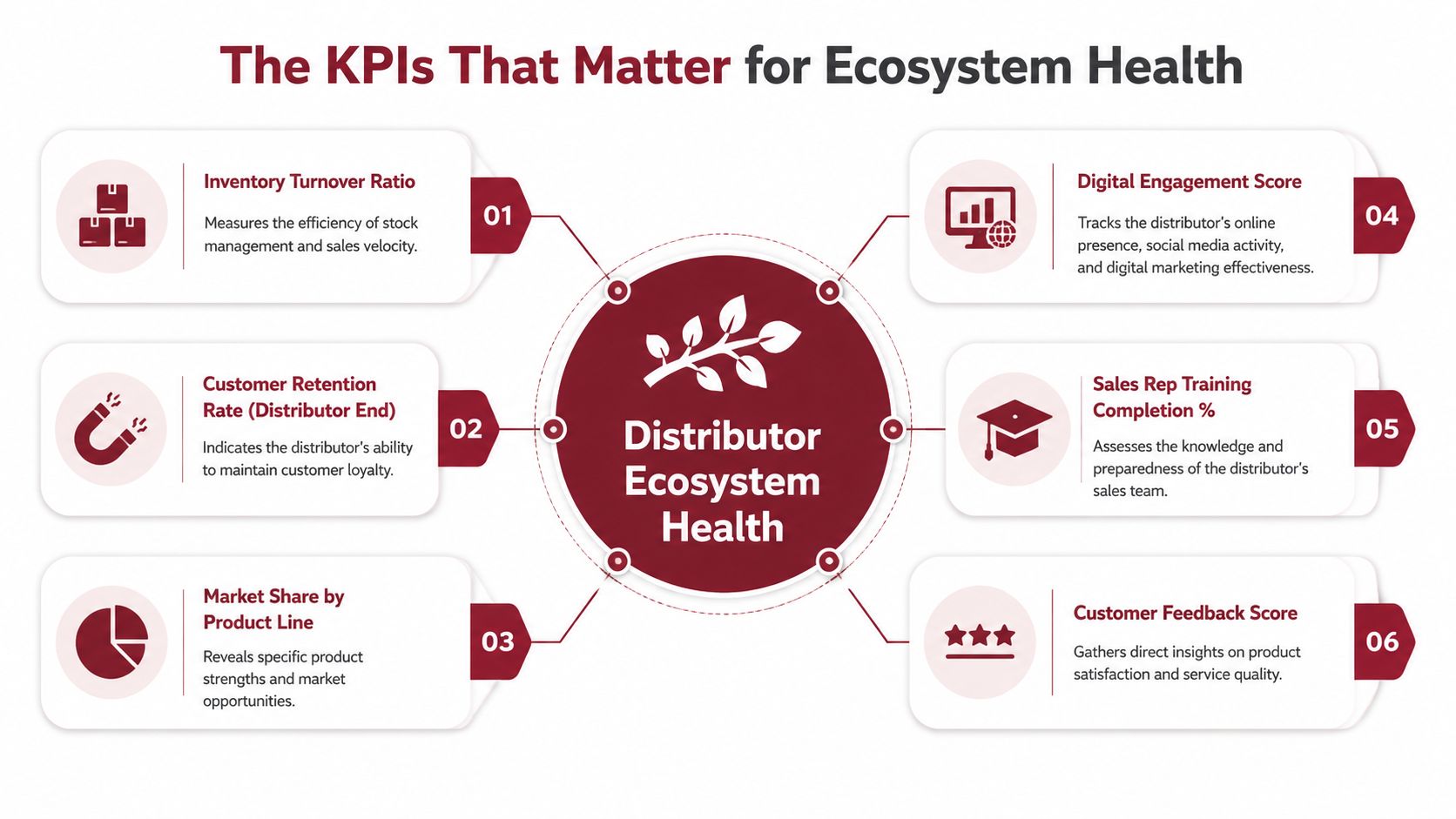
Service KPIs reveal customer risk first
When a distributor starts slipping operationally, customer experience usually feels it before the P&L does.
Track the KPIs that show whether the market is being served properly:
- On-time delivery rate: Indicates reliability against promised delivery windows.
- Order accuracy rate: Shows whether customers receive what they ordered.
- Perfect order rate: Captures whether the full transaction was completed correctly across delivery, accuracy, and condition.
- Order cycle time: Highlights whether speed is drifting in a way customers will notice.
- Defect rate: Signals product handling and quality-control weakness inside the distribution process.
A revenue-first view can miss all of that. A distributor may still be booking sales while service standards erode underneath. By the time revenue drops, the customer has often already adjusted behaviour.
The earliest sign of distributor weakness is often operational friction, not missed budget.
That matters even more in categories where repeat order confidence is tied to availability and reliability. Hardware, household goods, and home improvement lines don't just compete on product merit. They compete on whether buyers trust the system around the product.
Inventory KPIs show whether the channel is healthy
The second KPI cluster is inventory, a metric through which many brands discover the difference between movement and health.
Watch these indicators closely:
- Fill rate: Tells you whether demand is being met from available stock.
- Inventory turnover ratio: Shows whether stock is moving at a healthy pace.
- GMROI: Helps assess whether inventory is generating an acceptable return.
- Supplier responsiveness: Reveals how quickly issues are addressed when supply or service moves off track.
A distributor carrying too much stock may still look committed, but excess inventory can hide weak sell-through. A distributor carrying too little may protect cash while damaging service and buyer confidence.
For teams thinking in terms of broader channel design rather than isolated metrics, marketplace ecosystem strategy is a useful lens. Distribution performance doesn't sit outside the ecosystem. It shapes customer trust, stock confidence, and the brand's commercial reputation.
A short explainer on KPI selection is worth watching before you finalise any review model:
Don't use KPIs without trend context
A KPI without historical context invites overreaction. The value isn't in a single month. The value is in the direction, consistency, and relationship between metrics.
If on-time delivery weakens while order cycle time stretches and fill rate softens, that's not three separate problems. That's a service system losing control. Historical benchmarks make those patterns visible before the account team starts blaming “market conditions”.
From Data Collection to Diagnosis
Most distributor reviews collapse at the interpretation stage, not the measurement stage. Teams collect reports, compare them to target, then jump straight to blame. That's administration, not diagnosis.
A better process combines internal data, distributor reporting, and end-market signals. Supplier-performance frameworks recommend tracking quality, delivery time, cost, responsiveness, and compliance together, and warn against relying only on lagging indicators because waiting for revenue decline means missing earlier warnings such as rising support tickets or longer lead times, as outlined in this supplier performance management framework. The same guidance also recommends including financial-statement review and arrears monitoring in the evaluation.

Use more than distributor-supplied data
Distributor data matters, but it rarely tells the whole story on its own.
You need at least three views of performance:
| Data view | What it captures | Why it matters |
|---|---|---|
| Sell-in data | What the distributor bought from you | Shows ordering behaviour, not market pull by itself |
| End-market service signals | Complaints, response quality, support issues, delivery consistency | Reveals friction customers feel directly |
| Compliance and financial checks | Payment behaviour, arrears, reporting quality, local compliance | Shows whether the operation is stable and dependable |
That mix helps you answer the central evaluation question: is the distributor failing to execute, or is the broader route-to-market architecture failing around them?
If sell-in is stable but complaints rise and delivery performance weakens, you likely have an execution issue. If the distributor is engaged operationally but market coverage is thin and activation support is weak, the issue may sit with the brand's channel design. If payment behaviour deteriorates while service worsens, financial stress may be driving both.
Benchmark against your own history first
External comparisons can help, but historical performance is usually the cleaner starting point. Guidance on distributor KPI design specifically recommends using historical data and percent changes so performance can be compared over time. That's far more useful than arguing over whether one underperforming quarter is “normal”.
Start with a baseline period where the relationship was functioning reasonably well. Then compare current service, financial discipline, and responsiveness against that operating history. Patterns emerge quickly when the definitions are stable.
A disciplined workflow usually follows this order:
- Define the KPI set
- Agree the benchmark with the distributor
- Collect scorecard data
- Compare current performance against target and trend
- Convert gaps into an improvement plan with owners and deadlines
Diagnosis improves when each metric has a likely cause attached to it.
For example, rising complaints plus acceptable stock cover can suggest weak warehouse execution or poor customer service handling. Soft coverage plus decent service scores can suggest a sales activation or account-priority problem. Slow payment plus inconsistent inventory often points to working-capital strain.
Look for clusters, not isolated misses
One missed KPI can be noise. A cluster tells you where to investigate.
Useful interpretation questions include:
- Are service metrics weakening together? That often indicates an operational control issue.
- Are commercial metrics weak while service is sound? That may suggest poor coverage, pricing, or brand support.
- Are finance indicators drifting alongside reporting quality? That can signal stress inside the distributor's business, not just poor admin.
- Is underperformance concentrated by state, account type, or product family? That usually points to a structural issue rather than general under-capability.
Effectively, how to evaluate distributor performance becomes commercially valuable. Done properly, it helps you intervene at the right layer.
Turning Insights into Action and Accountability
A scorecard without action is only a tidy archive of disappointment.
Once the diagnosis is clear, the next step is to convert the findings into a joint operating plan. That usually means a small number of actions, named owners on both sides, and a review date that isn't vague. Good distributor management is firm, but it isn't theatrical. Ultimatums feel decisive and often produce defensive behaviour rather than improvement.
Why a collaborative approach works better
Distribution is not a high-margin business. Industry benchmarking cited in distributor-focused guidance shows average firms achieving only a 4% return on sales, while elite distributors reach 8–12%, which is why profitability matters so much when evaluating a partner, according to this distribution metrics analysis. The same guidance also treats days sales outstanding as a key working-capital indicator, with a typical target of 40–50 days.
Those economics change the tone of the conversation. A distributor can look strong on top-line sales and still be weak on cash conversion, margin retention, or fulfilment discipline. That doesn't excuse poor performance. It does mean your improvement plan has to reflect commercial reality.
If a distributor is under strain, asking for more stock, broader coverage, and heavier promotional support without fixing root causes can make the partnership worse. Better to identify whether the issue is margin mix, order discipline, payment behaviour, or service execution and then solve that problem directly.
Structure the action plan properly
The best corrective plans are brief and specific.
Use a format like this:
- Issue identified: State the performance gap in plain language.
- Root cause: Separate confirmed causes from assumptions.
- Owner: Name one person on each side.
- Corrective action: Define the operational change required.
- Review date: Set the next checkpoint.
- Escalation trigger: Be clear about what happens if the issue doesn't improve.
A good action plan might involve cleaner forecasting, tighter order cut-off discipline, refreshed sales training, account reallocation, claims-process repair, or revised stock parameters. What matters is that the action matches the diagnosis.
Strong brands don't confuse punishment with management.
Know when to escalate
Not every distributor relationship should be saved. Some partners won't prioritise the brand. Some won't report accurately. Some won't fix recurring service failure. Others are not capitalised well enough to support the channel they claim to cover.
Escalation should be structured, not emotional:
- Improvement plan
- Formal review against agreed actions
- Commercial reset or scope reduction
- Exit planning if capability or trust doesn't recover
That sequence protects the brand and keeps the process commercially credible. It also creates a record of fair management, which matters when you're dealing with long-standing partners or entering sensitive markets where reputation travels quickly.
Building Commercially Cohesive International Ecosystems
Evaluating a distributor is a tactic. Building a stable international commercial system is the strategy.
That's the shift many brands eventually have to make. They stop thinking about distributors as isolated sales agents and start treating them as operating nodes inside a wider ecosystem. Service consistency, payment behaviour, stock confidence, local compliance, account coverage, and brand activation all interact. If one part weakens, another part usually absorbs the pressure.
What changes as brands scale across regions
What becomes visible during international expansion is that the same distributor profile won't perform the same way in every market. Local expectations differ. Retail structures differ. Fulfilment confidence differs. So does the burden placed on the brand to support training, positioning, and channel adaptation.
That's why distributor evaluation becomes more important, not less, as growth accelerates. Without a disciplined review process, brands can mistake regional friction for partner failure, or mistake temporary volume for durable market traction.
A more coherent model combines distributor scorecards, end-market service signals, financial discipline, and local execution reviews. It also acknowledges a difficult truth. Great products do not automatically become strong channel businesses. They need a system around them that is commercially aligned and operationally reliable.
The strategic standard to aim for
The strongest operators don't ask only whether a distributor is selling. They ask whether that distributor is helping create a more trustworthy, more resilient, and more scalable route to market.
That perspective matters across domestic distribution, cross-border channel development, and marketplace-led expansion alike. A fragmented ecosystem imperceptibly damages growth and margin long before the headline numbers make the issue obvious. A cohesive one gives the brand room to compound.
For brands navigating that transition, Amazon distribution strategy in a broader channel context is part of the same conversation. Marketplace growth, distributor performance, fulfilment structure, and regional positioning are connected commercial decisions, not separate workstreams.
TPR Brands works with established product brands that need more than channel access. The firm helps founders and commercial teams build stronger market structures across Australia, the United States, Canada, the United Kingdom, Japan, and wider Asian expansion pathways. If you're assessing distributor performance, restructuring channel strategy, or preparing for international growth, TPR Brands brings the operator-level perspective needed to protect brand value while building a more cohesive commercial ecosystem.