Most advice on supply chain optimization is too narrow. It treats the problem as freight cost, lead time, or warehouse efficiency. That framing works while a brand is still operating inside one familiar market. It starts to break the moment the business moves into international marketplaces, where compliance, localisation, stock placement, channel behaviour, and customer promise all become part of the same operating system.
A domestic supply chain can look healthy on paper and still be structurally unfit for expansion. One pattern we continue seeing is successful hardware and home improvement brands with strong sell-through at home, but weak readiness for the US, UK, or Canada because the underlying network was built for a single-country rhythm. The catalogue may be proven. The replenishment model may be disciplined. The business can still run into avoidable friction once marketplaces, cross-border compliance, and regional fulfilment expectations start pulling in different directions.
That's why supply chain optimization isn't really an efficiency project for growth-stage brands. It's a commercial control function. It protects margin, supports marketplace trust, and helps a brand move from domestic competence to international coherence.
Moving Beyond Efficiency The Real Goal of Supply Chain Optimization
Australian operators already know distance changes the economics of logistics. For hardware and consumer goods brands, optimisation isn't mainly about shaving a few minutes off a metro delivery run. It's about reducing distance-driven cost, improving load planning, and designing a network that can handle a continent-scale footprint. The Australian Bureau of Statistics reported domestic freight movements of about 1.42 billion tonne-kilometres in the June quarter of 2024, a useful reminder that small planning gains can matter when freight exposure is spread across long inland legs and concentrated population centres. That dynamic is outlined in this discussion of Australian freight scale and supply chain pressures.
The problem is that many founders carry a domestic definition of optimisation into an international expansion decision. They focus on the visible line items first. Freight quotes. landed cost. warehouse rates. Last-mile speed. Those matter, but they rarely tell you whether the system is ready for a marketplace ecosystem that behaves differently by region.
Domestic efficiency can hide global weakness
A supply chain can be efficient and still be fragile. It can hit service targets at home while relying on assumptions that won't survive international expansion, such as a single demand pattern, a single compliance framework, or a single replenishment cadence.
One issue we repeatedly observe is that brands optimise around the current shape of demand rather than the future shape of the business. That usually creates three weaknesses:
- Network rigidity: Stock is positioned for domestic replenishment, not multi-country service.
- Data blindness: Planning relies on one central view of demand without enough regional signal.
- Operational overconfidence: Teams assume a proven local process will transfer cleanly into new marketplaces.
Practical rule: If your supply chain only works when the market, channel, and compliance environment remain familiar, it isn't optimised. It's merely tuned to current conditions.
That distinction matters because marketplace expansion is rarely linear. A brand can have strong retail discipline and still struggle when inventory promises are made across Amazon, distributor networks, direct channels, and regional fulfilment partners at the same time. What becomes visible during international expansion is that supply chain design shapes customer trust far more than is often anticipated.
The real target is commercial resilience
The stronger definition of supply chain optimization is simple. It means building a system that can preserve service quality, margin, and brand consistency while the business becomes more complex.
That has implications beyond logistics. It touches packaging decisions, product setup, import readiness, returns routing, and channel-level stock logic. It also affects how a founder thinks about assortment. In many categories, growth doesn't come evenly across the catalogue. It follows skewed demand patterns, which is why understanding power law distribution in product and channel performance becomes useful when deciding where inventory should sit and which SKUs deserve regional priority.
Brands that scale well don't optimise for cheaper movement alone. They optimise for fewer surprises, stronger fulfilment confidence, and better control when the ecosystem starts fragmenting.
Redefining Your Core Objectives and KPIs
When teams say they want better supply chain performance, they often mean lower transport cost or better on-time delivery. Those are necessary metrics. They're not enough for international marketplace growth.
Australian manufacturers increasingly treat resilience, visibility, and digital adoption as strategic priorities, not just operational improvements. The national policy direction has reflected that for some time. Australia's National Freight and Supply Chain Strategy, released in 2019, marked a formal push toward freight productivity and data-driven coordination, linking optimisation more directly to broader commercial outcomes, as noted in this overview of supply chain statistical analysis and Australian planning priorities.
Operational metrics are only the first layer
A founder expanding internationally needs a KPI set that translates logistics activity into commercial reliability. Cost per shipment and warehouse utilisation can't do that on their own.
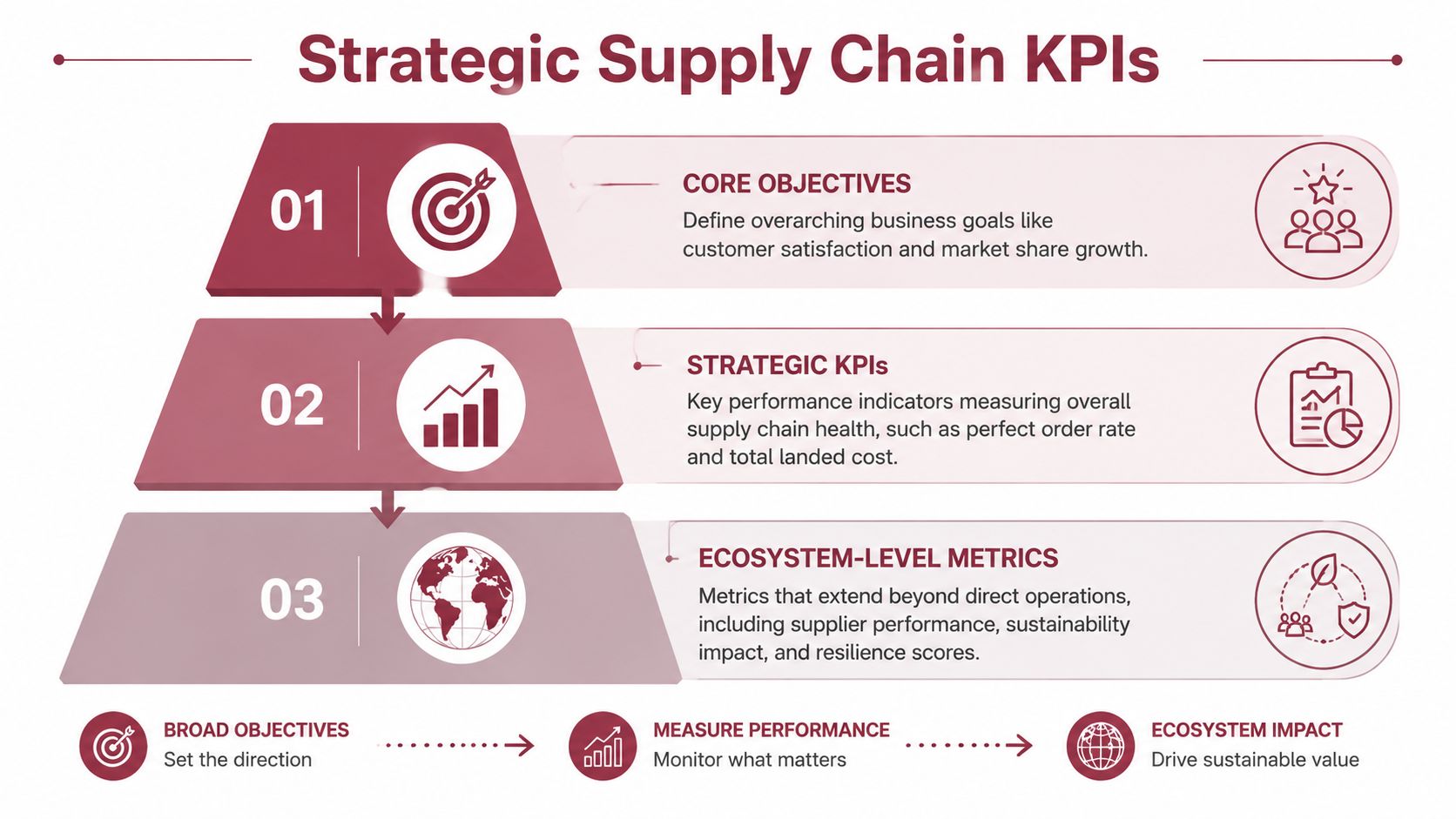
The more useful hierarchy looks like this:
| KPI layer | What it measures | Why it matters commercially |
|---|---|---|
| Core objectives | service stability, margin protection, market readiness | Keeps operations tied to growth strategy |
| Strategic KPIs | landed cost, perfect order discipline, inventory health | Shows whether the model is economically viable |
| Ecosystem metrics | fulfilment confidence, compliance pass-rate, channel cohesion | Reveals whether expansion is strengthening or weakening the brand |
A recent marketplace review revealed that the healthiest international operators often track a broader set of signals than their domestic peers. They want to know not only whether orders moved, but whether the system produced a consistent customer promise across channels.
Three KPIs founders should add
These aren't standard ERP labels, but they are useful operating concepts.
Fulfilment confidence means the business can make a stock promise and trust the underlying network to support it. This is more valuable than a general service-level figure because it reflects whether channel listings, replenishment plans, and warehouse availability are aligned.
Ecosystem cohesion measures whether pricing, assortment, branding, and stock availability remain coherent across marketplaces, distributors, and direct channels. Fragmentation here often shows up as customer confusion before it shows up in a logistics report.
Compliance pass-rate tracks whether shipments and products clear the relevant import and specification checkpoints without avoidable disruption. In cross-border hardware categories, this becomes a commercial KPI, not just a legal one.
Strong operators don't separate logistics performance from brand performance. They treat them as the same conversation.
Benchmarking these metrics against category peers is often more revealing than reviewing transport spend in isolation. A structured performance benchmarking approach can expose whether the problem is execution, network design, or a deeper mismatch between channel ambition and operational reality.
Once those KPIs are visible, better decisions follow. Teams stop optimising isolated activities and start managing the health of the whole marketplace ecosystem.
Key Decision Frameworks for a Scalable Supply Chain
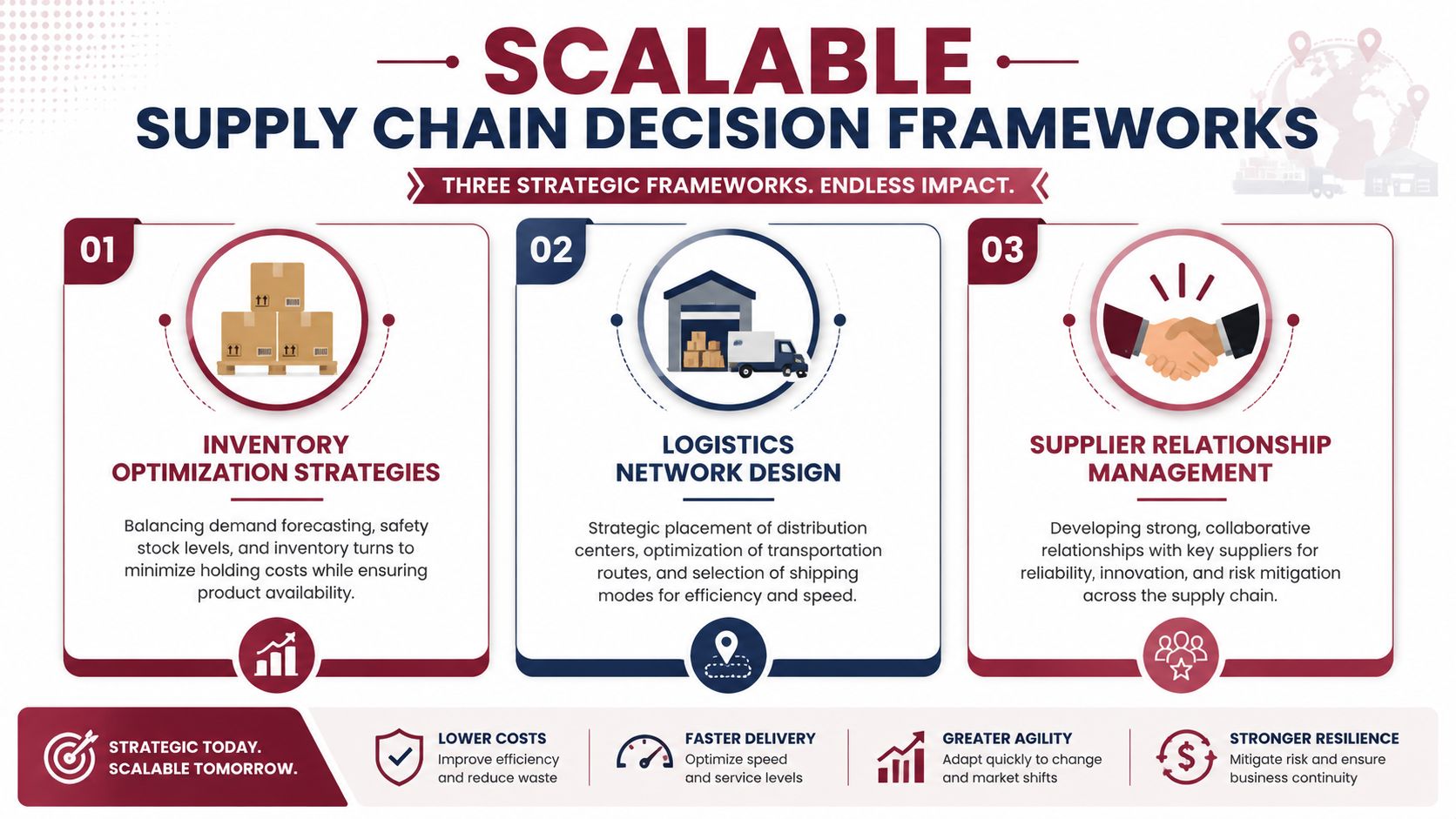
Scale introduces choice. Not just more volume, but more structural decisions that can't be solved with ad hoc fixes. Founders usually feel this when a previously manageable operation starts producing contradictory signals. One channel wants deeper stock. Another rewards local availability. A freight partner offers a lower rate, but weaker visibility. A 3PL can store product cheaply, but can't handle marketplace-specific routing or returns logic.
That's where frameworks matter. Not because they make decisions easy, but because they force the right trade-offs into the open.
Inventory placement is a network decision
One of the clearer examples comes from multi-echelon inventory optimization. In Australia, this approach has demonstrated a 15–20% reduction in working capital while maintaining a 98% order fulfillment rate, according to a 2024 study by the Supply Chain Council of Australia. The same source notes that, for hardware brands, this can translate into meaningful annual savings per $10 million in inventory. That evidence is referenced qualitatively here because the assigned source URL appears earlier in the article.
What matters operationally is the implication. Inventory shouldn't be treated as a static buffer. It should be positioned by node, by market, and by service objective.
A useful decision lens looks like this:
- Use centralised inventory when demand is still concentrated, assortments are broad, and expansion is exploratory.
- Use regional buffers when channel commitments harden and lead-time risk begins affecting service promise.
- Use multi-echelon logic when the business is supporting multiple countries, multiple service levels, and a growing SKU base that can't be managed through spreadsheet judgement alone.
The question isn't whether stock should be “lean”. The question is whether each unit is sitting in the right place for the commercial role it serves.
Partner choice should reflect ecosystem fit
Many brands still select 3PLs and freight providers on price sheets that ignore operational complexity. That's a mistake once the business spans marketplaces, distributors, and direct channels.
Use a simple comparison table when assessing operators:
| Decision area | Weak selection logic | Strong selection logic |
|---|---|---|
| 3PL | lowest storage and pick fee | ability to support routing rules, returns, channel integration |
| Freight forwarder | cheapest headline rate | customs reliability, documentation discipline, exception management |
| Supplier | lowest unit cost | consistency, compliance readiness, communication quality |
One pattern we continue seeing is that a low-cost partner often creates expensive downstream work. Internal teams end up reconciling bad data, chasing missing documents, and manually correcting stock discrepancies that should never have existed.
The cheapest operational partner is often the one that asks your team to do the most hidden labour.
Network design should match channel ambition
If a brand intends to build durable marketplace presence in several regions, the supply chain has to be designed around more than shipment movement. It needs to support customer expectations, returns handling, and channel-specific replenishment rhythms.
That's why network planning should sit close to growth planning. A sound global logistics strategy for international expansion usually starts by asking where service expectations are essential, where margin can absorb localisation, and where a decentralised node creates more control than a central warehouse ever could.
Scalable supply chain optimization is less about choosing one perfect model and more about choosing the right structure for the next stage of complexity.
An International Playbook for US Canada UK and Australia
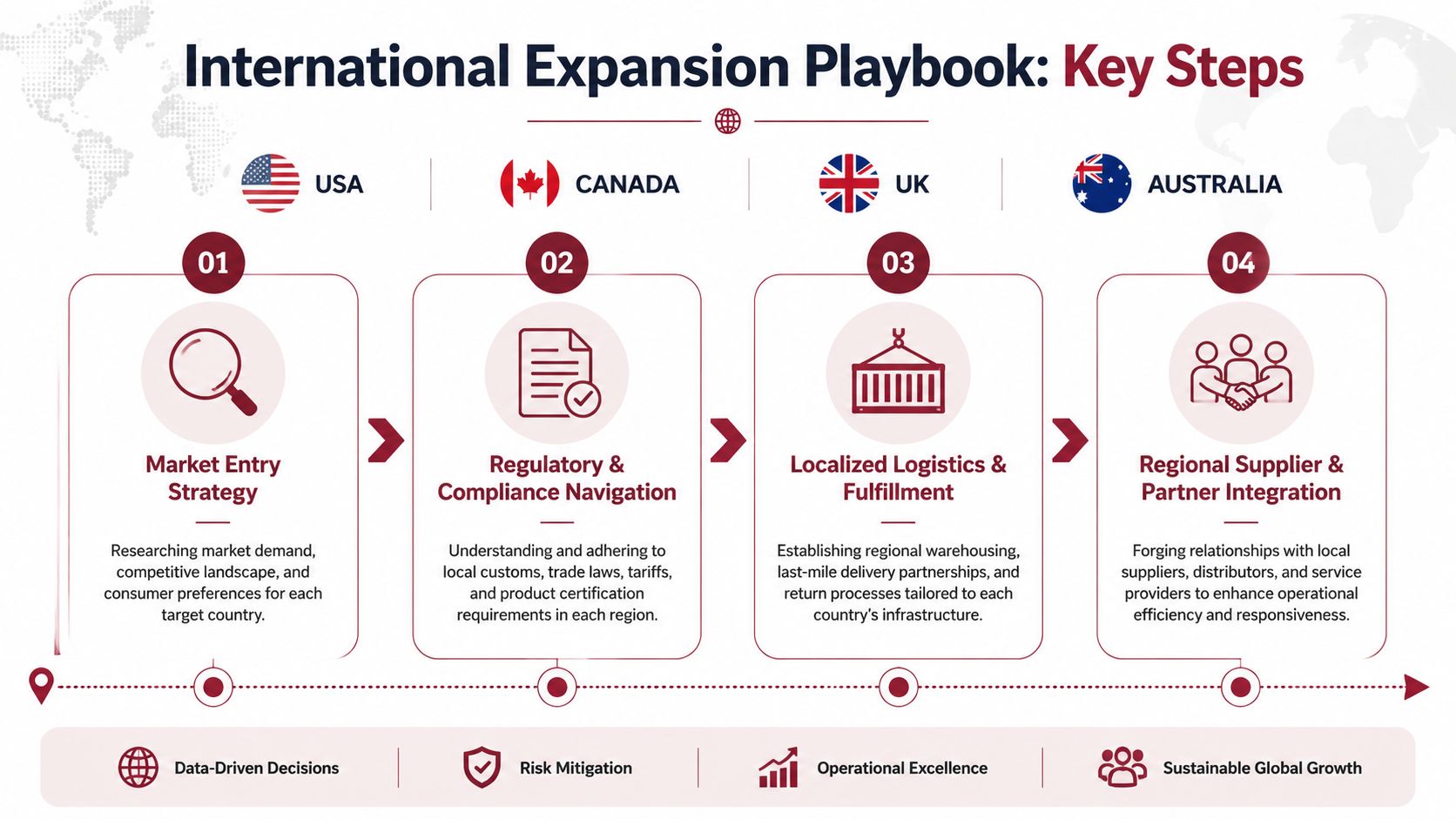
International expansion fails subtly before it fails visibly. Listings go live. Stock ships. Early demand arrives. Then the underlying friction starts surfacing through customs holds, channel penalties, delayed replenishment, rejected product specs, and customer-service noise that doesn't look like a supply chain issue until margin starts thinning.
For Australian hardware brands, one of the least appreciated constraints is compliance restructuring. Cross-border optimisation is often framed as routing and freight. In reality, 68% of export delays for Australian hardware brands entering the US or UK are caused by non-compliant product specifications rather than logistics failures, which is why product validation against ASTM or ANSI standards in the US and BS standards in the UK needs to sit inside the operating model itself. That point is outlined in SAP's discussion of supply chain optimisation and compliance complexity.
What changes by market
The four English-speaking markets most Australian brands look at first do not reward the same operating behaviour.
United States
The US offers scale, but it punishes loose localisation. Marketplace velocity can make a launch look healthy before the compliance or replenishment design is proven. Hardware brands need to validate product specifications early, not after channel onboarding. Distribution also needs more regional thinking because customer expectations and freight economics can diverge sharply across the country.Canada
Canada is often underestimated because founders assume it behaves like a smaller version of the US. It doesn't. Geography creates its own service and stock placement pressures. A single national plan can become too blunt, especially for brands relying on marketplace momentum and repeat replenishment.United Kingdom
The UK rewards disciplined localisation. It also requires tighter thinking around customs treatment, documentation quality, and product-market fit. For hardware and home improvement brands, the mistake isn't usually lack of demand. It's underestimating how quickly friction builds when imported products aren't aligned to local expectations and standards.Australia
Australia remains a useful control market because teams understand the customer and the freight logic. But domestic success can create false confidence. The systems that work in Australia often need redesign rather than replication when moved offshore.
A practical sequence for market entry
The brands that manage this well usually follow a more disciplined order of operations:
Validate the product before the route
Don't optimise freight for an item that isn't specification-ready for the destination market.Build regional operating assumptions
Treat each market as its own ecosystem with its own fulfilment expectations, returns behaviour, and demand signals.Decide where control must remain central
Brand rules, assortment logic, and commercial guardrails usually need central ownership.Decide where flexibility must become local
Forecasting inputs, stock placement, documentation flow, and channel support often need regional adaptation.
If a shipment clears the warehouse but fails the market, the supply chain didn't succeed. It just moved inventory.
That's the distinction many brands miss. International supply chain optimization is not only about moving product across borders. It's about redesigning the business so the product can arrive, clear, sell, replenish, and support the brand properly in a different commercial environment.
Leveraging Technology and Data for Global Control
Technology is useful when it improves judgement. It becomes expensive theatre when teams use it to automate confusion.
One issue we repeatedly observe is brands buying forecasting platforms, visibility tools, and dashboard layers before they've cleaned up their product data, supplier data, and channel logic. The result is predictable. Advanced software produces faster answers to the wrong question.

The strongest use of technology in international supply chain optimization is not generic automation. It's controlled visibility with local signal. That means a business can see stock, lead-time risk, and channel demand clearly, while still allowing each region to influence its own forecast and response model.
Where AI helps and where it doesn't
Used properly, AI-driven predictive modelling can tighten decision quality. It has been shown to reduce forecast errors by 30% and improve delivery responsiveness by 25%. A major Australian home improvement retailer implemented that kind of system and achieved a 99.5% on-time delivery rate while reducing inventory holding costs by 18%, according to this review of technology-led supply chain optimisation outcomes.
That doesn't mean every AI deployment works. It means the tool has to sit inside a disciplined operating model.
A sensible technology stack usually needs to answer these questions:
- Inventory truth: Where is stock located, and can each channel trust that figure?
- Lead-time visibility: Where are delays forming, and who owns the response?
- Forecast integrity: Which data is global, and which data must remain regional?
- Exception handling: Which disruptions require manual judgement, and which can be automated?
If the system can't answer those clearly, the business doesn't have control. It only has reporting.
Build one truth with regional flexibility
The phrase “single source of truth” is often used badly. In practice, international operators need a single commercial truth and multiple local demand truths.
That means central teams should keep authority over product hierarchy, core master data, and shared operational definitions. Regional teams should influence demand assumptions, seasonality interpretation, channel pacing, and replenishment priorities.
This walkthrough is useful context for that shift:
Good technology doesn't remove operational judgement. It tells the right people where judgement is needed first.
That's the value. Not more dashboards. Better decisions, made earlier, with less ambiguity. For brands operating across Australia, the US, Canada, and the UK, that's what turns data from a reporting layer into a control layer.
Managing Risk and Driving Continuous Improvement
A supply chain can become more efficient and less resilient at the same time. That's the optimisation paradox. Teams remove slack, centralise decision-making, and standardise planning until the model looks clean. Then regional volatility hits and the same system starts producing waste, delays, or channel friction because it was built for uniformity instead of adaptation.
That risk is visible in international forecasting. 42% of Australian brands using centralised AI forecasting for US expansion overstocked their channels by 25% due to failed localisation of trend data, according to the earlier-cited Easyship source. The lesson isn't that AI is the problem. The lesson is that centralisation without regional signal creates false confidence.
The system should learn, not just perform
Founders usually ask whether the supply chain is stable. A better question is whether it can adjust without commercial damage.
The most reliable international operators build review loops into normal operations. They don't wait for a major failure. They monitor where assumptions are drifting and where market behaviour has changed enough to justify intervention.
A practical improvement rhythm includes:
Regional demand review
Compare local sell-through patterns against central forecasts and challenge obvious mismatches early.Compliance review
Recheck whether product, packaging, and documentation still align with the market being served.Partner review
Assess whether 3PLs, forwarders, and suppliers are helping the business absorb complexity or creating it.Channel review
Look at where fulfilment promises, stock logic, and pricing behaviour are drifting apart.
Risk management has to be operational
Many businesses treat risk management as a separate function. In practice, it has to sit inside planning, replenishment, and channel governance. Otherwise the risk register becomes a document no one uses while the operating model keeps producing preventable errors.
A credible supply chain risk management approach doesn't just identify exposure. It assigns response rules, ownership, and escalation paths. That's what turns awareness into resilience.
A recent marketplace review revealed a pattern that matters here. The brands that recover fastest from disruption are rarely the ones with the most software. They're the ones with clearer decision rights, cleaner regional data, and fewer blind spots between product compliance, inventory planning, and channel execution.
Supply chain optimization is never finished. It matures as the ecosystem becomes more complex. The teams that treat it as an ongoing commercial discipline tend to protect margin better, preserve customer trust more consistently, and expand with far less hidden fragility.
If your brand is preparing for international marketplace growth and you need a more commercially coherent operating model, TPR Brands helps established product companies structure expansion across Australia, the US, Canada, and the UK without letting fulfilment, compliance, and channel fragmentation erode brand value.