Most businesses searching for website design in Tweed Heads think they're buying a site.
That's usually the first mistake.
A founder isn't really buying pages, a theme, or a launch date. They're buying a commercial asset that has to earn trust fast, support sales activity, reduce friction for buyers, and stay usable when the business moves beyond a local service radius. If the site only works as a digital brochure, it will need to be rebuilt the moment the company adds ecommerce, retail support, distributor enquiries, or marketplace expansion.
That matters more in Tweed Heads than many operators realise. It's a border economy, not a closed local market. A site often needs to speak credibly to nearby local customers, Gold Coast buyers, regional NSW demand, and sometimes a broader national audience at the same time. One pattern we continue seeing is that businesses underinvest in this first build, then discover later that their site can't support the next commercial step.
Beyond the Brochure Your Website's Real Commercial Purpose
The old model of a small business website was simple. Put the logo at the top, add a services page, a contact form, and call it done.
That model no longer holds up. In Australia, 94% of first impressions are influenced by website design quality, 75% of users judge credibility based on appearance, and users commonly decide within 0.05 seconds whether a site feels trustworthy, according to Australian web design statistics.
Those numbers change the conversation. A website design decision isn't cosmetic. It's a trust decision.
Your website is often the first sales contact
For many Tweed Heads businesses, the site is now doing work that used to happen in person or over the phone. It's handling the first brand interaction, the first credibility check, and the first test of whether a buyer feels safe making contact.
That applies whether you run a trade service, a professional firm, a local retailer, or a product brand. Before anyone asks for a quote, checks stock, sends a wholesale enquiry, or compares your offer with a competitor, they're reading design signals. Layout. load speed. Message clarity. Mobile usability. Brand consistency.
A polished visual system matters here, which is why strong graphic design for web work should sit inside the build, not get treated as decoration added later.
Practical rule: if your website can't establish trust before the visitor reads deeply, the copy and offer may never get a fair chance.
A local site still needs expansion logic
One issue we repeatedly observe is businesses commissioning a “local website” with no thought for what happens next. The result looks acceptable on launch day but becomes restrictive once the business adds new service areas, ecommerce capability, stockist support, or trade partnerships.
That's where website design in Tweed Heads becomes a more strategic decision than it appears. The immediate job may be local lead generation. The longer-term job may be supporting product launches, retail sell-through, online catalogue growth, or national demand capture.
A founder should ask a harder question before reviewing any agency portfolio: is this build meant to advertise the business, or is it meant to become infrastructure?
If the answer is infrastructure, priorities change quickly:
- Structure matters more than style alone. Navigation, page hierarchy, and content architecture need room to grow.
- Trust signals need to be designed deliberately. Buyers want clarity on who you are, what you sell, where you operate, and how to take the next step.
- The platform choice has consequences. A lightweight brochure setup can create friction when the business later needs ecommerce, integrations, or multi-region content.
The strongest websites don't just look current. They make the business easier to buy from, easier to understand, and easier to expand.
The Discovery Phase Defining Your Website's Job
A website project usually goes wrong before design starts.
It goes wrong in discovery, when the owner says they need a new website but hasn't yet defined what the site must do for the business. Without that decision, every later conversation becomes fuzzy. The homepage gets overstuffed, the navigation becomes political, and the final build tries to satisfy everyone without serving any clear commercial role.

A useful framing comes from this Tweed Heads web design analysis, which asks whether a website is even the highest-value channel right now. It notes that 97% of Australian employing businesses have a web presence, so the issue isn't whether to have one. It's whether that website actively supports channel expansion.
That's the right starting point.
The site needs one primary job
A website can support many functions, but it shouldn't have many masters. One primary commercial job should shape the build.
For example, your primary job might be:
- Lead generation for a service business. The site's job is to qualify buyers and drive enquiries.
- Direct ecommerce. The site needs product architecture, merchandising logic, and transaction confidence.
- Brand hub support. The site helps customers, retailers, or distributors understand the catalogue and brand positioning.
- Market entry platform. The site becomes the base layer for expansion into new channels, regions, or customer segments.
If you haven't defined that job, you're not ready to brief a designer. You're still in business planning.
Questions worth answering before anyone opens Figma
A founder doesn't need a technical vocabulary at this stage. They need commercial clarity.
Ask these questions first:
- Where does revenue need to come from first? Local services, online orders, trade accounts, stockists, or inbound distributor interest.
- Who is the most important buyer on day one? A homeowner, procurement contact, retail customer, installer, operations manager, or reseller.
- What action matters most? Call, form submission, quote request, checkout, sample request, or account enquiry.
- What future move should this site make easier? Ecommerce rollout, interstate expansion, marketplace support, or international readiness.
- What channel may deserve budget before the website does? For some operators, a stronger online selling setup, marketplace presence, or local search profile may bring more immediate value.
A website with no defined commercial job usually becomes a compromise document. It explains the business without moving the business forward.
What this changes in practice
Once the job is clear, better decisions follow.
A local trade business may need fewer pages but stronger enquiry pathways. A manufacturer may need fewer design flourishes and better technical product presentation. A product brand preparing for expansion may need a site architecture that can later support region-specific pages, retailer support content, and wholesale pathways without a rebuild.
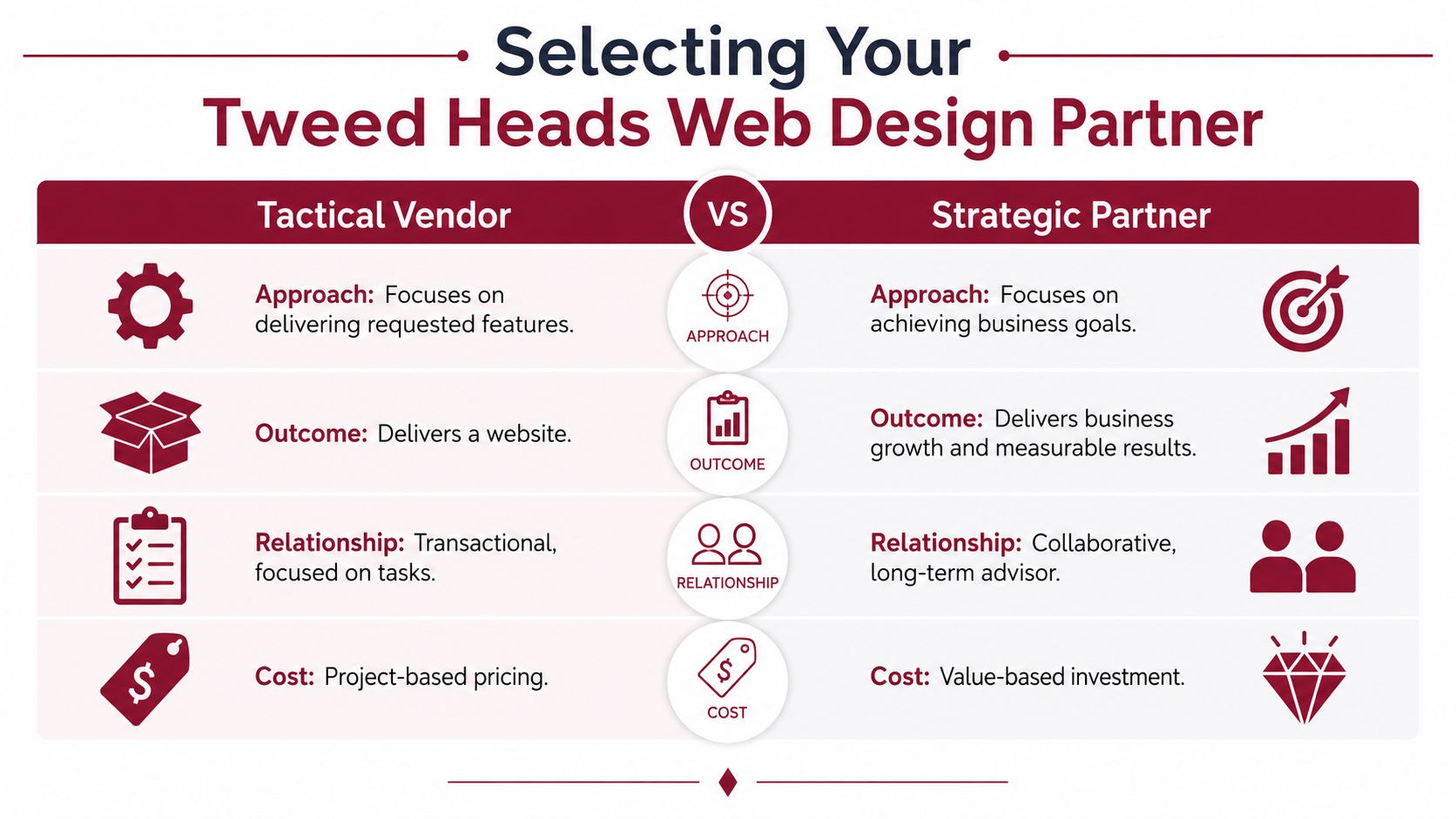
Experienced operators think differently from tactical vendors. They don't first inquire about your preferred font or slider style. Instead, they focus on what the website needs to achieve commercially during the next stage of growth.
How to Write a Brief That Attracts a Strategic Partner
A weak brief attracts order-takers.
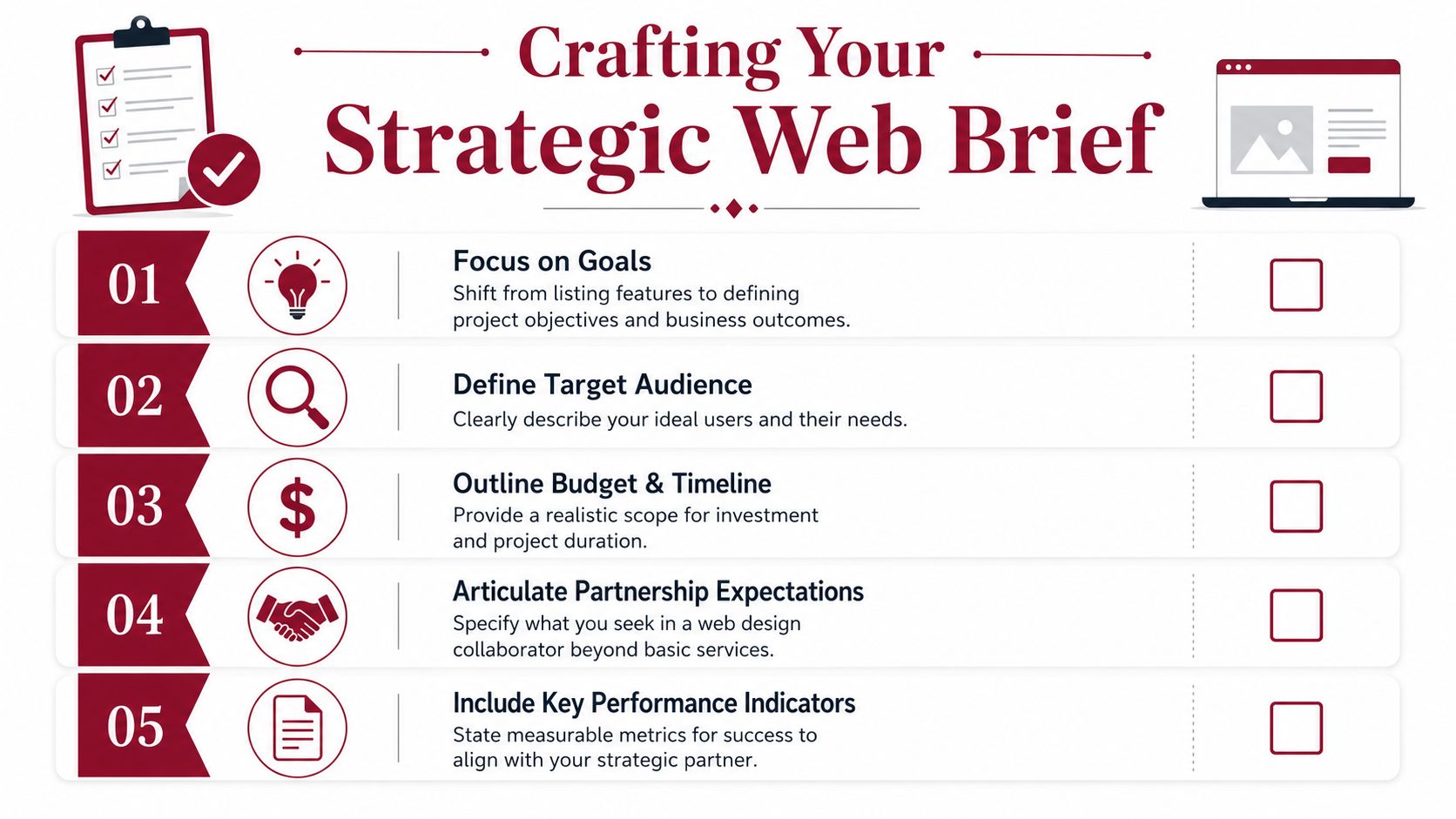
A strong brief attracts people who can think commercially, challenge poor assumptions, and build a site around outcomes rather than surface features. If your brief says “we want a modern website with a video banner and some animations,” you'll likely get proposals focused on production. If it says “we need a site that improves buyer trust, supports future ecommerce, and gives our sales team a cleaner lead pipeline,” the conversation changes.
Write for outcomes, not website parts
Most briefs spend too much time on outputs. Number of pages. Photo galleries. Pop-ups. Search bars. Blog layouts.
Those details matter later, but they shouldn't lead. Start with business context and commercial direction. That gives a good partner enough information to suggest the right structure, platform, and workflow.
A solid brief should cover:
- Business background. What the company sells, who it serves, and where growth is coming from.
- Commercial objective. What the site needs to improve or enable.
- Audience priority. Which buyer matters most at launch.
- Operational constraints. Systems, product data, compliance concerns, approvals, or internal bottlenecks.
- Future-state requirements. Ecommerce, stockist support, new regions, catalogue depth, or integration needs.
Ten questions your brief should answer
Checklist
- What problem is the new website solving?
- What's wrong with the current site or current channel mix?
- Who are the primary and secondary audiences?
- What action should the visitor take first?
- Which products, services, or categories matter most commercially?
- Does the site need to support future ecommerce or marketplace traffic?
- What internal systems or workflows must it connect with?
- What content already exists, and what needs to be created?
- What budget range is realistic for this build?
- What does a successful handover look like for your team?
Budget language matters
Many founders avoid budget in the brief because they don't want to anchor the discussion. In practice, hiding budget usually wastes time. It encourages mismatched proposals and vague scoping.
A range is enough. It tells a serious partner whether they should design for a lean foundational build, a more custom marketing site, or a platform with broader commercial requirements. If you need context for market expectations, web design pricing considerations in Brisbane offer a useful benchmark for how scope affects investment.
Include partnership expectations
This is often missed.
If you want a partner who can challenge assumptions, think about customer flow, prepare the site for future selling channels, and structure content for scale, say that clearly. If all you want is technical implementation, say that too.
One pattern we continue seeing across growth-stage brands is that vague briefs create vague accountability. Nobody owns the commercial result because nobody defined it up front.
Choosing Your Tweed Heads Web Design Partner
Who are you really hiring here. A designer to produce pages, or a partner to help build a website that can support the next stage of the business?
That distinction matters more than founders often expect. A good-looking site can still be the wrong commercial asset if it is hard to update, built around weak page structure, or boxed into a platform that creates friction once you add ecommerce, interstate campaigns, wholesale enquiries, or marketplace feeds.
Different partner models create different trade-offs
The right choice depends on business stage, internal capability, and how much future complexity you expect.
| Partner type | Usually works well for | Main upside | Common risk |
|---|---|---|---|
| Freelancer | Smaller builds, straightforward service sites, founder-led businesses | Direct communication and flexibility | Capacity limits, narrower specialist coverage |
| Boutique local agency | Businesses needing strategy plus local context | Better process and stronger regional understanding | Quality varies sharply from team to team |
| National firm | Broader digital programs, multi-stakeholder organisations | More depth across design, development, and marketing | Heavier process, less local commercial context |
A Tweed Heads or Gold Coast team may read local service demand, cross-border customer behaviour, and regional positioning faster. A larger firm may be the better call if the site needs to plug into a wider growth plan across multiple regions, product lines, or sales channels.
Neither model wins by default. The better question is whether the partner fits the job the site needs to do over the next three to five years.
What to test in the selection conversation
Portfolio review has limited value on its own. Founders get better signals from how an agency explains decisions, identifies constraints, and handles trade-offs.
Ask questions that force clear reasoning:
- Commercial priorities. How do they decide what the site should optimise for if brand, lead generation, recruitment, and sales all compete for space?
- Platform choice. Why are they recommending WordPress, Shopify, or a custom build for your operating model, not just for their own delivery convenience?
- Content ownership. Who is responsible for messaging, page structure, product or service copy, approvals, and upload?
- Future expansion. What would they build now to reduce the chance of a costly rebuild if you later add ecommerce, national SEO landing pages, distributor access, or marketplace integration?
- Post-launch support. What do you get after launch. Training, maintenance, documentation, bug fixing, analytics setup, or a handover and goodbye?
Useful partners usually put pressure on the brief. They ask where margin sits, what type of enquiry is worth the most, which pages carry revenue risk, and what the business may need six or twelve months after launch. That is a good sign.
Look for process maturity and QA discipline
Strong teams can explain their process without hiding behind jargon. They can show how discovery informs structure, how content is reviewed, how design decisions connect to conversion goals, and how testing happens before launch.
I would also look closely at quality control. Ask how they handle browser testing, mobile testing, redirects, form validation, CMS permissions, and launch checks. If their answer is vague, problems usually surface late, when fixes are slower and more expensive. A documented website quality assurance standards process is a better sign than polished mockups alone.
TPR Brands is one example of a firm that treats website design as part of broader brand and channel planning. That suits businesses that see a local Tweed Heads build as the base layer for future expansion into ecommerce, new regions, or international demand. Other providers may be a better fit for a simpler brochure site with limited operational complexity.
Choose for commercial alignment, operating fit, and execution discipline. Design taste matters, but it should not be the deciding factor.
Essential Technical Foundations for Future Growth
A site can look sharp and still underperform.
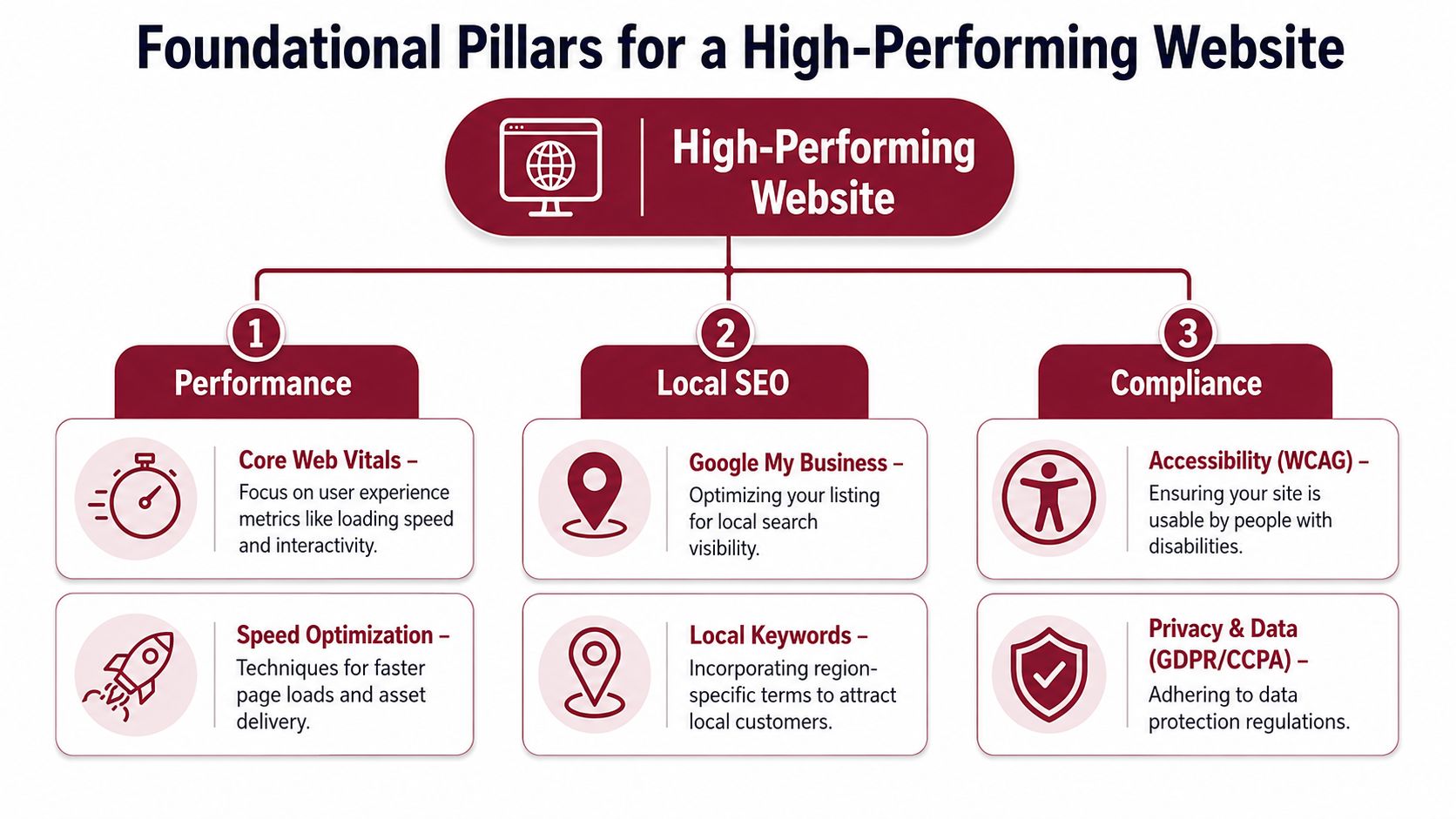
That usually happens when technical foundations are treated as developer detail rather than commercial infrastructure. For a business in Tweed Heads, the important technical layer isn't abstract. It directly affects whether local and cross-border buyers can find you, use the site smoothly, and trust it enough to act.
Performance is a conversion issue
For Tweed Heads businesses, regional web design guidance highlights two points that deserve attention from the start. First, cross-border visibility for NSW and QLD search intent is a genuine challenge. Second, Core Web Vitals, LCP, INP, and CLS, should be treated as hard requirements, with performance validated on Australian mobile networks.
That's practical, not academic.
If your pages are heavy, your scripts are bloated, or your forms and checkout elements lag on variable mobile connections, buyers feel the friction immediately. Many won't wait around to diagnose why the experience feels poor. They'll leave.
Local SEO in Tweed Heads isn't purely local
The border dynamic changes how page structure should be planned.
A site targeting only one town label can become too narrow. A site trying to rank everywhere with generic copy becomes vague. Better practice is to define service areas clearly, use region-specific landing pages where commercially justified, and make sure the business location, service footprint, and contact details are consistent across the site and business profiles.
That's where technical planning and commercial planning meet. If your future customer base includes both Northern NSW and Gold Coast demand, the website should reflect that deliberately rather than hoping search engines infer it.
Compliance and QA protect future optionality
Accessibility, privacy, and quality assurance are often treated as cleanup tasks. That's risky.
Founders should expect structured testing across devices, forms, key journeys, and content templates before launch. They should also expect a site build that can be maintained cleanly after handover. A disciplined quality assurance standards process reduces the chance of expensive fixes once traffic, campaigns, or ecommerce activity start increasing.
A technically weak website creates hidden drag. Sales teams feel it in lead quality, customers feel it in friction, and management feels it later when every upgrade costs more than expected.
Budgeting Timelines and Your Handover Checklist
Most founders ask the same three questions near the end of the process. What should this cost, how long will it take, and what do we need to own once it's live?
Those are the right questions. They push the project out of design language and into operating reality.
What website design in Tweed Heads usually costs
The cleanest benchmark available from the Australian market is this: current industry statistics for web design in Australia place basic website design costs in the $6,500 to $15,000 range, while a small-business survey reported an average quoted price of about $3,200. The same source notes that 80.7% of firms deliver core-feature projects within 1 month.
Those figures are useful, but they need interpretation.
A lower quote can still be appropriate if the scope is lean. A higher quote can be justified if the business needs stronger content planning, custom functionality, product architecture, or more involved stakeholder management. Price alone doesn't tell you whether the project is sensibly scoped.
Why timelines slip
A website build rarely slows down because of code alone. It slows down because decisions stall.
Common causes include delayed content approvals, missing product information, unclear ownership of feedback, and late changes to scope. If the founder wants speed, they need internal discipline. Nominate one decision-maker. Set review deadlines. Lock the sitemap before design starts.
A good partner should help manage this, but they can't manufacture clarity inside your business.
Handover checklist for full control
At launch, the business should receive more than a live URL.
Make sure you get:
- Admin ownership. Full access to the CMS, hosting, domain-related accounts, analytics tools, and connected platforms.
- Design assets. Logos, image files, brand elements, style references, and any reusable components created during the project.
- Technical documentation. Theme or build notes, plugin lists, integrations, form locations, and any custom functionality summary.
- Content access. Source files for copy, product data, downloads, PDFs, and media libraries.
- Training. A practical walkthrough showing your team how to update key pages, publish content, and manage common tasks.
- Support clarity. What's covered after launch, what's billable, and how future updates are handled.
If a website can't be handed over cleanly, it isn't fully your asset yet.
That handover matters even more if the website is meant to support future ecommerce, retail partner communication, or marketplace-led growth. The more commercially important the site becomes, the more damaging provider lock-in becomes.
A well-built website should leave you with options, not dependencies.
If your business is treating website design in Tweed Heads as the first layer of a broader growth system, not just a local brochure project, TPR Brands can help assess the commercial role the site needs to play, how it should support future channels, and what structure will hold up as the brand expands into new markets.