You are likely already in one of two camps.
Either Amazon feels unavoidable, and you are trying to decide how to use it without handing over margin, customer experience, and pricing control. Or you have resisted it on purpose, because you do not want a strong product pulled into a marketplace environment that can flatten brand value.
Both instincts are rational. Amazon can behave like a volume engine and a brand tax at the same time.
That is why serious leadership teams should stop treating amazon prime as a channel debate and start treating it as an infrastructure decision. The question is not whether Prime can produce orders. The question is whether it can give your business faster market access, lower expansion friction, and better operating efficiency than the alternatives, without weakening the brand you have spent years building.
For founders, CEOs, and commercial leaders, that is a board-level question. It touches market entry, logistics, cash flow, customer expectations, compliance, and the long-term shape of your revenue mix.
Beyond the Brown Box Reframing Amazon Prime as a Strategic Asset
Most established brands do not dismiss Amazon because they misunderstand ecommerce. They dismiss it because they understand trade-offs.
They know marketplaces can compress differentiation. They know price transparency can attract resellers and erode channel relationships. They know operational mistakes become visible fast. A poor listing, late fulfilment, or unmanaged returns process not only hurts sales but also changes how buyers perceive the brand.

Prime is infrastructure first, sales channel second
The brown box is the visible part. The strategic value sits underneath it.
amazon prime gives a brand access to a buying environment where convenience is already trusted, payment friction is low, and delivery expectations are clearly defined. For a leadership team, that matters because it reduces the number of systems you must build alone before you can test demand in a new segment or region.
That changes the nature of expansion.
A direct-to-consumer site asks your brand to earn discovery, conversion, and trust at the same time. Prime allows you to separate those jobs. Your brand still has to win the customer, but the transaction environment already has familiarity and operational confidence built in.
The strategic reframing most brands miss
Founders often ask, “Will Amazon damage our brand?” The better question is, “Can we use Amazon Prime in a way that strengthens the wider business?”
That is a different conversation. It forces the executive team to look at Prime as:
- A market-entry tool for testing demand before committing heavily to local infrastructure
- A logistics layer that can absorb complexity your team should not own too early
- A customer acquisition surface for high-intent buyers who are ready to purchase, not merely browse
- A competitive pressure point where slower rivals lose share because they hesitate too long
Brands rarely fail on Amazon because the platform is bad for them. They fail because they enter without deciding what role the platform should play in the company.
What works and what does not
What works is using Prime with a defined mandate. That might be geographic expansion, selective category growth, defense against marketplace leakage, or controlled entry into a customer segment that already shops on Amazon.
What does not work is treating Prime as a spare sales outlet. When leaders do that, the marketplace inherits problems the business has not solved elsewhere. Weak packaging, confused positioning, inconsistent pricing, and poor stock discipline show up faster and at scale.
The practical implication is. Prime is not a beginner’s hack for quick revenue. It is a strategic asset for brands that want to scale with more precision than a broad retail rollout usually allows.
The Commercial Case for Amazon Expansion
The commercial logic for Amazon is stronger when leaders stop measuring it as “incremental online sales” and start measuring it as market access plus channel resilience.
In Australia, Amazon Prime launched on 14 April 2018, and by 2023 membership had grown to an estimated 2.1 million members. Prime Day sales in Australia moved from AU$30 million in 2018 to AU$500 million by 2023, and Prime members spent on average AU$1,500 annually by 2024. Online retail penetration in Australia reached about 12% of total retail sales by 2019. Those figures are all summarized in this Amazon Prime user data compilation. For a CEO, that is not trivia. It is evidence that Prime concentrates a high-value buying audience and can shift purchasing behavior at meaningful scale.
Access to buyers with intent
Traffic quality matters more than traffic volume.
A marketplace shopper is not asking to be inspired in the same way a social audience is. They are usually closer to comparison, shortlist, or purchase. That changes the economics of customer acquisition because the brand is entering a demand environment where the buying mission already exists.
For many mature products, that is commercially attractive for three reasons:
- Faster signal on demand: Product-market fit becomes easier to assess when buyers are already shopping the category.
- Cleaner competitive benchmarking: You see price, reviews, positioning, and fulfilment expectations in one operating environment.
- Shorter route to conversion: The customer does not need to trust your standalone site first.
Prime can diversify risk, not just add revenue
Too many brands build growth around one route to market until that route becomes fragile.
A wholesale-heavy business can lose control when retailers compress assortment or delay commitments. A DTC-heavy business can become overexposed to rising acquisition costs, platform dependency, or weak repeat economics. Prime does not eliminate those risks, but it can reduce concentration.
That matters in a year when consumer behavior is not stable.
According to the verified market brief, Australia saw 2025 Prime price rises, with membership increasing 12% to AUD$9.99 per month, while churn reached 28% for low-income households. At the same time, Jungle Scout AU data showed search volume of over 50k monthly for “Prime hardware delivery AU”, alongside sparse optimized listings. That combination points to tension and opportunity. Price sensitivity is real, but demand for well-presented, fulfilment-ready products remains visible. The fact set appears in Amazon’s Prime Access membership coverage.
That is the kind of nuance executives need. Prime is not a frictionless gold rush. It is a commercial system where weak offers get exposed and strong offers can capture under-served demand.
Margin discipline matters more than top-line excitement
The danger in Amazon expansion is not that sales fail to appear. The danger is that sales appear before the model is financially sound.
A board-level assessment should include questions like these:
-
Can the business maintain healthy margin after fulfilment, advertising, returns, storage, and promotional costs?
-
Will Amazon Prime pricing create conflict with retail or distributor channels?
-
Does the current inventory model support fast fulfilment without excessive stock exposure?
-
Can operational systems maintain customer experience standards during growth periods?
-
Is the business using Amazon strategically or simply chasing additional sales volume?
One practical starting point is to model marketplace economics before launch, not after. A useful reference point for that exercise is this breakdown of Amazon fees.
Strong brands treat Amazon like a profit architecture problem, not a listing exercise.
Commercial upside belongs to prepared operators
The most overlooked benefit of Prime is speed of learning.
A leadership team can learn very quickly whether a category has room, whether the offer is priced correctly, whether fulfilment expectations are realistic, and whether the brand has enough distinction to defend its economics. Those lessons are valuable even when the wider strategy includes retail, distributors, or a major DTC push.
What does not work is entering Amazon to “see what happens”. Commercially, that usually means the brand is using the platform to answer questions it should have already framed properly.
Deconstructing Operational Models for Marketplace Fulfilment
Fulfilment is where strategy stops being theoretical.
Leadership teams often talk about Amazon as a demand engine, but the customer experiences the business through delivery speed, stock reliability, packaging condition, and returns handling. That means your fulfilment model is not a back-office choice. It is part of the brand promise.
FBA buys speed and simplicity, but gives up control
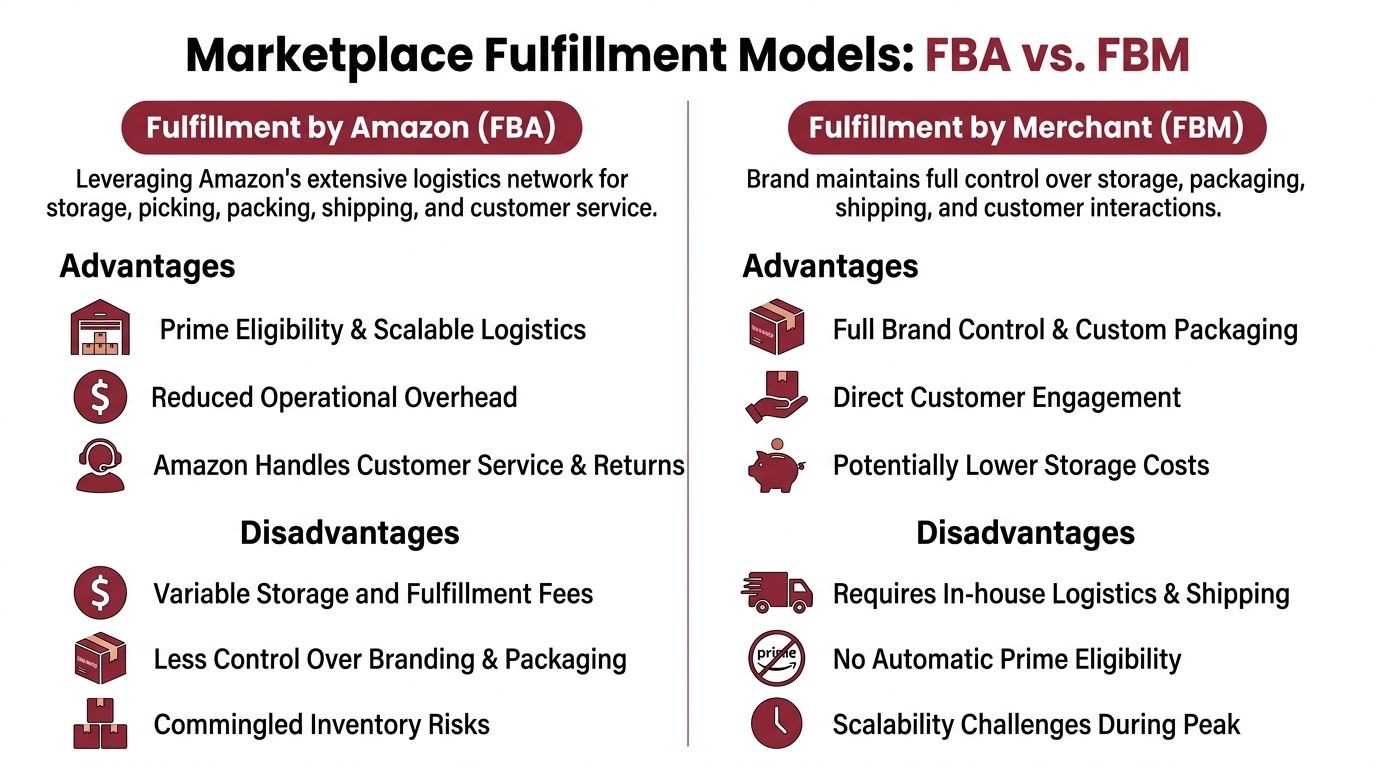
Fulfilment by Amazon (FBA) works best when the business wants Prime eligibility, operational scale, and fewer internal moving parts.
Amazon handles storage, pick-pack, shipping, customer service, and much of the returns process. For lean teams or brands entering a new market, that can remove a large amount of execution risk. It can also help standardise the customer experience when your own local infrastructure is still immature.
The trade-off is control.
FBA is less forgiving if your brand depends on presentation details, custom inserts, tightly controlled bundling logic, or unusual handling requirements. It can also become uncomfortable for brands with awkward carton dimensions, slow-moving SKUs, or products whose economics tighten quickly under storage and fulfilment charges.
FBM preserves control, but demands operational maturity
Fulfilment by Merchant (FBM) is often the right model for brands that already operate strong warehousing, packaging, and shipping processes.
If your business values branded presentation, direct control over dispatch standards, or tighter inventory orchestration across channels, FBM can be attractive. It can also suit products that need handling rules your team does not want Amazon to dictate.
The downside is that you own the operational pressure.
That means your team absorbs peak spikes, service risk, carrier variability, and customer communication burden. If your operation is merely adequate, FBM exposes that quickly. On Amazon, “good enough” logistics usually becomes visible as delayed shipping, weaker conversion, or customer dissatisfaction.
Hybrid models often suit real businesses better
A pure model sounds neat in a slide deck. Real businesses usually need a mixed one.
A hybrid approach can work well when the catalogue is varied. Fast-moving core SKUs may sit in FBA to secure Prime visibility and reliable delivery. Oversized, fragile, premium, or channel-sensitive items may remain under merchant control.
That split lets the business protect unit economics where needed without giving up marketplace relevance altogether.
A practical comparison looks like this:
| Model | Strengths | Risks |
|---|---|---|
| FBA | Prime eligibility, operational simplicity, scalable fulfilment | Reduced packaging control, storage fees, tighter margin pressure |
| FBM | Greater operational control, flexible packaging, stronger inventory coordination | Higher service burden, fulfilment complexity, operational pressure |
| Hybrid | Balance between Prime visibility and operational flexibility | Requires stronger inventory and logistics management |
The product should decide the model
I have seen brands choose fulfilment based on ideology. That usually ends badly.
The better approach is to let the product and the operating model decide. Ask:
- Is the item bulky or irregular? Heavy and awkward products often expose the limits of standard marketplace fulfilment.
- Does presentation carry premium value? If packaging and unboxing matter to perceived quality, control becomes commercially relevant.
- How volatile is demand? Large sales swings favor systems that can absorb peaks without service failures.
- Can the margin tolerate outsourced handling? If not, speed alone will not save the model.
For teams comparing setups in more detail, this overview of Amazon logistics is a useful operational reference.
The right fulfilment model is the one that protects service quality and contribution margin at the same time.
What does not work is selecting a model because it sounds easier. Easier for whom matters. A model that simplifies internal workload but weakens economics or customer experience is not easier. It is just slower to fail.
Protecting Your Brand in the Worlds Largest Marketplace
The most common executive objection to Amazon is not fulfilment. It is loss of control.
That fear is justified when a brand enters the marketplace passively. Unmanaged listings, inconsistent imagery, weak copy, unauthorized sellers, and erratic pricing can turn a premium product into a commodity surprisingly fast.

Brand protection is an operating function
Developed brands do not “hope” Amazon reflects the business correctly. They build systems for it.
That usually starts with Amazon Brand Registry, because ownership and control are hard to enforce without it. Brand Registry helps authorized brand owners manage listing content more effectively and creates a stronger basis for dealing with misuse, copycat listings, and catalogue distortion.
It is not a silver bullet. It is a minimum requirement for brands that care about presentation and channel governance.
Other protection layers matter as well:
- Listing discipline: Titles, images, A+ content, and variation logic should reflect the brand architecture, not just keyword stuffing.
- Authorized seller control: If channel boundaries are loose offline, Amazon will expose that weakness online.
- Pricing governance: A MAP policy only matters if the business monitors and enforces it.
- Review and returns analysis: Product issues, packaging defects, and customer confusion appear quickly in marketplace feedback.
The Buy Box is a control issue, not just a sales issue
Many operators talk about winning the Buy Box as though it is purely an advertising or pricing tactic.
It is broader than that. The Buy Box reflects whether the brand has built a stable commercial environment around the listing. If multiple sellers compete inconsistently, if stock is fragmented, or if service quality varies, the listing becomes harder to govern. That hurts conversion, but it also damages the customer’s sense of who the brand is.
For this reason, many premium brands eventually realise they need a deliberate account structure and active oversight. Passive distribution and premium positioning do not coexist comfortably on Amazon.
A useful external benchmark for brands thinking about operational oversight is this perspective on Amazon management.
Advertising can defend brand perception when used properly
Most founders think of Amazon Ads as a demand-generation tool. It is also a defensive tool.
Branded search coverage, sponsored placements, and controlled creative assets give the business more influence over how shoppers first encounter the product. That matters when your category has lookalikes, price-led alternatives, or competing claims that can blur differentiation.
Video is especially important for products that need demonstration, explanation, or proof of quality. In the AU region, Amazon Prime Video streaming TV ads require a minimum video bitrate of 15 Mbps, and Amazon Ads data shows higher bitrate correlates with a 20 to 30% uplift in viewer retention, according to Amazon’s Prime Video ad specifications. For leadership teams, that is not just a media detail. It is a reminder that technical standards shape brand presentation quality.
A short explanation is useful here:
On Amazon, brand protection is not separate from growth. The same controls that defend presentation also improve conversion quality.
What founders often get wrong
Three patterns show up repeatedly.
First, they assume a strong off-Amazon brand will automatically carry over into the marketplace. It rarely does without active structuring.
Second, they delegate Amazon to junior staff or fragmented agencies. That creates tactical activity without strategic governance.
Third, they treat advertising as a substitute for control. It is not. Ads can amplify a good operating system. They cannot repair weak listing ownership, poor reseller discipline, or unreliable fulfilment.
Navigating Global Expansion and Market-Specific Nuances
Australia is a useful example because it looks straightforward from a distance and more complex up close.
English-language market. Familiar consumer behaviour. Stable legal environment. Attractive gateway into the region. Many brands assume that means the expansion playbook can be copied from the US, Canada, or the UK with minor edits.
That assumption is expensive.

Australia rewards fit, not copy-paste execution
Amazon Prime launched in Australia in April 2018, and membership reached an estimated 2.1 million by 2023. At the same time, there is a specific gap in bulky hardware and related categories, where sellers report only 20 to 30% of those Prime-eligible listings qualify for fast shipping because of logistics constraints. That verified market dynamic is outlined in this analysis of unserved Amazon demand.
This point warrants executive attention.
A brand entering Australia with compact, easy-to-ship products faces one set of economics. A brand entering with power tools, storage systems, outdoor gear, or awkward replacement parts faces another. Prime creates opportunity, but the category-level experience is not uniform.
The opportunity is often inside the constraint
Many brands see logistical friction and walk away. Strong operators look for where that friction creates white space.
If a category has weak Prime coverage for bulky items, that can mean buyers are underserved rather than absent. A brand with disciplined inventory planning, sensible bundling, local compliance readiness, and realistic freight assumptions can enter a market where competitors still rely on generic listings and poor fulfilment logic.
That is why international expansion on Amazon should not begin with, “How big is the market?” It should begin with, “Where is the operating mismatch?”
Market entry gets easier when the thesis is narrow
The brands that expand well usually avoid broad catalogue launches.
They choose a tight opening range. They prioritize SKUs that are operationally manageable, commercially defensible, and easy to explain to a new buyer base. They also adapt copy, packaging, and offer structure to local expectations rather than assuming category language translates cleanly.
A practical leadership lens for entering a new Amazon region looks like this:
- Start with the easiest proof point: Choose products that can validate demand without exposing the whole catalogue.
- Localize the commercial logic: Delivery promise, product claims, and bundle structure should fit the market.
- Treat compliance as market entry, not admin: Labelling, product requirements, and customer disclosures shape launch timing and risk.
- Plan for regional differences in fulfilment reality: Prime capability on paper and customer experience are not always the same.
International Amazon growth works best when brands standardize what should stay consistent and localize what affects buying confidence.
Amazon can be a gateway, but only if leadership respects the differences
One of Amazon’s real advantages is that it lowers the need for heavy upfront physical infrastructure in every new country. That makes it a useful gateway into markets such as Australia, Canada, the UK, or Japan.
But gateway does not mean autopilot.
Consumer expectations differ. Freight behaves differently. Bulky goods economics can change sharply across regions. Local competition may look fragmented in one market and highly organized in another. A listing that converts well in one geography can underperform elsewhere because the value proposition is framed incorrectly.
That is why expansion decisions belong at leadership level. They are not only about translating content and shipping stock. They are about deciding where the brand can win with control.
The Founders Framework for Evaluating Amazon Readiness
The right question is not whether your brand “should be on Amazon”.
The right question is whether the business is ready to use Amazon Prime in a way that improves the wider company. That requires a disciplined evaluation across product, economics, operations, and brand maturity.
Product readiness
A strong product outside Amazon can still be weak inside Amazon.
Marketplace-ready products usually share a few traits. They solve a clear problem, photograph well, communicate value quickly, and do not require a salesperson to justify every feature. If the offer depends on nuanced education, installation complexity, or heavy custom quoting, the marketplace may expose friction rather than unlock scale.
Leadership teams should ask:
- Does the product win clearly in a search-driven, comparison-heavy environment?
- Can the core value be understood from imagery, copy, and reviews?
- Is there a sharp enough reason to choose this offer over adjacent alternatives?
If the answer is vague, the issue is not Amazon. It is positioning.
Financial readiness
Founders often overestimate revenue speed and underestimate structural costs.
Amazon economics are not just referral fees or ad spend. They include returns, packaging, freight assumptions, stock holding, promotional pressure, and the internal labor required to manage the account properly. If margins are already thin before launch, marketplace expansion magnifies weakness.
A useful executive discussion is not “Can we sell profitably?” It is “Can we sell profitably while protecting the rest of the channel?”
That distinction matters. A product that looks viable in isolation may become destructive if it triggers retail conflict or forces constant discounting.
Operational readiness
Many launches falter at this stage.
Your team does not need perfection, but it does need repeatability. Inventory accuracy, carton discipline, lead-time visibility, customer service handling, and returns processing all shape marketplace performance. Amazon rewards operational reliability and exposes inconsistency very quickly.
A simple internal scorecard helps:
-
Are inventory forecasts reliable?
-
Can customer enquiries be handled consistently and quickly?
-
Is the warehouse process repeatable during higher order volume?
-
Can the business maintain fulfilment speed expectations?
-
Are returns and damaged stock processes clearly defined?
Brand readiness
This is the least discussed and often the most important.
If your brand identity is weak, Amazon will not strengthen it. The platform will reveal that the business competes mostly on price or convenience. That may still produce sales, but it rarely builds a durable brand.
A marketplace-ready brand usually has:
- Clear positioning: Buyers can understand why it exists and what makes it different.
- Consistent asset quality: Images, copy, packaging, and messaging reinforce the same promise.
- Channel discipline: Resellers, distributors, and direct channels are not working against one another.
- Leadership intent: The business knows why it wants Amazon, and what role Amazon should not play.
If the leadership team cannot define Amazon’s job in one sentence, the launch is probably premature.
The decision framework in practice
A practical founder-level conclusion often falls into one of three categories.
Ready now means the product is clear, margins are sound, operations are dependable, and the brand has enough structure to maintain control.
Ready selectively means Amazon should start with specific SKUs, limited regions, or a defined commercial objective such as market testing or channel defense.
Not ready yet does not mean the opportunity is poor. It means the business should fix the underlying constraints first, then enter from a position of strength.
What works is deliberate sequencing. What does not work is launching broadly and hoping the team can build operating discipline under pressure.
Partnering for Deliberate and Controlled Growth
The brands that use amazon prime well do not treat it as a shortcut.
They treat it as one part of a wider growth architecture. That means making conscious decisions about where Prime fits, which products belong there, how fulfilment should work, how brand control will be enforced, and which markets justify the added complexity.
That is the commercial reality founders eventually run into. Amazon can accelerate growth, but it also concentrates mistakes. Weak positioning becomes more visible. Fragile margins break faster. Loose channel governance creates conflict. Expansion into a new country can look simple until logistics, compliance, and local customer expectations start shaping the result.
Experienced leadership teams often decide not to build every capability alone.
A strong partner does more than manage listings. They help the business decide what should scale, where it should scale, and under what controls. They bring market context, operational judgement, and the discipline to protect brand value while opening new revenue paths.
That tends to produce a better result than reactive expansion. It also lets founders keep their attention on product quality, leadership, and the broader business instead of being pulled into marketplace firefighting.
Frequently Asked Questions About Amazon Prime for Brands
Is Amazon Prime good for established brands?
Yes, when used strategically. Amazon Prime can help established brands access high-intent customers, improve fulfilment speed, support international expansion, and test new markets without heavy infrastructure investment.
Does Amazon Prime reduce brand control?
It can if the marketplace is unmanaged. Brands usually maintain stronger control through Brand Registry, pricing discipline, fulfilment planning, and active marketplace governance.
Should brands use FBA or FBM with Amazon Prime?
The best model depends on the product, margin structure, packaging requirements, and operational maturity. Many established brands use hybrid fulfilment models combining FBA with merchant-controlled logistics.
Is Amazon Prime useful for international expansion?
Yes. Amazon Prime can reduce market-entry friction by providing established fulfilment infrastructure, customer trust, and faster access to demand in new regions.
What is the biggest mistake brands make with Amazon Prime?
Many brands enter Amazon without a clear strategic role for the platform. Weak positioning, poor margin planning, and unmanaged fulfilment often create operational and brand problems later.
If you are evaluating how to use Amazon without giving up control of margin, positioning, or long-term brand value, TPR Brands works with established product companies that want to expand deliberately into new channels and international markets. The focus is not on chasing volume at any cost. It is on building controlled growth around proven products.