Many Australian brands fail in the US market not because the product is weak, but because the expansion strategy is commercially unstable from the beginning.
For established founders, the United States represents enormous opportunity alongside enormous operational pressure. The market is larger, more competitive, more fragmented, and far less forgiving than Australia. Weak positioning, poor localization, pricing mistakes, and fragile logistics structures are exposed quickly.
The brands that scale successfully in the US rarely treat expansion as a simple export exercise. They treat it as a structured market-entry strategy built around positioning, compliance, channel control, operational discipline, and long-term brand value.
Why The US Market Is a Puzzle for Australian Founders
Many Australian brand builders see the United States as the natural next step for growth. It’s an English-speaking market with a huge economy and a consumer base that often appreciates Aussie quality. This sense of familiarity, however, is deeply misleading.
The sheer scale, regional diversity, and fierce competition in the US create a unique set of challenges that can bring even the most promising brands to a standstill. The core issue is one of translation—not just of language, but of market fit, consumer expectations, and brand positioning.
What makes a product a bestseller in Sydney or Melbourne may not resonate with shoppers in New York or California. This disconnect is where most expansion plans falter.
The Great Product Fallacy
Founders are wired to believe their product is superior. While quality is the ticket to the game, it’s not enough to win in the US. The market is saturated with great products.
Victory is a result of strategic positioning. We’re seeing this firsthand as we orchestrate the US entry for a multi-million dollar Australian cosmetics brand. Even for an established, successful company, the difference between success and failure hinges entirely on strategy, not just product excellence.
This guide moves beyond generic checklists to focus on the strategic pillars that separate sustainable growth from a costly failure:
- Deep Market Intelligence: Understanding the psychology of the American consumer, not just their demographics.
- Strategic Regulatory Planning: Using compliance as a competitive advantage, not a bureaucratic hurdle.
- Phased Distribution: Choosing channels that build brand equity, not just chase volume.
- Intelligent Brand Positioning: Adapting your message for a new audience without losing your core identity.
The goal isn’t just to sell Australian products in the USA; it’s to build an enduring Australian brand. This requires a shift from a product-led approach to a brand-led strategy.
Understanding the available channels is a crucial first step. For a deeper analysis, our guide to navigating an online marketplace breaks down the strategic implications of each platform.
This roadmap explores why some brands thrive while others merely survive, highlighting how the right strategic framework is the most critical factor for achieving real scale.
What We See Across US Expansion Projects
At TPR Brands, we work with Australian brands entering the US market across categories including cosmetics, lifestyle products, household goods, hardware, and ecommerce-led consumer brands.
The same commercial patterns appear repeatedly.
Brands that succeed usually:
-
enter with controlled SKU selection
-
localize positioning properly for US buyers
-
protect pricing structure early
-
build operational systems before aggressive scaling
-
treat marketplaces like Amazon as part of a broader channel strategy
Brands that struggle often expand too quickly, underestimate logistics complexity, or assume domestic brand strength will automatically transfer into the US market.
In practice, successful US expansion is usually less about launch speed and more about operational discipline.
Mapping Your US Market Entry and Competitive Moat
Before a single product leaves Australia, smart founders map the terrain. A successful US launch isn’t a matter of luck; it’s the result of meticulous planning that starts with deep market intelligence and ends with a rock-solid regulatory strategy.
This phase is a forensic analysis of the American market, designed to carve out a defensible position for your brand. It’s what separates the countless Australian products in USA from the few that command attention and a premium price.
Conducting Deep Market Intelligence
Your first job is to understand the American consumer’s psychology, their expectations around price, and the true saturation of your specific niche. Is your premium cosmetic brand competing against celebrity-backed giants or nimble, clean-beauty startups? Is your durable household good competing on price or on a unique design that solves a real frustration?
This isn’t about broad demographics. It’s about uncovering granular insights that create a competitive edge.
- Psychographic Profiling: Go deeper than who your customer is and focus on why they buy. Do they value sustainability, brand heritage, cutting-edge tech, or minimalist design? What truly drives their purchase decision?
- Price Elasticity Analysis: Determine the perceived value of your product in an American context. A price point that works in Australia might be perceived as too low-end in the US, damaging your brand’s premium positioning.
- Competitive Landscape Mapping: Analyze direct competitors, substitutes, and emerging players. Scrutinize their messaging, distribution channels, and customer reviews to pinpoint their strategic weaknesses.
This detailed groundwork, which we cover in our guide on exporting Australian products, helps you sharpen a unique value proposition that will resonate with a specific, profitable segment of the US market.
This visual breaks down how these initial stages flow from one to the next, starting with intelligence and ending with your protective moat.
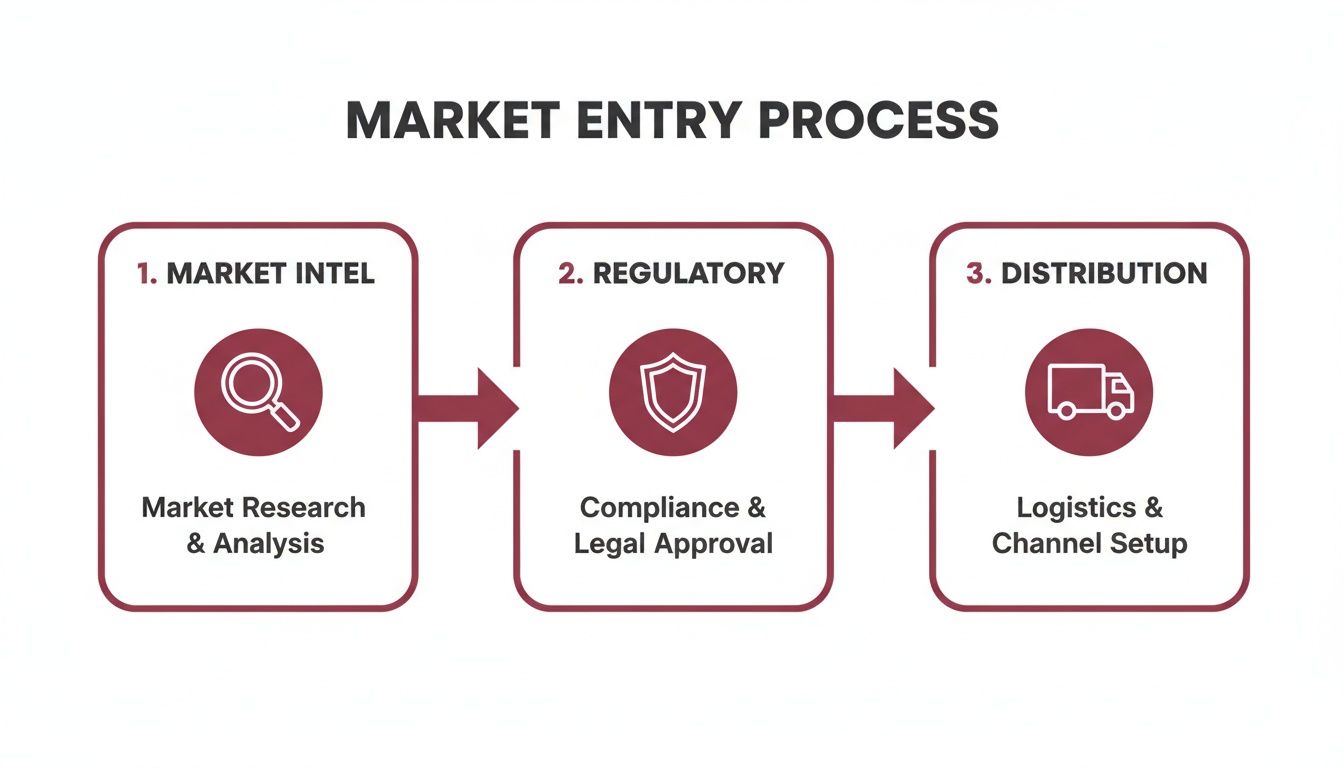
A successful launch is a sequence of deliberate decisions, where solid market intelligence informs everything that follows.
Building Your Regulatory Moat
Once you’ve identified your market opportunity, it’s time to address the non-negotiable regulatory hurdles. For many founders, this is the most daunting part of US expansion. However, viewing compliance as a mere box-ticking exercise is a strategic error.
Smart founders transform compliance from a barrier into a “regulatory moat.” It becomes a powerful asset that builds consumer trust, de-risks the supply chain, and distinguishes the brand from less diligent competitors.
We’re currently applying this principle with a multi-million dollar cosmetics brand entering the US. They faced potential import holds due to minor differences in ingredient labelling under FDA guidelines. By proactively addressing this, we not only avoided costly delays but also strengthened their pitch to retail partners who demand flawless compliance.
Key agencies you will likely encounter include:
- Food and Drug Administration (FDA): Essential for cosmetics, health and wellness products, and anything food-related.
- Environmental Protection Agency (EPA): Relevant for household cleaners, pesticides, and certain electronic devices.
- Consumer Product Safety Commission (CPSC): Sets safety standards for a vast range of consumer goods to prevent unreasonable risks.
The economic opportunity for compliant brands is massive. In 2026, the United States imported $16.57 billion in goods from Australia. While agribusiness and resources were major contributors, categories relevant to innovative consumer products—like iron and steel products ($400.36 million) and plastics ($99.21 million)—demonstrate strong demand in sectors like hardware and home goods. These figures, which have grown steadily under the Australia-United States Free Trade Agreement (AUSFTA), show that a well-prepared brand can achieve significant success.
Mastering these regulations isn’t just about getting your product onto US soil. It signals to retailers and consumers that your brand is serious, reliable, and committed to excellence.
Why Most Distribution Strategies Fail
For an Australian founder, your distribution strategy is arguably the most critical decision in a US expansion. This is where strategy meets reality, and a single misstep can neutralize a superior product and a strong brand story.
Too many founders default to the path of least resistance—usually a premature launch on Amazon—without considering the long-term consequences for brand equity. The brands that scale intelligently use a deliberate, layered approach, not a high-volume, low-margin sprint.
For many Australian brands, Amazon USA becomes one of the earliest expansion channels because it provides immediate access to US consumer demand. However, successful Amazon expansion requires careful control of pricing, fulfilment, localization, and marketplace positioning. Brands that enter Amazon USA without a structured strategy often experience rapid margin pressure and long-term brand dilution.
Choosing Your Entry Point: Control vs. Scale
Every channel presents a trade-off between control, cost, reach, and speed. There is no single “best” option. The right choice depends entirely on your product, capital, and five-year brand vision.
The main channels to consider when bringing Australian products in USA markets include:
- Direct-to-Consumer (DTC) Ecommerce: Launching your own US-based website.
- Big-Box Retail: Partnering with national giants like Sephora, The Home Depot, or Target.
- Marketplace Selling: Using platforms like Amazon, Walmart, or specialized sites.
- Specialized Distributors: Working with regional or category-specific partners with existing retail relationships.
An “Amazon-first” approach is tempting due to its apparent speed, but it is fraught with risk. Founders often find themselves battling counterfeiters, squeezed on margins by price wars, and losing all control over their brand narrative. It becomes a race to the bottom, not a foundation for a premium brand.
The Power of a Phased Channel Strategy
The smartest brands don’t just pick one channel; they layer them in a strategic sequence. The goal is to use each channel for a specific purpose, building brand equity and market data along the way. This phased approach allows for deliberate growth while minimizing risk.
A common path for a premium cosmetic brand, for example, might be:
- Targeted DTC Launch: This provides total control over branding, pricing, and the customer experience. You gather invaluable data on your American customer and their preferences.
- Expansion to Select Independent Retailers: This builds brand credibility and places your product with tastemakers, often at better margins than big-box stores.
- Approach to Major Retail Buyers: Now, you can enter meetings with major chains armed with proven sales data and established brand equity, negotiating from a position of strength, not desperation.
A controlled DTC launch isn’t just about sales; it’s a proof of concept. When you can show a major retail buyer exactly who buys your product and why, you fundamentally change the dynamic of the conversation.
This methodical layering ensures you don’t dilute your brand before it’s established. For Australian brands, which often built their reputation on quality, protecting that premium perception is paramount. This also demands a robust logistics network; understanding order fulfilment in a new market is non-negotiable before committing to any channel.
US Distribution Channel Comparison for Brand Founders
To align your brand’s vision with a channel strategy, the table below breaks down the main options across the factors that matter most to founders: control, cost, and scalability.
Comparing US Distribution Channels
Direct-to-Consumer (DTC)
Best for brand control, customer data, and premium positioning. Requires stronger marketing investment and operational management.
Amazon and Marketplaces
Best for visibility and demand validation. Lower brand control and often higher pricing pressure.
Independent Retailers
Useful for building credibility and selective market presence. Growth is slower but often supports stronger positioning.
Big-Box Retailers
High scale potential but lower flexibility. Requires operational maturity, strong inventory systems, and stable margins.
Specialized Distributors
Helpful for brands needing regional expertise or retail access. Success depends heavily on partner quality and alignment.
Ultimately, your distribution strategy should be a direct reflection of what you want your brand to become. Choosing a channel isn’t just a logistical decision—it’s a strategic one that defines your brand’s future.
Executing a Go-To-Market Plan That Works
With a distribution strategy in place, the focus shifts to execution. This is where a launch is made or broken. Success comes down to two interdependent pillars: brand positioning and the operational logistics that support it.
Countless founders get this wrong. They invest heavily in a brilliant marketing campaign, only to see it collapse because the product isn’t on the shelf or unexpected fees have destroyed their margins before they’ve made their first sale.
Translating Brand, Not Just Language
Your brand’s story is your most powerful asset, but it must be translated for a new audience. What resonates with a shopper in Perth may not land with someone in Pennsylvania. This isn’t about abandoning your Australian identity—it’s about reframing it for a different cultural context.
The key is to stop listing product features and start articulating customer benefits that tap into American values and solve their specific pain points.
- A high-performance cosmetic brand might shift from talking about “natural Australian botanicals” to framing its product as “a solution for stress-induced skin issues common in a fast-paced US lifestyle.”
- A rugged outdoor product “built for the Aussie outback” becomes “durable enough for any adventure, from the Rocky Mountains to the Appalachian Trail.”
This new narrative must inform your pricing. If you position your brand as a premium solution, your price must reflect that. Underpricing is a classic error that signals a lack of confidence and can permanently damage your perceived value in a saturated market.
Building Your Operational Backbone
While your marketing team crafts the story, your operations team must build the delivery system. A flawless go-to-market plan is worthless if your logistics fail. For Australian products in USA markets, this operational backbone has several non-negotiable components.
First, a Third-Party Logistics (3PL) partner is essential. Their location is a strategic decision. A West Coast 3PL may seem logical for shipments from Australia, but if your primary customers are on the East Coast, cross-country freight costs will silently erode your margins.
Next is customs brokerage. This is far more than paperwork; it’s about accurately classifying goods to pay correct duties. An error here leads to costly delays, fines, or even seizure of your entire inventory.
One of the most critical and frequently underestimated calculations is your landed cost. This is the total cost to get a product into your customer’s hands, including the item cost, brokerage fees, logistics, shipping, duties, taxes, insurance, and handling. Ignoring this number is a recipe for disaster.
A promising home goods brand once secured a major retail order, only to have its entire margin wiped out by unexpected demurrage fees and higher-than-quoted inland freight charges. They had a great product and a willing buyer, but their operational planning was incomplete.
The Real-World Impact of Flawed Logistics
Consider this real-world pattern: an Australian brand known for innovative kitchen gadgets prepares for a US launch. They create a compelling DTC campaign and generate early press.
The problem? They chose a 3PL based solely on the lowest storage fee, ignoring its poor tech integration and distance from major shipping hubs.
Here’s what happened:
- Slow order processing led to a flood of negative reviews about shipping times.
- Inaccurate inventory tracking caused them to oversell a popular item.
- Unexpected shipping surcharges for deliveries to rural zones destroyed their profit margins.
The brand’s launch didn’t stall due to a lack of demand. It stalled because its operational foundation was weak. This highlights a crucial insight: your supply chain is as much a part of your brand experience as your website or packaging.
Why Smart Founders Partner to Scale
Entering a market as large and complex as the United States is rarely a solo mission. For most Australian founders, the question isn’t if they should partner, but what kind of partnership will drive intelligent growth. The choice is between burning capital to build a US team from scratch or leveraging a strategic partner to accelerate market entry.
Intelligent scaling means finding more than just a distributor. It’s about engaging a genuine extension of your founding team—a partner who operates with a long-term vision and an unwavering commitment to your brand’s integrity.
What to Look for in a Brand Expansion Partner
The US market is filled with firms promising to get your product on shelves. The challenge is to filter out transactional players and identify a true strategic partner—one who will prioritize your brand’s long-term health over quick, uncontrolled sales that erode value.
When assessing a potential partner, your criteria should be sharp and non-negotiable:
- On-the-Ground Market Expertise: They need deep, current knowledge of the US retail and e-commerce landscape. High-level theory is useless; you need real-world, operational experience.
- A Proven Track Record with Similar Brands: Ask for case studies, but ensure they are relevant. Success with a food product doesn’t automatically translate to the hardware or beauty category.
- A Transparent Operational Model: You must have full visibility into their process, including logistics, inventory management, marketing spend, and retail negotiations.
- A Shared Philosophy on Brand Health: The right partner understands that protecting your brand from margin erosion and over-distribution is the primary objective.
A partner’s job isn’t just to sell your product. Their job is to help you build your brand in a new country. If they don’t understand that distinction, they are the wrong partner.
This partnership model is about de-risking the entire expansion. Instead of making a series of costly mistakes in a foreign market, you are tapping into the experience of operators who have already learned those lessons.
Asking the Questions That Matter
When vetting potential partners, you must push past the sales pitch and into the operational details. The quality of their answers reveals their capabilities and alignment with your goals.
As we guide a multi-million dollar cosmetics brand through their US launch, the questions we ask on their behalf are pointed and specific, designed to uncover how a partner truly thinks about brand protection and sustainable growth.
Here are the questions every founder should be asking:
- How will you protect our brand from margin dilution on marketplaces like Amazon? A good partner will have a clear strategy for managing pricing, combating unauthorized sellers, and using Amazon as a controlled channel, not a free-for-all.
- What is your process for adapting our brand positioning for US retailers and consumers? Look for a detailed answer involving market research and competitor analysis, not a vague promise to “localize” content.
- Walk me through your reporting structure for inventory, sales velocity, and marketing ROI. Vague answers are a major red flag. A true partner provides data-driven dashboards for a live view of your US business.
- Describe a time you advised a brand against a retail opportunity and why. This question cuts to their integrity. A strategic partner prioritizes your long-term brand health over a short-term sales win, even if it means turning down a large order from the wrong retailer.
The opportunity for high-quality Australian products in USA is significant. The demand is confirmed by data; in 2026, US imports from Australia reached $16.57 billion. Categories perfect for home improvement and household brands performed strongly, with soaps and lubricants at $21.56 million, plastics at $99.21 million, and iron/steel at $400 million. These figures underscore a clear appetite for well-positioned Australian goods.
Choosing the right partner is the single most important decision on your US expansion journey. It determines whether you spend years navigating a difficult market alone or accelerate sustainable growth from day one.
Answering Your US Market Entry Questions
Once the high-level strategy is mapped out, the same high-stakes questions always surface. I’ve heard them from dozens of Aussie founders preparing to enter the US. These aren’t minor details; they’re the practical, make-or-break concerns that can derail a launch.
Here are the direct answers, based on our experience helping brands navigate the realities of US market entry.
How Much Capital Is Required to Launch in the US?
There is no magic number. Any agency that provides a single figure without a deep understanding of your business is guessing. The real answer depends entirely on your channel strategy, product category, and growth velocity.
That said, a six-figure budget is a realistic starting point for a serious, controlled launch. This isn’t just about inventory. A proper budget must account for the true cost of entry.
Core cost centers include:
- Compliance & Regulatory: This can range from a few thousand dollars for simple certifications to tens of thousands for products requiring extensive FDA or EPA approval, such as cosmetics or household chemicals.
- Freight & Duties: Shipping a container from Australia to a US port is just the first step. You then have customs duties, brokerage fees, and crucial inland freight to move stock to a 3PL warehouse. These costs can easily add 20-30% to your landed cost of goods.
- 3PL Setup & Warehousing: Expect initial setup fees, followed by ongoing monthly storage and pick-and-pack costs. A good 3PL partner may cost more upfront but will save a fortune through efficiency and fewer errors.
- Marketing & Launch Activation: Whether launching DTC or supporting a retail entry, your initial marketing spend must be significant to build the first wave of momentum.
I always advise founders to budget an additional 15-20% for unforeseen expenses like legal fees, insurance, and trademark registration. This defensive move prevents early cash flow crises.
Should I Set Up a US Entity?
For most brands planning a serious expansion, the answer is yes, eventually. While you can technically sell into the US from an Australian entity, establishing a US-based LLC or C-Corporation becomes a strategic necessity as you scale.
The primary reason is liability protection. A US entity insulates your Australian parent company from legal issues in the litigious American market. It also simplifies banking, state and federal tax navigation, and hiring US staff. More importantly, major US retailers often require it, as it signals commitment and simplifies their procurement systems. The question isn’t if, but when.
How Do I Protect My Brand From Amazon Discounters?
This is a critical challenge for any premium brand. The only way to win is to be proactive. Once pricing erodes on a marketplace like Amazon, repairing the damage to your brand’s perceived value is incredibly difficult.
Protecting your brand’s integrity requires a multi-layered defense:
- Enroll in Amazon Brand Registry immediately. This is non-negotiable. It provides tools to report counterfeiters and unauthorized sellers violating your intellectual property.
- Implement a MAP (Minimum Advertised Price) Policy. A well-drafted MAP policy, created with legal counsel, sets clear rules for how retail partners can advertise your products and is the most effective tool for preventing online price wars.
- Be highly selective with distribution. The fewer distributors you have, the easier it is to police your supply chain. We advise brands to avoid partners known for “leaking” products to unauthorized third-party sellers on Amazon.
What Is The Biggest Mistake Australian Brands Make?
The single biggest and most costly mistake is assuming that what works in Australia will automatically work in the United States. This goes far beyond spelling and slang; it’s a fundamental error in market translation.
Many founders believe their “authentic Aussie story” is a silver bullet. But US consumers are bombarded with thousands of brand stories daily. Your message must connect directly to their needs, their cultural context, and their pain points.
For example, a rugged outdoor brand message that works in Australia might need to be reframed around “weekend adventures” for an urban US audience. A clean beauty brand’s focus on native botanicals may need to be translated into benefits that address skin issues caused by a different climate or lifestyle.
Success requires genuine cultural and market translation, not a simple copy-and-paste job.
Frequently Asked Questions About Expanding Australian Brands into the USA
Why do Australian brands struggle in the US market?
Most Australian brands struggle because they underestimate the operational complexity, competitive pressure, and localization required for successful US expansion.
Is Amazon USA the best entry point for Australian brands?
Amazon USA can be a strong launch channel, but it should usually be part of a broader market-entry strategy that protects pricing, fulfilment quality, and brand positioning.
What is the biggest mistake founders make during US expansion?
The most common mistake is assuming domestic success will transfer naturally into the US market without adapting positioning, pricing, logistics, or customer messaging.
How important is logistics during US expansion?
Logistics is critical. Weak fulfilment systems, poor inventory planning, and inaccurate landed-cost calculations can quickly destroy profitability and customer trust.
When should brands work with a US expansion partner?
Brands often benefit from external support once operational complexity, compliance management, logistics coordination, or multi-channel growth begins stretching internal resources.
Expanding successfully into the US market requires more than exporting products internationally. It requires structured positioning, operational planning, logistics coordination, compliance discipline, and controlled channel strategy.
At TPR Brands, we work with Australian brands building scalable US market presence across ecommerce, Amazon, retail, and international growth channels. That includes strategic market-entry planning, fulfilment support, localization strategy, and long-term brand protection.
For established founders, the goal is not simply selling products in the United States. The goal is building a durable international brand with sustainable growth and stronger commercial control, learn more about our approach.