Most brands don’t fail on Amazon Canada because demand is missing.
They fail because they assume it behaves like the US.
That assumption breaks everything.
Amazon Canada is not a scaled-down version of the US marketplace. It is a different operating system — with different consumer expectations, logistics constraints, and localisation requirements that quietly destroy poorly planned expansions.
What looks like an easy international extension is often the point where strong products start to stall.
Why Amazon Canada Breaks US Expansion Playbooks
Many brands assume success in the US or Europe can be directly replicated in Canada.
This assumption creates immediate strategic failure.
Canada looks familiar on the surface, but once you operate inside it, the differences in consumer behaviour, logistics structure, and compliance quickly reshape your entire expansion model.
Founders who succeed here recognize this from day one, avoiding the trap of simply replicating their US strategy.
I’m seeing this play out right now with a multi-million dollar cosmetics brand.
We’re relabelling for French Canadian, and it’s not just translation. It has to be the right type of French or it doesn’t pass.

The opportunity in Canada is not theoretical—it is structural.
Amazon is already the dominant ecommerce platform, meaning the challenge is not demand creation, but correct positioning inside an established buying ecosystem.
Marketplace Economics: The Data Behind the Opportunity
Underestimating the scale of the Canadian market is a frequent mistake. The numbers reveal a mature and highly engaged e-commerce landscape.
The table below breaks down the metrics that illustrate the opportunity for international brands.
| Metric | Figure | Implication for Brand Founders |
|---|---|---|
| Projected Market Share (2026) | 41.5% of all retail e-commerce | Amazon is the dominant platform; launching here provides immediate access to the largest segment of online shoppers. |
| Annual Net Sales (2024) | CAD 19.8 billion | The platform facilitates significant revenue, proving its capacity for scalable brand growth. |
| Number of Canadian Sellers | Over 80,000 | A robust ecosystem with reliable fulfilment infrastructure exists, allowing brands to integrate efficiently. |
These figures demonstrate that Canadian consumers don’t just use Amazon—they rely on it. For a brand founder, this means an existing audience is actively searching for products. The strategic challenge is not creating demand, but positioning the brand to capture it effectively.
A common real-world pattern: A brand assumes its US or European value proposition will resonate in Canada. However, Canadian consumers, while influenced by US trends, often prioritize durability and quality over the lowest price, particularly for home, outdoor, and seasonal products.
Why Brand Positioning Is Critical in the Canadian Market
Positioning is where most brands underestimate Canada.
This is not a low-cost, high-volume market. It is a value-driven market where durability, reliability, and trust often outperform price competitiveness.
Brands that assume price wins end up in margin compression.
Brands that position correctly win long-term category control.
Consider these categories:
- Hardware and Tools: Products engineered for harsh winters and long-term use resonate strongly.
- Home Improvement: A robust DIY culture fuels consistent demand for quality materials and supplies.
- Premium Household Goods: Consumers often invest in items that offer superior performance and longevity.
The strategic lesson is clear: smart positioning is essential. Simply making a product available is insufficient. It must be positioned as the superior solution for the discerning Canadian consumer. Lasting success comes from a deliberate, market-aware strategy, not from uncontrolled scaling that erodes brand value. Building and managing a powerful Amazon storefront is a crucial component of this strategic positioning.
Validating Your Product for the Canadian Market
Entering a new market without rigorous validation is a significant gamble. We have observed many brands assume a US bestseller will automatically succeed on Amazon Canada, only to face stagnant sales and escalating costs. Before committing to inventory, a founder must undertake a surgical analysis to confirm a genuine market fit.
This is not about superficial keyword searches. It is a deep dive to determine if your product has a defensible position in the Canadian e-commerce landscape. Success on Amazon.ca is not accidental; it is engineered.
Performing a Surgical Competitive Analysis
A proper competitive analysis on Amazon.ca involves more than identifying similar products. It is about mapping the competitive terrain to find a strategic entry point—a gap in pricing, positioning, or customer experience that your brand can exploit.
Focus your analysis on these areas:
- Direct Competitors: Scrutinize their pricing strategies, review velocity, and the quality of their product listings. Determine if they are positioned as premium or budget brands.
- Pricing Benchmarks: Identify the optimal price corridor. Pricing too high or too low can undermine a launch. Account for currency conversion, local taxes, and market expectations.
- Positioning Gaps: This is where strategic opportunities are found. Analyze the 1, 2, and 3-star reviews of competitors. Consistent complaints about poor durability, missing features, or weak support highlight unmet needs your brand can address.
This intelligence gathering is an ongoing process, not a one-time task. The insights inform your pricing, marketing messages, and inventory strategy.
Building Your Canadian Financial Model
Hope is not a viable business strategy. Before investing in the Canadian market, a clear understanding of your unit economics is non-negotiable. Many brands fail by underestimating the true landed cost of getting a product into a Canadian customer’s hands.
We see this pattern repeatedly: a founder focuses on shipping costs alone, ignoring the cumulative impact of freight, duties, taxes, and Amazon’s fees. An oversight here can turn a profitable product into a loss-leader.
Your financial model must account for these Canada-specific variables:
- Landed Costs: The total cost to import your goods, including international freight, customs clearance, and import duties.
- GST/HST: As a non-resident importer, you must collect and remit the Goods and Services Tax (GST) or Harmonized Sales Tax (HST), which varies by province.
- Amazon.ca Fees: These are similar to other markets but must be calculated in Canadian dollars. Include referral fees, FBA fees, and projected advertising spend.
This model provides a realistic profitability forecast, enabling you to set a retail price that is both competitive and margin-protective. It is a critical step that is too often overlooked in the rush to launch.
Foundational Compliance and Logistics
Navigating the administrative requirements for a Canadian launch is essential. The two most critical pillars are obtaining the correct business credentials and ensuring product labelling compliance.
First, you need a Business Number (BN) with an importer/exporter account from the Canada Revenue Agency (CRA). This is required to legally import goods and manage tax obligations. For most international founders, partnering with a customs broker streamlines this process. The complexities of market entry are universal; our guide on expanding to Amazon Australia details similar challenges that apply when expanding into any new country.
Second, your packaging must comply with Canada’s bilingual labelling requirements. Get this wrong and you don’t launch. Simple.
While Quebec has the strictest laws, the smartest strategic move for a national launch is to use both English and French on packaging from the start. This demonstrates a serious commitment to the market and preempts future compliance issues. Treating these tasks as foundational, not as red tape, sets the stage for a much cleaner market entry.
Localizing Your Brand: How to Speak to the Canadian Consumer
Many international brands make a critical error when creating their Canadian listings. They simply copy their US content, assuming a quick translation or currency change is sufficient. This is the fastest way to alienate Canadian shoppers and kill brand trust before it even begins.
A listing that converts in Canada is not merely translated; it is localized. It must feel as though it was created for Canadians, by a brand that understands the local context.

True localization goes far beyond spelling. It requires a deep understanding of how Canadians search, what they value, and the cultural nuances that make a brand feel authentic. Skipping this step is a recipe for low click-through rates, poor sales, and a launch that fails to gain traction.
Nailing the Canadian Nuances
Language is the first step. While English is the primary language in most of Canada, regional terminology, spelling, and tone matter. Using the right language shows you’ve done your homework.
- Local Terminology: Canadians have their own terms. We wear a toque (beanie) in winter, relax on a chesterfield (sofa), and drink pop (soda).
- Spelling: Using Canadian/British English spelling is non-negotiable. Think colour, centre, and analysing. Getting this wrong is an immediate signal of an outside brand.
- Tone: Canadian marketing communication is generally more reserved and authentic than typical US hard-sell copy. Over-the-top claims can be perceived as insincere.
Imagine a brand selling winter jackets. A generic US listing might focus on ‘extreme winter performance’. A smart brand localizing for Amazon Canada would use phrases like ‘stay warm during a Canadian winter’ or ‘perfect for the hockey rink or the ski hill’. This isn’t just a keyword swap; it’s about connecting the product to the Canadian way of life.
Optimizing for How Canadians Search
The keywords that drive traffic in the US will not necessarily perform in Canada. Founders must conduct specific keyword research to understand how Canadian shoppers search for their products. A US customer might search for “coffee maker,” while a Canadian is just as likely to search for “Keurig machine” or a specific brand name.
Optimization must cover every part of your listing:
- Titles: Naturally integrate primary Canadian keywords while making the core benefit clear.
- Bullet Points: Use a mix of primary and secondary keywords. Focus on benefits that solve Canada-specific problems, like “-30°C temperature rating” for winter gear or “durable for cottage country” for outdoor equipment.
- A+ Content: This is your opportunity to tell your brand’s story in a Canadian context. Use this space to demonstrate how your product fits into the local lifestyle, building a connection that specifications alone cannot.
Simply running text through a spell-checker is a lazy approach that misses the cultural subtext. A brand that mechanically changes words without understanding the context appears disingenuous, eroding the trust required for a sale.
Using Imagery That Reflects the Canadian Lifestyle
Your product photos and videos are powerful localization tools. Using stock photos of American-style suburbs or landscapes that are clearly not Canadian creates an immediate disconnect.
To build trust, your visuals must feel authentically Canadian. For a kitchenware brand, this might mean showing a family making tourtière for Christmas. For an outdoor brand, it could be an image of someone using your gear while canoeing in Algonquin Park or hiking in the Rockies.
Showcasing your product in a distinctly Canadian setting—a backyard deck, a sunny day at the cottage, or a snowy street in Montreal—makes your brand feel familiar. This visual storytelling demonstrates an understanding of your customer’s life. When a Canadian shopper sees themselves in your listing, they are not just buying a product; they are connecting with a brand that “gets” them.
Choosing Your Canadian Fulfillment Strategy
Fulfilment strategy in Canada is not an operational detail—it is a strategic decision that determines your entire cost structure and customer experience.
This decision defines how much control you retain versus how much speed and convenience you gain.
For most founders, the wrong choice here locks in inefficiencies that are difficult to reverse later.
The Power and Peril of Fulfilment by Amazon (FBA)
For many international founders, Fulfilment by Amazon (FBA) appears to be the default choice. The advantages are compelling: access to Amazon’s vast fulfilment network and the Prime badge, which is a powerful trust signal for Canadian shoppers that dramatically increases visibility and conversion rates. We’ve seen brands tie up thousands in stock that just sits.
However, this convenience comes with strategic trade-offs that many overlook.
- Cross-Border Inventory Costs: Shipping inventory in bulk to Canadian FBA centres ties up significant capital. You are pre-paying not just for freight but also for customs, duties, and taxes on unsold goods.
- Long-Term Storage Fees: If sales forecasts are inaccurate, you will incur punitive long-term storage fees. This risk is particularly high for new-to-market products with unproven sales velocity.
- Loss of Control: FBA is a black box. You surrender control over your packaging experience, have limited ability to manage returns on your own terms, and are subject to Amazon’s evolving policies and fee structures.
FBA is a powerful tool, but treating it as the only option is a strategic error. We have seen brands ship thousands of units to Canada, only to have them sit for months, accumulating fees and tying up cash flow.
The FBM and Hybrid Partner Models
Fulfilment by Merchant (FBM) restores control over your inventory, packaging, and customer experience. However, it presents a major challenge: meeting Canadian expectations for fast, affordable shipping. Competing with Prime delivery from an international warehouse is often cost-prohibitive.
This is where a hybrid model becomes a compelling strategic alternative. Partnering with a Canadian third-party logistics (3PL) provider or a specialist fulfilment partner can significantly de-risk your market entry. Our Amazon expansion partner guide explores this approach in detail. This strategy allows you to hold inventory in Canada without committing all of it to Amazon’s network upfront.
Choosing between FBA and an FBM/Partner model is a critical decision. This table breaks down the core strategic considerations for a brand founder.
FBA vs FBM: A Strategic Comparison for Brands Entering Canada
| Factor | Fulfilment by Amazon (FBA) | Fulfilment by Merchant (FBM) / Partner | Strategic Consideration |
|---|---|---|---|
| Speed to Market | Fast setup within the Amazon ecosystem. | Slower, as it requires vetting and integrating with a partner. | FBA offers immediate speed, but a partner model provides greater long-term flexibility. |
| Inventory Risk | High. Bulk stock is committed to Amazon, risking storage fees. | Low. Inventory can be held at a 3PL and fed into FBA as needed. | A hybrid approach is a powerful method for testing the market without over-committing capital. |
| Brand Control | Low. Amazon controls packaging and the last-mile experience. | High. You or your partner control the entire unboxing experience. | For premium brands, owning the customer experience is a crucial differentiator. |
| Shipping Costs | Predictable but bundled into various FBA fees. | Variable; can be high without strong negotiated rates. | A Canadian 3PL can often secure better domestic shipping rates than an international seller could alone. |
The trade-offs are significant.
The strategic lesson for many established brands is to adopt a hybrid approach. Start by using a Canadian 3PL for fulfilment, then strategically send small, frequent shipments into FBA to maintain Prime status without overexposing your inventory. This provides the best of both worlds: brand control, reduced financial risk, and the conversion power of Prime.
Your First 90 Days on Amazon Canada: Building Strategic Momentum
A great product does not guarantee a successful launch on Amazon Canada. Momentum must be built from day one, and the first 90 days are critical. The objective is not just to secure initial sales, but to signal to the Amazon algorithm that your product has velocity and deserves high search ranking.
We have seen countless brands falter at this stage. Some overspend on advertising with an unsustainable Advertising Cost of Sales (ACoS), while others are too cautious, allowing their products to become buried deep in the search results.
The strategic lesson is to treat your launch as a data-gathering mission. A structured approach is required to learn what drives Canadian consumers and then scale your efforts intelligently.
Structuring Your Initial Ad Campaigns
Your initial ad strategy should be focused on discovery, moving from broad targeting to precise execution. This is a methodical process.
- Weeks 1-4: The Discovery Phase: Begin with a broad match campaign to uncover unexpected search terms and local phrasing. Run this alongside a category targeting campaign to appear on competitor product pages. The goal here is pure data collection; a high ACoS is expected and should be viewed as an investment.
- Weeks 5-8: The Refinement Phase: Analyze the search term reports from the first month. Move high-performing terms into a new phrase match campaign for greater control. Simultaneously, launch product targeting (PAT) campaigns against the ASINs of your most direct and vulnerable competitors.
- Weeks 9-12: The Profitability Phase: By now, you should have a validated list of your top-converting keywords. Move these into a tightly focused exact match campaign. This is where you begin to optimize for a lower, more sustainable ACoS, shifting from exploration to driving profitable growth.
The biggest mistake we see is brands aiming for a low ACoS from day one. For the first 90 days in a new market, a high ACoS on discovery campaigns is an investment in market intelligence.
Pairing Ads with Promotions to Build Velocity
Advertising alone is rarely enough to generate the sales velocity needed to influence the Amazon algorithm. It must be combined with smart promotions to drive initial sales and, critically, secure early reviews.
This timeline illustrates how to choose your path, prepare your product, and launch effectively.
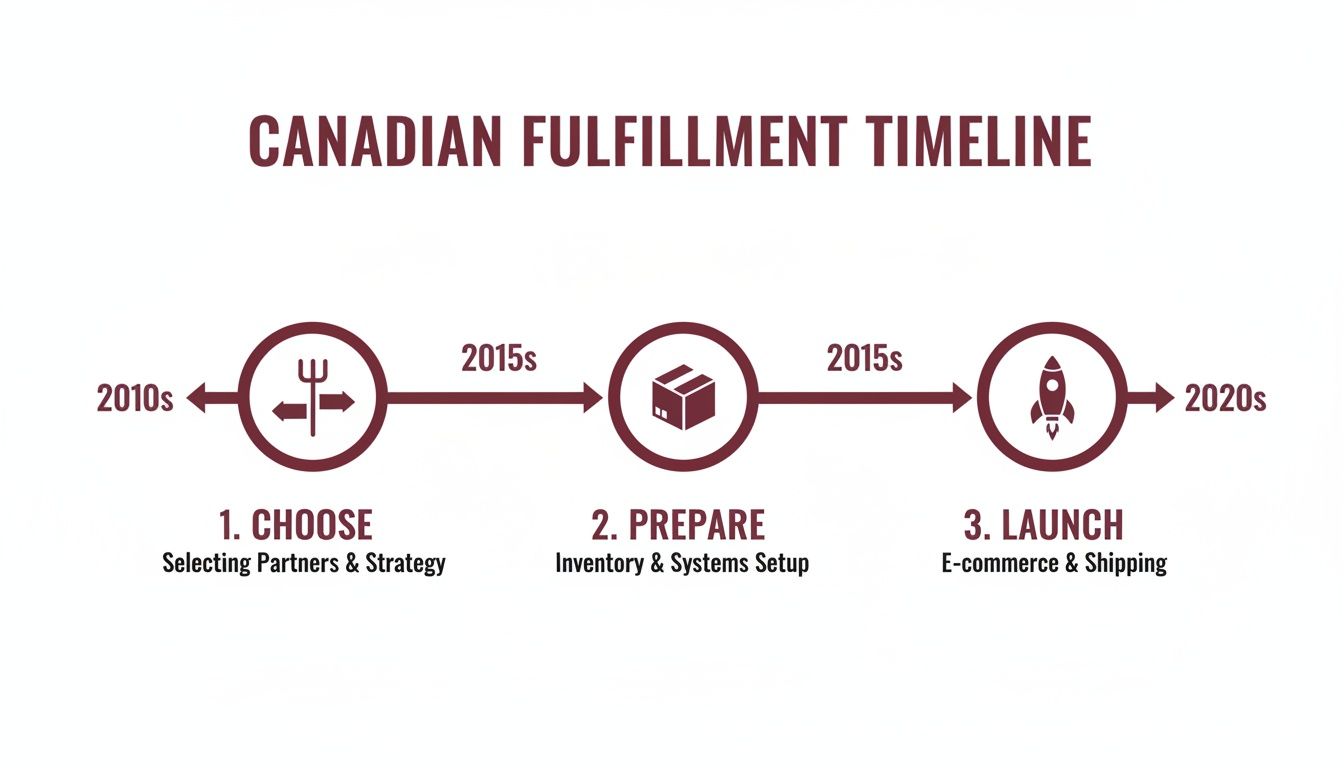
As this shows, a launch is not a single event but the culmination of strategic choices and preparation.
We recommend these promotional tools to build initial momentum:
- Coupons: The digital coupon badge is a highly effective way to increase click-through rates in crowded search results.
- Launch-Day Deals: Create urgency with “Prime Exclusive Discounts” or a “Deal.” A promotion in the first few weeks can generate a sales spike that signals demand to the algorithm.
- Vine Program: For trademark-registered brands, the Amazon Vine program is essential. It is the fastest path to securing up to 30 high-quality reviews from trusted reviewers, providing the social proof needed to convert shoppers.
Your first 90 days on Amazon Canada set the foundation for long-term success. It is a period of calculated investment—using advertising to learn and promotions to build velocity. By analyzing data and adapting your strategy, you will build a strong platform for a profitable brand in the Canadian market.
From Product to Market Position
At scale, success on Amazon Canada is not driven by product quality alone.
It is driven by execution.
How well you localise your brand.
How accurately you model landed costs.
How tightly you control logistics.
How strategically you enter the market.
Brands that treat Canada as a simple extension of the US struggle to scale.
Brands that treat it as its own system build defensible market share.
The difference is not the product.
It is the strategy behind it.
I’ve seen strong brands stall in Canada, not because the product wasn’t good, but because the execution wasn’t right.
The ones that get this right treat Canada as a strategy, not an extension.
If you’re looking at Amazon Canada and want to get it right the first time, this is the part that matters.
If you’re planning an Amazon Canada expansion, the difference between growth and stagnation is usually decided before the first shipment leaves your warehouse.
Most brands get that decision wrong. Start a brand conversation.