Most brands don’t fail on Amazon Canada because demand is weak.
They fail because they assume Amazon Canada behaves like the US.
That assumption leads to a simple but costly mistake: copying a successful US strategy and expecting it to perform the same way in a different commercial system.
In reality, Amazon Canada is not a smaller version of the US marketplace. It is a different ecosystem with different pricing dynamics, customer expectations, and competitive pressure.
And that changes everything.
Success in one market does not transfer automatically. It must be re-engineered for each new region.
Moving Beyond Product to Think Like a Global Brand
Most founders approach expansion as a logistics problem.
They assume that if the product works, everything else will follow.
But Amazon is not a distribution channel. It is a network of competing regional ecosystems where discovery, trust, and conversion behave differently in every market.
A product solves a problem.
A brand earns trust.
And in a new market, trust does not transfer.
It has to be built again from zero.
To succeed globally, founders need to rethink four core areas:
- Brand Positioning — How does your value proposition translate into a new cultural context?
- Market Economics — What do landed costs, taxes, and fees do to your pricing model?
- Consumer Trust — How do you build credibility without local history or reviews?
- Distribution Strategy — Does FBA alone work, or is a hybrid model required?
Founders who master this transition stop seeing their Amazon store as just a sales channel and start treating it as an asset for building a brand in new territories. They realize that product success doesn’t translate automatically; it must be carefully translated. For founders exploring this path, understanding the landscape for Amazon sellers in Australia can provide crucial insights into what it takes to win in a key growth market.
The challenge isn’t just selling more units. It’s about building an operational backbone and brand presence that supports smart, sustainable growth across borders. Many brands discover that the fastest and most capital-efficient way to achieve this is not by going it alone, but through strategic partnerships that provide immediate access to on-the-ground expertise.
Choosing Your Next Marketplace for Expansion
Expanding your Amazon store internationally without a calculated strategy is a surefire way to burn capital. Many founders assume that launching in every available marketplace at once is a sign of aggressive growth. In reality, it’s a recipe for operational chaos and brand dilution.
A scattergun approach never works. Smart brands make calculated bets based on where their product has the highest probability of becoming a brand leader. This means digging deeper than surface-level data like population size or a country’s total ecommerce sales. Real-world patterns show that success is driven by analyzing category-specific growth, local buying habits, and the competitive landscape on the ground. A product that’s a bestseller in your home market could fail completely if you misjudge local demand or competition.
The goal is not to enter more markets.
The goal is to enter the right market with the highest probability of category leadership.
Analyse Market-Specific Category Demand
Before committing to a new country, you must validate that genuine demand for your specific product category exists and is growing. A country might have a massive ecommerce market, but if your niche is underdeveloped or, worse, saturated with low-cost competitors, you’re facing an uphill battle.
For instance, a brand selling high-end kitchen gadgets might find immediate traction in the UK, where Amazon is a mature and trusted platform for home goods. That same brand might struggle in an emerging marketplace where consumers primarily purchase low-cost essentials online.
It is about matching product strengths to a market’s specific appetite. This is where data becomes critical. In Australia, for instance, we see significant promise in sectors like home improvement and consumer products. This highlights a critical decision for any brand going global: do you focus on just moving a product, or do you build a strategic brand presence?
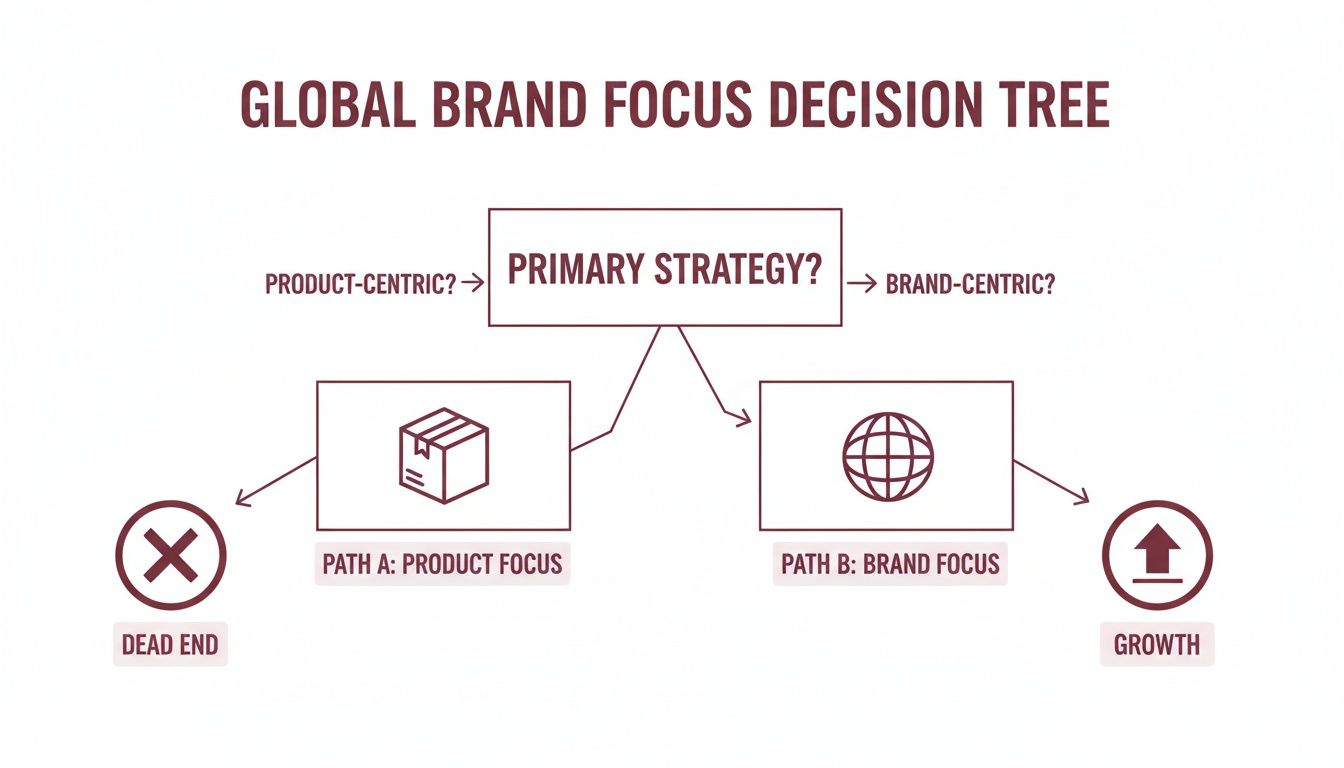
This visual underscores a fundamental truth observed across countless brands. A myopic focus on the product often leads to stalled growth, whereas a holistic brand strategy is what unlocks sustainable, long-term expansion.
Evaluate The Competitive and Logistical Landscape
Once you’ve identified a market with strong category demand, the next step is to analyze the competition and confront the logistical realities. Entering a market dominated by entrenched players requires a vastly different strategy—and a much larger budget—than entering one where the competition is fragmented.
You need to ask pointed questions:
- Who are the top sellers in my category on that specific Amazon store?
- What is their pricing strategy, and how are their listings positioned?
- How strong is their review history and overall brand presence?
Beyond competition, you must map out the operational costs. Logistical complexity can destroy margins if not planned for. This includes everything from Fulfilment by Amazon (FBA) fees, which vary by country, to import duties and local taxes like GST or VAT.
The true cost of entering a new market is never just the shipping fee. It’s the sum of all duties, taxes, storage costs, and the marketing investment required to win the first sale profitably.
A market that appears attractive on the surface can quickly become financially unviable once these hidden costs are factored in. This is a crucial step that many founders overlook in their rush to expand. If you’re exploring key growth markets, our guide on how to successfully sell on Amazon Australia offers a deeper dive into these specifics.
To formalize this process, smart brands use a framework to compare potential markets side-by-side. It cuts through the noise and forces an objective look at the variables that truly matter.
Marketplace Opportunity Assessment Matrix
| Marketplace (e.g., AU, UK, CA) | Category Demand & Growth Rate | Competitive Intensity (Saturated vs. Emerging) | Logistical Complexity (FBA fees, import duties) | Consumer Behaviour (Price vs. Speed sensitivity) |
|---|---|---|---|---|
| AU | ||||
| UK | ||||
| CA |
By populating this matrix, you create a clear, data-driven comparison that highlights the path of least resistance and greatest opportunity, moving your decision from a gut feeling to a strategic calculation.
Understand Local Consumer Behaviour
Finally, success hinges on understanding how local consumers think and shop. Are they price-sensitive deal hunters, or do they prioritize fast delivery and brand trust? The answer dictates your pricing, marketing, and fulfillment strategy.
In the Australian market, for example, consumer behavior on Amazon shows a strong preference for convenience and speed. Projections for 2026 highlight a major opportunity for home improvement and consumer product brands, with the electronics and appliances category forecast to hit approximately 1.2 billion AUD. This aligns perfectly with scaling proven hardware products into a market where purchase intent is high. Many consumers here choose Amazon for its reliability over pure price hunting. You can find more detailed forecasts on Amazon’s category sales in Australia on Statista.com.
This kind of insight is invaluable. It tells you that competing on speed and building trust will likely be more effective than simply trying to be the cheapest. By pulling together data on category demand, competition, and consumer behaviour, you build a robust plan for choosing your next marketplace wisely—ensuring your expansion is a strategic move, not just a shot in the dark.
Building Your Operational Backbone For Global Scale
An ambitious global strategy is worthless without flawless execution on the ground. Once you’ve selected your target markets, the real work begins. This is where you build the operational backbone that can support a successful international Amazon store.
Execution is where most expansion strategies fail—not planning.
I’ve seen many promising expansions falter right here—not from a lack of vision, but from underestimating the sheer complexity of global logistics and compliance.
The first major decision founders face is the fulfillment model. Fulfilment by Amazon (FBA) is often the default choice, and for good reason. It provides immediate access to Amazon’s powerful logistics network, Prime eligibility, and trusted customer service. It simplifies entry into a new market.
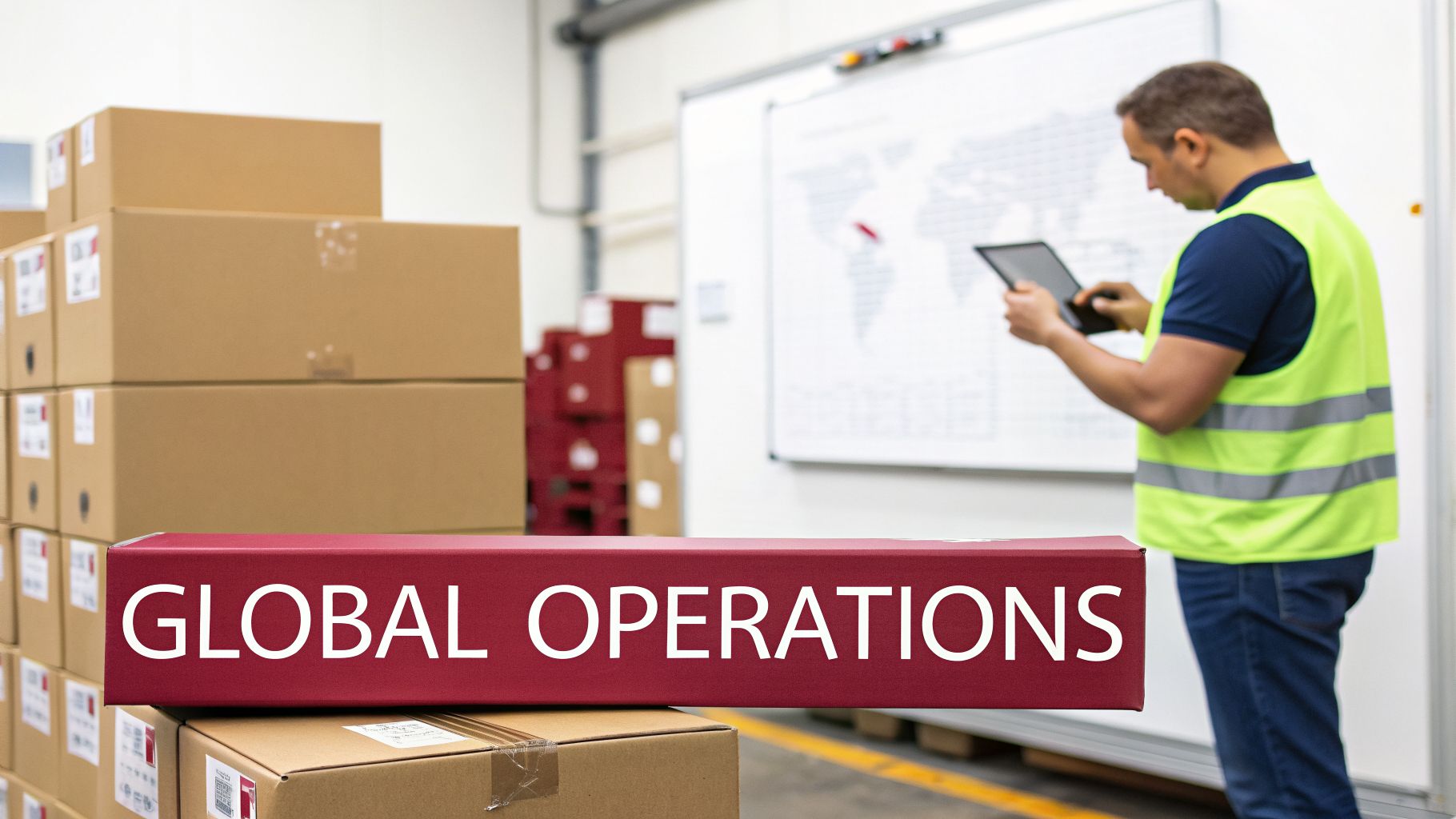
But FBA isn’t a silver bullet. The costs, including storage, fulfillment, and long-term storage penalties, can seriously erode margins, especially for larger or slower-moving products. This is when Fulfilment by Merchant (FBM) or a hybrid approach becomes a strategic alternative. With FBM, you or a third-party logistics (3PL) partner handle inventory and shipping, which gives you far more control over branding, packaging, and costs.
Choosing Your Fulfilment Strategy
The right choice comes down to your product, margins, and operational capacity. There is no single correct answer.
- FBA is ideal for: High-volume, standard-sized products where delivery speed is a major competitive advantage, allowing you to tap into the loyal Prime customer base from day one.
- FBM is better for: Oversized, heavy, or high-value items where FBA fees are prohibitive. It also provides more control over the customer experience and multi-channel inventory.
Many of the most successful brands we work with use a hybrid model. They place their fastest-moving SKUs in FBA to maximize visibility and sales velocity while fulfilling larger or more niche products via FBM to protect margins. This dual approach offers a powerful balance of speed and cost control.
Navigating The Maze Of Global Compliance
Beyond fulfillment, the web of international legal and compliance hurdles is where many brands get tangled. Every market has its own non-negotiable rules, and ignorance is not a defense.
An operational failure here doesn’t just delay shipments; it can get your products seized at the border and your seller account suspended. It is a serious risk.
For example, expanding into Europe means registering for Value-Added Tax (VAT) and complying with strict packaging laws under the Extended Producer Responsibility (EPR) program. If you’re selling electronics in Australia, you must ensure your products meet local safety standards and carry the Regulatory Compliance Mark (RCM). These are not minor details; they are fundamental requirements for market access.
Founders often mistake compliance for a one-time checklist. It’s an ongoing operational discipline. What’s compliant in the UK may be a violation in Canada, and regulations are constantly changing.
This operational rigor extends to every part of your supply chain. The pressure on global fulfillment is immense, demanding exceptional inventory visibility and delivery predictability. As platforms like Amazon continue to dominate, the gap widens between what consumers expect and what many brands can deliver. This is especially true for hardware and household brands, where managing inventory effectively becomes the primary bottleneck to growth. It’s no longer just about DTC funnels; it’s about being ‘retail ready’ for a fragmented commerce world. You can read more about these fulfilment pressures and how they are shaping the Australian e-commerce landscape on ValueAddedResource.net.
Managing Inventory Across Borders
Ultimately, effective inventory management is the lifeblood of a global Amazon store. Stockouts kill sales velocity and search ranking. Overstocking leads to crippling storage fees and tied-up capital. Managing this delicate balance across multiple regions, with different lead times and sales forecasts, is a monumental challenge.
Smart brands rely on dedicated inventory management software to get a unified view of stock levels across all marketplaces. This allows them to:
- Set automated reorder points based on sales velocity in each specific region.
- Forecast demand more accurately by factoring in local seasonality and promotions.
- Strategically transfer stock between countries to prevent stockouts or reduce excess inventory.
Building this operational backbone isn’t the glamorous part of global expansion, but it is the single most important factor determining whether a brand scales intelligently or collapses under its own ambition.
Winning Locally By Translating Your Brand

One of the fastest routes to failure on an international Amazon store is simply copying and pasting domestic product listings. Too many founders assume a direct translation is sufficient, but this misses the cultural nuances that drive buying decisions.
In new markets, relevance matters more than product quality.
To truly enter a new market, you must translate your brand, not just your words.
Your product may solve the same problem everywhere, but how you talk about it must be adapted for local discovery and connection. It’s the difference between showing up and actually being seen. This requires moving beyond simple translation to full-scale localization.
Beyond Words: Localising Your Product Story
Localization is the strategic adaptation of every element of your product detail page to resonate with the local culture. This includes language, imagery, keyword strategy, and even the benefits you choose to highlight.
What works in one market can feel completely tone-deaf in another. The term ‘outdoor gear’ might evoke rugged mountain climbing for a Canadian audience. For an Australian, it’s far more likely to be associated with beach camping and backyard barbecues. Using the wrong cues in your A+ Content can instantly alienate potential buyers.
Effective localization requires getting a few things right:
- Nuanced Copywriting: Hire native-speaking copywriters who understand local idioms and cultural references to rewrite your descriptions from the ground up, not just translate them.
- Culturally Relevant Imagery: The people and environments in your lifestyle images must reflect the local audience. A photo of a family in a North American suburban home will not connect with a buyer in a London flat.
- Tailored Keyword Research: You must uncover the specific search terms local shoppers are using. This often reveals search patterns completely different from your home market.
Mastering Amazon SEO for Regional Discovery
Once your brand story feels local, the next job is ensuring people can find it. Each regional Amazon store has its own search algorithm and customer search behaviors. A keyword driving huge traffic in the US might have zero search volume in the UK.
This is where a dedicated Amazon SEO strategy for each market becomes non-negotiable.
You need to identify and target high-intent keywords relevant to local shoppers. This involves using region-specific tools to find both primary and long-tail keywords, then embedding them strategically throughout your title, bullet points, backend search terms, and description.
This effort is especially critical in rapidly expanding marketplaces. Amazon Australia, for instance, has seen explosive growth. Merchandise sales are projected to climb from 2.5 billion AUD in 2021 to 8.2 billion AUD by 2026.
With 93% of Australian consumers now buying from marketplaces, failing to optimize for local search is a massive missed opportunity. You can explore more on this trend by reviewing these Amazon Australia sales forecasts on Statista.com.
Winning on a global Amazon store means winning hundreds of small, local battles for relevance. It’s about ensuring your brand doesn’t just speak the language, but also understands the conversation.
Protecting Your Brand’s Value Across Borders
As you expand, you must protect the integrity and value of your brand. Two critical tools for this are Amazon Brand Registry and a clear Minimum Advertised Price (MAP) policy.
Brand Registry gives you powerful tools to control your product listings, remove counterfeit sellers, and access premium marketing features like A+ Content. It’s your primary defense against brand dilution in a new country.
Enforcing a MAP policy ensures your pricing remains consistent, preventing your brand from being devalued by rogue resellers. This is crucial for maintaining brand perception and protecting relationships with other retail partners. Without it, you risk a race to the bottom that can permanently damage your brand’s equity.
Measuring What Matters For Sustained Growth
Many promising international expansions are killed by vanity metrics. Chasing top-line revenue at all costs is a common mistake that often masks deep profitability issues that can sink a brand before it gains traction.
For founders scaling their Amazon store globally, the key isn’t just measuring growth; it’s measuring what matters for sustained, profitable growth. Focusing only on revenue or Advertising Cost of Sale (ACoS) provides a dangerously incomplete picture. A low ACoS looks great, but if sales are stagnant, you are simply advertising efficiently to a tiny, unprofitable audience.
A rising revenue figure feels like success, but if your underlying margins are eroding with every sale, you’re not building a business—you’re funding a hobby. Smart founders track profitability, not just activity.
This is the strategic lesson: move from being a reactive seller to a strategic operator. Understand profitability at a granular level to make smart decisions about where to invest and when to pull back.
The Metrics That Reveal The Truth
To get a clear view of your performance, you must look beyond surface-level dashboard numbers. The real story is told through a combination of advertising, conversion, and operational health metrics.
These are the KPIs that experienced brand builders live by:
- Total Advertising Cost of Sale (TACOS): This is the single most important metric for measuring long-term brand health. It calculates your total ad spend as a percentage of your total revenue, not just ad-attributed sales. A falling TACOS over time proves your advertising is successfully driving organic sales and building real brand equity.
- Unit Session Percentage (USP): Think of this as your conversion rate at the unit level. It tells you what percentage of visitors to your product page actually make a purchase. A low USP in a new market is a red flag that your listing isn’t resonating—it could be a problem with your price, poor localization, or weak reviews.
- Inventory Performance Index (IPI): Your IPI score is how Amazon judges your inventory management. A score below 400 can lead to storage limits and higher fees, directly hitting your bottom line. For any serious seller, maintaining a healthy IPI is non-negotiable.
Tracking these numbers allows you to diagnose problems before they become critical. For instance, if your ACoS is stable but your TACOS is rising, your reliance on paid advertising is increasing—a clear sign your organic rank and brand presence are weakening.
Pricing For Profit, Not Just For Sales
Your pricing strategy for a new international Amazon store must be built from the ground up. Simply converting your domestic price to the local currency is a recipe for losing money on every sale. You have to create a new model that accounts for every single cost of selling in that specific region.
A profitable pricing strategy meticulously accounts for:
- Landed Costs: This includes your product cost, international shipping, import duties, and any customs fees.
- Local Taxes: GST, VAT, and other sales taxes must be factored into your final price, not treated as an afterthought.
- Marketplace & Fulfilment Fees: Amazon’s referral fees and FBA costs vary significantly by country and product size, so you need the exact figures.
- Marketing & Returns: You have to budget for local advertising and the real cost of processing returns in that market.
Only after calculating this true cost of goods sold can you set a price that delivers a sustainable margin. This isn’t about being the cheapest; it’s about pricing for profitability. The goal is to build a repeatable model for profitable growth in each new country, not growth at any cost.
The Partnership Calculus: Expanding Alone vs. With a Partner
At a certain stage of expansion, the challenge is no longer strategy—it is execution capacity.
Many brands reach a point where internal teams are stretched across logistics, compliance, advertising, and marketplace operations.
This isn’t just a matter of preference. It’s a hard calculation of resources, risk, and speed to market. Many founders, driven by the same spirit that built their brand, instinctively want to go it alone. The desire for total control is powerful.
But that path is littered with hidden costs that can drain capital and stall momentum before your brand ever gets a real foothold in a new country.
The Hidden Costs of Going It Alone
Expanding your Amazon store internationally by yourself means you carry the entire operational and financial burden. The most immediate, and often underestimated, challenge is the sheer amount of capital required.
Every new market demands a significant investment in inventory. This isn’t a one-off purchase; it’s working capital that gets tied up for months on ships, in customs, and sitting in an FBA warehouse on the other side of the world. This can seriously constrain the cash flow needed for product development and marketing back home.
Beyond the financial strain, other costs quickly pile up:
- The Steep Learning Curve: You and your team are forced to become instant experts on international compliance, from VAT registration in Europe to product safety standards in Australia. Mistakes here aren’t just costly; they can get your account suspended.
- The Leadership Drain: Your most valuable asset—your leadership team’s time and focus—gets swallowed by operational details. Instead of driving brand strategy, they get bogged down in logistics and troubleshooting customs issues.
- Slower Speed to Market: Every single step takes time. Setting up legal entities, building relationships with local service providers, navigating bureaucracy—it all adds up. This delay gives your competitors a window to establish themselves while you’re still figuring out the basics.
The solo approach essentially forces you to rebuild your operational system from scratch in every new country. For many brands, this proves to be a slower, more expensive, and far riskier path than they ever anticipated.
The Strategic Advantages of a Partnership
Working with a strategic partner, on the other hand, presents a completely different calculation. It is about leveraging existing infrastructure and on-the-ground expertise to achieve faster, more intelligent growth. This isn’t about giving up control; it’s about gaining a powerful asset.
A strong partner brings immediate, tangible benefits that directly solve the challenges of solo expansion. You get instant access to an established distribution network, sidestepping logistical headaches and long setup times. Financial risk is shared, as partners often invest alongside you, easing the capital burden of holding international inventory.
A partnership isn’t an outsourced service; it’s an embedded strategic advantage. It allows a founder to focus on building the brand while the partner executes the complex mechanics of market entry.
The most critical advantage, though, is expertise. An experienced partner already understands the local market dynamics, consumer behaviour, and the complex web of compliance. They have already made the mistakes and learned the lessons, allowing you to bypass that painful and expensive learning curve. For founders weighing these options, our detailed Amazon expansion partner guide provides a framework for making this crucial decision.
A Framework for Deciding
When does a partnership make the most sense? It comes down to a clear-eyed evaluation of your own resources and strategic priorities.
Consider a partnership if:
- Speed to market is a critical priority. You need to capture an opportunity before your competitors do.
- You want to minimize upfront capital risk. Tying up cash in international inventory would strain your business.
- Your team lacks the bandwidth or expertise for global logistics and compliance.
- You want to focus on brand and product, not on becoming an international logistics expert.
The journey from a successful product to a great global brand is complex. But the real-world pattern is clear: great products scale faster and more intelligently through strategic collaboration.
At TPR Brands, we work with established consumer brands expanding into global Amazon marketplaces including the United States, Canada, and Australia.
We focus on helping founders scale internationally through marketplace strategy, logistics execution, and brand positioning.
Learn more at https://tprbrandsau.com.