The most popular advice on vendor evaluation is also the advice that creates the most expensive problems later. Compare price. Check quality. Confirm lead times. Move forward.
That approach might work when a business is buying a narrow input for a stable domestic operation. It breaks down when a brand is trying to build a controlled presence across multiple marketplaces and regions. A vendor can look efficient on paper and still weaken pricing discipline, create listing inconsistency, mishandle compliance, or introduce fulfilment friction that customers experience as a brand failure rather than a supplier failure.
One pattern we continue seeing is that strong product businesses often misread vendor selection as a procurement event instead of a structural brand decision. The result isn't always immediate disaster. More often, it's slow fragmentation. The catalogue becomes inconsistent across channels. Returns handling drifts by region. Customer experience varies. Margin gets squeezed by operational correction work that never appeared in the original quote.
Across multiple marketplace ecosystems, the partner you choose doesn't just supply capacity. They shape commercial coherence. That is why vendor evaluation criteria deserve to be treated as a test of international readiness, not a purchasing checklist.
Beyond Price and Quality: Redefining Vendor Evaluation
Cheap supply rarely creates cheap growth.
The vendor decisions that look efficient in a spreadsheet often become expensive once a brand starts operating across marketplaces, distributor relationships, and regional service expectations. A partner can meet the visible tests of price and product quality, then weaken catalogue consistency, slow issue resolution, distort channel pricing, or create customer experience gaps that show up as lower ratings and higher support costs.
The strategic question is broader than supplier competence. It is whether a vendor fits the operating system your brand will need in multiple markets.
The hidden risk in a technically acceptable partner
A technically capable vendor can still be a poor ecosystem match. That problem usually appears after expansion begins, when regional differences expose weaknesses that were easy to miss in a domestic review.
A supplier that performs well in one country may struggle with local packaging norms, marketplace data requirements, retailer onboarding standards, or after-sales expectations in another. The product still ships. The partnership still underperforms. What fails is the connection between the vendor's operating habits and the brand's regional execution model.
That gap matters most in categories where the customer experiences the brand through a chain of touchpoints, not a single item. Household products, home organisation, beauty accessories, and connected devices all fall into this pattern. Listing accuracy, packaging consistency, fulfilment reliability, and returns handling influence brand perception as much as unit quality.
Vendor evaluation should test whether a partner preserves ecosystem cohesion across regions, channels, and customer touchpoints.
Procurement discipline has a place in brand strategy
Many private brands avoid formal evaluation methods because they associate them with government tenders or large enterprise buying teams. That is a mistake. Structured procurement disciplines exist for a reason. They force teams to decide in advance what commercial outcomes matter, instead of letting the lowest quote shape the criteria after the fact.
The useful lesson is not any single weighting formula. It is the principle behind one. Price should be assessed alongside service reliability, execution risk, compliance readiness, and the amount of management overhead a partner will create. Once a brand enters international marketplaces, those factors influence margin protection and brand control more than a small difference in unit cost.
A more disciplined process also exposes a point many vendor reviews miss. Selection criteria are not only a filter for bad suppliers. They are a test of whether your business has defined the channel model it wants to scale. Teams that need a practical benchmark can compare their process against stronger channel partner selection criteria. The strongest operators evaluate vendors less as isolated suppliers and more as components of a regional growth system.
Reimagining Core Criteria for Marketplace Ecosystems
Traditional vendor evaluation criteria usually list cost, quality, service, and reliability. Those categories are still useful, but only if they are redefined through the reality of modern channel expansion.
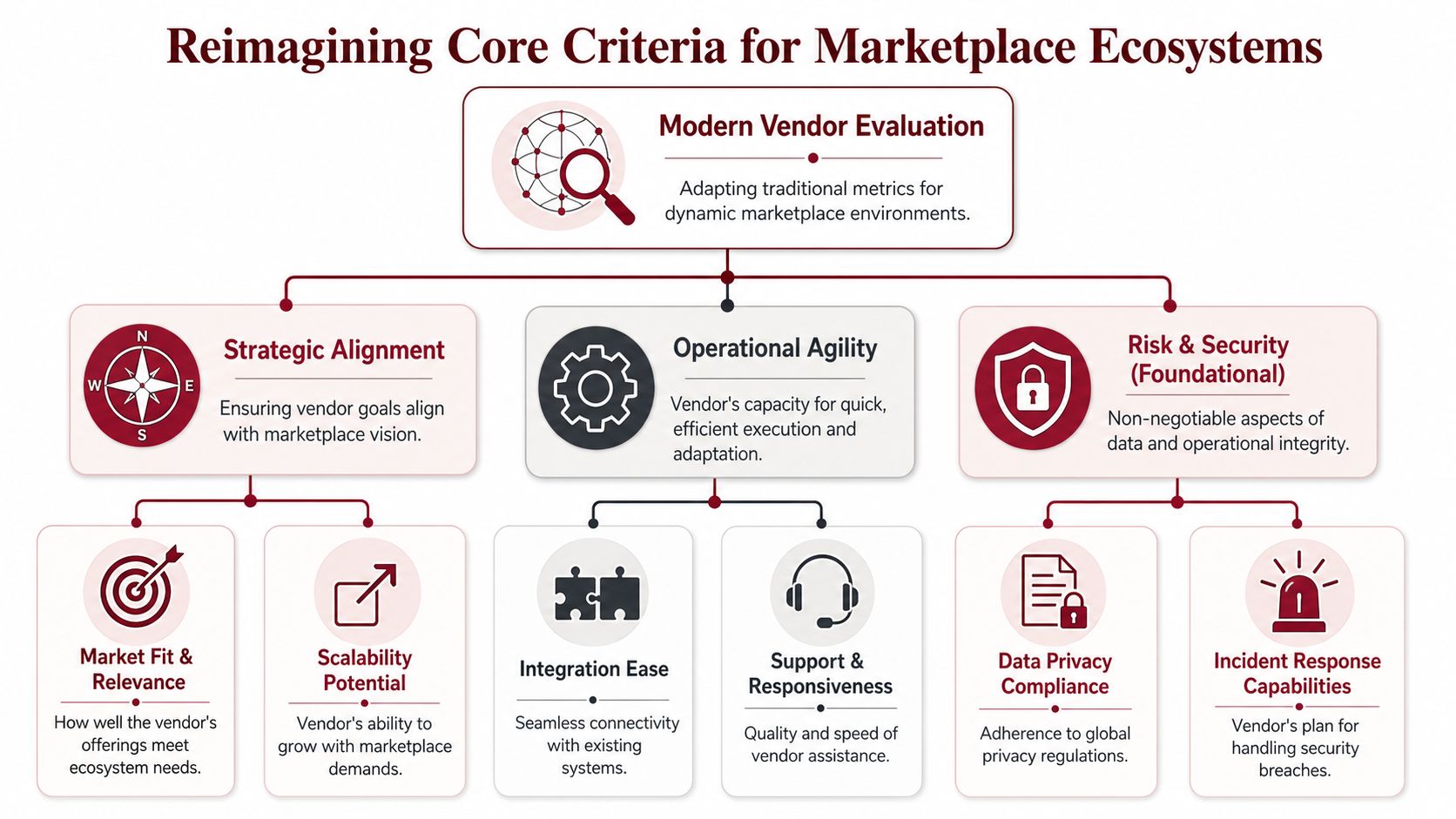
Cost is broader than quoted price
In a marketplace ecosystem, cost isn't the invoice line. It's the total commercial burden created by the relationship.
That includes the labour required to correct poor product data, the friction caused by inconsistent inventory feeds, the margin damage from unmanaged returns, and the downstream cost of fixing presentation errors across regional marketplaces. A vendor with a lower unit price can still become the more expensive option if your internal team has to absorb the correction work.
A commercially useful cost assessment should ask:
- What management overhead will this partner create: Will your team need constant intervention to keep listings, stock status, and order flows stable?
- How will this affect pricing integrity: Can the partner operate without triggering discount-led channel conflict?
- What does failure cost in market terms: If they miss a launch window or mishandle replenishment, does the brand lose trust, ranking stability, or retail confidence?
Quality has to include operational quality
Quality evaluation often remains a product-only question. That's too narrow. For marketplace-led growth, quality also includes data quality, content accuracy, packaging consistency, service handling, and the reliability of exception management.
In the Australian framework, Quality Assurance is technically defined by the mandatory presence of ISO 9001 certification and documented defect rates, and vendors that can't provide ISO 9001 documentation or defect rate logs are automatically disqualified from the shortlist, according to this overview of ISO 9001 supplier evaluation criteria and scorecards. That matters because it shifts quality from opinion to evidence.
For brands entering new channels, evidence-based quality is a strong proxy for whether the partner can protect brand consistency under pressure.
Operator view: Product quality opens the door. Process quality determines whether a brand can scale without becoming harder to manage each quarter.
Reliability is really fulfilment confidence
Reliability sounds straightforward until a brand starts operating across marketplaces, distributors, and regional service expectations. Then reliability stops meaning "usually on time" and starts meaning "commercially dependable across a fragmented system".
A reliable partner maintains stock accuracy, communicates exceptions early, handles peaks without chaos, and supports a customer experience that still feels like one brand. That's why fulfilment confidence is a better lens than generic reliability.
A useful way to test this is to separate reliability into three operational questions:
| Criteria lens | What to check | Why it matters |
|---|---|---|
| Inventory discipline | Stock synchronisation and replenishment accuracy | Prevents overselling and avoidable cancellations |
| Execution consistency | Packaging, dispatch, and service handling stability | Protects customer trust across channels |
| Recovery capability | How the partner manages errors and exceptions | Shows whether disruption becomes a contained incident or a brand problem |
What becomes visible during international expansion is that none of these criteria sit alone. Cost, quality, and fulfilment confidence compound each other. The strongest operators evaluate them as an ecosystem, not as disconnected procurement boxes.
Building a Weighted Scorecard for Strategic Evaluation
The most useful scorecard isn't the one with the most categories. It's the one that forces the business to make strategic trade-offs in advance.
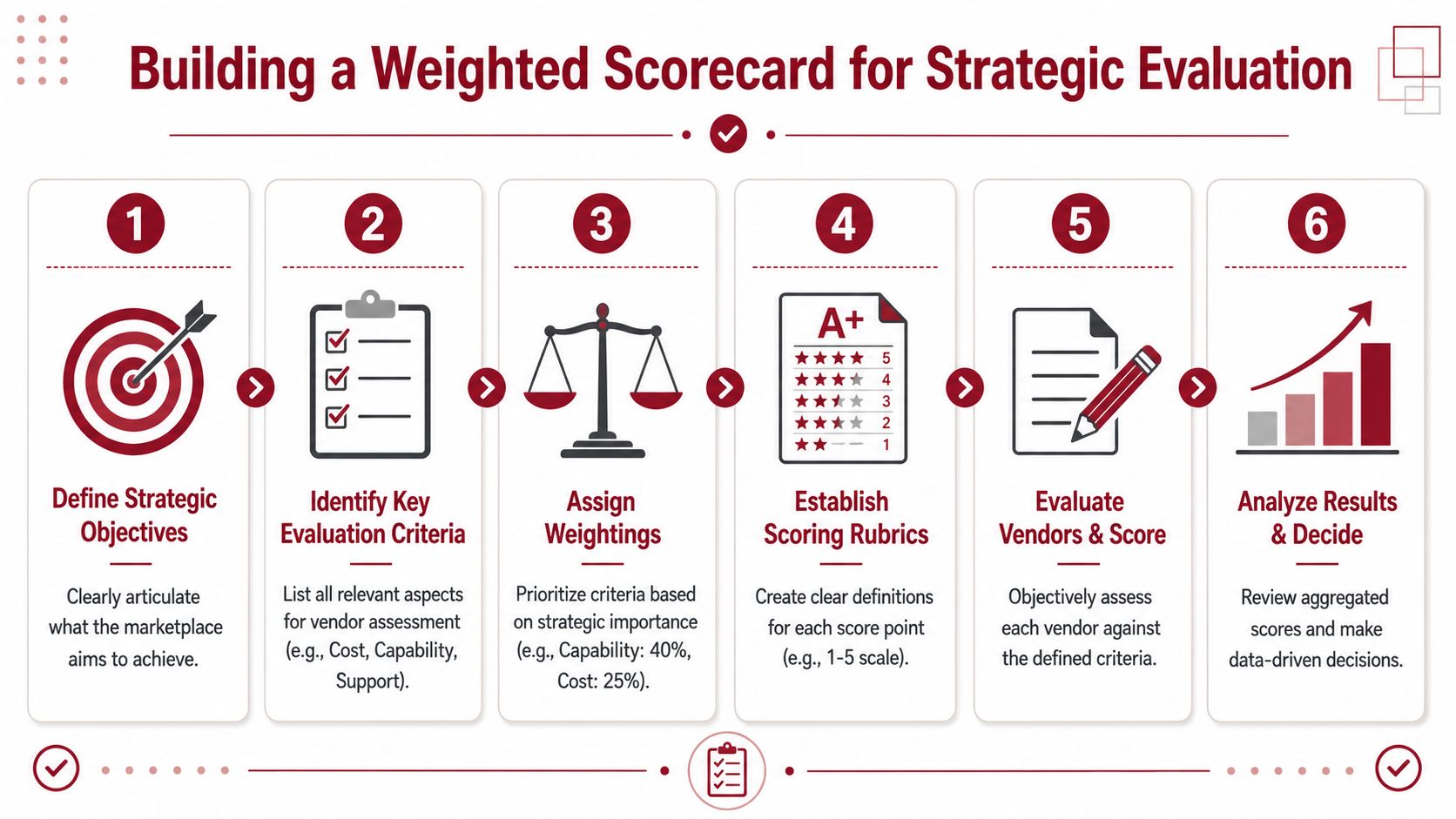
One issue we repeatedly observe is that teams treat all criteria as equally important until the final meeting, then let the cheapest quote or the strongest sales presentation decide the outcome. A weighted scorecard prevents that drift. It translates business priorities into a decision structure before emotion, urgency, or relationship bias takes over.
Start with the commercial objective
A scorecard should reflect the growth problem you're solving.
A brand entering a new geography with fragile delivery expectations may place the highest weight on logistics reach and execution control. A premium household brand may place more weight on brand protection, service quality, and pricing adherence. A connected-product business may need stronger weighting on technical integration and compliance governance.
The discipline is simple. Decide what failure would hurt most, then weight against that risk.
According to this Australian vendor selection framework, formal scoring matrices assign explicit weights to criteria, with an example of cost at 30% of the total score, and score each vendor on a 1 to 5 scale, where 1 means Very weak, 3 means Adequate with gaps, and 5 means Strong evidence and fully compliant. That structure matters because it evaluates overall value, not just lowest price.
A scorecard only works if the scoring language is precise
Many scorecards fail because the weights are clear but the scoring rubric isn't. If one evaluator gives a 4 because a vendor "seems strong" and another gives a 2 because evidence is missing, the matrix creates false objectivity.
A better rubric defines evidence thresholds. For example:
- Strategic fit: Score higher only if the partner can explain how they would support your brand in the target market, not just list their existing capabilities.
- Operational readiness: Score higher when systems, service processes, and escalation paths are documented and observable.
- Commercial control: Score higher if the vendor can support channel discipline without creating pricing confusion or catalogue sprawl.
The practical question isn't whether a partner says yes. It's whether they can show how they'll execute without destabilising the wider ecosystem.
For teams reviewing partner performance beyond the initial selection stage, a more mature framework for evaluating distributor performance often sharpens the same thinking.
Build the matrix around consequences, not preferences
Better scorecards become strategically useful. They convert abstract concerns into weighted commercial realities.
Practical rule: If a criterion would materially damage margin, customer trust, or channel control when mishandled, it deserves meaningful weight.
A simple sequence works well:
- Define the expansion objective in commercial terms.
- List the criteria that influence success in that market.
- Assign weights that reflect the cost of failure, not internal politics.
- Create a scoring rubric tied to evidence.
- Score independently before group discussion.
- Compare weighted totals and review where the differences came from.
A scorecard's core value isn't mathematical neatness. It's that it exposes whether the business is choosing a vendor for strategic reasons or rationalising a convenient choice.
The Critical Axis of Compliance and Security
Compliance and security often get treated like legal footnotes. In cross-border marketplace operations, they're closer to structural load-bearing walls.

A vendor can be commercially attractive, operationally responsive, and competitively priced, but still expose the brand to material risk if their controls are weak. That risk expands quickly when the partner handles customer data, supports software-enabled products, manages regional compliance documents, or sits inside critical service workflows.
Why security weightings reveal strategic maturity
In the Australian market, this issue is already formalised. For IT and AI vendors, Security and Compliance must be weighted at 30 to 35% in the evaluation matrix, with evidence requirements that include SOC 2 scope verification and root-cause analysis samples, according to this guidance on the five key supplier evaluation criteria for Australian IT and AI vendors. That weighting is a strong signal. It treats governance as a core commercial issue, not a back-office concern.
For founders, the lesson is broader than AI. If a partner touches sensitive data, regulated products, warranty pathways, or market-entry documentation, security and compliance belong near the centre of the evaluation model.
What strong teams actually look for
Mature operators don't ask whether a vendor is "compliant" in a general sense. They ask what evidence exists, how current it is, and whether the partner can operate responsibly when something goes wrong.
That usually means checking:
- Documented controls: Certifications, policy frameworks, and clear scope boundaries
- Incident discipline: Root-cause analysis, response procedures, and escalation ownership
- Governance visibility: Whether leadership can explain how compliance is managed in practice
- Regional readiness: The ability to adapt documentation and operating standards to local obligations
One pattern we continue seeing is that weak compliance cultures often show up elsewhere first. Incomplete paperwork, vague accountability, inconsistent documentation, and verbal reassurance instead of evidence usually indicate broader operational looseness.
Brands that need a tighter process around evidence collection and market-entry readiness often benefit from a more disciplined approach to compliance documentation. The strategic point is simple. A partner's compliance posture is one of the clearest signals of how they'll behave when complexity increases.
Navigating Regional Vendor Evaluation Nuances
Global standardisation is often sold as procurement discipline. In cross-border marketplace operations, it can be a source of selection error.
A single scorecard creates the appearance of control, but it usually measures vendor strength against headquarters assumptions rather than local operating reality. That distinction matters. The same partner can improve conversion, fulfilment stability, and seller coordination in one market, then weaken customer experience and brand trust in another because the surrounding ecosystem works differently.
Regional evaluation is not a cosmetic adjustment to the procurement template. It is a test of international readiness. Brands that handle it well ask whether a vendor fits the local marketplace system, including channel norms, service expectations, documentation standards, regulatory habits, and communication patterns. Brands that miss this tend to select suppliers who look efficient on paper but create friction once local teams, platforms, and customers interact with them.
Vendor quality is regional, not universal
In the US and Canada, capacity tends to matter early because marketplaces punish stockouts, slow replenishment, and inconsistent execution quickly. A vendor that cannot absorb promotional volatility or support broad assortment changes will often create downstream damage across retail media, account health, and customer reviews.
The UK applies a different pressure. Documentation quality, process consistency, and channel discipline carry more weight because retail partners and platform operators often expect cleaner reporting and tighter execution standards. A vendor with acceptable operational output but weak recordkeeping can still become expensive to manage.
Japan is the clearest case where ecosystem fit gets underestimated. Technical capability is only part of the decision. Communication cadence, long-term orientation, escalation style, and trust formation affect whether the relationship works at all. Teams entering Japan often confuse responsiveness during pitch stages with true operating compatibility.
Australia sits somewhere else again. The market often exposes weak commercial reasoning. Vendors that sound persuasive but cannot show clear value, evidence, or policy discipline tend to break down under scrutiny. That makes Australia a useful test market for whether your evaluation process can separate polished sales narratives from operating substance.
Australia shows why local criteria change strategic outcomes
Australian public sector evaluation frameworks are useful here because they make trade-offs explicit. Under the Commonwealth Procurement Rules, value for money sits at the centre of supplier assessment, and agencies are expected to disclose evaluation criteria and weightings in advance. The practical implication is larger than procurement hygiene. It forces decision-makers to explain why a higher-cost vendor may still be the better commercial choice if risk, service reliability, whole-of-life cost, or implementation quality justify the premium.
That logic aligns with New South Wales guidance, which asks buyers to assess financial and non-financial costs and benefits, fit for purpose, supplier history, whole-of-life costs, and sustainability factors, as outlined in the NSW buyer guidance on evaluation criteria. For private brands, the lesson is straightforward. Regional vendor evaluation works best when scoring reflects the local cost of failure, not just the quoted price of supply.
A useful discipline is to adapt your vendor partnership due diligence checklist by market before any shortlist is finalised. If the questions do not change by region, the brand is probably still evaluating for procurement convenience rather than ecosystem fit.
A practical regional lens for founders
A stronger regional model starts with a blunt question. What does this market punish fastest?
- US and Canada: Fulfilment delays, poor replenishment logic, and fragmented cross-channel execution
- UK: Inconsistent documentation, weak process control, and poor channel governance
- Australia: Thin value justification, weak evidence trails, and vague accountability
- Japan: Short-term behaviour, low cultural fluency, and weak relationship discipline
This is why vendor evaluation criteria have strategic consequences far beyond sourcing. A regional mismatch does not stay contained within operations. It affects customer trust, retail partner confidence, internal workload, and the brand's ability to scale coherently across markets. A better question is not whether a vendor is good. It is whether that vendor strengthens the local ecosystem your brand is trying to build.
Validating Partners Through a Strategic Pilot Phase
A polished proposal can hide a fragile operating model. That is why strong brands validate vendors before they embed them.
The most effective way to do that is a structured pilot. Not a vague trial period. Not an informal first order. A defined, limited-scope validation process with clear success criteria, observable metrics, and controlled exposure.
A pilot tests ecosystem fit, not just service delivery
In Australia's AI vendor evaluation framework, a pilot or pilot checklist is required before full commitment, with defined success criteria and limited data sets for testing. The same framework notes that this approach has been adopted by 85% of Australian AI procurement teams since 2022, and that it has reduced vendor failure rates by 42%, according to the SafeAI-Aus AI vendor evaluation checklist.
That logic applies far beyond AI. A pilot creates the only evidence that really matters. How the partner performs in your operating environment.
What a good pilot should expose
A serious pilot should test the claims that matter most to the long-term relationship.
That usually includes:
- Data integrity: Can the partner handle catalogue information, product attributes, and operational data without introducing confusion?
- Execution consistency: Do orders, dispatches, customer communications, and exception handling reflect the standards they promised?
- Escalation quality: When something goes wrong, do they recover with discipline or improvise under pressure?
- Regional adaptability: Can they handle localisation requirements without slowing everything down?
One issue we repeatedly observe is that brands often pilot volume when they should be piloting complexity. A small clean order flow tells you very little. A better pilot includes edge cases, document checks, communication testing, and realistic service scenarios.
Keep the pilot constrained and evidence-led
A pilot works best when it is narrow enough to control risk but broad enough to reveal operating truth.
The pilot is where a vendor stops selling and starts showing.
A practical structure might include a limited SKU set, a fixed test period, predefined response expectations, and a clear review at the end. If the vendor handles only the easy parts well, the pilot has still done its job.
For teams tightening pre-contract review and partner validation, a more formal partnership due diligence checklist can help separate presentable vendors from dependable ones.
The important shift is psychological. A pilot isn't a courtesy offered to the vendor. It's a strategic filter used by the brand to test whether the partnership improves the ecosystem or adds another future repair project.
From Evaluation to Ecosystem A Strategic Growth Engine
Vendor evaluation criteria matter because partners don't sit at the edge of a brand. They shape its operating centre.
A founder may believe they're choosing a manufacturer, distributor, logistics provider, software partner, or local operator. In reality, they're choosing part of the customer experience, part of the compliance posture, part of the margin structure, and part of the brand's regional credibility.
The real output is commercial cohesion
The conversation now shifts. The goal isn't to find the cheapest acceptable vendor. It's to assemble a network that can carry the brand across regions without distorting it.
That requires a broader lens. Cost has to include correction cost. Quality has to include process evidence. Reliability has to mean fulfilment confidence. Compliance has to be treated as a marker of operational maturity. Regional evaluation has to reflect localisation rather than generic global assumptions. Pilots have to validate reality, not just confirm enthusiasm.
Strong expansion depends on partner architecture
Great products do not automatically become great brands in new markets. Strong catalogues do not automatically create strong marketplace presence. What often decides the outcome is whether the business has chosen partners that reinforce each other or pull the ecosystem apart.
When teams get this right, expansion becomes more controlled. Channel conflict is easier to manage. Customer trust is easier to preserve. Margin is less vulnerable to hidden operational waste. The brand feels coherent across borders because the underlying partner structure is coherent.
That is why vendor evaluation should be treated as a strategic growth discipline. Not because procurement language sounds rigorous, but because the right partner architecture becomes one of the clearest advantages a scaling brand can build.
If you're assessing distributors, operators, or channel partners as part of international growth, TPR Brands works with established product businesses that need more than surface-level market entry advice. The focus is on building commercially cohesive expansion across regions, with the operational judgement required to protect brand value while opening the right next channels.