Most advice about an organizational readiness assessment starts too late and asks the wrong question. It asks whether the business can launch. It should ask whether the business can absorb the operational strain, localise without distorting the brand, and keep backing the move once the first layer of friction appears.
That difference matters in marketplace expansion. A strong domestic catalogue, healthy sell-through, and solid retailer relationships can create false confidence. Founders often interpret home-market success as proof of export readiness. In practice, international expansion is rarely blocked by product quality alone. It stalls in the seams between compliance, fulfilment, channel conflict, margin structure, data discipline, and leadership attention.
One pattern we continue seeing is that brands treat readiness like a checklist completed before launch. Operators know it's closer to a stress test. It reveals whether the organisation can move from one ecosystem to another without breaking the commercial coherence that made the brand work in the first place.
The Illusion of Readiness in Marketplace Expansion
A popular belief in expansion planning is that readiness is mostly a matter of momentum. If the product works in Australia, demand exists elsewhere, and the team is capable, then the move is largely execution. That framing is comfortable, but it's incomplete.
What becomes visible during international expansion is that readiness isn't a simple extension of domestic competence. A brand can be well run, profitable, and operationally disciplined in one market while still being structurally unready for another. The issue usually isn't effort. It's hidden mismatch.

Why domestic success distorts judgement
A founder sees a product with repeat demand, disciplined operations, and a team that has already solved plenty of hard problems. That creates a natural assumption that expansion risk is mostly tactical. It often isn't.
Recent analyses from 2024 to 2025 highlight that 78% of Australian hardware brands fail their first international expansion attempt due to unaddressed compliance gaps, a risk standard US-centric tools often miss, according to research on implementation context and local adaptation. That's not a marketing problem. It's a readiness problem.
One issue we repeatedly observe is that brands over-index on visible launch tasks and underweight the operating conditions underneath them. Listings can go live. Inventory can be shipped. Paid traffic can be switched on. None of that proves the organisation is ready to support the market properly.
A business can be launch-ready and still be structurally unready.
What generic checklists miss
Generic readiness tools tend to flatten real-world complexity. They ask whether you have budget, resource, leadership support, or a market entry plan. Those questions matter, but they don't expose the friction that sits inside cross-border marketplace ecosystems.
In practical terms, readiness has to account for issues such as:
- Compliance translation: Product acceptance in Australia doesn't automatically transfer to US, UK, or Canadian requirements.
- Fulfilment confidence: A serviceable warehouse model at home may create weak delivery promises, returns friction, or inventory fragmentation abroad.
- Localisation discipline: Copy, claims, packaging logic, and channel presentation need adaptation without breaking brand consistency.
- Decision stamina: Teams need the will to keep investing after the first setbacks, not just the capacity to start.
A more useful starting point is to treat expansion readiness as a commercial diagnostic, not a launch formality. That's why a serious operational readiness checklist for growth planning should test whether the organisation can sustain market entry, not merely announce it.
A Commercially Intelligent Assessment Framework
An organizational readiness assessment becomes useful when it stops behaving like an HR exercise and starts behaving like a commercial operating review. The strongest versions don't ask whether the business feels prepared. They test whether the core system of the business can carry expansion without eroding trust, margin, or control.
A practical model has eight domains. They work together. Weakness in one often distorts the others.
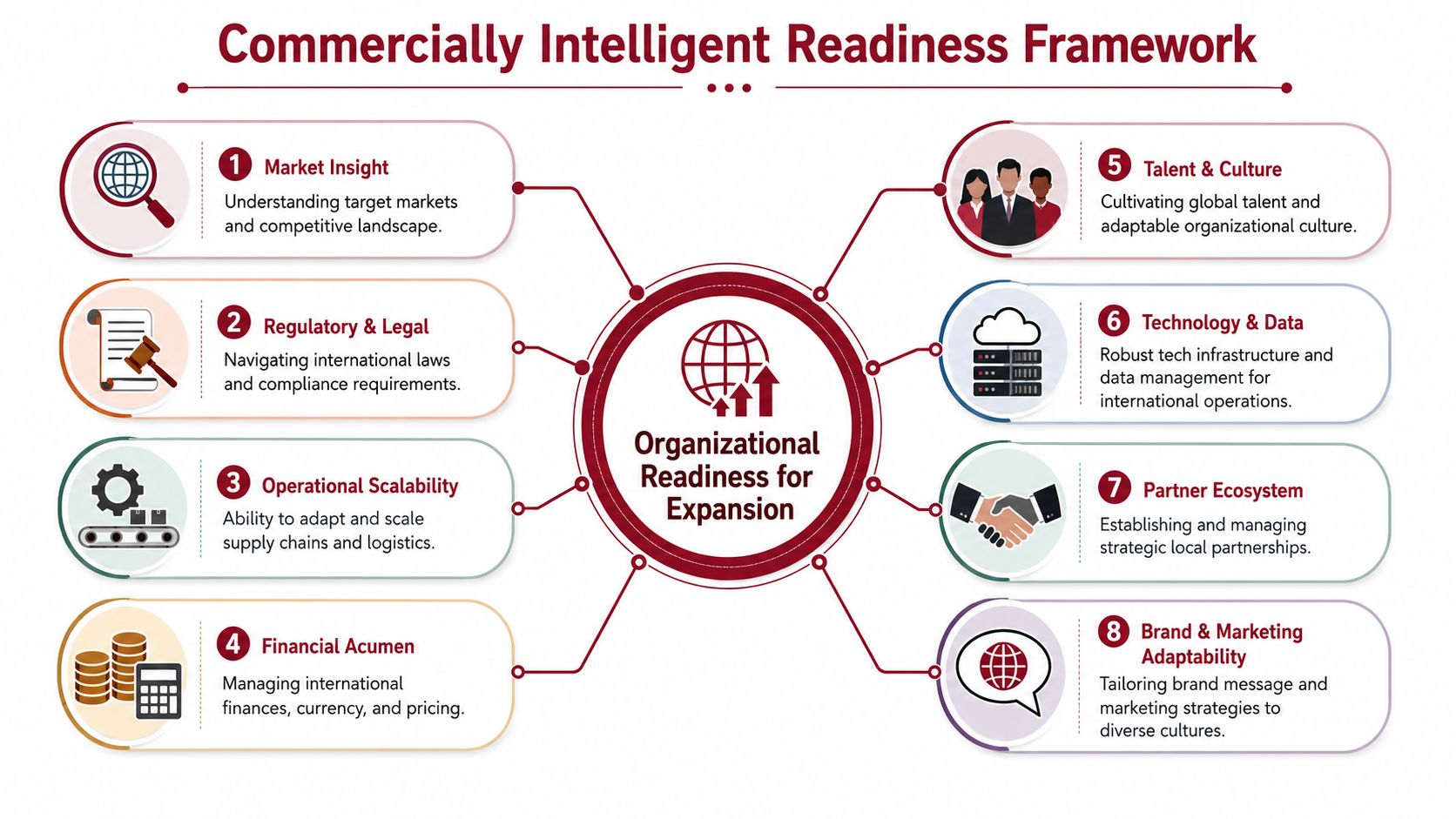
The eight domains that matter
Strategy comes first. Not because strategy is abstract, but because weak strategic clarity forces every downstream team to make assumptions. Founders need to define why this market, why this channel mix, and what role the expansion plays in the broader business. If the answer is “growth”, decisions become inconsistent very quickly.
Product-market fit needs to be reassessed, not assumed. A product that performs strongly in a domestic retail context may struggle in a marketplace environment where reviews, search behaviour, replacement cycles, and perceived value work differently. Great products do not automatically become great brands in unfamiliar ecosystems.
Operations is where many expansion plans start to fray. This includes stock flow, returns handling, customer service structure, systems integration, and escalation paths. When operators look at readiness, they aren't asking whether the team is busy. They're asking whether the team can absorb complexity without losing control.
A sharper lens often comes from broader commercial due diligence before market entry. That kind of review forces the organisation to confront assumptions before they become expensive habits.
What founders often underestimate
The next four domains are usually less visible in boardroom enthusiasm, but they shape outcomes.
- Supply chain: This isn't only about freight. It's about whether the supply model supports channel confidence across fragmented regional ecosystems.
- Compliance: In expansion, compliance is a growth function. If the team treats it as paperwork, delays and channel restrictions follow.
- Go-to-market: Positioning must survive translation. The message has to work in a different trust environment, not just a different postcode.
- Finance: Margin logic changes fast when exchange rates, landed cost, returns, marketplace fees, and support overhead start moving together.
Here's a useful media overview of how readiness assessment thinking is applied in practice.
The final domain is usually the decisive one
People is often treated too narrowly. Founders ask whether they have the team. The better question is whether they have the right ownership model, decision rights, internal credibility, and tolerance for ambiguity. International marketplace expansion creates pressure across product, operations, compliance, and commercial leadership at the same time.
Across multiple marketplace ecosystems, one pattern keeps appearing. Businesses don't usually fail because they lacked a framework. They fail because the framework didn't reflect how the business works. A commercially intelligent assessment corrects that. It links each domain to the practical ways a launch can lose momentum.
| Domain | What strong readiness looks like | What weak readiness tends to cause |
|---|---|---|
| Strategy | Clear market thesis and expansion role | Reactive decisions and scattered priorities |
| Operations | Defined processes and escalation paths | Service inconsistency and internal churn |
| Compliance | Requirements mapped early | Delays, blocked listings, and rework |
| People | Ownership and commitment are explicit | Slow decisions and fading momentum |
Conducting the Assessment with Key Questions for Founders
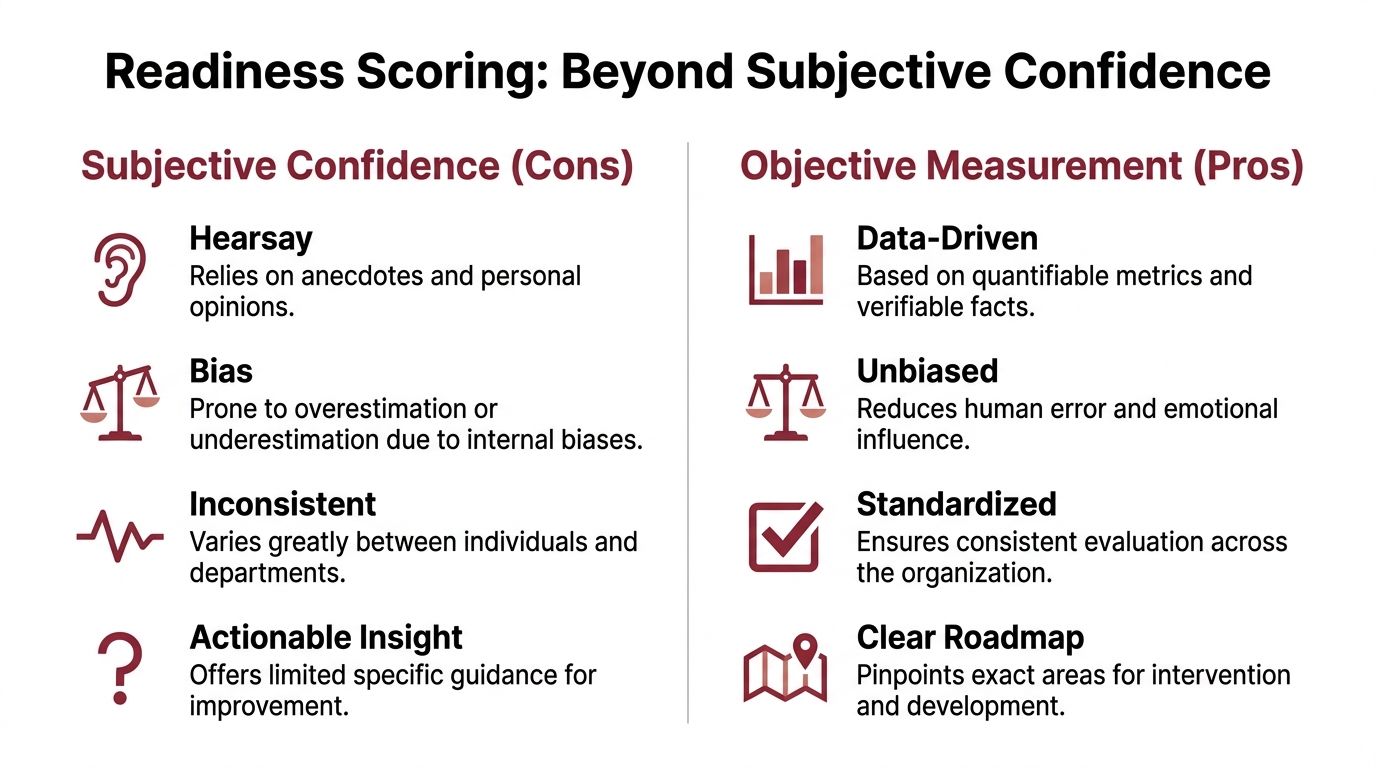
A useful organizational readiness assessment is less about scoring opinions and more about exposing contradictions. Leadership says the market matters. Operations says it can support the launch. Finance says the numbers work. The assessment gets interesting when those statements are tested against each other.
One pattern we continue seeing is that founders ask broad questions that invite optimistic answers. “Are we ready operationally?” doesn't reveal much. “What breaks first if order volume arrives before compliance clearance, customer service scripts, and returns routing are aligned?” produces a very different discussion.
Questions that expose structural weakness
In strategy, ask who is making the non-obvious trade-offs. If the UK channel demands packaging changes that weaken domestic efficiency, who decides? If the US market offers volume but lower net margin, what threshold makes that attractive? If no one can answer clearly, the strategy isn't operational yet.
In operations, ask where the exceptions will go. Standard workflows tend to look clean until the first damaged shipment, restricted product claim, listing suppression, or channel dispute lands in the business. One issue we repeatedly observe is that brands have nominal process ownership, but no actual cross-functional response model.
Practical rule: If your escalation path depends on “the team working it out”, you are not ready.
In go-to-market, the right question isn't whether there is a launch plan. It's whether the positioning can survive a different trust environment. In some ecosystems, authority comes from retail heritage. In others, it comes from reviews, delivery confidence, category language, or installer trust. If your domestic message relies on cues that don't translate, the brand enters the market looking less mature than it is.
Why self-scoring creates false confidence
The assessment process itself can distort the result. A 2023 study found that 65% of organisations that failed to have assessments completed by different representatives reported inflated readiness scores, while 58% of hardware brands that ignored governance frameworks faced implementation collapse within 12 months, according to UNICRI's organisational readiness study.
That result mirrors what operators see in practice. Single-owner assessments almost always read cleaner than reality. The commercial team sees demand. The operations team sees complexity. The compliance lead sees risk. If only one of those perspectives is captured, the organisation ends up assessing confidence, not readiness.
A stronger founder review usually includes questions like these:
- For leadership: What are we willing to keep funding if the first phase underperforms but the long-term case still holds?
- For operations: Which process currently works domestically but becomes unstable once distance, returns, or regional service expectations change?
- For compliance: Which product claims, documentation points, or packaging assumptions are most likely to create entry friction?
- For finance: What cost category are we still underestimating because it hasn't yet appeared in domestic reporting?
Use disagreement as a signal
When teams disagree, that isn't a problem to smooth over. It's often the most useful output of the assessment.
A founder hearing “sales is ready, compliance is not” shouldn't ask who is right in the abstract. The better question is what that disagreement reveals about sequencing, ownership, and governance. Stronger brands let those tensions surface early because they understand that hidden disagreement becomes expensive once stock is committed and channel expectations are set.
Scoring Readiness by Measuring Capacity and Motivation
Most readiness models fail at the point where confidence turns into commitment. They're built to measure whether the organisation has the resources, systems, and processes to do the work. They rarely test whether the organisation is willing to keep going when the work becomes frustrating, slower than expected, or politically inconvenient.
That gap matters more in marketplace expansion than many founders realise.
Capacity is not the same as motivation
A 2018 systematic review of 30 organizational readiness tools found that 100% assessed an organization's capacity to implement change, but 0% included a validated measure for its motivation or willingness, as noted in the Frontiers review of readiness tools.
That distinction is commercially important. Capacity answers questions like these:
- Do we have the people, systems, and budget?
- Can our supply chain support another region?
- Do we understand the compliance work required?
Motivation asks something less comfortable:
- Will leadership keep prioritising this when domestic issues compete for attention?
- Will the team protect the expansion effort when results are initially mixed?
- Does the organisation actually want this market, or does it merely like the idea of it?
Capacity launches projects. Motivation keeps them alive.
A simple scoring model that works
Score each domain on two separate axes. Use a simple internal scale if you want, but keep the logic tight and evidence-based.
| Domain | Capacity test | Motivation test |
|---|---|---|
| Strategy | Is the expansion thesis defined clearly? | Will leadership defend it when trade-offs appear? |
| Operations | Can current systems absorb complexity? | Will teams redesign workflows rather than patch around them? |
| Compliance | Are requirements mapped and resourced? | Will the business slow down when approval risk demands it? |
| People | Are owners assigned? | Do those owners have real commitment and influence? |
The point isn't mathematical sophistication. It's separation. When organisations blend these two dimensions, they produce misleading averages. A business can score high on operational capability and still be low on organisational will. That's how zombie projects begin. They are resourced enough to start, but not championed enough to survive.
A more disciplined version of this can sit beside regular performance benchmarking across channels and markets, especially when leadership wants to compare readiness assumptions against actual operating behaviour.
The four practical quadrants
You don't need a complex maturity model. Four basic patterns are enough.
- High capacity, high motivation: Move forward, with controlled sequencing.
- High capacity, low motivation: Pause. The business can launch, but may not sustain the effort.
- Low capacity, high motivation: Attractive but risky. Leadership wants the move, but the operating model isn't ready.
- Low capacity, low motivation: Don't force it. Revisit the market logic first.
An organizational readiness assessment becomes more than an internal workshop. It becomes a filter against self-deception.
Interpreting Results and Building a Remediation Roadmap
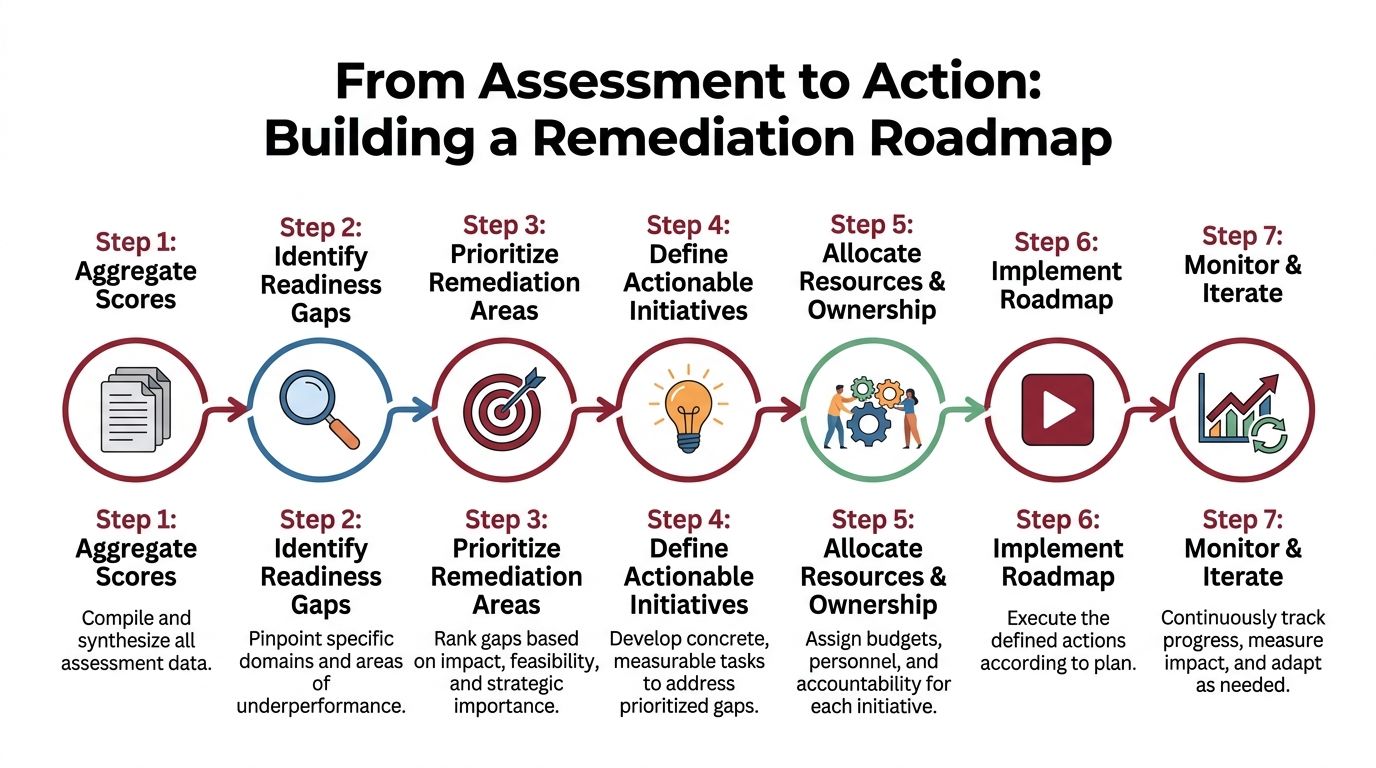
A readiness score on its own doesn't help much. Founders don't need another document proving that some areas are strong and others are weak. They need a way to sequence action without wasting momentum or creating false urgency.
The most useful way to interpret results is through Red, Amber, Green logic. It's simple, but it forces discipline.
Use Red, Amber, Green properly
Red issues are launch blockers. They include unresolved compliance questions, unclear ownership, unstable fulfilment structures, or unit economics that only work under optimistic assumptions. These don't get “managed during rollout”. They get fixed before scale.
Amber issues won't necessarily stop entry, but they will reduce control and margin if left unattended. Typical examples include weak localised messaging, fragile returns processes, incomplete support documentation, or slow reporting loops.
Green issues are ready. That doesn't mean perfect. It means the area can support the expansion with normal management attention rather than heroic intervention.
Treating a Red issue as Amber is one of the fastest ways to confuse activity with progress.
Build the roadmap in phases
A remediation roadmap should be staged, not dumped into a single implementation plan. The sequence matters because some fixes increase the organisation's ability to absorb later complexity.
Stabilise the blockers
Fix the conditions that would make launch irresponsible. This usually means compliance, governance, ownership, or fulfilment reliability.Strengthen the vulnerable seams
Improve the areas most likely to create friction once the market goes live. Returns, escalation handling, localised positioning, and support workflows often sit here.Refine for scale
Once the foundation holds, improve reporting, partner management, channel expansion logic, and margin optimisation.
A structured process matters. According to 2024 Prosci benchmark data, 78% of Australian firms using a structured, multi-step approach to readiness assessment achieved successful change implementation, compared to 42% of those that skipped formal readiness checks, as outlined in Prosci's readiness assessment benchmark discussion.
Keep ownership visible
A practical roadmap doesn't need to be complicated. It does need named ownership, evidence of completion, and a clear decision about whether each item must be resolved before launch or can be addressed in parallel.
- Assign one owner per issue: Shared accountability usually means no accountability.
- Define proof, not intention: “Review packaging compliance” is weak. “Compliance sign-off completed for target market requirements” is stronger.
- Attach sequencing rules: Some actions are mandatory before stock commitment. Others can follow first launch.
- Reassess after remediation: Readiness should be checked again after work is completed, not assumed to be improved because effort was made.
Many organisations benefit from a decision structure rather than a spreadsheet. The roadmap should tell leadership what to fix first, what to defer, and what not to touch until the earlier layers are stable.
From Readiness Assessment to Ecosystem Cohesion
A serious organizational readiness assessment isn't a one-off gate before expansion. It's part of building a business that can move between marketplace ecosystems without losing coherence.
That matters because international growth rarely fails in a dramatic way at first. It often weakens the business gradually. Margin starts thinning. Service complexity rises. Localisation becomes inconsistent. Different channel decisions start pulling the brand in different directions. Marketplace fragmentation subtly damages growth long before leadership calls it by that name.
Across multiple marketplace ecosystems, the stronger operators treat readiness as an ongoing commercial discipline. They reassess when new channels are added, when fulfilment structures change, when regional compliance shifts, and when the team's internal attention gets stretched. They understand that expansion is an ecosystem transition, not a listing exercise.
A 2014 study of Australian health service organisations found that 89% of high-readiness organisations met all compliance milestones within 18 months, whereas 42% of low-readiness organisations failed their first audit benchmarks, according to the published ORCA-related evidence summary. The sector is different, but the structural lesson travels well. Readiness quality changes implementation quality.
What stronger brands do differently
They don't confuse enthusiasm with preparedness. They don't assume a good domestic model will automatically travel. They don't let channel activity get ahead of operating alignment.
Instead, they build around a few disciplined habits:
- They localise without fragmenting the brand
- They design fulfilment around trust, not convenience alone
- They treat compliance as part of market entry strategy
- They keep ownership explicit across commercial and operational teams
The real output of readiness work isn't a score. It's a more coherent business.
That's why the longer-term conversation has to move beyond launch preparation and towards marketplace ecosystem strategy for international growth. Founders who make that shift tend to see the risks earlier, sequence investment more cleanly, and protect brand value while entering more complex markets.
TPR Brands works with established product brands that need more than launch support. If you're assessing whether your business is structurally ready for expansion into the US, UK, Canada, Australia, Japan, or broader marketplace ecosystems, TPR Brands helps clarify the commercial, operational, and localisation realities before they become expensive.