Why do so many founders still treat third party certification as an administrative hurdle when it often determines whether a product is trusted, stocked, and scaled at all?
One pattern we continue seeing is that brands invest heavily in product quality, packaging, and channel strategy, then treat certification as a late-stage compliance task. That thinking rarely survives contact with international expansion. In unfamiliar markets, buyers don't know your manufacturing standards, retailers don't know your internal controls, and regulators don't care how strong your domestic reputation is.
Third party certification closes that trust gap. It gives a market an independent reason to believe your claims. In fragmented marketplace ecosystems, that matters far more than is often realized.
Beyond the Badge A Strategic View of Certification
The weakest way to think about certification is as a badge. The stronger way is to see it as transferable trust.
A founder entering the UK, Canada, Japan, or the US is asking a new market to accept risk. The product may be well designed. The factory may be disciplined. The brand may have strong traction at home. None of that automatically carries across borders. Customers, distributors, and marketplace operators still need proof that the product is safe, consistent, and fit for sale in their environment.

That's why third party certification sits much closer to brand strategy than many operators realise. It reduces uncertainty at the point where a brand has the least inherited trust. It also protects against a common expansion mistake: assuming product confidence inside the business will be accepted as market confidence outside it.
Trust has to be legible
In domestic growth, reputation can carry a lot. In cross-border growth, legibility matters more. Retail buyers want recognised evidence. Marketplace compliance teams want defensible documentation. End customers want reassurance, even if they never consciously read the certification file.
A recent pattern across hardware and consumer categories is that stronger operators embed certification thinking into sourcing, packaging claims, channel sequencing, and quality assurance standards well before launch. Weaker operators leave it until a retailer asks for paperwork or a marketplace listing is challenged.
Certification is often the first credible signal a new market receives about whether your product belongs there.
The commercial shift
Certification can look like cost on a spreadsheet. In practice, it often acts more like market infrastructure. It supports premium positioning, lowers friction in buyer conversations, and gives teams a cleaner route into regulated or reputation-sensitive channels.
The brands that scale cleanly don't ask, “What's the cheapest way to get approved?” They ask, “What proof does this market need before it trusts us?”
Certification and Marketplace Ecosystem Cohesion
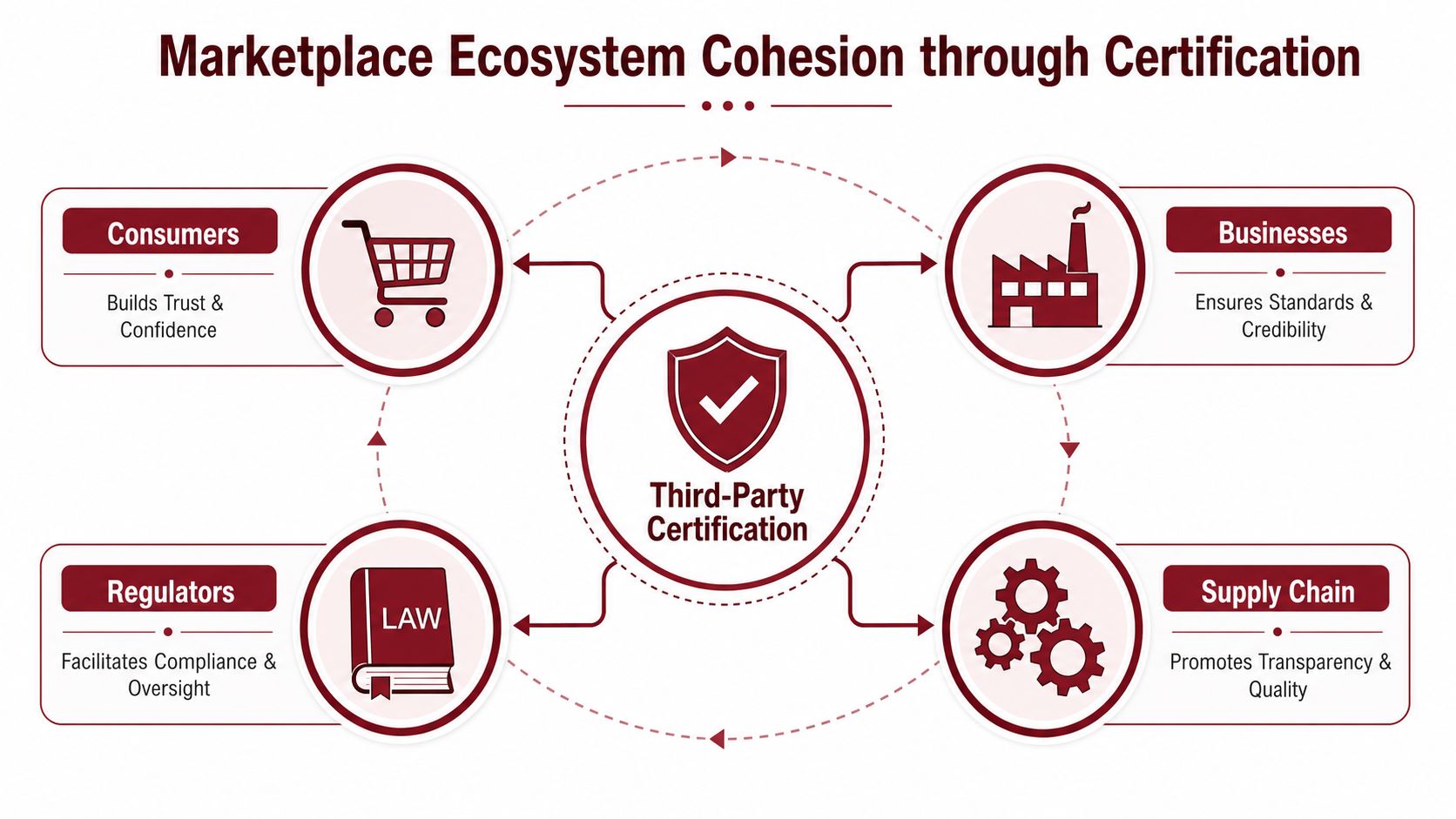
Third party certification matters because marketplaces aren't just collections of listings. They're trust systems.
Across multiple marketplace ecosystems, one issue becomes visible quickly: when trust signals are weak, friction appears everywhere. Retailers become cautious. regulators increase scrutiny. Customers hesitate. Returns, disputes, and listing interruptions become more likely. Certification helps align the expectations of all parties interacting with the product.
Under Australia's Electrical Equipment Safety System, a Recognised External Certification Scheme (RECS) certifier is an accredited body that issues Certificates of Conformity, and that independent review provides a higher level of confidence in compliance while ensuring certification bodies are competent and credible, making it a cornerstone of safety compliance and market trust, according to the EESS guidance on RECS certifiers.
Why independence changes the commercial equation
A self-declaration tells the market what you believe about your own product. Third party certification tells the market that an independent body has reviewed evidence and is prepared to stand behind that assessment within its scope.
That difference is commercial, not just technical.
For founders, independence changes how four groups respond:
| Group | What they need | Why certification helps |
|---|---|---|
| Customers | Reassurance | It lowers perceived purchase risk |
| Retailers | Defensible product acceptance | It supports ranging and compliance reviews |
| Regulators | Credible evidence | It improves confidence in submitted documentation |
| Supply chain partners | Consistency | It helps standardise expectations across sourcing and distribution |
Cohesion beats fragmented credibility
One pattern we continue seeing is that brands can survive with fragmented messaging in low-trust channels for a while, but they struggle to build premium, repeatable growth that way. A product page might claim quality. Packaging might claim safety. A sales rep might claim compliance. If those claims aren't supported by recognised certification, the ecosystem around the product remains loose and fragile.
Practical rule: In new markets, trust built through independent validation travels faster than trust built through brand storytelling alone.
This is especially relevant in categories like consumer electronics, household products, and connected devices, where one weak compliance signal can affect everything from onboarding to reviews to channel confidence. Certification becomes connective tissue. It helps the product, the documentation, the retailer conversation, and the customer promise say the same thing.
Reputation compounds when evidence is portable
Mature operators don't use third party certification only to satisfy a gatekeeper. They use it to create coherence across the whole expansion model. The certificate supports the compliance file. The compliance file supports the listing. The listing supports conversion. The conversion supports reorder confidence.
That's what ecosystem cohesion looks like in practice. It isn't abstract. It's the commercial advantage that appears when every participant in the chain can rely on the same verified proof.
Key Certification Types and Their Commercial Impact
Which certifications change commercial outcomes, and which ones merely satisfy a checklist? That is the question scaling brands need to answer early, because certification spend only pays back when it improves access to channels, protects margin, or supports a stronger market position.
The commercial weight of a certification depends on the risk a retailer, regulator, distributor, or marketplace is trying to control. In one category, safety approval determines whether the product can be listed at all. In another, environmental claims shape procurement decisions and price tolerance. Treating every certification as equal usually leads to wasted budget in low-value areas and underinvestment where the business is genuinely exposed.
Safety and market access
Safety certification sits closest to revenue for many hardware, household, and consumer product categories. If a product uses mains power, produces heat, includes parts that create child-use risk, or enters a tightly monitored retail segment, safety evidence often decides how quickly a brand can get approved and how much friction appears during onboarding.
The cost of weak safety compliance shows up well beyond legal exposure. It can delay ranging decisions, trigger extra document requests from retail buyers, and make marketplaces more cautious about promotional support. Once a product is associated with safety concerns, future launches become harder because the buyer remembers the compliance problem long after the first shipment is gone.
For many operators, the practical question is not whether safety matters. It is whether the current evidence is strong enough to support expansion plans. That becomes easier to assess when certification is reviewed alongside product safety standards rather than parked in a separate legal file.
EMC and connected-product stability
EMC certification and related approvals have a different commercial effect. They shape product reliability in-market, which means they influence reviews, return rates, and channel confidence.
I have seen connected devices enter a new region with decent creative, solid pricing, and clear demand signals, then underperform because interference issues or compatibility failures surface within weeks. At that point, the problem is no longer technical in the eyes of the market. It becomes a product quality issue, and marketplaces tend to punish that quickly through ratings, suppressed conversion, and higher support costs.
For connected-home, consumer electronics, and smart appliance brands, EMC compliance protects more than legal access. It protects the customer experience that supports repeatable marketplace growth.
Materials and environmental positioning
Materials compliance and sustainability-linked certifications play a different role. They rarely create demand on their own, but they often support premium defensibility.
In home improvement, lifestyle, and premium household categories, these certifications can help a brand:
- Enter stricter retail environments where procurement teams need clearer product evidence
- Support premium pricing logic when customers expect proof behind sustainability claims
- Reduce claim risk when marketing teams want to communicate sourcing, material, or environmental standards with more discipline
The strategic test is straightforward. If a certification improves access, strengthens trust, or supports premium positioning, it belongs near the front of the expansion plan. If it does none of those things, it may still be required, but it should be treated as a compliance cost rather than a growth asset.
Navigating the International Compliance Matrix
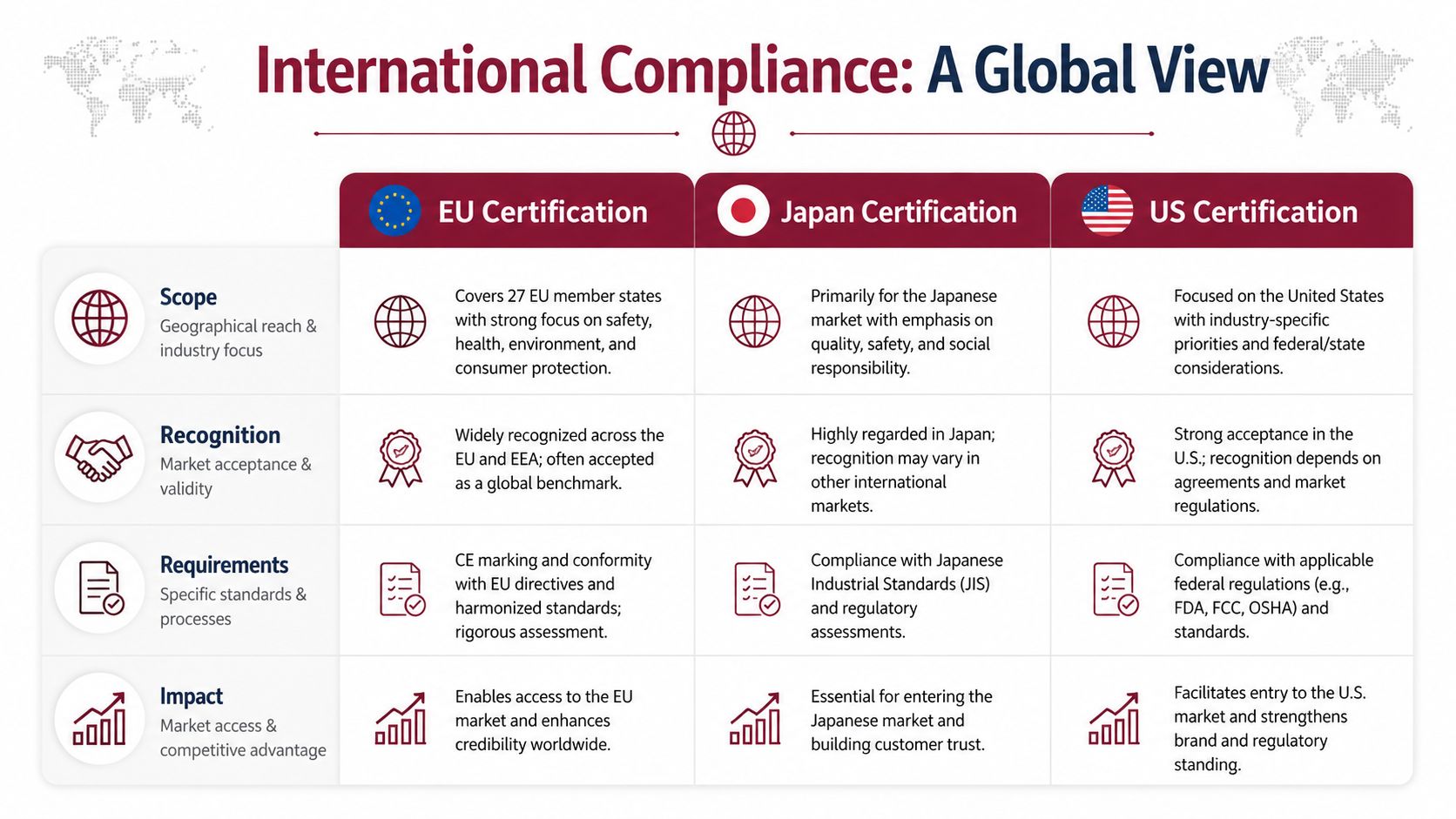
International expansion exposes a hard truth that domestic success can hide. Compliance isn't universal, and certification recognition doesn't travel as cleanly as founders expect.
A product cleared for one region may still face additional documentation, labelling, testing, or certification hurdles somewhere else. That's where otherwise capable growth plans start to fragment. The catalogue may be ready. Inventory may be in motion. Channel conversations may be active. Then the launch slows because the compliance pathway was assumed rather than mapped.
Different regions ask different questions
The EU, UK, US, Canada, Australia, and Japan all operate with their own compliance logic. Some systems focus heavily on harmonised market access. Others place more emphasis on specific national schemes, local approvals, or category-based technical requirements.
That creates a practical challenge for brands in hardware, consumer electronics, and home improvement. The question isn't only whether the product is compliant. The question is whether the proof format is recognised by the next market, the next retailer, and the next channel operator.
A recent marketplace review revealed a familiar pattern. A brand had prepared for EU entry but had not operationally separated UK requirements after Brexit. The product team thought they were late in execution. The underlying issue was earlier: the expansion model treated Europe as one compliance block when the commercial pathway no longer behaved that way.
A fragmented certification plan usually shows up later as delayed listings, duplicated testing, or stock that can't move where the sales team expected.
Australia shows why local frameworks matter
Australia is a useful example because it combines clear standards with strong emphasis on independent assurance in several categories. In steel, third-party certification through ACRS involves annual manufacturer audits and quarterly production data checks to ensure compliance with Australian Standards, and the scheme operates as a two-stage independent model unique to Australia and New Zealand, accredited by JAS-ANZ for consistent quality assurance, as outlined in the ACRS technical note on third-party steel product certification.
That level of scrutiny tells founders something important. Market entry isn't only about passing a test once. In many sectors, the market wants confidence in ongoing control.
Here's a useful way to think about international compliance pressure:
| Region | Typical commercial friction |
|---|---|
| EU | Broad market reach, but technical file discipline matters |
| UK | Separate post-EU pathway can disrupt assumptions |
| US | Strong retailer and liability sensitivity in regulated categories |
| Canada | Additional national recognition can create parallel work |
| Australia | Independent certification and recognised schemes carry weight |
| Japan | Local compliance expectations often require specific preparation |
Later-stage problems are usually downstream symptoms of earlier planning gaps. Teams that document regional requirements early, align test scopes across markets, and centralise compliance documentation tend to preserve speed and margin far better than teams that localise reactively.
A short overview of global compliance pressure is useful here:
Localisation is part of certification strategy
Founders often think about localisation as language, packaging, and channel positioning. It also lives inside the compliance model.
The strongest international operators don't ask whether one certificate can cover the world. They ask where certification can be structured to reduce duplication, where local approvals must be handled separately, and how early those requirements should influence product configuration, packaging claims, and launch sequencing.
Selecting Your Certification Partner Strategically
The certifying body isn't just a service provider. In many categories, it's part of your route to market.
One issue we repeatedly observe is brands choosing a partner on price alone, then discovering that the resulting documentation doesn't carry enough weight with key retailers, marketplace compliance teams, or regional authorities. The spend happened. The confidence didn't.
Cheap approvals often become expensive delays
A cheaper certifier can still be the right choice if its accreditation scope, category competence, and market recognition align with your plan. The problem isn't low cost. The problem is poor fit.
Founders should assess certification partners the same way they assess distributors or manufacturing partners. Ask whether the body is recognised in target markets, whether it regularly handles your product category, and whether it can support a multi-region pathway instead of a single-country file that has to be rebuilt later.
What experienced operators actually check
The strongest teams usually review a partner across a small set of commercial criteria:
- Accreditation scope: Does the body cover the exact standards and jurisdictions your expansion model requires?
- Category familiarity: A connected home device, a steel component, and a household electrical product don't create the same review burden.
- Retail and marketplace acceptance: Documentation that satisfies one gatekeeper may not satisfy another.
- Efficiency across regions: Some partners can coordinate testing and evidence in ways that reduce duplicated work.
- Ongoing support: Certification isn't always a one-time event. Surveillance, file updates, and change control matter.
The right certification partner doesn't simply issue a document. They help preserve channel access when the market starts asking harder questions.
Strategic fit beats procedural convenience
The approach to certification separates experienced operators from reactive ones. Reactive teams ask, “Who can certify this fastest?” Better teams ask, “Who can certify this in a way that supports where the brand is going next?”
That distinction matters when a product range is broadening, when private-label risk is rising, or when a retailer review is likely to trigger deeper scrutiny of technical files, claims, or traceability. A certifier with strategic fit can reduce future disruption. One without it can subtly lock the business into rework.
Common Pitfalls and Commercial Realities of Certification
Most certification problems don't begin in the lab. They begin earlier, in planning assumptions.
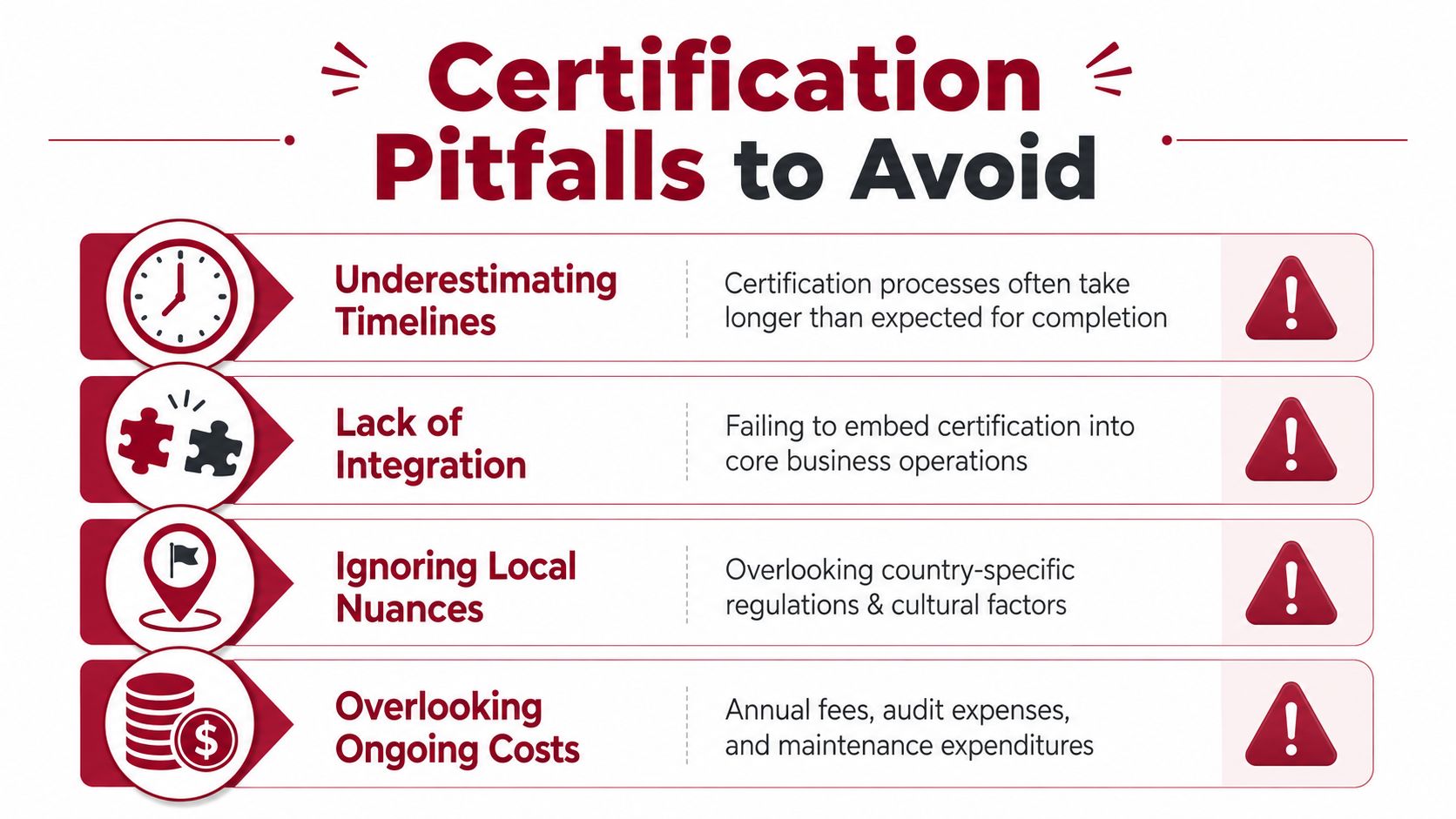
Brands underestimate lead times. Product teams finalise design choices before compliance implications are understood. Expansion budgets include freight, channel fees, and packaging updates, but they leave certification too loosely scoped. The result isn't just stress. It's margin pressure and delayed commercial execution.
The margin issue founders often meet too late
Data shows 57% of Australian consumer product CEOs report that third-party certification costs reduce gross margins by 8–12% when expanding into US/UK markets, and 33% of brand expansion plans stall because of these unanticipated expenses, according to the UL update referenced for Australian and New Zealand certification capability expansion.
That doesn't mean certification is a bad investment. It means unmanaged certification is a margin problem.
One pattern we continue seeing is that brands only evaluate certification as a direct cost. They don't model the knock-on effects. Testing changes can delay launch windows. Audit requirements can affect factory coordination. Late packaging revisions can create write-offs. If the commercial team hasn't priced those realities in, the brand often enters the new market with weaker profitability than expected.
What goes wrong operationally
Some mistakes are avoidable if they're recognised early.
- Timelines are treated as administrative: Teams assume approval will move in parallel with launch, then discover the launch depends on approvals that aren't close to complete.
- Design and compliance sit too far apart: Engineers or product managers make decisions that later complicate certification or force retesting.
- Regional nuance is ignored: A product file prepared for one market gets stretched into another market where it doesn't fully apply.
- Ongoing obligations are forgotten: Surveillance, audits, product changes, and evidence maintenance remain active after launch.
Commercial insight: A delayed certification decision usually becomes a delayed revenue decision.
A more resilient preparation model
The cleaner route is to make certification part of expansion architecture, not post-production paperwork. For scaling brands, that usually means a tighter sequence:
- Map target markets first: Decide where the product needs to sell before finalising proof requirements.
- Review product claims early: Safety, sustainability, performance, and material claims should align with what can be evidenced.
- Align suppliers and factories: If a factory can't support required audits, records, or consistency expectations, the problem is upstream.
- Centralise documentation: Technical files, declarations, test reports, and supplier records should be organised before channel onboarding begins.
- Build traceability into operations: Teams that can show change control and product lineage are in a far stronger position during scrutiny, with traceability requirements starting to shape expansion quality, not just compliance hygiene.
The brands that manage certification well don't remove cost. They reduce surprise. That's a major difference when the goal is controlled, repeatable international growth rather than a single successful shipment.
Frequently Asked Questions for Scaling Brands
Is third party certification only relevant in regulated categories
No. It has the highest urgency in regulated categories, but it also matters in premium and trust-sensitive categories where the buyer needs assurance before switching to an unfamiliar brand. In those cases, certification supports commercial credibility even when it isn't the only route to sale.
Can certification help support premium pricing
Sometimes, yes. Not because a badge automatically creates willingness to pay, but because independent verification can make quality, safety, or sustainability claims more believable. That tends to matter more when the product is entering a market where brand recognition is still low.
Should brands certify for every future market at once
Usually not. The better approach is sequencing. Map the next likely markets, identify overlap in requirements, and avoid building a global certification stack that the business won't use soon. Over-certifying too early can tie up capital without improving immediate market access.
What's the biggest mistake founders make
Treating certification as downstream admin. By the time it becomes urgent, it's often influencing launch timing, packaging, claims, sourcing, and margin all at once.
When does certification become a strategic asset rather than a cost
When it improves one of three things: market access, trust transfer, or premium defensibility. If it does that consistently across a channel ecosystem, it's no longer just a compliance line item. It's part of how the brand scales safely.
TPR Brands helps established product companies build commercially cohesive expansion strategies across Australia, the US, Canada, and the UK. If your team is preparing for international growth and wants a sharper view of how compliance, channel structure, localisation, and marketplace trust fit together, start a conversation with TPR Brands.