What happens when a founder discovers that “we know where it comes from” isn't enough for a marketplace, an importer, or a regulator that wants proof?
That's the gap. Most brands treat traceability requirements as a compliance file that sits somewhere between quality assurance and procurement. Then international expansion starts, scrutiny rises, and a basic domestic process suddenly looks thin. Supplier spreadsheets, batch notes, and emailed declarations might be acceptable inside a familiar local channel. They rarely survive contact with a more demanding ecosystem.
One pattern we continue seeing is that strong Australian product businesses assume traction equals readiness. It doesn't. Great products do not automatically become great brands in international marketplaces, because marketplaces don't only assess demand. They assess operational credibility, supply chain coherence, and whether a business can substantiate what it says about origin, safety, and conformity.
For hardware, home improvement, and consumer product brands, this matters more than most founders realise. Public conversations around traceability still lean heavily toward food, agriculture, and pharmaceuticals. Meanwhile, the brands dealing with imported components, contract assembly, private label adjustments, and multi-country fulfilment are left to work it out themselves. That's where expansion gets blocked, long before a listing goes live or a distributor signs.
Is Your Supply Chain Ready for International Marketplaces
A domestic supply chain can look organised and still be unfit for international marketplaces.
That sounds harsh, but it's usually true. Brands often know their suppliers, have acceptable QA routines, and can answer basic retailer questions. What they can't always do is produce a verifiable chain of custody quickly, consistently, and in a format that matches the expectations of a new market. That distinction matters.
Readiness is different from familiarity
Many founders confuse familiarity with control. They've worked with the same factory for years, know the importer, trust the packaging line, and haven't had a major incident. But traceability requirements test something else. They test whether your business can prove what happened, where it happened, and which exact inputs relate to which finished units or batches.
Across multiple marketplace ecosystems, that's where confidence breaks down.
A recent marketplace review revealed a recurring pattern in premium consumer categories. The product itself was solid. Reviews were healthy. The issue sat behind the catalogue. Documentation lived across inboxes, older ERP notes, supplier PDFs, and ad hoc spreadsheets maintained by operations staff who knew the business well but couldn't turn that knowledge into audit-ready evidence.
Practical rule: If your traceability only works when a specific staff member is available to explain it, you don't have a system. You have institutional memory.
What founders often underestimate
International expansion is an ecosystem transition, not a listing exercise. New markets bring new expectations around proof, accountability, and response speed. If a marketplace, customs body, insurer, retail partner, or legal adviser asks for evidence, the question isn't whether you broadly comply. The question is whether you can demonstrate that compliance cleanly.
That becomes even more important when fulfilment structures change. Once inventory moves through overseas warehousing, marketplace prep, third-party logistics providers, and local resellers, weak traceability starts creating friction at exactly the point where a brand needs confidence.
A founder should be able to answer questions like these without creating a fire drill:
- Component visibility: Can you identify which supplier lot sits inside a top-selling SKU?
- Document linkage: Can you connect a conformity claim to the relevant certification, test result, or declaration?
- Response speed: Can your team produce that information without searching across disconnected files?
- Market fit: Is your current process suitable for the jurisdiction you're entering, not just the one you already know?
If the answer is uncertain, the supply chain isn't ready yet.
Brands that want cleaner international growth usually benefit from tightening operational foundations before expansion pressure exposes the gaps. That often starts with better supply chain optimisation for multi-market growth, not more marketplace activity.
The Traceability Gap in Consumer and Hardware Goods
The public conversation around traceability requirements is badly skewed.
Food systems have visible standards. Pharmaceuticals have obvious regulatory intensity. Livestock traceability is widely discussed in Australia. Hardware, home improvement, household goods, and consumer product categories get far less practical guidance, even when their supply chains involve the same complexity: imported inputs, component transformation, relabelling, assembly changes, and multi-party fulfilment.
Why the public guidance misses the real problem
A major underserved angle is the assumption that traceability review covers only food and agriculture, leaving hardware and home improvement brands without clear guidance on how ISO 9001 and GS1 apply to non-farm steel and assembly chains. That nuance is critical for Australian hardware firms scaling to the US and UK, where non-food traceability mandates are emerging but remain poorly documented in AU-specific guidance, as noted by the Australian Steel Institute's traceability focus area.
That gap creates a false sense of security. Founders read broad statements about quality systems, supplier approvals, and product documentation, then assume their current process is enough. It often isn't.
One issue we repeatedly observe is that brands sourcing from Asia have paperwork, but not a traceable framework. They may hold invoices, test reports, and packaging specs. They may even have supplier declarations. But the documents aren't structured in a way that links component origin, manufacturing events, and final sellable units into a verifiable chain.
What traceability means in marketplace terms
In marketplace ecosystems, traceability isn't just about being able to say where a product came from. It's about being able to prove the product's history in a way that supports trust across multiple actors:
| Marketplace actor | What they care about |
|---|---|
| Importer or customs adviser | Provenance, component origin, supplier identity |
| Marketplace operator | Product safety, authenticity, claim substantiation |
| Retail partner | Recall readiness, batch visibility, documentation quality |
| Insurer or legal team | Clear evidence trail when something goes wrong |
That's why a generic approach doesn't hold up. “Made in China, packed in Australia” is not a traceability strategy. Neither is “our factory is certified”. Those statements may be true, but they don't answer the harder questions about what happened inside the product's chain of production and movement.
The brands that struggle most aren't usually careless. They're relying on systems designed for purchasing and logistics, when the market is asking for evidence and proof.
For hardware and consumer brands, this becomes a brand protection issue as much as a compliance issue. A premium positioning can weaken very quickly if the business can't substantiate product claims, material inputs, or component history under pressure. That's one reason product governance and product safety standards across channels have become commercially linked rather than administratively separate.
Mapping Global Regulatory and Marketplace Mandates
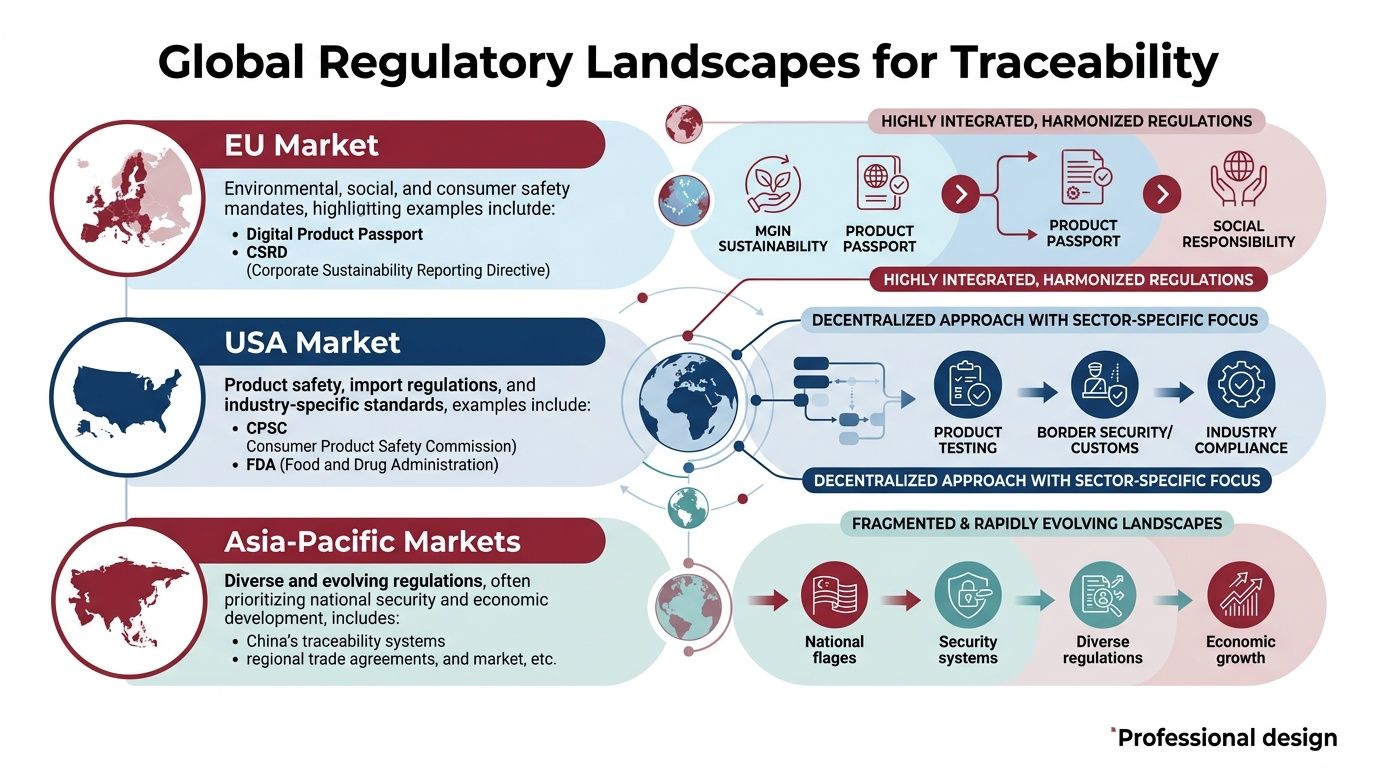
Traceability requirements don't behave like a single global rulebook. They behave like a patchwork of local expectations, category-specific mandates, and marketplace-level risk controls.
That's where many expansion plans lose realism. A founder might build a system that satisfies one market, then assume it can be copied into another. What becomes visible during international expansion is that each region asks different questions, in different formats, with different levels of tolerance for ambiguity.
To frame that fragmentation clearly, this comparison helps.
Australia as a signal of regulatory depth
Australia already shows what mature traceability looks like when a sector is regulated properly.
In construction and hardware, mandatory traceability verification under AS/NZS 5131 requires a verifiable link from manufacturer credentials to fabricated assemblies on a specific project. Failure to provide that evidence invalidates the Conformity Certificate and prevents project certification under the National Construction Code, as outlined in this AS/NZS 5131 technical note.
That standard is useful far beyond structural steel because it shows the direction of travel. Mature systems don't reward vague assurances. They require documented linkage between credentials, product movement, and end use.
Here's a useful contrast:
| Market context | What the system tends to demand |
|---|---|
| Australia in regulated sectors | Verifiable documentation linked to conformity and project use |
| US market entry | Strong scrutiny around import documentation, safety, and origin proof |
| EU market entry | Greater emphasis on documented product history, declarations, and structured data |
This isn't a matter of one region being stricter and another being easier. It's a matter of different enforcement logic.
Localisation sits inside compliance
Australia's broader expansion environment makes this point even sharper. The market is described as a “smooth and swift” entry point because of its open trading economy and global trade agreements, but businesses still need market-specific localisation rather than generic marketplace tactics, according to the Global Expansion guide to Australia.
That same logic applies in reverse when Australian brands go offshore. A process that works locally won't automatically satisfy a US importer, an EU distributor, or a marketplace compliance team.
This short overview adds useful context.
One pattern we continue seeing is that brands over-focus on channel mechanics and under-invest in regulatory translation. They prepare listings, ads, and fulfilment plans, but don't translate product evidence into the language of the target market.
That's why strong operators treat traceability requirements as part of regulatory change management across regions, not as a static compliance file. The requirement changes as the ecosystem changes.
Required Data Elements for Verifiable Traceability
What would your team need to produce within 24 hours if a US marketplace, EU distributor, or customs broker challenged one product claim?
That question usually exposes the state of traceability. Australian hardware and consumer brands selling offshore often have plenty of files, but weak proof chains. A test report sits in one folder, a supplier declaration in another, and shipment records live inside a freight portal no one can access quickly. The issue is not document volume. The issue is whether the brand can connect a finished product, its imported components, and the supporting evidence in a form a third party will accept.
The data has to prove both identity and history
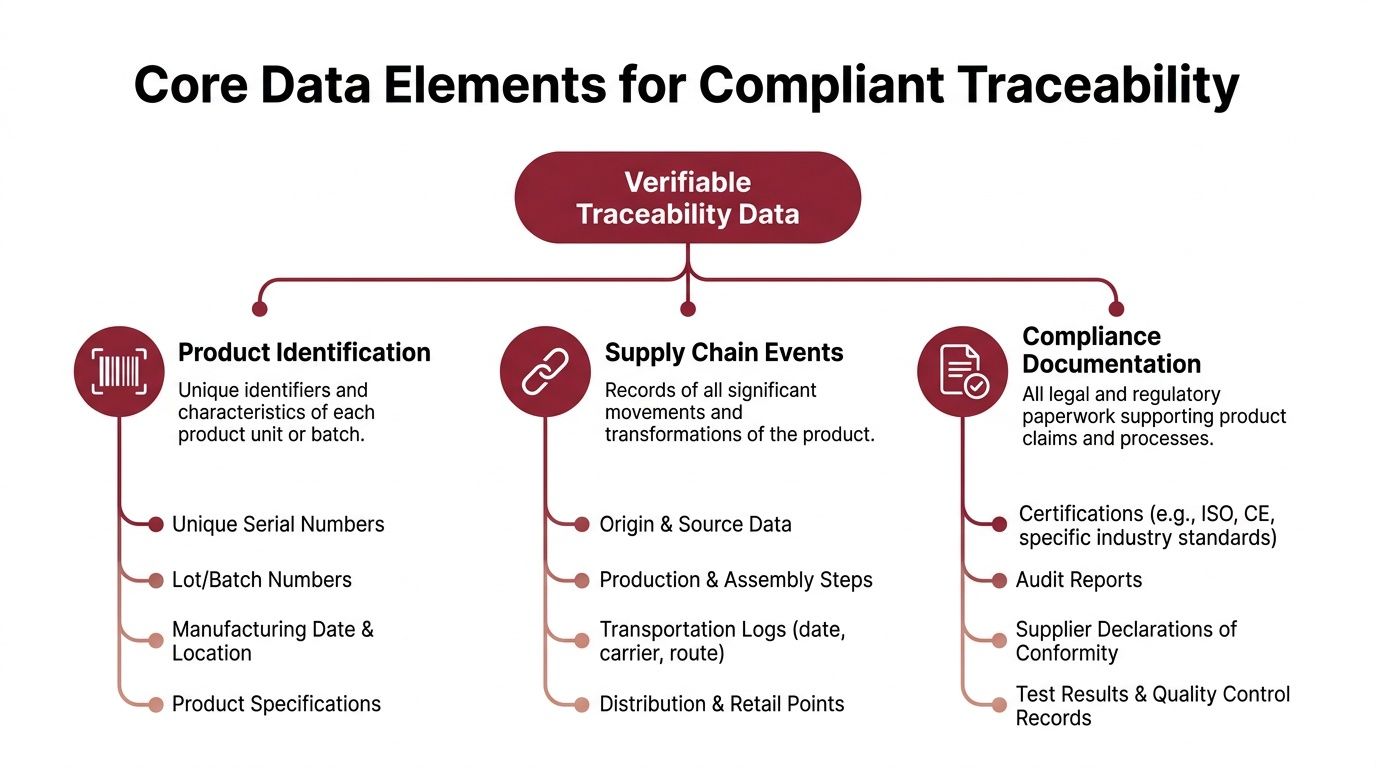
Under the GS1 Traceability Standard adopted in Australia, end-to-end traceability is structured around two mandatory data categories: product attributes and transaction data, with each product requiring a conformity declaration backed by verifiable evidence, as described in the National Building Products Coalition traceability and digitalisation guide.
For founders, the practical test is simple. Product attributes prove what the item is. Transaction data proves what happened to it.
Product attributes should identify the exact item being sold and the basis for each compliance claim. For hardware, home improvement, and consumer products, that usually means product identifiers, model references, materials, component composition, applicable standards, test results, certifications, and declarations tied to the right version of the product. If a charger, lighting product, power tool accessory, or plumbing component changed supplier or bill of materials, the record needs to show which version is in market.
Transaction data should show chain of custody. That includes receiving records, dispatch records, transfer logs, warehouse events, importer references, batch links, and where relevant, serial-level or lot-level movement history. This matters more in US and EU expansion than many Australian brands expect, because proving compliance often means proving which input came from which supplier and when it entered the finished goods stream.
A usable evidence set usually includes:
- Identification records: SKU references, model numbers, component identifiers, lot or batch references, and serial data where relevant.
- Technical evidence: specifications, test reports, declarations of conformity, certification records, and approved artwork or label versions.
- Supply chain event records: receipts, dispatches, transfers, container or shipment references, warehouse logs, and 3PL handling records.
- Supplier and factory linkage: records connecting each component or material to the upstream supplier, manufacturer, or production site.
- Version control: evidence showing which documents apply to which production run, especially after substitutions, reformulations, or packaging updates.
Imported components are where the proof chain usually breaks
This is the gap that catches expanding brands. The finished product may have a clean declaration, but the underlying component trail is patchy. A supplier confirms compliance by email. A factory changes a sub-supplier without notice. A distributor in Europe asks for evidence tied to a specific shipment, while a US marketplace asks for product-level documentation that matches the listing and packaging exactly.
Those requests sound similar. Operationally, they are not.
A stronger system links every key claim to source evidence and ties that evidence to the exact product, batch, component set, or shipment in question. That is what makes traceability verifiable instead of merely documented.
Three questions separate a file library from a working traceability system:
- Can each compliance claim be substantiated with primary evidence?
- Can the team retrieve that evidence quickly, without relying on one employee or one supplier contact?
- Can the evidence be matched to the exact goods sold into the US or EU market, not just to a similar product?
Conformity declarations matter here, but only when they are supported properly. A declaration without linked test records, supplier references, manufacturing details, and movement history is weak evidence. It may satisfy a light-touch check. It usually fails under escalation.
The better operators build traceability into product governance early. They set naming rules, ownership rules, and document controls across procurement, quality, and operations. They also treat compliance documentation workflows as part of commercial readiness, because the commercial test is straightforward. If proof cannot be retrieved fast and defended across jurisdictions, expansion slows down.
The Commercial Consequences of a Weak Supply Chain
When traceability fails, the obvious damage gets most of the attention. Recalls. Legal exposure. Listing removal. Shipment delays.
The quieter commercial damage is often worse.
A weak traceability system limits where a brand can go, who will stock it, and how confidently it can defend its premium positioning. It narrows the business toward easier channels with lower scrutiny and weaker margins. That outcome often arrives gradually, which is why founders miss it until expansion momentum slows.
The hidden cost isn't only compliance failure
One issue we repeatedly observe is that brands interpret traceability as a defensive necessity. They only think about it when legal risk appears. Commercially, that's too late.
Weak proof changes buyer behaviour. A distributor becomes cautious. A marketplace escalates a documentation request. A retailer asks for stronger substantiation before range expansion. Internal teams become slower because every compliance query triggers manual reconstruction.
The result is drag across the whole growth engine.
A supply chain issue doesn't need to become public to hurt the brand. It only needs to make a gatekeeper uncertain.
That's especially relevant for Australian hardware and consumer product brands built on imported components. A key unaddressed question is how to prove traceability for imported components, including from China, to meet US and EU compliance, because those jurisdictions now require end-to-end traceability, including under frameworks such as UFLPA and CBP, while Australian guidance remains siloed in agriculture, leaving hardware brands with a compliance gap, as highlighted in this discussion of Australian traceability framing in export supply chains.
Where the commercial pressure shows up first
The pressure usually appears in a few places before founders label it as a traceability problem:
- Channel resistance: New partners ask harder questions about origin, testing, declarations, or bill-of-materials visibility.
- Margin pressure: The brand gets pushed into less demanding channels that don't build long-term value.
- Internal inefficiency: Operations, legal, and sales waste time assembling proof each time a request arrives.
- Brand vulnerability: A single incident becomes harder to contain because the evidence trail is fragmented.
Across multiple marketplace ecosystems, the stronger brands understand that traceability is a trust architecture. It supports authenticity, recall readiness, claim substantiation, and internal decision-making at the same time.
The weaker brands keep treating it as a file for “if something goes wrong”.
That's the wrong lens. If you can't prove origin, transformation, and conformity under pressure, you don't just have a compliance weakness. You have a market access weakness.
A Compliance Checklist for International Scaling
What happens when a US retailer, Amazon compliance team, or EU importer asks for proof on a product you already shipped?
A credible answer requires more than a folder of PDFs. It requires a traceability system that can tie a finished SKU back to its components, supplier declarations, testing records, and manufacturing history across more than one jurisdiction. For Australian hardware, home improvement, and consumer product brands, that is where expansion plans often get exposed. The business may be compliant enough for local trading, but not structured well enough to satisfy US and EU scrutiny on imported parts, origin claims, or marketplace documentation checks.
Strategic questions worth asking before expansion
Australia's pharmaceutical regime shows how detailed mature traceability systems can become. Australia mandates serialized track-and-trace for prescription medicines, using GS1-aligned identifiers and product-level data requirements, as outlined in this overview of pharmaceutical track-and-trace regulations in Australia. Consumer goods and hardware do not follow that same model, but the direction is still relevant. Regulators, customs authorities, and major marketplaces increasingly expect structured, verifiable records rather than general assurances from the brand.
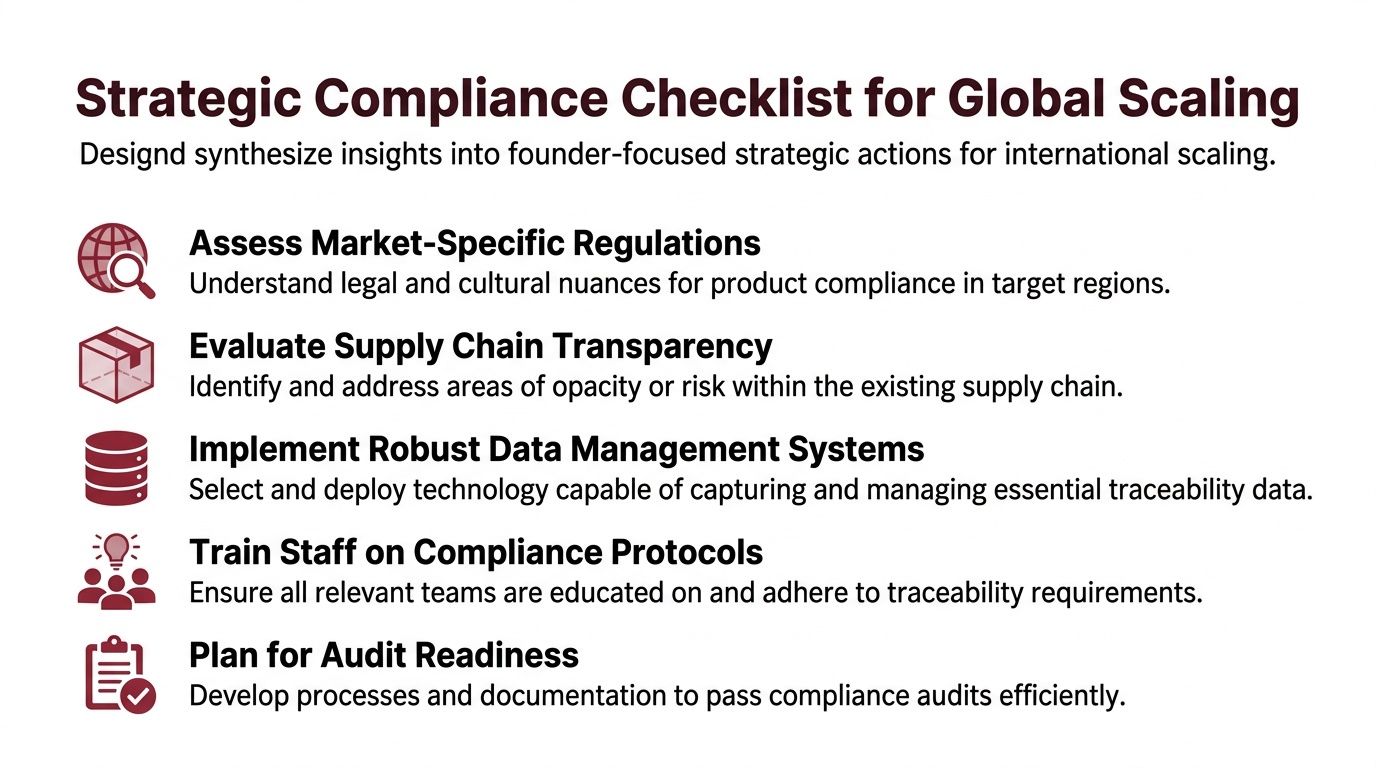
Before entering the US or EU, founders should be able to answer five questions with confidence:
- Market by market: Have we checked each target market separately, including marketplace rules, importer expectations, and product-specific obligations?
- Component origin: Can we show where imported parts came from, who supplied them, and how they flow into our finished SKUs?
- Record linkage: Do declarations, lab reports, bills of materials, and purchase records clearly connect to the exact product being sold?
- Proof under pressure: Can the team retrieve that evidence quickly if a retailer, regulator, customs authority, or platform asks for it this week?
- Control points: Do we know which supplier, assembler, or internal handoff would break the evidence chain first?
These questions sound operational. They are commercial.
If the answer to any of them depends on one team member's inbox, a spreadsheet no one else trusts, or suppliers sending documents after a shipment is held, the business is carrying hidden expansion risk. I see this regularly with Australian brands that source globally, assemble selectively, and assume a local compliance file will stretch across US and EU channels. It rarely does.
What this checklist reveals
A good checklist exposes whether traceability sits inside the operating model or outside it as an admin task.
The stronger brands build records that support sales, channel approvals, customs reviews, retailer onboarding, and incident response without rebuilding the proof set every time. The weaker brands treat each request as a one-off exercise. That slows market entry, weakens negotiations with better distributors, and increases the chance that a documentation issue becomes a listing issue or a shipment issue.
For founders, the practical test is simple. Can the business prove origin, conformity, and product history at SKU level across both your home market records and your destination market requirements? If not, international scaling is still ahead of your systems, even if demand is already there.
TPR Brands works with established product businesses that are ready to scale without weakening brand value, channel quality, or operational control. If your team is expanding into new marketplace ecosystems and needs sharper alignment between compliance, localisation, distribution, and commercial structure, speak with TPR Brands.