The most common advice about a certificate of origin is also the most expensive. Treat it as end-of-process paperwork, hand it to a junior operator, and deal with it when the freight is ready.
That approach works right up until it doesn't.
For established product brands expanding across borders, the certificate of origin isn't an admin footnote. It sits at the point where sourcing, tariff treatment, customs clearance, retailer expectations, and marketplace service levels all meet. When that point is weak, brands don't just face a document issue. They absorb margin leakage, shipment friction, and avoidable credibility damage in-market.
One pattern we continue seeing is that strong brands often prepare thoroughly for channel strategy, pricing architecture, localisation, and fulfilment routing, but still underweight origin documentation. That's a mistake. In cross-border trade, small documentary errors can behave like structural weaknesses because they show up late, usually when inventory is already moving and customer commitments already exist.
A certificate of origin matters most when the rest of the expansion plan looks commercially sound. That's why founders should care.
The Unseen Cost of Scaling Internationally
A certificate of origin is often described as a customs form. That description is technically tidy and commercially misleading.
For an expanding brand, it functions more like a control document. It helps determine whether goods clear smoothly, whether the importer can access the intended tariff treatment, and whether the shipment aligns with what every downstream party thinks it is buying. In Australia, a Certificate of Australian Origin is mandatory for customs clearance at the port of delivery in the destination country and is often required under a letter of credit, according to Business NSW's guidance on the Certificate of Australian Origin.
Why founders feel the pain late
The damage rarely appears when the document is created. It appears later.
It shows up when stock misses a booking window. It shows up when an importer can't support a tariff claim. It shows up when a retail partner expected landed cost stability and gets a different result. By then, the issue no longer belongs to compliance alone. It becomes a commercial problem involving margin, inventory timing, and partner confidence.
Across multiple marketplace ecosystems, fragmentation starts to become visible. The catalogue may be strong. The product may already perform in domestic channels. Yet one weak compliance process can interrupt a launch sequence, distort pricing assumptions, or force teams into reactive workarounds that shouldn't exist in a mature expansion model.
Practical rule: If a document can alter customs clearance, tariff position, and buyer confidence at the same time, it belongs in commercial planning, not just shipping admin.
The real cost isn't the document
The form itself isn't the expensive part. The expensive part is everything around it when it's wrong, delayed, misunderstood, or treated as optional when it isn't.
A recent marketplace review revealed a familiar pattern in household and consumer product categories. Teams spend months refining packaging, channel messaging, and launch inventory assumptions, but the origin workflow still depends on emails, disconnected files, and inconsistent product descriptions. That kind of setup might survive occasional export activity. It doesn't scale cleanly across multiple regions.
The certificate of origin becomes strategically important because it carries a simple but high-stakes claim. Where was this product grown, produced, or manufactured? Once that claim interacts with customs, banks, importers, and marketplace timelines, it stops being minor paperwork.
What stronger operators do differently
Brands that expand well don't isolate origin documentation from broader market-entry decisions. They tie it to:
- Landed cost discipline: Tariff treatment has to match the pricing model.
- Fulfilment reliability: Clearance friction affects stock availability and marketplace continuity.
- Brand protection: Repeated documentation errors make a business look less dependable than it is.
- Regional readiness: Different markets care about different forms of proof and verification.
When founders understand that, the certificate of origin stops looking bureaucratic. It starts looking like what it is. A small document with outsized influence on market entry speed and commercial control.
Preferential vs Non Preferential Certificates
The cleanest way to think about this is simple. A non-preferential certificate of origin is a passport. It tells customs where the goods are from. A preferential certificate of origin is a VIP pass. It doesn't just identify origin. It helps qualify for reduced or zero tariffs under a relevant free trade agreement.
That distinction matters because many brands conflate proof of origin with access to trade benefits. They're related, but they aren't the same commercial instrument.
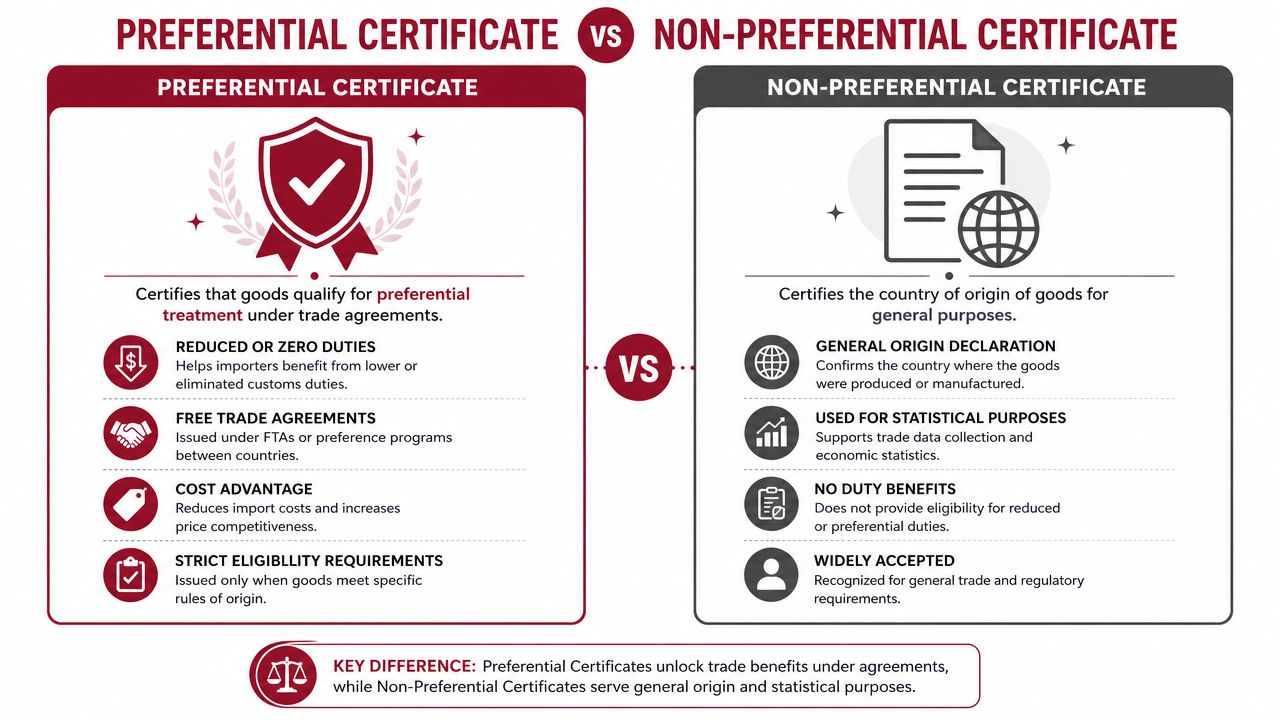
One document proves origin. The other can protect margin
A non-preferential certificate is usually about general origin declaration. It may support customs processing, buyer requirements, banking requirements, or country-specific trade controls. It tells the border authority what the product's nationality is for administrative and regulatory purposes.
A preferential certificate operates differently. It supports a claim that the product qualifies under an FTA's rules of origin. If that claim holds, the importer may receive better tariff treatment. That's where the document moves from compliance into pricing strategy.
For founders, the practical question isn't “Which form do I need?” It's “Does this product qualify for the tariff treatment our commercial model assumes?”
Rules of origin are where product strategy meets trade reality
Weaker expansion plans often unravel when a product assembled in one country doesn't automatically qualify as originating there for preferential treatment. The product has to satisfy the specific origin rules that apply under the relevant agreement.
Under the UK-Australia FTA rules of origin guidance, goods can qualify if they are wholly obtained or produced, produced entirely using originating materials, or made using non-originating materials that satisfy the relevant Product-Specific Rules. The same guidance also notes that importers in Australia don't need a formal declaration of origin for shipments under $1,000 AUD customs value, which removes the certificate requirement for some low-value movements. In the same source, over 99% of U.S.-manufactured goods exported to Australia became duty-free under the FTA.
That combination is useful because it shows the strategic spread. In one case, origin documentation can be the difference between standard duties and duty-free treatment. In another, the shipment value itself changes the documentation burden.
The practical decision framework
Founders don't need a customs seminar. They need a commercial lens.
| Certificate type | Strategic role | Typical business impact |
|---|---|---|
| Non-preferential | Confirms product origin for general trade purposes | Supports border processing, buyer confidence, and documentary consistency |
| Preferential | Supports an FTA tariff claim | Can improve landed cost and pricing position if origin rules are actually met |
One issue we repeatedly observe is that teams classify products commercially but not structurally. They know the range, price point, and target customer. They haven't pressure-tested the bill of materials, processing steps, and HS code implications against the trade agreement they're relying on.
If your margin model depends on preferential duty treatment, origin qualification needs to be validated before launch, not after the first shipment is booked.
That's the difference between a product that merely enters a market and a product that enters with commercial advantage intact.
Navigating Issuing Bodies and Regional Nuances
A certificate of origin starts affecting margin long before customs reviews it.
The commercial risk sits in who issues it, how the destination market treats that issuer, and whether your importer, broker, or marketplace partner accepts the document without delay. Teams that treat origin certification as a standard back-office task usually find the cost elsewhere. It shows up in slower market entry, extra broker time, shipment holds, and price pressure when duty assumptions fail under local scrutiny.
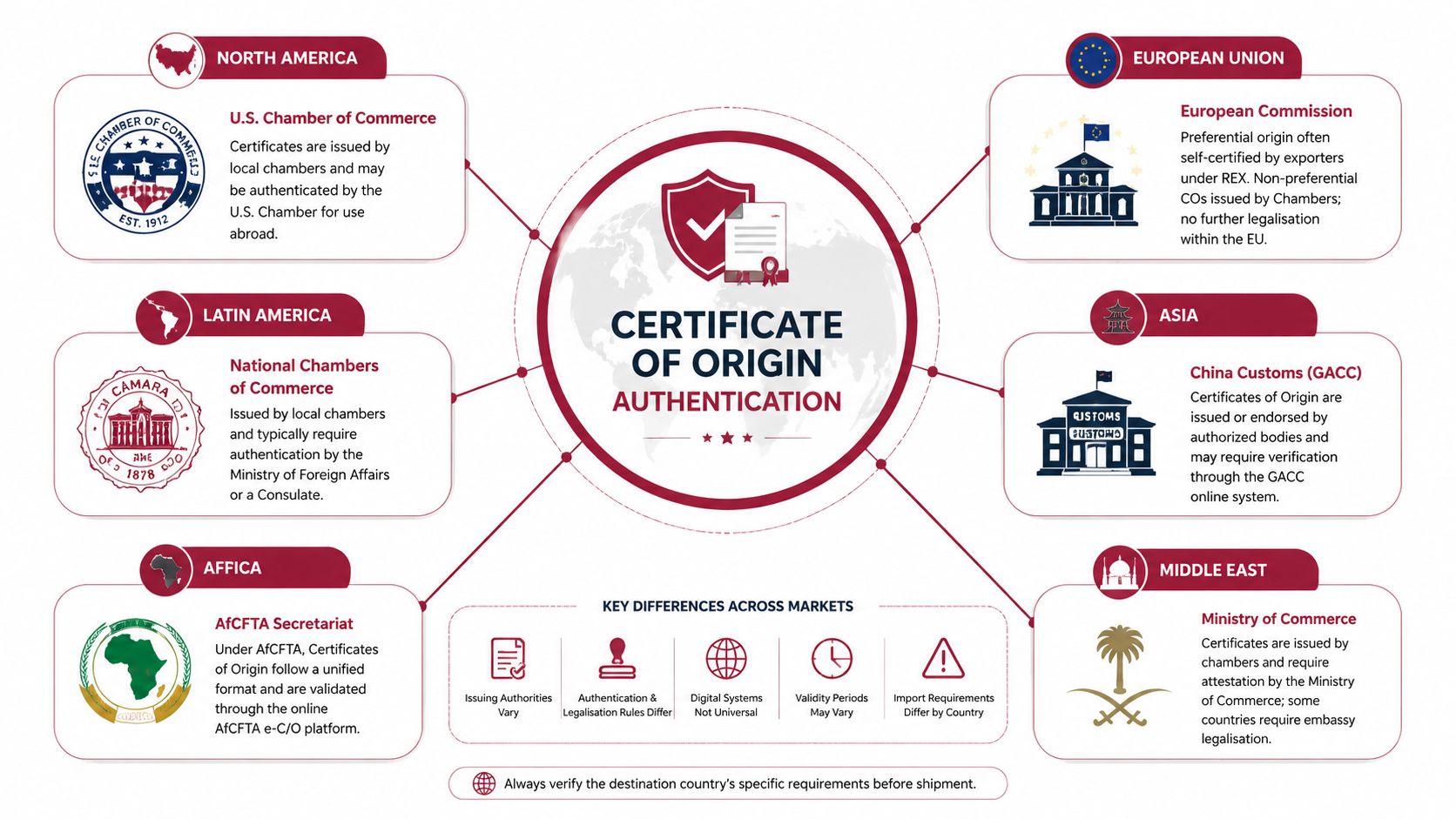
The issuing body affects more than admin flow
Issuer choice shapes speed and credibility.
The same WCO study cited earlier, the Comparative Study on Certification of Origin, notes that chamber-issued certificates remain widely used for non-preferential origin, with Chambers of Commerce acting as a leading issuer model. It also notes that issuance costs vary materially by market and provider. For a brand shipping across several destinations, that is not a clerical detail. Repeated certificate fees, rework, and inconsistent acceptance can chip away at contribution margin order by order.
I have seen founders focus on unit economics and freight rates while ignoring issuer strategy. Then the first expansion wave hits. One market accepts the document immediately. Another asks for reissuance, further authentication, or clarification from a broker who has never seen that format from that provider. The product is the same. The drag comes from the issuer path.
Australia has a defined issuer environment
In Australia, exporters work through a limited group of accredited bodies rather than an unrestricted pool of providers. That changes the decision from “who can issue this” to “which approved issuer fits our operating model.”
That choice affects more than fees.
- Workflow speed: Portals, cutoff times, correction handling, and service responsiveness differ by issuer.
- Control across teams: If sales, operations, and freight partners use different issuers without a policy, document inconsistency starts fast.
- Importer confidence: Some buyers and brokers are comfortable with a familiar chamber-backed format and ask questions when the issuing route changes.
- Scalability: A provider that works for occasional exports may create friction once shipment volume rises or SKU complexity increases.
The practical move is to set one issuer policy per trade lane or region, then train internal teams around it. That reduces variation, shortens review time, and gives brokers a more predictable file. It also helps to place the certificate inside the wider customs clearance process for international shipments instead of treating it as a stand-alone document request.
Regional nuance changes acceptance and friction
Regional differences are where growth plans either stay intact or start leaking profit.
Some markets are comfortable with digital validation and lighter-touch origin proof in specific frameworks. Others still put more weight on chamber or government-backed documentation, especially where banks, importers, or customs officers expect a familiar format. The legal validity of a certificate matters, but market acceptance matters just as much. If the receiving side hesitates, your launch calendar slips and your landed-cost model starts absorbing avoidable overhead.
Marketplace-driven brands feel this faster than traditional wholesale exporters. Their customers expect inventory availability, predictable delivery windows, and stable pricing. A certificate that triggers extra review in one country can lead to stockouts, expediting costs, or listing disruptions that have nothing to do with product demand.
Strong operators ask a harder question: will this origin document move through the importer, broker, bank, and customs authority without resistance in this specific market?
What disciplined brands set up early
The brands that scale cleanly build a regional origin plan before shipment volume gets messy. That plan usually covers:
- Issuer selection by destination
- Acceptance expectations from importers, brokers, and banks
- Escalation paths when a certificate needs amendment
- Cost controls for repeated issuance across high-frequency orders
- Rules for when one template or issuing route should not be reused in another market
What fails is copying one successful documentation setup across every country and assuming the field will behave the same way. Front-end commerce scales faster than back-end acceptance. Origin paperwork is often where that gap becomes expensive.
A Repeatable Process for Obtaining Certification
Most certificate of origin problems don't come from one bad shipment. They come from the absence of a repeatable system.
Brands with mature export operations don't treat each certificate as a fresh admin event. They build a process that makes the origin claim supportable, consistent, and fast to reproduce. That reduces internal confusion and helps the commercial team avoid late-stage surprises.
A useful visual summary sits below.
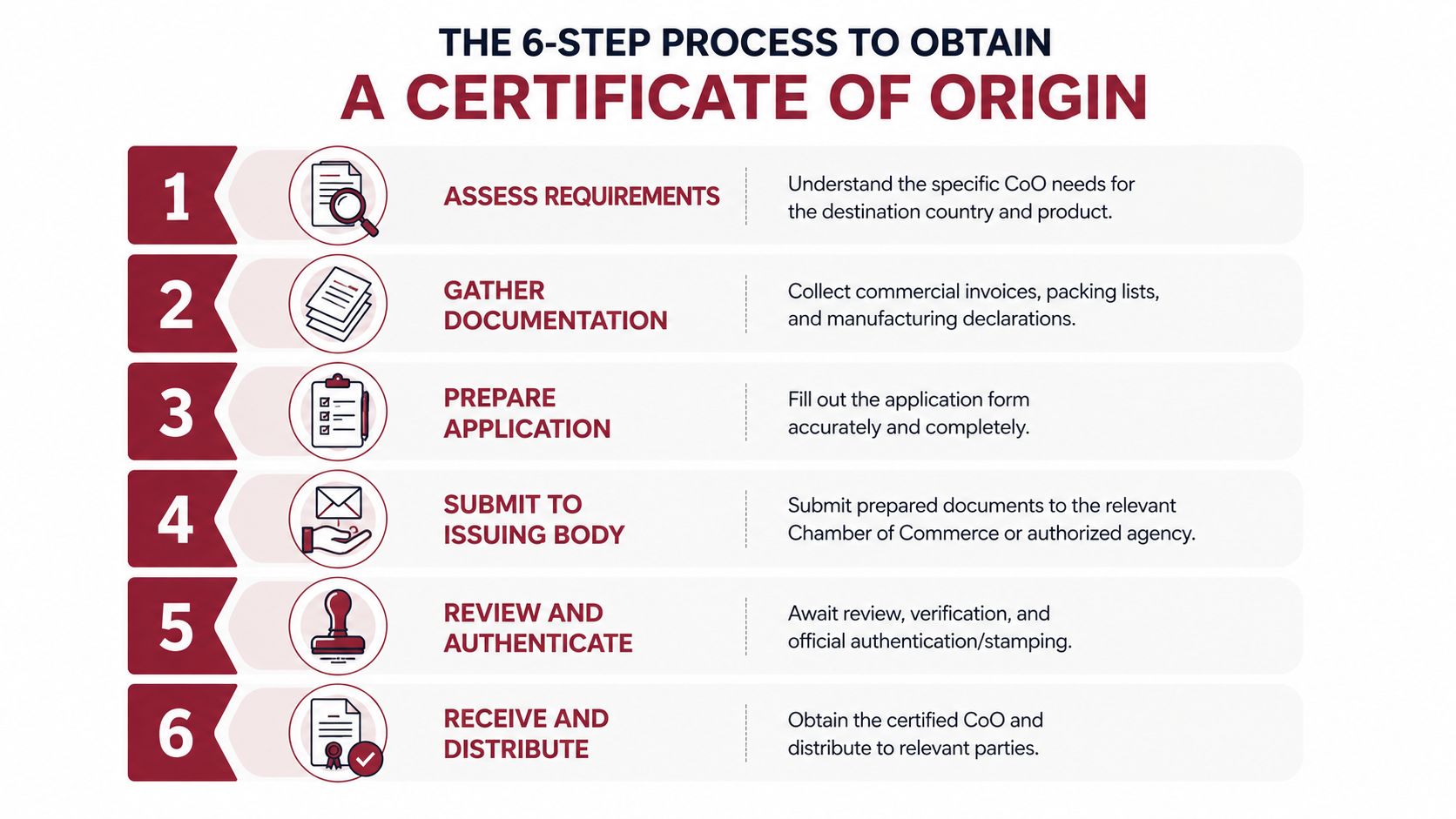
Build the file before you need the form
The certificate should be the output of a controlled documentation chain, not the start of one.
For most established product businesses, that means keeping a coherent file that links the commercial invoice, packing list, product description, manufacturing or sourcing support, and shipment details into one consistent origin story. If the language differs across documents, customs friction rises. If the legal entities differ, questions start. If the product description is vague, the risk moves upstream into classification and origin qualification.
A practical internal stack often includes:
- Commercial invoice with product descriptions that match the trade documentation.
- Packing list that aligns with quantities and shipment structure.
- Transport documents such as the bill of lading or equivalent shipping record.
- Manufacturing or supplier support that substantiates where the goods were produced or transformed.
- Internal origin rationale that explains why the product qualifies under the intended framework.
Where teams struggle, the issue is usually file discipline, not form completion. A fragmented folder structure is often an early warning sign of broader compliance fragility. Good compliance documentation practices usually show up long before customs ever reviews the shipment.
Registration and issuer readiness matter
In Australia, the process also includes organisational readiness. For example, exporters must be registered before they can apply through certain accredited issuers. The Australian Industry Group states that businesses cannot apply for Certificates of Origin unless they first register for export documentation services by completing a Registration Form, according to Australian Industry Group's certificate of origin information.
That's a useful reminder for founders. Market entry isn't just product readiness plus freight. It also includes issuer readiness, internal sign-off paths, and document ownership.
A short explainer can help teams align on the workflow before they scale volume.
Where self-declaration creates leverage
Not every trade lane requires the same third-party model. Under certain frameworks, self-issued declarations can replace chamber-issued certificates. The WCO guidelines note that for Australian exports to the US or UK, a self-issued declaration can replace third-party certificates, and analysis cited there indicates this approach can reduce certification turnaround time by approximately 40%, provided the importer holds the right substantiating documentation, as set out in the WCO guidelines on certification.
That's not a shortcut for weak operators. It works best when a business already has disciplined records, product-level origin logic, and an importer that understands the claim structure.
Self-declaration rewards brands that already run clean internal systems. It punishes brands trying to use speed as a substitute for proof.
The repeatable process is the asset. The certificate is one output of that capability.
Compliance Traps and Common Commercial Mistakes
When a certificate of origin fails, the failure usually doesn't look dramatic at first. It looks like a mismatch, a clarification request, a hold, a resubmission, or a broker query. Then the commercial consequences start to spread.
One issue we repeatedly observe is that brands assume customs documentation errors stay inside logistics. They don't. Once inventory timing changes, channel launch timing changes. Once duty treatment changes, pricing assumptions change. Once documents have to be corrected after dispatch, buyer confidence changes too.
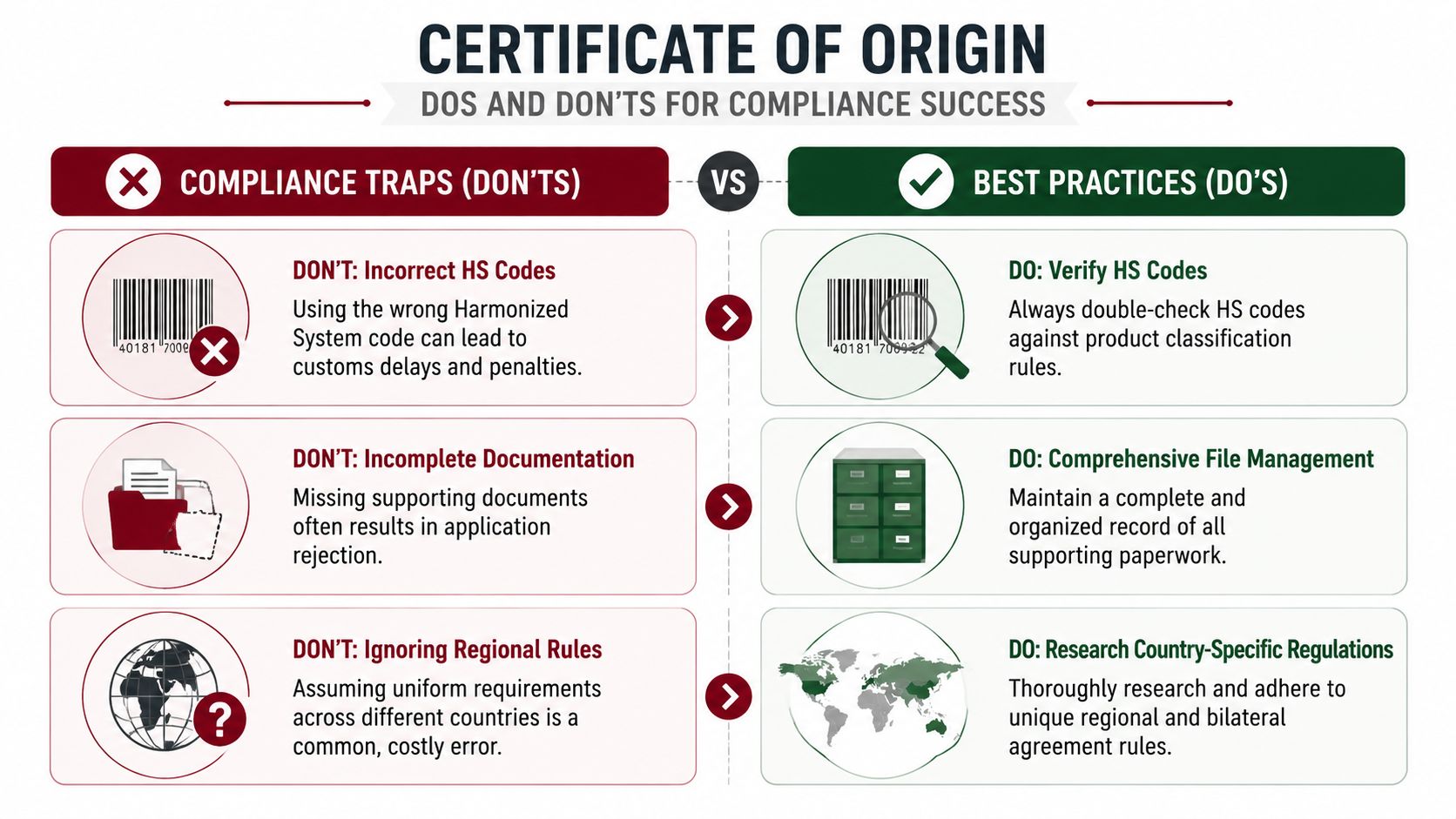
The common failure pattern
A recent marketplace review revealed a pattern that appears across connected devices, home organisation, and household products. The brand has solid demand indicators and a credible distributor or marketplace route. The shipment file, however, contains small inconsistencies:
- HS code drift: The classification used in the invoice and the origin support doesn't align cleanly.
- Description mismatch: Marketing language finds its way into trade documents, making the goods harder to identify.
- Weak substantiation: The team believes the product qualifies, but can't show a clean origin trail from components to finished item.
- Regional assumptions: The exporter uses a document style that worked in one market and assumes it will pass smoothly in another.
None of these errors feel strategic when they happen. All of them become strategic when they delay a launch or remove expected tariff treatment.
The data behind the risk
This isn't a fringe issue. According to the Australian Border Force, 38% of Australian FTA claim failures in 2025 were due to missing or incorrect Certificates of Origin, as referenced in DFAT guidance on obtaining a certificate of origin.
That figure matters because it shows where many teams still break. Not at demand generation. Not at product quality. At documentary execution.
What weaker brands get wrong
The mistake isn't just clerical. It's structural.
Weaker operators often wait until a shipment is imminent, then ask whether the product “needs a certificate.” Stronger operators ask earlier whether the product qualifies for the commercial position the business wants to take in that market. That leads to better sourcing choices, cleaner internal records, and fewer surprises at the border.
A practical contrast looks like this:
| Don't do this | Do this instead |
|---|---|
| Assume country of shipment and country of origin are effectively the same | Validate origin against production reality and the applicable agreement |
| Let product descriptions vary across invoice, packing list, and certificate | Keep one disciplined product description across the file |
| Treat HS coding as a freight detail | Treat classification as part of margin and compliance planning |
| Rely on institutional memory | Keep product-level origin support in a controlled file |
Border friction usually starts as an information quality problem. Customs just happens to be where the inconsistency gets exposed.
The trust issue founders often miss
There's also a brand risk that doesn't get discussed enough. If an importer, broker, or retail partner has to keep chasing corrected origin documents, the exporter starts to look operationally immature. That perception can affect future ranging decisions, forecast confidence, and the willingness to back larger inventory positions.
This is why origin mistakes are more than back-office errors. In international expansion, they become visible signals about whether the business is ready for broader regional scale.
Building a Cohesive and Compliant Global Footprint
The deeper lesson is simple. A certificate of origin is a small document inside a much larger operating system.
When brands treat international expansion as a listing exercise, this document feels inconvenient and technical. When they treat expansion as an ecosystem transition, it becomes obvious why origin discipline matters. Pricing, importer confidence, customs clearance, fulfilment timing, and regional trust all connect back to operational coherence.
Cohesion beats patchwork expansion
Across multiple marketplace ecosystems, the strongest brands don't win because they moved first. They win because their commercial model and operating model match. Their landed cost assumptions are supportable. Their fulfilment design reflects local market realities. Their documentation tells the same story as their sourcing and product architecture.
That's what cohesion looks like.
By contrast, fragmented expansion usually leaves clues. One market has the right paperwork process. Another relies on memory. One distributor gets complete files. Another gets partial support. One product line qualifies for a tariff position on paper, but the business can't substantiate it consistently. Those gaps don't stay isolated for long.
The founder-level takeaway
Founders don't need to become customs specialists. They do need to recognise which details have strategic weight.
The certificate of origin is one of those details because it sits close to money and close to trust. It influences whether tariff benefits are captured, whether inventory enters on time, and whether international partners view the business as credible at scale. For hardware, household, home improvement, and consumer product brands, that matters even more because margin can already be under pressure from freight, channel fees, localisation, and fulfilment complexity.
A useful starting point is to pressure-test expansion readiness through the broader lens of exporting Australian products into international markets, not just through sales-channel ambition.
The brands that scale cleanly tend to respect these operational inflection points early. They don't over-romanticise market entry. They build for repeatability, documentary consistency, and commercial control.
That's usually what separates a strong product entering a new market from a strong brand building a durable international footprint.
For established product brands that want a commercially sharper view of international expansion, TPR Brands works as an operator-led growth partner across marketplace ecosystems, localisation, compliance, and channel structure. If you're planning entry into Australia, the US, Canada, or the UK and want the expansion model to protect margin as well as drive growth, that's the right conversation to have early.