The most popular advice about international growth still overweights marketing, channel selection, and launch timing. Those things matter. They just aren't the main reason many otherwise strong product brands stall once they enter a new market.
What usually slows the machine is less visible. A listing goes live, initial demand looks promising, then the operation starts absorbing friction from labelling updates, product safety interpretations, GST handling, marketplace documentation, advertising claim reviews, or changes to import requirements. None of that feels dramatic in isolation. Together, it changes the economics of expansion.
That's why regulatory change management deserves a different framing. It isn't a back-office legal exercise. It's part of the operating system for predictable growth, especially for brands moving across borders, categories, and marketplace ecosystems.
The Real Reason International Expansion Stalls
Founders often assume expansion stalls because the offer wasn't strong enough, the ads weren't efficient enough, or the local distributor wasn't aggressive enough. One pattern we continue seeing is different. Brands enter well, then lose momentum because the business never built a reliable way to absorb regulatory change.
In Australia, that challenge isn't theoretical. Australian businesses experienced an average of 257 regulatory change events every business day in 2020, according to Everglow's review of regulatory change management. That volume changes the discussion immediately. Compliance can't sit in a spreadsheet, a legal inbox, or a quarterly review cycle when the operating environment moves that quickly.
A good product can still get into market. It just can't scale cleanly without a system that notices change early, assesses whether it matters, assigns ownership, and converts it into action before the issue reaches stock, listings, claims, fulfilment, or customer trust.
Reactive compliance looks cheaper than it is
Reactive compliance feels efficient because it delays cost. Teams tell themselves they'll deal with issues when they arise. In practice, that approach pushes risk into the commercial engine. It usually surfaces later as launch delays, rework, blocked inventory, channel confusion, or marketplace friction that nobody initially attributes to compliance.
That's also why expansion work should start well before launch planning. Good commercial due diligence for marketplace expansion isn't only about channel potential and pricing logic. It also tests whether the business can maintain control once market conditions, rules, and obligations begin shifting.
Practical rule: If compliance only appears at the point of launch approval, the business has already left it too late.
Growth breaks where ownership is unclear
The worst operating pattern isn't lack of effort. It's fragmented responsibility. Product assumes legal is watching. Legal assumes operations is implementing. Operations assumes the marketplace team has adapted the listing and packaging workflow. No one owns the full path from regulatory update to commercial execution.
That gap is where expansion loses speed.
Regulatory change management matters because international growth isn't a listing exercise. It's an ecosystem transition. When the underlying control model is weak, the brand may still launch, but it won't stay coherent for long.
How Regulatory Debt Weakens Your Marketplace Ecosystem
Regulatory debt is rarely created by one bad decision. It builds through tolerated exceptions. A product file stays outdated because the next shipment is already booked. One marketplace rule gets handled manually because the volume still looks manageable. An old label format remains in circulation because changing it would slow the local team.
After enough of those calls, inconsistency stops being accidental. It becomes embedded in how the business runs.
The immediate risk is obvious. Penalties, stock holds, account issues, and corrective work all sit on the table. The bigger commercial problem is less visible. The brand starts operating as a collection of local fixes rather than a controlled international system. Catalogue data differs by channel. Packaging and claims drift by market. Supplier documents, tax settings, and marketplace content no longer reflect the same version of the truth.
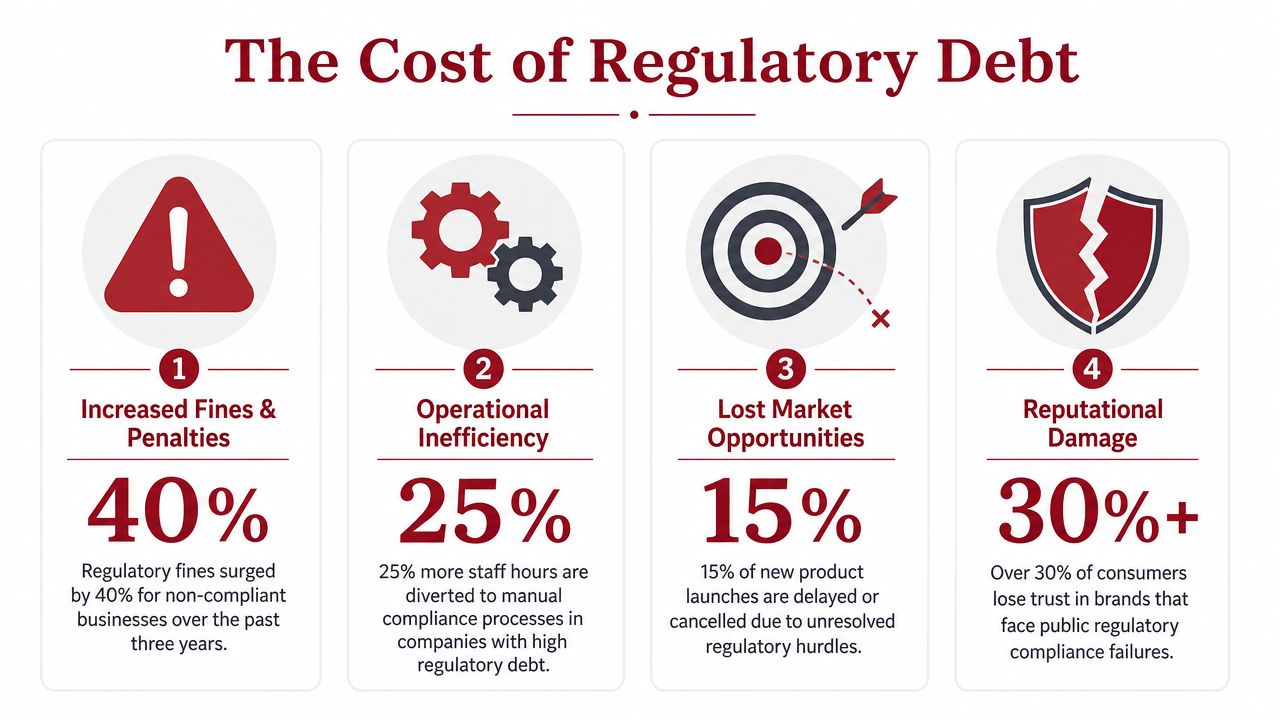
Delay turns into fragmentation
The issue is not a single delay. It is the operating drag that follows when regulatory updates sit in legal or quality folders while commercial teams keep trading. By the time implementation catches up, listings have already gone live, inventory has already moved, and local teams have already created their own workarounds.
That is how marketplace ecosystems weaken. Not through one headline compliance failure, but through repeated small gaps between rule changes and execution.
Across cross-border operations, regulatory debt usually shows up in a familiar pattern:
- Listings fall out of alignment: Claims, warnings, ingredients, or product attributes differ by region, creating review friction and customer confusion.
- Fulfilment loses reliability: Packaging, declarations, or import documents no longer match current requirements, so stock gets delayed or pulled for checks.
- Manual work expands: Teams rely on inboxes, spreadsheets, and local judgement because there is no shared obligations register tied to affected SKUs and channels.
- Margin diminishes: Relabelling, expedited fixes, account remediation, and delayed launches absorb budget that should have funded growth.
I see this most often in product-led brands that expand faster than their control model. Sales enters the new market first. Process catches up later. Compliance then gets treated as a cleanup function, even though the failure happened upstream in operating design.
For brands in regulated product categories, product safety is usually where the cracks become visible first. Documentation, testing records, warnings, and marketplace content need to stay aligned as requirements change. That is why product safety standards in Australia should be managed as part of an ongoing operating system, not a one-off launch task.
Customer trust notices inconsistency before leadership does
Customers do not describe the problem as regulatory debt. They see a brand that feels unreliable.
A warning label differs between channels. A retailer page makes a claim the brand site no longer uses. Delivery timing changes because stock is held at the border. Support gives one answer in one market and a different answer in another. Each incident looks minor on its own. Together, they reduce confidence in the brand and increase the cost of conversion.
Brands rarely lose momentum because a regulation changes. They lose momentum because the business failed to convert that change into controlled execution.
That is why regulatory change management matters beyond legal risk. It protects ecosystem cohesion. And cohesion is what lets a brand scale into new markets without constant rework, margin leakage, or channel instability.
Building a Framework for Commercial Resilience
A workable regulatory change management model isn't a legal checklist. It's an operating framework that helps the business absorb change without destabilising catalogue quality, fulfilment confidence, or channel execution.
The strongest teams build around six components. Not because frameworks are fashionable, but because expansion gets messy when any one of these is missing.
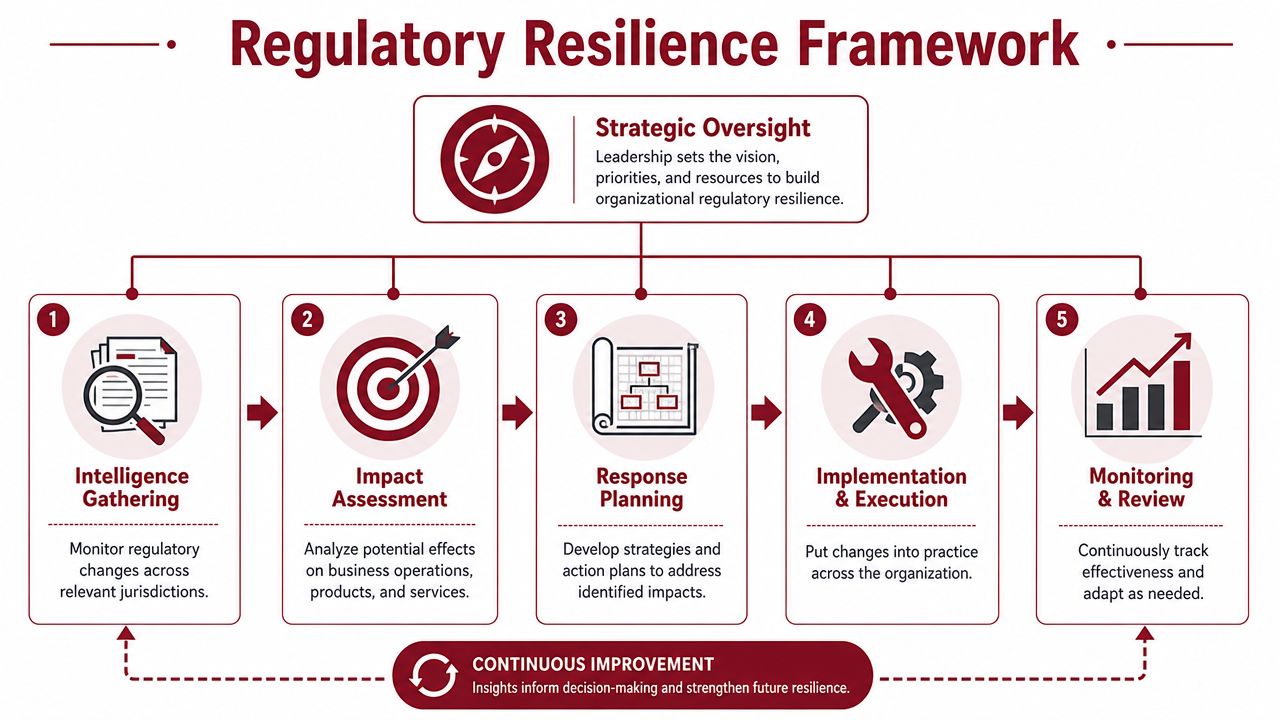
Governance and impact assessment
Governance comes first because somebody has to own the outcome. Not ownership in theory. Ownership in the practical sense of deciding what matters, who acts, and whether implementation is complete. Without that, the business defaults to cross-functional ambiguity.
Impact assessment is where most organisations either become disciplined or stay reactive. A regulation isn't useful when it arrives as a document in a compliance folder. It becomes useful when someone maps it to affected SKUs, claims, marketplaces, packaging, tax settings, supplier documents, and internal controls.
A mature risk assessment framework for expansion decisions helps here because it gives teams a common way to decide whether a change is operationally minor, commercially material, or strategically disruptive.
Change control and communication
Change control is the bridge between interpretation and execution. The business decides how updates are approved, documented, tested, and rolled into the operation. Weak change control produces duplicate work and version confusion. Strong change control creates a documented path from identified change to implemented response.
Communication matters because most compliance failures are coordination failures. Product, operations, finance, marketing, and customer support don't need the same level of detail, but they do need the same truth. If each team receives a different interpretation, implementation starts diverging immediately.
A practical communication model usually includes:
- Decision notices: A short internal summary stating what changed, what it affects, and who owns implementation.
- Function-specific actions: Clear tasks for packaging, listing content, fulfilment, finance, or support.
- Effective date tracking: A visible deadline so teams know when a change moves from optional preparation to operational requirement.
Training and monitoring
Training is often treated as a final-stage task. It works better when it's embedded in rollout. People need to understand what has changed in their workflow, not just that a policy was updated. Marketplace teams should know how claims language must adapt. Operations should know what documentation now needs to travel with stock. Support teams should know which customer questions are likely to emerge.
Monitoring is what stops regulatory change management becoming performative. Once the change is implemented, the business still needs evidence that controls, listings, documents, and processes reflect the new requirement.
Operator's view: If you can't verify implementation in the channel, warehouse, support workflow, or policy library, you haven't implemented it. You've only announced it.
What works is boring in the best possible way. A central obligations register. Named owners. Trigger-based reviews. documented change control. Cross-functional sign-off. Post-implementation validation.
What doesn't work is equally consistent. Shared inboxes. Periodic manual sweeps. Local interpretations. Spreadsheet registers that nobody trusts. Policy updates without workflow updates.
That difference is what separates expansion that remains controlled from expansion that keeps leaking margin every time the environment shifts.
From Regulatory Noise to Actionable Intelligence
Most brands don't fail because they never hear about a regulatory update. They fail because they can't translate the update into decisions at product, channel, and process level.
That translation problem sits inside impact assessment. A regulation arrives as text. The business needs to know which SKU families it affects, which product claims need review, whether supplier declarations still hold, whether packaging or marketplace content needs adjustment, and whether the issue belongs with legal, operations, marketing, or all three.
Materiality decides where effort goes
Not every change deserves the same response. That's where materiality becomes commercially useful.
According to the Victorian Government's Regulatory Change Measurement methodology, a regulatory change is considered material for administrative burdens if it equals or exceeds $250,000 per annum, which triggers mandatory cost assessment, as outlined in the Victorian Government RCM methodology. Even if a private business isn't applying that framework formally, the principle is valuable. Teams need thresholds that separate background noise from issues requiring structured escalation.
Without thresholds, organisations either underreact or overreact. Underreaction creates exposure. Overreaction wastes management time and slows commercial execution.
Mapping rules to the catalogue
What becomes visible during international expansion is that strong brands map regulatory obligations to the operating model, not just to a legal register.
For a connected device brand, that might mean linking a regulatory change to:
- SKU attributes: battery specifications, wireless claims, compatibility statements, warranty language
- Packaging components: symbols, warnings, manuals, inserts
- Marketplace content: bullets, A+ content, product description, image overlays
- Supply chain steps: supplier certifications, customs documents, lab test records
- Customer communications: FAQs, support scripts, returns guidance
For wellness or household products, the mapping often shifts toward ingredient disclosure, usage claims, safety directions, and retail presentation consistency.
A regulation only becomes actionable when someone can point to the exact product files, workflows, and claims it changes.
Compliance teams add strategic value. They stop being the department that says no and become the function that tells the business what must change, what can stay, and what needs executive attention.
A short explainer can help teams align on that mindset:
The practical filter
The most effective operating question isn't “Does this regulation apply in theory?” It's “Where does this land in our commercial system?”
That filter produces better decisions. It reduces noise. It also prevents the common mistake of handling every update as a legal memo instead of an operational instruction.
Navigating Cross-Border Compliance Ecosystems
Cross-border expansion gets harder when leadership assumes regulations behave the same way everywhere. They don't. Each market has its own enforcement style, documentation culture, policy priorities, and tolerance for ambiguity.
One pattern we continue seeing is brands trying to export a compliance model that worked in one region directly into another. That usually creates localisation friction. Not because the team is careless, but because each marketplace ecosystem asks for a different kind of discipline.
Regional compliance ecosystems at a glance
| Region | Primary Regulatory Focus | Operational Impact Example |
|---|---|---|
| Australia | Consumer protection, GST handling, product safety, import requirements | A product range may need adjusted tax handling, documentation, and market-specific packaging before scale feels stable |
| United Kingdom | Product conformity, claims discipline, importer responsibilities | Marketplace content and packaging often need tighter alignment with local documentation expectations |
| European Union | Sustainability direction, repairability expectations, privacy and product obligations | Connected products may need stronger documentation control across product design, support content, and after-sales workflow |
| United States | Multi-layered federal and state requirements, consumer protection variation | A product claim acceptable in one context may need review across state-level exposure and retail channel expectations |
| Canada | Bilingual presentation, product standards, import and retail conformity | Packaging and listing adaptation can become a front-end operational task rather than a post-launch correction |
| Asia markets | Market-specific standards, documentation expectations, local approval pathways | Brands often need regional process redesign instead of simple translation |
This table isn't a legal summary. It's a commercial one. The important point is that compliance isn't just about what the law says. It's about how the regional ecosystem expects a brand to behave.
Compliance officers have moved into strategy
That shift is becoming more visible in Australia. A 2024 SPA Australia report highlighted that capability uplift and policy redesign are critical for Australian compliance officers navigating current operating environments, positioning them as contributors to strategic decision-making and innovation, as discussed in Oceans Group's analysis of compliance officers in Australia.
That matters for international brands because it changes who should sit at the planning table. Compliance leadership shouldn't only appear after the commercial plan is built. They should shape launch sequencing, market entry assumptions, documentation architecture, and localisation choices early.
For Australia specifically, product labelling requirements often become one of the clearest examples of ecosystem-specific behaviour. A brand may think it has “the same product” across regions while the market sees a product that still needs local adaptation to be commercially credible.
Cross-border compliance works better when the business treats each region as an ecosystem with its own behavioural logic, not as a translated version of the home market.
When teams understand that, they stop asking whether a market is easy or hard. They start asking whether their operating model fits.
The Operator's Checklist for Marketplace Entry
Marketplace entry rarely fails because demand was misread. It usually slips because the business treated compliance as a final approval step instead of part of launch design. By the time the first listing is live, weak ownership, missing documentation, and inconsistent product data are already expensive to fix.
A workable entry plan needs a compliance go-live sequence alongside the commercial one. That means clear ownership, a defined scope of obligations, and a method for checking that what was approved is what reaches the channel. Brands that set this up early spend less time on rework, fewer launch delays, and fewer internal debates about who is responsible for what.
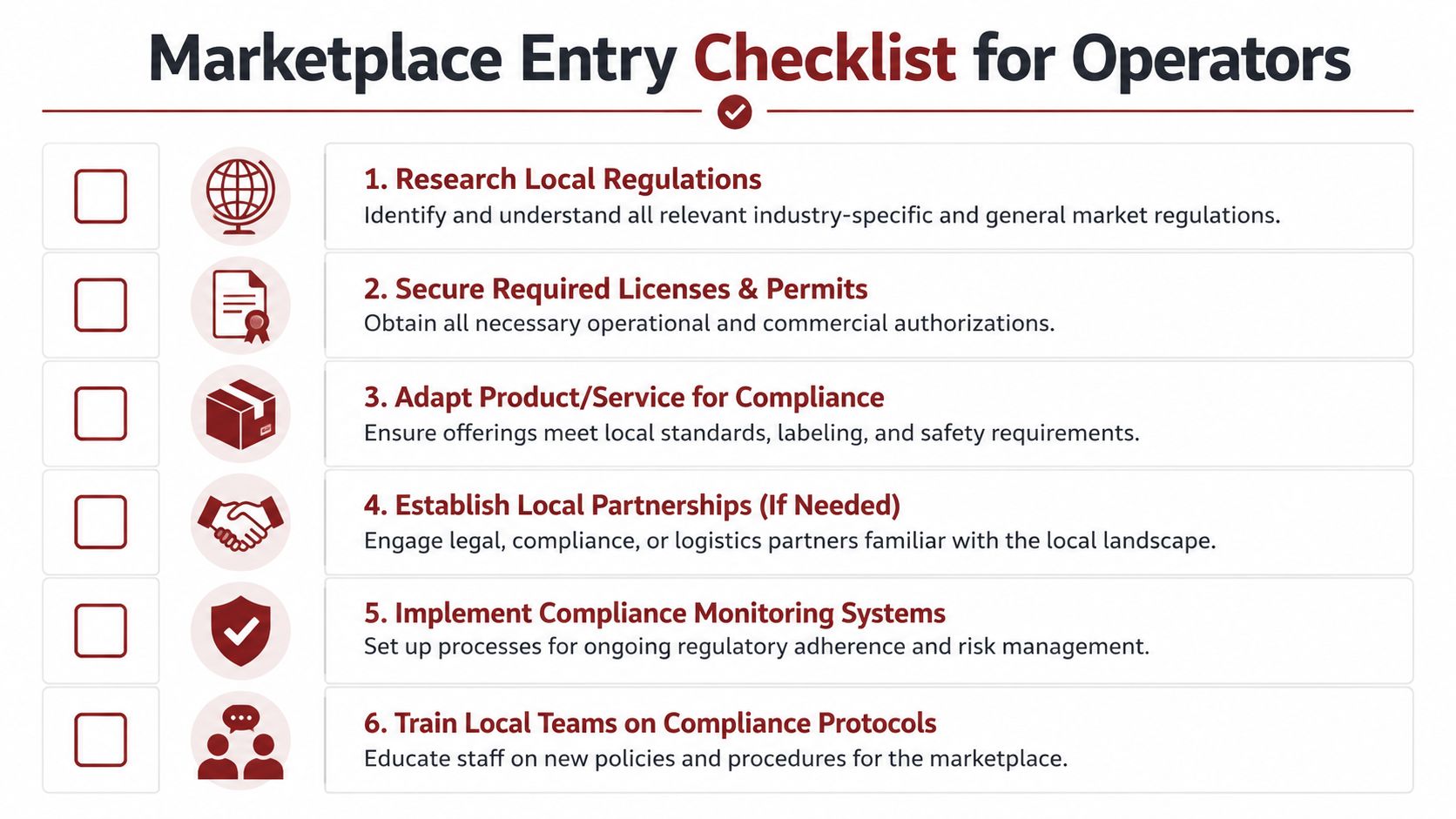
Pre-launch discipline
Appoint one accountable owner
One person should own regional regulatory coordination. Legal, product, operations, finance, and marketplace teams still contribute, but one owner keeps decisions moving and gaps visible.Define the regulatory universe
List the regulators, marketplace rules, tax settings, product safety obligations, import conditions, documentation requirements, and labelling expectations that apply to the category and country.Build the obligations register before listings go live
Map obligations to SKUs, packaging, claims, documents, and workflows before launch. If teams wait for the first issue to appear, they are already working in remediation mode.
Launch readiness
Translate requirements into operational tasks
Requirements only matter if they change execution. Product teams need specification rules. Content teams need claims boundaries. Logistics needs document accuracy. Finance needs the correct tax treatment.Run a controlled implementation review
Check packaging files, listings, manuals, invoices, tax settings, and support scripts against the same current standard. Such a review reveals inconsistencies before a customer, regulator, or marketplace flags them.Train teams on the parts they touch
Keep training role-based. Marketplace managers need claim discipline. Warehouse teams need document clarity. Customer support needs consistent answers that match the approved product and policy position.
Post-launch control
Set monitoring triggers
Establish review points, alert sources, and owner check-ins so regulatory change is handled as an ongoing operating process rather than a one-off launch task.Validate in-channel, not just on paper
Review real listings, product detail pages, shipped units, invoices, and support interactions. Plenty of brands pass internal review and still fail at the point where the customer or marketplace sees the product.Escalate material changes quickly
If a change affects unit economics, core SKUs, channel viability, or launch timing, move it to executive review early. Slow escalation turns a manageable adjustment into a market-entry problem.
Checklist test: If the team cannot explain who owns a regulatory update, where it is logged, what SKUs it affects, and how implementation is verified in-channel, the market entry process is not ready.
This checklist works because it treats compliance as operating infrastructure for growth. It protects listing accuracy, fulfilment continuity, margin assumptions, and launch timing. For brands entering new marketplaces, that discipline is not administrative hygiene. It is how expansion stays predictable.
Turn Compliance into a Competitive Advantage
Brands that scale well across marketplaces don't treat compliance as an unavoidable burden sitting beside growth. They treat it as part of growth infrastructure.
That mindset changes a lot. It reduces fragmentation. It improves fulfilment confidence. It keeps product, content, documentation, and customer experience closer together as the business expands into new regions. Above all, it gives leadership a more predictable operating base for decision-making.
Regulatory change management is valuable because it protects commercial momentum. It helps brands keep moving when rules shift, marketplaces tighten expectations, or new regions introduce different forms of friction. That's not a legal outcome. It's an operating advantage.
For founders and commercial leaders, the useful question isn't whether compliance matters. It's whether the current model strengthens expansion or erodes it. Mature brands know the answer before they enter the next market.
If your brand is preparing for cross-border marketplace growth and you want an operator-led view of how compliance, localisation, fulfilment, and channel strategy fit together, TPR Brands works with established product businesses to build commercially cohesive international marketplace ecosystems.