The most popular advice on multi-channel growth is still wrong. It says more channels mean more revenue, as if expansion is mostly a listing problem and inventory just needs to keep up in the background.
Established brands know that isn't how it plays out.
Once a catalogue sits across Amazon, Shopify, retail partners, and international marketplaces, stock becomes a proxy for something bigger. It governs delivery promises, pricing stability, channel confidence, and whether a customer experiences one coherent brand or a fragmented business with the same logo appearing in multiple places. A multi channel inventory management system matters because it holds that commercial reality together.
What becomes visible during international expansion is that inventory isn't just stock. It's market access. It's fulfilment credibility. It's the operating layer that decides whether a brand enters a new region with control or with avoidable friction.
The Hidden Cost of Multi Channel Fragmentation
The standard growth narrative treats channel expansion as an uncomplicated positive. Add Amazon. Add eBay. Add a second Shopify storefront. Add a wholesale partner. Revenue should follow.
One issue we repeatedly observe is that channel growth often outpaces operational cohesion. Brands don't lose control in a dramatic way. They lose it gradually, through small mismatches between what systems say, what marketplaces display, and what warehouses can ship.
In Australia, 70% of inventory management failures stem from using spreadsheets or paper logs for multi-channel tracking, leading to overstocking costs averaging AUD 45,000 annually per mid-sized retailer, according to Square's overview of multichannel inventory management in Australia. That figure matters less as an isolated cost and more as a signal. Spreadsheet-led growth doesn't just create admin drag. It creates commercial distortion.
Where fragmentation actually shows up
A founder usually notices the problem in one of four places:
- Marketplace availability shifts too slowly. A product sells through on one channel, but another channel still shows stock.
- Retail partners receive inconsistent allocations. Internal teams protect one account while starving another.
- Pricing starts absorbing operational mistakes. Margin drops because urgent transfers, split shipments, and stock corrections become normal.
- Customer trust gradually weakens. Delivery windows slip, backorders rise, and support teams start explaining preventable problems.
Across multiple marketplace ecosystems, these issues rarely stay confined to operations. They influence reviews, repurchase behaviour, and channel relationships. That's why inventory fragmentation isn't a back-office inconvenience. It's a brand integrity problem.
A strong product catalogue can still produce a weak marketplace presence when stock accuracy, fulfilment logic, and channel visibility aren't aligned.
That's especially important during expansion, when leadership teams often assume catalogue strength will carry into new regions. It usually doesn't. The structural gap between a product catalogue and a functioning marketplace ecosystem becomes obvious once fulfilment pressure starts. The distinction is explored well in this view of product catalogue versus marketplace ecosystem.
The margin damage founders don't always name
The hidden cost isn't only overselling. Sometimes it's the opposite.
Brands with poor inventory cohesion often over-purchase to create a false sense of safety. They hold more stock than they need because they don't trust the numbers across channels. That buffers one risk while creating another. Cash gets trapped, forecasting gets noisier, and expansion decisions start relying on guesswork rather than confidence.
A multi channel inventory management system becomes strategic at the point where leadership realises they're not trying to manage units. They're trying to preserve commercial control while the business becomes more distributed.
Rethinking the Multi Channel Inventory System
Most businesses still evaluate a multi channel inventory management system like office software. They compare features, review connectors, and ask whether the dashboard looks clean.
That framing is too narrow. In practice, the system acts more like the central nervous system of a commercial ecosystem. It's the layer that tells every channel, warehouse, retail touchpoint, and fulfilment partner the same truth at the same time.
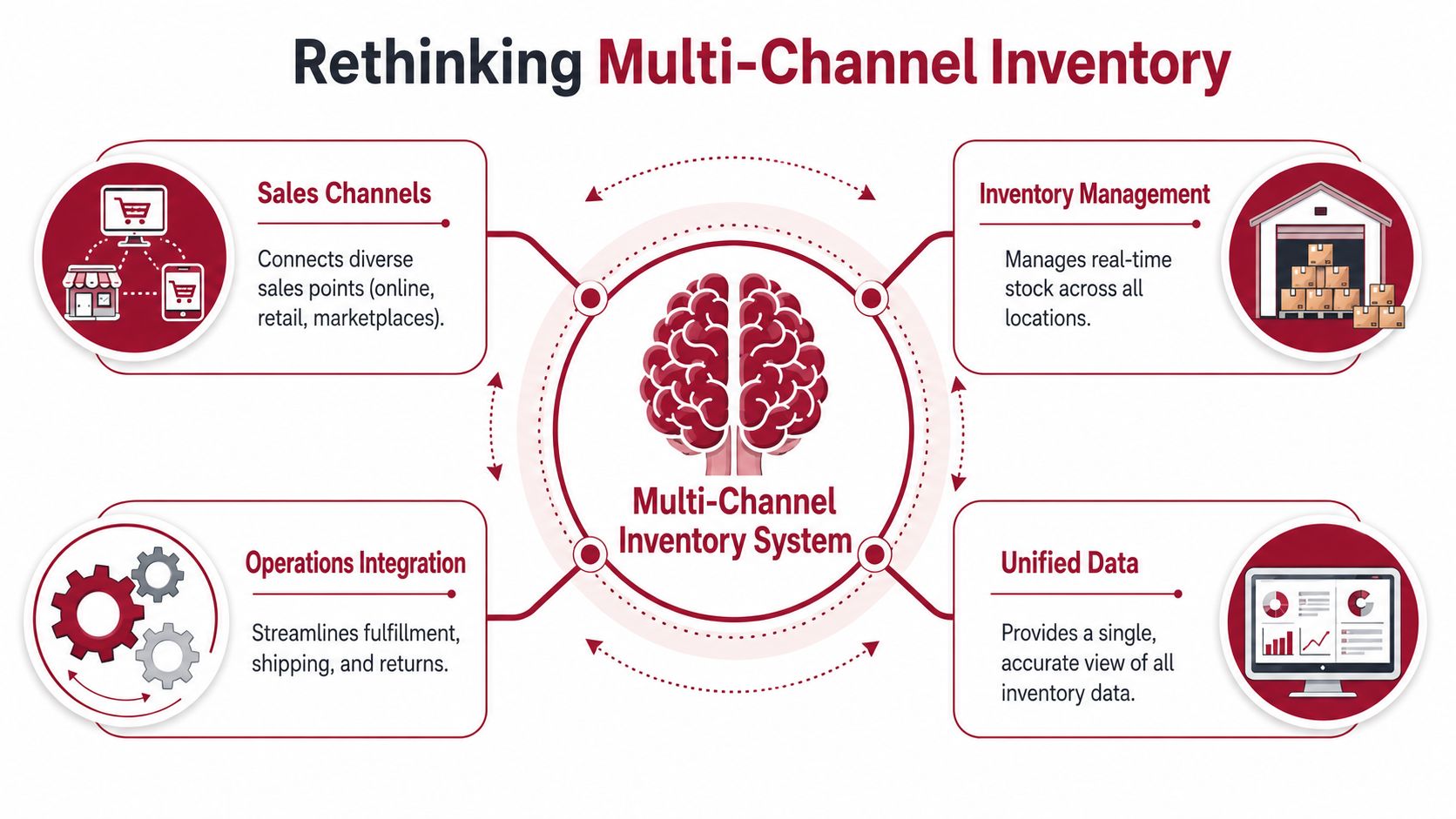
It's not about software neatness
A mature system doesn't matter because it reduces admin alone. It matters because it protects consistency.
If a customer buys on a Sydney D2C site, an Amazon UK listing, or through a retail partner in Canada, the operational answer should still reflect one brand. Availability should be credible. Fulfilment commitments should be realistic. Product data should stay aligned. Returns should re-enter the business with the right status and the right implications for future sellable stock.
When those flows remain disconnected, the business starts behaving like separate entities that happen to share products. That's when channel conflict grows. Teams start making local decisions that undermine broader expansion goals.
The system's real job is ecosystem cohesion
One pattern we continue seeing is that brands think in channels while stronger operators think in systems. Channels are just endpoints. The commercial risk sits in the spaces between them.
A useful way to assess a multi channel inventory management system is to ask whether it creates a single operating reality across these areas:
| Operating layer | What cohesion looks like |
|---|---|
| Sales channels | Each channel reflects actual stock position and realistic sell-through |
| Fulfilment | Orders route according to commercial logic, not manual intervention |
| Product data | Listings carry consistent attributes, compliance fields, and variations |
| Reporting | Leadership sees one version of stock exposure, not multiple conflicting views |
That's the difference between inventory visibility and ecosystem control.
Practical rule: if finance, operations, and marketplace teams each trust a different stock number, the business doesn't have an inventory system. It has competing narratives.
This is why a system decision should sit inside a broader marketplace ecosystem strategy. International growth multiplies the number of operational handoffs. Without a unifying layer, every new marketplace introduces another version of the truth.
Why this matters more in international expansion
Domestic channel complexity is manageable for longer than many organizations expect. International complexity isn't.
Once different regions enter the picture, inventory starts carrying localisation consequences. Product availability interacts with freight timing, market-specific compliance, regional fulfilment promises, and channel-level expectations. A missing unit isn't just a missed sale. It can trigger a sequence of customer service issues, account friction, and brand inconsistency across markets.
A multi channel inventory management system is valuable because it gives leadership a way to manage ecosystem presence, not just stock.
Core Capabilities for Global Marketplace Expansion
The capabilities that matter most during international growth often aren't the ones vendors lead with. Many systems can connect channels. Far fewer can maintain commercial control when a brand is selling across regions, fulfilment models, and compliance environments at the same time.

A technically critical specification is real-time synchronisation across all connected channels, which directly reduces stockout rates by 35% and increases order fulfilment speed by 28% in Australian retail operations, according to this multichannel inventory guide citing Deloitte Australia's 2024 Omnichannel Retail Trends Report. That same source notes the operational effect comes from integration with PIM, ERP, and order management layers, so each SKU carries accurate compliance data and product attributes needed for Australian consumer product regulations.
Real-time sync is really fulfilment confidence
Many groups describe real-time sync as a stock control feature. Operators tend to see it differently. It's a confidence layer.
When a marketplace receives a stock signal from your system, it is effectively receiving a promise. That promise influences conversion, shipping expectations, and account health. If the signal is late or wrong, the problem isn't solely technical. The brand has misrepresented its ability to fulfil.
Across multiple marketplace ecosystems, this becomes more sensitive when selling across time zones. A stock discrepancy in one market can be corrected manually. The same discrepancy across several markets overnight can create a queue of avoidable exceptions by morning.
Product data and compliance can't sit outside inventory logic
One pattern we continue seeing is brands underestimating how closely inventory accuracy and compliance accuracy are linked. Inventory systems that treat compliance as a separate problem tend to create risk later.
For global expansion, a stronger operating model connects inventory with:
- Marketplace-specific product attributes that need to travel with the SKU
- Regional compliance fields that affect whether a listing can remain active
- Variation integrity so bundles, packs, and product families don't create false stock positions
- Order management rules that reflect what can legally and operationally ship into each region
Strong systems outperform basic channel connectors. They don't just tell you where stock is. They preserve the integrity of what each channel is allowed to sell.
Fulfilment logic matters as much as availability
International brands rarely fulfil from one source forever. The structure often evolves into a mix of local warehousing, marketplace fulfilment programmes, and third-party logistics providers.
That creates a practical question. Which stock should satisfy which order, under which commercial conditions?
A capable multi channel inventory management system supports that decision-making without forcing teams into constant manual overrides. If your UK marketplace orders should route differently from Australian D2C orders, the system needs to reflect that operating logic clearly.
For teams assessing broader network efficiency, this view on supply chain optimization is closely connected to inventory architecture.
A useful overview of why these decisions matter in practice is below.
The capabilities that separate scalable systems from basic ones
Not every requirement belongs in a feature matrix. Some belong in a board-level conversation about growth risk.
| Capability | Why it matters commercially |
|---|---|
| Channel-wide synchronisation | Protects marketplace trust and reduces false availability |
| PIM and ERP connectivity | Keeps product data, stock, and operational logic aligned |
| Multi-region fulfilment rules | Supports growth without relying on manual routing decisions |
| Compliance-aware SKU structure | Prevents avoidable listing issues and allocation mistakes |
The commercial lesson is simple. If a system can only tell you how much stock you have, it's useful. If it can preserve fulfilment confidence and product integrity across regions, it becomes strategic.
How to Evaluate Systems for Strategic Growth
The wrong way to evaluate a multi channel inventory management system is to ask which platform has the longest feature list. The second wrong way is to ask which one is cheapest.
Both approaches ignore the real question. Which system can support the brand you're trying to become, not just the channel mix you have today?
Strategic fit beats feature volume
A recent marketplace review revealed a pattern that shows up often in established product businesses. Leadership chooses software based on immediate pain relief, usually stock visibility or order admin, then discovers the system struggles once new channels, regions, or fulfilment partners are added.
That happens because system selection was treated as procurement, not strategy.
For Australian hardware and home improvement brands, integrating POS with e-commerce platforms like Shopify and eBay enables automatic stock level synchronisation across 5+ channels, cutting manual update time by 76% and reducing cross-channel fulfilment errors by 63%, according to Shopify's 2025 Enterprise AU report on multi-channel management. That's useful evidence, but the deeper lesson is broader than efficiency. Integration quality determines whether channel expansion remains manageable.
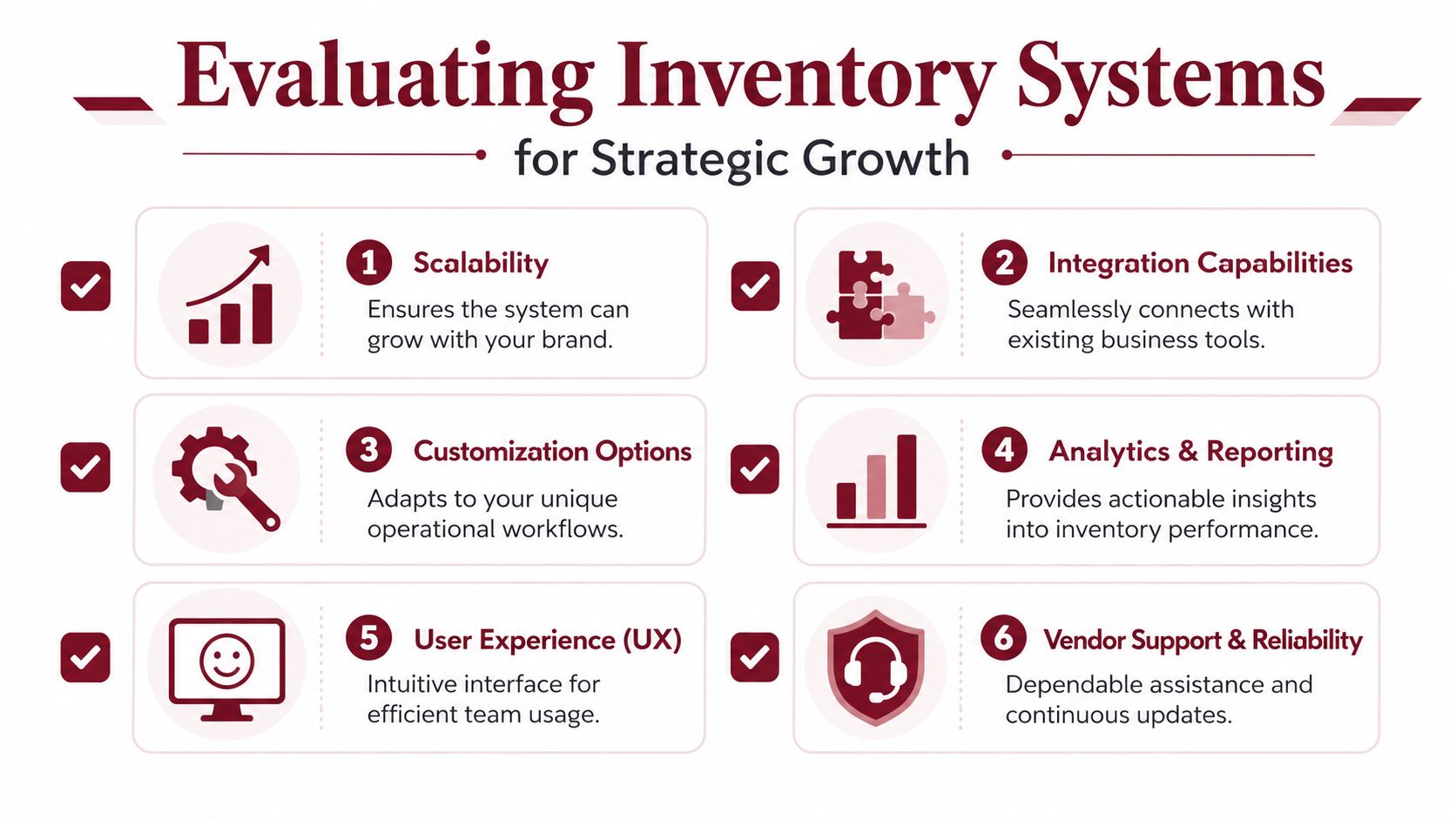
The criteria that actually matter
When evaluating systems for strategic growth, these questions tend to reveal more than generic demos do:
Ecosystem compatibility
Can the system work cleanly with the marketplaces, retail tools, and operational platforms that already shape your business?International readiness
Does it support the localisation realities of expansion, including regional workflows, operational variance, and market-specific selling structures?Operational resilience
When order volume spikes or a new channel is added, does the system remain stable, or does it introduce more exception handling?Data discipline
Will the platform reinforce clear SKU structure, channel mapping, and stock logic, or will it allow inconsistency to spread?
These questions matter more than cosmetic simplicity. A clean interface is welcome. It doesn't solve structural weakness.
What stronger operators look for
The strongest evaluations usually include people outside the software buying team. Founders, commercial leaders, operations managers, and marketplace teams often need different answers from the same system.
Most software disappointments start before implementation. The business buys a tool for one department, then expects it to carry an international operating model it was never selected to support.
That's why evaluation should include a realistic stress test. Not a polished demo. A scenario.
For example:
- A product sells through quickly on one marketplace.
- A retail partner still has open demand.
- Another region has inbound stock not yet available for sale.
- Customer service needs a clear answer on future availability.
- Finance wants clean visibility on what is committed.
If the system can't handle that scenario coherently, it probably won't support strategic growth.
Price-first decisions usually cost more later
Budget matters. It always will. But low-cost systems often shift complexity onto the team rather than removing it.
That usually appears in the form of spreadsheet workarounds, duplicated product data, marketplace-specific stock corrections, and manual reconciliation after every operational exception. The software looks cheaper until labour, account risk, and decision delays are added back into the picture.
The right evaluation lens is commercial fit. Can this platform support the expansion path you're pursuing, preserve channel coherence, and remain useful when the business becomes more international and more operationally layered?
An Implementation Roadmap for Ecosystem Transition
Implementation often fails when businesses treat it as a software launch. The better view is that a multi channel inventory management system introduces an ecosystem transition. It changes how stock is represented, how channels relate to one another, and how commercial decisions move through the business.
That's why strong implementation starts before any integration is switched on.
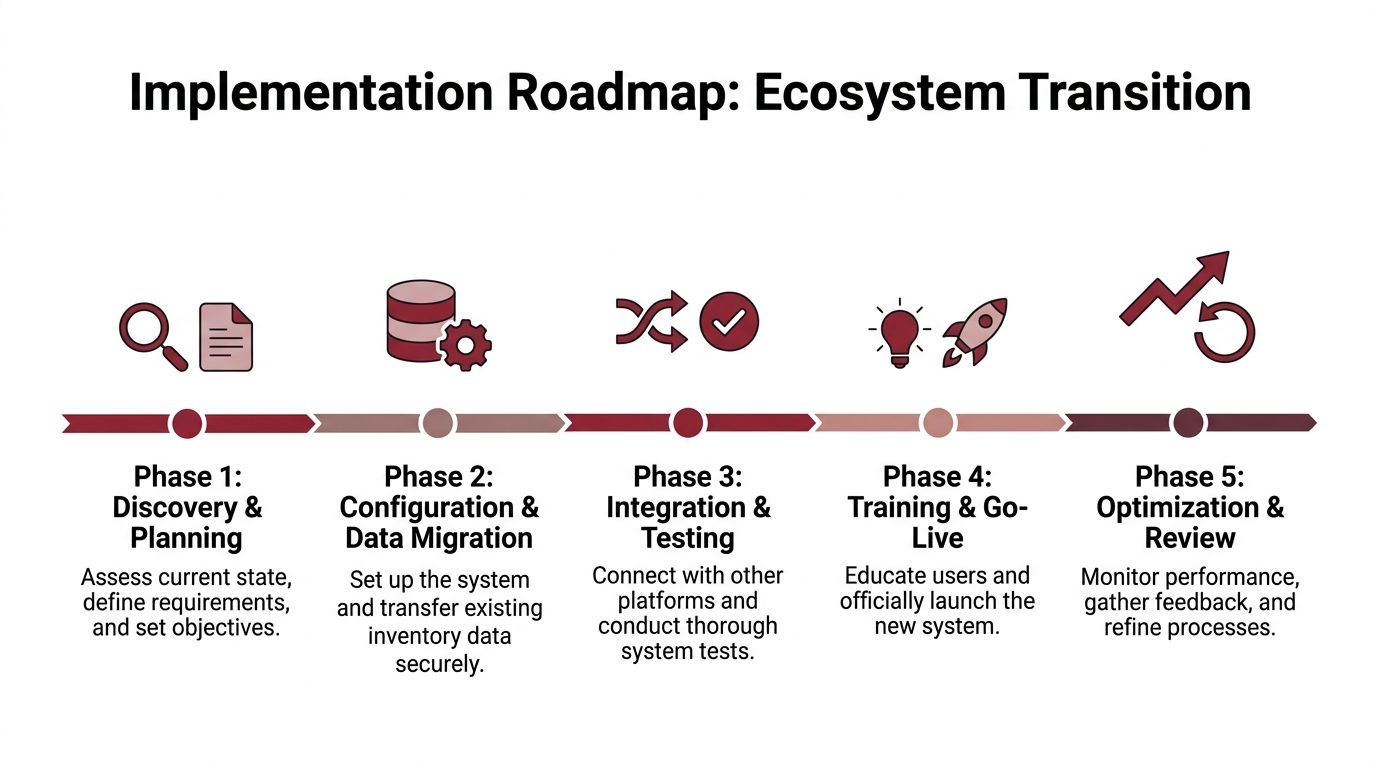
Phase one begins with commercial reality
The first job is a commercial audit. Not a technical one.
Look at where stock truth currently lives, which channels create the most operational friction, where fulfilment confidence is weakest, and which regions are most exposed to inconsistency. A brand may think its problem is inventory visibility when the deeper issue is fragmented SKU logic or unclear ownership between marketplace, operations, and finance teams.
A useful early audit includes:
- Channel exposure. Which marketplaces and retail accounts currently rely on unstable stock signals?
- Fulfilment structure. Which orders are being routed manually because the operating logic isn't clear?
- Data quality. Where do SKU naming, variant handling, or bundle structures break consistency?
- Regional readiness. Which expansion plans depend on cleaner inventory governance before they can scale?
Channel strategy should come before full rollout
One mistake operators make is connecting everything at once. That creates speed, but not control.
A better approach is sequencing channels according to commercial importance and operational risk. For one brand, that may mean stabilising Shopify and domestic retail first. For another, it may mean aligning Amazon and a local 3PL before entering another region.
A phased logic often works better than a broad launch:
| Phase | Focus |
|---|---|
| Audit | Identify where inventory fragmentation is distorting commercial decisions |
| Prioritise | Select channels and regions that most need unified control |
| Unify data | Clean SKU, variant, and stock structures before full integration |
| Roll out | Introduce channels in sequence and test exceptions carefully |
| Refine | Tighten routing, reporting, and governance once live activity begins |
This is slower at the beginning and faster later.
Data migration is where many projects become fragile
Product businesses often underestimate how much inherited mess lives inside the catalogue. Duplicate SKUs, inconsistent bundle logic, outdated dimensions, channel-specific naming conventions, and old product statuses all create friction once a system tries to centralise them.
Clean data is not an administrative nicety. It determines whether your system reflects commercial reality or simply reproduces existing confusion in a more expensive environment.
This stage usually needs decisions, not just cleanup. Which SKU is master. Which variation structure is permanent. Which channel-specific workarounds should be retired. Which product attributes need to remain localised.
Go live should be controlled, not theatrical
Go live is often over-romanticised. Strong operators tend to treat it as a monitored operational handover.
That means clear ownership, defined exception handling, and a deliberate test window where the team watches allocations, stock movements, order routing, and returns closely. It also means accepting that early refinement is part of the process.
One pattern we continue seeing is that teams train users on screens but not on decision logic. Staff can click through workflows, yet still don't understand why inventory behaves differently by channel or region. That gap creates manual overrides, and manual overrides usually recreate the fragmentation the new system was meant to remove.
Implementation succeeds when the business changes with the system. Otherwise the software just inherits old habits.
Measuring Performance and Avoiding Common Pitfalls
Once a multi channel inventory management system is live, the goal isn't to admire cleaner dashboards. The goal is to verify that the business has become more coherent, more controllable, and more commercially reliable across channels and regions.
That requires better measurement than basic stock counts.
The KPIs that reflect ecosystem health
A recent marketplace review revealed that weaker operators still focus almost entirely on stock on hand. Stronger ones track whether inventory decisions are improving fulfilment quality, margin protection, and regional resilience.
The most useful measures usually include:
- Inventory turnover by region so leadership can see whether stock is moving differently across market environments
- Order fulfilment accuracy because service confidence matters as much as availability
- Dead stock exposure across the network, especially after adding new marketplaces
- Landed cost accuracy where international growth depends on realistic margin visibility
- Channel allocation performance so teams can see whether premium channels are being protected properly
ABC analysis is especially useful once the system is stable enough to trust. Australian businesses adopting ABC inventory analysis alongside multichannel systems achieve 31% higher gross margins and 22% faster inventory cycle times, according to NetSuite's overview of multichannel inventory management. That matters because it shifts attention toward the SKUs that carry disproportionate commercial consequence.
The pitfalls that erode system value
Most system underperformance doesn't come from the initial purchase. It comes from neglect after launch.
Common failure patterns include:
Weak data governance
Teams add new products, bundles, and channel variations without disciplined SKU control.Static fulfilment logic
The business adds channels or regions, but routing rules and allocation assumptions stay unchanged.Misread marketplace maturity
A fulfilment model that works in one market may not support customer expectations in another.Forecasting disconnected from reality
Inventory plans remain generic instead of reflecting actual channel behaviour. Brands that want sharper planning discipline usually need stronger demand forecasting tied to marketplace-level signals.
Inventory systems age quickly when governance doesn't. The software may still be running, but the operating model around it starts drifting.
What long-term success actually looks like
Long-term success is quieter than is often expected. It doesn't always show up as dramatic growth first.
It shows up when a new channel can be added without destabilising existing ones. When a regional expansion doesn't create immediate fulfilment confusion. When finance, operations, and channel teams stop debating which stock number is real. When customer promises become more dependable because the operating layer behind them has become more disciplined.
That's the strategic value of a multi channel inventory management system. It doesn't just help manage stock. It helps a brand maintain cohesion while it expands into a more complex commercial ecosystem.
If your business is preparing for marketplace expansion and needs operational structure that protects brand value, TPR Brands works with established product companies to build commercially cohesive growth across Australia, the US, Canada, the UK, and beyond. The focus isn't on adding channels for the sake of it. It's on entering the right marketplaces with the right control, localisation, and fulfilment logic already in place.