Most advice about the customs clearance process treats it like paperwork discipline. Get the forms right, pay the charges, move on.
That framing is too shallow for any brand serious about international expansion.
One pattern we continue seeing is that established domestic brands assume customs friction is a freight problem. Then the first meaningful international shipment hits a hold, lead times blow out, stock allocations collapse, and the team discovers something uncomfortable. Customs didn't expose a logistics weakness. It exposed an ecosystem weakness. Product data, packaging decisions, origin declarations, landed cost assumptions, and partner selection were never properly aligned for the market they were entering.
For founders and operators, that matters because customs sits at the exact point where brand ambition meets government scrutiny. A marketplace may tolerate weak listings for a while. Border systems won't. They require coherence. If your invoice says one thing, your packing list implies another, and your product category triggers a permit requirement no one noticed, the shipment stops moving whether demand is strong or not.
That's why the customs clearance process is better understood as an operational test of market readiness. It shows whether the business is entering a region as a disciplined operator or shipping stock across a border and hoping the rest will sort itself out.
Your First International Ecosystem Test
Customs is often the first place a brand learns whether its international model is real or just optimistic.
A strong catalogue, healthy domestic demand, and a capable freight provider can still produce a poor border outcome. I have seen brands enter a new market believing customs sits at the end of the process, somewhere between shipping and sell-through. In practice, customs sits in the middle of everything. It tests whether product data, sourcing decisions, packaging, commercial terms, and document control agree with each other.
That is why early customs failures are so expensive. They do not just delay freight. They expose weak operating discipline in front of regulators, brokers, retailers, and marketplaces at the exact moment the brand is trying to establish credibility.
Where the usual advice falls short
A lot of customs content frames clearance as an administrative checkpoint. File accurately, pay what is due, release the goods.
That view misses the commercial risk.
Border scrutiny does not assess your business in departmental silos. It sees one shipment and asks a simple question. Does this consignment make sense as presented? If the invoice description is vague, the packing list is inconsistent, the product composition is incomplete, or the origin claim cannot be supported, the shipment can slow down even when no one intended to cut corners. Brands that want a smoother result usually need better compliance documentation for international shipments, not just faster paperwork at the last minute.
Time is part of the problem, but not the whole problem. Some shipments clear quickly. Some do not. Inspection volume, document quality, product type, and how well the importer has prepared all affect the outcome. The strategic mistake is building a launch plan that only works if every border event goes to schedule.
A brand that has committed marketplace media spend, retailer delivery dates, or promotional inventory without any tolerance for customs variability has already created margin risk. Customs makes that weakness evident.
What experienced operators read from a border delay
The first hold is rarely about one document alone. It usually points to a pattern.
Sometimes the product was developed without enough attention to how customs would classify it. Sometimes the commercial team approved a bundled offer that changed the way the goods should be described. Sometimes finance set declared values one way, procurement recorded them another way, and the broker inherited the contradiction hours before arrival. None of those mistakes looks dramatic inside the business. At the border, they become one problem with one result. The goods stop moving.
That is the part newer international brands underestimate. Customs does not damage brand value because regulators dislike friction. Brand value gets damaged because operational inconsistency turns into stock gaps, late marketplace replenishment, broken delivery promises, and awkward conversations with channel partners who expected a disciplined importer.
What stronger brands do differently
The brands that handle customs pressure better tend to share the same habits:
- They treat product data as a trade asset. Descriptions, materials, intended use, and country of origin are controlled with the same discipline used for listings and sales reporting.
- They budget for friction. Margin plans include the real possibility of inspections, storage, rework, and delayed availability.
- They brief partners with precision. Brokers and forwarders receive clear instructions, complete files, and enough lead time to challenge weak assumptions.
- They connect border performance to customer experience. A customs issue upstream often becomes a stockout, a delayed order, or a missed campaign downstream.
The weaker pattern is just as consistent. Ownership gets pushed outward. The supplier wrote the description. The forwarder booked the freight. The broker lodged the entry. No one inside the brand owns the full picture, so no one notices the contradictions until customs does.
The real test
The first international customs event is not a formality. It is an audit of whether the business can present one coherent version of the product, the transaction, and the market-entry plan across every document and every partner.
Brands that pass that test tend to scale faster because their operations support marketplace velocity instead of slowing it down. Brands that fail it usually blame logistics first. The actual issue sits higher up the chain.
The Pre-Shipment Compliance Framework
Customs failures rarely start at the border. They start in the weeks before dispatch, when a brand treats compliance as paperwork assembly instead of commercial risk control.
That distinction matters because pre-shipment decisions shape far more than clearance timing. They affect landed margin, marketplace availability, partner confidence, and how quickly customs starts treating your entries as low-trust cargo. Established brands get caught here too, especially when product, sourcing, and finance teams each hold part of the truth and no one tests whether the full file tells one defensible story.
Three areas usually decide the outcome. Classification. Valuation. Document integrity.
Classification sets the tone for everything that follows
HS classification is often approached as a duty-saving exercise. That is usually the first bad decision.
A weak classification choice does more than create a possible duty adjustment. It undermines the credibility of the invoice, origin claim, and broker instructions attached to it. If customs reviews the product and sees a category mismatch, the issue stops being technical and becomes operational. Your business looks like it does not understand its own goods.
That happens often with kits, accessories, multi-material products, bundled sets, and items whose commercial name is cleaner than their customs identity. Internal product language causes real damage here. “Starter kit” may work in marketing. It tells customs very little. Material composition, principal function, component mix, and finished form carry more weight than the label your sales team prefers.
The better commercial habit is simple. Choose the classification your team could defend six months from now, under review, with the actual product in front of an officer.
Valuation needs a method, not a convenient number
Declared value problems usually come from inconsistency, not fraud.
One shipment includes tooling. Another excludes assists. A third reflects a discount with no supporting trail. Finance may see reasonable commercial adjustments. Customs may see a business changing the basis of value entry by entry. Once that pattern appears, every future declaration gets harder to defend.
The practical question is whether your valuation method is repeatable. If the same product ships next month through another supplier batch or under a different promotion, can the team explain why the customs value changed and produce records that support it? If not, the number is too fragile.
For growing brands, this is often where margin planning breaks down. The landed cost model used for pricing and the customs value logic used for import entry are built separately. That gap eventually shows up in an audit, a broker query, or a post-entry amendment that wipes out the savings people thought they had protected.
Document integrity is where brands lose credibility fastest
The expensive mistake is rarely one missing file. It is a file set that describes different versions of the same shipment.
An invoice may use one product description. The packing list shortens it. The booking note uses supplier shorthand. The origin statement reflects where final packing occurred instead of where origin rules were fulfilled. No single error looks dramatic in isolation. Together, they tell customs your controls are loose.
That problem gets sharper when tariff preference or origin claims are involved. Analysts at Magellan Logistics found that origin declaration errors regularly strip away tariff savings and create avoidable rework for importers. For brands importing private label, assembled, or reformulated goods, origin should never be treated as a casual field copied forward from a supplier template.
I see this most often when sourcing spans multiple countries and the commercial team keeps speaking in supplier geography rather than customs origin logic. Assembly in one country, components from another, packaging in a third. That may be manageable. It is only manageable if the declaration set reflects the legal basis clearly and consistently.
A clean invoice does not repair a weak shipment file. Customs reviews the whole record.
The framework that holds up under pressure
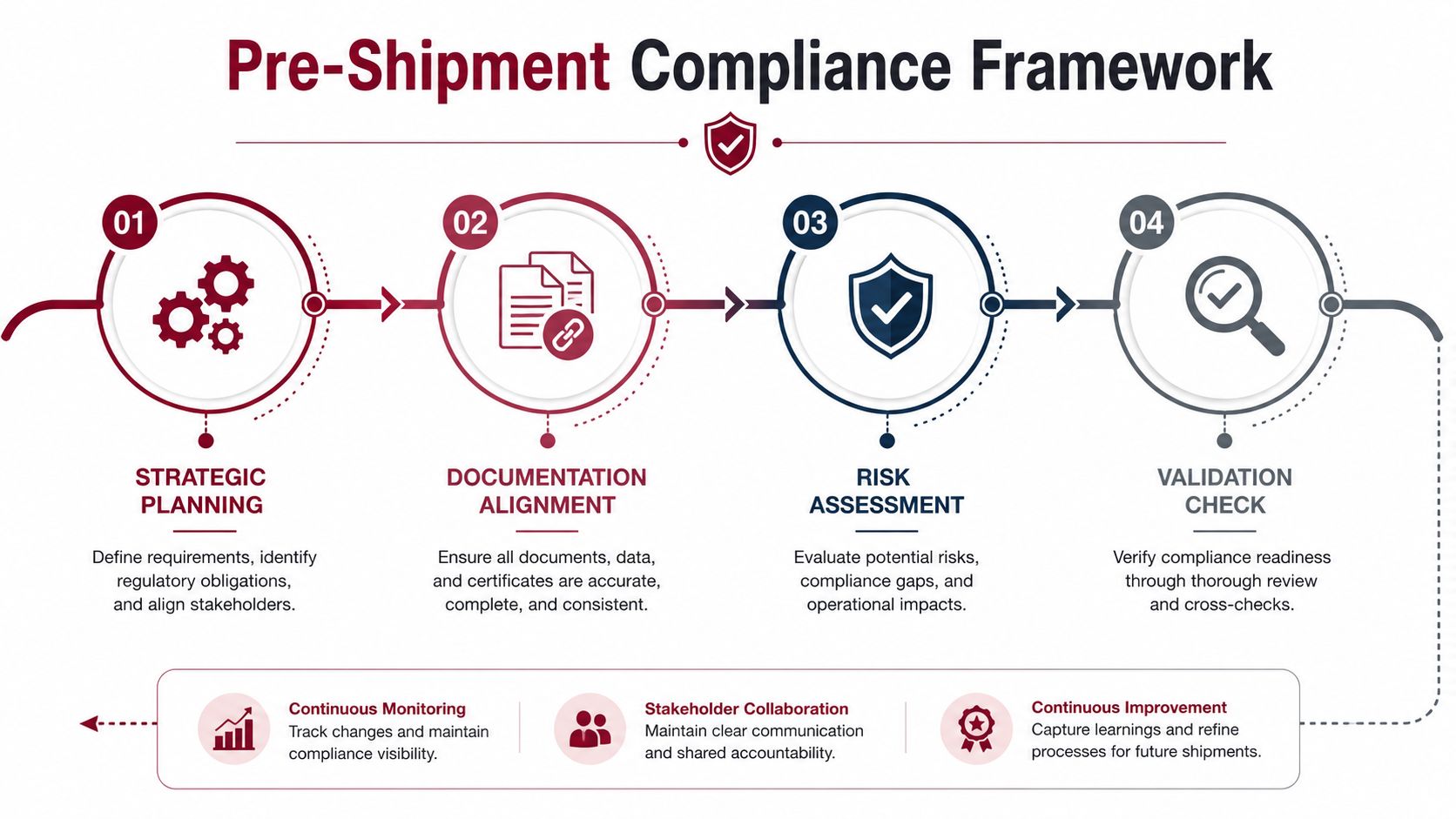
Before freight leaves the factory, the shipment file should answer four questions without contradiction:
- Can the product classification be defended with product facts? Use material composition, function, and product form, not supplier shorthand or internal naming.
- Is the declared value based on a consistent method? The team should be able to explain inclusions, exclusions, discounts, and related-party influences the same way on every shipment.
- Do the documents describe one commercial reality? Product identity, quantities, origin position, and shipment structure should align across invoice, packing list, booking data, and broker instructions.
- Have permit and control risks been checked early enough to act on them? Product teams often discover category restrictions after booking, when the only remaining options are delay, storage, or relabelling.
Brands that scale cleanly usually turn this into a formal pre-dispatch review, not a last-minute email chase. A structured compliance documentation process gives brokers better inputs, gives internal teams clearer accountability, and prevents customs issues from turning into stock gaps and margin leakage after the goods are already in motion.
Selecting Your In-Market Customs Partner
The cheapest broker often looks efficient on a spreadsheet and expensive everywhere else.
That's because customs brokerage isn't only a filing function for established brands. It's an intelligence function. The right in-market partner doesn't just transmit declarations. They interpret how your product category is likely to be treated, flag documentation gaps before dispatch, and communicate clearly when a hold turns from routine to commercially significant.
Commodity broker or operating partner
A transactional broker usually answers the question you asked. A strong broker answers the question you should have asked earlier.
That difference becomes material in categories like consumer electronics, household products, wellness items, and hardware. These products often carry hidden complexity. Component materials matter. Battery presence matters. Packaging material matters. Product claims matter. One broker may process paperwork efficiently while missing the category-specific issue that creates delay.
A recent marketplace review revealed a simple pattern. The strongest customs partners tend to sound more like operators than service vendors. They talk in terms of risk pathways, not just forms lodged.
Questions worth asking before appointment
Founders and operations leaders usually get better outcomes when they vet brokers with specificity rather than generic capability questions.
Ask things like:
- What experience do you have with this exact product type: Not “homewares” broadly, but metal fittings, connected devices, supplements, grooming tools, or whatever sits in your catalogue.
- How do you handle communication during a hold: You want cadence, escalation logic, and plain-English interpretation of what's happening.
- What do you review before goods depart origin: If the answer starts after the freight booking is live, they're already arriving late to the problem.
- Where do importers in this category usually get caught out: Good partners have seen the pattern before and will answer directly.
- How do you flag regulatory changes that affect repeat shipments: Ongoing intelligence matters more than one clean entry.
What the best partners actually protect
The practical value of a capable customs partner is broader than clearance speed.
They protect listing continuity because inbound inventory keeps flowing more predictably. They protect margin because avoidable classification and declaration mistakes get caught earlier. They protect reputation because your local distributors, retail partners, or marketplace operations team aren't repeatedly learning about delays after the fact.
A weak customs partner creates a particular kind of organisational fatigue. Your team spends time chasing answers, reconciling conflicting information, and calming internal stakeholders while inventory sits in limbo. A capable one reduces uncertainty, even when the answer is inconvenient.
“Tell me early, tell me clearly, and tell me what changes next” is the standard experienced operators should expect from a broker.
The selection lens that matters
One pattern we continue seeing is that brands choose customs support the way they choose freight. They compare fees. They ask about turnaround. They treat providers as interchangeable.
They aren't interchangeable if your category has compliance nuance or your market-entry plan depends on precise stock timing. The better selection lens is whether the partner can support your wider channel and market model. If a brand is entering new regions through multiple routes, such as distributor, marketplace, and direct fulfilment, the customs partner has to understand the operational consequences of delay across all three.
That's why broker selection should sit closer to a channel strategy decision than a purchasing decision. A disciplined channel partner selection criteria framework usually produces a stronger customs partner too, because it forces the team to evaluate fit, communication quality, and market intelligence rather than fee alone.
Navigating Key Marketplace Ecosystems
Brands often treat customs as a universal back-office function. That assumption usually breaks the moment they enter their second or third market.
Customs performance is shaped by the commercial system around it. The border process in each region exposes a different operational weakness, and those weaknesses hit revenue faster than many leadership teams expect. A delayed container is one problem. A marketplace launch that misses its availability window, loses ranking momentum, and forces reactive discounting is a different problem altogether.
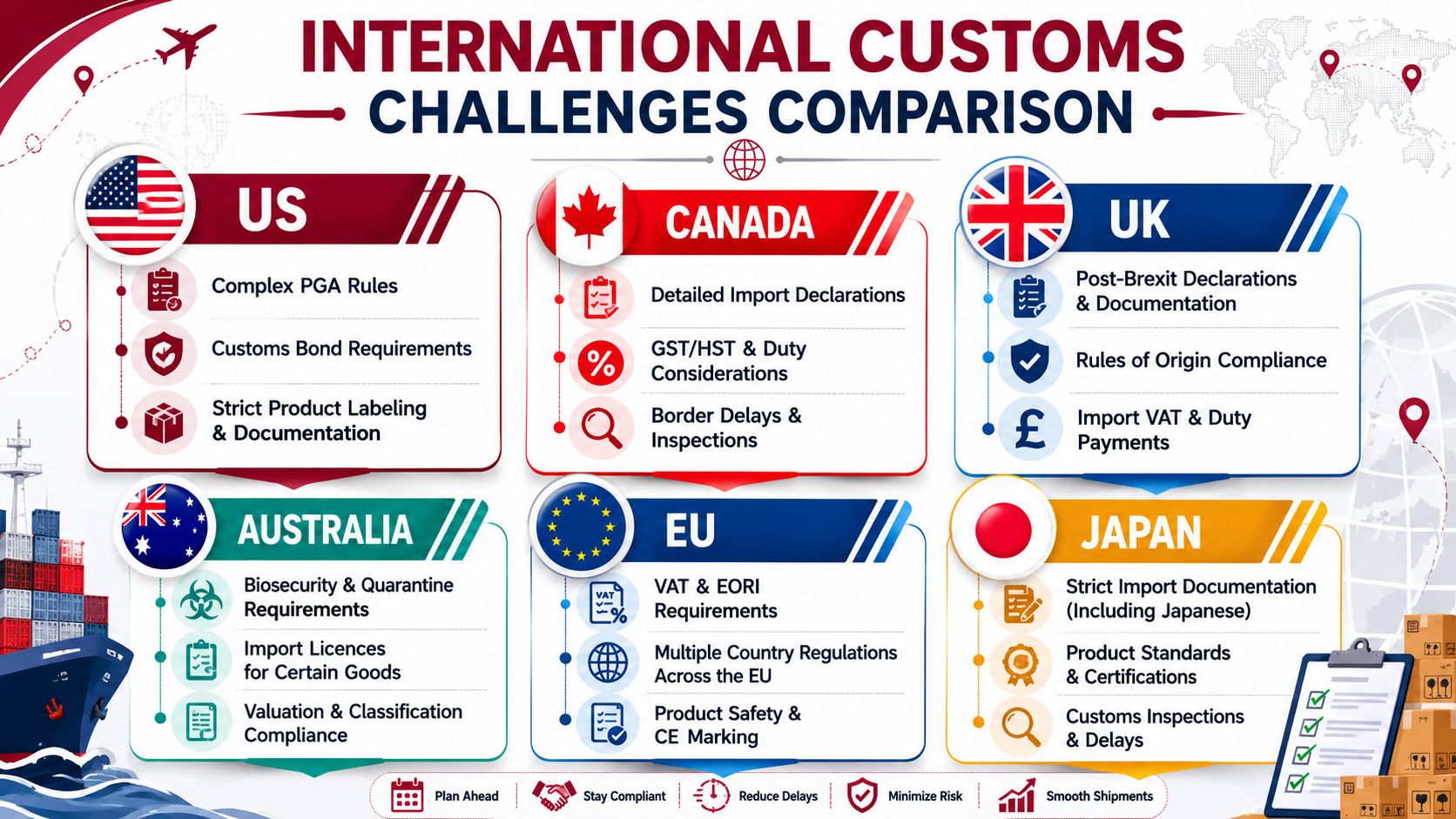
The recurring friction points by region
| Market | Pattern that trips brands up |
|---|---|
| United States | Product categories can trigger overlapping customs and regulatory scrutiny. Teams clear the shipment paperwork, then discover the product itself invites extra attention. |
| Canada | Small inconsistencies across bilingual labelling, valuation, and origin details can create avoidable review and rework. |
| United Kingdom | Origin treatment, post-entry administration, and border documentation have a direct effect on landed margin. |
| Australia | Biosecurity rules catch packaging, pallets, and product-adjacent materials that commercial teams often ignore. |
| European Union | VAT setup, importer structure, and country-level execution shape whether the model works commercially after clearance. |
| Japan | Documentation standards are less tolerant of approximation. Minor errors slow trust, correction, and release. |
Australia tests operational discipline early
Australia is a strong filter for first-time international operators because the risk is rarely confined to the declared goods. Packaging, timber, ingredient profile, and category-specific controls can all change the outcome.
As noted earlier, compliant shipments can move quickly. That does not make the market predictable. Teams get into trouble when they build launch timing around best-case transit and best-case clearance, then treat inspection or biosecurity intervention as an exception rather than a scenario to plan for.
I have seen brands lose more value from a poor packaging decision than from the duty itself. A timber pallet choice made upstream by a supplier can hold stock at the border, miss a marketplace replenishment window, and leave the local team trying to explain why demand was generated before inventory was available.
The US and EU expose different structural mistakes
The US tends to punish organisational silos. Customs, product compliance, and category regulation are often managed by different people, but the shipment still arrives as one commercial event. If those workstreams are misaligned, the border becomes the point where the mismatch shows up.
The EU exposes a different problem. Brands underestimate how much the entry model affects the economics after the goods are released. VAT treatment, importer setup, and country-by-country execution are not administrative details. They shape cash flow, resale viability, fulfilment options, and the amount of operational drag the business will carry into scale.
A brand can clear goods into Europe and still have the wrong commercial structure.
The UK, Canada, and Japan each punish a different kind of overconfidence
The UK catches teams that confuse market familiarity with operational simplicity. Shared language does not reduce the need for precise origin treatment and accurate paperwork.
Canada tends to reveal internal inconsistency. Finance, freight, the supplier, and the local sales team may all describe the same shipment slightly differently. Customs sees those gaps immediately.
Japan is where approximate documentation culture starts to get expensive. “Close enough” descriptions, lightly checked invoices, and informal corrections create friction that is hard to recover from once confidence drops.
Markets test more than whether goods can cross a border. They test whether the business is configured to operate credibly inside that market.
Why this matters for marketplace expansion
Marketplace growth teams often separate localisation, fulfilment, and customs into different conversations. In practice, they affect the same outcome: whether stock lands in the right condition, at the right time, under a structure that protects margin and supports conversion.
That is why the logic behind why some products feel closer to a new market than others matters well before a shipment departs. A product can look commercially ready because demand exists, while still being operationally misfit for the market it is entering.
The customs clearance process sits inside a wider ecosystem position. Brands that understand that early tend to protect speed, margin, and brand trust. Brands that do not usually learn it through delay notices, stock gaps, and expensive corrections.
The Hidden Economics and Common Pitfalls of Customs
Customs rarely hurts brands in the place they expect.
Teams usually budget for duty, tax, broker charges, and entry fees. Then they treat the rest as bad luck. In practice, the expensive part is the chain reaction. A held shipment distorts replenishment, forces manual rework, weakens launch timing, and pulls senior staff into problems that should have been prevented before dispatch.
That is why customs belongs in commercial planning, not in a narrow compliance box.
The cost stack teams under-model
The visible charges are easy to spot on a landed cost sheet. The harder costs sit in timing failure and organisational friction.
A shipment that clears late can leave marketing spending against low stock, push a marketplace listing out of rank-sensitive periods, or force a retailer conversation your sales team should not have to manage. Finance may still code the issue under freight or operations. The cause often sits upstream in customs preparation, classification logic, origin support, or document quality.
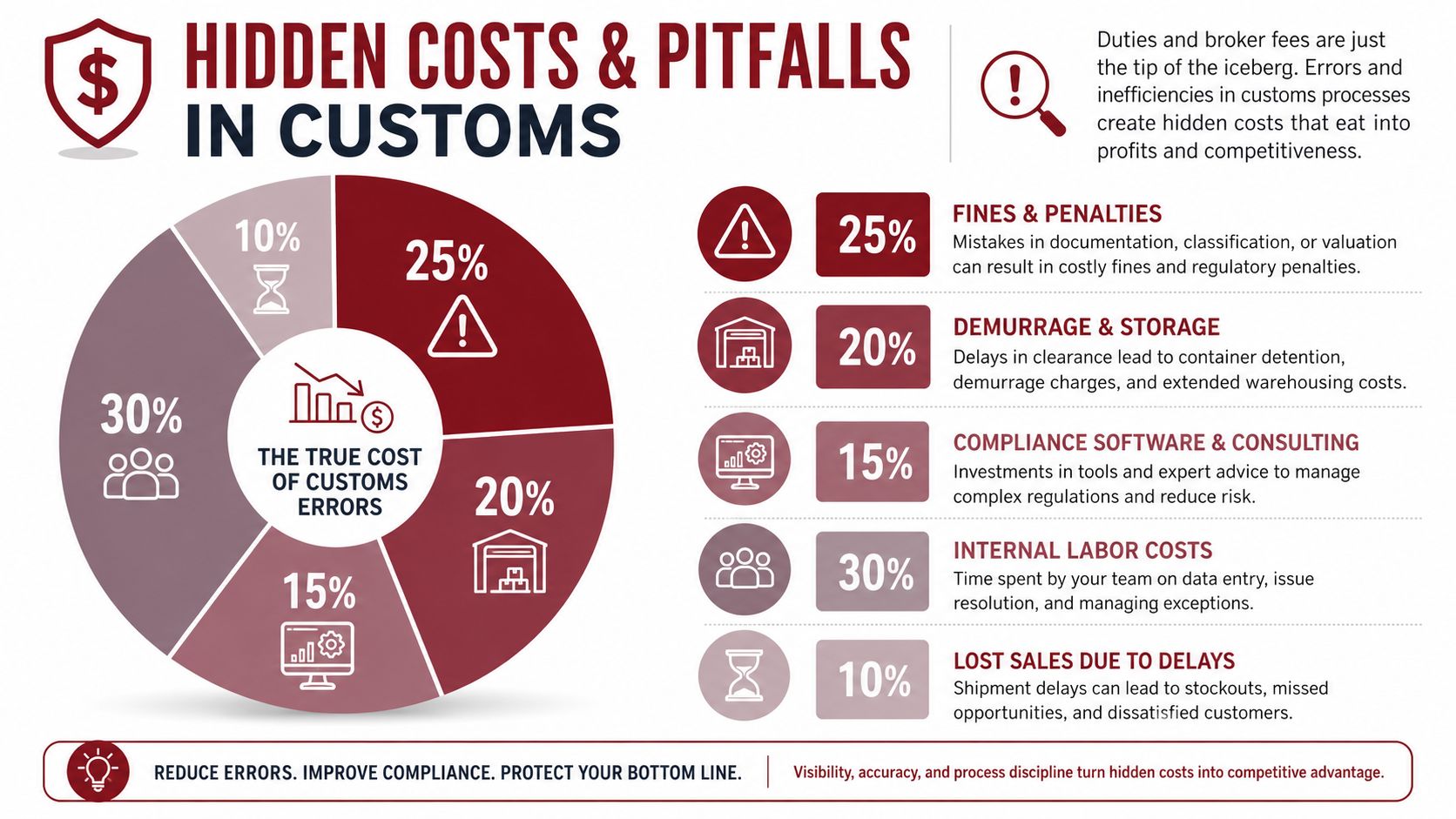
I see this mistake repeatedly with brands entering a new market. They model customs as a static charge. Customs behaves more like a volatility source. If the underlying setup is weak, one avoidable hold can wipe out the margin discipline the team spent months trying to build.
The low-value trap that catches hardware brands
Low-value consignments create false confidence.
Teams hear that a shipment sits below a threshold and assume it will move with minimal attention. That assumption breaks down fast for hardware, electrical accessories, replacement parts, and home improvement categories where permit, biosecurity, product description, or materials issues still matter. The invoice value may be modest. The compliance exposure may not be.
That gap causes forecasting errors. The stock plan treats the shipment as routine, but customs assesses the goods based on what they are, how they are described, and whether supporting controls are in place. Once that shipment is stopped, the problem is no longer administrative. It becomes a sales, inventory, and credibility problem.
A short industry explainer helps visualise how these disruptions unfold in practice.
Hidden customs costs that damage marketplace velocity
Strong operators translate customs risk into commercial terms early.
- Inventory timing risk: Late inbound stock can break launch sequencing, promotional calendars, and ranking stability.
- Margin leakage: Relabelling, corrective entries, storage, and exception handling add cost without creating any commercial upside.
- Partner confidence loss: Repeated date changes train distributors, retailers, and internal sales teams to discount your timelines.
- Management distraction: Senior people end up solving border issues because the operating model was not tight enough before shipment.
These costs rarely appear together in one report. That is part of the problem. Brands can be disciplined in media efficiency and channel pricing while missing the operational leakage that keeps eroding profitability underneath.
A better way to think about landed cost
Landed cost should include the likelihood that customs friction will interfere with availability, not just the tax and freight attached to a shipment.
That is the same commercial logic behind the margin shrinkage on Amazon that teams often misdiagnose. Small structural mistakes pass through fulfilment systems, stock allocation, and marketplace performance faster than many operators expect.
If customs risk can interrupt availability, it belongs in commercial planning, not just compliance planning.
Managing Post-Clearance Audits and Continuous Improvement
Most brands relax once inventory is delivered. That's understandable. It's also where a lot of operational learning stops too early.
Post-clearance audits are often treated like rare punishment events. A better view is that they're part of the normal accountability structure of international trade. Even compliant importers can face questions, requests for records, or reviews of how declarations were made.
Audit readiness is a maturity signal
When customs authorities review a shipment after release, they're not only checking the entry. They're testing whether the business can explain its own commercial logic with discipline.
That means your records need to show more than final documents. They should show how the declaration was arrived at. Product specifications, supplier statements, origin support, classification reasoning, and valuation logic all matter. If the team can only produce fragments scattered across inboxes, the problem is usually internal governance rather than one shipment.

A calm response works better than a defensive one
The strongest operators don't treat an audit notice as an accusation. They treat it as a process test.
A practical response usually looks like this:
- Centralise the file: Pull every shipment document, product detail, and approval note into one place.
- Reconstruct the decision path: Show how classification, valuation, and origin claims were determined.
- Check for internal inconsistency: Before responding, make sure finance, operations, and supplier records tell the same story.
- Answer precisely: Give the authority what it asked for, clearly and without unnecessary narrative.
- Capture the lesson: Whether fault is found or not, use the review to strengthen future entries.
Strong audit responses are usually quiet, organised, and well documented. Weak ones are rushed, fragmented, and overly reactive.
Continuous improvement starts after release, not before it ends
One issue we repeatedly observe is that teams run a post-mortem only when customs goes badly. They should also review shipments that cleared smoothly.
Clean entries reveal what's working. Audits reveal where assumptions need to be tightened. Both are useful. The goal isn't merely to survive scrutiny. It's to make the next shipment more reliable than the last one.
For serious brands, customs capability compounds the same way other operational capabilities do. Better records lead to better classification discipline. Better classification discipline supports cleaner declarations. Cleaner declarations support more stable inventory flow.
That's how a reactive compliance function turns into a durable operating advantage.
From Logistics Hurdle to Commercial Advantage
The brands that scale cleanly across borders don't treat customs as an annoying back-office step. They treat it as part of commercial architecture.
That's the key shift. The customs clearance process isn't separate from marketplace performance, brand value, or channel stability. It influences all three. A weak process creates margin leakage, poor inventory confidence, and unnecessary friction with partners. A disciplined process supports smoother replenishment, steadier market entry, and better operating credibility.
What stronger operators understand earlier
Across multiple marketplace ecosystems, the most resilient brands tend to recognise a few things sooner than everyone else:
- Expansion is an ecosystem transition: Products aren't just entering a market. They're entering a regulated operating environment.
- Fulfilment structure shapes commercial performance: Customs friction doesn't stay at the border. It rolls into stock position, channel timing, and customer experience.
- Documentation quality is brand discipline in another form: Clean files usually come from clean internal thinking.
- Predictability has value: The ability to move goods reliably often matters as much as the headline cost of moving them.
Customs capability becomes a strategic asset
A recent marketplace review revealed a pattern that experienced founders already suspect. The businesses that perform well internationally usually respect operations as much as they respect product and marketing.
That doesn't mean building a bureaucratic culture. It means understanding that growth gets fragile when compliance, localisation, and fulfilment are treated as afterthoughts. Strong catalogues don't automatically produce strong marketplace presence. Operational cohesion does a lot of the heavy lifting.
The customs clearance process is one of the clearest places where that cohesion becomes visible. If the shipment moves smoothly, it usually reflects broader organisational alignment. If it doesn't, the border often exposes issues the business was carrying already.
For brands entering Australia, the US, Canada, the UK, Japan, or the EU, that's worth taking seriously. Customs is not just what happens before inventory can be sold. It's one of the clearest signals of whether the business is prepared to scale in a new ecosystem with control.
If you're building an international expansion plan and want a commercially grounded view of where customs, localisation, fulfilment, and marketplace structure intersect, TPR Brands works with established product brands to build more coherent market-entry ecosystems across regions and channels.