A large share of channel failure isn't caused by weak products. It's caused by weak channel judgement.
One pattern we continue seeing is that founders treat distribution as a coverage problem. More doors, more listings, more regions, more revenue. In practice, evaluating distribution channels is closer to diagnosing ecosystem fit. A channel can increase visibility and still damage margin. It can add sales and still weaken brand control. It can look efficient in one region and become operationally expensive in another.
That tension gets sharper during international expansion, where the channel itself becomes part of the product experience. Fulfilment speed, partner behaviour, compliance handling, merchandising standards, data access, and pricing discipline all shape whether a brand scales cleanly or fragments under growth.
The Channel Expansion Paradox
In Australia, 68% of new international brand entries into the hardware and home improvement sector fail within the first 12 months due to insufficient ecosystem positioning, despite having high-quality products, according to Ecosystem Marketplace reporting on brand entry failure.
That figure should force a rethink. Strong products don't automatically become strong brands in new channels. Commercial traction depends on where the product sits, how it's fulfilled, who represents it, how pricing is held, and whether the surrounding ecosystem reinforces trust or undermines it.
Founders usually don't make channel mistakes because they're careless. They make them because the wrong signals look persuasive early. A retailer says yes. A distributor promises coverage. A marketplace shows immediate search demand. Revenue appears before the hidden costs do.
Why channel choice goes wrong
The mistake isn't expansion itself. It's evaluating channels as isolated routes to market rather than as connected parts of a commercial system.
A recent marketplace review revealed the same pattern across premium consumer categories, household products, and home organisation brands. The first decision often centres on top-line access. The second-order effects arrive later:
- Margin pressure appears first when servicing costs, promotional expectations, and partner discounts stack up.
- Brand dilution follows when different channels present the same catalogue with different levels of quality, service, and pricing discipline.
- Operational drag sets in when inventory, fulfilment, and support requirements no longer align across regions.
Practical rule: If a channel improves reach but weakens control, economics, and customer confidence at the same time, it isn't expansion. It's deferred cleanup.
What experienced operators look for
The more mature question isn't “Can we open this channel?” It's “What behaviour will this channel introduce into the business?”
That changes the evaluation process. Instead of asking whether a channel sells, you ask whether it creates a stable, repeatable operating model. Instead of chasing apparent distribution breadth, you test whether the channel strengthens the commercial ecosystem you're trying to build.
Across multiple marketplace ecosystems, the brands that hold value over time tend to make slower decisions upfront and faster decisions later. They stress-test partner dependence. They model cost-to-serve. They look at whether the new channel reinforces trust or creates contradiction.
That's the paradox. Expansion feels like growth when the channel opens. It only becomes real growth if the ecosystem stays coherent after it opens.
A Unified Framework for Channel Evaluation
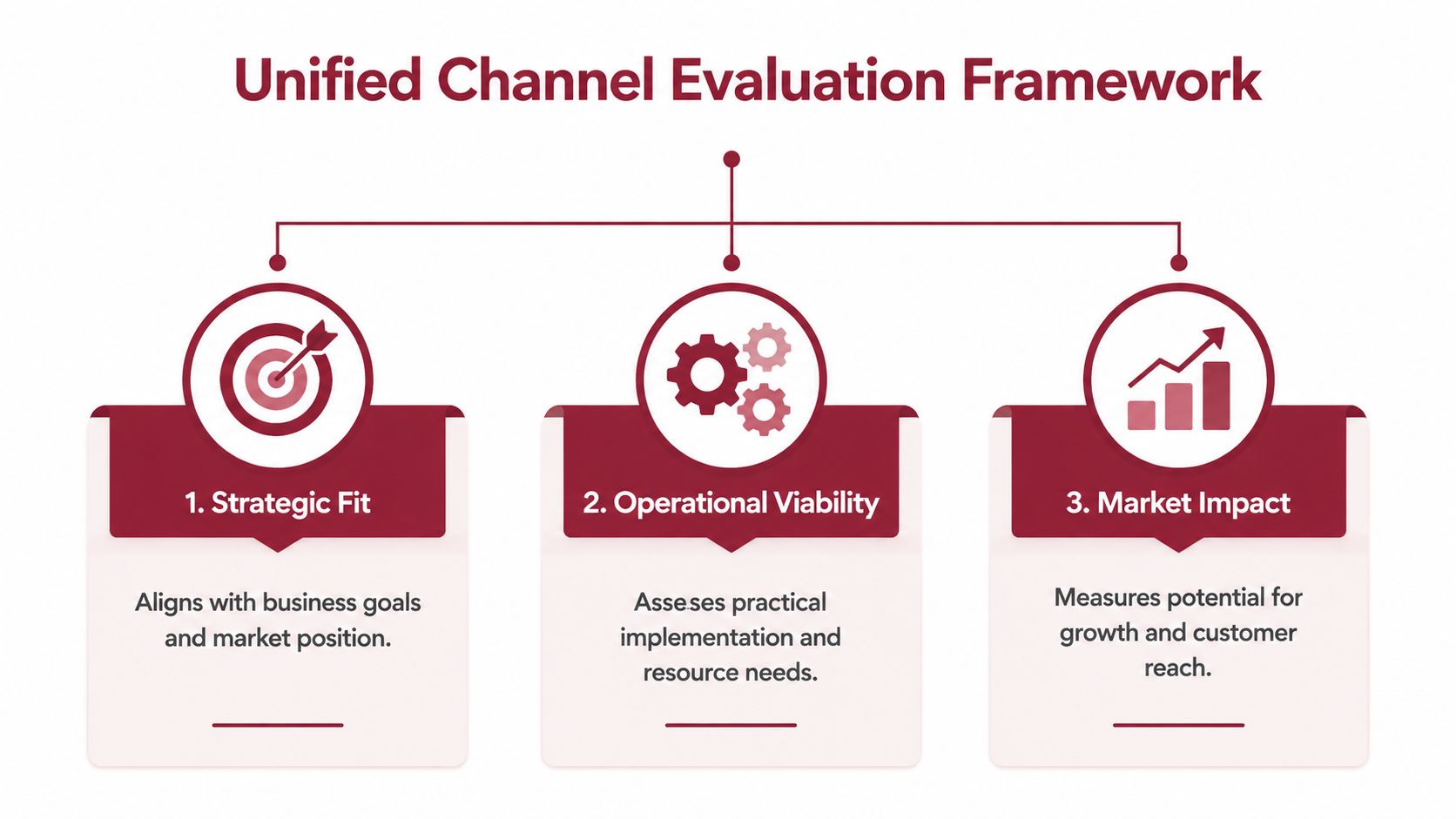
The strongest channel decisions usually come from a framework that links strategy, operations, and market behaviour. Without that, teams end up comparing channels on revenue potential alone, which is rarely enough.
Commercial viability
Start with economics, but not just invoice revenue. Channel evaluation needs to include the full cost-to-serve: onboarding friction, returns handling, promotional funding, freight assumptions, packaging constraints, support load, and stockholding requirements.
One issue we repeatedly observe is that brands compare channels using gross sales while ignoring the operating shape each channel imposes. A wholesale account may look cleaner on paper but create margin leakage through rebates, ranging pressure, or stock rotation. A marketplace may create attractive demand visibility but introduce fulfilment and returns costs that distort true contribution.
The useful question is simple. After all fulfilment, service, compliance, and partner costs are included, does the channel still deserve inventory and management attention?
For teams that want a tighter commercial lens, TPR Brands' channel partner selection criteria offers a practical way to review catalogue fit, service expectations, and partner dependence before expanding further.
Operational viability
Some channels fail because they were mispriced. Others fail because the business can't operate them cleanly.
Data from the Australian Ecosystem Models Framework shows that brands using structured fulfilment networks, such as third-party logistics with regional warehousing, achieve 32% higher commercial performance metrics than brands relying on direct-to-consumer shipping, as outlined in CSIRO's marketplace fulfilment framework reference.
That matters because fulfilment structure isn't a back-office detail. It affects delivery reliability, inventory placement, retailer confidence, customer expectations, and the practical cost of scale. Across multiple marketplace ecosystems, brands often underestimate how quickly a weak fulfilment model can erode the value of a promising channel.
A channel can tolerate imperfect marketing for a while. It won't tolerate chronic stock instability, slow replenishment, or inconsistent service standards.
Brand ecosystem alignment
The third pillar is the least discussed and often the most important. A channel should strengthen how the brand is understood in the market, not just where it appears.
That includes questions such as:
- Presentation quality. Does the channel support the product story, category context, and merchandising standards the brand needs?
- Pricing discipline. Will the channel hold a coherent price position relative to adjacent channels?
- Customer trust signals. Does the buying experience feel consistent with the product's intended market position?
A premium household product can lose more value through poor channel context than through weak creative. The same product placed in a poorly aligned marketplace environment, next to discount-led substitutes and inconsistent sellers, starts to feel interchangeable.
A practical decision matrix
A simple weighted matrix helps force trade-offs into the open.
| Channel Option | Margin Potential (Weight 0.3) | Brand Control (Weight 0.25) | Scalability (Weight 0.2) | Logistical Complexity (Weight 0.15) | Market Reach (Weight 0.1) | Weighted Score |
|---|---|---|---|---|---|---|
| Direct-to-Consumer | ||||||
| Third-Party Marketplace | ||||||
| National Retail | ||||||
| Distributor Model |
The point isn't mathematical precision. It's governance. When leadership teams score channels together, they surface disagreements early. That's often where genuine insight sits. Sales may favour reach. Operations may flag complexity. Brand leaders may see positioning risk that a spreadsheet hides.
A good framework doesn't remove judgement. It makes judgement visible.
Observing Channel Behaviour in the Wild
Textbook definitions of channels aren't very helpful once a brand is trading across them. What matters is how each one behaves inside the business.
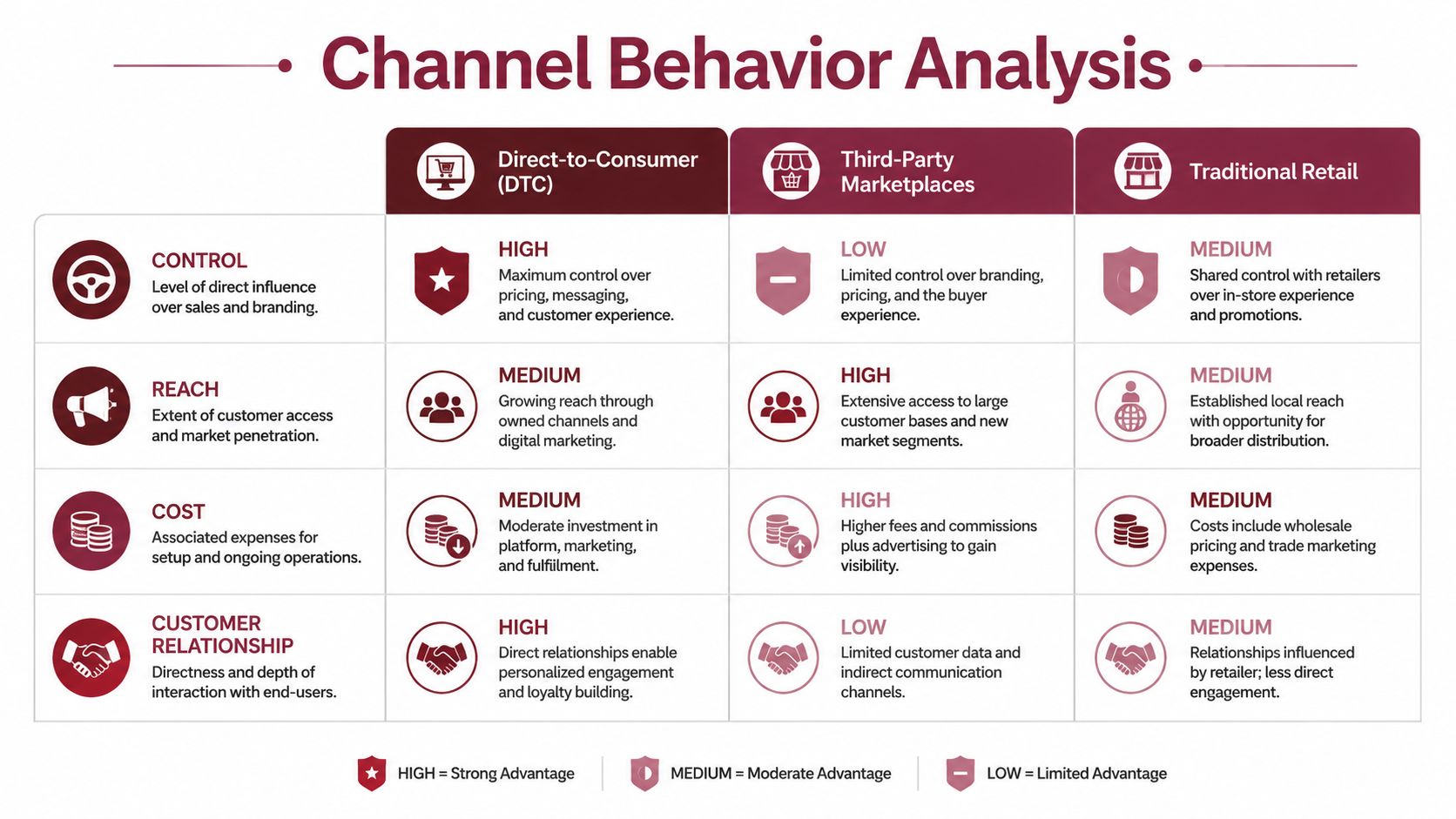
Direct-to-consumer behaves like a control engine
DTC gives the brand the closest relationship with demand signals, merchandising, and customer feedback. It's where operators can test bundles, sharpen positioning, and learn quickly from behaviour.
But that control comes with ownership. The brand owns traffic quality, service standards, post-purchase communication, and fulfilment friction. In categories like connected devices, household products, and wellness, DTC often works best as a learning and margin engine, not as the only route to scale.
When founders overestimate DTC's role, they often confuse control with reach. The channel can produce excellent data and still underperform as a broad market access vehicle.
Marketplaces behave like rented infrastructure
Third-party marketplaces compress access to demand, but they also compress differentiation. The channel can create rapid discovery, especially when the catalogue is already proven, yet it also changes what the brand owns.
One pattern we continue seeing is that marketplace demand looks stronger than it really is because the platform absorbs so much customer acquisition friction. That's useful, but it creates dependency. The brand gains access to traffic while losing a degree of customer relationship depth, merchandising freedom, and data transparency.
Marketplaces are rarely neutral. They reward operational consistency, pricing clarity, and catalogue discipline. They punish fragmentation quickly.
That doesn't make them weak channels. It means they need to be evaluated as capability rentals. You're using another ecosystem's infrastructure. The key question is whether the rented reach creates durable brand value or only temporary sales volume.
Retail and distribution behave like leverage with constraints
Traditional retail and distributor-led models can enable scale that DTC and marketplaces can't replicate easily. They can also introduce the most expensive forms of misalignment.
Retailers care about category productivity, stock reliability, packaging clarity, and commercial predictability. Distributors care about territory economics, account access, and sell-through support. Neither party is there to preserve the brand in the abstract. They respond to incentives, operational ease, and confidence in repeatability.
A short comparison helps:
- DTC usually offers stronger control and cleaner first-party learning, but requires internal capability depth.
- Marketplaces can accelerate access, but often create data asymmetry and price visibility pressure.
- Retail adds credibility and volume when the offer fits the shelf and the replenishment model works.
- Distributors extend reach where direct coverage is inefficient, but they can also create distance between the brand and the end market.
The strategic choice underneath the channel choice
Founders often think they're selecting a route to market. They are in fact deciding what capabilities they want to own and what capabilities they're willing to rent through partners.
Across consumer electronics, home organisation, and premium lifestyle products, stronger brands tend to stay clear on one point. Every channel should have a role. If two channels fight over the same customer with the same offer and different economics, conflict is already embedded in the model.
That's when channel selection stops being a distribution decision and starts becoming an ecosystem architecture problem.
Due Diligence and Mitigating Channel Conflict
A partner can look commercially attractive before operational questions are asked. That's why due diligence needs to go beyond account lists, margin talk, and verbal promises about reach.

What to test before signing
The first screen is capability. The second is behaviour.
Ask potential distributors, retail partners, or channel operators questions that expose how they work:
Operational coverage
Which accounts do they actively manage, and which ones sit passively in the network? How do they forecast, replenish, and escalate stock issues?Brand handling discipline
How do they present premium lines versus volume lines? What approval process exists for merchandising, pricing changes, and promotional activity?Data visibility
What reporting do they provide, how often, and at what level of detail? Can they separate sell-in from sell-through in a way that helps decisions?Market understanding
Do they understand the category's buying cycle, compliance requirements, and service expectations, or are they merely broadline operators adding another SKU range?
A practical benchmark for these reviews is this guide to evaluating distributor performance, especially when a prospective partner appears strong commercially but the operating model is still unclear.
Where channel conflict usually starts
Conflict rarely begins with dramatic disagreement. It starts with ambiguity.
A brand launches into multiple channels with overlapping pricing, duplicate product ranges, unclear territorial expectations, and no agreed rules about who owns which customer segment. The early weeks feel manageable because volume is still small. The pressure arrives when one partner sees another undercutting price, discounting too aggressively, or receiving better stock access.
Operator note: Most channel conflict is designed in at the start, then discovered later.
The usual fault lines are predictable:
- Range duplication that gives every channel the same offer and no strategic role
- Loose pricing policy that invites reactive discounting
- Unclear territory rights that create silent account overlap
- Poor inventory governance that makes one partner feel deprioritised
How to reduce friction before it becomes expensive
Brands that protect margin and trust tend to formalise channel boundaries early.
Use channel-specific product architecture where possible. Reserve certain packs, bundles, or merchandising formats for specific environments. Define territory logic clearly, even when the market feels small. Set a pricing framework that protects position without making commercial execution impossible. Then agree how issues are escalated before they become emotional.
For teams working through the operational detail, this discussion on partner oversight is useful before contract finalisation.
The strongest channel relationships aren't informal. They're structured in a way that allows trust to survive pressure.
Localising Channel Strategy for International Markets
International expansion changes the channel question completely. What works in one region can misfire in another because the surrounding ecosystem behaves differently.

Australia rewards structural alignment
Australia is a useful reminder that channel strategy isn't abstract. It's shaped by actual network structure.
The centralised nature of Australia's distribution network means major supermarket chains such as Coles and Woolworths operate their own national and regional distribution centres, and those groups collectively share more than 83.3% of the food distribution market, as outlined in this review of Australia's merchandising and distribution structure.
Even when a brand isn't selling grocery, the broader lesson matters. Australian distribution often favours central coordination, disciplined replenishment, and clear operational compliance. Brands entering the market with a fragmented, retailer-by-retailer mindset can underestimate how much the local system rewards coherence.
What becomes visible during international expansion is that localisation isn't just copy translation or packaging changes. It's adapting to how the market concentrates decision-making power.
For a closer look at how product presentation and market familiarity affect trust, this perspective on marketplace localisation is worth reading.
North America often forces sharper channel separation
The US and Canada usually require a different posture. Brands often face a wider mix of retail formats, distributor structures, regional account behaviour, and marketplace intensity. That doesn't automatically make those markets harder. It makes them less forgiving of vague channel roles.
One issue we repeatedly observe is that brands carry one commercial narrative into North America when they need several. A marketplace strategy, a retail strategy, and a distributor strategy may all coexist, but they can't all carry the same assortment logic, service promise, and pricing assumptions.
The UK tends to reward disciplined brand translation
The UK often looks familiar to Australian or North American operators at first glance. Language overlap creates false confidence. But channel behaviour can still differ materially, especially around category presentation, retailer expectations, and value perception.
In practice, localisation there is often less about broad structural redesign and more about precise adaptation. Product hierarchy, merchandising language, and the level of proof required in the offer all matter. If the brand assumes similarity means interchangeability, execution starts to drift.
Asia exposes ecosystem maturity differences quickly
Across Asian markets, the biggest challenge is usually not demand potential. It's variation. Marketplace dominance, distributor capability, local trust signals, service expectations, and compliance routines can differ substantially from one country to another.
That means the wrong expansion instinct is standardisation for its own sake. The better instinct is controlled adaptation. Keep the core brand intact, but let channel design reflect local buying behaviour, partner reliability, and fulfilment realities.
International expansion isn't a listing exercise. It's an ecosystem transition, and local channel behaviour decides whether the transition holds together.
From Channel Selection to Ecosystem Design
The core task in evaluating distribution channels isn't ranking options on a spreadsheet. It's deciding what kind of commercial system the brand is trying to build.
Strong catalogues don't automatically create strong marketplace presence. Retail access doesn't automatically create trust. Distributor coverage doesn't automatically create market understanding. Those things only become durable when the channels reinforce one another instead of competing destructively inside the same business.
The shift founders need to make
The shift is from opportunistic expansion to deliberate ecosystem design.
That means choosing channels for their role, not just their revenue promise. It means protecting margin by understanding fulfilment structure before growth accelerates. It means defending brand value by creating clearer boundaries between DTC, marketplaces, retail, and partner-led distribution. And it means localising channel strategy with enough humility to accept that each region carries its own operating logic.
A useful planning lens is distribution network design, especially when the business has already outgrown a simple direct-versus-wholesale debate.
Brands that scale well rarely do so because they opened the most channels. They scale because they built a coherent system that could carry more complexity without losing control.
If you're reviewing channel options across Australia, North America, the UK, or adjacent international markets, TPR Brands works with established product businesses that need a commercially structured path into new marketplace and distribution ecosystems.