Most founders ask the wrong question first.
They ask whether an agent or distributor is cheaper. The sharper question is this: which model gives your brand the right mix of speed, control, and protection once you enter a new market?
That distinction matters because international expansion isn't a listing exercise. It's an ecosystem decision. The partner model you choose affects inventory flow, retailer confidence, pricing behaviour, customer experience, legal exposure, and how easily you can correct mistakes later. A strong product can still underperform if the surrounding commercial structure is weak.
One pattern we continue seeing across multiple marketplace ecosystems is that brands treat the agent vs distributor decision as a sales channel choice, when it's instead an operating model choice. It changes who carries stock, who speaks to retail, who owns local momentum, and who feels the consequences when demand doesn't arrive on schedule. Once that structure is in place, everything else tends to follow.
For established hardware, household, and consumer product brands, this becomes even more important. These categories rely on fulfilment confidence, clean channel architecture, and consistent local execution. If your partner model creates fragmentation, the market sees it quickly. If it creates cohesion, retailers and customers tend to trust the brand sooner.
The Question Founders Ask vs The One They Should
The common version of the question sounds commercial, but it's usually too narrow. Founders ask, “Should I use an agent or a distributor?” What they often mean is, “Which one costs less up front?”
That framing overlooks the essential issue. The better question is: which structure fits this product, this market, and this stage of the brand?
Cost is rarely the real decision
An agent can look leaner at first glance. A distributor can look expensive because margin leaves the business earlier. But the headline cost isn't the same as the total commercial consequence.
If you appoint an agent, you often retain more control. You may also retain more responsibility. That can include stock planning, credit exposure, fulfilment complexity, retailer negotiations, market support, and the work required to keep channel execution aligned with the brand you think you're building.
A distributor changes that equation. You give away margin, but you may gain local infrastructure, inventory ownership, retail access, and a cleaner operational footprint. For some brands, that trade works well. For others, it creates distance from the market at exactly the moment they need visibility.
The wrong partner model doesn't only reduce profit. It changes how your brand is experienced in-market.
The second-order effects matter more
What becomes visible during international expansion is that the first-order question is rarely the hardest one. The harder issues appear later.
A founder might save money with an agent structure, then discover they've built a market that depends heavily on their own team to manage replenishment, pricing consistency, compliance, and retailer follow-through. Another founder might appoint a distributor for speed, then realise the local market now sees the distributor's commercial priorities more clearly than the brand's own.
That's why serious brands should treat agent vs distributor as a structural choice, not a procurement exercise. It shapes your operating burden, your pace of entry, and your ability to protect brand value when the market becomes noisy.
Here's a practical comparison to ground the decision early:
| Commercial factor | Agent | Distributor |
|---|---|---|
| Inventory ownership | Brand retains ownership | Partner buys and owns goods |
| Customer relationship | Often closer to the brand | Often mediated by the distributor |
| Financial exposure | Brand carries more direct risk | Distributor carries more inventory and credit risk |
| Speed of market entry | Can be slower to operationalise | Can be faster where network and stockholding matter |
| Pricing control | Usually stronger for the brand | Usually less direct |
| Exit complexity | Depends heavily on contract terms | Depends heavily on contract terms and stock position |
Defining the Roles Beyond the Titles
A lot of confusion starts with labels. “Agent” and “distributor” sound like adjacent commercial roles. In practice, they create very different market structures.

Three questions cut through the noise
When assessing any partner model, ignore the title for a moment and ask three questions.
- Who owns the inventory?
- Who owns the customer relationship?
- Who carries the financial risk if things go wrong?
Those three questions tell you more than any pitch deck.
According to the Australian distribution and sales channels guide, distributors in Australia typically purchase goods upfront at wholesale prices, add a margin averaging 22–28%, and resell them within defined territories. Agents, by contrast, retain no ownership of goods. This ownership difference is fundamental.
What an agent actually does
An agent is usually a market-facing representative. They introduce accounts, support sales activity, and help build local commercial relationships, but they don't usually buy your stock. The brand remains closer to the transaction and usually stays more exposed to the operational consequences.
This model can work when control matters more than reach. It's often better suited to products that need tighter pricing discipline, careful technical explanation, or direct brand stewardship in early-stage expansion.
A recent marketplace review revealed that founders often like agent structures because they feel safer. In reality, they can require a stronger internal operating team. If your business isn't ready to manage overseas demand with discipline, the apparent simplicity disappears quickly.
What a distributor actually changes
A distributor is not just a sales partner. A distributor is effectively a local customer with infrastructure. They buy, hold, resell, service accounts, and absorb part of the commercial friction that would otherwise sit with the brand.
That can be powerful in hardware, household, and home improvement categories where inventory availability and retailer confidence matter. It can also create distance. If a distributor owns too much of the in-market execution, the brand can lose visibility into how it's being positioned.
For brands working through channel partner selection criteria, that's the practical filter. Don't ask which label sounds better. Ask which structure matches the operating reality you want to build.
Operator view: Titles don't protect brands. Clear commercial architecture does.
Comparing the Commercial and Financial Models
The economics of agent vs distributor are straightforward on paper and much messier in execution.
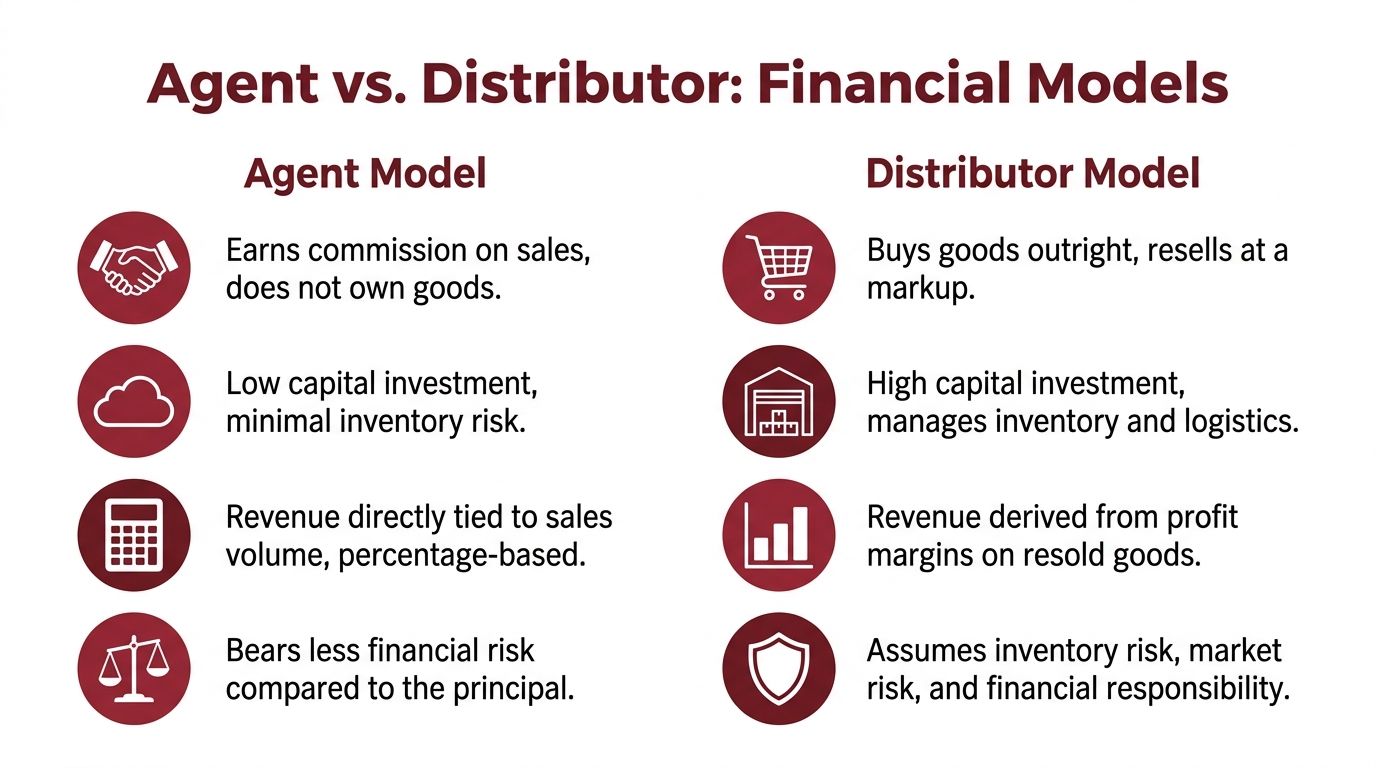
The money flows in different directions
In the Australian market, sales agents typically earn a commission of 3–5% of sales, whereas distributors realise a profit margin of approximately 30% because they purchase goods at wholesale and bear the bad debt risk, as outlined in this Australian distribution strategy reference.
That gap isn't a small pricing detail. It reflects two very different commercial roles.
With an agent, the brand keeps more of the gross value per sale, but also keeps more of the burden attached to the sale. With a distributor, the brand gives up more margin, but the distributor funds inventory and accepts more local commercial exposure.
For founders, this often creates a false comparison. They look at 3–5% and conclude the agent model is obviously more efficient. But that only holds if the brand can support the rest of the system competently.
What founders tend to underestimate
One issue we repeatedly observe is that brands undercost the internal effort required to make an agent model work well. If your team still has to manage stock forecasting, retailer servicing, market follow-up, returns, payment friction, and pricing discipline, the commission line doesn't tell the whole story.
By contrast, a distributor margin can look heavy, but it often purchases speed, local warehousing discipline, and simpler execution. That doesn't make it automatically right. It means the commercial comparison should include operational substitution, not just percentage leakage.
A practical way to compare the two:
- Gross margin retention: Agent models usually preserve more margin on paper.
- Working capital burden: Distributor models can reduce the direct pressure on the brand because the partner buys stock.
- Pricing visibility: Agent structures often support tighter pricing control.
- Channel speed: Distributor structures often help brands move faster where local stockholding matters.
- Support load: Agent structures usually require a stronger internal team behind them.
Later in the legal discussion, a separate issue becomes important. Exit and termination terms can reverse the economics if they're poorly structured.
For teams reviewing their wholesale pricing strategy, model selection needs to occur. Price architecture, partner incentives, and market expectations need to align before outreach starts.
A short legal perspective is worth watching because the financial model only works if the contract reflects it:
Navigating Legal Frameworks and Contractual Realities
The agreement matters more than the label on the agreement.
A weak contract can turn a sensible market entry plan into a long, expensive clean-up exercise. That's particularly true when brands expand from Australia into the UK, US, or Canada and assume partner models behave the same way across jurisdictions.

The hidden issue most guides skip
A major legal asymmetry often gets missed. In the UK and EU, commercial agents have statutory exit compensation rights under the Commercial Agents Regulations 1993, while Australian distributors do not have an equivalent automatic payout. The same source also notes that 68% of Australian supplier contracts lack a stock buyback or compensation clause in this context, which leaves termination risk badly under-negotiated in practice, as discussed in this legal commentary on termination and compensation.
That matters because founders often assume a distributor can be replaced if performance slips. In reality, the commercial unwind can become difficult very quickly, especially where stock remains in market, exclusivity exists, or the partner believes it has built the territory for you.
Practical rule: If you haven't negotiated the exit while everyone is optimistic, you probably haven't protected the relationship properly.
Contract points that deserve real scrutiny
Too many agreements focus on margin and territory, then leave the harder issues vague. That's where problems begin.
Look closely at:
- Exclusivity conditions so the partner only keeps territory rights if performance is clear and measurable.
- Stock handling on termination including sell-through periods, buyback mechanisms, and treatment of unsold inventory.
- Brand controls covering pricing presentation, product claims, packaging adaptation, and channel conduct.
- Data access so the brand can still see what's happening in the market instead of operating through filtered reports.
- Compliance obligations especially where technical files, labelling, certifications, or retailer requirements differ by region.
The legal framework should support operational discipline, not sit beside it. For many established brands, the agreement becomes the main tool for preserving ecosystem cohesion once expansion begins.
That's why contract preparation belongs alongside compliance documentation planning, not after it. If legal terms, product readiness, and market structure are drafted separately, misalignment shows up later in the form of channel conflict, stock disputes, or partner friction.
The Impact on Market Entry and Ecosystem Cohesion
The partner model affects more than the partner. It affects the entire market experience around the brand.
Across multiple marketplace ecosystems, one pattern keeps showing up. Brands with coherent market-entry structures look more credible than brands with scattered representation, even when the product is identical. Buyers notice consistency. Retailers notice fulfilment confidence. Customers notice whether the brand feels organised.
Speed changes perception
In hardware and related product categories, entry speed isn't only about revenue timing. It shapes retailer belief. A market that sees reliable stock, consistent communication, and accountable local execution tends to trust the brand faster.
That practical advantage is visible in the Australian hardware context. A 2023 study by the Australian Industry Group noted that 65% of hardware manufacturers reported faster market penetration, within 6–9 months, when using distributors, compared with 14–18 months with agents. The source link appears earlier in this article where the underlying distribution model is defined.
That doesn't mean distributors always win. It means the right distributor can compress the distance between product readiness and channel presence.
Fragmentation damages brands quietly
Agent-led structures can work very well, especially when brand control matters. But they can also create fragmentation if the brand lacks strong local operating discipline.
A recent marketplace review revealed a familiar pattern in consumer categories. The product catalogue is strong, the packaging is competent, and demand exists. But the market experience feels disjointed because pricing varies, replenishment lags, and no one is clearly responsible for aligning the ecosystem. The issue isn't the product. The issue is the structure around it.
Strong catalogues don't automatically create strong marketplace presence. The surrounding commercial system does.
For brands entering new regions, localisation also sits inside this decision. The wrong partner model can weaken local adaptation because no one owns the details properly. That includes retailer messaging, merchandising expectations, support timing, and channel mix. Consequently, marketplace localisation patterns become commercially relevant rather than cosmetic.
A distributor can strengthen cohesion if they bring inventory discipline and a controlled network. An agent can strengthen cohesion if the brand itself has the systems and patience to manage the market directly. The wrong version of either model creates noise.
A Decision Framework for Established Brands
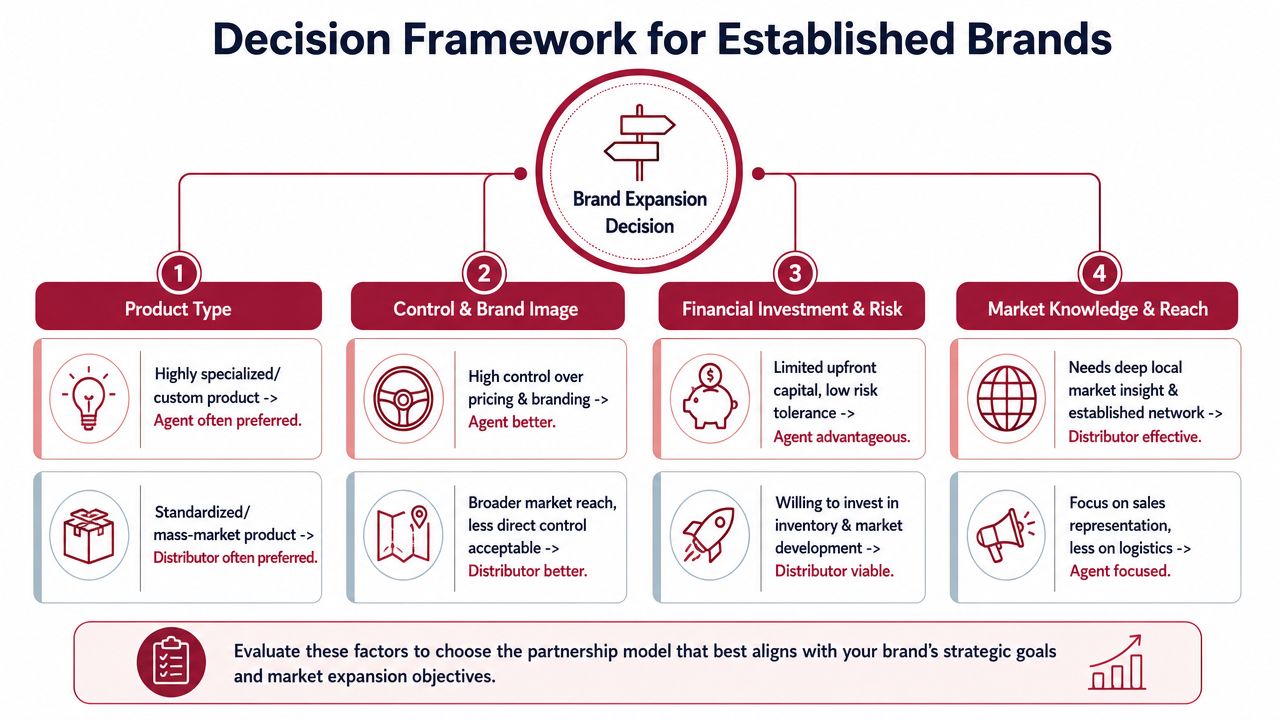
The best decision usually becomes obvious once you stop asking one question and start asking four.
Start with margin reality
For Australian consumer and household products, the distributor model becomes the dominant choice over agents when product margin exceeds a tipping point of 35%, and 52% of new Australian brands fail to calculate that threshold correctly, according to this discussion of agent and distributor differences.
That single point explains many failed channel decisions. Founders often assume distributors are more expensive. In practice, distributor economics can make commercial sense once product margin gives enough room for partner incentive, market development, and local stockholding.
If the margin structure is too tight, the distributor may never behave like a committed growth partner because the commercial reward isn't there. In that case, the model itself is wrong before the relationship starts.
A practical four-part filter
Use this framework when choosing between an agent and a distributor.
Product behaviour
A specialised product, technically complex range, or tightly specified premium line often suits an agent model better when the brand needs close market supervision.
A broader, more standardised, repeat-purchase range often suits a distributor more easily, especially where stock availability influences buyer confidence.
Control requirements
If you need direct influence over pricing, account development, and brand presentation, an agent structure usually keeps you closer to the market.
If you can tolerate less direct control in exchange for faster reach and simpler local execution, a distributor may be the stronger option.
Internal operating strength
Some brands choose agents because they like the theory of control, then discover they don't have the internal capacity to support that control. The structure only works if the team has the capacity to carry it.
Ask bluntly:
- Can your team manage overseas replenishment discipline?
- Can you support local accounts quickly and consistently?
- Can you monitor pricing and brand execution without relying on guesswork?
If the answer is uncertain, a distributor may be the more realistic structure.
Exit tolerance
This factor gets ignored until it becomes painful. If you're entering a market where partner replacement may be necessary, the contract design and stock position matter as much as the commercial upside. Some brands should accept slower expansion in exchange for a cleaner ability to adjust later.
The best partner model is the one your margins can sustain, your team can support, and your contract can unwind without drama.
Structuring the Partnership for Long Term Success
Once the model is chosen, the actual work starts. Good partnerships don't run on optimism. They run on clarity.
The strongest arrangements usually define what happens before launch, during growth, and at the point of disagreement. That means agreeing not only on price and territory, but also on reporting cadence, marketing support, service expectations, compliance ownership, brand presentation, and how both sides will handle underperformance.
A simple founder checklist helps:
- Define commercial boundaries: Set territory, channel permissions, exclusivity terms, and what counts as acceptable performance.
- Protect brand consistency: Document packaging rules, product claims, visual standards, and marketplace conduct.
- Require visibility: Build in regular reporting on sales movement, inventory position, account feedback, and channel issues.
- Plan the exit early: Clarify notice periods, stock treatment, sell-through rights, and handover expectations before signatures are exchanged.
- Review behaviour, not just revenue: A partner can hit sales targets and still weaken the brand through poor pricing discipline or fragmented execution.
One pattern we continue seeing is that healthy partnerships share information early and solve friction before it turns political. That's especially true in international expansion, where distance can hide small problems until they become structural ones.
Agent vs distributor isn't a theoretical debate. It's a long-term design choice. Get the structure right and the market becomes easier to manage. Get it wrong and even a strong product can look disorganised abroad.
If you're weighing an agent against a distributor and want a more commercial view of how that choice affects localisation, fulfilment, compliance, and long-term market structure, TPR Brands works with established product brands on exactly that kind of expansion decision.