For brands and manufacturers looking to expand their product line on Amazon, the real challenge isn’t getting listed—it’s scaling profitably across markets without losing control of margin or brand positioning.
At TPR Brands, we work directly with companies to export, position, and grow their products on Amazon using real-world distribution experience and international supplier networks.
Amazon can be an outstanding expansion channel, a fast demand signal, and a practical way to test new markets. It can also compress margins, weaken pricing discipline, and turn strong brands into commodities if used without a clear strategy.
This guide is built for founders who want to use Amazon as a controlled growth channel—not just another sales platform.
Through our experience working with export-ready brands and global partners, we’ve seen firsthand what separates products that scale on Amazon from those that stall. The difference is rarely the product—it’s the strategy behind how it’s introduced, positioned, and expanded.
Amazon Is Not A Strategy It Is A Channel
A lot of brands treat Amazon as a growth plan. It isn’t one. It’s a channel with its own economics, incentives, and operational demands.
This is where many brands struggle when trying to expand their product line on Amazon. Without a structured export strategy, clear pricing architecture, and controlled channel positioning, expansion quickly becomes reactive instead of strategic.
At TPR Brands, we help brands define Amazon’s role before launch—whether as a market entry tool, a controlled growth channel, or part of a broader international expansion strategy.

That distinction matters because channels don’t tell you what kind of brand you’re building. They only amplify the choices you’ve already made.
If your positioning is weak, Amazon exposes it. If your margin structure is fragile, Amazon pressures it. If your packaging, listing content, and fulfilment model aren’t aligned, Amazon makes the gaps visible very quickly.
What founders often get wrong
The common mistake is launching because competitors are there, or because a distributor suggested it, or because the volume looks too big to ignore. None of those are sufficient reasons.
A founder should ask tougher questions:
- Does this channel reinforce our price position or force us into constant comparison?
- Will customers understand why our product is better from the listing alone?
- Can the business absorb platform fees, media spend, returns, and promotional pressure without weakening the wider P&L?
- Do we want Amazon to be a customer acquisition tool, a clearance outlet, a market-entry vehicle, or a core sales channel?
Those are product marketing questions as much as commercial ones.
Practical rule: If you can’t explain Amazon’s role in one sentence inside your broader channel strategy, you’re not ready to launch.
Sales can rise while brand quality falls
That’s the part many operators learn too late. Revenue can improve while strategic quality declines.
A listing can convert. A campaign can scale. Orders can stack up. Meanwhile, your independent retailers get undercut, your premium cues disappear into a crowded search page, and your team starts making short-term decisions to protect rank rather than long-term decisions to protect the brand.
That’s why Amazon should be treated the way a disciplined operator treats any major route to market. It gets evaluated against brand control, margin resilience, and strategic fit.
Not every strong product belongs there immediately. Some should launch later. Some should launch with a narrower catalogue. Some should use Amazon only in selected markets. Some shouldn’t lead with Amazon at all.
Expanding your product line on Amazon expanding your product line on Amazon starts with restraint. Not because the platform is weak, but because it’s powerful enough to damage a good business when used without intent.
Why Smart Brands Can No Longer Ignore Amazon
Saying Amazon isn’t a strategy doesn’t mean serious brands can dismiss it. They can’t.
Consumer attention and buying behaviour have moved hard toward digital discovery. In Australia, total advertising expenditure reached A$11.4 billion in 2023, with a 6.5% year-on-year increase driven by digital channels, and digital advertising accounted for 68% of total spend by 2022 according to Statista’s marketing data. That doesn’t prove every brand should rush into Amazon. It does prove that product marketing now lives inside digital environments where buyers compare options quickly and expect immediate validation.
Amazon sits directly inside that behaviour.
Reach is only part of the case
The obvious advantage is access to demand. Amazon gives a brand exposure to customers who may never visit its own site, never walk into a specialty retailer, and never respond to paid social.
For established brands, that matters most in three situations:
- Category expansion where the product already has traction elsewhere, but awareness is narrow
- Geographic testing when a brand wants a lower-friction read on demand in a new market
- Search capture when buyers already know the problem they need solved and are actively comparing offers
That last point is where Amazon becomes more than distribution. It becomes a high-intent search environment.
Amazon is also a market intelligence engine
Most founders initially evaluate Amazon like a sales team would. Units sold, ad spend, returns, reviews. Useful, but incomplete.
The stronger view is to treat Amazon as an an ongoing source of product marketing feedback. Search terms reveal how buyers describe the category. Reviews show which claims land and which don’t. Conversion differences across variants often expose what matters more than internal assumptions did.
A founder can learn a lot from what customers do when they have several tabs open and alternatives one click away.
That’s especially useful when a business is deciding whether a product has legs outside its home channel. Amazon won’t replace proper market research, but it does force reality into the conversation. Customers either understand the offer or they don’t. The page either answers objections or it doesn’t.
Amazon gives you direct exposure to buyer behaviour under competitive pressure. That’s valuable because it strips away the comfort of brand assumptions.
Diversification matters more than founders admit
There’s another reason smart brands keep Amazon on the table. Channel concentration is risky.
If too much revenue depends on one retailer, one distributor group, or one acquisition channel, the business becomes vulnerable. Terms change. ranging shifts. Paid media gets more expensive. A single account manager’s decision can affect a meaningful share of revenue.
Amazon can help reduce that dependence. Not perfectly, and not without creating a different kind of exposure, but it can widen the route-to-market mix.
What Amazon does well for established operators
A disciplined brand often benefits from Amazon when it uses the platform for specific jobs:
- Demand validation in adjacent categories or markets
- Search presence when buyers already shop the category there
- Review capture that strengthens proof at scale
- Catalogue learning around bundles, packs, and hero SKUs
- Operational diversification beyond a single retail or wholesale path
This is the true opportunity. Not “everyone’s on Amazon”. A better argument is this: buyer behaviour has changed, digital product marketing now shapes category choice, and Amazon is too consequential to ignore if you’re trying to scale deliberately.
Common Mistakes When Expanding Your Product Line on Amazon
Many brands approach Amazon as a quick growth channel, but the most common mistakes we see include:
- Expanding too quickly without validating demand
- Launching too many SKUs instead of focusing on hero products
- Ignoring export and compliance requirements
- Competing on price instead of positioning
- Treating Amazon as a sales channel instead of a strategic expansion tool
These are the same issues we help brands solve before and during their Amazon expansion process.
The Hidden Costs of Unchecked Amazon product line expansion
Founders usually see the upside first. More reach. Faster sell-through. New-market access. Those are real.
What hurts brands is not Amazon itself. It’s unchecked growth without controls.
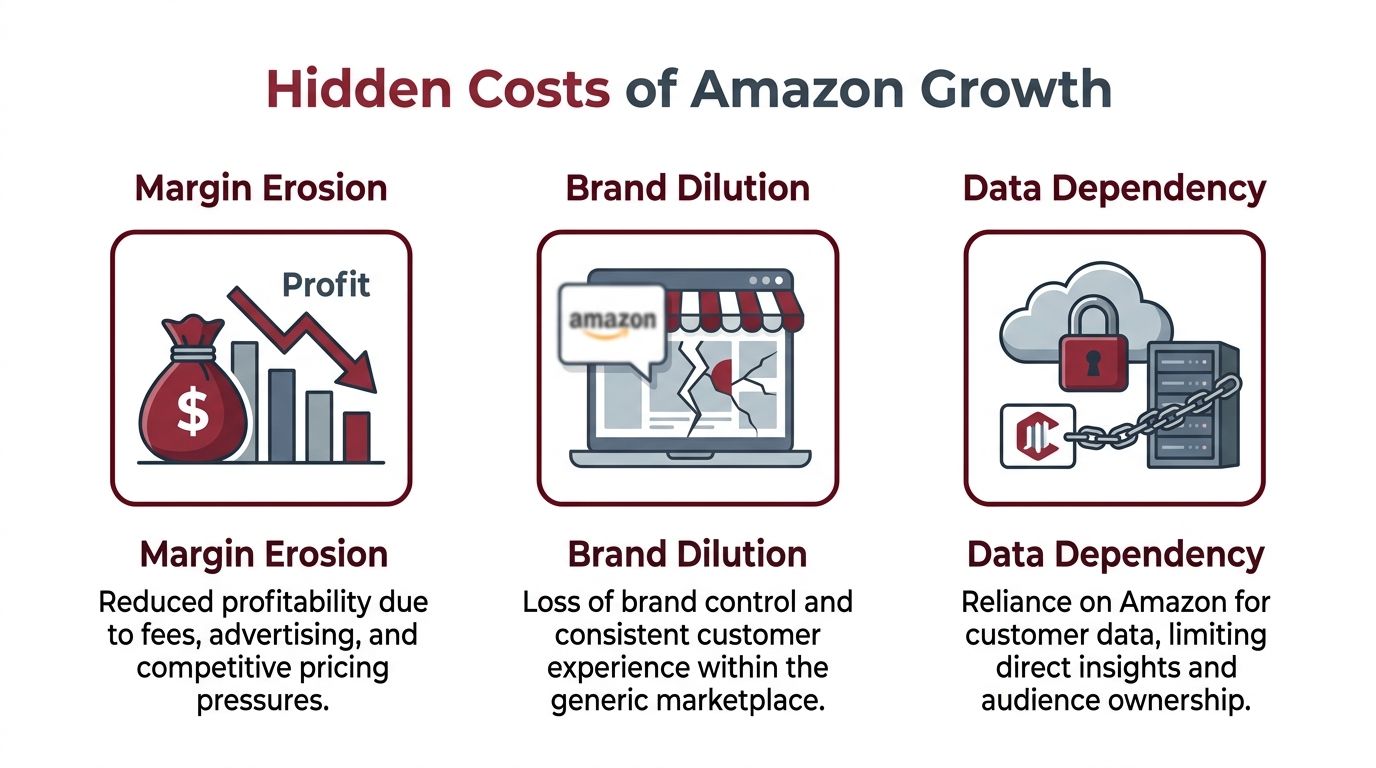
A good launch can drift into a bad operating model if the business starts chasing volume at the expense of economics and control.
Margin gets thinner before most brands notice
The first leak is usually margin. Not because one fee is fatal, but because several small pressures stack together.
You pay for fulfilment. You pay for storage. You pay for advertising because organic visibility is rarely enough on its own. Then you discount to protect conversion or defend rank. Then a competitor lowers price and the whole category starts reacting to the Buy Box instead of the brand.
At that point, revenue can still look healthy while contribution gets weaker.
A founder should model Amazon at the unit level before launch, not after the first few months of sales. That means understanding net profitability after platform costs, media spend, returns, packaging implications, and channel conflict. A lot of brands don’t do that rigorously enough. Reviewing the cost structure in a detailed breakdown of Amazon fees for sellers is a sensible starting point, but the key issue is strategic: can the product absorb channel friction and still justify the effort?
Brand presentation gets flattened quickly
Amazon standardises shopping behaviour. That’s part of its power, and part of the risk.
A premium product with thoughtful packaging, retailer training, and in-store storytelling can look oddly ordinary on a search results page. Your differentiators get compressed into a main image, a title, a price point, a review count, and a few bullets.
If the team doesn’t build the listing deliberately, Amazon strips context away and the customer compares on the easiest signals available. Usually price, rating, and delivery speed.
Here’s the pattern operators see all the time:
- Strong product enters Amazon with confidence based on off-platform performance
- Listing underperforms because the proposition isn’t translated for marketplace behaviour
- Team reacts with discounts and ad spend instead of fixing positioning
- Sales improve temporarily but the product becomes easier to compare and harder to defend
- Retailers notice pricing inconsistency and channel friction starts
That’s not a traffic problem. It’s a product marketing failure.
A marketplace doesn’t preserve premium positioning for you. Your team has to rebuild that positioning inside the constraints of the platform.
You don’t own the customer relationship in the same way
This is the strategic cost many founders undervalue.
On your own site, you can shape the post-purchase journey, capture more first-party insight, test bundles, refine lifecycle messaging, and learn directly from repeat behaviour. Amazon gives you demand access, but it also sits between the brand and the buyer.
That matters because long-term brand value comes from customer understanding, not just transaction volume.
When too much of the business runs through Amazon, teams can become dependent on the platform for visibility, reviews, and demand generation. Then internal decisions start optimising for Amazon performance rather than broader brand strength.
The primary risk is operating drift
Unchecked Amazon product line expansion rarely fails in one dramatic moment. It drifts.
The business starts making exceptions. Price discipline loosens. Pack architecture gets messy. Too many SKUs launch. Retail partners get uneasy. Internal reporting celebrates gross sales while ignoring quality of revenue.
That’s when Amazon stops being a useful channel and starts steering the business.
A Framework for a Strategic Amazon Launch
The right Amazon launch starts before listing creation. It starts with a decision: should this business use Amazon now, later, selectively, or not at all?
That decision should be made with evidence, not ego. Product marketing helps because it forces the team to define audience, message, economics, and channel role before inventory goes live.
Start with segmentation, not catalogue ambition
A common founder mistake is trying to put the whole range on Amazon. That usually creates complexity without adding clarity.
A sharper approach is to identify which customer segments are most likely to buy in a marketplace context and which SKUs best fit that behaviour. Precision matters. A 2024 report found that established Australian hardware brands using data-driven customer segmentation achieved 23% shorter sales cycles, 92 days versus 120 days, when expanding into new markets, according to Kadence Australia’s report on data-driven product marketing. The lesson applies beyond hardware. Better segmentation improves speed because the message becomes more relevant and the offer becomes easier to evaluate.
On Amazon, that often means choosing hero products over broad assortment.
The core decision table
Use a simple operating screen before launch.
| Criteria | Green Flag (Go) | Red Flag (Caution) |
|---|---|---|
| Margin resilience | Product can tolerate platform costs, media spend, and returns without damaging broader profitability | Product only works if pricing stays ideal and advertising remains low |
| Brand clarity | Value proposition is easy to communicate through images, bullets, reviews, and A+ content | Product needs high-touch education or in-person explanation to justify price |
| SKU discipline | Clear hero SKUs, bundles, or packs suited to marketplace buying behaviour | Large, confusing catalogue with overlapping variants and weak differentiation |
| Supply chain readiness | Inventory planning, packaging, and replenishment are stable | Frequent stockouts, packaging issues, or uncertain lead times |
| Channel alignment | Existing retail and distributor relationships can be managed without major conflict | Amazon pricing is likely to undercut important partners immediately |
| Review readiness | Product quality and support are strong enough to sustain public scrutiny | Known defects, inconsistent experience, or support delays still exist |
| Internal capability | Team can manage content, ads, compliance, and listing hygiene consistently | Launch is being treated as a side project with no clear owner |
Track the right KPIs
Most Amazon dashboards push teams toward shallow reading. Revenue, units, and TACoS-style metrics can be useful, but they’re not enough for a founder making strategic decisions.
Watch a tighter set of indicators:
- Contribution margin per unit so volume doesn’t hide weak economics
- Branded search volume on-platform to see whether the brand is gaining recognition, not just buying traffic
- Conversion rate by hero SKU to test whether the core proposition is landing
- Review content themes to identify claim-message gaps
- Share of voice on priority search terms to understand discoverability in category context
- Stock health and suppression issues because operational sloppiness quickly harms visibility
A capable operator should also understand who owns the work. Listing optimisation, advertising, forecasting, creative refresh, and channel governance can’t sit in a vague shared bucket.
Decide the role before you decide the tactics
Amazon can play very different roles in a business. Treating every role the same is costly.
A founder might use Amazon as:
- A defensive presence so unauthorised sellers don’t define the brand
- A controlled growth channel with a narrow product set and strict pricing
- A market-entry vehicle into a new geography
- A clearance mechanism for selected inventory, though this needs care if brand equity matters
- A discovery layer that feeds demand into broader retail and direct channels
If your team can’t state which of those applies, don’t launch yet.
For businesses that are ready to operate more seriously inside the platform, a working understanding of the Amazon seller model and account structures helps, but the larger issue is governance. Amazon rewards activity. Good brands reward discipline. The launch has to be designed so the first doesn’t consume the second.
Protecting Your Brand on The Everything Store
A strong Amazon presence doesn’t happen by accident. It’s built through defensive choices.
That matters because the platform naturally pulls listings toward sameness. If you don’t actively protect the brand, the category will do the positioning for you.

Control the assets that shape perception
Founders often focus on ads first. That’s backwards.
The first protection layer is content control. Your title, main image, secondary image sequence, comparison modules, A+ content, and store structure all carry product marketing weight. They don’t just “decorate” a listing. They explain why the product deserves its price and who it’s for.
For brands entering crowded markets, content quality has measurable consequences. In competitive Asian markets, achieving a top-3 organic SEO ranking for region-specific keywords has been shown to result in 2.3x higher product adoption rates post-launch, according to Product Marketing Alliance’s coverage of technical product marketing measurement. The exact marketplace mechanics differ, but the principle holds on Amazon. Visibility and content quality are linked. If the listing doesn’t earn discovery and trust, the product won’t scale cleanly.
Build defences before problems appear
The practical protections are not glamorous, but they matter:
- Register the brand early so you have stronger control over listing content and a clearer basis for enforcement
- Create a channel policy before launch, not after conflict appears
- Limit the initial catalogue so the team can maintain quality and detect issues quickly
- Map authorised sellers clearly if wholesale stock can leak into marketplaces
- Design pricing architecture that protects premium perception instead of inviting race-to-the-bottom comparisons
A lot of Amazon problems are really governance problems. They show up publicly because the internal rules were weak.
If a retailer, distributor, or marketplace partner can’t explain your pricing and channel logic in one sentence, conflict is coming.
Treat A+ content like packaging, not decoration
Brands with premium ambitions need to think of listing content the way they think of shelf presence or packaging design. The goal isn’t to add more words. It’s to remove doubt.
Use A+ content to do three jobs well:
| Job | What good execution looks like |
|---|---|
| Clarify the promise | States the use case, user, and product advantage cleanly |
| Reinforce trust | Shows material quality, proof points, compatibility, or care standards |
| Defend price | Explains why the product is worth more than generic alternatives |
That’s where many brands underperform. They use generic lifestyle imagery, weak comparison charts, and broad claims that could apply to any competitor.
Manage the channel, not just the listing
Protection also requires active management. Monitor seller activity. Watch for pricing drift. Check suppressed content, image changes, duplicate listings, and review themes that indicate fulfilment or quality problems.
That’s why many established operators eventually move beyond casual account oversight and into structured Amazon management support. Not because Amazon is impossibly difficult, but because brand damage often starts in small neglected details.
Expanding your product line on Amazon isn’t about saying the right things. It’s about preserving a coherent brand experience inside a channel that constantly pushes toward convenience, speed, and comparison.
Using Amazon for International Expansion
For many brands, Amazon becomes most attractive when local growth starts getting harder. The domestic market feels familiar. Expansion looks expensive. Amazon appears to offer a shortcut.
For brands working with TPR Brands, this stage is where export strategy becomes critical. Expanding your product line on Amazon internationally is not just about logistics—it’s about aligning compliance, pricing, positioning, and demand across different markets from day one.
Sometimes it does. Sometimes it only looks like one.
A realistic expansion sequence
Take a brand with strong performance in Australia. The product has repeat purchase, healthy retailer feedback, and a credible premium position. The founder wants to test the US or UK without building a full local sales team on day one.
Amazon can be useful here. It offers infrastructure, built-in demand, and a way to test whether the product translates outside its home market. The founder can learn quickly which search terms matter, which pack sizes fit local buying behaviour, and whether the proposition still makes sense in a more competitive environment.
That’s the upside.
The harder part begins when operational assumptions from the home market stop holding.
Market entry is not just a logistics problem
A lot of teams think international Amazon expansion is mainly about freight, fulfilment, and tax setup. Those matter, but they aren’t the whole job.
The primary challenge is adaptation. Product compliance, market-specific claims, packaging conventions, local expectations around materials or safety, and customer support standards can all change. That’s where launches slow down or become expensive.
Australian hardware exporters face significant regulatory hurdles in North America, with 28% incurring delays due to non-compliance with standards such as US CPSC certification, as noted in this analysis of underserved market positioning and compliance challenges. That’s a useful warning for any founder considering cross-border Amazon expansion. The platform may simplify access to demand, but it doesn’t remove market-entry obligations.
What translates and what doesn’t
Some parts of a brand travel well:
- Clear functional value
- Strong product quality
- Simple use cases
- Visual differentiation
Other parts often need local adjustment:
- Claims language
- Certification references
- Sizing, voltage, or specification framing
- Image context and use-case examples
- Bundle logic and price architecture
Global marketplace expansion works best when the brand treats Amazon as an entry point, not proof that full market adaptation has been solved.
Use Amazon to learn, not to assume
That’s the best use of the platform internationally. It can validate interest, reveal friction, and expose where local knowledge is missing.
A founder should treat early cross-border Amazon performance like a serious market test. Watch where customers hesitate. Study review language. Look at where returns cluster. Check whether your main claims need translation into different buying logic.
International product marketing is rarely about copying the domestic playbook. It’s about identifying which parts of the brand are universal and which parts need local interpretation.
When to Partner for Global Marketplace Expansion
Founders often delay partnership decisions because they assume bringing in outside support means losing control. In practice, the opposite is often true.
When expansion gets more complex, specialist support can protect control by reducing noise, avoiding preventable errors, and keeping the founding team focused on the work only they can do. Product, brand direction, capital allocation, and strategic priorities shouldn’t get buried under listing issues, compliance checks, freight coordination, and channel disputes.
The fundamental decision is about opportunity cost
A founder can learn Amazon. A commercial lead can try to manage international channel setup. An operations team can piece together compliance and marketplace workflows.
The question isn’t whether that’s possible. The question is whether it’s the best use of the company’s time.
This becomes more obvious in international expansion. The best route to market is not always the most visible one. For Australian brands targeting Asian expansion, using Japanese trading houses, or sogo shosha, instead of traditional retail has been shown to yield 31% higher margins, according to this analysis of identifying underserved market segments and revealing hidden growth opportunities. That kind of channel insight is easy to miss if the team is focused only on the obvious marketplace path.
What good partnership buys you
A serious expansion partner should bring more than execution.
They should add:
- Channel judgement so the brand doesn’t confuse access with fit
- Market adaptation insight so listings, claims, and offers translate properly
- Operational structure that reduces launch chaos
- Brand protection discipline across pricing, content, and authorised distribution
- Local context that internal teams usually don’t have on day one
That’s not outsourcing strategy. It’s strengthening it.
The strongest founders don’t partner because they can’t grow alone. They partner because they know unmanaged growth is expensive.
The brands that scale cleanly tend to make this decision earlier than others. They recognise that Amazon can be a powerful lever, but only when it sits inside a broader channel strategy with enough local knowledge to protect margin and brand equity at the same time.
Frequently Asked Questions for Founders
Should every established brand expand your brand on Amazon
No. Some products fit the platform well. Others lose too much context, pricing power, or channel alignment once they’re there.
A better question is whether Amazon helps the brand reach the right customers without weakening economics or creating avoidable channel conflict. If the answer is unclear, hold back and narrow the launch plan.
What’s the biggest product marketing mistake brands make on Amazon
They assume a good product will explain itself.
It won’t. On Amazon, product marketing has to translate the offer into search behaviour, image hierarchy, review proof, comparison logic, and a clear reason to buy now. If the team relies on generic copy or off-platform brand reputation, the listing usually underperforms.
How do I know if Amazon will damage my margins
Model the business at contribution level before launch.
Look at platform fees, fulfilment costs, returns, media spend, packaging implications, promotional pressure, and the likely effect on other channels. If the product only works under perfect conditions, Amazon probably isn’t the right next move.
How should I handle unauthorised resellers
Treat it as a channel governance issue, not just a marketplace annoyance.
Start by tightening distributor and wholesale terms. Map where leakage is likely to happen. Keep internal records of authorised sellers and product identifiers. If you wait until listings become messy, enforcement gets harder and retailer trust can erode.
Should I launch my full catalogue or just a few SKUs
Usually a few.
Hero SKUs, practical bundles, and packs with clear marketplace logic are easier to manage and easier for customers to understand. A narrower launch also gives the team cleaner data on pricing, conversion, and review themes.
Is FBA always the right fulfilment choice for international expansion
Not always. It can simplify speed and customer expectations, but it can also add pressure around forecasting, storage, and local operational setup.
The right fulfilment model depends on the product, market, margin structure, and how much flexibility the business needs during the testing phase. The mistake is treating fulfilment as a purely operational choice when it also affects customer experience and economics.
How do founders measure brand equity on Amazon
Not with one metric.
Use a mix of signals: branded search behaviour on-platform, review language, conversion stability at your target price, repeatability across hero SKUs, and whether the product can sustain premium cues without constant discounting. If sales rise but price discipline collapses, brand equity probably isn’t improving.
What should happen before an international Amazon launch
Three things should be true.
- Compliance is checked for the destination market
- The offer is adapted for local expectations, not just copied from the home market
- Ownership is clear across content, inventory, pricing, and account management
If those aren’t in place, the launch is early.
When does partnering make the most sense
When the internal team starts spending senior time on work that doesn’t compound.
If the founder is mediating channel conflict, the operations lead is untangling compliance questions, and the brand team is reacting to listing issues instead of driving growth, partnership often becomes the more efficient option.
If you’re serious about expanding your product line on Amazon and entering new markets without sacrificing margin or brand control, TPR Brands can help you build a structured, export-ready growth strategy.
We work with established brands to position, launch, and scale products across Amazon and international markets using proven systems built from real-world distribution experience.
Reach out to discuss how we can support your expansion.
How TPR Brands Helps You Expand on Amazon
We support brands at every stage of Amazon expansion, including:
- Identifying high-potential products for marketplace growth
- Preparing products for export and compliance
- Structuring pricing to protect margins and brand positioning
- Optimizing listings for visibility and conversion
- Managing controlled scaling across international markets
Our focus is not just growth—but sustainable, profitable expansion.