Most brands don’t fail on Amazon because of bad products.
They fail because they expand too fast, into the wrong market, with no real strategy.
We’ve seen it happen repeatedly—brands jump straight into the US, burn through ad spend, lose control of pricing, and stall before they ever scale.
But the brands that win globally take a different path.
They start with Amazon Australia.
Not because it’s the biggest market—but because it’s the smartest place to build a scalable, repeatable expansion model.
This article breaks down exactly why.
How We Help Brands Scale on Amazon
We don’t just write about Amazon. We actively work with brands to build, launch, and scale their presence across Amazon Australia and international marketplaces.
That includes:
• Opening wholesale accounts to test demand
• Building high-converting listings and A+ Content
• Running ads to validate and scale
• Expanding brands into Canada, the US, and the UKWe’ve seen what works and what destroys brands on Amazon.
Most of it comes down to control, positioning, and execution.
Why Australia Is Your Strategic Proving Ground
Thinking of Amazon.com.au as a smaller version of its US or UK counterpart is a common and critical mistake. The real value for a strategic brand isn’t immediate sales volume. It’s the market intelligence and operational blueprint you gain for future global expansion. Marketplace success requires strategic positioning, and Australia offers a unique combination of opportunity and manageability.
It’s an affluent, English-speaking country where consumer behaviors closely mirror North America and Europe. This cultural alignment makes it an almost perfect control group for an international strategy, allowing brands to test new markets successfully.
Amazon Australia vs US: Where Should You Start?
Most founders default to the US.
It feels like the obvious move—bigger market, more demand, more opportunity.
But bigger doesn’t mean smarter.
| Factor | Australia | United States |
|---|---|---|
| Competition | Lower | Extremely high |
| Ad Costs | More affordable | Expensive and volatile |
| Risk Level | Controlled | High |
| Market Complexity | Moderate | Very complex |
| Speed to Validation | Faster | Slower |
| Capital Required | Lower | High |
The result?
Australia gives you something the US doesn’t: a controlled environment to prove your strategy before scaling aggressively.
Smart brands don’t start where it’s biggest.
They start where they can win.
The Perfect Test Environment
Launching in Australia allows you to validate your entire market entry strategy on a smaller, less costly stage. Before committing significant capital to the hyper-competitive US market, you can find real answers to fundamental questions:
- Product-Market Fit: Does your value proposition truly resonate with a Western audience outside your home market?
- Pricing Strategy: Can you maintain healthy margins after factoring in international shipping, duties, and local fulfillment costs?
- Messaging and Positioning: Does your brand story connect with Australian consumers, or does it need localization to be effective?
- Logistical Strength: Can your supply chain handle the demands of a distant market without breaking?
A successful launch in Australia is more than a new revenue stream; it’s a proof of concept. It demonstrates to potential partners, investors, and your own team that your brand has the DNA for global success.
We see a recurring pattern: early Amazon success in a home market, followed by stalled growth when attempting international expansion. Brands that succeed globally do things differently. Success in Australia provides the data and confidence needed to tackle larger regions. It’s the difference between expanding on a hunch and expanding based on a proven model. Every lesson learned in Australia is directly applicable to a future push into Europe or North America.
For example, we’ve worked with brands entering Amazon Australia where listings weren’t optimized, pricing wasn’t aligned, and no real strategy existed.
After restructuring the listing, improving positioning, and aligning pricing, we created a scalable foundation that could then be expanded internationally.
De-Risking Your Global Expansion
Great products do not automatically become great brands. Many fail internationally not because of a lack of demand, but because of flawed execution. A premature launch into a massive market like the United States can burn through capital with staggering speed, leaving a brand with stranded inventory and a damaged reputation.
Australia acts as a strategic buffer against this risk. The cost of entry, advertising, and even making mistakes is substantially lower. A misstep in campaign bidding or an inventory shortfall in Australia is a learning experience; the same error in the US can be a catastrophic, seven-figure problem.
This controlled environment is where you refine your operational playbook. You can fine-tune inventory forecasting, perfect customer service responses, and build a profitable advertising model without the immense pressure of a top-tier market. For any ambitious Amazon seller, this is an invaluable advantage.
By treating Australia as a proving ground, you aren’t just selling a product. You are building a scalable, repeatable framework for market entry that can be deployed across the globe. You’re investing in a long-term strategy, not just chasing short-term sales. This is how smart brands begin their journey toward becoming a global name.
The Biggest Mistake Brands Make When Expanding to Amazon Australia
The biggest mistake we see is brands treating Amazon like a passive sales channel.
It’s not.
If you don’t control your listings, pricing, and who is selling your product, Amazon will control it for you.
That’s when:
• Prices drop
• Listings get messy
• Brand perception weakensThe brands that win are the ones that take control early and build properly from day one.
Navigating Australian Compliance and Account Setup
Before the first sale, it’s the unglamorous groundwork that makes all the difference. Many founders, eager to get products live, treat compliance as a box-ticking exercise. This is a massive strategic error—one that separates professional operators from amateur sellers who stumble into costly, brand-damaging mistakes.
Getting this right from day one protects your brand, prevents operational headaches, and paves the way for a smooth, scalable launch into a market that is maturing incredibly fast.
GST, Business Structures, and Product Safety
Navigating Australian regulations isn’t a simple checklist; it requires a founder-focused approach. There are three pillars of a strong compliance foundation: Goods and Services Tax (GST), your business entity structure, and non-negotiable product safety standards. Getting any of these wrong can lead to stranded inventory, financial penalties, or a sudden account suspension.
-
GST Registration: As an overseas business, you must register for GST if your sales turnover connected to Australia hits AUD $75,000 or more in any 12-month period. Our advice is to register proactively. It signals to both Amazon and the Australian Taxation Office (ATO) that you are a serious, compliant operator.
-
Business Entity: Will you operate as a foreign entity or set up an Australian subsidiary? This choice directly impacts your tax obligations, liability, and operational complexity. For many brands, operating as a foreign entity is simpler to start, but establishing a local Proprietary Limited (Pty Ltd) company can offer significant long-term advantages, especially with plans to expand beyond Amazon.
-
Product Compliance: This is non-negotiable. Products like consumer electronics, toys, and many household goods must meet specific Australian safety standards. Selling non-compliant items isn’t just an Amazon policy violation; it’s illegal and exposes your brand to massive legal and reputational risk.
A brand founder once shared that they lost over $100,000 in inventory because their electronic wellness device lacked the proper Australian regulatory compliance mark. The stock was seized and destroyed. A completely avoidable disaster stemming from an overlooked detail.
We’ve seen brands delay launches or lose momentum simply because compliance wasn’t handled early, it’s not just admin, it’s part of your growth strategy.
Structuring Your Amazon Seller Account for Growth
Your account setup should be built for long-term goals, not just today’s launch. A poorly structured Amazon seller account creates barriers to growth, complicates reporting, and can severely limit your ability to manage the brand effectively.
Consider a real-world pattern we often see: a successful US brand launches in Australia using the personal details of a marketing manager. A year later, that manager leaves the company. The brand is then left with a nightmare, trying to regain control of its primary account credentials, banking information, and Brand Registry access.
To avoid this, your account setup must be institutional, not personal. Use corporate information, a dedicated business email address, and secure multi-user access permissions right from the start. This ensures continuity and control, no matter how your team changes.
This foundational work is becoming even more critical given the market’s trajectory. By 2026, Amazon is projected to solidify its lead as Australia’s top marketplace, reaching 60% of shoppers, while its main competitor eBay is expected to fall to 51%.
This is the essential, behind-the-scenes work that enables a brand to scale efficiently. An organized and compliant setup isn’t just about avoiding problems; it’s about building a stable platform for future success. For more details on the practicalities, check out our guide on how to sell on Amazon Australia from overseas.
We’ve also seen brands lose access to their own Amazon accounts because they were set up incorrectly. Fixing this later is slow, painful, and sometimes impossible.
Building Your Amazon Australia Advertising Engine
Most brands waste money on ads because they launch them before the listing and positioning are correct.
So, your account is compliant and listings are live. For many brands, this feels like the finish line. In reality, it’s just the starting point. Having a product on Amazon Australia is one thing; ensuring customers can find it is another challenge entirely.
Many founders treat advertising as just a cost of doing business. This view is incredibly limiting. A well-structured advertising engine is far more; it’s a powerful tool for building your brand, generating profit, and gathering critical market intelligence.
You can’t just copy and paste a successful US or UK advertising strategy into the Australian market and expect the same results. The competitive landscape is different, shopper search behavior is unique, and advertising costs are at a different stage of maturity. The goal isn’t to simply burn cash on clicks; it’s to build a sustainable machine that fuels long-term growth.
The process flow below shows how advertising is the final step, built upon the essential foundations of compliance and account setup.
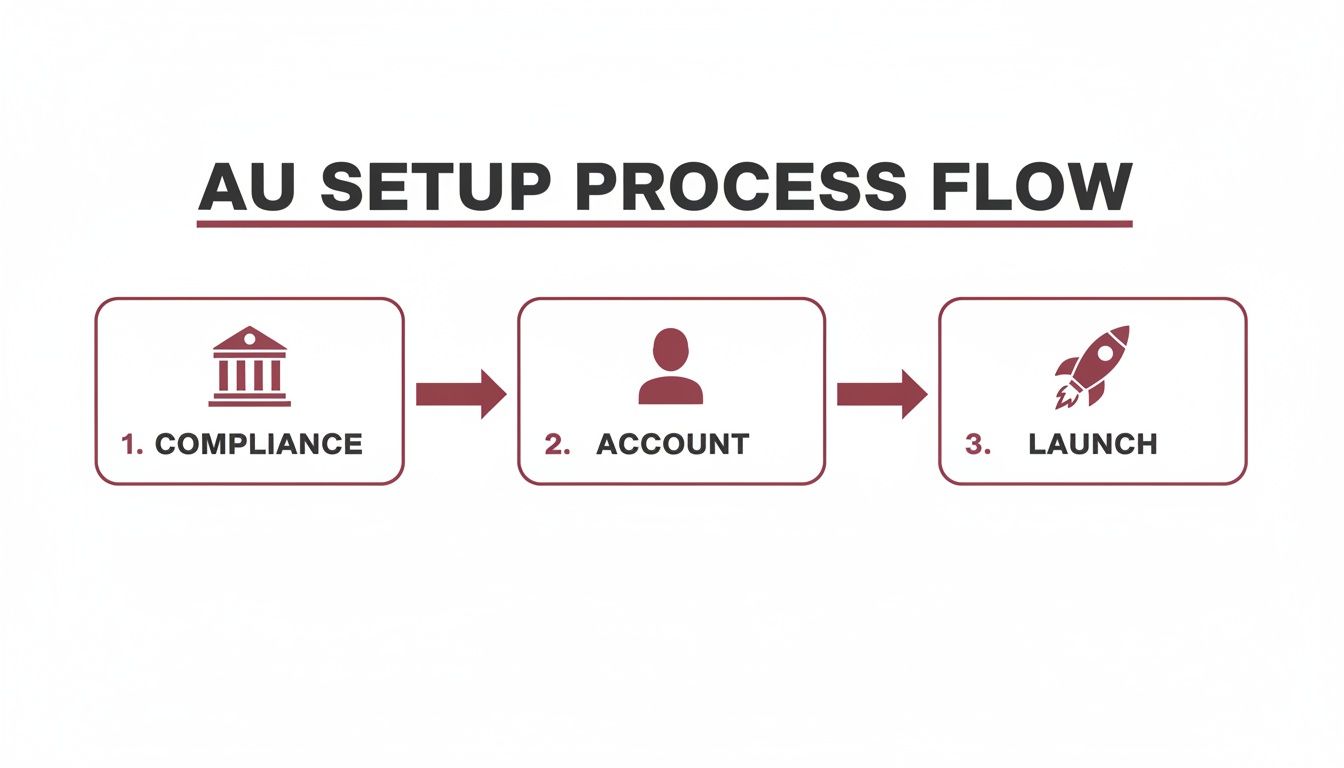
Think of advertising as rocket fuel: incredibly powerful, but useless without a solid launchpad to support it.
Structuring Your Campaign Portfolio
A sophisticated advertising strategy involves building a portfolio of campaigns, where each has a specific job. We advise founders to think in terms of three core functions: Discovery, Profitability, and Defence.
-
Discovery Campaigns (Broad & Phrase Match): The main goal here is data collection. You’re asking Amazon’s algorithm to find new, relevant search terms that real Australian shoppers are using. These campaigns will almost always have a higher Advertising Cost of Sale (ACoS), but their true value is in the market intelligence they generate, not immediate profit.
-
Profitability Campaigns (Exact Match): Once discovery campaigns uncover high-converting search terms, you move them into their own dedicated exact match campaigns. This is where you focus on efficiency. You can bid more confidently—and aggressively—on these proven terms to maximize sales at your target ACoS. These campaigns become your core sales drivers.
-
Defensive Campaigns (Product & ASIN Targeting): These campaigns protect your brand’s digital shelf space. Here, you bid on your own branded keywords and target your own product detail pages. This simple move stops competitors from placing their ads on your listings and poaching customers who are a click away from buying. It’s a low-cost insurance policy for your brand equity.
A common mistake brands make when entering Australia is running just one or two broad campaigns. This approach mixes discovery goals with profitability goals, leading to messy data and wasted ad spend. Separating campaigns by function gives you the clarity and control needed to scale effectively.
Choosing the Right Ad Products for the Job
Amazon offers a suite of advertising tools. Knowing which to use—and when—is what separates experienced sellers from beginners. The key is using the right tool for the right strategic objective.
This reference table clarifies when and where each ad type makes the most sense for brands in the Australian market.
Amazon Ad Product Selection for Australian Brands
| Ad Type | Primary Objective | Best For | Strategic Tip for AU Market |
|---|---|---|---|
| Sponsored Products | Immediate Sales & Visibility | Driving traffic to specific product listings, targeting high-intent keywords, and boosting sales velocity. | This is your workhorse. Use it to build the foundation of your discovery and profitability campaigns. It directly impacts sales rank, which is crucial for gaining initial traction. |
| Sponsored Brands | Brand Awareness & Category Presence | Introducing your brand to new shoppers, controlling the message at the top of search results, and driving traffic to your Brand Store. | Perfect for targeting broader, top-of-funnel category keywords. Use it to tell your brand story and establish yourself as a credible player in the category. |
| Sponsored Display | Retargeting & Audience Building | Re-engaging shoppers who viewed your products but didn't buy. Building brand recall both on and off Amazon. | Because the AU market is less saturated, Sponsored Display can be a surprisingly cost-effective way to stay top-of-mind and guide shoppers back to your listing. |
Each ad product serves a distinct purpose.
Sponsored Products are essential. They appear directly in search results and on product pages, making them the primary driver of immediate sales. These should form the backbone of both your profitability and discovery efforts.
Sponsored Brands are your top-of-funnel brand-building tool. These banner ads appear at the top of search results, featuring your logo, a custom headline, and several products. They are ideal for establishing a strong presence when shoppers are just beginning their search.
Finally, Sponsored Display ads are your weapon for retargeting. They give you the power to re-engage shoppers who have visited your product pages but didn’t purchase, following them both on and off Amazon.
Building this advertising engine requires patience and a commitment to data-driven decisions. It’s not about finding one “magic” keyword. It’s about creating a systematic process of discovery, refinement, and defense that builds both sales momentum and brand value over time.
Optimizing Listings for the Australian Shopper
We’ve seen brands copy and paste US listings into Amazon Australia and completely kill conversion. A great product with a generic listing is practically invisible. We’ve seen countless brands simply copy-paste their US or UK content into Amazon.com.au. This is a fundamental mistake that undermines brand credibility and kills conversion rates.
Localization isn’t just about changing “color” to “color.” It’s about strategically adapting your entire product detail page to connect with the unique culture, language, and expectations of Australian shoppers. This is where tactical execution meets smart brand positioning to build consumer trust.
Crafting Compelling Localized Copy
First, go beyond generic keyword tools and dig into Australian vernacular. A direct translation of a US listing often feels clunky and foreign, signaling to the buyer that you’re an outsider and eroding trust.
Your copy must speak their language. For a hardware brand, this might mean using “ute” instead of “pickup truck” or referencing “the weekend barbie” instead of a “backyard cookout.” For a wellness product, it could involve addressing lifestyle factors specific to Australian city life or our love for the outdoors.
- Titles: Include the most relevant, high-volume Australian keywords, but also clearly state the core product benefit.
- Bullet Points: Use these to address market-specific pain points. If your product solves a problem related to the humidity in Queensland or hard water in Adelaide, call it out directly.
- Product Description: Tell a story that puts your product inside an Australian context. Go beyond listing features and paint a picture of how it fits into their daily lives.
This detail shows you understand the market and instantly sets your brand apart from sellers who didn’t make the effort.
Localizing Visuals and A+ Content
Imagery is arguably more powerful than text. Using stock photos of North American homes or landscapes is an immediate red flag for any savvy Australian consumer. Your visuals must reflect the local environment and lifestyle.
If you sell outdoor gear, show it being used at a recognizable Aussie beach or out in the bush, not in the Rocky Mountains. If you sell home goods, feature architecture and interior design styles common in Australian suburbs. This visual alignment makes your brand feel familiar and aspirational.
The most successful international brands on Amazon Australia don’t look international. Their A+ Content showcases their products in a way that feels completely native, reinforcing the idea that this product was made for them.
Your A+ Content is the prime real estate for this. Use it to compare your product against competitors actually available in the Australian market, not just those in the US. Highlight certifications or standards that Australian consumers recognize and value.
The opportunity in specific categories is massive. Electronics and appliances are forecasted to generate billions of Australian dollars by 2026, creating huge openings for home improvement and hardware brands that position themselves correctly. You can explore more data on these trends and find out more about these category-specific sales forecasts on Statista.com.
The Critical ASIN and Review Strategy
One of the most important strategic decisions you’ll make as an Amazon seller is how to handle your ASINs and reviews. Amazon’s tools allow you to sync global listings, which can instantly populate your new Australian ASIN with thousands of reviews from the US or UK.
This seems like an obvious win, but it has a major drawback: it merges everything. A potential Australian buyer might see reviews complaining about shipping times to Ohio or referencing a promotion unavailable in Australia. This creates confusion and can seriously damage trust.
The alternative is to start with a fresh, country-specific ASIN. While you sacrifice initial social proof, you gain complete control over your brand reputation in the new market. This allows you to build a base of genuine, local reviews that speak directly to the Australian experience.
For most premium brands, we recommend the second approach. Building a new reputation from scratch is a deliberate investment in your long-term brand integrity. It’s certainly the harder path, but it’s one that establishes a stronger, more authentic connection with the Australian shopper.
Measuring Performance and Managing Your Budget
Success on Amazon is a numbers game. Yet many founders get lost in vanity metrics like clicks and impressions, mistaking activity for progress. A strategic brand looks past the noise and zeroes in on the KPIs that signal genuine profitability and brand health.
This financial discipline is what separates a brand that stalls from one that scales. It shifts the conversation from, “How much did we spend on ads?” to, “How much is advertising contributing to our total growth?”
Beyond ACoS: The Metrics That Actually Matter
Advertising Cost of Sale (ACoS) is the metric everyone talks about, but focusing on it alone is a strategic mistake. A low ACoS might look good on paper, but it tells you nothing about your overall business health. Smart brands know to look deeper.
To measure real performance, you need to track a more sophisticated set of KPIs.
-
Total Advertising Cost of Sale (TACoS): This is the single most important metric for understanding the true impact of your advertising. It measures your total ad spend against your total sales revenue, both paid and organic. A TACoS that trends down over time is the clearest sign your advertising is creating a halo effect, lifting your organic rank and driving more non-paid sales.
-
Organic Sales Ratio: This is the percentage of your sales that come from organic, non-paid traffic. A healthy brand should see this ratio climb over time. If you’re pouring money into ads but your organic sales are flat, your advertising isn’t building brand equity; it’s just renting sales.
-
New-to-Brand (NTB) Metrics: Amazon provides data on how many of your sales come from customers who have never purchased from your brand before. This is a crucial indicator of market penetration. A high NTB percentage shows your ads are successfully introducing your products to new Australian shoppers, not just reconverting existing fans.
We often tell founders that ACoS measures the efficiency of an ad, but TACoS measures the effectiveness of your brand strategy. One helps you tweak a campaign; the other helps you build a business.
Budgeting for a Successful Australian Launch
One of the first questions founders ask is, “How much should we budget for our launch in Australia?” There’s no magic number, but you can build a realistic forecast based on strategic goals, not guesswork. Don’t just apply a random percentage of your US or UK budget—the Australian market has its own dynamics.
Start with a clear objective for your first 90 days. Are you chasing sales velocity to build reviews, or is the goal to gather data? For most launches, the primary goal should be visibility and data collection. This means your initial TACoS will naturally be higher as you invest in discovery campaigns to find out what Australian shoppers are actually searching for.
The market’s rapid growth reinforces this need for dedicated investment. By 2026, Amazon Australia is projected to capture a huge slice of the online retail pie, estimated at around 15-20% of all internet sales in the country. You can see more on Amazon’s market share in Australia via Statista.com. Carving out a piece of that growing market requires a focused initial investment.
Creating a lean, effective reporting dashboard is key to making informed decisions without drowning in spreadsheets. A simple weekly dashboard tracking TACoS, organic sales ratio, and NTB metrics gives you all the high-level insight needed to guide your strategy and future investment.
Expanding Beyond Australia
Once a product proves itself in Amazon Australia, expansion becomes the next move.
We’re currently working with brands expanding into:
• Canada (with bilingual labelling)
• United States
• United KingdomEach market has different compliance and positioning requirements, but when done properly, it creates a scalable global growth model.
Common Questions from Founders Scaling in Australia
When founders consider expanding their brand internationally, Australia always comes up. The questions we hear aren’t just about ad clicks or campaign tactics; they’re the big, strategic questions that determine whether an expansion succeeds or fails.
These are the real concerns brand leaders have, and based on our experience helping brands navigate this exact path, here are the direct answers.
Is Australia Too Small of a Market to Prioritize?
It’s a classic mistake to judge the Australian market purely on its population. We’ve seen many founders compare its 26 million people to the 330 million in the US and quickly dismiss it as a low priority. This thinking misses the strategic value completely.
Australia isn’t just about immediate sales volume. It’s a high-value, highly developed market where consumer behavior closely mirrors that of the US and UK. Success here is a powerful signal that your product, pricing, and messaging will work in other major Western markets, but you get to validate it all at a much lower cost and risk.
Think of it as a de-risked dress rehearsal for your global expansion. It’s the perfect place to refine your operational playbook before you take it to the crowded, expensive, and unforgiving stages of North America and Europe. The real prize isn’t just the initial sales; it’s the strategic intelligence you gain for your entire global roadmap.
Should We Hire a Local Agency or Build an In-House Team?
This is a critical decision. Building an in-house team promises deep brand alignment, but it’s often a slow and expensive process, especially when you have no existing knowledge on the ground. You can easily burn through time and money just trying to understand Australian consumer nuances, compliance, and logistics from halfway around the world.
On the other hand, a typical digital marketing agency can handle the tactical work of running campaigns. But many lack the founder-level strategic perspective needed for true brand scaling. They’re structured to manage ad spend, not to help you build a durable, international business.
The most effective model we’ve seen isn’t a simple hire or a standard agency retainer. Many brands grow faster through strategic partnerships that fuse on-the-ground expertise with a deep focus on the brand’s long-term global vision. This approach is less about outsourcing tasks and more about co-building a scalable international presence from day one.
How Do We Compete with Cheaper Products on Amazon?
Established brands should never get into a race to the bottom on price. That’s a game you can’t win, and you shouldn’t even try to play it. As a premium Amazon seller, your strength isn’t being the cheapest; it’s being the most trusted. You don’t compete on price—you win on brand.
While Australian shoppers are definitely price-conscious, they place an enormous value on reliability, quality, and trust. Your entire strategy has to be built around reinforcing your product’s premium value at every single touchpoint. This is how you build a brand moat that protects you from price wars.
- Superior Listing Quality: Invest in professional, localized photography and copy that speaks directly to the Australian lifestyle and solves a local problem.
- Detailed A+ Content: Use this space to tell your brand story, showcase your quality, and make it crystal clear why your product is different from the cheaper alternatives.
- Strong Customer Reviews: Proactively manage your reviews to build a powerful base of social proof from real Australian customers.
- Clear Brand Story: Your branding—across your listing, Brand Store, and ads—must consistently communicate why your product is worth paying more for.
When you focus on these elements, you shift the conversation from price to value. You start attracting customers who are looking for a reliable solution, not just the cheapest option available. This is how you build a profitable, long-lasting brand on Amazon Australia.
Ready to Expand to Amazon Australia the Right Way?
If you’re serious about scaling beyond your home market, the difference isn’t your product—it’s your execution.
We work with brands to build controlled, scalable Amazon strategies across Australia and global marketplaces.
If you want to understand what this could look like for your brand, let’s talk.
Get in touch and see what’s possible.
👉 Reach out to discuss your product and see what’s possible.