An Amazon store can become one of the strongest international growth assets in a product business — or one of the fastest ways to lose margin if expansion is handled poorly.
Many established brands reach a point where domestic growth becomes harder to scale efficiently. Advertising costs rise, retailers demand more support, and operational complexity increases faster than profit. That is usually when international Amazon expansion starts becoming commercially attractive.
The problem is that most advice around global Amazon growth is written for new sellers, not established brands managing inventory systems, compliance exposure, distributor relationships, and long-term brand positioning.
Scaling an Amazon store internationally requires more than translating listings and forwarding inventory overseas. It requires operational structure, localization strategy, compliance planning, fulfilment discipline, and market sequencing that protects both margin and brand value.
That’s the moment many founders look at international Amazon marketplaces. Not because overseas expansion sounds exciting, but because capital needs a better next use.
Beyond Local Success The Global Amazon Store Imperative
A familiar pattern shows up in product businesses with real traction. The founder assumes expansion means taking the existing amazon store, changing a few spellings, forwarding stock offshore, and switching on ads. That approach usually creates a messy foreign operation rather than a scalable new market.
An international amazon store isn’t a duplicate storefront. It’s a new commercial outpost with its own search behavior, compliance expectations, delivery standards, pricing realities, and customer trust signals.
Australia is a useful example because it shows both the opportunity and the trap. Amazon’s Australian business moved from scepticism to real scale quickly. By 2023, Amazon’s gross merchandise value in Australia exceeded AUD 4.5 billion annually, capturing around 10 to 12% of the country’s e-commerce market, and independent sellers drove 55% of sales volume by 2024 according to this Amazon history timeline reference.
That matters for one reason. It proves newer marketplace ecosystems can become major revenue channels fast. It doesn’t prove that every brand entering them is prepared.
The mindset shift founders need
Domestic success can hide structural weaknesses.
A brand may rank well because it understands one local customer, one local freight setup, one tax system, and one set of claims that regulators tolerate. Move that same catalogue into another market and weaknesses surface immediately. Product titles feel off. packaging misses a requirement. pricing loses margin after duties. stock reaches the wrong fulfilment node. Brand content doesn’t match local buying language.
Your first international launch doesn’t test whether the product is good. It tests whether the business can translate itself accurately under pressure.
Founders who scale well treat expansion as brand architecture, not channel extension. They ask different questions:
- Where does our product fit naturally: Not where Amazon has traffic, but where our offer solves a familiar problem without heavy re-education.
- What must stay central to the brand: Materials, performance promise, use case, and positioning.
- What must change locally: Claims, imagery, copy tone, pack configuration, fulfilment method, and price ladder.
What strong operators do differently
The better operators don’t chase every marketplace at once. They choose one market that teaches them how their brand travels.
They also stop thinking of the amazon store as a single asset. It becomes a network. Each country store should be run like a controlled commercial launch with separate assumptions, separate risks, and clear thresholds for further investment.
That operational shift affects inventory planning, budgeting, forecasting, and expansion timing across every new market.
What We See Working Across International Amazon Expansion
At TPR Brands, we work with established product businesses expanding into international Amazon marketplaces across Australia, the United States, and other growth regions.
The same operational patterns appear repeatedly.
Brands that scale successfully usually:
-
enter one strategically chosen market first
-
simplify SKU complexity during launch
-
localize content properly instead of directly copying domestic listings
-
treat fulfilment and compliance as commercial priorities
-
protect margin before chasing scale
The brands that struggle are often dealing with the opposite. They move too quickly, expand into too many marketplaces simultaneously, or underestimate how much operational structure international Amazon growth actually requires.
In practice, successful Amazon expansion is rarely about launching faster. It is about building a market entry model that can scale cleanly once demand appears.
Phase 1 Strategic Foundations for Global Expansion
The expensive mistakes happen before the first unit lands in a fulfilment centre.
Most of them come from choosing the wrong market for the wrong reason, or setting up the wrong operating structure because it seemed faster. Speed helps only when the structure can hold.
For many established brands, the first international Amazon expansion market is either Australia or the United States because both offer strong marketplace maturity, established fulfilment infrastructure, and clearer operational pathways for Amazon Global Selling. The right choice depends less on raw marketplace size and more on product fit, margin structure, logistics complexity, and how easily the catalogue can be localized.
Pick the first market for operational fit
Founders often overvalue headline demand and undervalue operational friction. A market can look attractive on paper and still be a poor first launch if compliance is burdensome, local competition is entrenched, or your product needs too much adaptation.
Use a practical filter.
- Product fit: Does the product solve an already understood need, or will you need to educate the market from scratch?
- Regulatory friction: Can you satisfy import, packaging, and category rules without redesigning the product line?
- Margin resilience: After marketplace fees, shipping, tax handling, returns, and local advertising, can the product still sustain healthy contribution?
- Catalogue transferability: Will your hero SKUs make sense as they are, or do they depend on local habits, voltages, sizes, or climate assumptions?
- Operational learnings: Will this market teach you something useful for the next one?
A first market should be commercially worthwhile, but it should also be a strong training ground. Expansion is cumulative. The right first market reduces the cost of the second.
Choose your structure before you choose your launch date
There are three broad ways to enter a new Amazon market. None is universally best. Each is a trade-off between control, complexity, speed, and capital commitment.
| Global Expansion Model Comparison | Best For | Pros | Cons |
|---|---|---|---|
| Amazon Global Selling | Brands testing a market without building full local infrastructure | Faster setup, centralised account management, easier early-stage validation | Less local control, can expose hidden compliance gaps later, not ideal for every category |
| Local business entity | Brands with sustained demand and a longer investment horizon | Better tax and operational control, cleaner local presence, stronger platform and supplier alignment | More setup work, more admin burden, more legal and accounting overhead |
| Strategic distribution partner | Founders who want local execution without building everything in-house | On-the-ground market knowledge, shared operational load, can speed up market adaptation | Lower direct control, margin sharing, success depends heavily on partner quality |
A lot of founders default to the first option because it looks efficient. Sometimes that’s right. Sometimes it creates a halfway house where the brand carries most of the risk without getting enough local advantage in return.
What each model really means
Amazon Global Selling works well when your goal is disciplined market validation. You want data before heavier commitment. You’re prepared to learn through a limited SKU set and keep systems lean.
A local entity makes sense when the market is already strategic. You’re not asking whether you should be there. You’re asking how to build there properly.
A distribution partner becomes attractive when execution quality matters more than direct ownership of every moving part. In categories with stricter compliance, freight complexity, retail crossover, or local servicing demands, a good partner can prevent years of avoidable operational drag.
Practical rule: If your team can’t name who will own tax registration, listing compliance, freight coordination, and inventory forecasting in the target market, you aren’t ready to launch.
The structural mistake that keeps costing brands
Many brands build around account access instead of business design. They ask who can open the amazon store. They should ask who can support it once demand appears.
That means deciding in advance:
- Who carries legal responsibility for product claims, import documentation, and tax handling.
- Who controls catalogue decisions if localization needs to move quickly.
- Who owns the customer experience when returns, damaged stock, or listing issues appear.
- Who decides reinvestment levels after the first launch window.
If you need a broader view of how marketplace positioning affects these choices, our guide to Amazon marketplace expansion is useful before committing to a structure.
What not to do
Don’t launch into multiple countries just because Amazon makes cross-listing look simple.
Don’t establish a local entity because it feels more serious.
Don’t hand the whole market to a third party because your internal team is overloaded.
All three can work. All three can also trap you if they don’t match the stage of the brand.
Phase 2 The Operational Playbook for Your First Market
Operational failure rarely looks dramatic at first. It looks like a customs query, a delayed inbound shipment, a listing held back for missing data, or stock allocated badly enough that ad spend arrives before inventory settles.
That’s why the first market needs an operating plan, not just a launch plan.

Fulfilment is a margin decision
Most founders frame fulfilment as a delivery choice. It’s really a margin and control decision.
FBA usually creates the strongest customer experience and simplifies marketplace operations. It can also improve launch performance when speed and conversion matter. But it demands tighter prep standards, better inbound documentation, and stronger forecasting.
FBM gives you more flexibility if product flow is uncertain or if your own warehouse network is stronger than Amazon’s for a specific product type. It can also protect you from overcommitting stock in a market you’re still learning.
Hybrid models work well for brands with uneven demand across SKUs. Put the proven movers into FBA and keep slower, bulky, regulated, or awkward items elsewhere until demand patterns are clear.
Where brands usually get caught
The issue isn’t only freight cost. It’s what sits behind it.
A first-market launch often stalls because the team hasn’t mapped the full chain of responsibility. Who prepares carton labels. Who checks product classification. Who confirms commercial invoice language. Who verifies certificates. Who monitors the shipment after handoff.
Amazon’s Sell Globally feature helps, but it doesn’t remove the need for operational discipline. In Amazon AU expansion workflows, an estimated 25% of delays in international shipments are caused by unaddressed customs documentation, according to the Amazon seller forum discussion on Sell Globally expansion steps.
That number matters because customs delays are rarely random. They usually come from process gaps that could have been prevented.
A practical compliance checklist
For a founder, compliance has one job. Keep the product sellable without freezing working capital.
Use a checklist addressing the basics before inventory moves:
- Tax setup: Confirm whether the target market requires local GST or VAT registration before you trade.
- Importer role: Decide who is importer of record and document it properly.
- Product claims: Review every front-of-pack and listing claim for local acceptability.
- Safety and category rules: Check whether your category needs testing records, certificates, or warnings.
- Labelling: Confirm country-specific wording, units of measure, warnings, and language expectations.
- Documentation pack: Keep invoices, origin records, declarations, and product documents in one accessible file set.
- Recall readiness: Know what you’d do if a local regulator or Amazon compliance team asks for proof quickly.
Compliance should be built into launch operations, not delegated after the shipment leaves.
A strong logistics setup also depends on choosing who handles cross-border movement, local warehousing, and exception management. For brands working through these questions, our international logistics strategy framework for expanding brands.
Inventory placement needs judgement
Stockouts waste momentum. Overcommitted inventory traps cash and creates storage pressure. The fix isn’t a perfect forecast. It’s a controlled entry plan.
Start with a narrower SKU range than you think you need. Launch with products that have simple compliance, clear use cases, and repeatable demand signals. Hold reserve inventory outside the marketplace network if replenishment timing is uncertain.
One of the least discussed issues in cross-border expansion is where your inventory lands inside the network. Warehouse selection affects cost, replenishment speed, and operational resilience. In some regions, underserved warehouse zones can yield 30 to 40% better margins than saturated hub locations, based on the warehouse optimization angle described in this video discussion on regional inventory opportunity. For founders, the lesson is simple. Don’t optimize only for category demand. Optimize for where the network serves you efficiently.
A short operational briefing can help teams align before they start moving stock:
What works in the first market
The brands that handle the first market well do a few things consistently.
- They simplify the initial SKU set. More catalogue breadth usually creates more compliance and inventory risk.
- They assign one accountable operator. Shared responsibility sounds collaborative until a shipment gets held.
- They prepare for exceptions. Customs queries, receiving delays, and document requests aren’t edge cases.
- They separate validation from scale. First prove the market can transact cleanly. Then widen the range and spend.
Strong operations make international scaling more predictable, profitable, and easier to manage long term.
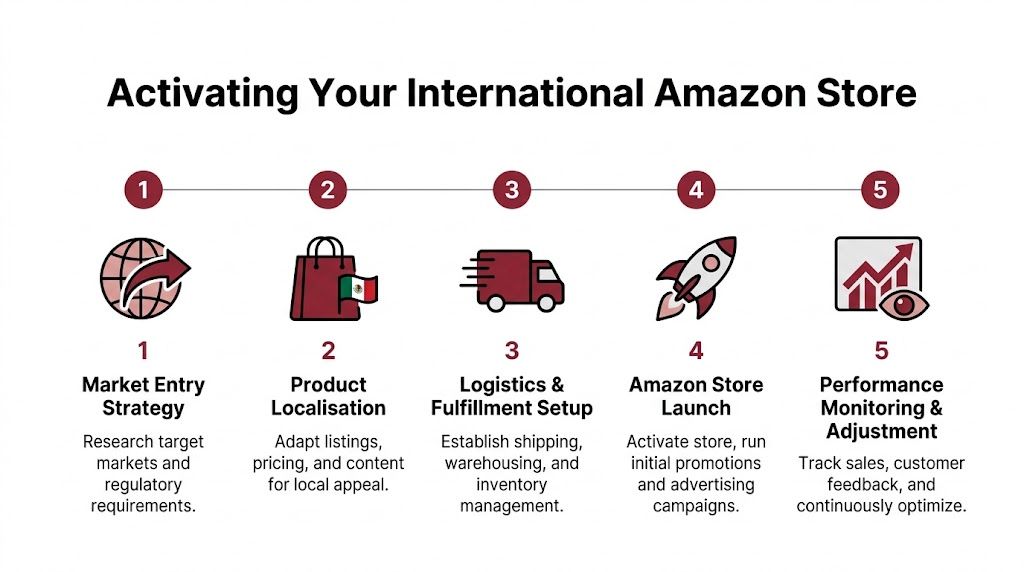
Phase 3 Activating Your International Amazon Store
A new amazon store doesn’t gain traction because the account went live. It gains traction because the launch sequence is deliberate.
Most weak launches suffer from the same problem. The business spends heavily on availability and too lightly on localization, pricing discipline, and brand control. The result is traffic without enough conversion, or conversion without enough margin.
Start with localization that changes buying behavior
Translation isn’t localization. Localization changes how the product is understood in-market.
The product title, bullets, imagery, A+ Content, and Brand Store all need to reflect the language customers use when they compare options. That includes spelling, terminology, use-case framing, and the adjectives that signal quality in one market but mean very little in another.
For hardware and home improvement products in particular, feature expectations can shift across regions. Weather resistance, electrical compatibility, material assumptions, and installation language may all need adjusting. The useful strategic question isn’t “Can this SKU sell overseas?” It’s “What does the overseas customer need to see before this SKU feels made for them?”
Protect the brand before you accelerate spend
Brand Registry should be handled early, not after the first signs of demand.
When a listing starts moving, copycats, unauthorized resellers, and content inconsistencies become more expensive to fix. Registry gives you a stronger base for content control, reporting, and brand asset management. It also reduces the risk that a fast launch turns into a governance problem.
Protecting the brand early helps preserve long-term marketplace value as international sales grow.
Price for margin, not for optimism
Founders often carry domestic pricing logic into a foreign market and then discover too late that the economics have shifted.
Your target price needs to account for:
- Marketplace fees
- Inbound freight
- Duties and local tax handling
- FX movement
- Promotional spend
- Returns and damaged inventory
- Any local support cost tied to the category
If the final number looks uncompetitive after all that, the answer usually isn’t to cut price and hope volume rescues margin. The answer is to reconsider the SKU, pack format, route to market, or market timing.
A good launch price also leaves room for campaigns. If you launch at the edge of viability, every promotion weakens the whole model.
Use stores and content as conversion assets
A localized Brand Store matters more than many brands assume because it helps organize trust. Customers moving across listings want coherence. They want to understand the range, the use cases, and why the brand is credible in their market.
Amazon Ads data tied to Australian Brand Store expansion shows that brands using the Multi-Country Expansion tool to create localized Brand Stores saw an average 35% uplift in conversion rates, compared with 12% for brands using non-localized assets, according to this Amazon Ads localization video reference.
That gap is large enough to change launch economics.
A practical launch sequence
The first month should be staged, not improvised.
Week one. Confirm listings are clean, browse paths are correct, images display properly, and pricing appears as intended after all local fees.
Week two. Begin advertising with tightly grouped local keywords. Avoid broad waste until search term data starts showing which phrases convert.
Week three. Push traffic into the Brand Store and A+ pathways, not only to individual listings. That helps build catalogue understanding and cross-sell logic.
Week four. Review customer questions, early review patterns, ad search terms, and any conversion drop-offs by SKU. Fix content before increasing budget.
Promotional timing matters
Promotional events can provide momentum when the underlying setup is solid. They can also expose weaknesses fast.
During Amazon Australia’s 2024 Prime Day, FBA-listed products saw 28% higher conversion rates, and over 60% of sales came from third-party sellers, according to this Amazon facts summary covering Prime Day and AU marketplace performance. The practical lesson isn’t that every brand should rush into event-led discounting. It’s that fulfilment readiness and event participation can materially improve launch traction when the basics are in place.
What doesn’t work
Three launch habits tend to undermine otherwise good brands:
- Overloading the catalogue at launch: More listings usually means more weak listings.
- Using domestic creative unchanged: The customer notices when the brand hasn’t adapted.
- Scaling ads before conversion is stable: Paid traffic magnifies listing problems.
A launch should create signal. If you can’t tell what’s working, you launched too broadly.
Phase 4 Scaling and Optimizing Your Global Footprint
Growth across markets becomes fragile when the founder tracks only top-line sales.
A healthy international amazon store needs operational reading, commercial reading, and risk reading. Without all three, the business can look like it’s scaling while margin, stock health, or brand control subtly deteriorate.

The metrics that actually help
Revenue matters. It just doesn’t diagnose enough on its own.
A founder should review metrics that answer four questions:
| Focus area | What to watch | Why it matters |
|---|---|---|
| Demand quality | Sessions by country, conversion by SKU, search term intent | Shows whether traffic is relevant and whether localisation is working |
| Margin health | Contribution after fulfilment, ad spend, returns, and landed cost | Prevents growth that looks strong but weakens the business |
| Inventory stability | Sell-through patterns, weeks of cover, ageing stock risk | Protects cash and reduces avoidable fulfilment friction |
| Brand control | Listing accuracy, review themes, reseller activity, content consistency | Keeps growth from eroding trust |
The best review rhythm is short and regular. If teams wait for quarterly summaries, problems usually become expensive before anyone acts.
Build a response plan before you need it
International operations break in predictable ways.
A listing gets suppressed. A shipment is delayed. Reviews turn because instructions were unclear in-market. Packaging creates damage in a climate you didn’t account for. A local competitor reframes the category better than you do.
Strong operators don’t avoid every problem. They make sure each problem already has an owner, a process, and a decision path.
That means documenting playbooks for:
- Listing suppression
- Customs or inbound holds
- Negative review spikes
- Stockouts on hero SKUs
- Price instability caused by FX or local competition
- Unauthorized channel leakage
Resilience is mostly organizational. Teams need to know who acts first and what evidence they need.
Local adaptation is a long-term lever
One reason some international launches plateau is that the business treats localization as a launch task instead of an ongoing discipline.
Customer language shifts. Competitors reframe use cases. Seasonal demand changes the bundle logic. Reviews reveal that the product solves a slightly different problem in the new market than it did at home.
That’s why local content refinement is not cosmetic. It is commercial optimization. If your team needs a stronger framework for how products should be positioned as they enter new channels and regions, our product marketing for expanding brands is the right kind of lens.
How to assess a strategic partner
When founders realize they need help, they often hire for output instead of judgement.
A service provider can upload listings, move freight, or run ads. A growth partner should be able to make better commercial decisions with you. That difference matters more as markets multiply.
Ask harder questions:
- Can they explain where your margin will be made or lost?
- Do they understand compliance and operations, not just front-end conversion?
- Can they challenge your SKU selection and market timing?
- Do they know how to protect brand value while expanding distribution?
- Can they support the next market, not just the current task list?
A weak partner increases activity. A strong one improves decision quality.
What scaling should look like
Expansion across markets should feel controlled.
You should know why a market is growing, which SKUs deserve more inventory, which content changes improved conversion, and what operational risks need investment before the next step. If you don’t know those things, the business isn’t scaling yet. It’s accumulating exposure.
Conclusion From Great Product to Global Brand
A global amazon store can become one of the most valuable growth assets in a product business. It can also become an expensive distraction when the brand treats international expansion like a copy-and-paste exercise.
The difference is rarely effort. It’s structure.
Founders who expand well make disciplined choices early. They choose markets for fit, not ego. They set the right entity and operating model. They localize properly, protect the brand, control fulfilment, and scale only after the first market proves it can work cleanly.
Great products still matter. They’re the entry ticket. They aren’t the full strategy.
Global growth rewards brands that can translate their value across markets without losing margin, clarity, or operational control. That takes market understanding, patient sequencing, and strong commercial judgement. It also takes knowing when internal bandwidth is no longer enough for the next stage.
Frequently Asked Questions About International Amazon Expansion
What is the best first country for Amazon expansion?
For many established brands, Australia and the United States are common starting points because both markets have mature Amazon infrastructure, strong customer adoption, and scalable fulfilment systems. The best market depends on product fit, compliance requirements, logistics costs, and margin structure.
Should brands use Amazon FBA when expanding internationally?
Amazon FBA often improves conversion rates and customer experience in new markets, particularly during launch phases. However, some brands benefit from hybrid fulfilment models depending on SKU size, inventory risk, and operational flexibility.
How much localization is needed for international Amazon expansion?
Successful international Amazon expansion usually requires more than direct translation. Product titles, imagery, A+ Content, pricing strategy, and use-case positioning often need adapting for local buying behavior.
What are the biggest risks when expanding an Amazon store internationally?
The most common risks include compliance failures, incorrect pricing assumptions, poor inventory forecasting, customs delays, weak localization, and expanding into too many markets too quickly.
When should a brand work with an Amazon expansion partner?
Brands often benefit from external support when international expansion starts affecting compliance management, logistics coordination, localization strategy, inventory forecasting, or marketplace growth planning across multiple regions.
International Amazon expansion works best when growth is treated as a structured commercial strategy rather than a fast marketplace rollout.
At TPR Brands, we help established product brands expand into international Amazon marketplaces with stronger operational planning, localization strategy, fulfilment structure, and long-term brand protection. That includes market selection, Amazon launch strategy, logistics coordination, compliance planning, and scalable marketplace growth support across multiple regions.
For brands preparing to scale internationally, the goal is not simply entering another Amazon marketplace. The goal is building a stronger global brand with controlled, sustainable growth.