Most advice about amazon australia is too shallow. It treats market entry like a listing exercise: open the account, ship inventory, switch on ads, wait for sales. That approach is exactly how established brands damage margin, lose channel control, and misread early demand.
Australia can be an excellent market. It can also punish sloppy expansion. The brands that do well aren’t the ones that move fastest. They’re the ones that validate fit, control landed cost, and decide in advance how Amazon fits into the broader brand architecture.
The Real Opportunity on Amazon Australia
Amazon Australia is no longer an experimental side channel. It is a serious piece of the retail environment, and founders should treat it that way.
In 2024, Amazon Australia revenue reached $1.936 billion, with a compound annual growth rate exceeding 40% since 2021, and Prime membership revenue climbed 38.8% to $480 million, implying roughly 4.29 million members according to GoSell Global’s review of Amazon AU’s 2024 filing. That matters because it tells you two things at once. First, customer adoption is deep enough to support real scale. Second, Amazon has already built a habit loop in Australian households.

The mistake is assuming platform growth automatically means your brand should enter now. A growing marketplace is not the same thing as a good fit for every catalogue. Some brands see a clean path because their products are compact, easy to explain online, and resilient to price comparison. Others walk into immediate pressure from freight, compliance, returns, or copycat competition.
What founders should assess first
Before discussing launch tactics, ask four harder questions:
- Does the product travel well: Products that are bulky, fragile, regulated, or installation-heavy often need more than a standard FBA playbook.
- Can the margin survive transparency: Amazon makes price comparisons easy. If your product wins only when hidden inside retail shelves, the platform will expose that quickly.
- Is the brand story clear in a search result: Some products convert on function alone. Others need education, bundling, or proof that’s harder to communicate inside marketplace constraints.
- Will Amazon strengthen or weaken channel strategy: If existing distributors, retail partners, or your own DTC economics matter, Amazon has to be positioned carefully.
Amazon Australia is a real opportunity. It just isn’t a shortcut.
For the right brand, amazon australia can create fast access to demand, customer feedback, and new-category trial. For the wrong brand, it becomes an expensive lesson in why product success at home doesn’t always translate cleanly into a new market.
Validate Your Brand for the Australian Market
A founder shouldn’t enter amazon australia because the market is growing. Entry should happen because the product has a defendable reason to win with Australian buyers and a realistic route to profitable fulfilment.
The platform now reaches a very large buyer base. As of late 2025, 8.8 million Australians had shopped on Amazon in the past year, up 11% year on year, representing about 10% of total online spend, and 63% of consumers used Amazon to try new product categories, according to Roy Morgan’s Amazon, Temu and Shein growth analysis. That tells you discovery is happening on-platform. It does not tell you whether your specific offer belongs there.
Start with demand quality, not just demand size
A large audience can hide weak product-market fit. Founders often see broad demand and assume their catalogue will slot in naturally. The stronger test is narrower.
Look at whether your product solves an obvious problem for Australian households, works within local standards, and can be understood without a salesperson. If the product relies on in-store demonstration, local installer networks, or category education, your Amazon launch needs a tighter SKU strategy.
A practical validation pass usually includes:
Search intent review
Study how competitors frame the offer. Pay attention to whether shoppers search by problem, specification, material, compatibility, or brand.Assortment discipline
Don’t launch the whole catalogue first. Start with the products that have the cleanest economics and lowest regulatory friction.Competitive pricing reality
Compare not just list prices, but likely delivered value. A product can look competitive before freight, GST, returns, and oversized handling are included, then fail once the actual cost stack shows up.
Use a compliance screen before a marketing screen
Founders often validate demand first and compliance second. In practice, that order creates wasted work. Products that face category-specific regulation, labelling changes, safety requirements, or customs complexity should be screened before you spend time building out launch assumptions.
That is especially important for brands crossing from domestic retail into marketplace distribution. On Amazon, listing velocity can expose problems faster. A packaging issue, unsupported claim, or missing compliance document can stop progress at the exact moment demand appears.
Here’s a simple market-entry filter that keeps validation disciplined.
| Validation question | What you’re testing | Why it matters |
|---|---|---|
| Is the product easy to understand online | Search-to-conversion clarity | Marketplace traffic won’t rescue a confusing offer |
| Can margin survive after landed cost | True profitability | Revenue without retained margin is a channel trap |
| Is the product compliant for Australia | Market access | Demand is irrelevant if the product can’t be sold cleanly |
| Does the item fit Amazon fulfilment logic | Operational fit | Bulky, fragile, or awkward products need extra planning |
| Will Amazon help brand positioning | Channel role | A sale today can create channel conflict tomorrow |
Validate with a founder’s lens
The right question isn’t “Can we sell on Amazon AU?” It’s “Should this brand use Amazon AU as part of a controlled expansion plan?”
Practical rule: If your first model depends on aggressive discounting, broad catalogue launch, or hoping fees stay manageable, the market probably isn’t validated yet.
The strongest launches usually share the same characteristics. They begin with a focused SKU set, conservative assumptions, and a clear understanding of what must be true for the market to deserve more investment.
Australian buyers will try new categories. That creates opportunity. It also means your product will be tested quickly against local expectations on value, quality, delivery and compliance.
Navigating Australian Regulatory and Compliance
Founders often treat compliance as an administrative step. In amazon australia, it’s closer to a market access decision. If the product, packaging, claims, or documentation are wrong, your listing quality doesn’t matter.
This is also where a lot of brands make a strategic mistake. They think Amazon is the whole entry strategy, when in reality it should sit inside a broader Australian operating model that includes compliance ownership, returns handling, customer support, and channel logic. A marketplace can accelerate exposure. It can also accelerate mistakes.
Amazon alone won’t protect your brand
If you rely on Amazon in isolation, you hand too much control to a single channel environment. That’s risky in a market where trust, product standards, and after-sales experience matter.
For some brands, Amazon should act as the entry point for controlled demand capture while retail, trade, specialist distribution, or DTC play different roles over time. For others, Amazon should remain a narrow test channel until product claims, packaging and local support are fully adapted.
One practical reference point for operators assessing marketplace setup, fulfilment options, and entry mechanics is TPR Brands’ overview of selling on Amazon Australia. The important point is not the platform setup itself. It’s making sure setup sits beneath a real market-entry plan.
Where compliance pressure usually appears
A common failure pattern is trying to localise too little. Brands reuse packaging, claims, inserts, or category language from another market and assume minor edits will be enough.
That’s especially dangerous in products adjacent to health, beauty, electronics, or technical household use. eStore Factory’s summary of Amazon Australia trends notes that unbranded or non-compliant imports in categories such as beauty and electronics often fail due to strict therapeutic goods regulations and experience return rates 15-25% higher than platform averages. The operational lesson is simple. Compliance failure doesn’t just create legal exposure. It also drives customer dissatisfaction and weakens marketplace economics.
If a product needs caveats, disclaimers, or category education to stay compliant, your listing and packaging have to carry that burden clearly.
Australian Market Entry Compliance Checklist
| Compliance Area | Key Consideration | Governing Body/Standard |
|---|---|---|
| Consumer law | Product claims, warranties, refund rights, representations | ACCC |
| Therapeutic or health-adjacent claims | Whether the product falls under regulated therapeutic treatment or device rules | TGA |
| Biosecurity and imports | Whether materials, components, or packaging trigger import controls | DAFF |
| Product labelling | Metric units, origin information, warnings, instructions, safe use | Applicable Australian consumer and category standards |
| Electrical safety | Whether devices, chargers, or powered accessories require local conformity | Applicable Australian electrical safety requirements |
| GST and tax setup | Registration, collection, reporting, invoice handling | Australian tax framework |
| Marketplace documentation | Safety sheets, test reports, declarations, supporting files | Amazon category and compliance requirements |
What works and what doesn’t
Some patterns are consistent across product categories.
What works
Pre-audit the catalogue: Decide which SKUs are low-friction, which require adaptation, and which shouldn’t launch.
Translate claims into compliant language: Don’t assume wording from the US, UK or Canada carries over cleanly.
Assign one owner internally: Someone needs authority over compliance files, packaging revisions, and approvals.What doesn’t
Launching first, fixing later: Once the listing is live, every issue becomes public and expensive.
Treating Amazon documentation as the whole requirement: Marketplace approval and legal compliance are related, not identical.
Using your broadest range immediately: Complexity multiplies with every additional SKU.
Founders who handle compliance well usually move more slowly at the start. They launch cleaner, get fewer avoidable setbacks, and preserve brand trust while they scale.
Designing Your Supply Chain and Pricing Strategy
A lot of brands misprice amazon australia because they start with target retail and work backwards. That usually produces a number that looks competitive on paper and fails in operation.
Australia is a demanding logistics market. This review of Amazon fulfilment challenges in Australia notes that vast geography creates high last-mile delivery costs, uneven fulfilment centre infrastructure can cause stockouts for bulky items, and labour shortages have pushed fulfilment fees up by as much as 20-30% for oversized items compared with the US and UK. If you sell hardware, home improvement, heavy household goods, or awkward packs, this isn’t a footnote. It’s part of the core economic model.

Build landed cost before you build the listing
A useful pricing model for australia starts with all-in landed cost, not ex-factory cost. That means product cost, international freight, customs-related costs, GST impact, Amazon fees, storage, returns handling, and the operational cost of staying in stock.
For bulky categories, you also need to stress-test the model under less favourable conditions. What happens if inbound takes longer than expected, remote-area delivery mix rises, or Amazon storage positioning creates uneven replenishment pressure?
Margin killers founders underestimate
Some costs show up early and clearly. Others leak out over time and are harder to spot until profitability has already weakened.
Oversized handling pressure
Heavy or long-pack products can look attractive because average order value is higher. But the fulfilment profile can erase that advantage quickly.Inventory imbalance
If stock pools aren’t sized properly, a brand can be in stock nationally on paper and still miss demand in practical terms because replenishment isn’t aligned with where units are moving.Return economics
Products with installation complexity, compatibility questions, or unclear usage instructions can trigger expensive return loops.Promotional distortion
A launch discount can mask weak underlying economics. Founders then mistake subsidised traction for normal demand.
One practical way to model these variables is to map your cost stack against Amazon’s marketplace structure and fee categories before launch. TPR Brands’ breakdown of Amazon fees in Australia is one example of the type of fee review operators should do before deciding which SKUs deserve launch priority.
Pricing discipline for established brands
The strongest operators usually make three decisions early.
They separate hero SKUs from range-fillers
Not every product deserves marketplace distribution. A core item with strong search relevance and clean fulfilment economics might belong on Amazon. A bulky accessory with weaker demand might belong in another channel, or not at all.
They price for resilience, not optimism
If the model works only when freight is smooth, returns are low, and ad efficiency stays favourable, it doesn’t really work. Price needs room for volatility.
A founder should be able to explain margin at full cost without using the phrase “we’ll make it up on volume”.
They treat stock depth as a pricing decision
When replenishment is slow or expensive, under-ordering can be as damaging as over-ordering. Stockouts reset momentum. Excess stock ties up capital and can force reactive discounting.
For amazon australia, the pricing question isn’t whether you can match the visible market. It’s whether you can maintain brand standards, deliver reliably, and still protect contribution after the hidden costs of distance and fulfilment are accounted for.
Building Your Go-To-Market and Channel Plan
A good launch into amazon australia doesn’t start with creative assets. It starts with sequencing. Founders need to know which channel is doing what, in what order, and why.
That matters because Amazon can perform several jobs at once. It can be a demand test, a discovery engine, a cashflow channel, a review builder, or a beachhead for broader Australian expansion. Problems usually begin when a brand expects it to do all of those jobs immediately.
Phase the market, don’t flood it
The cleanest launches use a phased structure. They don’t open every SKU, every marketing lever, and every fulfilment pathway at once.
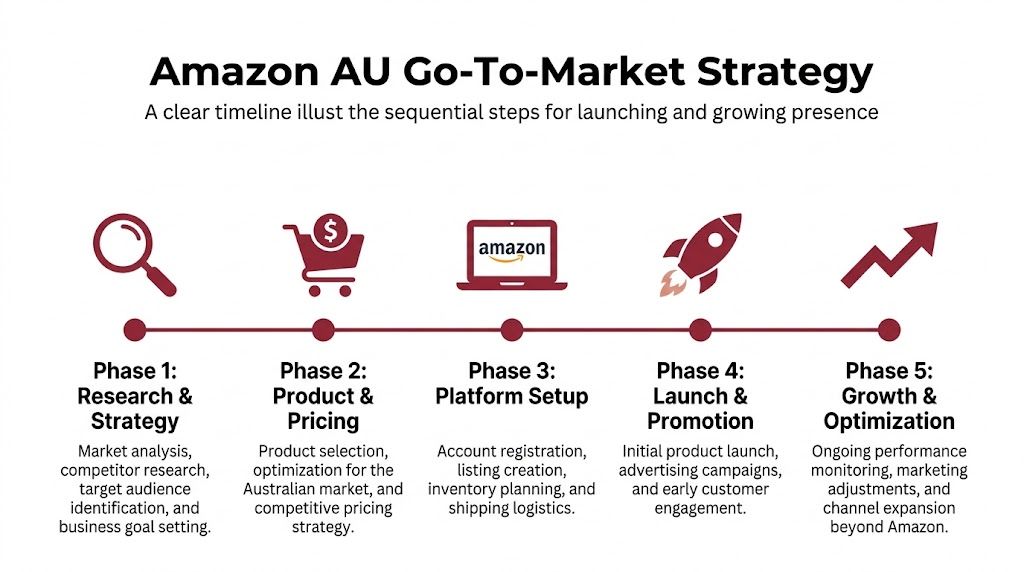
A workable sequence often looks like this:
Research and strategy
Lock product selection, margin thresholds, compliance status, and channel role. Decide what success means before launch.Product and pricing
Finalise localisation, pack format, retail architecture, and the price bands you’ll defend.Platform setup
Build listings, inventory plans, and operational workflows. Logistics planning needs to be grounded in reality, not hope. A practical reference for founders comparing fulfilment structures is TPR Brands’ page on Amazon logistics in Australia.Launch and promotion
Start with disciplined support. Early traffic should help validate conversion quality, not just create noise.Growth and optimisation
Add range, refine ads, improve conversion assets, and consider whether other channels should now come into the mix.
Choose partners by function, not by pitch
A lot of expansion plans break because partner selection is too loose. Founders choose providers based on capability decks instead of operational fit.
Assess support partners by the specific risk they reduce:
- 3PL or fulfilment support should reduce inventory friction, returns complexity, or service failures.
- Marketplace operators should improve listing governance, catalogue discipline, and commercial reporting.
- Regulatory advisors should reduce approval risk and rework.
- Channel partners should help you preserve pricing and brand standards outside Amazon, not undermine them.
Keep Amazon in its lane
Amazon is powerful, but it shouldn’t be allowed to define the brand by default. If you sell a product that also belongs in trade, specialty retail, or DTC, the launch plan needs clear boundaries.
The channel plan should answer one hard question. If Amazon grows faster than expected, does that strengthen the brand system or destabilise it?
When the answer is unclear, founders usually over-expand on the platform and create avoidable conflict later. Better discipline early gives you room to scale without rewriting the whole market strategy.
Your Australian Launch Checklist and Risk Mitigation
Launch day isn't the true test. The first few months are. That’s when assumptions about stock, pricing, listing clarity, packaging, and customer expectations get challenged by actual behaviour.
Most expansion problems aren’t dramatic. They are cumulative. A delayed inbound shipment, a few confused reviews, a stock mismatch across variants, an early price reaction from a competitor. None of those issues alone has to derail the launch. Together, they can flatten momentum fast.
Pre-launch checks that actually matter
A serious pre-flight review should cover the basics, but it also needs to pressure-test the launch against likely failure points.
Catalogue readiness
Confirm SKU selection: Launch the items with the strongest economics and cleanest compliance profile.
Check variation logic: Don’t create unnecessary complexity in packs, colours, or sizes if demand is still unproven.
Review content clarity: Titles, images, bullets, and usage instructions should reduce confusion before it creates returns.Operational readiness
Validate inbound timing: Build around realistic receiving windows, not ideal ones.
Set reorder triggers: Decide in advance what inventory signal triggers action.
Prepare returns handling: Installation issues, compatibility questions, or packaging damage need a process before they appear.Commercial readiness
Define your floor price: Know the point below which volume stops being useful.
Align launch spend with learning goals: Advertising should help you identify what converts, not just push traffic.
Plan for competitor response: If incumbents drop price or increase visibility, your team should know how it will react.
Common early-stage risks and how to handle them
A launch checklist is only useful if it connects directly to mitigation.
| Risk | What usually causes it | Practical mitigation |
|---|---|---|
| Stockout after early traction | Forecasting from optimism instead of actual replenishment constraints | Launch narrower, monitor velocity daily, set reorder rules before launch |
| Negative early reviews | Confusing instructions, damaged packaging, wrong expectations | Improve listing clarity, inserts, and support response processes |
| Margin erosion | Hidden fulfilment and returns costs, reactive discounting | Review contribution by SKU weekly and protect floor pricing |
| Listing suppression or compliance friction | Missing documentation, unsupported claims, packaging mismatch | Keep compliance files centralised and assign one owner internally |
| Channel conflict | Amazon price architecture drifting away from other channels | Set market-wide pricing logic and channel boundaries in advance |
What experienced operators do differently
They don’t treat launch as proof of concept. They treat it as the first live test of a system.
That changes behaviour. They hold back SKUs that aren’t ready. They slow down range expansion even when sales look promising. They fix root causes instead of compensating with promotions.
Early momentum is useful. Clean operating signals are more useful.
A founder should leave the first launch window with answers to a few very specific questions. Which products convert without excessive education. Which returns are preventable. Which costs were underestimated. Which parts of the offer local buyers clearly value. Those answers shape the core Australian business, not the launch spreadsheet.
Expanding Intelligently Is the Only Way to Win
amazon australia is attractive because it offers access, visibility, and scale. It is dangerous for exactly the same reasons. The platform will expose weak assumptions quickly, whether those weaknesses sit in margin, compliance, logistics, or brand positioning.
Great products don’t automatically become strong international brands. The ones that succeed in Australia usually enter with discipline. They validate fit before they widen range. They model landed cost before they chase volume. They use Amazon as part of a channel strategy, not as a substitute for one.
That is the practical difference between growth and overexposure. One builds an asset. The other creates activity that looks promising until the economics and brand control start slipping.
Founders who approach australia with clear operating rules usually make better decisions early, and they don’t have to undo as much later.
TPR Brands works with established product companies that are expanding into new channels and markets with a controlled growth model. If you’re assessing whether amazon australia fits your brand, margin structure, and broader international strategy, you can learn more at TPR Brands.