Strong sales don’t prove control on Amazon. They often hide the moment control has already started slipping. That’s the mistake established founders make when they move from traditional retail into marketplaces. They assume catalogue ownership, pricing discipline, brand presentation, and channel authority carry across because the product is proven — but this is exactly how brands lose amazon listing control without realising it.
We’ve seen brands doing strong revenue while quietly losing control underneath — pricing drifting, listings changing, and competitors gaining ground without them even noticing.
On Amazon, that assumption breaks quickly. Amazon runs on a shared catalogue, competing contributors, automated repricing, inconsistent enforcement, and regional quirks that can turn a healthy listing into a distorted one without warning.
The result is uncomfortable. A brand can still be active, still spending on ads, still shipping stock, and still be losing authority over its own product page. By the time the problem is obvious in revenue, the actual damage has usually happened earlier in content, pricing, attribution, or contribution control. Most brands don’t see it until it is already costing them.
That’s why this matters more than most Amazon advice. The biggest risks aren’t beginner errors. They’re the invisible failures that hit serious brands after launch, especially when they expand from Australia into larger marketplaces and assume the same operating habits will hold.
The Dangerous Assumption of Amazon Listing Control
Most founders define control too loosely.
They think control means the listing is live, the brand name is correct, stock is available, and revenue is coming through. That is operational presence, not control. Real control means you can defend the listing, protect pricing, correct errors quickly, and keep the brand position intact when the catalogue changes around you.
Amazon doesn’t care who created the product. It rewards whoever influences the detail page, the offer stack, and the buying decision at that moment. Those aren’t always the same party.
A successful brand can look secure while the underlying asset is already weakening. A title gets edited. An image changes. A reseller appears. The Buy Box shifts. A partner controls the contribution. Mobile presentation collapses. None of that shows up in a founder’s mental model if they’re used to retail environments where the shelf, the packaging, and the price architecture are more stable.
We worked with a brand recently that was selling consistently, running ads, and shipping stock, but had no real control over their listing.
Another seller had effectively taken over key elements of the page, and the brand didn’t realise until conversion started dropping.
You can be the manufacturer, the trade mark owner, and the best-known seller of the product, and still lose practical control of the listing. This is where most brands realise too late they’ve lost control of their Amazon listing.
That’s why brands that want serious channel discipline need a stronger operating standard than “the page is up and selling”. Amazon listings are not static product pages. They’re contested digital assets that need active management. If your team treats them like finished marketing collateral, you’re already exposed.
For brands that are only now realising how much can drift beneath the surface, disciplined Amazon management for established brands is less about optimisation and more about preserving commercial authority.
The Silent Erosion of Your Brand on Amazon
The fastest way to lose control isn’t dramatic. It’s quiet. This is how amazon listing control erodes – slowly, quietly, and often unnoticed.
On Amazon AU, consumer product listings experience unnoticed content changes in 62% of cases, and those changes can drive a 50-70% drop in search visibility because the shared catalogue allows competing sellers and bots to alter titles, images, and backend data without owner notification, according to Ave7Lift’s review of Amazon change monitoring.

That single fact should change how a founder thinks about Amazon.
If a listing can be altered without the brand being notified, then a listing is not a finished asset. It is a moving target. And for established hardware, household, and consumer brands, that matters because the product page carries more than conversion copy. It carries positioning.
How catalogue corruption actually shows up
Most founders expect a major issue to look major. On Amazon, it rarely does. It often starts with a detail that seems minor until it changes how the algorithm reads the listing or how the customer interprets the product.
Common patterns include:
- Title dilution: Core descriptors get replaced with generic wording, weakening relevance and click intent.
- Image degradation: Compliant, brand-led imagery gets overwritten by weaker assets that make the product look cheaper or less trustworthy.
- Attribute corruption: Material, size, compatibility, pack count, or use-case data becomes inconsistent.
- Category drift: The ASIN ends up mapped into the wrong browse path, which breaks discoverability.
- Backend keyword damage: Indexing erodes because the listing no longer reflects the original search logic.
None of that needs to be malicious to be expensive. Sometimes another seller contributes bad data. Sometimes a bot rewrites fields. Sometimes Amazon’s own systems decide another version of the content is preferable. The outcome is the same. Your listing stops representing your product accurately.
We’ve seen this happen even on strong listings. Small changes creep in over time until the page no longer reflects the original brand positioning.
Why established brands feel this more sharply
A weak listing hurts any seller. It hurts established brands differently because they have more to lose.
If your product already has retail traction, your pricing, packaging, and message usually say something deliberate about quality. You’ve invested in where the product sits in the market. When Amazon turns the page generic, it strips out part of that positioning and trains the customer to compare you on the wrong terms.
That’s where founders often misread the problem. They see a sales slowdown and assume traffic softness, ad inefficiency, or seasonality. In reality, the listing may no longer be presenting the product in a way that supports the brand’s intended value.
Operational rule: If you’re only checking sales reports, you’re measuring the aftermath, not the cause.
By the time most founders notice, they’re already reacting… not controlling.
What works and what doesn’t
What doesn’t work is relying on launch quality. A well-built listing at day one doesn’t stay well-built by default.
What also doesn’t work is occasional manual review. By the time someone notices an image mismatch or a corrupted attribute during a monthly check, the listing may have already lost ranking, wasted ad spend, and confused returning buyers.
What does work is tighter control around the fields that shape discoverability and conversion. For most brands, that means treating listing surveillance like inventory control. You don’t assume stock is fine because it was fine last month. You check it because movement creates risk.
A practical monitoring rhythm usually focuses on a short list:
| Area to watch | Why it matters |
|---|---|
| Title | Protects relevance, click-through intent, and brand language |
| Main image | Shapes trust and conversion immediately |
| Category and attributes | Determines discoverability and fit |
| Bullet points | Carries core buying logic and differentiation |
| Offer presentation | Signals whether another seller is reshaping the page environment |
Founders entering the US, UK, or Canada from Australia often underestimate this because they assume catalogue discipline travels with the product. It doesn’t. Every region adds more sellers, more contributors, and more chances for drift.
If your listing is your digital shelf, Amazon lets too many people touch the shelf. And most of them don’t care about your brand.
When Your Pricing Strategy is Hijacked by Bots
Most brand founders build pricing as part of brand strategy. Amazon turns it into a software-driven race you didn’t agree to enter.
In the Australian marketplace, listings in competitive hardware and home improvement categories can experience price erosion of up to 25-35% within the first 6 months of launch because unauthorised resellers and automated repricing tools undercut official brand prices, according to Axleit’s analysis of Amazon price erosion.

That isn’t just a margin issue. It’s an amazon listing control issue.
And once the market sees your product discounted, it rarely resets cleanly.
A founder may decide the product should sit at a premium because the materials are better, the warranty is stronger, the packaging is cleaner, and the retail strategy is built around long-term value. Then an unauthorised seller enters, reprices aggressively, and the market starts teaching customers a different story. The product no longer looks premium. It looks unstable.
We’ve seen brands enter Amazon with a clear pricing strategy, only to have it unravel within months because unauthorised sellers entered and repricing tools took over.
The race you didn’t agree to enter
The problem usually unfolds in a familiar sequence.
You launch with discipline. The page is clean. The offer is priced to protect the channel. Then another seller appears. They might have sourced excess stock, parallel imports, old inventory, or units bought through side channels. They don’t care about your margin architecture because they’re not building your brand.
Then the bots take over.
One seller drops price. Another repricer reacts. A third seller follows. The official offer either joins the race downward or loses visibility when the Buy Box shifts away. The founder still thinks this is a pricing anomaly. It’s often the start of structural margin compression.
A quick look at Amazon fee pressure helps explain why this becomes dangerous so quickly. When the platform takes its cut and fulfilment costs stack on top, there isn’t much room for sloppy pricing discipline. Brands that haven’t modelled this properly usually discover the problem too late. A clear Amazon fees breakdown for operators is often where the main conversation should start.
Why this hits Australian brands hard
This isn’t rare. We see this constantly with brands moving from retail or wholesale into Amazon.
Australia creates a specific trap. Brands often arrive on Amazon AU after succeeding in wholesale, specialty retail, or domestic distribution. They assume marketplace pricing will broadly reflect the discipline they’ve built elsewhere.
That assumption breaks when the catalogue becomes a shared arena and smaller third-party sellers use software to react faster than the brand team does. The issue isn’t only that someone sells lower. It’s that the algorithm tends to reward the seller willing to be more aggressive right now.
Here’s what founders often underestimate:
- Unauthorised sellers don’t carry your brand obligations: They don’t protect channel relationships, future launches, or perceived value.
- Repricing software removes human judgement: It reacts to movement, not strategy.
- A lower visible price changes buyer psychology: Customers start anchoring your product lower, even if your intended market position is higher.
- Recovery is harder than prevention: Once the market has seen the product discounted, climbing back to a premium position is difficult.
Later in the cycle, pricing pressure also contaminates international expansion. A brand trying to enter the US or UK with a disciplined offer structure can find that Amazon has already trained part of the market to expect the product at a different value level.
This short explainer captures the practical side of the Buy Box battle and why price movement can escalate faster than founders expect.
If your price is being set by sellers who don’t care about your brand, you don’t have a pricing strategy.
What actually works
Reactive discounting doesn’t work. It protects short-term visibility by sacrificing long-term economics.
Complaining to Amazon after the price floor is already broken usually doesn’t work either. By then, the platform has observed enough market behaviour to treat the lower price as a legitimate competitive signal.
What works is tighter channel design before the listing gets crowded. That includes cleaner distribution boundaries, stronger reseller enforcement, earlier detection of unauthorised offers, and a launch plan built around margin defence rather than volume vanity.
If your Amazon price can be moved by sellers who have no stake in your brand, then you don’t own your pricing strategy. You’re borrowing it until someone else tests the floor.
The strategic cost is bigger than many founders realise. Price erosion doesn’t just reduce profit per unit. It weakens negotiations with retail partners, distorts product value in new regions, and turns Amazon from a growth channel into a leak.
The Technical Traps That Invalidate Your Listing
Some Amazon failures are obvious. Others are technical… and far more dangerous.
These are the issues that make founders say, “We have the product, we have stock, we have the rights, so why can’t we fix the page?” The answer is that Amazon often separates ownership, contribution control, suppression logic, and customer experience in ways that don’t match how normal brand operators think.
Contribution control is not the same as Amazon listing control
One of the least understood traps is the contribution conflict. It happens when another party owns the detail page contribution, which can stop the listing owner from editing the title, bullets, or images. That means a seller can remain active against an ASIN while being unable to correct the content causing suppression, according to SupplyKick’s explanation of Amazon listing suppression mechanics.
That sounds absurd until it happens to your brand.
We’ve had brands come to us unable to edit their own listing. Not because they didn’t own the product, but because they didn’t control the contribution.
It becomes even more dangerous during expansion into the US, UK, or Canada through distribution partners, co-vendors, or marketplace operators. If the wrong party controls the winning contribution, the brand can lose practical editing power while still carrying the reputational and commercial downside of a damaged listing.
A simple founder-level checklist helps here:
- Confirm contribution ownership before launch: Don’t assume the party uploading the ASIN is acting in your long-term interest.
- Define edit rights in writing: If a partner manages listings, the agreement should be explicit about who controls detail page changes.
- Review suppression workflows: If the page breaks, know who can fix it.
- Audit support dependency: If correction requires Amazon case escalation, expect delays.
The mobile page your team never really reviewed
The second trap is less visible because the desktop version often looks fine.
Approximately 70% of Amazon buyers shop on mobile devices, yet most sellers build listings on desktop, creating a mobile clarity gap where complex infographics and bullet structures become unreadable, with the potential to reduce ROAS by 30-50% due to lost conversions, according to this analysis of mobile-first Amazon listing performance.
For founders, the lesson is simple. A listing is not good because it looked polished in a desktop content review meeting.
The listing that converts is the one the customer can understand in seconds on a phone screen.
That changes how content should be reviewed. Mobile buyers don’t absorb layered diagrams, dense feature stacks, or overbuilt comparison graphics the way internal teams expect. They skim. They look for immediate confidence. They decide quickly whether the product feels clear, credible, and fit for purpose.
What to audit before blaming traffic
When sales soften, many teams jump straight to ads, bids, and campaign structure. That’s often the wrong sequence. The listing may be invalidating demand before the ad account ever gets a fair chance.
Check these first:
| Technical risk | Founder consequence |
|---|---|
| Contribution conflict | You can’t fix the page directly |
| Suppression issue | Traffic stalls while stock remains available |
| Poor mobile clarity | Paid traffic lands but doesn’t convert |
| Broken hierarchy in bullets and images | Customers miss the core buying reasons |
| Partner-managed listing rights | Resolution depends on someone else’s process |
A lot of “Amazon underperformance” is really unresolved catalogue control mixed with poor mobile execution. Those are not media buying problems. They are asset control problems.
The brands that handle this well don’t treat Amazon pages as creative files. They treat them as operating infrastructure that needs governance, testing, and clear authority across every market they enter.
The Playbook for Reclaiming Brand Control
By the time most brands come to us, they’re already dealing with one or more of these issues.
Once a founder sees the problem, the response shouldn’t be panic. It should be structure.
Reclaiming control on Amazon isn’t about one magic fix. It’s about building a system that can detect drift, defend the listing, improve conversion quality, and hold together when you expand across regions. Most brands fail because they do isolated tasks. They register the brand but don’t monitor the page. They improve images but ignore partner control. They chase ad efficiency while the listing itself remains unstable.
The stronger approach is a four-part operating playbook.
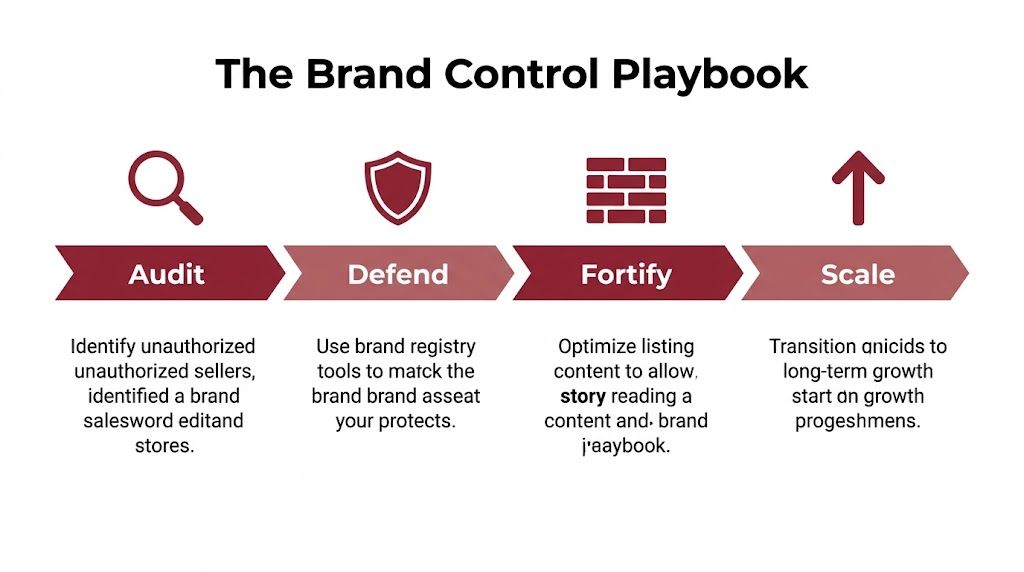
A good starting point is proper Amazon Brand Registry support. But registration is only the beginning. It gives you tools. It does not run the discipline for you.
Audit what you actually control
Amazon isn’t a listing problem. It’s a system control problem.
Start with a blunt review of the current state.
Not what your team thinks is true. What the marketplace is doing with your ASINs today. This audit should cover content authority, seller environment, pricing movement, image consistency, mobile presentation, and region-by-region differences.
A useful audit asks questions like these:
- Who is selling against the ASIN right now
- Who appears to control the editable content
- Which fields have changed recently
- Whether the mobile view preserves the core buying argument
- Whether pricing on Amazon is damaging other channels
Many established brands find that their Amazon presence has outgrown their internal visibility. Different people own fragments. Marketing owns images. Sales owns channel relationships. Operations owns stock. A distributor owns the listing in another market. No one owns the whole system.
Practical rule: If no single operator can explain who controls price, content, and contribution rights across each region, the brand doesn’t have control. It has fragments of responsibility.
Defend the listing before optimising it
Founders often want to jump straight to better creative and more ads. That comes later. First, stop the leakage.
Defence usually means setting a fixed baseline around governance:
- Brand Registry enabled and maintained: Useful for protection, reporting, and escalation advantage.
- Listing monitoring in place: Track title, images, bullets, attributes, and category changes.
- Offer stack reviewed regularly: Know when unauthorised sellers appear.
- Partner contracts tightened: Protect contribution rights, content control, and channel boundaries.
- Escalation paths prepared: Don’t invent the process during a suppression event.
This stage is deliberately unglamorous. That’s why many teams underinvest in it. But without defence, every optimisation sits on unstable ground.
Fortify the page for how buyers actually shop
After defence comes strengthening the asset itself.
Many brands waste money producing content for internal approval instead of customer comprehension. The mobile clarity gap is the clearest example. As noted earlier, approximately 70% of Amazon buyers shop on mobile devices, and poor mobile presentation can reduce ROAS by 30-50% because buyers can’t absorb the information needed to convert.
That should reshape how listing content gets built.
Instead of asking whether the page looks rich, ask whether the customer can understand the product quickly on a phone. Instead of adding more infographic layers, simplify the first-screen message. Instead of stuffing bullets with every feature, prioritise the claims that make the buying decision easier.
A stronger fortification approach usually includes:
| Fortification area | What good looks like |
|---|---|
| Main image | Clear, compliant, readable at small size |
| Secondary images | Demonstrate use, benefit, and trust cues quickly |
| Bullets | Scannable, specific, mobile-friendly |
| A+ content | Supports the narrative without replacing clarity |
| Video assets | Reinforce confidence and reduce ambiguity |
Brands in hardware, household, and home improvement categories often need this more than lifestyle categories do. The buying decision may depend on fit, compatibility, durability, installation logic, or use-case credibility. If those points are buried in unreadable graphics or collapsed text, conversion falls even when traffic is fine.
Scale with regional discipline
International expansion usually exposes weak operators.
A listing strategy that’s barely controlled in Australia won’t become more controlled when spread across the US, UK, and Canada. It becomes more fragile. More marketplaces mean more partner relationships, more content surfaces, more pricing conflicts, and more chances for contribution authority to drift.
The brands that scale well set regional rules early.
Some do this with direct control. Others do it through structured distribution partnerships. Either way, the discipline needs to be explicit. Who owns the listing? Who controls the edit rights? Who can approve content updates? Who monitors unauthorised sellers? How does pricing align across markets without wrecking margin or position?
A practical regional framework looks like this:
- AU: Use the home market to prove the governance model, not just the sales model.
- US: Tighten partner permissions because seller density and contribution complexity rise quickly.
- UK: Align content and compliance details early so localisation doesn’t create avoidable errors.
- CA: Treat it as its own operating environment, not a copy of the US listing stack.
Founders need to be honest about capacity. If the internal team is already stretched, adding regions without stronger controls usually spreads failure more efficiently.
The right goal isn’t maximum presence. It’s defendable presence.
Beyond the Listing A Strategic Path to Global Scale
Amazon matters. But if it controls your brand, you have a bigger problem.
That distinction is what separates operators from founders who become trapped inside one marketplace’s logic. If all your authority, visibility, and pricing power depend on Amazon behaving well, you don’t have strategic control. You have platform dependency.
The strongest brands use Amazon as one part of a broader channel design. They use it for discovery, volume, and market validation. But they don’t let it become the sole place where brand value is defined. They build retail relationships, protect DTC economics where appropriate, and enter new markets with infrastructure that reduces operational chaos instead of multiplying it.

That matters even more for Australian brands moving into the US, UK, and Canada. International expansion is often framed as a listing exercise. It isn’t. It is a control exercise. The question is not whether you can get the product live. The question is whether you can enter a new market without losing pricing discipline, contribution authority, content integrity, and channel coherence.
The founders who do this well usually stop trying to solve everything as isolated Amazon tasks. They build systems and partnerships that already account for distribution, compliance, local market behaviour, and brand protection. That approach is slower at the start and stronger over time.
A product doesn’t become a global brand because it appears in more marketplaces. It becomes a global brand when it can scale without becoming generic, discounted, or operationally fragile.
The brands that avoid this don’t get lucky. They build control into their strategy from the beginning.
That is the key strategic lesson behind listing control. The point is not to win every small catalogue fight forever. The point is to build a growth model where no single platform can arbitrarily rewrite your value.
Without strong amazon listing control, expansion into new markets only multiplies the problem.
If you’re reading this and recognising parts of your own setup, it’s worth looking at properly.
We’ve worked with brands at every stage, from early launch to established products already selling, and the pattern is usually the same.
Control starts slipping long before it becomes obvious. And by the time most brands notice, they’re already trying to recover — not prevent.
👉 Reach out and we’ll take a look at where things are actually sitting.