You’re probably in a familiar position. The product works. Domestic sales are steady. Retailers understand it. Your direct channel has validated demand. Then the growth conversation turns to the US, and Amazon USA quickly becomes the obvious next move.
That’s usually where strong brands make a poor decision. They treat Amazon like a listing exercise instead of a market entry decision. For an established brand, that mistake doesn’t just waste ad spend. It can distort pricing, invite grey-market sellers, create compliance problems, and weaken the positioning you’ve spent years building.
Amazon USA can absolutely become a serious growth engine. But it only works when you approach it like a controlled expansion programme, not a seller account with inventory attached.
The Global Scaling Paradox for Successful Brands
The paradox is simple. The better your brand performs at home, the easier it is to assume that success will transfer cleanly into a larger market. In practice, the opposite often happens. Brands with proven products often enter Amazon USA with too much confidence in the product and too little respect for the operating system around it.
Amazon isn’t just another retailer. It’s the dominant digital retail environment in the United States, with 37.8% of the US ecommerce market, plus access to 310 million active customers and 200 million Prime subscribers, according to Repricer Express citing Statista-based Amazon market data. That scale is exactly why founders are drawn to it. It’s also why poor execution gets exposed quickly.

A great product is not a market strategy
Founders often assume the main challenge is traffic. It usually isn’t. The challenge is controlled translation. Your product has to survive a different search environment, different pricing expectations, different compliance requirements, and a marketplace structure that rewards operational consistency more than founder conviction.
A product that performs well in Australia can still fail in the US for reasons that have nothing to do with quality. The unit economics might collapse under local fees. The packaging might create friction with US compliance expectations. The listing might use the wrong search language for the category. A reseller might undercut your pricing before your own launch is stable.
Strong products usually fail in new markets because the operating model wasn’t built for the market they entered.
That’s the scaling paradox. The product can be validated and still be commercially vulnerable.
Why Amazon USA creates both leverage and exposure
The attraction is obvious. Amazon offers demand concentration, established logistics, and immediate access to a massive customer base. For a founder trying to expand without building a full US field operation on day one, that’s a powerful route.
The risk is less obvious until you’re in it. On Amazon USA, visibility can arrive before control does. If your listings aren’t protected, your supply chain isn’t localized, and your pricing logic isn’t built for US conditions, growth can start in the wrong shape.
Three patterns show up repeatedly:
- Margin gets diluted early because brands launch with domestic assumptions rather than US landed economics.
- Brand equity gets blurred when listings are live before registry, enforcement, and channel boundaries are in place.
- Operational issues surface fast because Amazon doesn’t care how established your brand is elsewhere.
The founder shift that matters
The right mindset is not “how do we start selling on Amazon”. It’s “how do we use Amazon USA as a structured entry point into the US without giving away pricing power or operational control”.
That sounds subtle, but it changes every decision that follows.
You stop asking whether Amazon can generate revenue. It can. You start asking better questions:
- Which selling model protects our margin profile
- How much control do we need over pricing and presentation
- What needs to be localized before launch
- Where can operations break under US conditions
- What must be in place before scale is allowed
That’s how established brands use Amazon USA properly. As a tool for deliberate expansion, not as proof of ambition.
Choosing Your Path 1P vs 3P Selling Models
Before you worry about listings, ads, or reviews, you need to decide what relationship you want with Amazon itself. That choice shapes your economics, your control, and the amount of operational responsibility you carry.
Amazon built a large, mature ecosystem over time, and its path to a $1 trillion market capitalization in September 2018 reflects how developed that ecosystem became, as outlined in this Amazon history timeline. That maturity is why the 1P versus 3P decision is foundational. It isn’t an admin preference. It’s a strategic position.
The commercial difference between 1P and 3P
With 1P, you sell to Amazon through Vendor Central. Amazon becomes the retailer. It buys inventory from you, controls retail pricing, and handles the customer-facing sale.
With 3P, you sell on Amazon through Seller Central. You remain the seller of record. You control retail pricing, the catalogue set-up, and much more of the daily commercial levers.
Here’s the practical comparison.
| Factor | 1P (Vendor Central) | 3P (Seller Central) |
|---|---|---|
| Commercial relationship | Amazon buys from your brand as a wholesale customer | Your brand sells directly to the end customer on the platform |
| Pricing control | Limited. Amazon has substantial control over retail price | Higher. You set pricing, though market pressure still applies |
| Margin structure | Can support volume, but often compresses margin through wholesale terms and deductions | Usually offers stronger gross margin control if operations are disciplined |
| Catalogue control | More limited once Amazon is the retailer | Much stronger control over listings, content, and listing changes |
| Operational burden | Lower in some areas, but disputes and chargebacks can be frustrating | Higher. Your team needs stronger systems and marketplace discipline |
| Brand protection | Harder to manage if multiple sellers appear around your listings | Easier to govern if account structure and enforcement are well organised |
| Data visibility | More restricted | Better access to day-to-day marketplace signals |
| Best fit | Brands prioritising wholesale volume and willing to trade some control | Brands prioritising control, pricing discipline, and long-term brand asset building |
What 1P gets right and where it goes wrong
For some brands, 1P is attractive because it looks familiar. It resembles a retail account. Amazon places orders. Your team supplies inventory. The model can feel cleaner to founders who already know wholesale.
That simplicity has a cost. Once Amazon controls retail pricing, your brand can lose an important lever. If you’re in a category where presentation, premium positioning, or reseller discipline matter, 1P can become uncomfortable quickly. You may gain purchase orders and lose clarity over how the brand is being represented.
1P tends to work better when a brand values reach and account simplicity more than channel precision.
Why many established brands prefer 3P
3P usually gives serious brands the control they need. You can manage listing copy, protect pricing more directly, shape inventory strategy, and respond faster when market conditions shift.
The trade-off is operational. Seller Central rewards teams that are organized, responsive, and detail-driven. If your systems are loose, 3P exposes that weakness fast. If your systems are strong, 3P lets you build Amazon as an owned growth channel rather than a wholesale account you merely service.
Decision lens: If your brand depends on margin protection, premium positioning, or controlled channel strategy, 3P is usually the stronger starting point.
Hybrid structures can work, but only with rules
Some brands use a hybrid model. They may run 3P for hero SKUs, launch control, and direct marketplace learning, while selectively using 1P where Amazon’s retail demand is useful. That can work well, but only when the channel architecture is deliberate.
Without clear rules, hybrid turns messy. Pricing conflicts emerge. Internal teams argue over ownership. Inventory gets allocated to the wrong channel. The brand ends up reacting instead of directing.
A sensible founder asks four questions before choosing:
- How much pricing control do we need to protect brand value
- Can our team handle operational ownership inside Seller Central
- Do we want Amazon as a customer, or as a platform
- Where are we willing to trade simplicity for control
For most established brands entering Amazon USA, the wrong choice isn’t always catastrophic. But it does create drag. And drag is expensive in a market this competitive.
Building Your Brand Fortress with Brand Registry
If you launch on Amazon USA without protecting the brand first, you’re inviting avoidable problems. Unauthorized sellers appear. Listing content gets changed. Counterfeit risk increases. Price integrity starts to slip before your account has any real momentum.
That’s why Brand Registry is not a nice extra. It’s a precondition for disciplined expansion.

Treat Brand Registry as infrastructure
A lot of brands think about Brand Registry as a content tool. That’s too narrow. Yes, it supports richer listings. But its real value is structural. It gives you a stronger position to defend your catalogue, assert ownership, and reduce the chance that somebody else defines your brand on Amazon.
For established brands, the sequence matters. Registry should sit upstream of launch, not downstream of trouble.
That means doing the legal and trademark groundwork early, then using registration as the base layer for everything that follows. If you need help understanding the practical role it plays inside a wider launch plan, TPR Brands has a straightforward overview of Amazon Brand Registry support.
The tools that actually matter
Once Brand Registry is active, several capabilities become useful. Their value depends on how deliberately you use them.
- A+ Content helps you control the narrative around the product. That matters most in categories where product quality isn’t obvious from a main image alone.
- Brand Analytics gives your team a better read on how shoppers interact with your brand and category.
- Vine can help with early review generation when used as part of a planned launch, not as a substitute for product readiness.
- Transparency adds a practical anti-counterfeit layer for brands with genuine enforcement needs.
- Brand Store gives you a cleaner destination for traffic, especially when multiple products need to be merchandised together.
None of those tools fixes weak positioning. But all of them become valuable once the brand is clearly defined.
Practical rule: Secure ownership first, then optimize presentation. Brands that reverse that order usually spend time cleaning up problems they could have prevented.
Protection needs a routine, not just enrolment
Registry doesn’t defend the brand by itself. Someone still has to watch the catalogue, identify seller issues, escalate violations, and maintain consistency across listings.
That work should include:
- Seller monitoring so unauthorized offers are spotted early
- Content governance to keep titles, images, and claims aligned
- Pricing enforcement across your broader channel network
- Counterfeit prevention where the category risk justifies it
This walkthrough is useful if your team wants a visual explanation of how registry functions inside the marketplace stack:
The bigger point is strategic. On amazon usa, the listing is not just a sales page. It’s a brand asset under continuous pressure. Registry gives you the right to defend it. It doesn’t remove the obligation to do so.
Localization Pricing and Margin Control
Most failed Amazon launches don’t fail because the product is wrong. They fail because the brand exported a domestic model instead of building a US one.
Localization on Amazon USA is not a translation task. It’s commercial adaptation. The language of the listing matters, but pricing logic, search behavior, and category expectations matter more.
Localization starts with how Americans search
Founders often assume their existing keyword set is close enough. It usually isn’t. The US customer may use different problem language, different category shorthand, or different use-case terms than your domestic buyer. If your listing copy reflects your internal product language rather than local search behavior, you’ll be paying for traffic you should have earned organically.
It is essential that product teams work with marketplace operators, not in isolation. Keyword decisions affect titles, bullets, backend search terms, ad structure, and even the order in which product benefits are presented.
A premium household item, for example, may need different messaging depending on whether the US shopper sees it as a convenience product, a durability product, or a giftable product. The product hasn’t changed. The buying frame has.
Pricing has to be built from landed reality
A common founder mistake is pricing backwards from domestic RRP. That’s not a margin strategy. That’s wishful conversion.
US pricing has to absorb marketplace fees, fulfilment structure, returns exposure, ad intensity, and any import-related costs relevant to the category. Then it still has to make sense against customer expectations in the local competitive set.
The practical sequence is usually:
- Map the full landed cost into the US market.
- Stress-test margin under realistic ad and return conditions.
- Compare against the local price architecture in your category.
- Adjust pack size, bundle logic, or product mix before launch if the economics don’t hold.
If the margin only works when everything goes perfectly, the offer isn’t ready for Amazon USA.
The smarter play is selective availability
A strategic tactic many brands overlook is not trying to win broad shelf space immediately. Instead, they identify where availability is weak and demand is steady.
According to this Keepa-focused strategy breakdown on warehouse-specific opportunity, established brands can use tools like Keepa to identify warehouse-specific underserved shelf space, including ASINs with frequent out-of-stock patterns. That creates a path to place inventory more selectively, pursue higher-margin demand pockets, and avoid broad overexposure in the early stages.
That matters because expansion shouldn’t be confused with blanket distribution. Controlled growth often comes from serving the right pockets first.
What works and what doesn’t
A simple contrast helps.
| Approach | What happens |
|---|---|
| Copy domestic positioning | Listings sound accurate internally but weak in local search and conversion |
| Match competitor pricing blindly | Margin erodes before account stability is established |
| Localise search intent and economics together | Listings align better with demand and the P&L has a chance to hold |
| Expand inventory selectively | Capital stays focused and performance is easier to manage |
The discipline here is commercial, not cosmetic. Founders who treat localization as market design usually scale with fewer surprises. Founders who treat it as translation usually find the surprises in their margin line.
Mastering Fulfilment Compliance and Operations
Amazon rewards operational discipline more than brand history. A strong product, a good story, and solid creative won’t protect your account if fulfilment performance slips or compliance is handled casually.
That’s why Amazon USA should be treated as an operations project as much as a commercial one.
Fulfilment model is a control decision
Most established brands weigh FBA, FBM, and sometimes a blended structure based on current warehouse capability, inventory velocity, and margin tolerance.
FBA can reduce a lot of friction because Amazon takes over core fulfilment tasks, and that often helps brands move faster in a market they don’t yet fully control. FBM can still make sense where a brand already has strong local warehousing, specialized handling needs, or a deliberate reason to keep fulfilment in-house. The wrong approach is choosing a model for philosophical reasons rather than operational fit.
If your internal team is still working out the implications of US warehousing and service standards, it helps to map that against a practical fulfilment planning framework before inventory lands.
The metric that can shut growth down
For Amazon sellers, Order Defect Rate must stay below 1%, and the Buy Box drives 82% of sales, according to this Amazon KPI analysis covering ODR and Buy Box eligibility. Once ODR moves above that threshold, Amazon’s enforcement process can escalate quickly.
That matters more than many founders realize. It means operational sloppiness isn’t just inefficient. It can directly affect visibility, conversion, and account health.
The same source notes that exceeding the threshold can trigger an automated process that may lead to suspension. In practice, that means every function around the order has to be reliable:
- Inventory accuracy so orders aren’t cancelled due to stock errors
- Packaging quality so products arrive in saleable condition
- Returns handling so customer issues don’t snowball into defects
- Customer communication so avoidable claims are contained early
Compliance problems usually appear before scale
Australian brands entering the US also face adaptation issues that don’t care how well the product sells domestically. Labelling, claims, materials, and import treatment all need local scrutiny. In hardware, household, and home-adjacent categories, this gets technical quickly.
A practical operating checklist should include:
- Product labelling review against relevant US requirements
- Material and chemical claim review where standards differ
- Packaging suitability for US parcel movement and Amazon handling
- Reverse logistics planning before the first wave of returns arrives
- SKU adaptation if current product configuration creates friction in the US market
Compliance should be handled before launch economics are finalized. If the SKU has to change later, your pricing model changes with it.
What disciplined operators do differently
The brands that cope well with Amazon USA tend to do three things early.
First, they audit fulfilment as if the account were already under pressure. They don’t wait for live defects to discover weak packaging or poor inventory sync.
Second, they localize the service model. That means clear returns processes, realistic lead times, and local support structures where needed.
Third, they assume operational variance will happen and build buffers around it. Safety stock, cleaner inbound planning, and tighter issue escalation matter more than optimistic forecasting.
Operational perfection may sound excessive. On Amazon, it’s closer to the minimum requirement.
Executing a Strategic Launch and Scaling Plan
Most Amazon launches fail long before the first week of sales data arrives. They fail in the planning stage, when the brand goes live without enough readiness in listing quality, inventory logic, compliance adaptation, and review strategy.
A launch on Amazon USA should behave more like a coordinated market entry than a catalogue upload.
Launch is about sequencing, not excitement
Founders often want velocity straight away. That instinct is understandable, but early aggression without structure usually produces noisy data and weak decisions.
A better launch sequence is tighter. Listings go live when they’re retail-ready. Inventory is in place before ads start pushing traffic. Review generation is planned. Pricing is already stress-tested. The team knows which signals matter in the first weeks and which don’t.
That kind of launch tends to produce cleaner learnings. And clean learnings are what make scaling possible.
Advertising is a data engine first
A lot of brands either overspend on PPC too early or underinvest because they see it as a cost centre. Both approaches miss the point.
Early advertising on Amazon USA should be treated as controlled intelligence gathering. It tells you which search terms convert, where your positioning is weak, and which ASINs deserve more inventory support. It also helps defend your own branded territory so competitors don’t frame the customer decision before you do.
Useful launch behavior usually looks like this:
- Start with a focused SKU set rather than broad catalogue exposure
- Use PPC to test search intent before expanding claim language
- Watch conversion by query theme instead of only looking at top-line spend
- Protect branded terms early so your own launch doesn’t leak demand
The first objective of launch advertising isn’t scale. It’s signal quality.
Pre-adapted SKUs reduce avoidable drag
This becomes even more important for Australian brands. A key challenge is navigating US compliance and adaptation hurdles, including local import regulations and standards such as Prop 65. The same discussion of AU brand entry hurdles into Amazon USA notes that some Australian brands face 30% higher rejection rates without pre-adapted SKUs.
That’s a useful warning because rejection isn’t just a compliance issue. It interrupts launch timing, ties up capital, and distorts early momentum. If the SKU needs to be reformatted, relabelled, or reconfigured after launch plans are in motion, the rest of the commercial model gets dragged with it.
Scaling only works after the base layer holds
Once listings convert, fulfilment is stable, and early ad data is coherent, then scale becomes rational. Not before.
At that stage, the brand can expand in measured ways:
- Add adjacent SKUs that support the same search and customer logic.
- Increase ad coverage once profitable query clusters are clearer.
- Deepen inventory selectively instead of widening blindly.
- Tighten listing content based on actual customer behavior, not assumptions.
The launch phase is where founders either build a repeatable engine or create a complicated mess. The difference usually comes down to restraint, sequencing, and local market preparation.
Your Phased Rollout and Partnership Checklist
Most founders don’t need more Amazon advice. They need a way to assess whether their business is ready to expand into Amazon USA without creating avoidable channel damage.
The cleanest way to do that is with a phased rollout. Not because phased plans look tidy on paper, but because each stage forces a different kind of discipline.
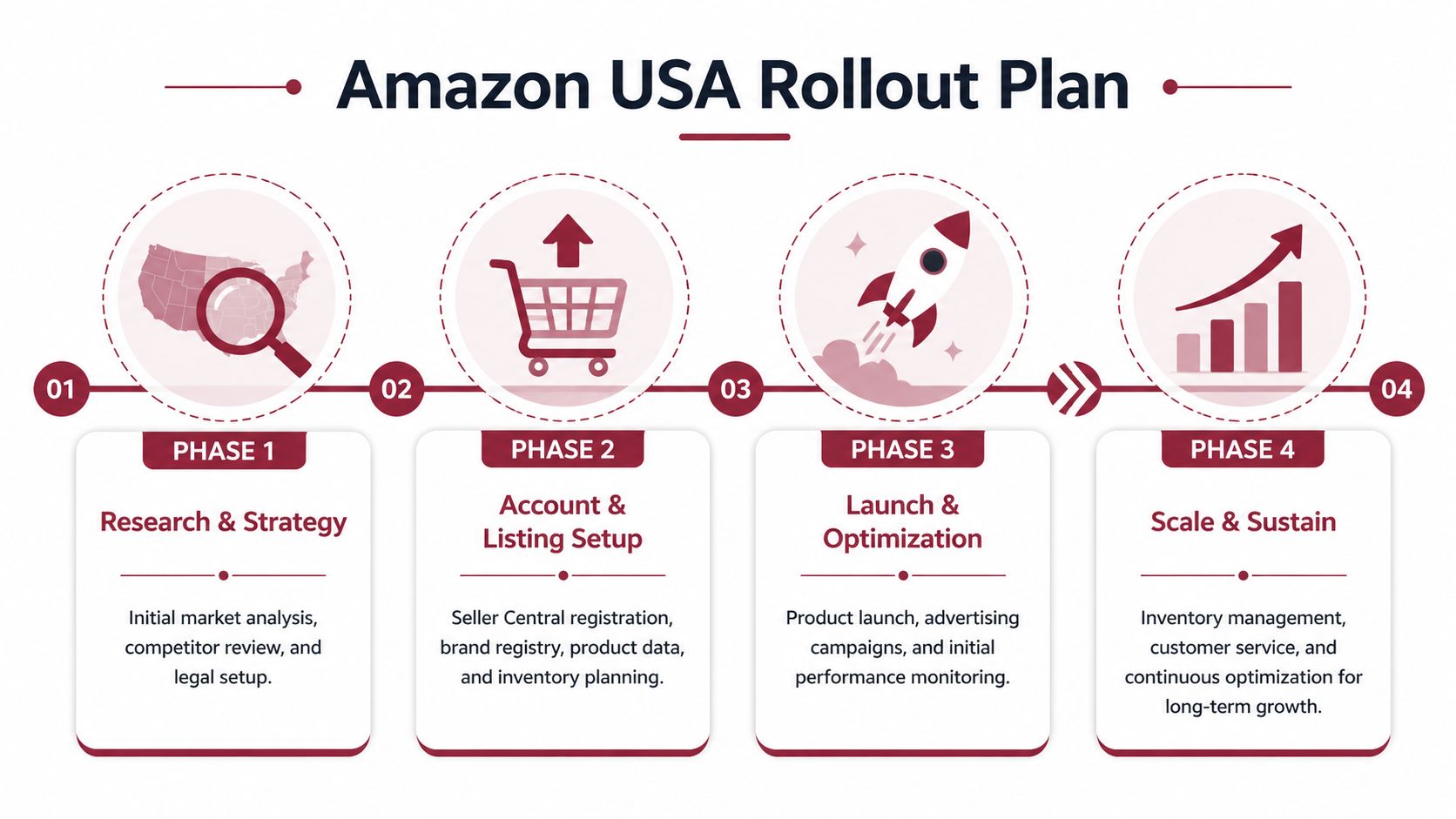
Phase one is strategy before activity
In this situation, strong brands slow down enough to avoid expensive momentum.
The work here includes market fit assessment, model selection, compliance review, trademark readiness, and margin modelling. If the economics only work with optimistic assumptions, or if the product needs major adaptation, the right move is to fix that before launch pressure arrives.
Questions worth asking at this stage:
- Do we know whether 1P or 3P fits our control needs
- Have we built a US-specific margin model
- Are there category-specific compliance or labelling risks
- Is the product architecture right for the market
Phase two is infrastructure and account readiness
This is the build stage. Seller Central structure, listing assets, inventory routing, brand protection, and operational workflows all need to be ready before the brand is visible.
A practical readiness check should cover:
- Trademark and registry status
- Listing content quality
- Image and packaging consistency
- Fulfilment model selection
- Returns and customer issue handling
- Reseller and pricing policy alignment
Phase three is launch with controlled pressure
At this point the question isn’t “are we live”. It’s “are we learning fast without breaking the account”.
The early launch period should be narrow enough to manage but active enough to generate useful data. If you need external execution support at that point, one option is working with an Amazon agency partner structure that handles marketplace operations in a more coordinated way.
What matters is not who presses the buttons. It’s whether the team running the launch understands both the marketplace and the brand’s wider channel strategy.
Brands scale better when launch is treated as a validation phase, not a victory lap.
Phase four is expansion with rules
Scale should happen after the account proves it can hold standards. That means acceptable conversion, clean operations, protected listings, and margin logic that survives real trading conditions.
A founder checklist for this stage is simple:
| Checklist area | Readiness question |
|---|---|
| Brand control | Can we defend pricing, content, and seller quality as volume increases? |
| Operations | Can our fulfilment and service model absorb higher order flow without defects? |
| Finance | Do the economics still work after ads, returns, and local costs settle into reality? |
| Organisation | Does someone own Amazon as a business, not just as a channel? |
Most good products can enter Amazon USA. Fewer are prepared to do it in a way that protects long-term brand value.
That’s the true filter. Not ambition. Readiness.
TPR Brands works with established consumer product companies that need structure around marketplace expansion, including brand positioning, compliance adaptation, channel control, and in-market execution across the US and other regions. If your product already has traction and you’re assessing Amazon USA as a serious growth channel, you can review TPR Brands to see whether the model fits your stage.