If you’re a brand looking to expand your product line onto Amazon Australia, the standard advice you’ll find online can do more harm than good.
We work directly with international and local brands exporting into Australia, and one of the most common issues we see is companies treating Amazon like a simple sales channel — when in reality, it’s a complex market entry model.
This is why strong products often underperform in new markets. Not because of demand, but because the operating model, compliance, and positioning weren’t built for that market.
In this guide, we’ll break down how to approach Amazon Australia properly — based on real-world experience working with brands expanding into the region.
An amazon store isn’t a plug-in channel. It’s a market entry model with its own economics, compliance burden, fulfilment logic, brand risks, and governance demands. A product that works in one market can still fail in another if the packaging, claims, sizing, support model, tax setup, or inventory planning doesn’t translate.
Brand owners usually see the visible layer first. Listings, reviews, ad campaigns, and sales rank. The harder part sits underneath. Cash tied up in inventory. Margin pressure from freight and storage. Local product standards. Channel conflict with wholesale or DTC. Internal teams stretched across too many systems. If those foundations aren’t organized, the amazon store becomes expensive noise rather than durable growth.
That’s why serious expansion starts before the first ASIN goes live. It starts with readiness, then market selection, then operating design. The brands that scale well treat Amazon as part sales engine, part distribution infrastructure, and part brand governance environment. They build for control first, then speed.
Beyond Another Sales Channel The Reality of Global Expansion
Many brands still treat a new amazon store like a website extension. Upload the products, adapt a few keywords, and expect demand to transfer. In practice, that approach breaks down quickly because a marketplace doesn’t reward product quality alone. It rewards operational fit.
Amazon AU is a good example. The marketplace launched in late 2017 and reached over AU$2.3 billion in gross merchandise value by 2020, while third-party sellers accounted for about 65% of total units sold by 2023. In categories such as home improvement and household goods, independent sellers reported average annual sales above AU$200,000, according to Amazon AU marketplace data compiled by Seller Snap. That scale attracts brand owners for good reason. It also creates false confidence.

Why marketplace growth can mislead brand owners
A fast-growing marketplace can make almost any category look easy. It isn’t. Growth at platform level doesn’t remove the need for local compliance, margin discipline, and catalogue accuracy. It just hides those problems for a while.
A founder might see strong domestic traction and assume the offer will travel unchanged. Then the friction starts:
- Product claims don’t localise well: What performed on your DTC site may trigger scrutiny or confusion in another market.
- Packaging creates returns: Imperial measurements, missing warnings, or unfamiliar terminology reduce trust.
- Operations carry the strain: Customer service, replenishment, and listing maintenance usually expand before revenue stabilises.
Practical rule: If the marketplace is doing the heavy lifting for your launch thesis, you probably don’t yet have a launch thesis.
The amazon store is its own business unit
The healthiest way to think about global expansion is to treat each amazon store as a mini business unit. It needs its own assumptions, operating model, and success criteria. That includes who owns pricing, who owns compliance, who approves content changes, and how inventory gets funded.
The biggest mistake isn’t moving too slowly. It’s entering a new marketplace with no clear answer to a simple executive question: are we building a controlled channel, or are we improvising one?
Brands that get this right usually expand with restraint. They choose a narrow catalogue, lock down their operating standards, and build around repeatability. That’s how an amazon store starts supporting brand value instead of eroding it.
The amazon store is its own business unit
The healthiest way to think about global expansion is to treat each amazon store as a mini business unit. It needs its own assumptions, operating model, and success criteria. That includes who owns pricing, who owns compliance, who approves content changes, and how inventory gets funded.
The biggest mistake isn’t moving too slowly. It’s entering a new marketplace with no clear answer to a simple executive question: are we building a controlled channel, or are we improvising one?
Brands that get this right usually expand with restraint. They choose a narrow catalogue, lock down their operating standards, and build around repeatability. That’s how an amazon store starts supporting brand value instead of eroding it.
The amazon store is its own business unit
The healthiest way to think about global expansion is to treat each amazon store as a mini business unit. It needs its own assumptions, operating model, and success criteria. That includes who owns pricing, who owns compliance, who approves content changes, and how inventory gets funded.
The biggest mistake isn’t moving too slowly. It’s entering a new marketplace with no clear answer to a simple executive question: are we building a controlled channel, or are we improvising one?
Brands that get this right usually expand with restraint. They choose a narrow catalogue, lock down their operating standards, and build around repeatability. That’s how an amazon store starts supporting brand value instead of eroding it.
What Most Brands Get Wrong About Amazon Expansion
Many brands assume Amazon is just another sales channel. In reality, it requires tight control over pricing, distribution, and brand positioning.
From what we’ve seen working with expanding brands, the biggest issues usually come from entering too quickly — without clear ownership, structured operations, or a defined channel strategy.
That’s when margin erosion, reseller conflict, and inconsistent customer experience start to appear.
The brands that succeed treat Amazon as a controlled growth channel, not an experiment.
The Readiness Audit Are You Truly Prepared for an Amazon Store
Brand ownersoften ask whether the market is ready for their product. The better question is whether the business is ready for the market.
That distinction matters because even in a category with visible demand, weak internal readiness turns expansion into a drain on cash and management attention. On Amazon AU in 2024, the home & kitchen category generated AU$1.2 billion in sales and grew 28% year-on-year, according to regional marketplace statistics reported by RepricerExpress. Strong category demand is useful. It is not a substitute for readiness.
Start with operational truth, not optimism
The first audit area is supply chain resilience. If your business already struggles with stock forecasting, supplier communication, or carton compliance, international Amazon won’t fix that. It will expose it.
Look closely at the parts of the operation that fail under pressure:
- Lead times: Can suppliers hold consistent quality when purchase orders increase?
- Freight planning: Do you know what mode you’ll use when replenishment timing changes?
- Stock discipline: Can the team prevent both stockouts and slow-moving overhang?
- Returns handling: Is there a clear process for damaged, unsellable, or mislabelled inventory?
A lot of launches fail because the internal team confuses shipping product with running a marketplace operation. They aren’t the same thing.
Audit the brand before the listings
Many products are commercially proven but still poorly positioned for an amazon store. They rely on sales reps, physical merchandising, founder storytelling, or retailer credibility to carry the proposition. On Amazon, the product page has to do that work.
Ask harder questions than “Will this sell?”
- Is the value proposition obvious without a salesperson?
- Can a shopper understand the use case, spec, and difference in seconds?
- Does the brand hold together across titles, imagery, packaging, and support content?
- Are there any claims that need localisation, legal review, or removal?
The best listing team in the world can’t rescue muddy product positioning.
Check management bandwidth
Established brands often face a challenge: revenue may be healthy, but the decision rights aren’t.
If no one clearly owns marketplace P&L, listing control, channel policy, and compliance sign-off, the amazon store turns into a side project. Side projects generate side-project outcomes.
Here’s a practical readiness checklist to use before greenlighting a launch.
| Marketplace Expansion Readiness Checklist | ||
|---|---|---|
| Readiness Area | Check Point | Status (Yes/No) |
| Operations | Supplier lead times are documented and reviewed regularly | |
| Operations | Carton, labelling, and prep requirements can be executed consistently | |
| Inventory | The business can fund inventory without starving core channels | |
| Inventory | Replenishment logic exists for both upside demand and slower sell-through | |
| Brand | Product positioning is clear without founder explanation | |
| Brand | Packaging and claims can be localised for the target market | |
| Compliance | Product category requirements have been checked before launch planning | |
| Compliance | Internal documentation for certifications and product data is organised | |
| Team | One owner is accountable for amazon store performance | |
| Team | Customer service and returns workflows are in place | |
| Financial | Margin has been modelled after freight, storage, and advertising | |
| Financial | The business can tolerate a slower ramp without reactive discounting |
What a real go decision looks like
A serious go decision isn’t “we think there’s demand”. It’s “we can support this without destabilising the core business”.
That usually means starting with a focused range, a realistic stock plan, and a clear governance owner. Some brands also bring in external help for market entry, logistics, or compliance if those capabilities don’t exist internally. That’s often a stronger choice than pretending the current team has capacity when it doesn’t.
If your answers in the checklist are mixed, that doesn’t mean don’t expand. It means fix the operating gaps first, then launch with intent.
The Strategic Blueprint for Market Selection and Entry
Choosing a country for your amazon store is rarely a pure demand decision. It’s a fit decision. The right market is the one where demand, compliance burden, fulfilment logic, and brand positioning all line up well enough to support profitable execution.
A lot of brand owners choose the largest obvious market and only later discover they’ve selected the hardest operating environment for their current team. That’s backwards. Market selection should narrow risk before it expands revenue potential.
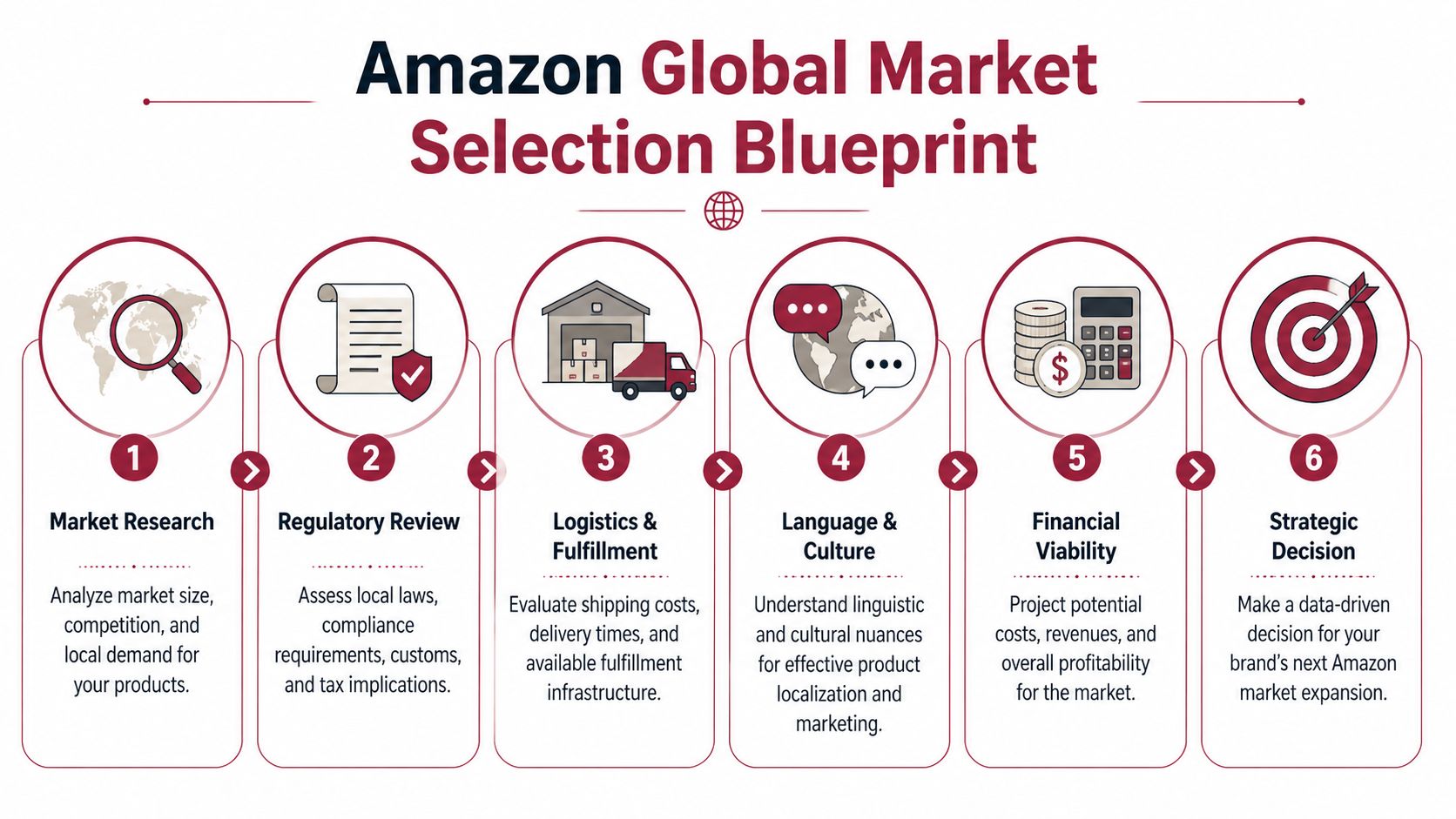
Market selection is really four decisions
The first decision is demand fit. Not broad category demand, but product-specific demand that matches your current offer. A product with strong domestic sales can still be wrong for another market if consumer expectations differ on sizing, power standards, materials, or use cases.
The second is regulatory complexity. Regulatory complexity often makes expansion plans expensive. If the category involves electrical standards, safety claims, certifications, restricted materials, or specific labelling rules, the market may still be attractive, but the route in must be tighter.
The third is fulfilment viability. Can you reach customers at a delivery standard that supports conversion without distorting margin? If the answer depends on heroic forecasting or constant emergency freight, the market isn’t ready for your current model.
The fourth is organisational fit. Some markets are manageable directly. Others are better approached through a partner model that already has compliance, logistics, or local operating structure in place.
Structure beats enthusiasm
Amazon’s 2025 data points to the difference a disciplined process makes. Sixty-eight per cent of US and Canadian brands expanding to Australia through a structured entry methodology achieved 20% year-on-year revenue growth, while 42% of unguided expansions initially failed due to category gating and compliance issues, causing 30-day listing delays, according to Amazon’s market entry guidance.
That pattern isn’t surprising. Structured entry forces brand owners to answer the questions that enthusiasm skips.
A weak market-entry model doesn’t usually fail in strategy meetings. It fails when stock is in transit and the listing still isn’t live.
Direct entry versus partner entry
This is the decision many leadership teams underestimate. Direct entry gives more immediate control, but it also puts more strain on internal capability. Partner entry reduces some of that burden, especially when local rules, customs process, or on-the-ground operations are unfamiliar.
Use a simple comparison.
| Entry model | Best fit | Main advantage | Main trade-off |
|---|---|---|---|
| Direct seller setup | Teams with in-house marketplace and compliance capability | Full control over systems and execution | Higher internal complexity |
| Distributor or operator partner | Brands entering a less familiar market | Faster adaptation to local conditions | Less direct control over day-to-day execution |
| Hybrid structure | Brands that want strategic control but external execution support | Balance between oversight and speed | Requires clear role definition |
For brands evaluating Australia specifically, TPR Brands’ Amazon Australia expansion approach is one example of a partner-led model built around marketplace entry, compliance adaptation, and channel control.
What smart operators screen out early
The best expansion plans reject markets for good reasons. They pass when:
- Compliance load is too high for the current team
- Margin depends on unrealistic pricing
- Localisation needs are deeper than expected
- The catalogue is too broad to govern well at launch
That discipline matters because each bad market choice creates follow-on damage. Delayed listings consume working capital. Compliance fixes absorb management attention. Poor early reviews distort launch momentum.
A sound entry blueprint doesn’t ask, “Where can we list next?” It asks, “Where can we win without compromising the brand?”
Designing Your Supply Chain and Fulfilment Architecture
Fulfilment is where strategy becomes visible to the customer. If the item arrives late, damaged, or inconsistently packed, the shopper doesn’t care that the launch model looked elegant in a planning deck.
Most brands frame the choice too narrowly. They ask whether to use FBA or FBM. The more useful question is which fulfilment architecture protects customer experience, cash flow, and operational control at the same time.

FBA, FBM, and hybrid each solve different problems
FBA usually improves delivery consistency and marketplace competitiveness. It can also reduce internal handling burden. The trade-off is stock commitment. You’re placing inventory into Amazon’s network and accepting less flexibility once goods are in the system.
FBM gives you more direct control over stock and order flow. For some brands, especially those with existing warehouse capability or specialist packaging needs, that control matters. The downside is that service levels must be excellent from day one. If they aren’t, conversion and account health can suffer.
Hybrid is often the most practical model for an established brand entering a new market. Fast-moving core SKUs go into FBA. Long-tail products, fragile variants, bundles, or test items stay in another fulfilment path until demand stabilises.
The real trade-offs brand owners need to weigh
The architecture decision affects far more than shipping speed.
- Cash flow pressure: FBA often requires a larger upfront inventory position.
- Forecasting risk: Too much stock creates storage drag and markdown pressure. Too little stock kills momentum.
- Returns logic: Different product types need different handling paths, especially in hardware and household categories.
- Customer experience control: The more fulfilment routes you use, the more clearly responsibilities need to be defined.
That’s why fulfilment architecture should be designed alongside finance, not after marketing.
Operator note: The right model is the one your team can repeat consistently, not the one that looks most sophisticated on paper.
Build for resilience, not just launch day
A launch can survive a few awkward weeks. Ongoing growth can’t. Once sales stabilise, the weak points become obvious. Inbound planning, carton prep, relabelling, local storage, and returns processing all need a defined owner.
Brands that want a more structured logistics setup often use a regional partner, a 3PL, or a mixed model that sits between supplier and Amazon. For teams assessing that path, TPR Brands’ logistics support model shows how some operators approach inventory flow, local handling, and market adaptation without building every capability in-house.
A short visual breakdown helps when aligning operations and commercial teams:
A simple architecture test
Before locking the model, ask three questions.
- If demand outperforms plan, can we replenish without panic?
- If demand lags, can we protect margin without flooding the market with discounts?
- If one node in the chain fails, do we have a fallback that preserves customer experience?
If the answer to any of those is no, the architecture is still too fragile. Good fulfilment design doesn’t eliminate risk. It makes risk manageable.
Activating a Powerful Go-to-Market Plan
Most Amazon launches fall flat. The listings go live, a few campaigns start, and the team waits for traction that never compounds. The issue usually isn’t demand alone. It’s weak market activation.
A strong amazon store launch creates authority quickly. That means protecting the brand, presenting the product properly, and giving the algorithm enough quality signals to understand where you belong.
Lock in control before scaling visibility
Brand owners often rush into ads before securing the fundamentals. That’s backwards. The first move should be control.
Start with these priorities:
- Brand Registry access: This is the foundation for protecting brand assets and providing access to richer content features.
- Catalogue discipline: Titles, images, bullets, backend attributes, and variation structure must reflect how the market shops, not how your ERP stores data.
- Brand Store logic: The store should organise products around real buying behaviour, not internal category labels.
If those layers are weak, extra traffic only accelerates poor conversion.
Build a store that translates, not just copies
A lot of brands clone their domestic storefront and assume localisation is cosmetic. It isn’t. The language may still be English, but buying cues change by market. Product naming, measurements, claims, and visual emphasis all need review.
Amazon’s Multi-Country Expansion tool is useful here. According to Amazon marketplace expansion data shared in this video reference, using the tool to clone a Brand Store into a marketplace such as Australia can deliver a 78% conversion lift versus a manual setup, and North American brands using it saw a 40% traffic increase in Australia within 90 days. The number matters less than the underlying lesson. Structured localisation beats rushed duplication.
What should go live first
An effective launch sequence is usually narrower than brand owners expect.
-
Core hero SKUs first
Don’t launch the entire catalogue unless the whole catalogue is already governed well. Start with the products that are easiest to explain, easiest to fulfil, and strongest on margin. -
A+ Content with a job to do
Rich content should reduce hesitation. Show use case, installation logic, materials, compatibility, care, or feature hierarchy. Don’t fill the page with brand slogans. -
Sponsored Products for signal gathering
Early campaigns should teach you where conversion is naturally strongest. Use them to learn search term fit, price resistance, and content gaps. -
Store navigation that supports expansion
Even with a small launch range, structure the Brand Store as if you’ll add depth later. That avoids messy rebuilds.
The first job of launch advertising isn’t scale. It’s information.
Avoid the common self-inflicted problems
Early momentum usually stalls because the launch team tries to do too much at once. Broad catalogue rollout, overbuilt campaigns, and untested content create noise instead of signal.
A more disciplined launch keeps the operating loop short. Small product set. Tight reporting. Fast content updates. Clear ownership over reviews, returns feedback, and search term learnings.
What works is boring in the best sense. Accurate listings. Cohesive brand presentation. Modest but intentional advertising. Fast iteration in the first weeks. The brands that do this well don’t look flashy at launch. They look organised.
Governance and Growth Managing Your Global Amazon Presence
Launch is the easy phase to celebrate and the hardest phase to judge. Revenue arrives, dashboards start moving, and everyone wants to believe the model is working. Governance is what tells you whether that belief is deserved.
Without governance, a global amazon store becomes a collection of reactive fixes. Listings drift. Pricing fragments across channels. Content gets edited without review. Slow-moving ASINs linger. The business starts measuring activity instead of control.
Post-launch discipline protects brand value
This matters more now because catalogue quality is under heavier scrutiny. In post-2025, Amazon has been purging unproductive ASINs, and Australian sellers of imported goods have reported 30 to 40% higher delisting risks for non-localised listings. The same market discussion also highlights 25% growth in searches for “sustainable home improvement” in the last year, which shows why governance isn’t just defensive. It also helps identify category openings, as outlined in this Amazon marketplace analysis video.
That combination is important. You need systems that remove risk and surface opportunity at the same time.
The governance model that actually works
Good governance isn’t endless reporting. It’s a repeatable operating cadence.
Use a structure like this:
- Weekly commercial review: Pricing position, ad efficiency, stock cover, and conversion changes
- Monthly catalogue review: Suppressed listings, content accuracy, image compliance, and variation health
- Quarterly channel review: DTC overlap, wholesale conflict, margin by SKU, and expansion decisions
Each of those meetings needs a decision owner. If everyone can raise issues but no one can make the call, governance collapses into commentary.
Focus on the right indicators
Not every dashboard metric deserves leadership attention. The measures that matter are the ones that reveal whether the channel is strengthening or weakening the brand.
Watch for:
- Pricing consistency across channels
- Stock reliability on core SKUs
- Organic visibility trends on strategic search terms
- Returns patterns that suggest localisation or quality issues
- Content drift caused by unmanaged edits
For brands that want outside support on this layer, TPR Brands’ Amazon management model is one example of a service built around catalogue oversight, marketplace control, and ongoing optimisation rather than launch activity alone.
Governance is what separates a temporary revenue spike from a channel you can trust.
Growth should stay selective
Once the first market starts working, the temptation is to expand range, increase spend, and open more marketplaces. Sometimes that’s right. Often it’s premature.
Selective growth is better. Add products only when your current catalogue is healthy. Expand keywords only when conversion data supports it. Enter the next market only when the first one has reliable operating rhythm.
That’s how a global amazon store stays coherent. Not by moving fastest, but by refusing to let growth outrun control.
Founder FAQs on Global Amazon Expansion
Brand owners usually don’t need more tactical Amazon tips. They need clean answers to strategic questions that affect risk, capital, and brand value.
| Founder FAQs | |
|---|---|
| Question | Answer |
| Should we launch every SKU in a new amazon store? | Usually no. A narrower launch gives you cleaner data, tighter stock control, and fewer compliance variables. Start with products that are easiest to position and fulfil well. |
| Is direct entry always better than working with a partner? | Not always. Direct entry gives more control, but only if your team already has the systems and capability to manage compliance, logistics, and catalogue governance. If those capabilities are weak, partner support can reduce execution risk. |
| How do we avoid damaging our brand on Amazon? | Treat the marketplace as a governed channel, not an opportunistic one. Control pricing, content, reviews response, localisation, and stock availability with clear ownership. |
| When should we localise content instead of copying existing listings? | Immediately. Even closely related markets interpret product claims, measurements, imagery, and terminology differently. Copying domestic listings without review creates confusion and increases risk. |
| What usually hurts margin first in a new market? | Poor forecasting, unnecessary catalogue breadth, and weak launch discipline. Brands often spend too early on inventory and ads before they’ve validated positioning and operational rhythm. |
| How do we know whether a product is suitable for global marketplace expansion? | Look for proof of repeat demand, stable product quality, clear differentiation, and a business that can support international operations without disrupting the core channel mix. |
| What does a C-level owner need to monitor? | Channel economics, stock health, brand control, compliance exposure, and whether the amazon store is creating strategic leverage or simply adding workload. |
If you’re a brand looking to expand onto Amazon Australia, the difference between success and failure usually comes down to strategy, not product.
At TPR Brands, we work directly with product-based companies to help them enter and scale on Amazon while maintaining control over pricing, operations, and brand positioning.
If you’re considering Amazon as a growth channel, it’s worth getting the structure right from day one.
Reach out to discuss how your product line could successfully launch and scale in the Australian market.
If you’re assessing whether your product is ready for international marketplace expansion, TPR Brands works with established consumer product brands on structured entry, channel control, and cross-market growth planning.
FAQs About Expanding to Amazon Australia
Is Amazon Australia worth it for brands?
Yes — especially for brands looking to enter a growing eCommerce market with less saturation than the US.
Do I need FBA to sell in Australia?
Most brands benefit from Amazon FBA Australia, but the right model depends on your margins, logistics, and product type.
Can I expand my existing product line to Amazon?
Yes, but not all products transfer equally. Localisation, compliance, and fulfilment all need to be considered.